
Farmers Return Home, Large-Scale Land Leaseholders Panic

At the end of March, the weather in Tongchuan is still cool. Over the last few days, it has rained twice here; though the rain was light and intermittent, the dampness remains.
Once it finally cleared, Hongxia went up the mountain just after seven. She was a little anxious: the maize from before the New Year has yet to be fully cleared. “There’s still maize stover lying in more than 30 mu of sloping land.” All of it needs to be gathered up soon. In less than twenty days’ time, around Grain Rain, the next crop of maize is due to be planted in the ground.
But beyond the fact that time waits for no one, Hongxia has a new worry. Even if she gets the land ready, she does not know whether she will be able to keep on farming in the future.
More and more people are coming back to the village. After a few of Hongxia’s relatives returned to the village, they took back the land they had asked her to help farm in earlier years, about 20 mu in total: “We’re all villagers, aren’t we? If someone asks you for it, you can’t simply say no. Even if something was signed on paper, it lasts at most 3 to 5 years.”
Hongxia worries that as more and more people come back, more and more will want their land back. Then the investment her family has made in this hundred mu of land over the years may never be recouped.
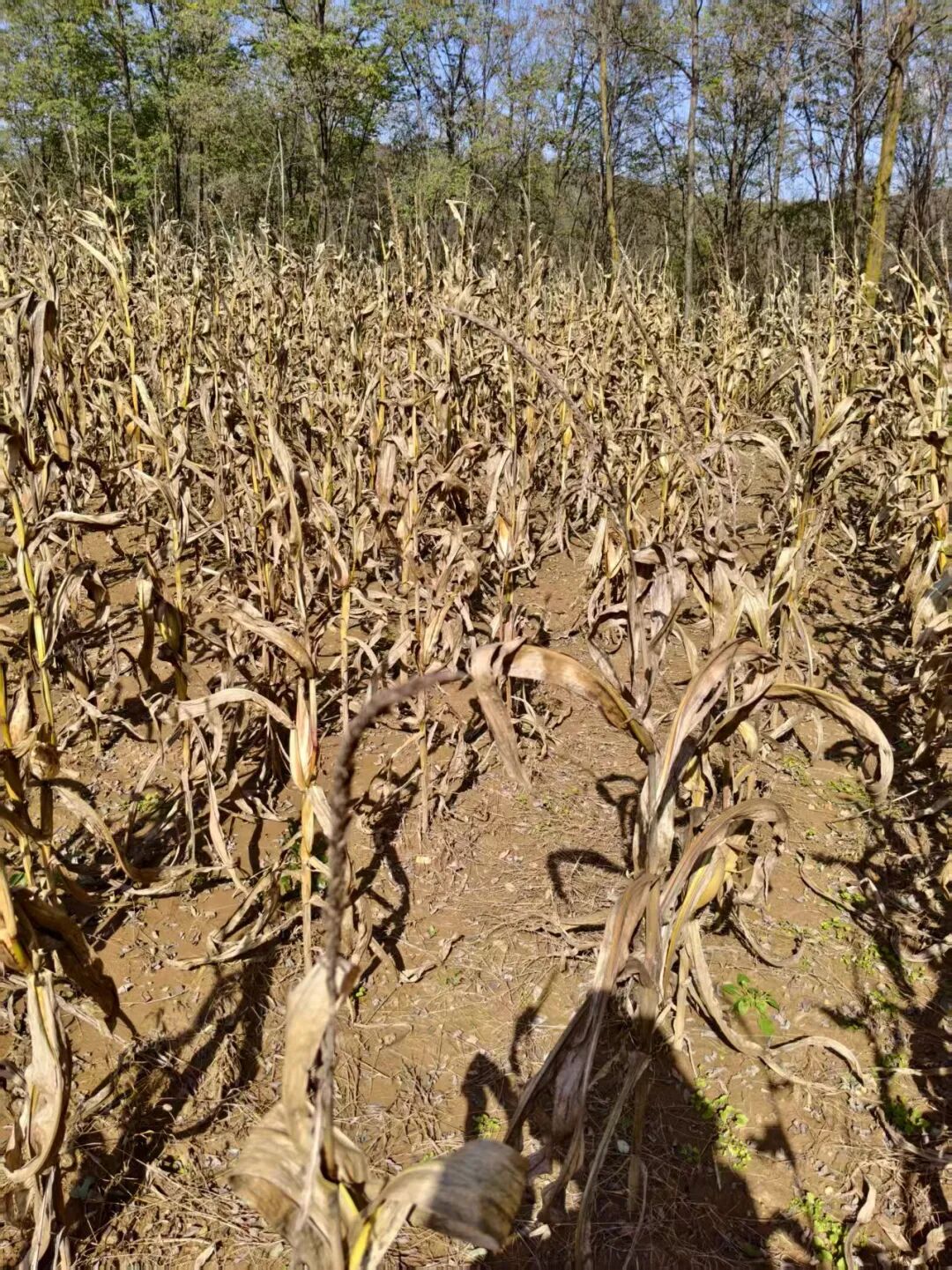
◉ The maize stover not yet cleared still stands in the land.
The Large-Scale Farmers Remaining in the Village
Hongxia is just over 40 this year, and she and her husband, Daming, have been farming together for more than twenty years. She always smiles as she teases herself, “I suppose I count as a veteran farmer by now.” The couple can’t bear to see so much land lying unworked, and Daming in particular does not like going away to work—he simply loves farming.
So at first they took charge of the roughly 10 mu of land the village had allotted to their family. Because Daming preferred farming to dealing with people, they began taking on the land of relatives and neighbours that had fallen into land abandonment and was left unworked, first accumulating more than 30 mu.
After that, to make land preparation, threshing, and other fieldwork easier, they bought more farm machinery, including a rotary tiller, a seed drill, a small walk-behind reaper, a thresher, and a three-wheeler, among others. As their farm machinery grew, to spread the costs and keep the machines from sitting idle, they additionally contracted other plots of land in the village at nearly 200 yuan per mu per year. They now have around 110 mu in total. Compared with the villagers’ former practice of “farming on their own,” this also counts as a small-scale form of “large-scale farming.”
Daming is always talking about “the freedom of farming”. This “freedom” means not having to be constrained by a boss, and being in control of his own time. But the flip side of “freedom” is working all year round, almost without a break. In spring it is land preparation and sowing, in summer pesticide spraying and weeding, in autumn harvesting, and only in winter, when it is cold, do they get a brief rest.
This life is not much different from having a job, and the large tracts of land also mean more reasons not to leave home. Hongxia says, “The land just surrounds you.”
Instead of facing the yellow earth with their backs to the sky, more people choose to leave. In Tongchuan, farming cannot keep people in place.
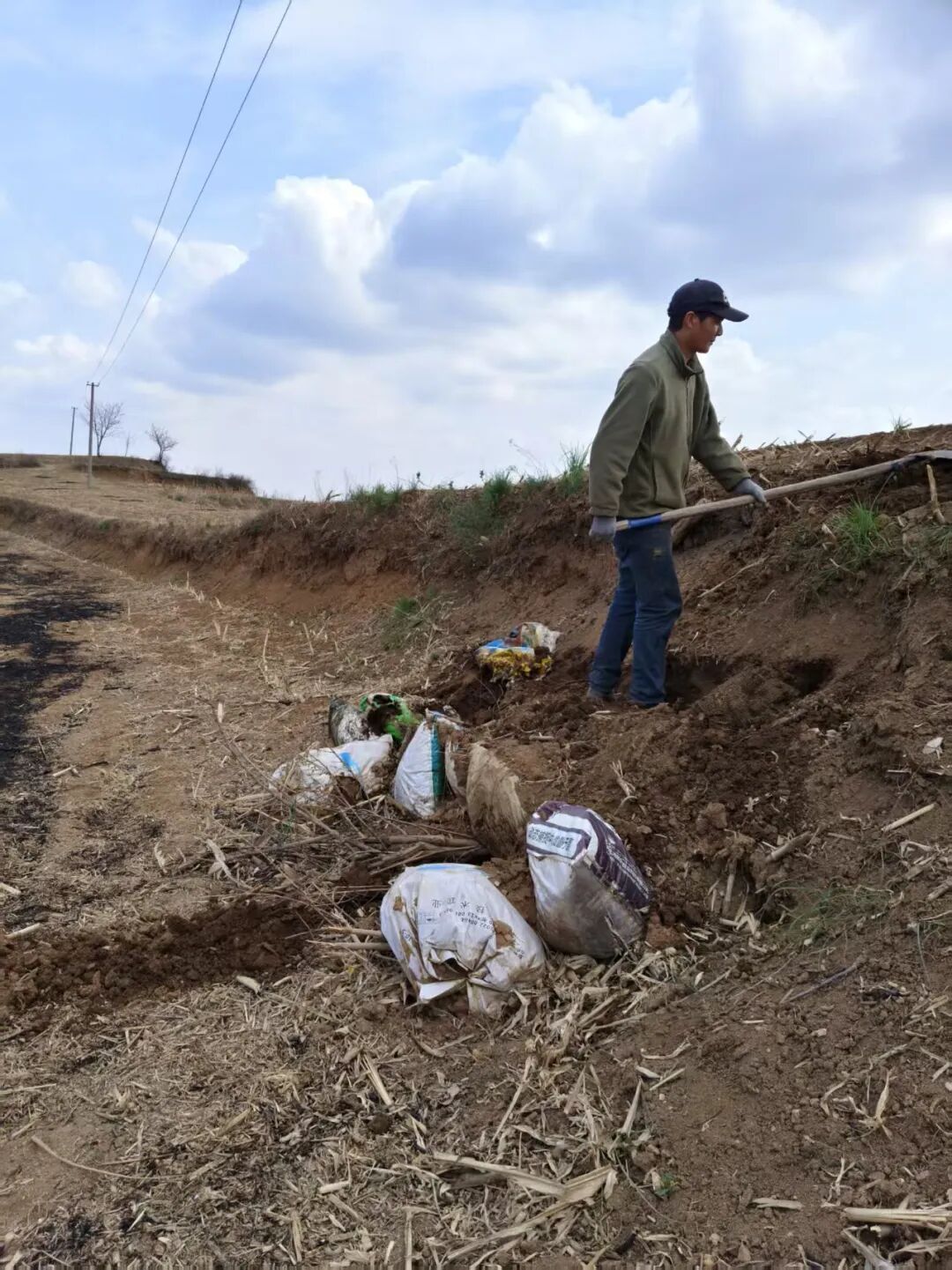
◉ Hongxia’s husband, Daming, is clearing their family’s land.
Land Abandonment for the City
Tongchuan is located in central Shaanxi and is bordered by the three cities of Xianyang, Yan’an and Weinan. It lies close to the southern edge of the Loess Plateau in northern Shaanxi. Although it is classed as part of the Guanzhong Plain in regional terms, a satellite map shows that the land here is far from flat; instead, it is all hills and mountains. Hills, tablelands, ridges, mounds, gullies and rivers are all found here.
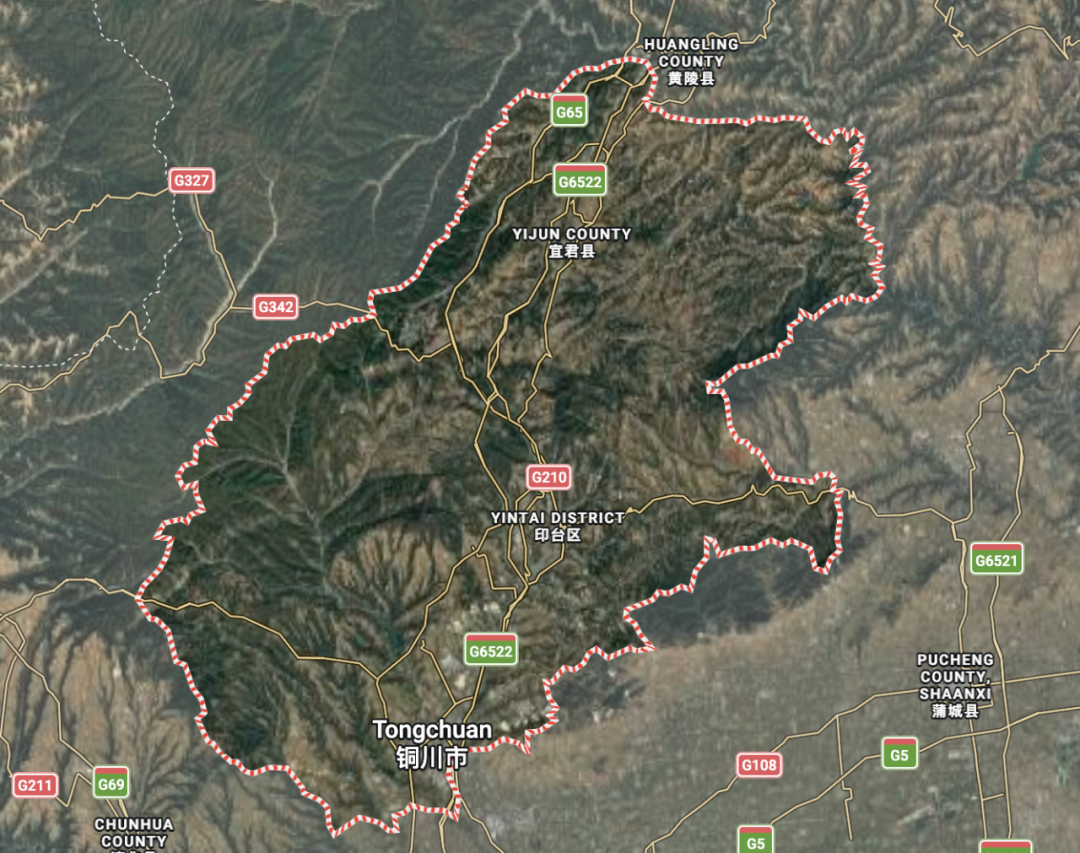
◉ Satellite map of Tongchuan, where flat land is rare and the terrain is all hills and mountains.
It is precisely because of the terrain that farming means making a living on sloping land. This is far more difficult and arduous than farming on flat ground. Sloping land is not like the broad plains, flat and unbroken, where extensive mechanisation can save labour and boost production efficiency. For local people, the level of mechanisation here is very limited, “A smaller vehicle can still labour up the slope, helping to carry things, but any slightly larger farm machine simply cannot get up at all.” In the end, a lot of the work still has to be done by hand.
Besides, the land is uneven, so its fertility is poor. “When it rains heavily in late summer and early autumn, soil erosion is severe; the mud is washed down the slope, leaving only small stones behind.”
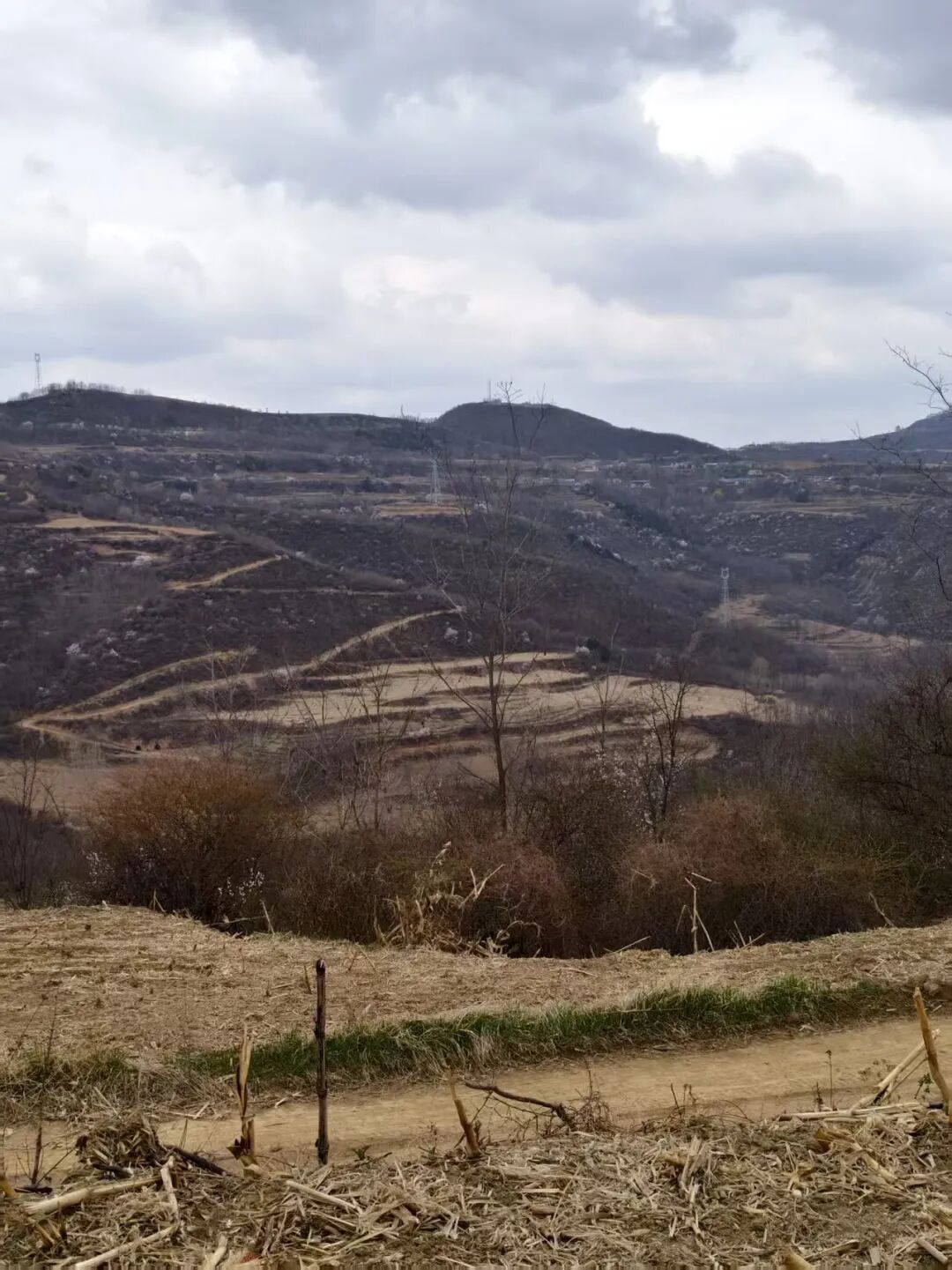
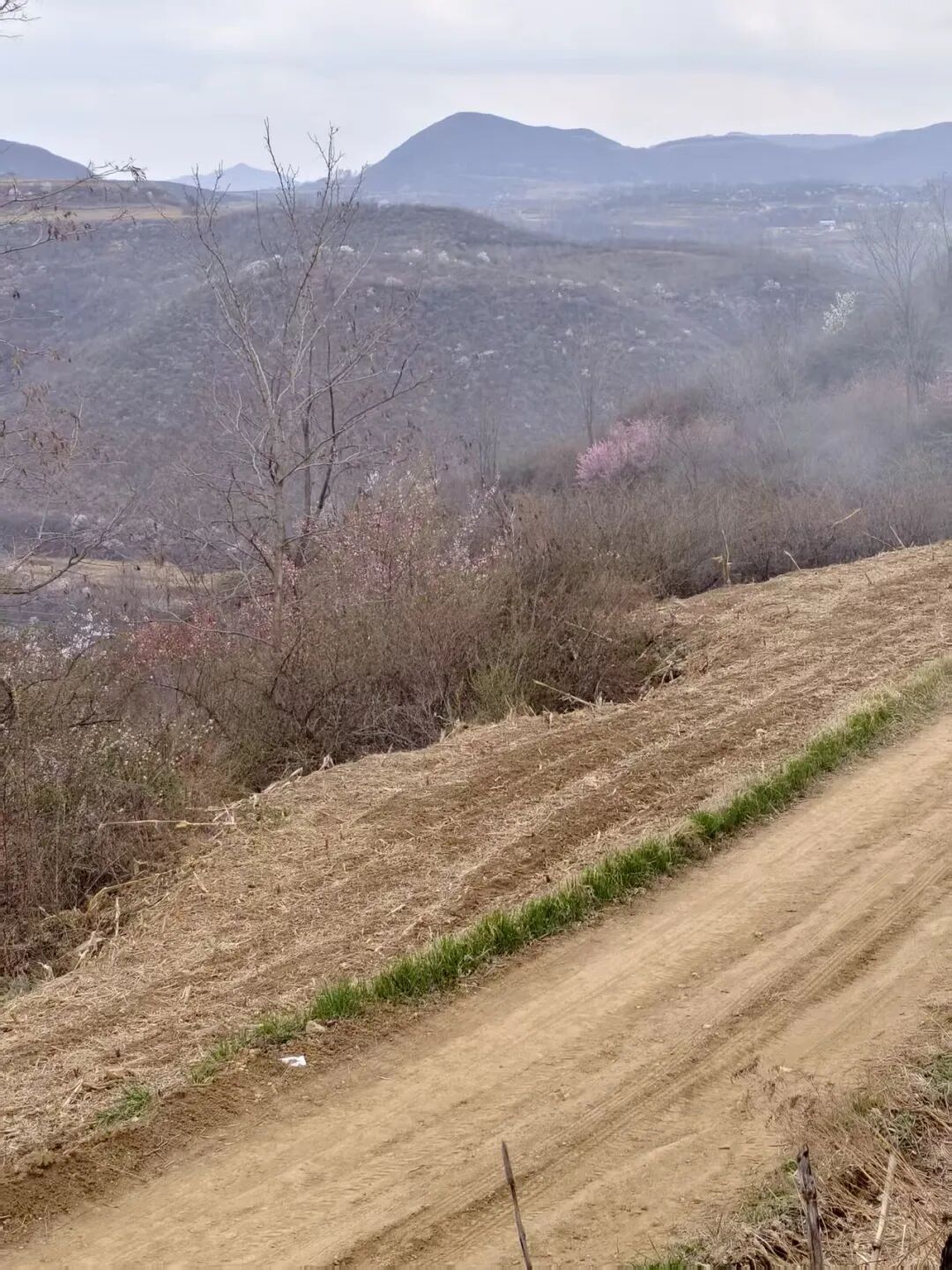
◉ The route Hongxia has to take every day up the mountain to reach the fields.
But for most villagers, besides the land itself being “not fertile enough”, another major issue behind land abandonment is that only one crop can be harvested in a year.
In most parts of Tongchuan, the temperature difference between winter and summer is large, and grain yields are low, unlike in the Guanzhong region, where two crops of grain can be harvested. Many farmers in Tongchuan who plant maize are unable to plant wheat, and those who plant wheat are unable to plant maize. As a result, after working out what the land can produce, people living here mostly choose maize. “If there are no major unusual weather events in a year, maize can yield more than 1,200 jin, while wheat yields only about 400 to 500 jin.”
For ordinary villagers in the area who have to support their families, this is clearly not enough either.
Farming is a life of “living at the mercy of the weather.” To find other ways to make a living, many villagers choose to go away to work. In Hongxia’s words, “With no knowledge or education, you can barely read any characters, and the only work you can do is low-skill, heavy physical labour.”
As the village population shrinks, the land gradually falls into land abandonment. Compared with farming, working in the mines is a more direct path to cash income. Land and mines, in a sense, make up the most fundamental livelihood structure of this area, one being “low return but relatively secure” and the other “high risk but quick cash”.
Land That Wears You Out
Hongxia’s husband, Daming, had also once worked in the mines, but only stayed for a year before giving up, “Coal mines are dangerous after all, and I still feel a bit afraid.”
Choosing to stay in the village and farm means choosing to toil over the land day after day. Most of the land farmed by Hongxia’s family is on the slopes: “110 mu, at least 100 mu are sloping land.” On sloping land, mechanisation is difficult, and every task is extremely labour-intensive.
The stones left exposed after the rain has washed away the soil have to be picked up by hand, one by one. Hongxia says, “If the stones are not picked up, the machines can easily break down, and the maize does not grow well either.” Whenever the weather clears after rain, she has to hurry up the mountain, first gathering the stones together with a rake, then putting on gloves and throwing the small stones into baskets, tipping basket after basket into the three-wheeler. Once a load is full, her husband rides it down to the bottom, and in this way load after load is taken away.
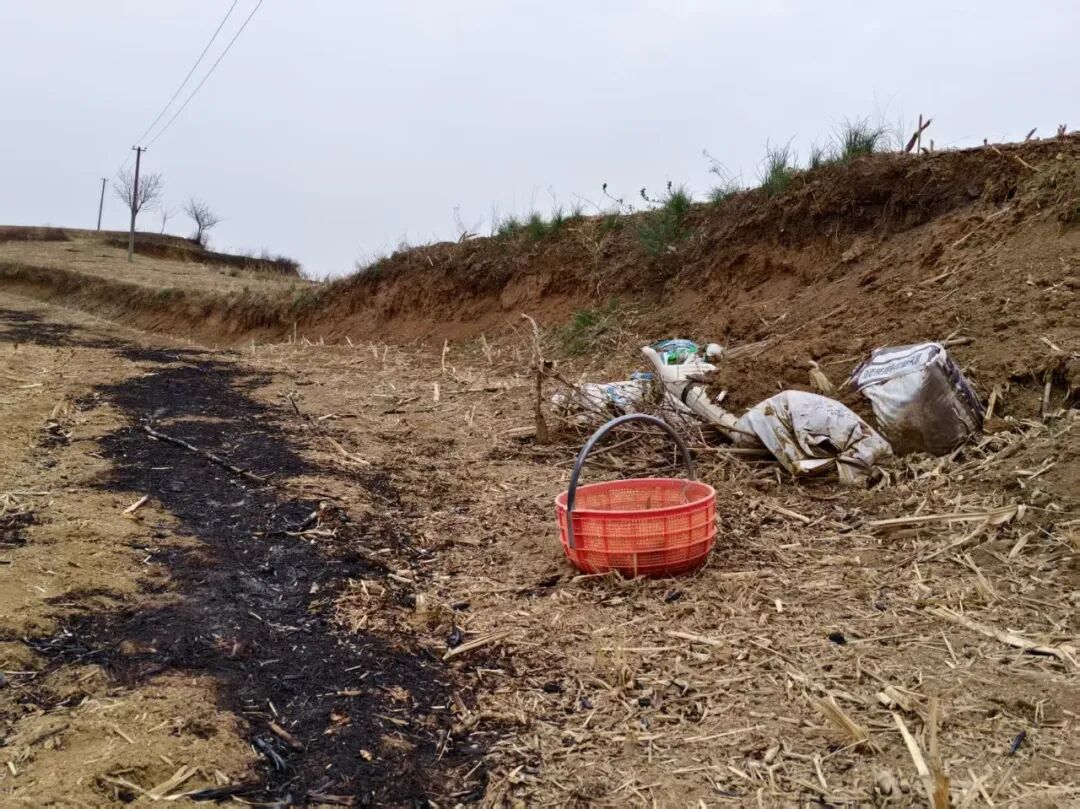
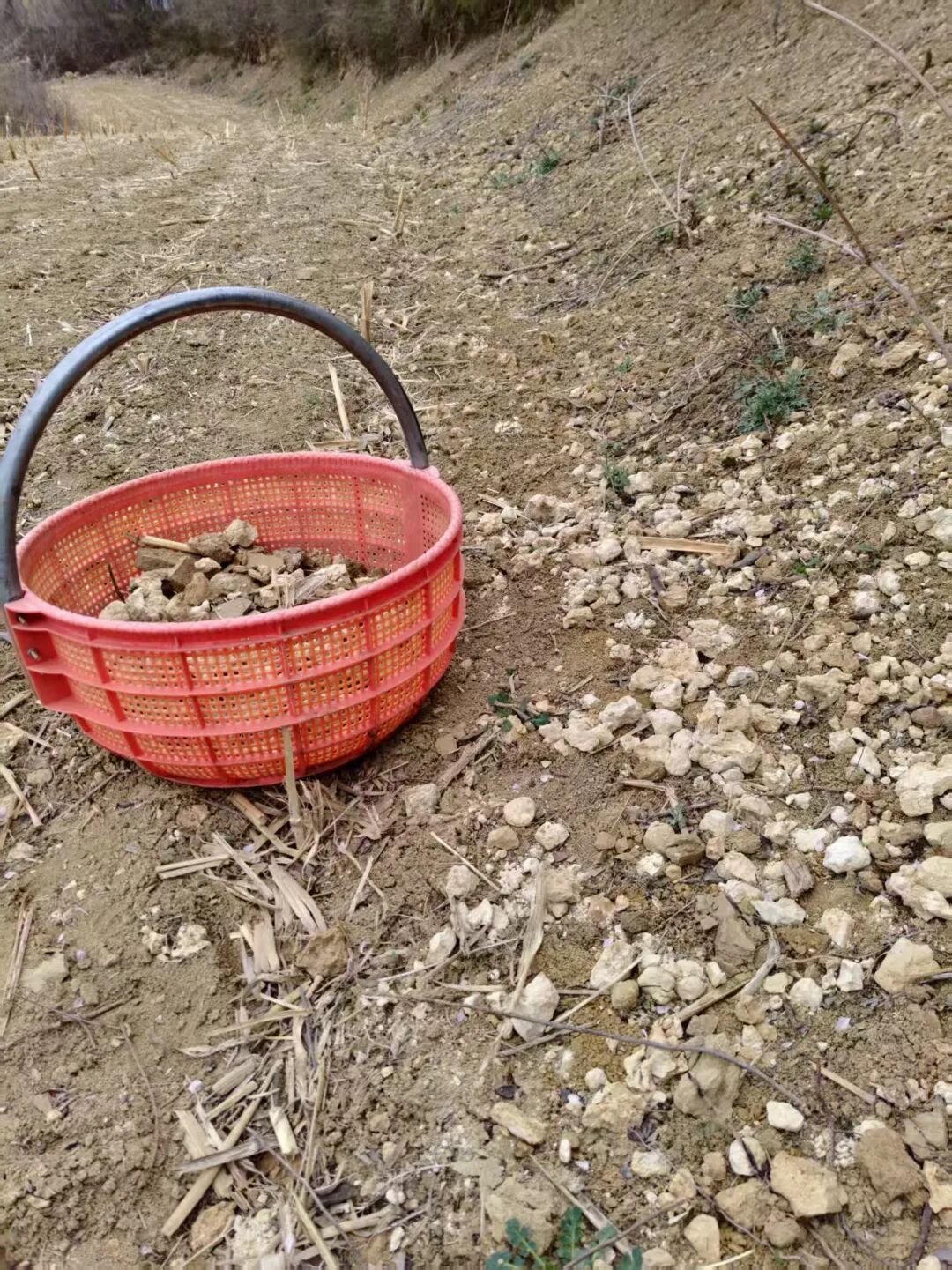
◉ Hongxia has loaded the stones from the field into baskets.
From planting to the final harvest, maize requires at least four rounds of handwork: sowing (planting), weeding, applying chemical fertiliser, maize picking, husking, threshing and stalk cutting. “Every stage requires people.”
Hongxia’s family farms a lot of land, and because machines cannot be used on sloping land, maize picking has to be done entirely by hand. When the maize ripens, the two of them alone simply cannot keep up. The maize harvest, from beginning to end, takes at most half a month, and the worst thing is if it rains; then they inevitably have to hire help for a rush harvest. Labour costs are no small expense. When the maize is ready for harvest, they hire workers at 100 yuan per person per day, taking on about four people at a time, for more than half a month. This also means that even if the scale is expanded, it is difficult to significantly reduce certain unit labour costs that cannot be quantified.
In recent years, Hongxia has clearly noticed some changes in the village labour market.
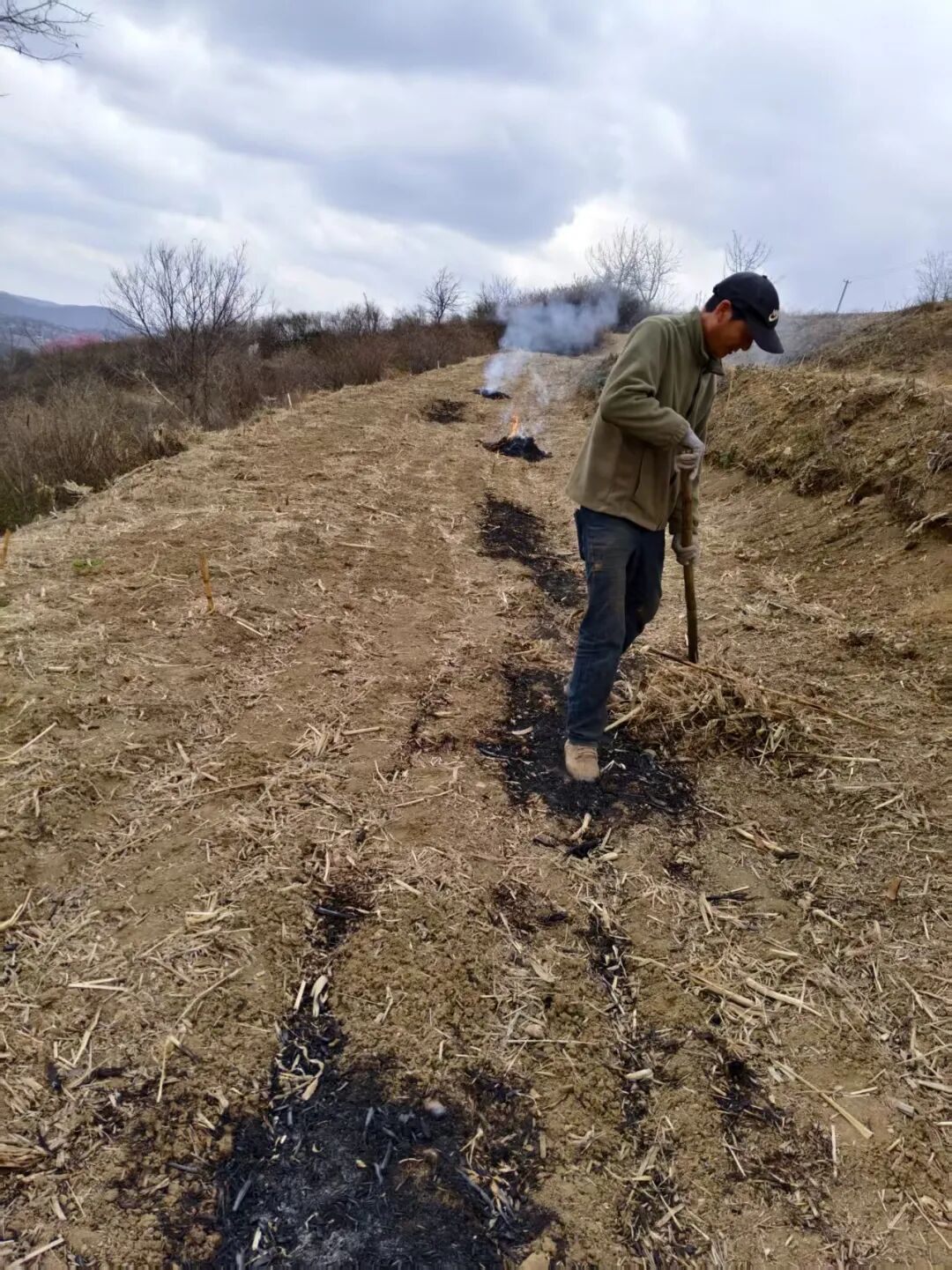
◉ Hongxia and her husband are clearing up maize stover that has been roughly crushed by a machine.
When the City No Longer Offers a Livelihood
A lot of people have come back.
When it comes to the growing number of people in the village, Hongxia first noticed it in the day rate for “maize picking” workers: “In previous years, at least 130 yuan a person a day, but last year it dropped to 100.”
Hongxia feels this change began after the pandemic. Whether it is going into the city to work or going into the mines to find a living, there are fewer opportunities than before.
In earlier years, Tongchuan had also been “rich”. During the First Five-Year Plan period, the state prioritised two projects in Tongchuan, Wangshi’an Coal Mine and Yao County Cement Plant, thereby laying the foundation for Tongchuan’s industrial base. At that time, Shaanxi’s industrial development also relied mainly on Tongchuan. And given Tongchuan’s importance, in 1958 Tongchuan became the second prefecture-level city to be established in Shaanxi, after the provincial capital, Xi’an.
At that time, Tongchuan’s industry grew rapidly; coal output at one point accounted for 70% of the province’s total, making Tongchuan an important national coal production base and the largest cement production base in the northwest. This also brought many opportunities to nearby people. Even when villagers had to go out for work, they did not need to travel too far, as the Tongchuan region had many mining areas. “If they could not farm, quite a few people went to coal mines to dig coal.”
For many people, working in the mines remains a realistic choice. “If one can endure the hard work, an income of seven or eight thousand yuan a month is possible.”
Besides going into the coal mines, jobs such as migrant work, catering kitchen work, security guarding and nannying have mostly become the main jobs for villagers who leave the village to work in the city. “Scraping a living out of the soil is ultimately uncertain; if there is a severe drought or heavy rain, the year’s harvest is ruined. Working away is hard too, but, after all, you get a monthly income, month after month, and a thousand or so yuan gives people peace of mind.”
Long-term unrestrained mining has left this city “riddled with holes.” It has not only created large numbers of mined-out areas and subsidence areas, but also caused serious environmental pollution; Tongchuan has therefore also been called a city invisible from a satellite.
Over time, the single industrial structure has also left Tongchuan’s economy at the bottom of Shaanxi’s rankings. The gradual withdrawal of heavy industry has also caused many people to lose opportunities to work in the city. According to Hongxia, coal mines have raised their requirements and only recruit young people; once someone is over 40, they are almost never hired. And, as the mining areas have been in operation for a long time, many mines have closed, and opportunities have decreased.
Jobs in the city are hard to find, and the pressure to make a living is high; some people cannot find work and can only go home. In the city, the moment you open your eyes you have to spend money: renting a home, buying food, everything is an expense. But back in the village, the house is their own, there is no rent to pay, and if there is a piece of land at the doorstep, growing some vegetables is enough to last through a summer. “We are all rural people, and if we cannot make money, we have to find ways to economise.”
There is another change that is more subtle. In the past, rural people moved into the city. Now, some urban residents have even begun returning to the countryside looking for casual work. Hongxia says that some city people who once worked in the mining areas have had their land taken and still have no stable income: “Living in the city is expensive, so they come to the countryside to work.” During the busy farming season, they help with flower thinning, maize picking and apple picking.
This reverse flow of workers has pushed down labour prices. But that does not mean that rural labour is plentiful. Quite the opposite: local labour remains in short supply. The younger generation is unwilling to do farm work, leaving middle-aged and older people, who “also have to look after their newborn grandchildren, so they have no staying power for the work”, while those who are too old can no longer manage the work in the fields. Moreover, the local supply of labour has also become more complex, made up of old people from the village, unemployed urban residents, and “landless farmers” who have relocated to the city. Together, they form a loose and unstable labour market.
Those Who Have Come Back Want Their Land Back
Following a slightly winding mountain road uphill, all that could be seen was the locally common mottled yellow-brown earth and a grey-brown, smog-like sky. Hongxia had no mind to look around; her eyes were on nothing but the maize stover, already withered yellow, still to be cleared.
With winter gone and spring coming, farmers are about to begin a new round of sowing. Hongxia can only hold on to the one certainty before her: “Whether or not it can be planted, first pick up all the stones; the land must not lie fallow—as long as it does not, that is enough.”
Now that the villagers have come back, naturally they want to take their land back. When villagers rent land, it is not like outside companies or organisations taking the land on contract, where there are contracts or standardised terms. Rural society is one of personal connections, and agreements are mostly oral. A single meal in someone’s home can be enough to settle the land rental arrangements, and even if neighbours are not well acquainted, a middleman passing messages can be enough to establish a relationship. But this leaves a hidden risk.
For farmers who had expanded their operations by leasing land for cultivation, once the land is taken back, the risks quickly become apparent, and their earlier investment in machinery has instead become a sunk cost. They cannot stop the losses either. “The machines cannot be sold, and even with less land, they still cannot do without them,” Hongxia said.
Hongxia and her husband had earlier invested a total of about 150,000 yuan in agricultural machinery, across a range of large and small vehicles. In fact, even in their best year, without counting the machinery investment, their annual net profit was no more than a thousand yuan. When the continuous rain came in 2025, all the maize was waterlogged. Even what was brought in could not dry out and went mouldy. One mu could be sold for only 300 yuan, barely covering the cost of seeds and chemical fertiliser.
It was not only Hongxia. A young man in his thirties in the same village had also run into the same problem. “He is even a university graduate.” When she mentioned him, regret was in her tone. Before the pandemic, he had gone back to the village specifically to farm the land on a larger scale and mechanise it. He thought that one person and machines could cultivate more than 100 mu, and that earning a hundred thousand or so yuan a year would be no problem. The young man was ready to make a grand start; he even paid 200 yuan above the local market price, taking about 80 mu of village land on contract at 400-500 yuan per mu. But, as it turned out, before three years had passed, he was left with less than 50 mu to plant. “Others have all taken their land back.”
In addition, it was not only the land. In order to farm, the university graduate had also invested quite a lot of money in agricultural machinery, all in all. “Now there is not so much land to plant; they all sit idle in the yard, gathering dust.” He had thought he might help others with some work at the autumn harvest and earn some fuel money, but he could not stay at home every day, just waiting. When he added it all up, these patchy earnings were nowhere near enough to support a family.
In the end, his “grand” wish was still let down by the land. “This year he, too, has gone down to the coal mine.” On this land, people with and without an education have come to the same end.
An Uncertain Future
For smallholder farmers with scattered holdings, farming is even less profitable. When the land returns to their hands, it does not bring a stable livelihood. Rather, it feels more like a “reluctant fallback”.
Hongxia says that her village is still one where land is relatively plentiful: each person can be allocated a little over two mu, close to three mu, and even a whole household’s holdings add up to only around ten mu. At the end of a year, one mu yields roughly 1,200 jin of maize. In recent years, the purchase price of maize has mostly fluctuated between about 1.1 and 1.4 yuan per jin. In other words, annual income is only just over 10,000 yuan. By contrast, the annual cost per mu for seeds, rotary tillage, sowing and fertiliser adds up to about 300 yuan. Once the costs are deducted and the remainder spread across a family of four or five, there is almost nothing left. “I had thought I could top up the income with odd jobs, but now there is no work to be had.”
And all of this is a true reflection of the state of the countryside today: for most people, there is no stable route to a secure livelihood or upward mobility, only a shifting mix of livelihoods, constantly adjusted back and forth in response to circumstances. Although the rural population comes and goes and is always in flux, it has never had a clear direction.
It is much the same with the land here. Some years ago, nobody in the village was farming it, and the land gradually came into the hands of people like Hongxia, who were willing to farm. In today’s uncertain life, people have come back, and the land has again returned, piece by piece, to being fragmented.
Hongxia is no exception. Now, she and her husband are still the so-called large-scale farmers with a hundred mu. Their future, too, is uncertain. “If there is any less land, we’ll turn to animal husbandry or set up a small snack stall.” When asked about the future, Hongxia’s answer was characteristically practical, but her tone was full of uncertainty and bewilderment.
Although it seems as if there are many options, the fact is that these are all just notions with no clear way forward. A person who has spent half a life working with the land has not yet figured out how to come to terms with the fact that they are gradually losing their land.
Foodthink
Author
Mi Xiaomai
A “second-generation farmer” who farmed as a child and, once grown, turned to writing, loves and hates the land, but hopes to record more of the countryside, farmers and farm life.
Daming in the article is a pseudonym; all images are provided by the author.
Editor: Xiaodan