
The Secret in the Supermarket Oil Bottle: Is Refined Vegetable Oil Really Good for You?
Let’s try a little test: who remembers what happened on 2 July 2024? Don’t check your phone – just think.
I guarantee most of you have forgotten. On this day in 2025 I searched online and found no one mentioning the oil tanker affair from a year ago. The correct answer: that day, The Beijing News exposed the practice of transporting edible oils and chemical liquids in uncleaned tankers.

Once the scandal broke, the government launched a crackdown on regulatory failures, the companies involved issued mea culpas, and the unscrupulous “oil pots” were roundly condemned. People returned to their happy, peaceful lives – and everyone was content. But this foodie was left disgruntled, as though something was missing. Hence this article.
I. Oil Pot or Bedpan?
After the tanker scandal, a sharp one-liner was circulating far and wide: “The real issue was never about whether the tank gets washed – mineral oil and edible oil should never share the same tank in the first place. However spotlessly you scrub a bedpan, would you use it as a teapot?”
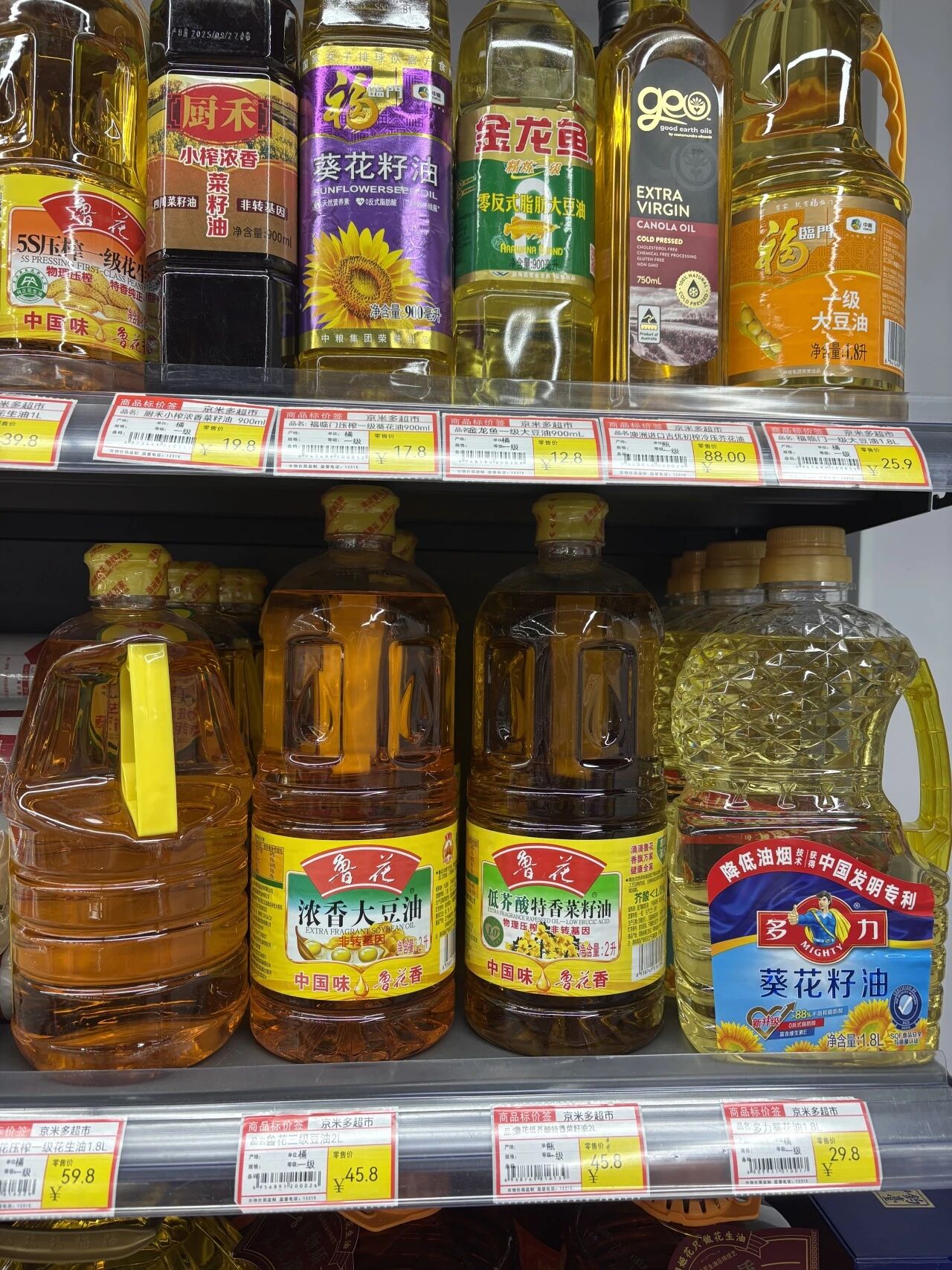
Oil pots – every household has one. In a modern kitchen, the oil pot is small and refined; the priority is a drip-free spout and a look that matches the kitchen décor. A slightly larger oil pot is just the jug you carried back from the supermarket. The vegetable oils on supermarket shelves all come from this or that big brand, produced by large edible-oil companies with annual outputs in the thousands or tens of thousands of tonnes. Transport and storage, like processing, are indispensable links in the long, globalised chain from plant to plate. In this sense, the tanker is nothing but a giant oil pot.
Public fury ran high over those mixed-use tankers carrying edible oil. As a foodie who cares about food health and food sovereignty, I was baffled throughout. The incident was indeed outrageous and rightly condemned, but I hope we can use this moment to dig deeper – to look more closely at what’s actually inside those tanks, at the stuff we call “oil”.
As for the “oil” in the pot, well – the first thing is bad news, and the second is bad news too. Both dreadful.
The first: the vegetable oil we buy from the supermarket is, in any traditional sense, no longer “oil” at all. The “mixing” of edible oils and non-edible chemical liquids has, in fact, been going on all along – it is happening now, and it will continue into the future.
Oil in its true sense as food – in the agricultural age, it was either animal fat rendered by heat or plant-seed oil pressed from seed. Before humans mastered rendering and pressing, animal fat and plant seeds had been rising and falling in the history of human food for tens of millions of years. Fat is an essential nutrient and deserves enormous credit for humanity’s triumph in the struggle for survival. Countless species were swept away by evolution’s long river for failing to obtain enough fat – I should salute the fat for this life of mine.
Let us set aside animal fats here, for the “edible oils” sold today are almost all vegetable oils – yet they are no longer the “oil” that nourished human life through evolution.
Why say so? Let’s look at the process.
Once humans entered the agricultural age and had more oilseed crops, mechanical pressing emerged in both East and West – applying force to squeeze the oil from plant seeds. But in 1843, humans first used carbon disulfide for solvent extraction of olive oil, and France led the way in solvent extraction research. Then Germany overtook them: first establishing the first batch extraction plant for industrial-scale production, then developing the basket-type continuous extractor, which greatly improved efficiency. Then came the United States, which in 1949 developed the more efficient rotary extractor that, through mass adoption, came to dominate the field. In 1955, China’s first continuous extraction oil plant was built in Jilin.
The 1950s was an era in which the food industry and globalisation surged forward, and an era in which sugar and refined vegetable oil made up an ever-growing share of the human diet. The food giants were the driving force behind it all. There is a book called Salt, Sugar, Fat: How the Food Giants Hooked Us, packed with real cases exposing how food giants spare no expense – from massive advertising budgets to buying off scientists and orchestrating academic fraud.
Before solvent-extracted seed oil reaches supermarket shelves, it undergoes two rounds of high heat in the factory. Solvent extraction comes in three forms – pre-press solvent extraction, single extraction, and double extraction – broadly similar in principle. n-Hexane dissolves the oil in the raw material to produce miscella. Two rounds of high heat follow: the first removes the solvent; the second, at high temperature, bleaches, deodorises and removes impurities. Pure, odourless, crystal-clear refined vegetable oil heads for supermarket shelves and into the home kitchen.

In modern solvent extraction, the solvent in general use is n-hexane – an inedible petroleum chemical product that is harmful to health.
This solvent leaves residue in the vegetable oil. According to the National Food Safety Standard for Vegetable Oil, edible vegetable oils produced by solvent extraction (including blended oils) must have a solvent residue level of ≤20 mg/kg. For mechanically pressed oil, solvent residue must be below detectable levels (a detected value below 10 mg/kg is considered undetected). The EU, by contrast, has set stricter standards for solvent residue in edible oil: the current safety limit is 1 mg/kg – 10–20 times stricter than ours.

II. The Industrialised Alchemist’s Furnace Turns Oil into Inflammation
Consumers clutch an agricultural-age cold-pressed oil composition sheet, searching the supermarket shelves as futilely as one who fishes in treetops. It is like presenting the Monkey King’s ID from the Eastern Continent of Superior Body while looking for the Great Sage, Heaven’s Equal – only to find he long since attained enlightenment and became the Victorious Fighting Buddha.
The second piece of bad news: supermarket oils may not only carry solvent residue but also contain trans fat.
Trans fat is not found only in hydrogenated vegetable oil – oil refining and high-heat cooking also generate trans fat.
For vegetable oil that has passed through two rounds of high heat, one piece of bad news is that the natural antioxidants originally present in plant seeds – vitamin E, phytosterols and other heat-sensitive nutrients – have perished. Another is that the monounsaturated fatty acids and polyunsaturated fatty acids, which once deserved enormous credit in humanity’s evolution through aeons of geological upheaval, have been largely destroyed. And an even worse piece of news: matter cannot be annihilated. After passing through the scorching furnace, undergoing its nine transformations and shedding its old body and bones, a portion of it has become the very trans fat that makes modern people tremble at the mere mention.
If you are as I am – half-knowledgeable yet endlessly studious – your research is bound to turn up discordant voices. Some sources mention that finished oil may carry residual solvent, or that the process can produce carcinogens such as benzo[a]pyrene; yet authoritative bodies maintain that harmful-substance levels in products passing inspection are within a controllable range. I choose to believe – God helps those who have faith.
Vegetable oil has also become a pro-inflammatory agent undermining the general health of modern people.
Vegetable oil contains linoleic acid (ω-6) and alpha-linolenic acid (ω-3) – essential fatty acids the human body cannot synthesise on its own. While plant-seed oils do contain some ω-3, the levels are not high. ω-3 is found in wild fatty fish, free-range chicken and duck eggs, grass-fed beef and lamb, and whole-milk dairy – but trying to meet your ω-3 requirement through plant-seed oil is like driving south when you want to go north.
The worse news, however, is excess ω-6. The healthy ratio of ω-3 to ω-6 falls between 1:1 and 1:4. Plant-seed oils have a much higher ω-6 share, and ω-6 is widespread throughout the food chain – the body was never short of it. Now that we consume ever more plant-seed oil, the ratio in the everyday diet may reach 1:15 or higher. This imbalance promotes inflammation, ageing and oxidative stress – a very big problem indeed.

Despite so many problems, solvent-extracted plant-seed oil is still popular the world over for one very simple reason. I grow my own rapeseed and groundnuts and have pressed oil myself with a small presser. Rapeseed with an oil content of around forty per cent (37.5–46.3 %) yields barely one liang of oil per jin – a yield of just over one-tenth. Sent to a village press for hot-pressing, the yield rises to over twenty per cent but less than thirty. Either way, about half the oil in the rapeseed is still left in the cake. Yet solvent extraction can achieve a yield of 99 per cent.
III. A Bear Dead of Stupidity, People Dead of Cleverness
When it comes to plant-seed oil, modern people have long since surpassed the stupid bear – oil yields keep rising, supermarket oil keeps getting cheaper, oil-rich ready-made and semi-processed foods keep getting more convenient and accessible. Ever cleverer, until we die of it.
I once read this line: “Nature does not make unhealthy food, but the factory does.” (Nature does not make unhealthy food, but factory does.)
As a stupid person, I take the stupid approach: one clean cut – no oil at all, full stop. I do not buy supermarket oil, do not eat takeaways, do not eat any oil-containing ready-made or semi-processed foods. The specifics:
One, no stir-frying. Vegetables are good, but stir-frying them is not. Vegetable oil subjected to high-heat cooking also generates trans fat. Vegetables can be dressed raw, roasted, steamed or blanched. An electric oven or air fryer is a modern-day blessing. Take aubergine, for instance – the ultimate oil sponge in a stir-fry. Toss it into the oven or air fryer with chilli and garlic for ten minutes, mash it up with salt and seasonings, and you have a refreshingly good accompaniment to rice. I cannot handle spice, so I skip the chilli, though I hear that adding century egg and pounding them together makes the Hunan classic home dish “léi cài” (pounded vegetables).

The electric griddle is another indispensable daily companion. I do not eat meat, but I fry an egg on the griddle every single day. The earliest version was oil-free: eggs and various additions, a little silken tofu, poured onto the preheated griddle and done. Later, when circumstances led me to stop buying shop-bought tofu, I worried about the egg sticking and scorching, so I switched to a barely-there oil – one drop is enough, using almost nothing. Friends who eat meat can try a minced-meat water-fried egg: use water instead of oil, at twice the volume you would normally use of oil. Once the pot is hot and the water boils, first add seasoned ingredients like shrimp, diced meat, shiitake and wood-ear mushroom; when the water boils again, pour in the beaten egg and stir. It is close to a speciality preparation from Changwu in Shaanxi. You could also refer to Foodthink’s earlier stir-fry sauce article – you can make a batch and keep eating it for a long time.
Two, choose trustworthy oil. Though I do not stir-fry, I do still use some oil. I buy walnut oil from Kangli, a Yi woman and fellow farmer at the Beijing Organic Farmers Market. Each year after the Spring Festival, I buy three jin – six small bottles – and to this day three remain unopened, averaging less than 3 g a day. This year’s harvest was nearly fifty jin of rapeseed and over a hundred jin of in-shell groundnuts, so I will not need to buy oil in the future.
Three, satisfy cravings by hand. Foodthink has already published my article on making mooncakes from scratch – a water-and-oil puff pastry version using walnut oil. The filling is entirely homemade with no additives, though it still had a touch too much oil. Since then I have developed taro-and-egg-yolk puff pastry and red-bean-and-egg-yolk puff pastry, with oat flour as the main outer-crust ingredient, in an oil-free version. You can also make oil-free biscuits from crushed dates, oats, black sesame, steamed buckwheat and egg yolk. These snacks are tasty, healthy and guilt-free – I will share the recipes in detail another time.

Replace refined vegetable oil with nuts and oilseed crops in their whole form. Fat is an essential nutrient for the human body; without it, fat-soluble vitamins simply do not work – you must eat enough. Many nutrients cannot be synthesised by the body, ω-3 in particular. My approach is to eat nuts rich in ω-3, such as walnuts, and some simply processed products such as black sesame paste.

Four, then there are home-grown peanuts. The most common ways I eat them:
1. Roast peanuts in their shells at a low temperature – 130 °C for one hour. They come out perfectly crisp, easy to peel, and gently sweet. A conventional oven or an air fryer will do. I prefer the air fryer because I only make a small batch – no more than half a jin each time – so I can pop a few out whenever I like and finish them before they go soft.
2. Boiled peanuts – another daily staple. This method requires soaking first: put shelled peanuts in water, leave them in the fridge, and toss a few into the pot each time you make soup. They work equally well in savoury vegetable soup and plain rice water. Boiled this way, the peanuts have a faint sweetness and a tender, yielding texture that is quite unlike anything else.
3. Fresh peanuts boiled in their shells. In Fujian, peanuts enjoy a long growing season. Bury a few seeds in any spare patch of ground, sowing from Spring Equinox all the way to Start of Autumn and White Dew, and you can dig them up fresh and eat them straight from Minor Heat and Major Heat right through to Minor Snow and Major Snow – half a year in all.
Apart from the last item, which is a farmer’s exclusive perk, city friends are welcome to copy this homework.
Some worry about the brickspert’s warning that “nuts are good, but eating too many is no use”, yet my stupid-person logic reads it this way: that advice is aimed at people whose recommended daily edible-oil intake is 25–30 g. Someone taking barely 3 g of oil a day need not apply.
