
When Drones Become the New Farm Tool: Who Is Defining “Scientific Farming”?

I. The Black Box Behind Drone Crashes
Drone crashes are common – not just with agricultural drones, but with all kinds of commercial drones. Once a drone crashes, it is no longer under the pilot’s control. It may plunge heavily to the ground or snag on an obstacle.
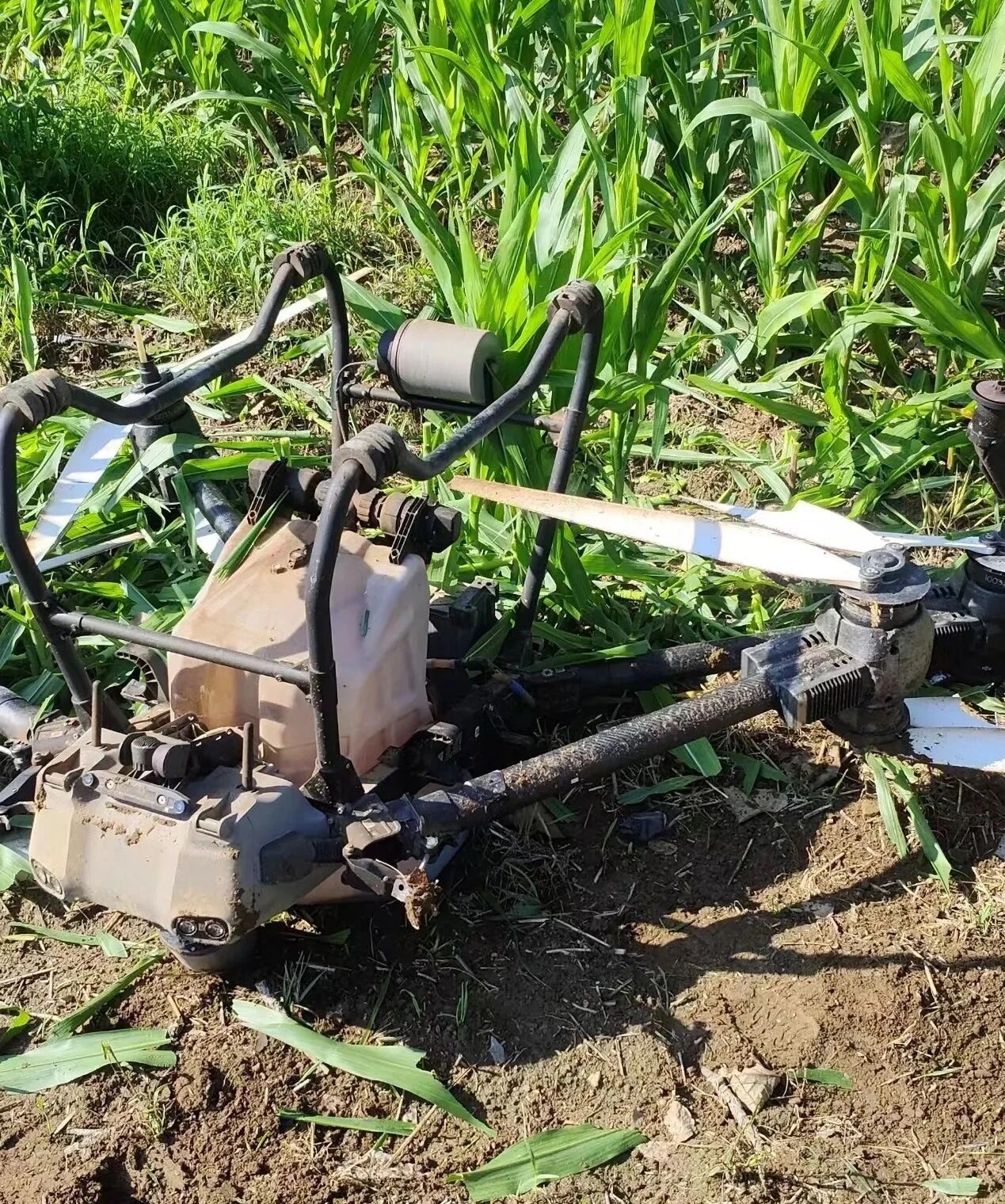
The crash I happened to witness left several surrounding villages without power for an entire day. Since a drone had snapped the line and caused the accident, everyone around understood. A day without electricity does not affect rural life all that much. The only one truly hit hard was the pilot himself.
The pilot, surnamed Li, was in his forties and had been in the business for just over two years. This accident cost him dearly. With the propeller blades smashed, he rushed the drone to the dealer. The broken spare parts were out of stock in the county seat, so he had to wait a few days for a shipment from the provincial capital. The new parts plus shipping came to just under 1,000 yuan, and insurance would cover most of it.
But the problem was that the farming season does not wait. The owner of the field had already hired a new pilot that same day to finish the spraying job, and the work Brother Li had taken on over the following days had to be handed off to other pilots. He had been counting on this job plus the work over the next few days to earn a rough 1,000-plus yuan – now he did not stand to make a single cent.
He also had to cover other losses from the accident. The damaged line was a main feed supplying electricity to several nearby villages, and the power company sent a crew out immediately upon receiving the call. Factoring in the repair costs, labour charges, and everything else – excluding compensation for lost time due to the power cut – Brother Li ultimately paid out more than 2,000 yuan.
The crash happened because Brother Li had not manually marked the obstacles. As he put it, “The radar on the drone can detect most obstacles, but these drooping power lines are trickier to pick up. Before the job, I asked Liu Er – the owner of the field – whether there were any power lines out there. He said no, so I didn’t go walk the field, I just marked it out with the remote controller. Who would have known I’d get so unlucky and run right into one!”
Generally speaking, before operating a drone, the pilot will first plan and map the work area. Mapping involves using the high-precision sensors mounted on the drone to conduct aerial photography of the farmland, efficiently capturing spatial data of the ground surface, and then setting work boundaries, marking obstacles, and planning flight routes. Drone mapping intelligence is improving year on year, and most obstacles can now be identified and marked.
But no matter how far drone technology advances, there will always be unusual situations that require pilots to exercise caution – you cannot leave it entirely to the drone to do the mapping. The user manual notes that the DJI T100, released in 2024, may fail to detect small obstacles, angled power lines, or objects level with the aircraft’s landing gear; in such cases, manual control may be necessary to prevent a flight accident. When encountering vertical pole-like structures or electricity pylons, radar detection performance is limited, and users should fly with extra care. Otherwise, one careless moment can lead to something like what happened to Brother Li – his drone snagged straight onto a length of black cable.

There are many causes of drone crashes, and hitting a power line is just one of them. What precautions to take when working near high-voltage lines is covered in pilot training, and DJI Agriculture’s official website also shows how to deal with such situations. Pilots who have been operating drones year-round have also developed their own old-school methods. Brother Yang, who has been a drone pilot for nearly ten years, has his “Three Don’ts of Flying”: don’t fly at midday (thermal updrafts), don’t fly over grave mounds (magnetic anomalies), don’t fly near high-voltage lines (signal interference).

But beyond the pilot’s own operational errors, technical mistakes, and environmental factors, the black-boxing of technology is also a significant technical cause of drone crashes. A “drone crash” is a highly specialised and common problem. Engineers in the industry have ample technical resources to investigate and address it, but for pilots who have acquired their knowledge through experience, the causes of such accidents remain as opaque as a black box. They cannot tell exactly where the machine went wrong and can only guess at the cause based on what they have experienced themselves and stories they have heard.
For pilots and farmers, a more immediate problem is that only the manufacturer holds the repair know-how. From sending the drone back to the factory for repairs to getting it fixed and returned, the process takes a long time. And the farming season does not wait – farmers often end up paying more to make up for the lost time caused by a crash, and the pilot whose drone crashed sometimes has to share part of that cost.
Yet the more they come to rely on drones, the fewer choices they have. They can only passively trust brands that offer better product guarantees.
XAG’s flagship P80 agricultural drone was plagued by repeated accidents in the summer of 2021. Search for “XAG P80” on short-video platforms such as Toutiao, Douyin, and Kuaishou, and you can still find farmers from all over showing footage of the drone crashing.
The solution XAG’s after-sales team ultimately offered: buy back the mapping system; increase the insurance limit by 20,000 yuan for users in the Heilongjiang region; and commit to free repairs on the sowing system within a specified deadline that year.
Three years on, the shadow this incident cast over farmers remains. Among the dozen-plus pilots and farmers I interviewed, 100 per cent were using DJI. Zhao Mingliang, a large-scale grain grower in the village, had just bought a drone this year. I asked him why he had not bought XAG’s latest model, the P150 – the price was about the same, and so were the features. He said, “First, XAG had too many crash accidents in the past two years – the consequences are something we simply cannot afford. Second, XAG’s local after-sales service is too limited; when something goes wrong, it is hard to get repairs done.”
These new types of agricultural machinery, seen as representatives of smart farming, are loved and hated in equal measure. Some farmers, when bringing them up, can’t help but fume with expletives mixed in: “(The drone) – this whole thing, I can’t figure out what the hell is going on with it!”
And yet they cannot get enough of them. Because once they start using drones, they have a hope of boosting their yield – even if, on closer reflection, it all seems a bit mystical.
II. The High-Yield Anxiety on the Land
Sun Bin was among the first in the village to buy a drone, and he fits the profile of the typical drone buyer. His family has been farming for three generations, and he is a well-known large-scale grain grower in the village. His annual yield is always held up for comparison – everyone says Sun Bin’s family can “rake in a few extra bags of grain per mu.”
To get to the bottom of the secret behind Sun Bin’s high yields, I made a special trip to his home for research. That morning, Sun Bin was washing his drone at home. It is his habit to give the drone a wash after a few jobs – he carefully rinsed the fuselage and propeller blades with a high-pressure sprayer, taking good care of the whole machine.
He told me that during the growing season, crops generally need four to five applications of fertiliser. In the past, tool limitations restricted what could be done, but now with a drone, they can fertilise to standard. “It is our own machine, after all. When the growth stage calls for fertilising, we just do it – it promotes growth! It works, it definitely works.”
Then again, Sun Bin could not really explain the logic behind it either, attributing his high yields entirely to experience. “I have been farming my whole life. It is all just experience – what tricks could there be? We plant the way everyone else does. It all comes down to putting in the hard work and bearing the hardship (a northeastern turn of phrase).”
Many people in the village are like Sun Bin – unable to articulate the connection between drones and higher yields. To boost yields and income, their old approach was to apply more chemical fertiliser: the more fertiliser, the higher the yield.
The government also issues policies such as subsidies and incentives for “one spray, multiple boosts“, all of which have shaped a perception among farmers that more fertilising means higher yields. So they are willing to buy more chemical fertiliser and use their drones to fertilise more frequently. But fertiliser cannot boost yields indefinitely, and the soil degradation that comes from over-reliance on chemical fertiliser actually constrains yields.
Nowadays, farmers are more inclined to say they rely on the principle of scientific farming. But what exactly does “scientific” mean when it comes to farming?

III. Who Is Defining “Science”?
The agricultural inputs industry has gradually shifted from an initial seller’s market to a buyer’s market. Originally, competition was confined to different brands of pesticides, fertilisers, and dealers, but now drones and other new technologies have joined the mix. To boost sales, agricultural input dealers are no strangers to flashy marketing tricks. One evening, as I was strolling through the village, I overheard people talking about the “routine” the county’s agricultural input shops use when they treat people to dinner.
“They (the input shops) call ahead to set up a table at a restaurant and invite people to a free meal. After dinner, an expert gives a lecture on fertilising, spraying, and field management techniques. If you buy your pesticides and fertiliser on the spot, you get a substantial discount,” a villager present told me.
In the past, agricultural input shops sold locally and relied on regular customers to maintain steady volumes. Now, in many areas, dealers are adopting a range of customer-acquisition strategies: some have moved from single-category sales to selling across multiple product lines – fertilisers, pesticides, and seeds; others have expanded beyond waiting for farmers to walk in, branching into direct supply of products and services to large-scale grain growers, bidding on government projects, and participating in aerial plant protection; still others have been strengthening their technical marketing capabilities – when a farmer comes in with a crop problem, they tailor a dedicated fertilising and spraying plan, guaranteeing that the treatment cures on contact, and earning the farmer’s trust in the process.
Once drone technology took off, agricultural input dealers began partnering with drone dealers for bundled sales. They repeatedly promoted the benefits of drone-applied fertiliser to farmers. Drone dealer Li Changjiang, for example, often touts the advantages of applying foliar fertiliser by drone. He says: “Take maize – once it’s this tall, a foliar fertiliser application can boost yield. The same goes for soya beans – it can raise protein content. And once the maize field reaches canopy closure, no other spraying machinery can get in, so what else can you do but spray? Look at the farmers who had top yields last year – they applied fertiliser five or six times a year. That’s why you need a drone to apply foliar fertiliser multiple times, to boost both yield and income.”

Whether more frequent drone spraying of foliar fertiliser necessarily increases crop yield is, academically, a matter of correlation rather than causation – yet in the mouths of agricultural input dealers it becomes a certainty. They use PowerPoint presentations to explain the “nano-penetration principle of foliar fertiliser” and other packaged scientific concepts to back up their claims, and farmers have no way to distinguish fact from fiction.
IV. The Old Farmer and the Filter Bubble
Second Uncle has farmed his entire life and is a staunch opponent of drones, convinced they are of absolutely no use for boosting yields.
Beyond his forty years of farming experience, Second Uncle – in his sixties – holds to what he calls the “fertilising is useless” theory, grounded in an economic cost-benefit calculation and “experts” on the internet.
With the rise of e-commerce, buying pesticides and fertiliser through live-streaming platforms has become a new channel option, dealing a major blow to traditional agricultural inputs sales. Every day, tens of thousands of people are live-streaming on short-video platforms such as Douyin and Kuaishou. Among the agricultural streamers are farmers, agricultural input dealers, and some who style themselves agricultural “experts.”
Some of them vigorously champion drone fertilising as a driver of production and higher yields, while others firmly oppose it, arguing it is of no use at all. Both sides bring out data, examples, and experience to back their claims, and farmers struggle to tell fact from fiction amid the torrent of conflicting information. On top of that, the recommendation algorithm on short-video platforms works by continuously pushing accounts and viewpoints you are interested in while filtering out dissenting or unwanted voices – so among the farming community, one filter bubble after another has in fact formed around the question of “how on earth should the land be farmed.”
He also does the economic maths. Previously, using a sprayer cart for fertilising, they applied fertiliser twice a year. Once the maize or soya bean plants grew too tall for the cart to pass through, they simply stopped. The cost of buying fertiliser worked out to just over 200 yuan per xiang (15 mu) of land. Now, with drone fertilising, there is no limit imposed by plant height, so fertiliser can be applied across the entire growth cycle. As the dealers put it, applying fertiliser about five times a year gives the best results, and the cost of fertiliser comes to just over 500 yuan per xiang.
“They say a drone can boost yield by 15 per cent, but grain prices are so low – would the extra three dou of grain you harvest even cover the cost of pesticides and fertiliser?” Second Uncle says.
The period around China’s National Day holiday in 2024 was the main harvest window for maize and soya beans in the northeast. The farmers I had surveyed that summer all said this year’s harvest had been good – yields were high. Second Uncle had applied fertiliser only twice this year, and his yield showed no significant drop compared with villagers who had applied it five or six times.
Whether they are staunch drone supporters or opponents, everyone is glad about the bumper harvest. But 2024 grain prices were far below those of previous years. Starting from the autumn, northeast maize prices fell steadily, dropping from 1.2 to 1.4 yuan per jin in past years to 1.1 yuan per jin this year. That means the selling price of maize per xiang of land is at least 2,000-plus yuan lower than before. Because drone-using farmers bear higher costs – an extra 500-plus yuan per xiang on fertiliser and pesticides, plus 200 to over 300 yuan per xiang for hiring a drone to do the spraying – when the numbers are carefully tallied, neither the drone supporters nor the opponents are left with much net profit from a single xiang of land.

V. More Yield ≠ More Income, the Overlooked Chain
The sustained decline in maize prices has two main causes. On one hand, market supply has increased – including both this year’s higher maize output and last year’s unsold harvest, that is, carryover grain. This surplus has produced the well-known dynamic in which “cheap grain hurts farmers.” On the other hand, imported maize volumes have been climbing steadily over the past two years, adding further to supply.
Yet as long as the final yield goes up, farmers are willing to invest more, driven by a mindset that is at once self-assured and gambler-like, applying heavier doses of fertiliser.
It is worth noting that farmers always retain the right to choose whether or not to use more chemical fertiliser. They are not blindly following the rhetoric of agricultural input dealers; they operate a decision-making system grounded in experience. The most important factor in that system is still yield. If the autumn harvest yield rises in a given year, then increasing the fertiliser is deemed worthwhile, and investment goes up the following year – this is what Second Uncle means when he says, “the better the land’s condition from one season to the next, the more of these things you pour into it.”
Conversely, a drop in yield shakes farmers’ confidence in their land, and the following year’s investment becomes more conservative and cautious. This also reflects the particular nature of agriculture as an industry whose labour object is living things – “you can’t just skip a year of planting crops” (a northeastern expression meaning that even if this year’s harvest is poor, you have to keep planting the next year).
But more than anything, it is a gambler’s mindset – sustaining stable high yields through high-cost inputs in a bet on a favourable grain purchase price. After all, for farmers, this is really all they can do.
At the same time, farmers still harbour doubts about new technology: Has the drone really increased grain yields? And even if yields have gone up, why aren’t their pockets getting fuller?
Faced with these questions, the drones’ flight formation offers no answers. All that remains on the land are stretches of neatly divided fields, price-tagged yet silent.

About the Lianhe Creative Programme
About Foodthink’s “Lianhe Creative Programme”: To better understand the current state of food and agriculture today, and to support more people in exploring the complexities behind food and farming issues, Foodthink, together with multiple public-interest and media partners, launched the 2024 Lianhe Creative Programme to support media creators and researchers in conducting fieldwork in the food and agriculture sector and to fund the production of public-facing content.
After multiple rounds of interviews with a panel of six judges, 18 creative projects were ultimately selected to receive support from Foodthink’s Lianhe Creative Programme. Eleven have been published so far:
Amei the Cleaner, Who Just Wants a Proper Meal | The Working Person’s Table
In Malaysia, Chinese Merchants Only Want Grade A Durian
“Fake Meat” Evicts Real Meat: Herders, the Table, the Amazon
Guaranteeing Sweet Watermelon, the Bitterness of Growing It
Malan in Shenzhen, with No Meal Companion
Why Did the Sweetness of Childhood Disappear?
Technology, Pesticides, and Drone Pilots: The Other Side of the “Technological Revolution”
Beyond high-cost, high-tech approaches, for small and medium-scale farmers of modest means, mastering ecological agriculture techniques that are adapted to local conditions, low-cost, and easy to operate is the more realistic and achievable option. From 23 to 25 December 2025, Foodthink, together with partners, will hold the second “Co-building and Co-learning Camp for Local Ecological Agriculture Systems” on the outskirts of Guangzhou, inviting “rural experts” with deep frontline experience and farming mentors to provide hands-on instruction in practical techniques such as soil improvement, compost-making, and liquid fertiliser preparation, and to explore market pathways for ecological agriculture and the possibilities of community collaboration. Register now through 14 December; half or full scholarships are available for applications submitted by 10 December! Whether you are in the midst of transitioning to ecological agriculture or hoping to devote yourself to it, we welcome you to join us as we search together for a sustainable path to farming that is uniquely yours.

All interview subjects in this article are identified by pseudonyms.
Editors: Xiaodan, Yuyang