
Are Weeds Humanity’s Enemy?
— Michael Pollan, Weeds, Roses, and Groundhogs: What the Garden Taught Me
I. Weeds Born in the Shadow of Agriculture

From ancient times to the present, there has been scarcely a farm untroubled by weeds. Compared with other stages of production—even compared with pest and disease control—weed control has been a weak spot for mechanisation and agrochemical products. Under these circumstances, when people try to engage with weeds head-on, what first comes to mind is usually nothing more than their edible and medicinal uses. But I would argue that for ecological agriculture, the more important significance of weeds lies in a shift of perspective: to borrow the words of the anthropologist Lévi-Strauss, it is not just good to eat—it is also good to think. In other words, weeds help us think: what should the relationship between humanity and nature be?
The very existence of weeds has already offered a preliminary answer. Just as rubbish is a resource in the wrong place, weeds are plants whose virtues have yet to be discovered—plants that were born, precisely, in the shadow of agriculture. Among the countless wild species, those successfully domesticated and put to use became crops; those less favoured yet competing with them were demoted to weeds. How the two are distinguished depends on human livelihoods and cultural needs. Few would guess that a common “noxious weed” in rice paddies—barnyard grass (long-term selective pressure has driven it to disguise itself as a close lookalike of rice, a phenomenon known as Vavilov mimicry)—was once a staple food in its own right.

When we step away from an anthropocentric viewpoint, weeds lose their moral charge of impurity or danger. Their appearance is simply a response to a disturbed nature and soil—a natural inclination of “nothing can be established without first breaking.” In the view of ecological agriculture, then, weeds can correct a land’s imbalances and may even serve as an antidote to certain entrenched ills of modern agriculture. For instance, weeds growing in compacted soil tend to break it up, while those in loose soil are adept at holding it together; where the soil lacks certain essential elements, some weeds can accumulate them, and heavy-metal contamination in certain soils must be drawn down by weeds. Once the soil regains its balance, they withdraw, their work done; conversely, if people persist in pulling weeds or disturbing the earth, they will not give up.
During a shared-learning exchange, an insight from an intern named Liangzai left a deep impression on me: “Weeds are mirrors—they reveal what is in my heart.” Under traditional agriculture, the contest between people and weeds was far less fierce. Weeding was regarded as an everyday chore, like sweeping. Hand-hoeing itself helped with soil moisture conservation, and weeds were put to use in many ways—famine relief, medicine, fuel, fodder, and weaving. Only with modernity did intensified agriculture’s growing disruption of water, soil, and ecological balance turn weeds into a natural enemy that civilisation had to conquer. But for every foot of defence we build, the weeds rise a foot higher. In conventional agriculture, chemical weeding that chased efficiency at all costs while completely disregarding the interplay between weeds and land ended up forging superweeds: even when confronted with powerful herbicides such as glyphosate, weeds will ultimately develop resistance through mutation or gene exchange. By contrast, “weed management” in ecological agriculture requires the farmer to step fully into a living ecology of diversity—not merely to tolerate or exploit weeds, but to nurture nature through the ever-emerging interplay of cooperation and competition.

II. How Ecological Agriculture “Dances with the Weeds”
The first is directly removing weeds that have already emerged, through physical means (hand-weeding, mechanical weeding, film mulching, and the like) and biological means (biopesticides). However, any single weeding method exerts some degree of selective pressure on weeds, ultimately producing a homogenised weed community.
The second is applying ecological principles to reduce weed emergence in the first place—for example, crop rotation, intercropping, stale seedbeds, drip irrigation, or even using grass to control grass. The essence of this kind of technique lies in creating uncertainty in timing and diversity in conditions, making it difficult for weeds to find a reliable formula for survival.
The third is allowing weeds to become an active force in building the farmland ecology. Once ecological balance matures and crops grow more robust, weeds cease to be a problem. This perhaps echoes an ancient saying: “The greatest physician heals the state, the mid-level physician heals the person, and the lesser physician heals the disease.”
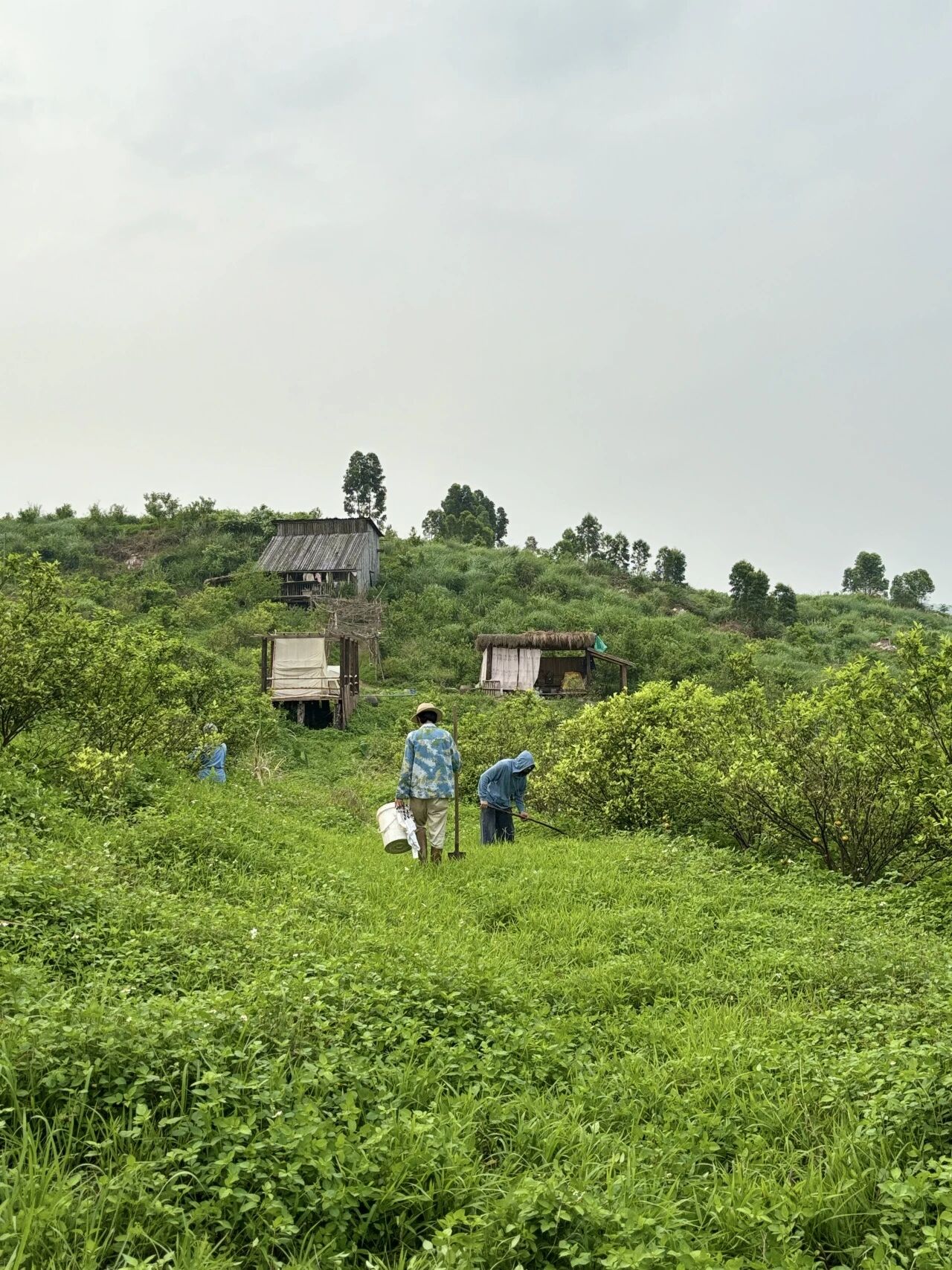
But the ideal of ecological restoration often has to yield to the practical pressures of farm revenue. Organic yields frequently fall short of conventional ones, and moreover, many ecological farms were established on “sick land”—soils polluted or depleted by chemical agriculture—that require a longer time to recover. Some farms have opted for more directly effective weeding methods, even at the cost of greater labour and resources. Sister Yuhu of Guiling Farm in Dali believes that ecological farms relying solely on these methods have not truly broken free from conventional agriculture’s mindset, and nature’s own restorative potential has not been trusted or activated.
If we fix our gaze on yield alone, we miss ecological agriculture’s “infinite storehouse”: sustainability and resilience—meaning crops that can better withstand adverse natural conditions. At Guiling Farm in Dali, the spacing between rose bushes is considerably wider than at most farms, with other fruit trees, shrubs, and the like intercropped among them, and weeds growing without any restraint. But do not look down on these weeds: parting the lush stems and vines, you find a layer of dead branches, fallen leaves, and humus threaded with mycelium, tenderly guarding the topsoil. Brown, soft, damp, fresh—a blended sensory rush greets you all at once.

Sister Yuhu recalls that when Dali endured consecutive droughts, other farms’ rose gardens suffered heavy losses, while Guiling Farm’s plants weathered the ordeal. Equally astonishing to other farmers is that the pests which rampage through their fields are barely to be found here. It is the biodiversity fostered by the weed community that completes the food chain, preventing any single pest from holding a monopoly.
Ecological agriculture brings yet another surprise to our lives: the flavour of food. For consumers who have tasted ecological produce, this needs no elaboration. But standing on healthy land to taste its bounty offers an even more vivid and whole nourishment. Sister Yuhu casually plucked a few fruits from a plum tree and handed them to us. The sweet-sour, juicy pleasure made it hard to imagine the bitterness this tree must have tasted when it first took root on the farm. The tree had been picked up—discarded by its previous owners—and for the first two years its fruit was barely edible. Sister Yuhu decided to wait one more year; if it was still this bitter, she would simply dig it up. To her surprise, by the following year—perhaps after the farm’s soil and water had “detoxified” it—the fruit’s flavour had transformed dramatically. The patience of days gone by has wrought this day’s happy bond.

III. The Scope of “Not Weeding”
First, reduce the pursuit of intensification. If one does not insist on pushing single-plot yield and uniformity to the absolute extreme, a modest amount of weeds is no great harm. Guiling Farm has three small plots growing different rice varieties; when it comes to common weeds such as barnyard grass, Sister Yuhu simply says: no need to pull them. In effect, she has come to regard a moderate presence of barnyard grass as a member of the farmland system—growing as it pleases, without diminishing the rice harvest.
Second, give weeds somewhere else to be. Ecological farms growing grain crops at scale—for example, Lüwo Farm in Xi’an and Yuefeng Island in Kunshan—will opt to leave a season fallow, allowing the land to “replenish” itself with weeds that help restore soil fertility. For weeds and crops, for land and people alike, this is a chance to catch one’s breath and reconcile: by the next season, crop-rotation pressure eases, and the demands on fertilising and weeding both diminish. At Xiqing Farm in Beijing, strawberry beds are kept free of weeds, but crops such as Brassicaceae that attract insects are sown around the periphery, thereby enlisting the ecological pest-control function that weeds can provide.
Beyond time and space, the boundary between weeds and crops can also be blurred through varietal diversity. Yuefeng Island takes on the task of conserving heirloom varieties. Among the hundreds of rice varieties it holds, roughly twenty are propagated in rows, while around forty are conserved in small plots of about one square metre. These conservation plots require additional reinforcement with bamboo poles and twine, and bird netting and shade cloth are added as the season calls for it. Here, rice of widely differing temperaments has truly opened my eyes: early-maturing and late-maturing, tall-stemmed and short-stemmed, paddy rice and upland rice—the list goes on. In particular, some tall varieties have leaves drooping like matted hair, their panicles spreading at ease—on the vast majority of other rice fields, they would be dismissed as “wild rice” or “weedy rice” and pulled out.

IV. The Unknown Fate of “Invasive Alien Weeds”
Of all the weeds I have come across, the only one that resists my effort to set aside my preconceptions is Canadian goldenrod. Introduced to Shanghai and other areas in 1935 as an ornamental plant, it has gradually spread into the wild, propelled by its extraordinary reproductive capacity and its tolerance of barren soil. At Lexiangu Farm in Fengxian, Shanghai, several idle plots have, within just a few years, become the domain of this invasive alien plant. Plants standing well over a person’s height, their stems already woody, surge in dense, frantic thickets; their allelopathy smothers every neighbouring herb in the cradle, making them a veritable fascist of the plant world. Every year, Teacher Yuan Qinghua brings people in to cut them down before flowering, but such measures can only temporarily hold back its onslaught.

For those few days, our main task was weeding. The mower could manage only the low-lying grass; the thick stands of Canadian goldenrod all had to be cut by hand, with sickles or chainsaws. Teacher Yuan patiently corrected the fine details of my technique, and as I gradually grew more skillful, a single sweep of the blade and a whole row of plants toppled in an instant. A battle spirit rose unbidden, indifferent to the drenching sweat and utter exhaustion, driving me to press ever deeper into the waste ground, stepping over broken stems without pause. This is a more absolute us-versus-them dynamic than in conventional agriculture: practical production needs elevated into a moral mission.
My experience is no isolated case. In our discussions, even those who hope to weed less or not at all find it hard to avoid a measure of hostility toward the noxious weeds. This perhaps rests on a principle like this: life that operates on reciprocity and tolerance can share space; life that operates on aggression and exclusivity must be checked. And so, rooting out noxious weeds is the “necessary evil” of improving the agricultural ecology.
“Invasive alien weeds” are not only a question between humanity and nature; they also carry the imprint of human activity. First, from the early colonial era to the present age of globalisation, human migration and territorial expansion have let certain species hitch a ride. Second, the regions where invasive weeds do the most damage are often also lands significantly disrupted by large-scale cultivation, chemical agriculture, and industrial and urban construction. The weakening of native ecosystems has, in effect, cleared away what were already limited competitors and natural enemies for the newcomers.
Even understanding all this, we can only accept the fact that Canadian goldenrod has come to this land, and no one can predict what its future fate will be. Perhaps native weeds can be enlisted to compete with it; perhaps new natural enemies will turn up to deal with it; perhaps humans will yet find a new use for it. But that takes time, and in the meantime, local people and other species will inevitably suffer. The one thing that is certain is that, on this land that humans keep disturbing, it is unlikely to simply disappear.
Perhaps the three-leaf beggar-ticks, which arrived earlier, can give us a little more confidence. Ecologically speaking, it is not a good successional species, but it does, in practice, help repair disturbed and polluted land, and through its many uses it has worked its way into people’s daily lives. In Stone City, Lijiang, Yunnan, it has embedded itself in the local knowledge system of the Naxi people just as its native close relatives have, thanks to its wide range of uses (medicinal, fodder); its Naxi name makes it hard to recall its invasive origins. At Sister Yanping’s Baicaoyuan, beggar-ticks have even made it onto the table as a wild vegetable. It turns out that traditional agricultural communities and ecological farmers have not drawn a mechanical boundary between native and alien species, nor have they elevated so-called “noxious weeds” into an us-versus-them matter. These weeds bring trouble, yes, but there is room for transformation: at the very least, you can eat them.

After a long circuit, “thinking” has come full circle back to “eating.” As the anthropologist Annamarie Moore has shown, the relationships of eating and feeding shape the fundamental bonds between the lives of different species. Humans feed both crops and weeds at the same time, but in opposite ways; and they eat them in opposite ways as well. After all, no finite life is self-sufficient—whether grass or human, in the end we must learn to coexist with other lives in our environment, giving and taking from one another. When the farm’s sheep happily accepted a meal of Canadian goldenrod, my prejudice against this weed diminished a little.
