
A Better Life, and a Farewell | Grandma Kouzi
Having weathered stretches of stifling sorrow and gloom, I understand all the more how vital joy, happiness, and clear skies truly are. Life is hard — we owe it to ourselves to create joyful, happy, sunlit days.
I. Creating Joy and Happiness
Expanding the wild ginger lily patch: two rooted seedlings per set, spaced forty centimetres apart, with a budding rhizome tucked in between. Forget whatever they say about “single-plant spacing, one metre apart” — wild ginger lily is vigorous, thrives in the thick, and doesn’t mind being crowded. This is the fastest route to a proper flower wall.

The seedlings at Eren Gu are my own — no money to spend, as many as I care to take. Who would I be saving them up for, hoarding and stashing them away?

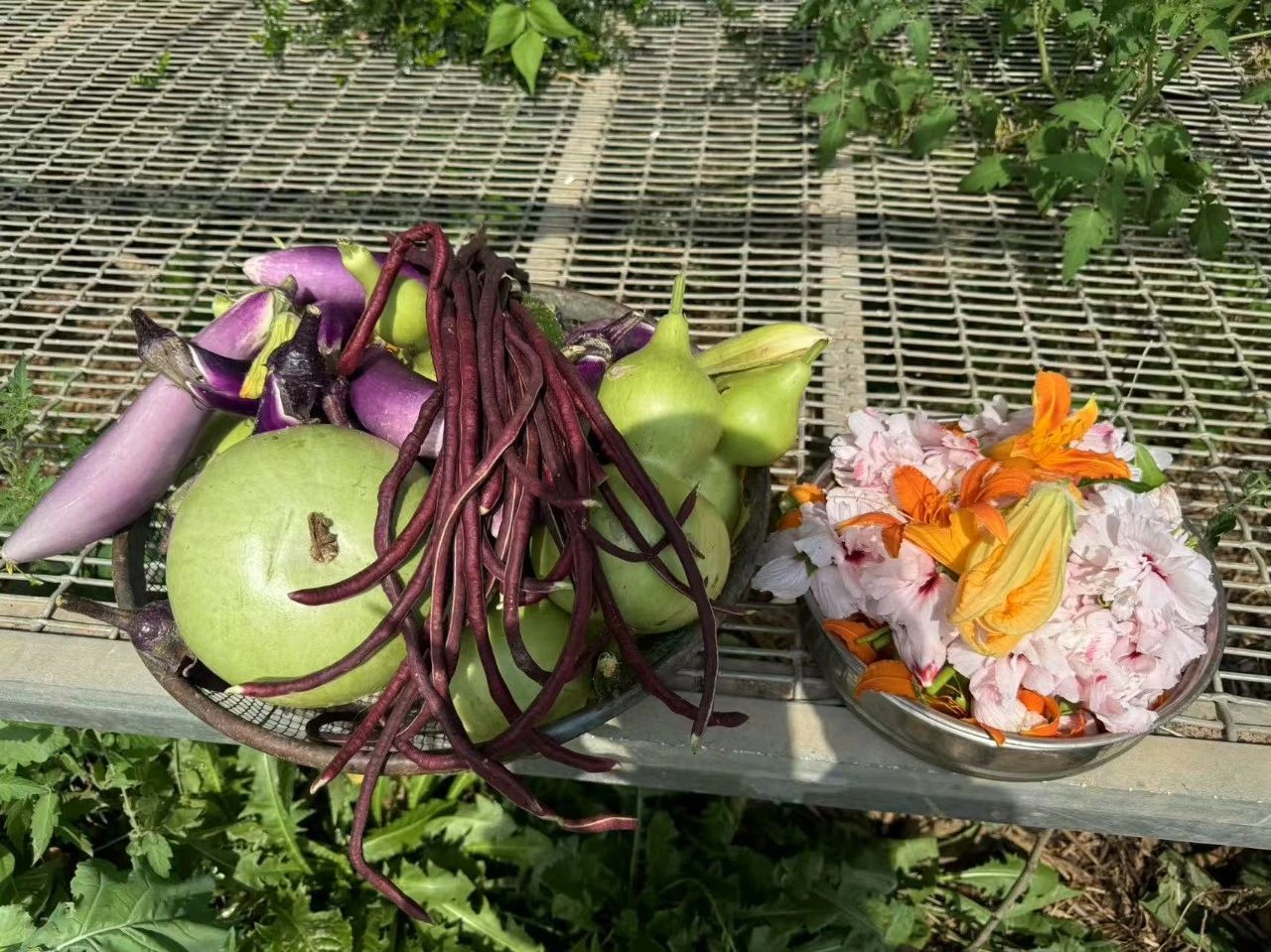
The long beans have just hit peak season — the very “bean nubs” that gave children from the four heartland provinces a lifelong taste aversion. I love growing purple long beans; they are high in anthocyanin.
At Eren Gu we don’t stir-fry; we boil them plain, and they have a faint natural sweetness. This way of eating works only for homegrown ones — store-bought beans boiled this way are barely palatable.
Boiling long beans isn’t about going as tender as possible, nor too old. The seeds have started to firm up, but the pod as a whole hasn’t been stripped of its flesh; it is still tight and substantial, sweet on the bite, with a slightly starchy, creamy texture on the tongue.
When long beans come in by the armful, the eating pressure builds, and you can easily eat until you’re stuffed. Halfway through, the light bulb goes on: why not just pick out the middle sections?
Once you work that out, it is like opening up the Ren and Du meridians — the lives of the bean-eating populace suddenly become blissful. I cleared the field myself, I planted the beans myself; I can eat as much as I want. Who would I be saving them for?
Picking through, eating only the best bits, consuming a fraction and discarding most. The leftovers pile up in a basin.

When it comes to eggs, there are always various so-called experts wagging their fingers, telling you eggs are good but you mustn’t have too many — no more than two a day. What about a meatless foodie who has built a habit of two per meal? Can’t argue the experts out of it, so skip eggs at lunch and have duck eggs instead — and I have plenty of those too.
Those so-called dietary guideline recommendations and standards are calibrated for people who sit more than they move, eat refined carbohydrates, and go over on sugar and oil. The farmer at Eren Gu gets plenty of exercise on top of daily farm work, the ingredients are clean, and the cooking is simple — little oil, little salt. Eat as much as you like, however you like.
Putting it in Kant’s words, “Freedom is being able to not do what you don’t want to do.” For me, that means rejecting other people’s standards. Not taking others’ standards as my own, I can have not only joyful, happy, sunlit days but also good health.
I am not making this up — the evidence is there. At my last health check-up, the centre had added a whole row of consultation rooms, staffed by retired traditional Chinese medicine practitioners brought back to sit and see patients. Picking up my results, I was practically ushered in by the receptionist; my age bracket was their prime target demographic. Even without any organic pathology, between neurasthenia, qi and blood deficiency, spleen–stomach disharmony, and endocrine dysregulation, one of them has to apply. Imported high-tech treatments, proprietary patent Chinese medicines, the latest miracle supplements — one of them will suit you. Nobody leaves empty-handed. That day I was the exception. After a full round of observation, listening, questioning, and pulse-taking, the expert slapped my health report and sent me on my way: “You can eat, you can go to the toilet, you can sleep, you can run — what are you doing here causing trouble?”
Framed! Shoved in here against my will, I swear to my cholesterol I did not mean to cause trouble.
II. So-Called Heaven’s Mandate Is Merely the Instinct to Cling to Life and Dread Death
The death side was simple: I signed a body-donation agreement with the Red Cross. All I had to do was sign; the rest was none of my concern.
The life side was a bit more complicated. I paid an entry fee and signed up for my first-ever half marathon. The trouble was not the fee or the registration — it was having to start running from that day on.
Worse, my body was in terrible shape at the time: severe depression, a collapsed immune system, a cold that turned into a persistent low-grade fever and cough lasting over two months.
Life and death are weighty matters. In the nadir of body and mind, I seriously wrestled with the question, “To be, or not to be.” These days I admire Cai Lei; back then it was Hawking. I was certain I could never be as strong as they were. If illness had a grip on my throat, I would have given up — chosen the easier way out.
After every treatment failed, I turned down every suggestion, TCM and Western medicine alike. I brewed my own herbal blend as tea and kept running — coughing, wheezing, all at once.
I decided I was not going to trust the doctors; I would try to treat myself. Running was my last gamble. If it did not work, I would end it myself.
What I feared then was not death — it was living. Terrified of a life worse than death.
I had never done any structured exercise before fifty. Running started on my birthday. Better to trust yourself than anyone else.
Three months later I finished my first half marathon. Addicted from that day on — ten years and counting.
What I love is not running — it is being properly alive.

III. Fear of Death
In fact, on my fiftieth birthday there was one more troublesome thing. I wanted to use my body-donation agreement as a springboard to talk to my parents about life and death, but it never came to that. That was my last attempt. They dodged the topic, and I stopped pushing.
But you can dodge the conversation about life and death — you cannot dodge life and death themselves.
Dad passed away at ninety-three, Mum at eighty-eight — both long lives. My siblings and I took shifts for ten years, providing round-the-clock care. Before they went into the ICU, they could still walk on their own and eat independently. No pressure sores. Without the ICU, it would have been a natural death in one’s own bed. But there is no “if.” Their last days were spent in the ICU — Dad for four, Mum for forty-four.
By the time Dad was lifted onto the 120 ambulance, he was unresponsive, but his hand gripped his waistband tightly — his trousers were only half pulled up.
At the ICU entrance, there was a standard consent form to sign first, mentioning that cardiopulmonary resuscitation (CPR) could cause rib fractures and so on. I was not brave enough. I sidestepped and let my eldest sister sign.
The doctor first told us Dad had suffered brain death and that we should go sort out the paperwork. Then, while we were still hunting for documents, he came back: CPR had restored a heartbeat. Dad was in a vegetative state.
The ICU was already under closed management, and during the pandemic all visiting was banned. Everything depended on a phone call from the doctor. My number was on the admission paperwork, and every day in the small hours I would get the doctor’s call with the routine update on treatment. At one in the morning on the fourth day, the news: bowel obstruction, enema ineffective, a cardiac arrest had just occurred. They wanted me to discuss with family whether to continue resuscitation if his heart stopped again.
I said no need to discuss — let go. I have never forgotten the image of Dad’s hand clutching his trousers. His consciousness was fading, but that last flicker of shame would not release him. I feared those words — “CPR may cause rib fractures.” I prayed that brain death meant no more pain, prayed he would not be captured by pain.
Mum spent longer in the ICU — forty-four days. She was covered in tubes: a breathing tube for air, a nasogastric tube for food and water, a urinary catheter, plus lines for blood sugar, blood pressure, heart rate, and more. Eight drugs running simultaneously — anti-inflammatory, anti-fungal, antipyretic, vasopressor, sedative, hypoglycaemic, cardiac stimulant, diuretic… The people in an advanced life support system are the human batteries of The Matrix.
In this system, being unclothed is standard. Every garment gets in the way of a procedure. The clothes humans wear for modesty and warmth were never designed for the ICU.
I began to feel a terrible gratitude for Dad’s brain death. When Mum first entered the ICU she was still conscious — she felt pain, she felt shame — she just could not speak with the tube in her mouth, could not respond with her body strapped down by equipment.
I was terrified of this way of dying. Checking Foodthink’s posting history, the last piece was already many months old. The first time I had been silent this long.
It did not stop me from working, from farming, from running and swimming. It was just that I could not gather my mind for clear thinking and expression. I kept going back and forth on paper and on screen, piling up the details of my parents’ final days, trying again and again to write a WeChat post, and never managing it.
IV. Refusing a Bad Death
We had once signed a document specifying no ICU admission and no aggressive treatment, making clear that our goal was to reduce suffering. The next day at midday, a nasogastric tube was inserted to deal with her inability to feed herself. This was standard hospital procedure; we did not consider it a traumatic intervention and did not object.
Only after the tubes began did I learn that in the medical system, external support is a system — once you start, everything that follows is bound to come.
Once the tubes were in, they had to be secured against removal, so sedatives began — essentially an induced coma. In a coma, one cannot pass stool independently, so a urinary catheter goes in. Mum’s oxygen saturation was already on the low side, with continuous supplemental oxygen; once comatose, the nasal cannula was not delivering enough, so a breathing tube went in, and a breathing tube means ICU… Every step had a fully sufficient and necessary reason — to treat illness and save a life. And so, at her advanced age, Mum could not have a natural death in one’s own bed with family at her side. Instead, she was sent to the ICU, and it was not a good death.
Before the tubes, Mum’s bowel and bladder function was normal and mostly under her control. The night before the tubes went in, she had three bowel movements, all in bed, each one very large, but clearly not diarrhoea. For the first two, Mum was still conscious; by the third, she barely responded. From then on, she was rarely awake.
This was the body signalling its farewell. When a person is nearing death, not eating, emptying out — this is the body’s life instinct. In the final moments, no food, no drink, the body fills with ketones, and it brings a sense of ease. I have read many books on near-death experiences; they all say dying is not painful, that there is comfort, a rising toward a place of light. This feeling must be the last gift received on this journey of life.
Life comes and goes with its own logic, but a hospital operates on the logic of saving lives. The advanced life support system in the ICU blocked this process and confiscated that gift.
The tearing between medical equipment and the natural order, blocking life’s natural departure, stripping away dignity and autonomy — that is a bad death. I am afraid of this way of dying. Terrified.
I want my passing to be smoother. I will say it directly: my plan is to sign an advance directive, specifically declaring that I waive cardiopulmonary resuscitation (CPR), waive the use of a ventilator, waive oesophageal feeding, and will not go into the ICU.
While I still have clarity, while I can still make choices, I want to fight for the right to die naturally. Everyone must die. The last freedom of this life is to refuse, for yourself, a way of dying you do not want — to refuse a bad death.
V. I Deserve a Better Life
In the process of writing, I accidentally deleted some of the passages about my parents. I did not try to recover them. I took it for a quiet act of Providence — heaven’s will telling me to let go.
Signing the advance directive is for a “good death.” Every day before that, I will fight for a “good life.”
Though I have no wish to endure the enormous suffering Cai Lei or Hawking did for the meaning of life, I will put in the effort for a life that is both meaningful and enjoyable. Joyful, happy, sunlit days — I deserve to have them.
This cling-to-life, dread-death soul of mine has specific, small-scale cravings for life here on earth, like a craving for good food. Having been drilled since childhood that one must not be “a well-fed lazybones,” my goal now, being self-sufficient, is more fruit and small grains — a full shift from “able to eat” to “eating well.”


Eren Gu has added some small improvements — beautifying the living environment, boosting the happiness index. Creating a waterside flower border is part of it, as are small craft projects, like this reading stand. Boiled long beans are healthy and good to eat, but too fiddly by hand. The reading stand frees both hands — you can read and shell beans at the same time, good to eat and good to look at.

I also got some fitness equipment and started learning strength training. Not aiming for an impossible physique — the goal is to keep muscle, slow down the loss. A person needs muscle to command their own body; no amount of other effort will improve the quality of life without it.

Ten years ago, to talk me out of running a marathon, Dad went online and searched “sudden death during a marathon.” He told me about an eighty-four-year-old American grandma who finished a marathon in the morning and was dead by the afternoon.
Mum, who does not use the internet, chimed in: as long as you do not run marathons, you will be fine.
I was thrilled at the prospect: a dashing run in the morning, a clean, swift departure to heaven in the afternoon — pure fortune earned over several lifetimes.
Dying like Marathon Grandma became my life goal from that moment. Though I know full well that praying to others is less reliable than relying on myself, this runner, swimmer, sunny-day farmer, rainy-day reader, well-fed lazybones that I am still cannot help but beg the Buddha, Jesus, Allah, the Jade Emperor, Grandma Taishan, and all the gods and spirits of heaven to bless this lifetime’s cultivation, that I may create joyful, happy, sunlit days, and also enjoy a natural, clean, and decisive farewell.

All images, unless otherwise noted, are by the author.
Editor: Xiao Dan