
Growing Bananas in a Brazilian “Forest”
I. A Journey That Began with Bananas
It is much the same with my work on the agroforestry farm in Brazil: in this high-density system of interplanted crops, you must not only understand the plants themselves but also develop a deep, embodied sense of where each type of plant sits within the whole ecosystem. Grasping how the plants move and interact has added so much joy to my work that I find myself perpetually absorbed in wonder at the natural world.
My interest in ecological agriculture comes from two directions. One is the subject matter that preoccupied me during my graduate studies in philosophy — colonialism, capitalism, ways of life, and the meaning of existence. The other is that ecological agriculture fulfils me at the level of daily living: it guarantees plenty of physical activity and wholesome food. After nearly a year travelling through farms in Kenya, Tanzania, South Africa, and Brazil, I have now arrived in Yunnan, eager to put my knowledge and skills into practice on this stretch of Chinese land.
II. The Banana Farm That Became a Forest
Louis is my second farm host in Brazil. His farm sits in a small village on the edge of the Atlantic Forest in Paraná state. This stretch of tropical rainforest lies in the south-east, near the borders of Argentina and Uruguay, and is the most species-rich region on Earth — yet its ecology has been severely damaged by the large-scale monoculture plantations of the colonial era. After taking over this century-old farm from his grandfather, he has spent sixteen years, step by step, transforming what was once a banana plantation into an agroforestry farm. Bananas have naturally become the key crop here.
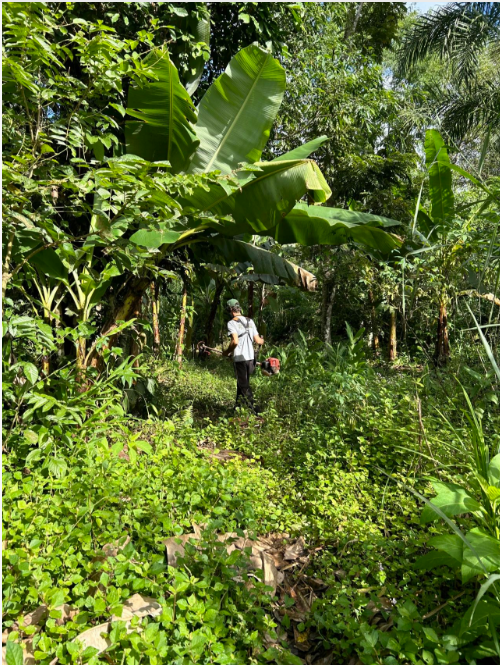
The agroforestry system Louis practices is formally called Syntropic Agroforestry — an ecologically restorative method of intercropping that, through multi-layered planting, mimics the succession process of a natural forest. Indigenous peoples of the Americas, as well as many other regions including the southwest of China, have long held such traditional planting wisdom. Over the past few decades, scientists have begun to take notice of and explore this traditional model — one that runs counter to the logic of industrialised agriculture yet is both ecologically sound and capable of abundant food production — validating and refining it from a scientific standpoint and inspiring many farmers to change course.
On the morning of our second day at Louis’s farm, we strapped on our machetes, loaded our tools into the handcart, and set off to work deep in the woodland.
Though the word “farm” naturally conjures images of large-scale monoculture — wheat, maize, and the like — the scene here is entirely different. Passing through the small wooden hut Louis spent seven years building, the farm entrance is alive with plants of a magical air, and century-old trees stand on either side. Along the way, tropical foliage surges in from both sides, clear streams babble past, and birds, flowers, and butterflies flit about, playfully leading the way.
Reaching the entrance to the first planting area, the view opens up at once. Enormous banana leaves and a jumble of tropical plants of varying heights fill the sight; dew-soaked wild grasses sweep past my ankles, and countless insects hover in the humid air. I feel myself tightly cradled in the green of this rainforest.
This is the first time I have truly seen what a mature agroforestry system looks like. Among the banana trees, each more than three metres tall, are cacao seedlings growing to calf height, turmeric and taro leaves reaching waist height, and plants of Mexican sunflower tall enough to reach the top of my head.
The broad leaves of the banana trees provide shade for the cacao or coffee below, while the trimmed leaves and trunks offer a mulch layer on the soil surface, suppressing weeds, retaining moisture, and returning nutrients to the topsoil. Turmeric repels pests, and together with the leaves of taro, it helps keep the soil warm and moist. Mexican sunflower, meanwhile, is a common “service plant,” subjected to “chop and drop,” becoming green manure that supplies nitrogen, phosphorus, and potassium.
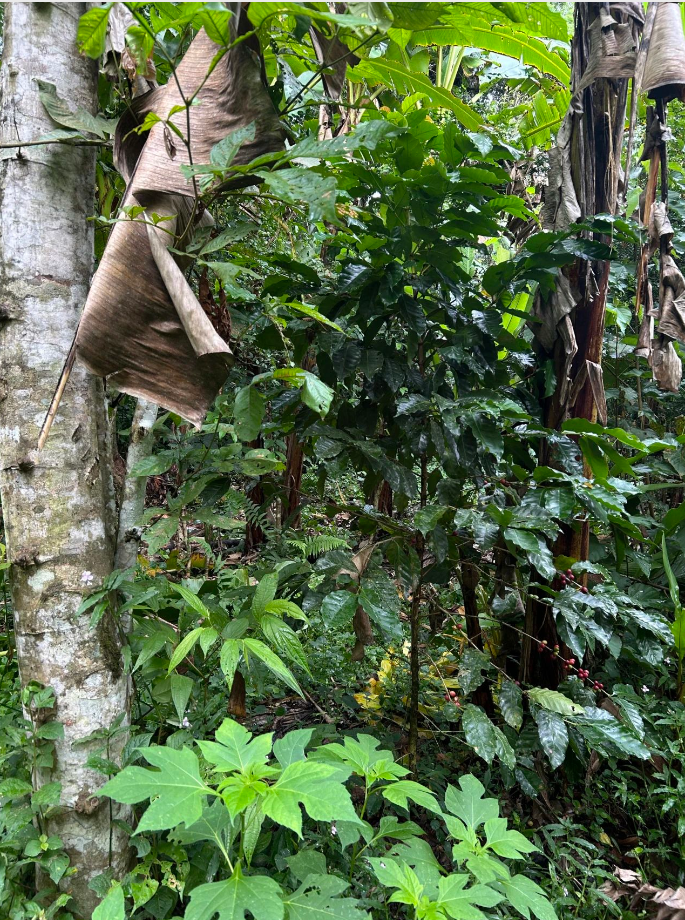
The farm also has planting areas at the sixteen-year, ten-year, five-year, three-year, one-year, and several-months stages, growing coffee, avocado, papaya, mandarin, cajamanga, and other crops… I feel so fortunate to be able to see agroforestry farms at all their different stages in one place. The earliest stage is essentially a mixed kitchen garden, called a horta in Portuguese. The three-year and five-year banana groves alone were enough to take my breath away; in the ten-year and older stands, unless you look carefully at the rows of fruit trees between the larger trees (called a canteiro in Portuguese), you would hardly recognise it as a cultivated woodland.
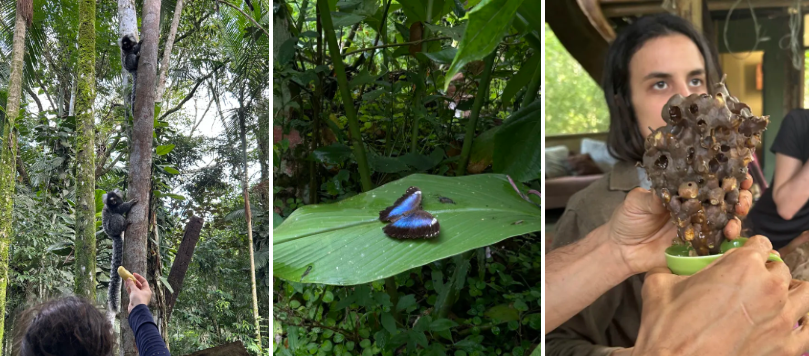
When it rains, you can spot five or six differently coloured species of birds sheltering under a single coffee tree. These native plants and animals (woolly monkeys, frogs, lizards, large numbers of wild birds, bees, butterflies…) together form a complex, diverse ecological community, assisting with pollination and pest control; their droppings enrich the soil, helping the vegetation grow more healthily and resiliently.
III. Working in the Forest
First comes clearing the banana leaves. For leaves that have already turned yellow, we cut them down along the midrib, then slice both halves of the leaf blade away from the petiole and chop them up. Leaves that have drooped and rotted to a soft mush are much harder to cut through; you can only patiently slice them away, otherwise the rotting juice will splatter from the squishy petiole and leave indelible brown marks on your skin.
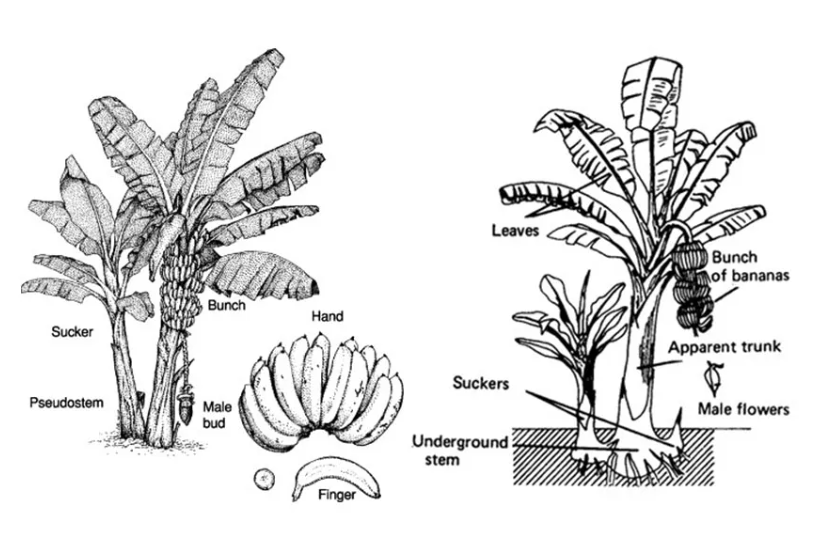
Beyond the leaves, the entire banana “trunk” is also felled. In fact, the banana is a herbaceous plant — what we see as the “trunk” of each banana “tree” is actually layer upon layer of tightly wrapped leaf sheaths (the “pseudostem”). Once the fruit has been harvested, this plant will no longer bear any more. So at harvest time, we cut the whole thing down to use as root mulch and green manure.
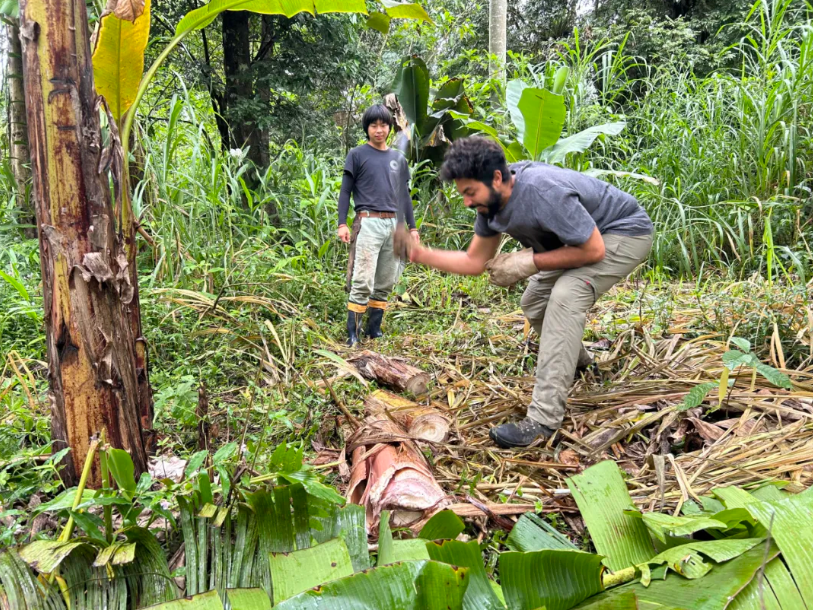
This is work that tests your technique as much as your strength. To “fell” a banana tree, you first have to control the direction of its fall so as not to crush the surrounding plants. Louis showed me how to cut a triangular notch at the mid-height of the pseudostem; push the upper section and it will naturally and slowly tip toward the gap, while the bunches of bananas still hanging on will not slam to the ground all at once.
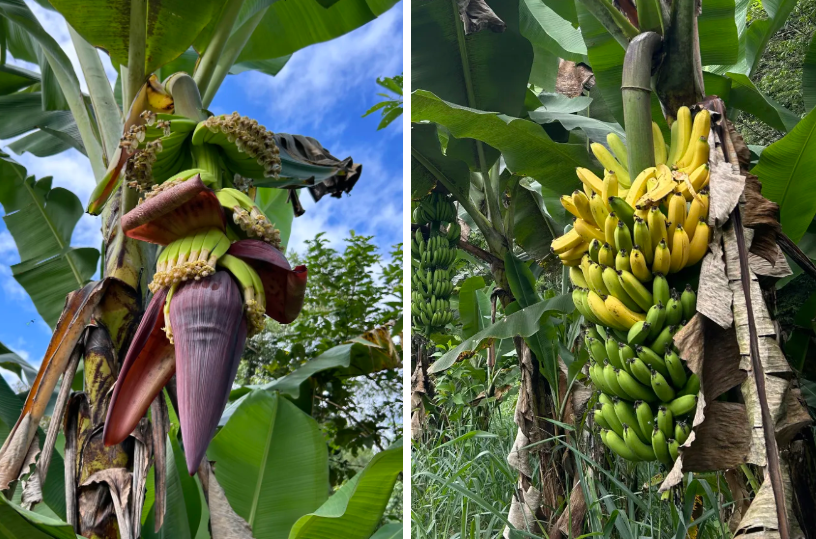
Once the trunk is down, we cut the yellowed, ripe fruit for eating and leave the unripe green bananas. The flower on the bunch, before it is removed, serves as a nectar source for hummingbirds; once taken off, it becomes a Brazilian stew.
Processing the lower part of the trunk is the most labour-intensive: the cut must be as close to the base as possible to ensure no new shoots emerge from the wound; the cut surface should form a bowl shape as far as possible, so that water can collect in the “bowl bottom” and prevent banana stem borers from entering the corm and infecting other plants. We watch and learn from Louis’s technique — he first drives the flat of the machete into the centre of the trunk, then makes push-cuts at 45 degrees to the upper left and upper right; he repeats the same on the other side, then pushes the trunk over, and the cut surface naturally forms a bowl.
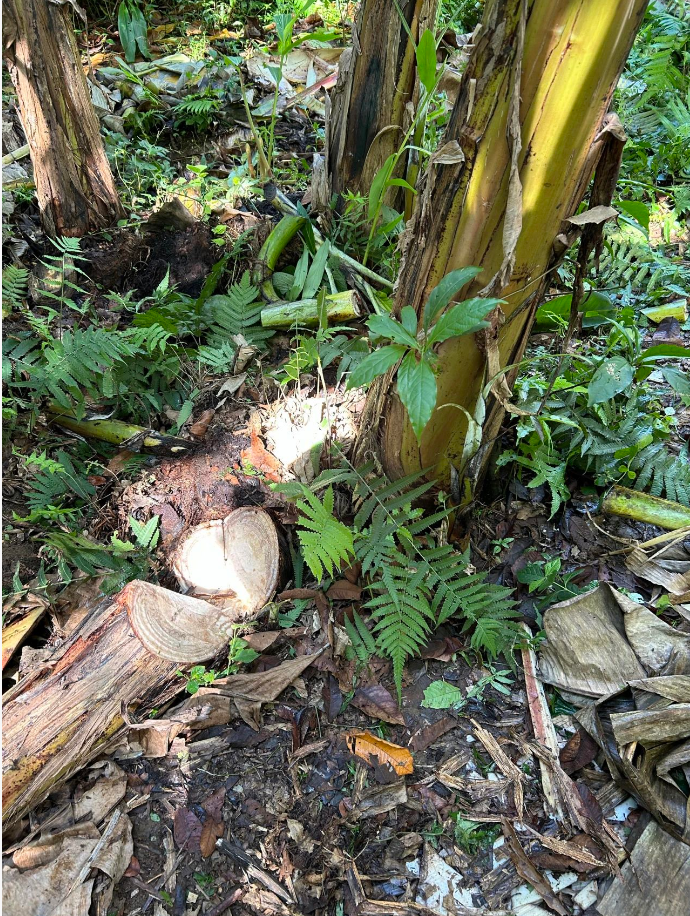
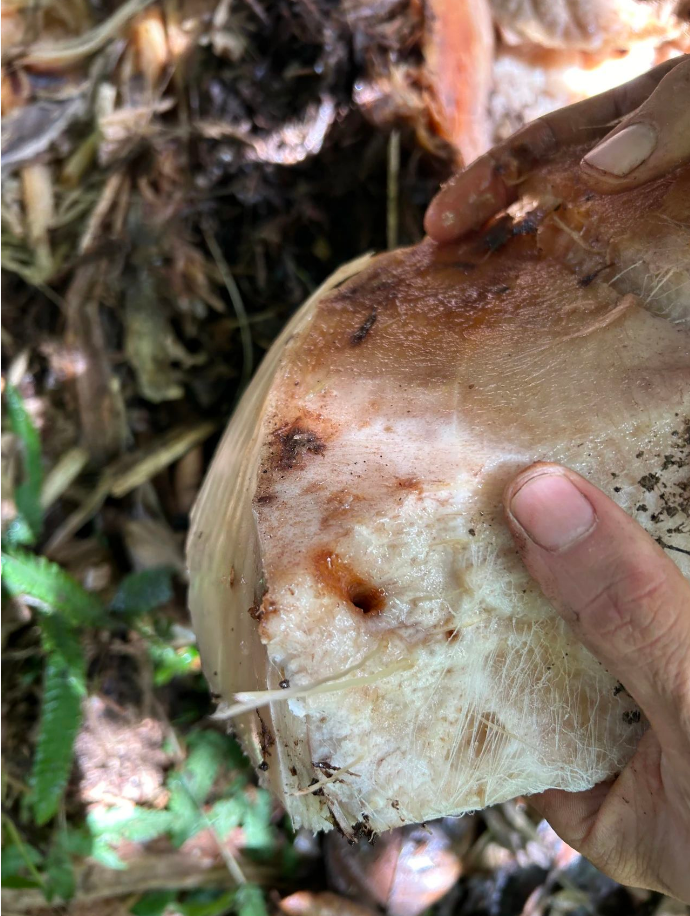
The cut leaves and trunk make excellent mulch: they suppress weeds, decompose quickly, and return nutrients to the soil. Sometimes the trunk is too thick, and after felling it needs to be split in half down the middle. This allows it to rot faster when used as mulch and also prevents it from rolling over and crushing the seedlings.
The other volunteers and I handled our machetes with great care, dreading the moment we might cut ourselves — first a single stroke from the middle of the cross-section, then one hand on the handle, one foot pressing down on the blade tip, sliding it through, somewhat clumsily segmenting the trunk. Louis, by contrast, moved like a seasoned warrior: several clean cuts, each landing precisely on the centreline, and the trunk split cleanly in two.
Finally, to ensure the bananas grow healthily with sufficient nutrients, we also need to remove the “excess” banana suckers — that is, sucker removal. This is because banana suckers typically coexist in “families,” sharing a single corm — which is the banana’s true stem. Although the cycle from growth to harvest is typically one year, roughly every six months a few new shoots emerge from the sides of the corm. Brazilians affectionately call this shared corm a “cradle (berço)” and, according to their order of emergence, name the suckers in the same family “grandfather,” “father,” “son,” “grandson”… When carrying out sucker removal, we select the best-conditioned plant from each of the three generations in every “family” and cut away the weaker ones.
In a setting so rich in biodiversity, once you have developed an understanding of the various life forms around you and the relationships between them, I feel even more acutely that “I” am a part of nature — bearing a share of responsibility in this environment (in a way, no different from a bee) — rather than existing as a master, directing and lashing other living beings.
IV. So There Are So Many Kinds of Banana
In this woodland on Louis’s farm, the bananas hang from their bunches large and plump, heavy clusters that seem eager to leap off the trees.
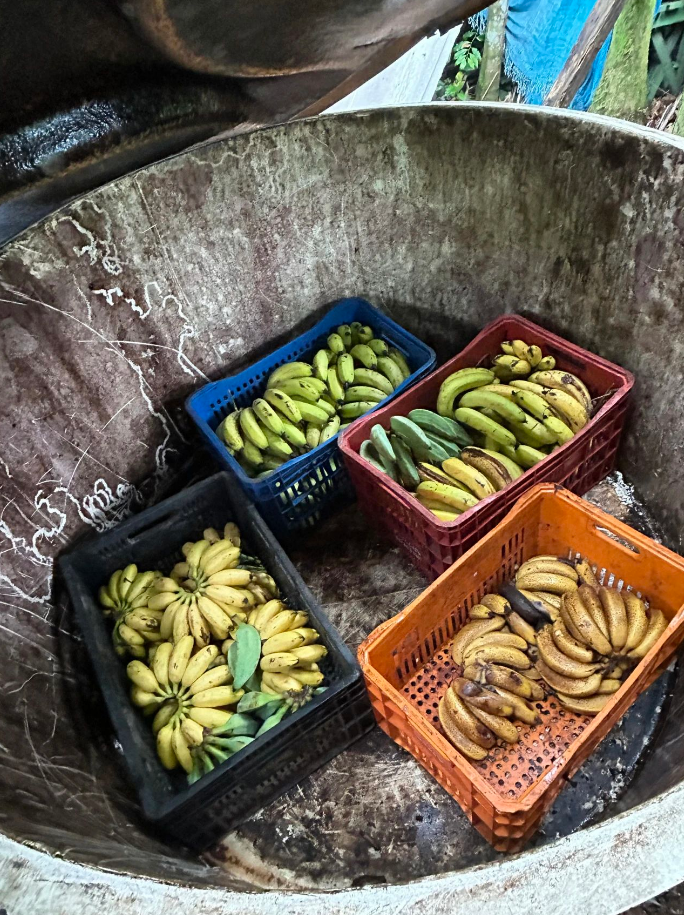
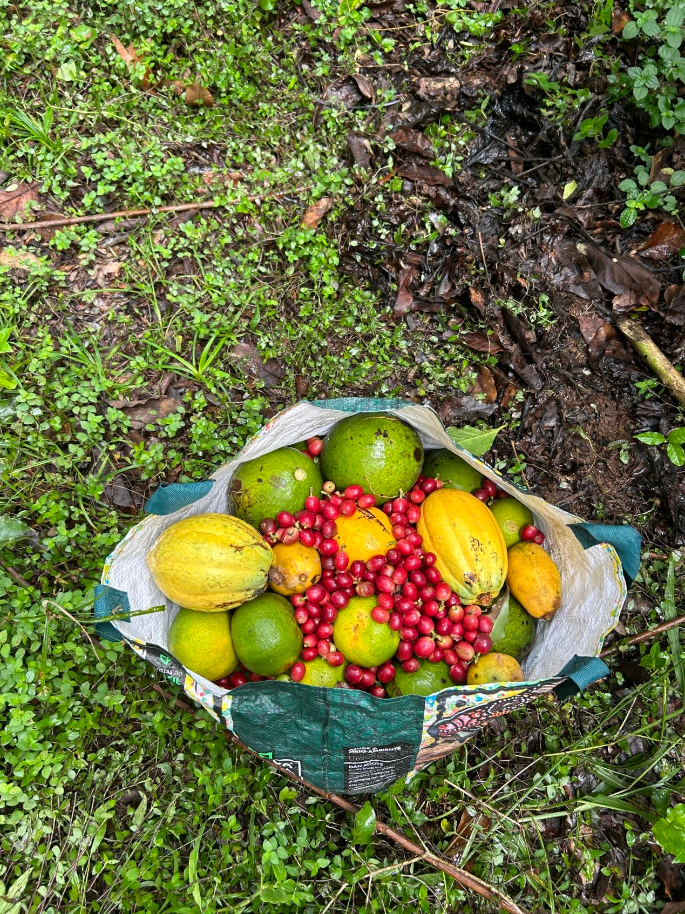
I have slowly come to love this fruit. Louis’s banana grove grows some twenty varieties; my two favourites are the Golden Banana (Ouro) — short fruits whose sweet fragrance blooms slowly in the mouth, like a soft light coming on — and the Silver Banana (Prata) — long and slender, with a distinctive tangy-sweet aroma that slides down the throat as you chew, the flavour shifting and evolving as if passing through a winding tunnel.
There are also the Apple Banana (Maçã), Nancia banana, Banana da Terra, and more, and each of these can be further divided into several subtypes. It is said that, taken across the whole world, there are over a thousand varieties of banana in all!
“Banana da Terra” appears as a staple food in both Africa and Brazil. The ones I saw in a Kenyan supermarket could be as long as a forearm; if you thought you had struck a bargain and went to eat one raw, your expression would probably have been as bitter as mine was at the time. Unlike the familiar fruit bananas, this crop — called matoke in Swahili — is a common staple in East Africa, typically boiled in a stew, with a flavour something like a potato.
In Brazil, the “Banana da Terra” is a little starchy and astringent — like chewing raw flour — but sweeter. People usually pan-fry it in butter and top it with a layer of Farofa (a common Brazilian toasted cassava flour), served as breakfast or an after-meal sweet. On Louis’s farm, the bananas are also turned into a more easily stored jarred syrup — called banamel, a banana honey — for spreading on bread or diluting in water. Elsewhere, bananas are made into convenient fruit pastes, dried fruit, and fruit wine.
Beyond their rich, sweet flavour, they offer an entirely new perspective: the cultivated bananas that humans first bred by crossbreeding wild bananas are now feeding roughly 500 million people.
V. Next Stop: Yunnan
Carrying these reflections, along with the gains from my year-long journey through ecological agriculture in Africa and Brazil, I have just returned to Yunnan, planning to gather more young people to work together on ecological agriculture, sustainable building, and nature communication.
Unless otherwise noted, all images in this article are provided by the author.
Editor: Pei Dan