The Anthropologist Who Sold Fish at a Wet Market | New Book Excerpt & Event Preview

Foodthink Says
Not long ago, in Foodthink’s “Chi Dian Hao De” story-collection feature, we received many fresh observations and shared stories about wet markets from all of you. So, what do wet markets mean in the eyes of an anthropologist?
To get a clearer view of the vitality and challenges facing China’s wet markets, anthropologist Shuru Zhong once became a “fishmonger”: on the island’s summer nights, wearing wellington boots and braving the fishy smell, she hauled fish and sold them, “embedding” herself in the bustling everyday life of wet market stallholders. She also set out from a fish stall in Hainan and went to more than 200 wet markets in over 50 cities across the country; with her feet and hands (and, of course, her taste buds), she experienced the flavour and freshness here, the toil and reward, the livelihood and trade, the human warmth and the rough-and-tumble world, the change and unease. These observations and reflections—centred on wet markets, on food spaces, social structures and the bustle of everyday human life—ultimately crystallised into her new book, Chinese Wet Markets.
For this issue’s new-book excerpt, let us follow Zhong back to the starting point of her fieldwork and share in the real, vibrant daily life in the wet market.

On the evening of 14 August 2026 in Shanghai and the evening of 22 August in Beijing, the publisher, Guangqi Shuju, will host book-sharing events for the new book; on the morning of 22 August, Zhong will also visit Beijing Organic Farmers’ Market, live-streaming as she strolls. Please see the preview at the end of this article for registration and booking.
*The content of this article is excerpted from the “Prologue” to Chinese Wet Markets, with thanks to the publisher, Guangqi Shuju, for authorisation.
It was a tropical summer night. A slight cool breeze had come up, but I felt the air growing stickier. The complex fishy smell of the wet market, mixed with sweat, had seeped into the fibres of my short-sleeved shirt, and no amount of washing would remove it. At 8 pm, having just finished a day of selling Spanish mackerel at Yefeng Market, I dragged my weary body on my way back to my rented flat. With every step, the water and sweat in my rubber wellington boots made a squelching sound.
I blended into the hurried flow of passers-by; no one would notice me. My clothes, together with the strong “market smell” clinging to me, made me a fishmonger in every sense at that moment. I suspected no one would know my real identity: I was, in fact, an anthropologist doing fieldwork in wet markets.
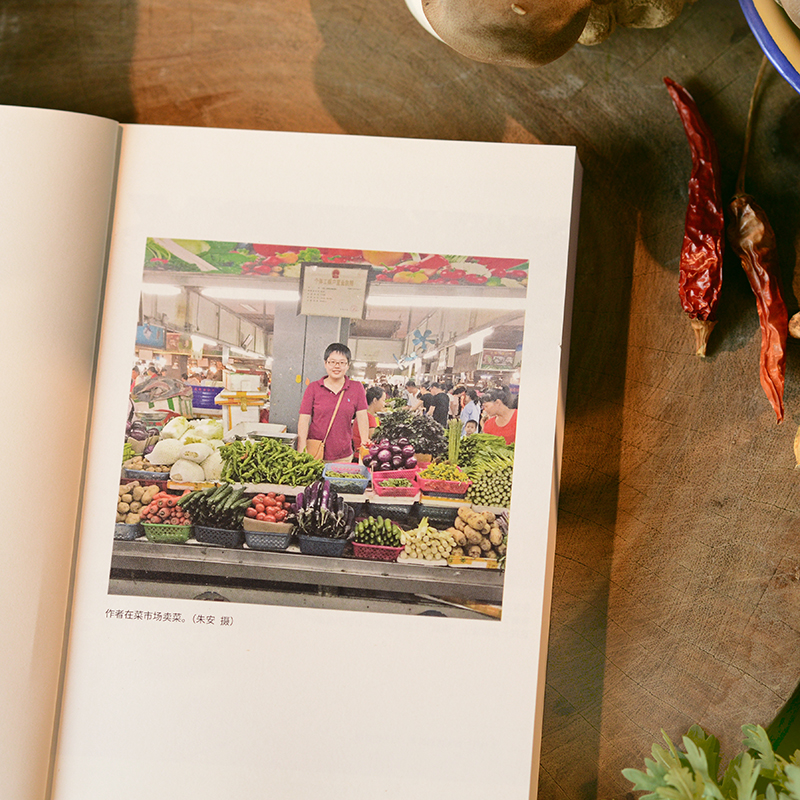
◉ The author selling vegetables at a wet market.
In June 2016, I had just completed the doctoral qualifying exam and had barely caught my breath when I flew from Texas, the United States, to Hainan, China, to begin fieldwork. I never expected to stay for 14 months. A close friend, Xiao Gua, offered to let me live at her home, which would help me save money. I was deeply touched, but I really did not want to cause her so much trouble for so long.
Y City in summer was scorching hot. I searched anxiously for a flat, and at a glance down the street everyone looked hurried. A newcomer, still feeling detached, I wished I could sprout an extra leg and walk fast enough to whip up a breeze, hiding myself and vanishing into the crowd. I had not realised before that there were so many handshake buildings tucked away in the city-centre streets. Local owners in Y City rented out whole buildings to agents from China’s north-east, who ran small guesthouses at 30 or 50 yuan a night. A few ran them themselves: their families lived on one floor, while the remaining five or six floors were each divided into several small single rooms of a dozen or so square metres, rented out for 700 to 1,000 yuan a month to members of the ant tribe who did manual work nearby.
I, too, became part of the ant tribe, trying to feel the city’s most mainstream pulse from my struggling status.
With Xiao Gua’s help, I eventually settled on a small room facing the street, with a balcony. Compared with the room I had first booked—a room on the second floor of a restaurant, steeped in cooking fumes and without sunlight—this place was genuinely hard to fault. Outside the window, I could reach out and touch a red sandalwood tree four or five storeys high; morning and evening it rustled in a duet with the sea breeze—though I later discovered that the tree also served as a shortcut for the rats to my room. I did not like the feeling of drifting, but, helplessly, my path of study had always kept me drifting about, and the year or more of fieldwork seemed to be nothing more than a transit stop. Even so, I still had to settle down and make a life.
My home was only a ten-minute walk from Y City’s largest wet market. A straight, tree-lined avenue led there; after a few street corners, you reached the market. That was also why I had decided to live there. Buying daily sundries was convenient too, with all kinds of shops around the market. For several days running, I worked like a worker ant, going back and forth and hauling the things I needed to survive. The tropical midday sun was fierce. A mop bucket, a washbasin and a reed mat were more than my two hands could manage; I had to stop every few steps and inch my way back home. Only after I had bought a single-burner stove and a wok, and connected a gas cylinder, did my mind gradually find its anchor. As long as I had a little kitchen where I could feed myself, I had energy. In the days that followed, in this kitchen that did not even have an extractor hood, I repeatedly put the theory of practice into practice. Seafood names are intricate; knowing them relies not only on written signs but also on smell, touch and taste to heighten synaesthesia, so that nothing is forgotten once it has passed through the belly. In the little kitchen, I cooked the flatfish given to me by wet market stallholder friends, and invented Spanish mackerel fish balls so fresh they made my eyebrows fall off. On the occasional evening when I gave myself a holiday, I would pick up two swimming crabs at the market and steam them plain; that was the snack for watching ball games. Old friends Liu You and Lin Li visited Y City; my little kitchen did not limit the standard of my hospitality in the slightest. To this day, they still often talk about the food we ate in Y City, especially the giant mantis shrimp with roe.
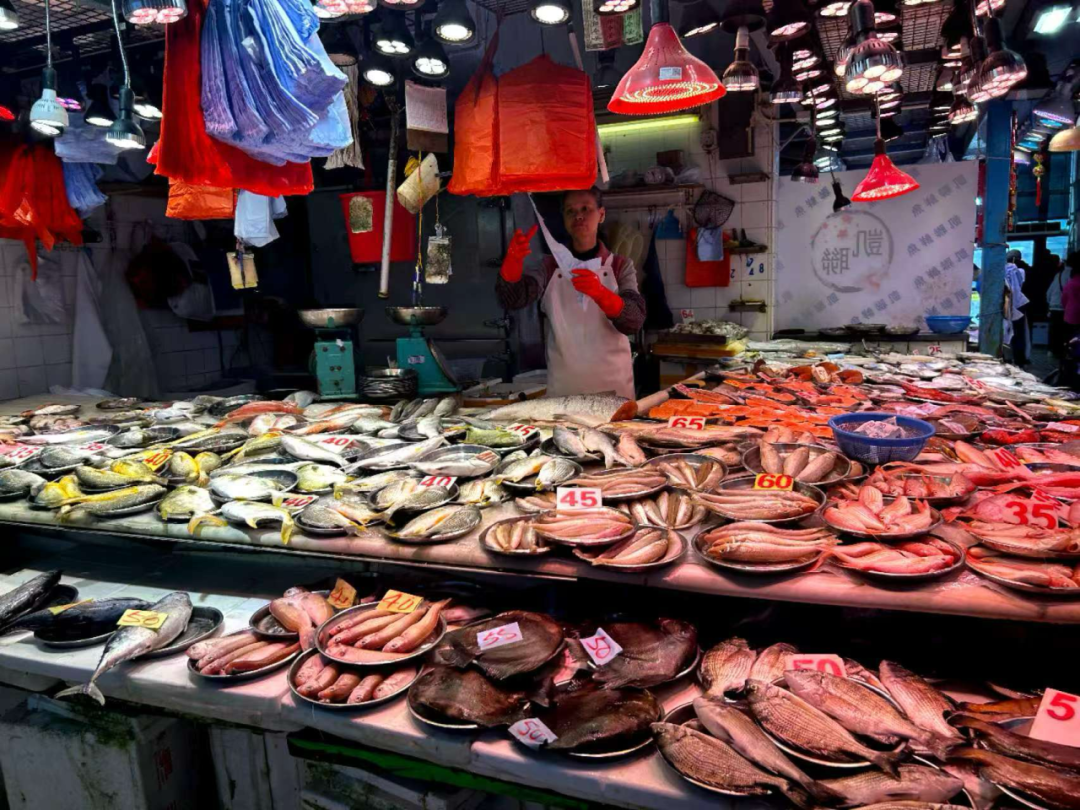
◉ Sea fish at Tai Po Market in Hong Kong in summer.
The landlord and his wife were local. They lived on the ground floor with their two daughters and had no regular jobs. The landlord also acted as caretaker and repairman for the whole building. The second floor, where I lived, somehow squeezed in four rooms; the passageway was dim, with standing water from washing clothes and cigarette butts carelessly thrown around. In the year and more I had been living there, I had only ever seen the occupant of the room next to mine.
The first wave were four young women who had come to Y City to work. They worked as waitresses in a nearby restaurant, which had rented the room as a staff dormitory; two double bunk beds were crammed into a dozen or so square metres, making it oppressively cramped. Their room had no outside window, so to get some air the door was often left open. Even without looking, I could often catch a glimpse of them lying on the beds and fiddling with their phones whenever they were in the room. One day, all four had disappeared; perhaps the restaurant had gone out of business too.
An auntie from Hunan who did odd jobs soon moved in. She was in her fifties and very kind, and we occasionally exchanged fruit. Because her son was ill and needed money, she was always looking everywhere for chances to earn. Her room was piled with scrap; scavenging was one of her sources of income. One day, she said her son’s condition had worsened and she needed to go back to her hometown; from then on she might not come over any more.
Some time later, a middle-aged couple from Jiangxi became my neighbours. They had originally run a barbecue stall in a night market, and the trade had been taken over directly from a fellow townsman who had given it up. They went out late and came home early, and on the ground floor, under the shade of the trees, they were skewering their goods, getting ready to set out with their stall—this was when we met and greeted each other. Later, they rented a shopfront on a busy stretch of road for 5,000 yuan a month, yet still could not escape the “harassment” of the chengguan. Enforcement was much stricter than before; previously, even if their road-blocking barbecue cart was confiscated, they could always get it back by paying fifty or a hundred yuan. However, because of the “dual-city, dual-repair” drive, even if they offered to pay, the chengguan did not dare accept it, and several barbecue carts were impounded.
This street had a very tropical, languid air, with no clear boundary between day and night. By day, under the shade of the trees at the road corner, about thirteen shoe-repairers from Jiangxi lined up in a row, waiting for business. They were all from the same place and knew one another, and everyone quietly observed the rule: the stall positions were not fixed, and each person moved one spot each day in turn. By the shoe stalls in the afternoon, some “masters” would pop up. Compared with the shoe-repairers, they were the stars; before long, several rings of people had gathered all around them, listening, with spittle flying, as they passionately predicted or analysed the winning numbers in the current draw of the private lottery.
When night fell, the people of Y City finally woke up. The open-air food stalls were the first to pick up the signal that the summer heat was gradually easing; they set out their pink and bright yellow plastic chairs with backs, and soon were filled with ravenous diners. After people had eaten Hainan home-style dishes, Sichuan-style hot pot or food from the north-east, those who wanted to keep going could stay on the same street, because mobile stalls selling barbecue, fried rice noodles and Hainan ice jelly would pop up from all directions. Some shrewd late-night stall bosses simply took over the second half of the night at the open-air food stall that had been serving dinner, neatly solving the venue problem and splitting the stall rent as well. At the barbecue stalls, different stories unfolded every night—drunkenness, laughter, and quarrels.
The crisp clink of bottles had barely died away when it was caught by the cries of the morning mobile sellers. Outside my room’s window, there were always several mobile sellers carrying shoulder poles and bamboo baskets, selling sea fish. Their best stock was reserved for early risers. After 8 am, the chengguan started work, and the cat-and-mouse game began. Sometimes, once the fish had been chosen and before payment had been made, the mobile seller would take off running—but after standing by on the road for a whole morning on several occasions, I realised that the mobile sellers and the chengguan were not always at swords’ points; rather, they were almost in a commensal relationship. Without the mobile sellers, the chengguan probably would not exist either.
* * *
In the early days of fieldwork, I was in the excited “culture shock” stage, finding everything new and fresh; even strolling along different market streets every day was endlessly fun. The old fish port wharf was very close to where I lived; after getting up early and slurping down some rice noodles, I could reach it in the time it took to digest. The wharf was about to be relocated, and the waterfront had already been fenced off with wire mesh. Set against the five-star Peninsula Hotel opposite, it looked more bleak and dilapidated than usual. The owner of the small grocery shop said I was only arriving now; the liveliest time had already passed.
Fishing boats returned at three or four in the morning, and the trade in sea produce was bustling and lively. I was not in a hurry, knowing that before the relocation I would have to make frequent visits. This was Y City’s oldest fish port. In the air after the early-morning trade, dirty water, stinking fish and salty, damp seawater mixed together, giving off a fishy stench that even I found hard to bear. Because it was about to be relocated, the sanitary conditions were worrying: fish offal was strewn across the ground, dead fish and litter lay in the hollows, and the ground had been stained jet black. By eight or nine in the morning, only three or five retail fish stalls remained. The stallholders wore pointed bamboo hats, tight long-sleeved tops with a floral pattern (to protect against the sun and tanning), and wellington boots—a typical outfit for fisherwomen.
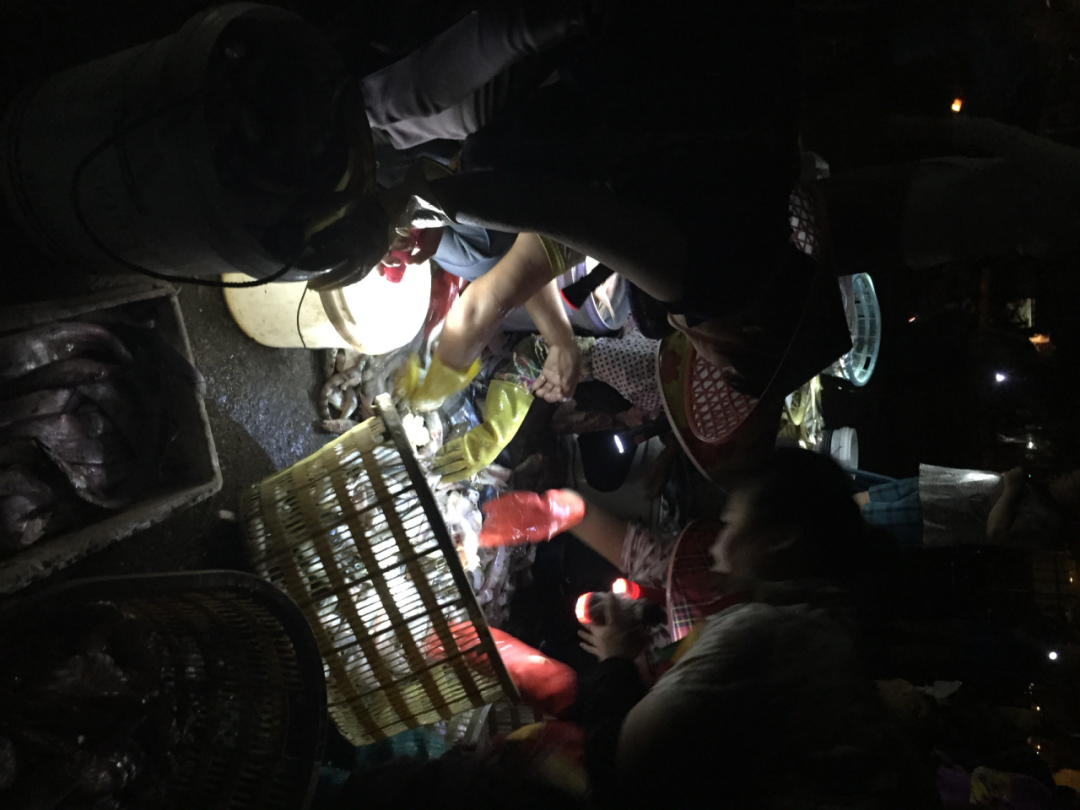
◉ A Hainan wharf wakes at midnight; before daybreak, the fisherwomen hold flashlights in their mouths as they sort through the catch.
During fieldwork, I was mistaken for all sorts of roles, and a reporter was one of them. Two fisherwomen running stalls thought I was a reporter and hurriedly pulled me over to complain. They were sisters-in-law; one had cut her hand slicing fish a few days earlier and still had it bandaged. One of them had a strong desire to express herself; she was hurriedly telling me something, and in that moment I regretted not having improved my clumsy Hainanese sooner. Her Mandarin was on a par with my Hainanese. When she saw me nod, she went on all the more eagerly; I was anxious and helpless. Fortunately, the younger one noticed what was happening, stepped in in time, and eased the awkwardness. It turned out that they were very unhappy about the relocation of the fish port.
The old fish port was a natural harbour, right in the heart of the city centre; now it was to be demolished and relocated in order to develop tourism. The new fish port was more than 40 kilometres from the city area, and was an artificial harbour prone to silt build-up; apart from being difficult to use, it would also greatly increase transport costs for seafood dealers in the city and seriously affect their business. Normally they did wholesale business and also retail; if they moved to the new fish port, retail would probably be very difficult. Veteran fishers had collectively petitioned the government not to relocate, to no avail. So they hoped I could help by doing some reporting and speaking out, so that the old fish port could be kept.
Anthropologists in the field have to face many requests like this, but are wary of overpromising. After I frankly said that I was a student, they were not overly disappointed; I breathed a sigh of relief. The two sisters-in-law then murmured: women in Hainan have it hard, and women are tired. I heard this phrase again and again in later fieldwork, and in their everyday lives I came to feel the deeper meaning in it.
In the first two months of fieldwork, I spent most of my time observing Y City’s wet markets. I carefully explored more than 30 wet markets in Y City, large and small. Some suburban markets were so remote that a round trip consumed a whole day. As I visited and observed, I seized every opportunity to find people willing to chat with me. At first I did not follow a fixed interview guide; through my presence and fragments of conversation, I tried to begin constructing an intricate, complex map in my head. I was no “social butterfly”; my usual trick was to buy something at a stall and then break the ice, and it worked every time, the only downside being my weight—all the food I bought on my daily market runs also had to be worked off!
The Yefeng Market closest to my home was Y City’s most famous and oldest market, and it was also the main fieldwork site in my plan. But my first encounters at Yefeng Market left me completely in the dark. Yefeng Market had more than 300 stalls; the busiest were the sea fish and live seafood areas. Local residents preferred sea fish; they considered live seafood such as lobster and abalone to be for tourists. It was only later that I learned that most of Y City’s live seafood came from fish farms in Zhanjiang or from Huangsha Aquatic Products Market in Guangzhou. Guangdong tourists who travelled a long way to Y City were quite likely eating seafood from back home. In the morning, the sea fish area was lively and the seafood area quiet; at lunchtime and dinner time, the seafood area was instead crowded with visitors streaming in, shoulder to shoulder. Walking through the market, I was naturally taken for a tourist, and more than once I was stopped by “seafood women” who asked whether I wanted to buy some seafood to have it cooked.
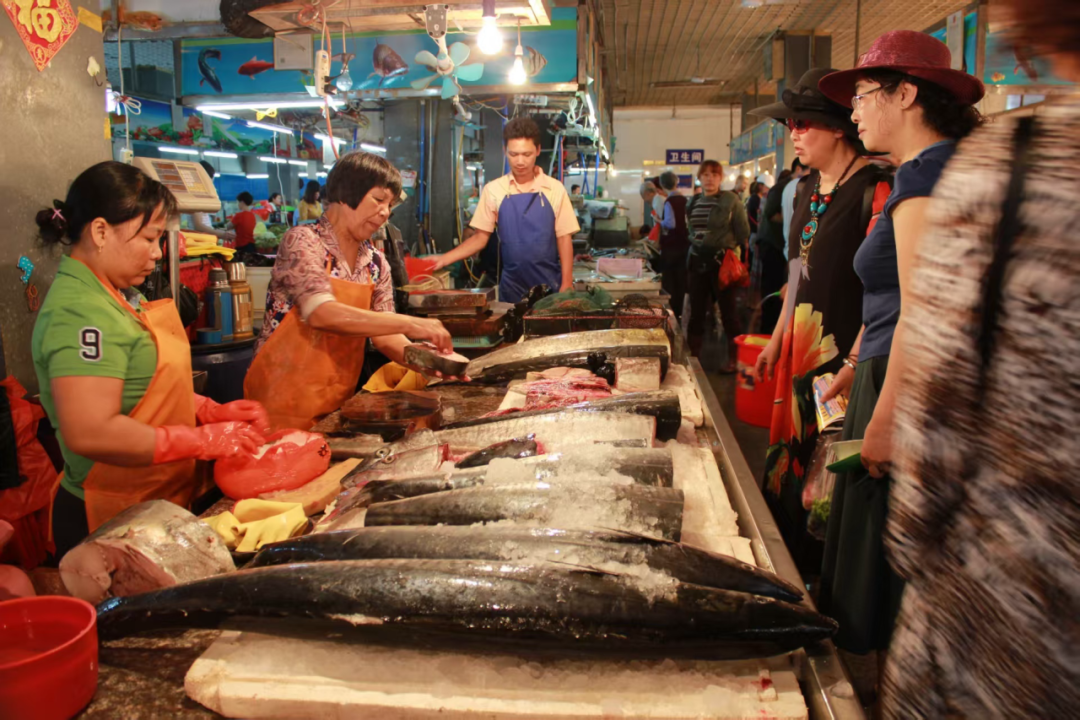
◉ The fish stall at Yefeng Market (Hainan, 2016)
In this market, the air carried not only the distinctive wet market smell—a mix of fishy stench, meaty aroma, earth and fresh greens—but also seemed to hold a faint tension. At first glance, mutual trust seemed thin. Y City’s reputation for ripping off seafood customers was “far-famed”; I saw out-of-town tourists carrying spring scales to buy seafood. Some grabbed the bags of prawns and squeezed them again and again, trying to shake out all the water; others accused the seafood stallholders of shortweighting to their faces, and the seafood stallholders would then pretend to get angry: “These shells are heavy to begin with; there’s a fair scale at the entrance—if you don’t believe me, go weigh them yourself!” Most tourists, seeing this display, fell silent. The seafood stallholders would read their customers, and when they came across some who were less wary and looked “easy to fleece”, they really would move briskly, weighing the small container along with the seafood before the customer could react, shortchanging them by two liang for every catty. Facing customers who watched the scale, they were unflappable; when weighing, a tare was enough to pass muster.
The aunties retailing abalone in small plastic basins moved at a clip; however fast I walked, they could catch up with me. “Miss, would you like some abalone? Ten yuan for three.” One of them said she bought her stock at a seafood shop outside the market: abalone at sixty yuan a catty, about twenty pieces. She sold them at ten yuan for three, making only a few yuan a catty. My instinct told me I should not take it at face value, because the gross margin on seafood was not that low. She also said, “Business is hard. The steps I walk in the market every day would be enough to get me back to my hometown. I don’t want to do it.” But every time I went to browse Yefeng Market, I could still run into her, and I saw her falling out with other abalone stallholders over competing for customers. The more I watched these scenes, the more questions arose in my mind.
In the early days of fieldwork, every day I had to put up with a great deal of coldness, rejection and mockery. My high level of education and my status as a young woman could only create more obstacles in a wet market. For stallholders, a customer who did not buy anything brought no benefit and could even seem to be of unknown origin—worthy of the highest degree of vigilance. The trick of buying something to strike up a conversation did not work at Yefeng Market. Their business was too good; they would brush me off with a few perfunctory words, because they were busy attending to new customers.
However, as I kept turning up at Yefeng Market, the owner of the grocery shop near the entrance recognised me and was very curious about me. After a few words of chat, I casually asked what the monthly stall fee was. She immediately became wary, finally voiced her suspicion, and asked back, “Boss, are you here to do business?”
At that time I had short hair and looked businesslike; she assumed I wanted to trade wholesale in the market or rent a stall and compete with them. I quickly explained who I was, saying I was a postgraduate student interested in consumption at the market, doing a social survey to understand people’s livelihoods. How to express my anthropological aims as honestly and precisely as possible was a problem. Over the first two months, I had already explained myself repeatedly in many fieldwork encounters, yet almost no one quite understood what I was actually doing. Wandering around with no commercial interest clearly had no place in their cognitive map. Perhaps they did not understand either: what knowledge could there be in a wet market, day in, day out?
I had also met my Waterloo in the history of my personal grocery shopping. After my attempts to interview had come to nothing, I chose to satisfy my appetite first. I picked out two horse-dung sea urchins from the stall of a young man from Zhanjiang, intending to savour this earthly delicacy with a mix of reverence and excitement. But the moment I cut the first one open, I was dumbfounded: it was full of foul muddy water, and there was no roe inside at all. I thought I had merely been unlucky; I did not expect the second to be the same. This had deeply wounded my affection for sea urchins, and I finally understood why seafood processing shops could only make steamed egg with sea urchin, because, apart from the empty shells, there was truly little substance to be found.
I went back to the young man from Zhanjiang to have it out with him. He said the sea urchins here were all like that, and the ones I had bought from other stalls were the same. Still indignant, I asked him where he got his stock. He replied disdainfully: “That can’t be told to you, and it’s none of your business.” That answer stung my anthropologist’s “dignity”; getting to the bottom of things was something of a professional technique in anthropology. Just because he would not tell me, did that mean I could not find it out through research? One day, I would know exactly who had stolen my sea urchin roe; that was a promise I made to myself on two counts, as both a consumer and a researcher.
The bustle of Yefeng Market was, to begin with, locked away from me. The barriers of trust between me and the stallholders, and the sea urchin incident, also made me realise that, behind the bustle, the transaction chains, cooperation and competition, business tactics, and the stallholders’ everyday lives were in fact shrouded in mist. The method of accompanying observation had reached its limits; I was unable to obtain more or deeper information. It was time to take one step further…
How did Teacher Zhong later “set up base” at a fish stall in the wet market?
In the end, was the “sea urchin thief” caught?
Why do Chinese people love browsing wet markets? Do young people still go to wet markets?
Why have China’s wet markets stood their ground amid the wave of the “supermarket revolution”?
What social structures and everyday wisdom do wet markets link together?
Together, let’s follow along with Teacher Zhong’s new book and explore the resilience and vitality of China’s wet markets!
“China’s Wet Markets“
Author: Shuru Zhong
Guangqi Shuju | Published July 2026
10 years, over 50 cities, over 200 wet markets…
Drawing on comprehensive observation and fieldwork of wet markets in various cities,
this book explores the history of wet markets, the stallholder community, the supply chains behind them, food consumption culture, urban public management, and more.
– Contents –
– About the Author –

Associate Professor at the School of Tourism, Sun Yat-sen University, with a PhD in anthropology from Texas A&M University in the United States.
Has long conducted research on wet market culture, sustainable food systems and food tourism, and continues to explore, in research and practice, how food can serve as a medium to reconnect people with food, nature, society and place.
– Event Preview –

All images in this article are illustrations from the book.
Layout: Xiaoshu
Scan the QR code to leave a tip and support original food knowledge
▼

▼
Click the image to read related articles.



▼
Click on a keyword to access more article collections.
Seeds | Agricultural Technology | Policy | Fermentation | Nutrition | Fruit | Fisheries | Events | Recruitment | Food Delivery Wet Market | Livestock | Food Talk | Sharing Events | Book Club | Harvest Festival | Smallholder Stories | Climate Change | Rural Development | Cooperative Economy | Urban Farmers | Food Safety | Digital Technology | Biodiversity | Pandemic and Food | False Solutions | Ecological Farming Internship Programme
Beijing | Hebei | Shanghai | Guangdong | Guangxi | Henan | Sichuan | Jiangxi | Xinjiang | Shaanxi | Hong Kong | Chongqing | Zhejiang | Jiangsu | Guizhou | Taiwan | Inner Mongolia | Philippines | Canada | Russia | Mexico | Italy | United States | United Kingdom | Germany | Netherlands | Thailand | Sweden | Japan