
The High-Standard Farmland I Have Seen, Farmed and Built Over the Years | Reader Comments
食通社说
I. I. Why Is High-Standard Farmland Abandoned?
Terraced fields in the south, where natural rainfall is not lacking, might just about grow some grain. In the north, in northern Shaanxi and Gansu, one can only rely on the weather. It can be used as farmland, but no one would dare to designate it as basic farmland; which leader who approved the project dares to guarantee that terraced fields in the north can provide a stable food supply? (IP: Ningxia)
Come to our Yunnan and see: the mountains are so huge, and the transformed high-standard farmland is completely unusable, with no water either. (IP: Yunnan)
It is entirely about making money. The high-standard farmland in xxxx Town has no water at all, and large areas are lying fallow. (IP: Chongqing)
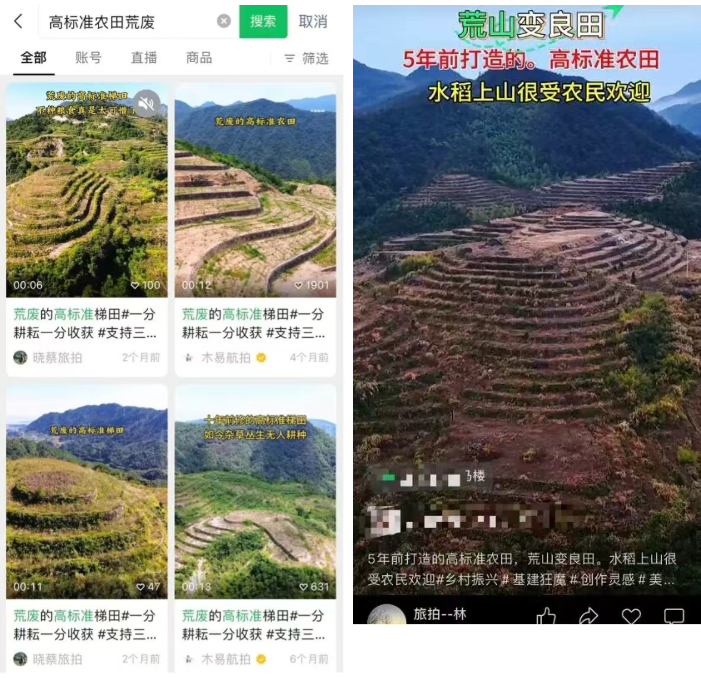
Have the differences between regions actually been properly taken into account? Our area is a plain, but when irrigation is needed, in some places people are scrambling for water, yet there is still none. (IP: Jiangsu) The field ridges on our high-standard farmland are four or five metres wide; from a distance they look like an aircraft runway. Do they need to be that wide? (IP: Hunan) Our hometown is xx in Sichuan. I don’t know who is behind this high-standard farmland. Local officials, eager to please their superiors and boost their political achievements, cut down mature fruit trees and planted worthless crops. It had taken a great deal of effort to develop a fruit and vegetable industry chain, but it has now been converted to grain production, and as a result every plot has ended up abandoned. (IP: Guangdong)
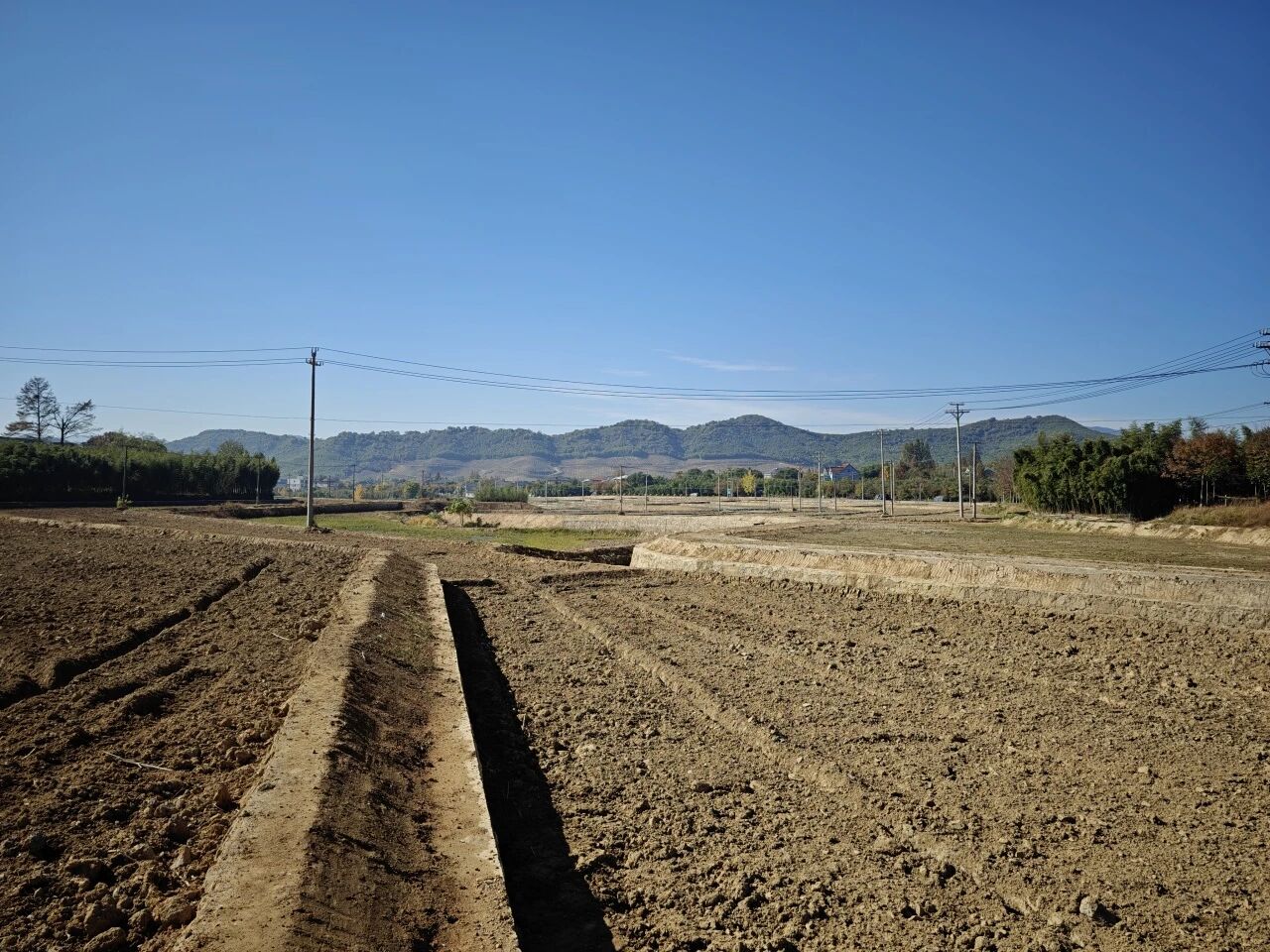
II. What Sort of High Standard Do Farmers Need?
The second is “choucao fa”, which is fast and allows simultaneous work, but when closing the slot it easily causes uneven soil fertility. Both methods require a combination of manual and mechanical work.
The last is “quanchan fa”, which suits mechanical work and is highly efficient, but it may bring up a lot of subsoil, making it difficult to restore soil fertility.
In 2022, the state issued the “General rules for high-standard farmland construction (GB/T30600-2022)”, which further detailed indicators such as plot regulation, effective topsoil depth, and cultivated land soil fertility. But, in land levelling, which construction method should be used is not specified in the General Rules or in local standard documents.
In the comments, several commenters have also put forward their views on how to build farmland facilities that safeguard food security and suit local natural and social conditions.
In an ideal form, high-standard farmland should be a reasonable localised configuration of soil, water channels, roads and other infrastructure, with its core lying in following “terrain”. It is the result of rural communities, through long-term farming practice, continuously adapting the farmland environment on the basis of local knowledge. But in reality, among the problems with many transformations, apart from issues such as cutting corners, the greatest deficiency is the lack of integration with “terrain”: the land is “formatted” without a clear understanding of topography, soil quality, or the lives of residents.
High-standard farmland is not simply better when it is larger or neater; rather, it should ensure that irrigation, water retention, and drainage on this plot are all convenient, and that soil fertility can be maintained. If the plots are too large, there will always be uneven places; the high ground will die of drought and the low ground will drown, and field ridges still have to be built in the middle. Water channels built straight and level may not match the actual terrain; when a large volume of water is brought in, the low spots may overflow the channels while the high spots still receive little water. Even if the ground is forcibly flattened, some exposed parts may be dead soil or even broken stones. These are situations I have seen in my fieldwork.
Three thousand years may pass, yet only three inches of soil are formed; if terrain and cropping patterns are ignored, even the highest-standard farmland will erode soil fertility. (IP: Shandong)
Our xx City in Hunan also has similar problems: through transformation, good fields become poor fields, and poor fields become abandoned fields. This year’s rice harvest may be less than half of last year’s. I hope that places not yet transformed must not turn fertile soil underground and cover it with subsoil from below. Otherwise, the land will not turn the corner within five years. Field transformation can end up as field damage. The state has invested, but looking at the large fields makes one uneasy, and the plans fall through. (IP: Hunan)
I have found that the people involved in high-standard farmland construction are all people who do not understand agriculture. They single-mindedly believe that once the land is levelled, it is high-standard farmland, but the land after levelling is all subsoil; cropping cannot become productive. It requires large inputs of farmyard manure and chemical fertiliser to nourish the land, and for four or five years there is only input without return. If farmers cultivate it themselves, the costs are high; if it is leased out, others may cultivate for one or two years without a harvest and not continue to invest. In the end, it can only lie fallow. Could they consider the actual situation? They say that farmland previously built in keeping with the mountains and beside the water wastes land. Using great effort, they flattened the hilltops, and in the end nothing was gained. (IP: Yunnan)
The best policy for agriculture is to stop meddling. (IP: Beijing)
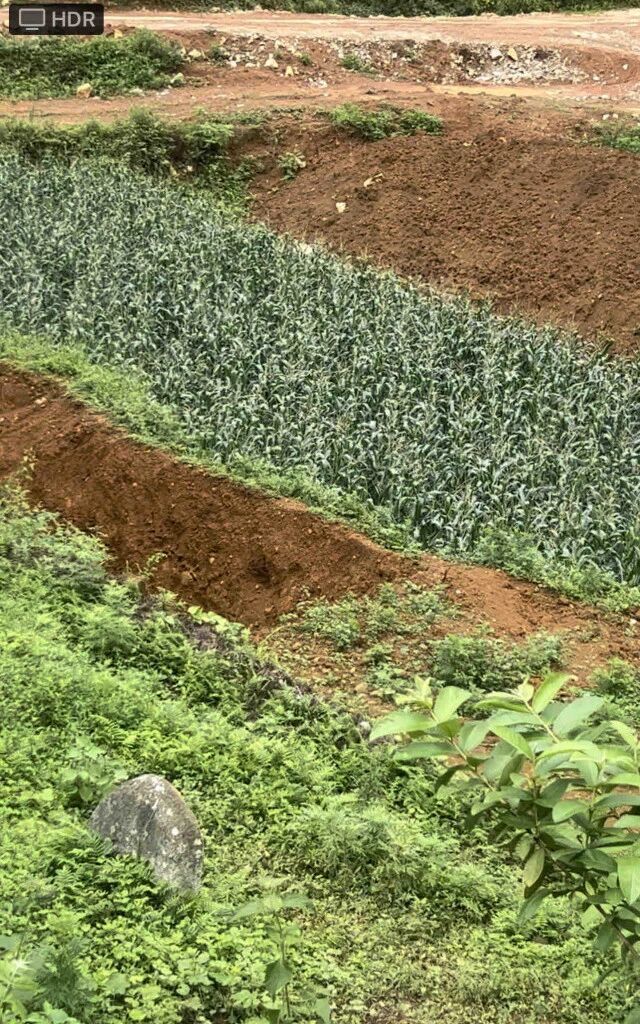
III. Contractors Have Something to Say Too
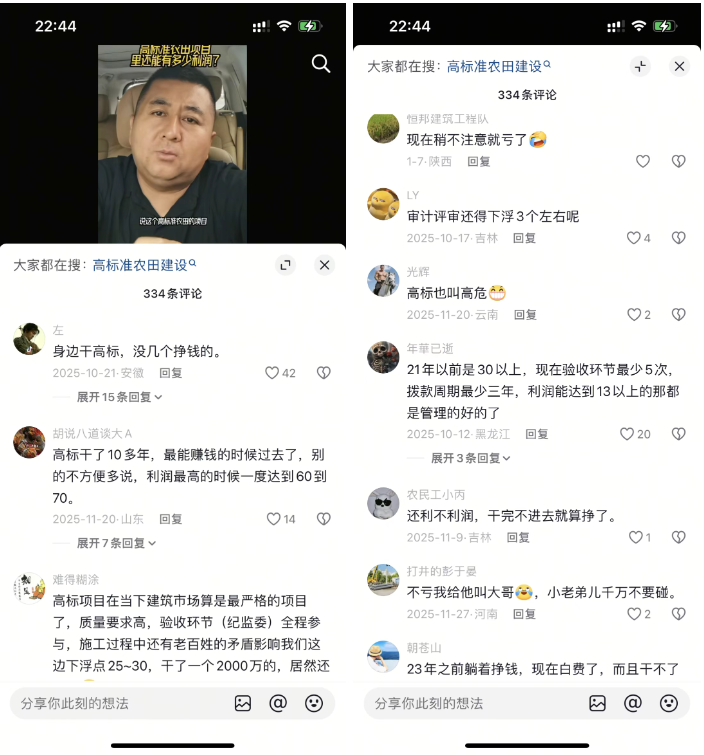
After central special-purpose funds are released, many contractors from housing construction and transport sectors come to carry out high-standard farmland construction. These contractors are basically local-boss, rogue project-manager types; if they do not bring people from the township police station to gang up on and beat villagers who do not cooperate with land acquisition, that is already good. How on earth could they proactively seek villagers’ opinions when carrying out the work?
When small county-level contractors come to do the work, villagers will demand that, in name, you take the job, but that in reality the work must be done by the village’s own people. In such situations, both the construction and design units are very resistant, because the village will not build according to the drawings: the drawings call for 10 steps, but they stubbornly build only 5. Although they themselves think that is enough, it will not pass the experts’ on-site acceptance inspection, and the design, construction and supervision units all still have to cooperate in producing change documentation. The problem is that changing 10 steps to 5 is non-compliant in the first place; producing the change documentation not only plants landmines for ourselves, but also for the review experts. If it blows up, no one in this circle can hope to make a living.
Finally, the single most important point is that, whether in design, construction or supervision, the people actually responsible for this area (especially design), whether junior technicians or project managers, make very little money. From start to finish, not a single person is paid enough, so how could they cooperate in dealing with so many trivial tasks? Moreover, in farmland and water conservancy projects, design firms mostly come from a land administration background and contractors mostly from a civil engineering background. In many small design institutes, you cannot find a single person with a water-related speciality anywhere in the institute; just the knowledge about irrigation relies entirely on what was picked up growing up in the countryside, and whatever can be done reasonably relies entirely on experience. The problem is: what good is three or five years of work experience? And those with more experience no longer have the stamina to be stationed on site and work overtime every day—completely stuck here. (IP: Hubei)
(Reply to the previous comment) Exactly, not one of the people actually doing the work has been paid enough. (IP: Shaanxi)

I once worked on an irrigation pumping station project. There was no water source, just dry pits. The designers said to wait for rain and collect the rainwater. I said, if it rains, water pools anyway—who are you pumping it up for? I asked a local farmer, and he just shook his head. (IP: Henan)
For high-standard farmland, shouldn’t the key focus be farm roads, mechanised wells, and ditches and channels? But now, they insist on setting proportions—for example, no more than 20% can go on roads, and trees must also be planted… A lot of space is then squeezed out by the roads, so the trees get pulled up and vegetables planted. (IP: Henan)
(Reply to the previous comment) It’s because if no proportions are set, everything goes to roads; the first draft design proposal worked through with the village always has roads taking up around 50%, followed by endless back-and-forth. But that is not the key. The key is that design fees are already low, and local governments further cut them with a local finance document. (IP: Hubei)
(Reply to the comment before that) Anyone who can talk about proportions really knows the work. (IP: Henan)
The visible roads are built well, but the hidden drainage is a mess, and it is not an isolated case. (IP: Heilongjiang)
No one has dragged down the standard; the standard was an engineering standard from the outset. Using engineering standards to build farmland that has to keep functioning over the long term—the result was sealed from the very start. (IP: Hunan)
IV. When Investment Becomes a Performance: How to Correct the Course
If we are talking about the problems inherent in high-standard farmland construction, there are far too many to count. What can be seen in the fields and what ordinary people complain about is only the surface; if the underlying problems are not solved, how can the surface be addressed?
1. The local government is far too concerned (Basically, local governments attach extreme importance to the funds, because the funds are mostly transfer payment funds, treasury bond funds, and central and provincial funds—it is all ready cash! Why are they so concerned? To divert the money! How do they do it? By setting up an agricultural investment company! The agricultural investment company acts as the project owner, then finds a state-owned enterprise to carry out the construction—surely then the money can be spent however they please?)
2. The construction unit is far too professional (An agricultural investment company is essentially an investor; investment is its expertise. How could they understand cultivation? Even if they were all willing to learn, could they really master it without eight or ten years?)
3. The design is far too scientific (How can you guarantee that a group of young men and women in their twenties or thirties can understand cultivation? If they do not understand it, how can they design? They design according to codes, guidance notes and documents. Some say the designers do not go to the site and just draw everything at the office from a map. I want to prove this point: they must have been to the site; it is just that they do not understand how to farm. So all they can do is design according to their own ideas and plans, in combination with the codes. As for the ideas of the people who will actually farm, they do not know those, so at planting time it will certainly seem unreasonable.)
4. The construction contractor is far too professional (Whether a private enterprise or a state-owned enterprise wins the tender and carries out the construction, they are extremely professional. It is the people who say they are unprofessional who are the amateurs. But their expertise is not in farmland construction or cultivation needs; they are highly professional in cost calculation and project planning. The vast majority of state-owned or private enterprises, once profit is calculated and the commission ratio is fixed, simply subcontract the work and do not actually carry it out themselves!)
5. On-site construction is far too professional (The people actually doing the construction or advancing the funds on site—their only criterion is that they have money and can advance it. Why? At the very beginning, the government had already diverted the money! They are unprofessional in construction but highly professional in calculation; cost control is calculated very precisely, and the materials can all be the cheapest available) (IP: Sichuan)
As a strategic investment, high-standard farmland construction has been the largest single investment in the rural revitalisation field during the 14th Five-Year Plan—the central government invested over 700 billion yuan during the 14th Five-Year Plan; adding local government fiscal investment, financial investment and social capital investment, the total scale will certainly exceed 1 trillion yuan. The total investment for rural revitalisation during the 14th Five-Year Plan is 10.8 trillion yuan. But in practice, the results have been especially poor, and it has lost public support.
Over the past five years, I have also written many complaints and posted quite a few videos. I have even become somewhat extreme in thinking that high-standard farmland has reduced grain output and that the figures for annual increases in grain output are not true. But what is more troubling is that the set of mechanisms and logic actually operating behind the scenes is widespread. It looks as if there are standards, procedures and supervision, but in reality they are all external. Everyone is “performing”, trying to conform to this set of correct, modern requirements. The current inspections by the Ministry of Agriculture and Rural Affairs are actually part of this process as well.
This is the case with high-standard farmland; in other areas of rural revitalisation, especially industrial revitalisation, the situation may be even worse. Presumably it would be similar in high-tech fields such as chips and AI. The high-sounding political slogans, the web of procedures and administration, and the rather unseemly tacit acceptance in real society have combined to produce today’s distinctive “performing” China. This “performance” is, of course, distorted, unnatural and costly, yet it has become a necessity.
Can in-depth reform solve these problems? That is also difficult, because it would touch existing interests and rules. (IP: Zhejiang)
The state has spent a lot of money on building high-standard farmland. Department staff have worked themselves to exhaustion, their responsibilities have been expanded without limit, and it has reached the point where no one wants to do it. Ordinary people are dissatisfied too. Since everyone is dissatisfied and it is difficult for everyone, the suggestion is to stop it. Do not call it high-standard farmland; just build small-scale farmland water conservancy facilities, and try to sort out water use and the roads. Soil fertility improvement should be done separately. (IP: Sichuan)
V. V. Outside Large-Scale Farmers Vs. Family Farms
If those growing crops on a large scale are not local people but outsiders or large enterprises, they are not increasing their income through yield; some are there only to defraud the state of its large subsidies, and not one is truly farming. (IP: Shandong)
As for outside large-scale farmers, if they do not understand agriculture, they are certain to lose money! The transformation of high-standard farmland is very complex; it must be adapted to local conditions and kept flexible and practical, otherwise it will backfire! (IP: Chongqing)
We have such cases there, too: large-scale land lessees planted a lot of sorghum and soybeans, but in autumn they did not harvest them and just left them there. Some bold farmers harvested a little. (IP: Shandong)
What they really want is the high-standard farmland subsidy. (IP: Guangdong)
On our side, rice is being grown up the mountains. The land has been leased by outsiders. The yield per mu is 100 jin. They are all living off state subsidy money. (IP: Zhejiang)
Mountain tops producing good fields? These people are on the subsidies, aren’t they? I heard local farmers say there is a dryland-to-paddy conversion project, and the subsidy is tens of thousands of yuan per mu. (IP: Guangxi)
They are there to pocket the subsidies: the transformation fee is tens of thousands of yuan per mu, but the actual cost is only a few thousand yuan, not more than 5,000 yuan. (IP: Guangdong)
What they earn is the subsidy. (IP: Guangxi)
They are simply here for the subsidies. (IP: Chongqing)
In such circumstances, how to enable operating entities capable of organizing and coordinating large-scale production to work better with smallholder farmers, allowing smallholder farmers to retain a voice in the production process, may well be the key to ensuring bumper grain harvests.
I have the feeling that there is a misalignment between public and market services. Large amounts of public money are spent on infrastructure projects, while those responsible for design do not understand agriculture, leading to waste. At the same time, modern farm machinery such as tractors, combine harvesters and drones is allocated in a fully market-based way, and these providers tend to serve large-scale farmers. For small operators and smallholders, it is hard to find farm machinery services during busy farming periods, and if they do find them, the prices are much higher than those for large-scale farmers. Many large pieces of farm machinery are indeed procured by the government, but in practice the work is contracted to private companies, so smallholders once again find it hard to get the relevant services. At least locally, part of the reason farmers are unwilling to farm is that farm machinery services are inconvenient. I hope improvements can be made in this area! (IP: Zhejiang)
Policies are also being adjusted, for example by encouraging moderate-scale farming at the hundred-mu scale. In past visits, Foodthink has also learned that some prefecture-level cities in Sichuan are collecting examples of households whose income from farming at home is broadly comparable to earnings from migrant work elsewhere—family farms are a major form of moderate-scale farming. In crop farming, it is indeed not the case that the larger the scale, the better.