
A Sweet Trap in the History of the Dietary Guidelines for Americans | Grandma Kouzi
7 January 2026. The first juicy morsel of gossip to land on this foodie’s plate at the start of the year: the US has released a new edition of the Dietary Guidelines for Americans. One stone sent up ripples for miles – opinions range all over the place. The most visible change? One picture tells the story.
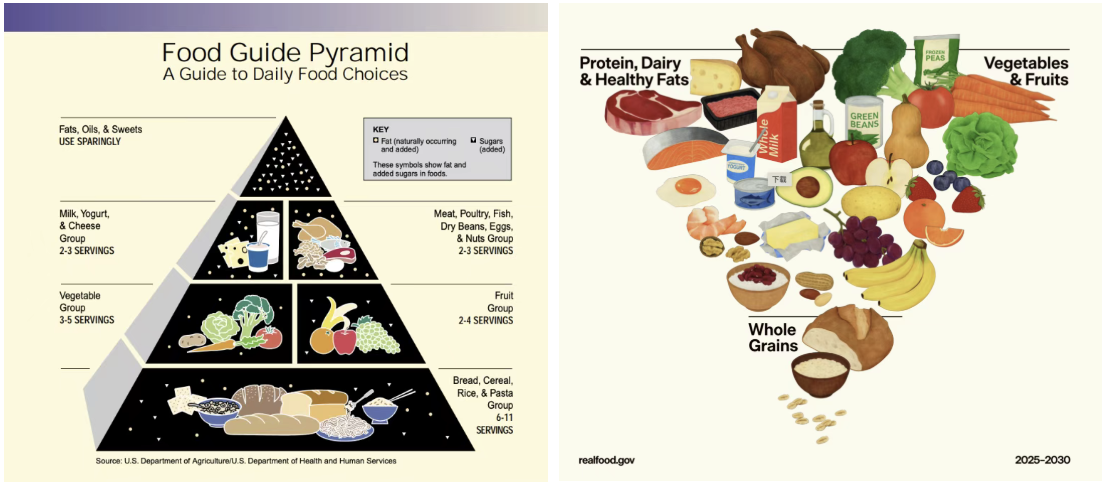
“The old Dietary Guidelines guaranteed a high incidence of ‘cardiovascular and endocrine diseases’ – that is where pharma companies and hospitals rake in their huge profits!”
Today, I am taking this opportunity to revisit the history behind the Dietary Guidelines for Americans.
I. From Fabricated Academic Papers to the First Dietary Guidelines for Americans
Before the first Dietary Guidelines were published on 23 January 1980, the US Senate’s Special Committee on Nutrition and Human Needs had issued a document called Dietary Goals in 1977. Although an official document, it was considered lacking in professional rigour. So in 1978, D. Mark Hegsted – a professor of nutrition at Harvard and a PhD in biochemistry – joined the US Department of Agriculture as Administrator of the Human Nutrition Bureau and drafted the first-ever Dietary Guidelines for Americans.
On the surface, D. Mark Hegsted was the right professional for the job – his expertise lined up perfectly. But those seeking science and fairness fell right into a sweet trap – one laid by a sugar-linked food industry.
The Sugar Association was founded in 1943. In that era, the US food industry evolved from scattered meat-processing firms into multinational giants with vast supply chains, forming an industry landscape centred on “meat processing” and ‘food processing.’
Originally, the Sugar Association was called the Sugar Research Foundation, and it rebranded to the Sugar Association in the 1970s. The reason for the name change is amusing in its own way: supposedly ‘to more broadly represent the interests of US sugar producers and consumers.’ But anyone who knows, knows – this association clearly represents the interests of sugar producers.
All of the Sugar Association’s funders are sugar-related companies, and they bankrolled a large body of research on heart disease. They did this not because food tycoons suddenly fell in love with medicine and changed careers to heal the sick, but to use “scientific research” to prove that sugar was not the root cause of heart disease. In the end, the Sugar Association’s core objective in funding medical research was to redirect public attention – more precisely, to shift the blame for heart disease, the number-one killer of Americans, from sugar to fat.
It is essential to set the scene for the 1940s and 1950s. At the time, heart disease was the leading cause of death in the US, and people turned pale at the mere mention of the ‘heart.’ In 1955, the sitting president – the 64-year-old World War II hero Eisenhower – suffered a sudden heart attack, and for six or seven weeks Vice President Nixon performed the duties of the office. That incident pushed the “heart disease panic” to its peak.
Post-war America had begun to dominate the world; the best opportunities and the most money were all in the US. The American people were more afraid of death and more fond of life than ever before – perfectly understandable. In times of peace and prosperity, who does not want to live a little longer and enjoy a little more? Research into heart disease captured the nation’s attention and attracted the very best of American scholars.
What people did not know was that the Sugar Association was watching heart disease research too. From the moment it was founded, the association had been funding research into cardiovascular disease and diet. At that time, heart disease was rampaging, and scientific research was in pursuit of the culprit. If sugar were definitively dragged out and paraded before the public, how would the sugar barons, whose fortune was shining bright, face it?
In that era, the US food processing industry (including sugar, meat processing, and dairy) accounted for roughly 2–3% of GDP but a staggering 15–20% of manufacturing – a key pillar of America’s post-war industrialisation. It is worth noting that before this, US food processing was dominated by meat processing; canned foods boomed during the two World Wars, and the growth engine after the wars was the sugar industry and related food processing. The sugar industry’s rising elite needed science to tell the American people: the real culprit behind heart disease was not sugar, but its neighbour next door – fat.
They say money can make a ghost push a millstone – and this time, science was the ghost. In 1967, three Harvard professors published a paper in the New England Journal of Medicine, one of the world’s top medical journals, claiming that sugars had no connection to heart disease.
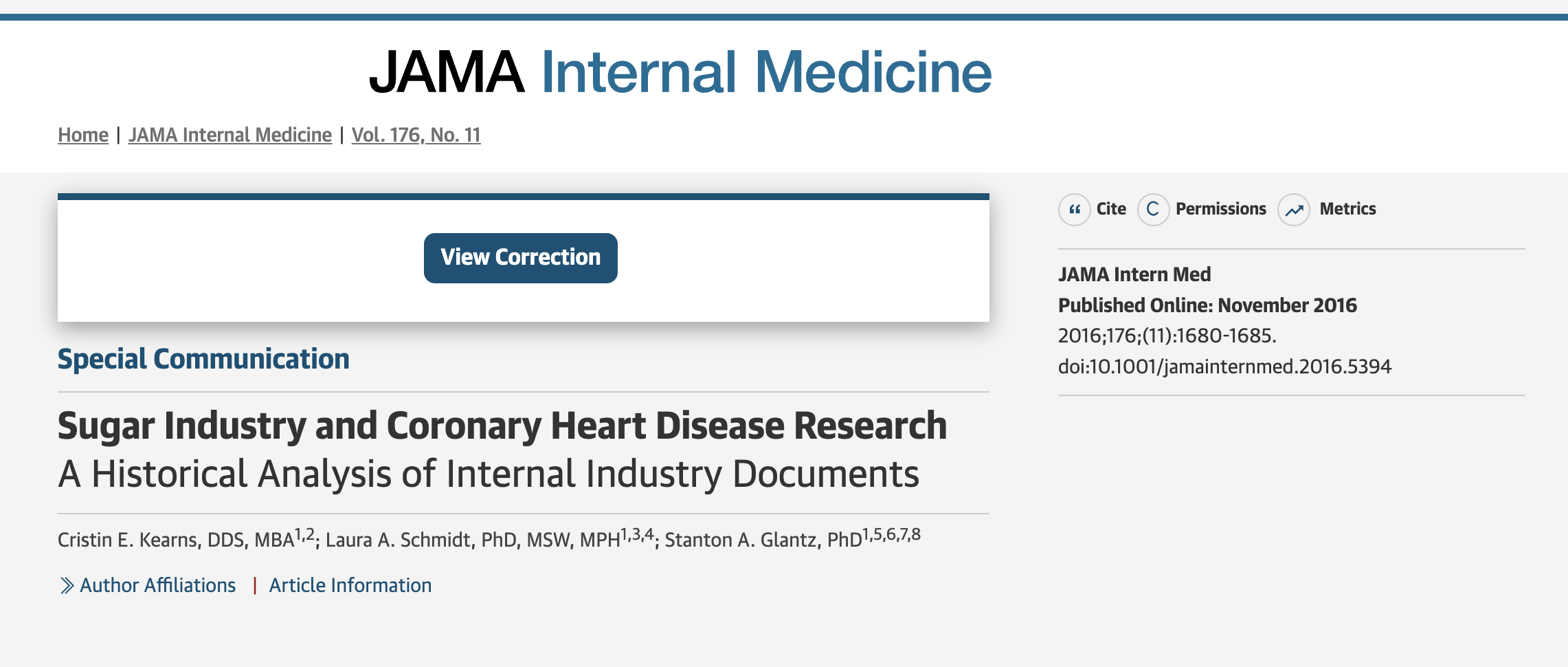
Of the three Harvard professors who sold human health for a pittance, two were figures of considerable renown. One was Frederick Stare, founder of the Department of Nutrition at Harvard School of Public Health, who had championed public health strategies such as regular exercise and water fluoridation. The other was D. Mark Hegsted, the drafter of the Dietary Guidelines for Americans, mentioned earlier. In 1980, the first Dietary Guidelines for Americans was published, and here is the key line: “Given the increasingly serious threat of heart disease to the American people, the public is urged to reduce saturated fat intake for the sake of their lives.”
Now everyone on the planet knows that the human heart is fragile and needs tender care. Excess sugar and fat are the main factors behind heart disease. Sugar and fat are co-champions – in many metrics, sugar actually takes the crown – yet at the awards ceremony, only fat gets pushed up onto the podium.
Blaming fat for heart disease was a “major achievement” jointly manufactured by the sugar industry and scientists. Under the guidance of such “scientific research” and the Guidelines, Americans’ fat intake dropped by 25% over half a century. By 2016, heart disease was still the American people’s primary killer, and obesity and diabetes were closing in fast. The true culprit? That one – sweet sugar. American life has been far too sweet.

II. A Lifetime of Glory: Ancel Keys’ Posthumous Shipwreck
The study was led by Ancel Keys of the University of Minnesota, who held two doctorates – one from the University of California and one from Cambridge University – and was a widely respected polymath in nutrition and physiology. Beyond the Seven Countries Study, he was also a key proponent of the Mediterranean diet and had made the cover of Time magazine for his research on cholesterol.
The Seven Countries Study data showed that fat was the culprit behind heart disease. But what this scientist did not say was that his research actually sampled populations in 22 countries. Why was the paper ultimately published as the “Seven Countries Study”? Because he dropped the 15 countries whose data contradicted his conclusion, selecting only the 7 countries whose data best matched his hypothesis to publish: the United States, the United Kingdom, the Soviet Union, Italy, the Netherlands, Finland, and Greece.
Moreover, even within those seven countries’ samples, he selected only the portions of data favourable to his case and inserted ‘fabricated statistical corrections’ into the statistical model to exaggerate the correlation between fat and heart disease. This most influential epidemiological study of its time cherry-picked just 499 individuals from a survey sample of 12,770…
Beyond the Seven Countries Study fraud, Keys’ academic misdeeds also included suppressing and blacklisting academic dissidents.
At the height of the Seven Countries Study’s popularity, John Yudkin of London University in England published a finding that could not have been less timely: the incidence of heart disease correlated more strongly with sugar consumption than with fat. Yudkin was a medical doctor who held professorships in both physiology and nutrition at London University. As one of the early advocates of the harms of sugar in the twentieth century, he published Pure, White and Deadly in 1972, dissecting the relationship between sugar and cardiovascular disease, obesity, and metabolic syndrome.
The pro-sugar faction and Keys hounded Yudkin relentlessly. They even turned the tables, smearing him as having taken kickbacks from meat and dairy companies. This drove the once-proud leading British scientist into disgrace – a veritable “social death” in the academic world: sponsors retracted their commitments and declined to support the conferences he convened; research journals refused to publish his papers; research institutions stopped inviting him to academic symposia; the British Sugar Board criticised him as being “far too emotional”; his book was mocked as science fiction…
Yudkin, his career derailed, grew melancholy in his later years and died at the age of 77. Keys, by contrast, enjoyed a lifetime of glory and peace to the very end. Born in January 1904 and passing in November 2004, he was a long-lived old man who saw his way past the age of one hundred.
Keys was a key proponent of the Mediterranean diet and practised it himself. Although I cannot find the specific recipes of this long-lived old man, by the common sense of the Mediterranean diet, his plate surely contained no added sugar – nothing like the sweetness of the average American diet.

III. The Evolution of the Dietary Guidelines
In the 1990s, the ranking of the US food industry had shifted from the traditional order of meat processing, sugar, and canned foods to sugar, meat, and beverages. The concepts of “low-fat” and “low-cholesterol” were all the rage; market share for related products surged, and consumers were led by the nose by delicious “low-fat” fare. Scientists “researched” this way, the state pushed this way, the advertising industry promoted in unison, and companies went with the flow, tacking on even more sugar to compensate for the mouthfeel that fat once provided, quietly ushering humanity into a new era of low fat, high sugar, and rampant obesity and diabetes.
Entering the new century, things began to shift. The Dietary Guidelines for Americans moved from “nutrient restrictions” to “food patterns” – in other words, from a focus on limiting individual nutrients to emphasising a reduction in processed foods and eating whole, unprocessed foods. The 2020 edition had already begun to “limit added sugar” and to address the issue of “ultra-processed food.” Unlike previous editions, which ran to the length of a book, this year’s Guidelines are a mere ten pages. The moment the new Guidelines dropped, the public was in an uproar; opinions range all over the place, and the sheer volume and heat of commentary have far outstripped the Guidelines themselves.
Back to the sugar-related content. Although the previous edition of the Dietary Guidelines for Americans was already curbing added sugar, it still permitted sugar additions in foods for children aged two and above. In the past, the language around sugar was often “advised to reduce,” with a target of “added sugar 10% of total daily calories.” This edition, however, takes an extremely hard line on added sugar: “No amount of added sugar or non-nutritive sweeteners is recommended, and neither forms part of a healthy or nutritious diet.” It further advises completely avoiding added sugar during infancy and the toddler years, and that children aged 5–10 consume no added sugar at all.
Emphasising that sugar does not count as part of a healthy or nutritious diet – I agree, though I am sceptical about its practical feasibility. The specifics warrant a separate piece and cannot be taken up here.
Almost every major update to the Dietary Guidelines has triggered a wave of transformation among food companies. As the Dietary Guidelines for Americans have continuously reinforced the equation “less fat = healthy,” the food industry has completed a commercial translation of this philosophy, giving rise to “health foods” such as “low-fat yoghurt” and “sugar-free drinks,” charting fresh trends in revenue growth.

The food industry now accounts for roughly 3.5% of US GDP, a share that has been steady with a slight upward tilt, though the margin is modest. But US GDP as a whole is unrecognisable compared with the past. The top player in the food industry had annual revenue of only about ten billion dollars in the era of the first Dietary Guidelines; today’s PepsiCo has surpassed 90 billion. The influence of these mega food companies on health and lifestyle trends has long since swept the globe, and with their formidable R&D and capital muscle, they can rapidly restructure their product lines. Who knows what new tricks they will deploy this time to seize the next strategic high ground.
Given that the Dietary Guidelines change every few years and cannot be fully relied upon, what healthy-eating method does the ordinary person have? Allow me a bit of the classic “the melon seller touts his own melon” – I invite all readers to click the link below and check out the healthy eating tips I have previously shared with you!

Editor: Xiaodan