
If No One Keeps Growing Them, They Will Vanish from the World Forever
Foodthink Says
Eating to Extinction is a work that explores the global crisis of food diversity and a vital call for the protection of local germplasm resources and cultural heritage.
On 9 July, Foodthink and Beiye Books jointly launched the Eating to Extinction Online Book Club Series, featuring in-depth discussions around the theme of food diversity and the protection of local varieties. Liu Yurong, a fellow farmer from Wangjingzhuang in Shexian, Hebei, shared the story of traditional bean conservation and seed saving in Wangjingzhuang, emphasising the connection between people and food and the importance of protecting local varieties. The discussion also covered topics such as seed banks, local culture, and dietary habits.
Thanks to The Paper’s Fan Shu Dang team for compiling the transcript. Follow Foodthink’s video channel to watch the recording of the book club session.

The Ark of Taste Initiative and the Slow Food Movement
The Ark of Taste, known in English as the “Ark of Taste”, is an independent initiative launched on the Slow Food movement’s website. On the site, you can filter entries by country or by crop type. It lists 6,592 endangered crop varieties in total.
The Ark of Taste emerged in the mid-1990s, growing out of the Slow Food movement founded by Italian journalist Carlo Petrini. A common thread across the movement is the desire to resist the ever-increasing industrialisation and homogenisation of food. The very term “slow food” therefore captures the philosophy they champion beautifully: the food we eat need not be fast food, nor does it have to be a white-feathered broiler rushed to maturity in barely over thirty days. We want to pay attention to the local culture of plants.
Foodthink travelled to Chengdu in 2017 to cover a Slow Food conference held in China that year. Dan Saladino, the author of Eating to Extinction, also visited China with the Slow Food movement in 2017. The story of Sun Wenxiang, a Chinese farmer featured in the book, grew out of Saladino’s own trip to Chengdu that year, when he interviewed the farmer as part of the movement’s visit.
The single most important first step in protecting these endangered crops is documentation — understanding which crops are in a state of endangerment. Eating to Extinction refers to two key lists:
The first is the Ark of Taste, which documents entirely through the lens of food and crops.
The second is the IUCN Red List of Threatened Species, formally known as the International Union for Conservation of Nature Red List of Threatened Species. I believe it comes up in the section on fisheries, where there is considerable discussion of wild large catfish, crucian carp and the like. You will find many references to the IUCN Red List, used to catalogue which fish and marine animal resources are under threat.
This forms a telling contrast with the Slow Food Ark of Taste: the IUCN primarily documents wild animals, whereas Slow Food approaches the task entirely from the perspective of vanishing food diversity, recording the crop varieties that are disappearing from our plates.
On Plant Blindness
This reminds me of an article I came across recently on WeChat Moments, titled Why Do We Always Fail to See Plants? The article is based on a recent paper, Typical Problems in Plant Science Education, and uses plant blindness as a case study to present its findings to a general audience.
The article introduces a fascinating term — plant blindness. It gives an example: in Britain, eight-year-old children can recognise many kinds of pets, yet cannot name the plants and flowers commonly found in their gardens. Forty-one per cent of British high school students can identify just one species of wildflower.
This gap is evident not only at the level of public awareness but also in the mechanisms of conservation. The US Lacey Act, enacted in 1900, initially protected only birds; plants were not brought within its scope until 108 years later, and the funding allocated to plant conservation is a pittance.
If our concern for wild plants falls far short of our concern for wild animals, then our regard for everyday food is likely to fall even further behind our regard for wild plants. The crops we eat once boasted an extraordinary diversity of varieties, yet we know so little about it. In truth, the diversity of many foods has already been lost.
The Different Logics of Animal and Crop Conservation
Animals and crops disappear through entirely different processes and demand entirely different methods of conservation.
If you look at the chapter on wild sturgeon, you will find that the loss of many fish stocks is the result of overfishing. Traditional fishing gear could only take a very small portion of the stock, but once destructive modern fishing equipment came into use, the populations of certain fish species experienced a cliff-like collapse. The original English title of this book is Eating to Extinction — which, translated literally, means “Eating These Species to Extinction”.
But when we talk about agricultural biodiversity, there is a well-known saying in the field: “If you want to protect me, then eat me.” This perfectly captures the plight of many niche, endangered plants and crops discussed in the book. If you do not eat it, if it is not woven into the fabric of local traditional food culture, then eventually no one will want to grow it any longer, and it could disappear from the earth for good.
Vavilov and the Theory of Centres of Origin for Cultivated Crops
Let us now turn to some concrete examples.
The book mentions several times a Russian plant scientist and geneticist named Nikolai Vavilov. Vavilov recognised early on that the cultivated crop varieties we rely upon were disappearing, so with remarkable foresight he spent twenty-five years travelling the globe, completing more than 180 expeditions, collecting over 150,000 seed samples, and establishing the world’s first seed collection in Russia.

Another of Vavilov’s major contributions was his theory of centres of origin for cultivated crops. When we interviewed Saladino, he mentioned something that thrilled him enormously — one of the most important stories in human history: over ten thousand years ago, we domesticated wild plants and transitioned from a hunter-gatherer way of life to sustaining ourselves by growing crops.
This theory of centres of origin essentially describes how our crops — wheat, maize, rice, for instance — were first domesticated by local communities in particular places, and from there spread across the world. When Vavilov proposed this theory in 1935, he identified eight major centres of origin. East Asia is also a very important centre of origin. Rice and millet (millet itself encompasses different varieties, such as broomcorn millet and foxtail millet) all originated in northern China. The soybean, too, is a crop of enormous importance that also originated in China.
Ex Situ Conservation: Seed Banks Around the World
What is “ex situ conservation”? This approach involves collecting crop samples and storing them in seed banks for careful preservation — what we call ex situ conservation in our field.
The book highlights several extremely important seed banks:
The Vavilov Seed Collection: The seed samples that Vavilov gathered over a hundred years ago are now kept at the Vavilov Institute of Plant Industry in Saint Petersburg, Russia.
The Millennium Seed Bank at Kew Gardens: Located in Sussex in southern England, it is one of the largest seed banks in the world, holding perhaps hundreds of millions of seed samples.
The Svalbard Global Seed Vault: Situated in the Svalbard archipelago of Norway, it is also known as the “Doomsday Vault”.
The National Crop Germplasm Resource Bank of China: Based at the Chinese Academy of Agricultural Sciences in Beijing.
All of these major seed banks store vast quantities of seed samples collected from around the world. Their role is to serve as backup resources: should certain crops disappear in the field, we can apply to these formal seed banks to recover the relevant varieties.
A good example: the book describes farmers in the Swabian highlands of Germany who were determined to revive lentil cultivation in their area. They travelled to the Vavilov Institute of Plant Industry in Russia to track down the relevant seeds and ultimately succeeded in re-establishing the crop locally.
In the chapter on sweet foods, the book features Syrian sweet cheese rolls — a local delicacy made from a special indigenous wheat variety. Because years of conflict in Syria had destroyed the local seed bank, they retrieved the variety from the Svalbard Global Seed Vault in Norway and were able to resume production.
So what do seed banks actually look like inside? Last year, during a visit to Europe, we toured several seed conservation organisations and research institutes. This photograph is of the small seed bank at VERN, a German seed conservation organisation, which holds several thousand varieties. Once you step inside, you see all sorts of jars and containers.


The most immediate sensation is just how cold it is, because seeds must be stored at low temperatures. At VERN, the seed bank is kept at roughly refrigerator temperature. But in Norway or other large-scale seed banks, temperatures can drop to minus 98 degrees Celsius, or even below minus 200 degrees Celsius. At that stage, mechanical refrigeration alone is no longer sufficient — liquid nitrogen is needed to store certain seed samples, bringing their metabolic activity to a near-complete standstill.
In Situ Conservation: A Dynamic, Participatory Approach
One thing I think is particularly brilliant about this book is that, in addition to ex situ conservation, it introduces many examples of in situ conservation.
Ex situ conservation is actually quite straightforward: you collect seeds from their native habitat or from a seed farm, then send them off to a cold store for preservation. It is a static form of conservation, and this work is typically carried out mainly by public breeding programmes, or even some private seed companies.
In situ conservation, by contrast, is something like this: there is a heritage variety in our village, and the villagers have been growing it for generations. If I do not plant it this year, my neighbour will, so the variety passes from one year to the next within the community. At the same time, the crop continues to interact and engage with the surrounding ecological environment and the farmland ecosystem.
Another feature of this kind of in situ conservation is that what it protects is the process of evolution and ecology itself. Compared with the static preservation offered by seed banks, this is a dynamic, participatory approach to conservation — one in which farmers and communities take an active part, rather than being solely the domain of scientists and public research institutions.
I have just attended the Eastern Network Exchange Meeting in Hefei, Anhui, hosted by our partner organisation, the Farmers’ Seed Network. At the event, they set up a seed exchange session, which is a wonderful form of in situ conservation. For example, in Anhui or neighbouring Zhejiang — places with similar climates and growing conditions — we can swap seeds with one another. This way, a variety is not only conserved on my farm but also in the neighbouring province.
Why Are Farmers Willing to Protect Endangered Varieties?
There is a fascinating passage on page 324 of Chapter 7. Although Saladino devotes considerable attention to the importance of formal seed banks, he also acknowledges that static conservation is far from sufficient. He writes that diversity must be preserved in situ, all around the world. Take these cheese varieties, for example: they are not merely food — their production helps sustain and support an entire way of life, a particular ecosystem.
The book presents many examples of endangered crops and foods where it is front-line farmers, chefs, and workers in cheese-making or dried-fish production who have taken conservation into their own hands. I have tried to distil why these people, often with very limited resources, are still willing to protect these endangered varieties:
1. Flavour and culinary culture. The most immediate motivation is simply taste. Take Dan Yue, a small-scale eco-farmer from Xiangshan in Zhejiang who grows a heritage variety of Chinese pearl onion (Allium chinense) on his farm. He explains why he saves his own seed: commercial breeding companies will not develop this variety. You may not even be able to find seed for sale in the market, because it is not a crop they prioritise. Yet local people love eating it, so the variety has naturally been kept alive.
2. Climate adaptability. As products of in situ conservation, these heritage varieties have co-evolved with their local ecosystems over thousands of years, making them better adapted to climatic variation and extreme weather. For instance, the Turkish Kavılca wheat mentioned at the outset of the book: its outer husk is exceptionally tough, which gives it effective resistance to Fusarium head blight and wheat rust.
3. Cultural identity and heritage. Some varieties are deeply intertwined with local cultural identity and inheritance — Syrian sweet cheese rolls, for example, or the “Kichee Red” cowpea mentioned in the vegetables chapter. This bean was first carried to the Americas by enslaved Africans during the transatlantic slave trade. In recent decades, their descendants — communities of African descent — have been the ones preserving this vanishing legume variety.
The book also highlights many other actors in conservation. There are restaurants and chefs. A restaurant in the Faroe Islands specialises in fermented foods rooted in Faroese culture, preserving numerous local fermented specialties. There is an artisan from Ireland dedicated to smoking salmon. And in Japan, a single curer of skipjack tuna who, by all accounts, is the only person left in the entire country still preserving the fish by this traditional method.
In London, a cheese shop has safeguarded a vast array of local cheese varieties. In our interview, Saladino mentioned that Britain experienced a renaissance of cheese varieties in the 1970s. Many farmhouse cheese varieties were revived from that time onwards, and today there are well over a thousand.

At the Eastern Network Exchange Meeting I have just attended, the turnout was remarkable: not only farmers but friends from botanical gardens and many other backgrounds. Everyone shares a passion for seeds, and this network is a space where people can swap seed, exchange techniques and insights on breeding and seed saving, and simply talk.
As we can see, nutritional value, food security, and adaptability to local climates are powerful drivers of the conservation of agricultural biodiversity and food diversity. That covers the main threads of the book for now. Next, I am delighted to introduce a fellow farmer I have known for many years, Liu Yurong, who farms in Wangjingzhuang, Shexian, Hebei.
For those who would like to read more about Wangjingzhuang, you can search for the article “Planting a Hundred Varieties Without Relying on Heaven” on Foodthink’s WeChat public account. It focuses on the conservation of heritage varieties in Wangjingzhuang and how this work supports climate adaptation locally.
Liu Yurong: Hello, friends online! The topic of my talk today is the in situ conservation of crop biodiversity in Wangjingzhuang. First, let me introduce the location and natural environment of Wangjingzhuang. These two photographs show the village in spring and in summer.


Wangjingzhuang belongs to Shexian County, Handan City, Hebei Province. It sits on the eastern foothills of the Taihang Mountains, at the junction of Henan, Hebei and Shanxi provinces. Because its dryland terraced fields are the most carefully laid out and the most grandly scaled, Wangjingzhuang forms the core conservation zone of the Shexian Dryland Terraced Field System.
To the west of the village stands the Huanglong Temple. An inscribed stone stele records that Wangjingzhuang was founded in 1230, during the Yuan dynasty, giving it a history of more than 790 years. Today it is a large natural settlement comprising five administrative villages. More than 4,600 people are registered there, with a resident population of roughly 3,000 — still, in every sense, a living, vibrant village.
Wangjingzhuang is a typical deep-mountain area, dry year-round with little rain; the average annual precipitation is around 500 millimetres. Spring is especially arid, with most rainfall concentrated in the monsoon season of July and August, which also brings frequent natural disasters. The locals often say, “In ten years, nine bring drought and the other one brings a flood.” Because of its deep-mountain isolation, traditional farming practices endure here to this day: donkeys remain the principal working animals and the main means of transport. The older houses are still built of stone, retaining the stone-built architectural style of the Ming and Qing dynasties. It was not until 1976 that Wangjingzhuang opened its first tunnel and gained a proper road link to the outside world. Thanks to this relative remoteness, both the traditional culture and the traditional farming of Wangjingzhuang have been preserved remarkably well.
In 2012, Wangjingzhuang was designated a Traditional Chinese Village. In 2014, the Shexian Dryland Terraced Field System, with Wangjingzhuang at its core, was inscribed as a Nationally Important Agricultural Heritage System. In 2021, Wangjingzhuang was selected as a global exemplary case under the “Biodiversity 100+” initiative for its conservation and sustainable use of biodiversity. In May 2022, the Shexian Dryland Terraced Field System was recognised as a Globally Important Agricultural Heritage System (GIAHS).
Wangjingzhuang’s Distinctive Biodiversity
A particularly outstanding feature of Wangjingzhuang is its remarkably rich biodiversity. Yet because the village sits among high mountains with steep slopes, where arable land is scarce and water extremely limited, villagers must grow a wide variety of crops across the hillsides.
Along the stone bunds, villagers typically plant drought-resistant, cold-tolerant Sichuan pepper trees as their principal cash crop. Before 2000, everything from children’s schooling to building houses and meeting daily living expenses depended on the sale of Sichuan pepper. The pepper trees also serve to stabilise the stone bunds and prevent soil erosion. Within the terraced fields themselves, large areas are devoted to high-yielding, drought-tolerant crops such as beans, maize, and foxtail millet. At the base of the bunds, staking vegetables like pole beans and pumpkins are planted, and pole beans may be intercropped with maize. Date plum trees and persimmon trees are also grown at the foot of the bunds, creating a mixed, multi-layered cropping structure that maximises the productive potential of the terraces.
During our 2020 survey, we found that Wangjingzhuang holds seeds for 171 heritage varieties. More than 400 species of wild medicinal plants also grow on the mountains, over 200 of which have been used in everyday prescriptions by practitioners of traditional Chinese medicine. All of this is a vivid testament to the rich agricultural biodiversity of Wangjingzhuang.
The Establishment of the Farmers’ Seed Bank and My Journey of Growth
Even now, villagers still grow heritage varieties every year, and nearly every household cultivates between 20 and 30 or more heritage crop varieties. The tradition of seed saving has endured: each year, before harvest, people climb up to the terraced fields to select the finest plants and set them aside separately, year after year.
To better protect the dryland terraced fields and expand their value, the Shexian Dryland Terraced Field Protection and Utilization Association was established in Wangjingzhuang in 2017. In 2019, with guidance from China Agricultural University, the Farmers’ Seed Network, and the Shexian Bureau of Agriculture and Rural Affairs, and with the support of Oxfam Hong Kong, the Association organised its members to visit more than 1,000 households across the village to collect heritage varieties. They gathered many samples of foxtail millet, maize, beans, sorghum, pole beans and more, carefully documenting their growth characteristics, planting schedules, and the cultural stories behind each one.
In November 2019, the Farmers’ Seed Bank was established in Wangjingzhuang. That same December, the seventh annual conference of the Farmers’ Seed Network was held here. At the time, I had not yet joined the Association, but the conference was right next door to our house and the buzz was wonderful, so I went along to sit in and listen. Professor Bai Keyu from the Chinese Academy of Agricultural Sciences was giving a talk on the genetics of foxtail millet, and another teacher spoke about filming for Douyin — both fascinated me enormously.
And so I made up my mind to join the Association. My family was poor, and though I passed the entrance exam for senior high school after junior high, I was unable to continue my studies. The chance to encounter experts and professors again, to absorb new knowledge — that was an opportunity to make up for what I had missed and to give myself a new lease on life. I joined the Association after 2020.
In April 2020, I took part in the terraced-field survey, the crop survey, and the village cultural survey, and came to understand our village far more deeply. In June 2020, I was honoured to meet Professor Sun Qingzhong from China Agricultural University and Mr Song Yiqing from the Farmers’ Seed Network, who had come to Wangjingzhuang. Professor Sun recognised me by name at first sight, which took me completely by surprise. Listening to the teachers’ talks reignited my hunger for learning, and I felt I, too, could make a contribution to my hometown. Encouraged, I enrolled at the Radio and Television University to study Chinese language, hoping that in time I could write and speak better, and express myself more fully.
Throughout this period, I gradually developed a deep interest in biodiversity and traditional heritage varieties. I began asking around the village, digging out the stories of those vanishing old varieties, and photographing and recording each stage of their growth in careful detail.
Wangjingzhuang’s Rich Bean Varieties
These are photographs I took of some of the bean varieties in Wangjingzhuang — just a very small selection. Wangjingzhuang’s beans are extraordinarily diverse, encompassing soybeans, adzuki beans, red beans, common beans (Phaseolus vulgaris), hyacinth beans (Lablab purpureus) and more, with over 40 varieties in total. I selected some of the more vibrantly coloured ones to photograph.
For instance, the soybean group includes yellow, green and black soybeans, each further subdivided by grain size into Large Yellow, Second Yellow and Small Yellow, and Large Green, Second Green and Small Green, and so forth. This classification reflects the fact that those prefixed “Large” or “Second” exhibit an erect, heavily branched growth habit.

The Small Yellow, Small Black and Small Green soybeans, by contrast, have a climbing growth habit. In terms of flavour, although the Small Yellow, Small Green and Small Black soybeans yield less than their large counterparts, they taste better. Wangjingzhuang’s adzuki beans come in an even wider range of colours — white, red, green, black and mottled adzuki beans — each carrying distinct medicinal properties. The common bean varieties are equally diverse, including Green-Flowered, Purple, Red Stringless, Black Stringless and White Common Bean, among others. The hyacinth beans include White-Flowered Green, Purple-Flowered Green, Purple-Stemmed Hyacinth, Purple Hyacinth and White Hyacinth, of which the White Hyacinth has recognised medicinal value.
In 2023, I carried out a season-long tracking study of our heritage bean varieties, planting the many varieties I had collected together in a single field to compare their growth periods, flowering and maturation stages, and plant architecture. For example, the Small Yellow soybean grows erect and heavily branched, while the White Common Bean (a member of the common bean group) is of the twining type.
The data show that Wangjingzhuang’s heritage bean varieties are generally tall, with a wide array of flower colours, leaf shapes and seed-coat colours — a truly rich diversity. As the photographs reveal, the colours of these beans are strikingly beautiful.
Wangjingzhuang’s heritage bean varieties tend to produce modest yields. The adzuki beans, for instance, average just around 80 jin per mu, falling below 60 jin in poor years, while the soybeans yield somewhat more, at roughly 200 jin per mu.
The sheer number of bean varieties in Wangjingzhuang is largely due to its position deep in the Taihang Mountains, at elevations between 678 and 1,030 metres, where distinctive mountain microclimates create significant differences in rainfall and climate from one ravine to the next.
Wangjingzhuang sits nestled between two mountains, with a valley running between them. The soil in the valley floor and channel depressions is relatively fertile — this is Class I land, the lowest in elevation. Beyond that lies the mid-slope, together with the land between the valley floor and mid-slope, which enjoys better ventilation but poorer soil — Class II land. Higher still, adjacent to the ridge, is Class III land, which is comparatively barren, along with some non-arable land.
Soybeans, for example, require ample moisture and rich soil, so most are planted in the valley floor and channel depressions. The adzuki beans, such as the Red and Green Adzuki, are more tolerant of poor soil and suited to mid-slope or ridge-adjacent land. Common beans and hyacinth beans need a support to climb, so they are typically intercropped with maize or trained up the stone bunds, allowing them to grow normally.
Planting Schedules and the Wisdom of Cultivation
Wangjingzhuang’s climate is arid with very little rain, so getting the planting schedule right is crucial. Once we have sown maize or foxtail millet, if the soil moisture conditions are poor, it is already too late to wait and resow, so we switch to soybeans instead. Soybeans make an excellent backup crop: they are a shade-tolerant crop, and can grow well even beneath a maize canopy.
The growth cycles of our heritage bean varieties differ from one another. The hyacinth bean (Lablab purpureus), for instance, has a longer growing season and must be sown each year in April. Soybeans are planted in May, while the adzuki beans are more flexible in timing — May or June will both do.
As for pole beans, villagers begin the traditional practice of zhǒng guā diǎn dòu — “sowing melons and planting beans” — around the Qingming period in early April. Planting pole beans at this time means they can be sown again in June or July, yielding two harvests a year. By July, the Green pole beans are ready; in August, villagers can enjoy the Purple; and in September, heritage varieties such as the Red Stringless and Black Stringless come into season. In October, there is still a chance to pick some Red Stringless and early-maturing hyacinth beans.
The choice of variety depends on the specific location and growing conditions. As the old Wangjingzhuang saying goes, “Planting a Hundred Varieties Without Relying on Heaven” — meaning that no matter how the year turns out, if you sow enough different varieties, there will always be some harvest. This is the wisdom behind Wangjingzhuang’s approach to biodiversity conservation and food security: protect the heritage varieties, and keep learning through practice.
Reviving the White Common Bean
Take my own case, for example. Because I am particularly fond of heritage varieties, I grow them every single year, constantly asking around and searching out more beautiful seeds to try. In 2019, during one of our surveys, I discovered that the village still had White Common Beans left from many years ago. These beans are a creamy milky white, and at first we classified them as soybeans. I then tried growing them in 2020 and 2021, but neither attempt succeeded. In 2022, I was visiting a neighbour’s house — because of my love for heritage varieties, I have a sharp eye for seeds — and I spotted some White Common Bean seeds he had kept on his windowsill for eight or nine years. I wanted to ask for them to grow. At first I offered him two yuan, but he refused; in the end I gave him one yuan, and he handed the seeds over.
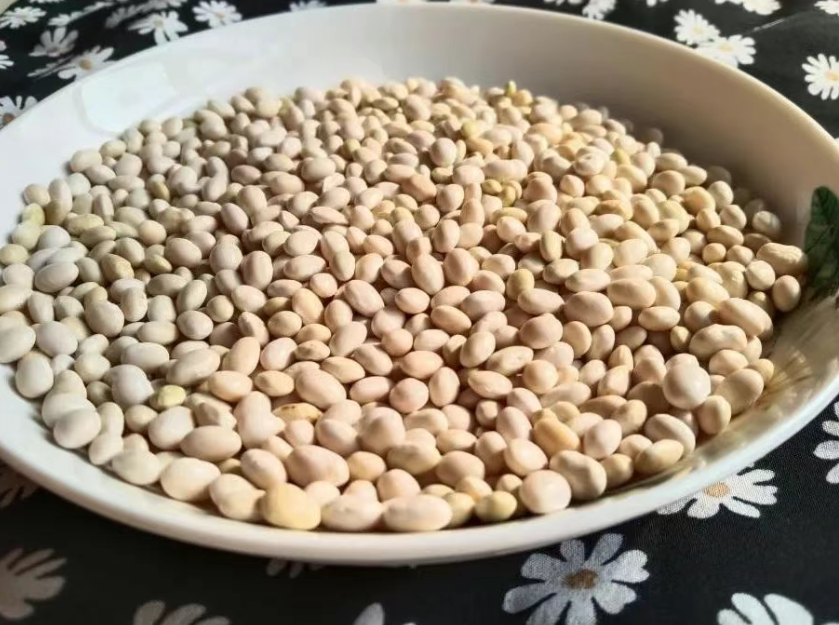

On 13 April, I began my trial sowing. Because the interval since the last growing season was so long, I first tried starting seedlings in paper cups, but that failed too. On 17 May, I planted some more in the field behind our house. In the end, only three little seedlings emerged, and then the birds ate them; gradually they all withered and died.
Just when I was disheartened and losing all hope, around 18 June, an official from our county Bureau of Agriculture and Rural Affairs suggested I try once more — this time sowing directly in the field. I checked the weather forecast in advance, brought water with me, and sowed the seeds straight into the soil. To my great delight, more than forty seedlings came up. To keep the birds off these tender shoots, I cut Sprite and Coke bottles in half and pushed them into the ground around the plants. Sparrows and other birds come along to feed, and sometimes they get a scratch on their bellies, so they stop coming back — and that has protected the White Common Beans very well.
After that, I went to check on them every few days and took a few photographs. At first we all believed it was a soybean, but as it kept growing, it became clear it did not look like one. I posted the photos in my WeChat Moments, joking that the ‘soybeans’ I had planted were growing “all wrong”. A teacher at Yunnan Agricultural University replied that soybeans can indeed have a climbing habit. But it was not until the plant produced white, butterfly-shaped common bean flowers that I became certain this was absolutely not a soybean. And only when it set pods did I realise the variety was a seed-use type common bean: its seeds are edible, but the pods are not.
By carefully documenting this whole process afresh, I also corrected our earlier misclassification. Once I had confirmed it was indeed a common bean, I made a new set of records. Every time I revive one of these endangered varieties, I feel immensely happy and proud — I feel I have given these old varieties a second life, and that is truly worthwhile. The more I do, the more I want to keep going. I hope that in the future I can contribute even more to the protection of biodiversity.
Bean Culture and Traditional Customs
Because of my passion for seeds, when very few people in the village still grew the White Hyacinth Bean by 2023, I made enquiries on my own and carried on cultivating it to bring it back. Some of our heritage foxtail millet varieties, such as Pi Ma Qing, have a darker grain colour and a high anthocyanin content, making them especially well suited for brewing a green-millet congee for people with liver troubles.
Wangjingzhuang was once a place cut off from the outside world, rather like the Peach Blossom Spring of legend. Villagers’ households were generally poor, and life was very hard. There were no roads into the village; the only link to the outside world was the village camel caravan, which could bring a little grain in from afar. Yet even so, food was desperately scarce. To stay alive, people had to go all the way to Anyang in Henan to buy the chaff stripped from millet grain — what we call grain chaff, yòu kāng. To survive, families ate almost entirely plant-based food, doing without meat for years at a stretch; a trace of oil or animal fat was only to be seen at New Year. Because they simply could not afford meat, villagers had to eat all sorts of beans to get the protein and amino acids the body needs. Day to day, they also relied on crops with medicinal value to keep themselves well. Depending on what they or a family member needed, they would grow a particular kind of bean: if one felt overheated, a cup of green bean soup helped; if hair was falling out and one needed to nourish the kidneys, one ate black beans; if there was swelling, a soup of adzuki beans. Adjustments like these were made to fit the body’s needs.
With so many crops growing here, Wangjingzhuang has adapted to its local geography and built up a distinctive ecosystem, one intimately woven into everyday life. Let me tell you about that through the culture of beans. Take a wedding, for instance. When the bride arrives at the groom’s home — stepping down from the sedan chair or out of the car, as it might be today — the groom’s family invites someone to stand at the doorway holding a traditional measuring vessel called a sheng. In Wangjingzhuang, this is a square, wooden vessel made to the old standard of ten sheng to one dǒu. Five kinds of grain are placed inside the sheng, and the five grains of Wangjingzhuang are foxtail millet, proso millet, beans, hemp seed, and wheat. The sheng is then scattered over the bride’s head and body, signifying that her life ahead will rise steadily, step by step, and be filled with happiness.
Funeral customs work in much the same spirit. In Wangjingzhuang, when someone has died, the coffin is prepared and, before the body is placed inside, a layer of millet stalks is laid on the ground and five grains are scattered over them — an act of gratitude to one’s parents and to the five grains for their nurturing care of us human beings. On the day the coffin is buried, an eternal lamp is lit beside it. When the lid is sealed and the filling-in begins, earth is first thrown in across, then along the grave’s length. Once the mound has been shaped into a round, the five grains are scattered over the top. This is called xiào zǐ sǎ fù guì — “the filial child scatters fortune.”
I have felt this quite personally myself. This past April, after my maternal aunt passed away, the person in charge of the funeral told me that, as her own sister’s daughter, I should take the five grains and scatter them over her grave. As I stood there, I was silently praying for rain to come, hoping that grains would sprout from the mound so that her family would never go without food or clothing and her descendants would grow ever more prosperous. I also hoped that once the grain grew, the sun would not scorch the bare earth of her resting place — that those five grains might shelter her from wind and rain.
We also have a custom of household separation here. In Wangjingzhuang, once a son has married, he typically sets up his own home apart from his parents. When the family divides its property, the bride’s parents bring a handful of vigorously growing mung bean sprouts along with some grain to the daughter’s new home. The meaning is that, like those bean sprouts, the daughter will take root, flourish, and grow strong and healthy in her husband’s household, and that her days together will grow ever better.
Every year at the Laba Festival, Wangjingzhuang celebrates the Birthday of the Sparrows. Villagers cook a bean-and-millet rice pilaf using all kinds of small beans and millet. Most of us in Wangjingzhuang follow Daoist beliefs, so first the millet rice is offered to the deities. Once the offering is done, a bowl of the bean rice is placed on the rooftop for the sparrows to eat. It is a gesture of gratitude to the sparrows, for legend has it that Wangjingzhuang once had no foxtail millet at all — the sparrows carried the seeds in from a faraway place. This, too, is a typical expression of the Wangjingzhuang people’s respect for nature and their desire to live in harmony with it.
Challenges Ahead
Today, although Wangjingzhuang still grows many heritage varieties, its biodiversity is also facing significant challenges.
First, one defining characteristic of Wangjingzhuang’s traditional heritage varieties is their long growing cycle and very low yields. For instance, the heritage variety Golden Empress maize produces only 500 jin per mu, whereas in the plains it can yield over 1,000 jin. Traditional adzuki beans also produce very little: black adzuki and red adzuki yield just 100 jin per mu, and red beans sometimes as little as 60 to 80 jin — remarkably low.
Second, seed resources are being lost. New varieties are being promoted vigorously for their higher yields, better marketability, and greater economic returns, which has led to a reduced planting area — and in some cases the near-disappearance — of many traditional heritage varieties.
Third, ours is a mountainous area, and traditional farming methods are still in use. The terrain of Wangjingzhuang is steep, making it impossible to use large agricultural machinery, so labour costs are particularly high. For example, when villagers plough with their donkeys, they can till at most one to one and a half mu in a day. Once the foxtail millet and maize seedlings emerge, gaps must be filled by hand, and weeding has to be done three times over. There is an old saying in Wangjingzhuang: “Only the millet that has been hoed clean three times makes a porridge that truly tastes richer, more fragrant.” As a result, villagers farm with great care and diligence, which drives labour costs exceptionally high.
Fourth, extensive areas of terraced fields have gone fallow. With urbanisation, younger farmers have begun to seek work elsewhere. For their children’s education and better access to healthcare, many have chosen to buy property in town. The village has lost its young workforce, leaving vast stretches of terraces uncultivated, while the income the terraces do generate remains very low. As our elders pass away one after another, traditional farming skills have not been adequately passed on. Moreover, the sheer physical demands of agricultural labour make young people reluctant to take it up.
Fifth, extreme weather makes farming ever riskier. Wangjingzhuang’s climate brings drought in nine out of ten years; in recent years the drought has been particularly severe and temperatures unusually low, causing poor seedling emergence or drastic yield losses. In 2019, a severe drought caused yields to drop by almost 70 per cent; in 2021, flooding struck; and in 2022, a serious cold spell — a late-spring cold snap followed by a persistently cool summer — meant that bean crops either failed to flower or produced underdeveloped pods with flat, shrivelled beans. This year has seen another severe drought. Where foxtail millet would normally be heading by now, people have only just begun gap-filling, and some are still waiting for their seedlings to emerge. Extreme weather has become one of the most destabilising factors in food production.
Yet we also face opportunities. First, demand is growing. More and more people today are health-conscious, favouring wholesome, ecologically produced food — and particularly heritage varieties. Wangjingzhuang’s wealth of heritage varieties and rich biodiversity means there are more channels of sale: people travel here specifically to enquire about and buy the particular old varieties or produce they are looking for, giving villagers who grow these heritage crops a broader market.
Second, Wangjingzhuang has been recognised as part of a Globally Important Agricultural Heritage System (GIAHS). The Farmers’ Seed Bank was established, along with exhibition halls and the Handan Seed Museum. Seed culture has been continuously promoted and celebrated, and both CCTV and Xinhua News Agency have made repeated documentary visits to Wangjingzhuang. On the commercial side, businesses are building their brands. Farmers can grow as they please — as long as they do not let the land lie fallow, they are safeguarding the biodiversity of heritage seed.
Wangjingzhuang has now submitted 60 heritage seed samples to the Hebei Provincial Seed Resource Bank. For instance, some varieties, such as the foxtail millet from Laiwu County, have been sent for space breeding, further strengthening the cause of biodiversity conservation.
Third, drawing on our earlier general survey, the flora-and-fauna survey, and the village culture survey, and under the editorship of Professor Sun Qingzhong from China Agricultural University, we published three gazetteers: “Shexian Dryland Terraced Field System: A Cultural Record of Place Names — Historic Landscapes,” “Shexian Dryland Terraced Field System: A Cultural Record of Crops — Nature’s Larder,” and “Shexian Dryland Terraced Field System: A Cultural Record of Villages — Stone Streets and Neighbours.” Together they cover Wangjingzhuang’s terraced fields, crops, and village culture. The Historic Landscapes volume was co-written by twenty members of the Terraced Field Association. These books have also introduced a wider outside audience to the crop culture, village culture, and terraced-field culture of Wangjingzhuang.
In addition, we hold a summer camp for local children every year. I serve as a counsellor at the camp, introducing the children to traditional heritage varieties and the culture surrounding them, so that Wangjingzhuang’s children grow up understanding and loving their homeland, treasuring its old varieties, and building deep emotional ties to the place from a young age. In time, when they grow up, they too can play an even greater role in sustaining Wangjingzhuang’s biodiversity.
I have finished reading Vanishing Foods. In truth, it gave me a very personal, visceral response. On page 64, for example, the book describes how farmers are told to pull out certain plants — plants that may have grown in that same spot for thousands of years — only for them to vanish in an instant. We are at the very last threshold: the more severely diversity is lost, the greater the risk we all face. I feel this with particular intensity. Wangjingzhuang is home to some outstanding heritage varieties. If no one keeps on growing them and passing them down from generation to generation, they will lose their life and vanish from this world forever. It falls to more of us to protect them — to race against time.
On page 86, I came across a passage that also deeply struck me: “Crops cultivated across millennia have become landrace varieties. For hundreds, even thousands of years, rice, maize and other cultivated grains have continued to evolve in different places, adapting to local environments, intertwined with ecosystems, populations, and cultures.” This passage is perfectly apt for Wangjingzhuang. From the time of its founding in the Yuan dynasty, Wangjingzhuang had only 500 people; today, it is home to over 4,600. Biodiversity has sustained population growth, feeding more and more people. Its distinctive cultural practices — the ways of growing Sichuan pepper, foxtail millet, maize, and other crops — together with the cultures surrounding beans and a whole range of produce, are inseparable from the ecosystem and from people’s everyday lives. All of this resonates deeply with me. Culturally, Wangjingzhuang observes a seasonal calendar of foods: bean-and-millet rice at the Laba Festival, dumplings at the Winter Solstice, steamed wheat-flour buns at ancestral rites — crops and culture woven tightly together.