
Can You Make a Living Walking to Deliver Food in Australia?

Then I happened to spot someone online delivering food on foot in Melbourne’s CBD, and I thought it suited me perfectly. I love walking, trams in the city centre are free, and they come every two minutes – quick and easy. And just like that, I joined the ranks of food delivery riders.
At first I was thrilled, as though I’d unlocked a new character in a game. Friends back home would act surprised, and I could hear the unspoken question behind their words: why would a former city career woman be doing this sort of thing? But here in Australia, no one looks down on what I do.
As far as I’m concerned, delivering food is miles better than my old job in Beijing’s creative industry – like carving flowers on a pile of shit.
I. How Much Can You Earn Delivering Food in Melbourne in a Month?
I sorted out my criminal record clearance and Australian Business Number (ABN) – having an ABN means I have sole trader status, can file a tax return, and can take orders as a self-employed delivery rider. Next, I verified my identity on the platform, completed an online safety course, and all the paperwork was done within a week. Before long, Uber Eats had posted me a cycling safety kit.

Lots of people start delivering food to grab the platform’s referral bonus, and I’m no exception.
At the time, Uber Eats’ rule was that new riders who deliver 40 orders in their first month earn AUD 400 (roughly RMB 1,868), and so does the person who referred them. What does that mean in practice? If you’re cooking at home – eggs, dairy, meat and veg every meal – AUD 400 covers two to three weeks’ worth of groceries.

In 2023, Australia’s minimum hourly wage was AUD 23.23 (roughly RMB 108). Can food delivery earnings hit the minimum wage?
If you drive and keep taking orders non-stop, you’ll average around AUD 25 an hour after tax. Once you deduct fuel, servicing and other running costs, your net take might hover just around minimum wage. My friend Emma drives for deliveries in Melbourne – her car is pretty thirsty, so after expenses her effective hourly rate works out to about AUD 22.
For someone like me, delivering on foot, the range per order is limited and each job earns roughly AUD 5 – do the maths and it’s certainly below minimum wage. But as a Working Holiday Visa holder, my attitude to delivering food is simply “having a go” rather than putting food on the table, so I don’t sweat the numbers.

I deliver three days a week, working three to four hours across the lunch and dinner peaks, earning anywhere from AUD 10 to 20 an hour. Sometimes there are bonus campaigns – complete three orders and you pocket an extra AUD 10 or so.
All told, I completed over 80 orders in my first month. Factoring in platform bonuses, peak-hour surcharges and tips, I earned over AUD 1,200 (roughly RMB 5,617). My other part-time café job covered the rent, and some months I even had AUD 300 left over.


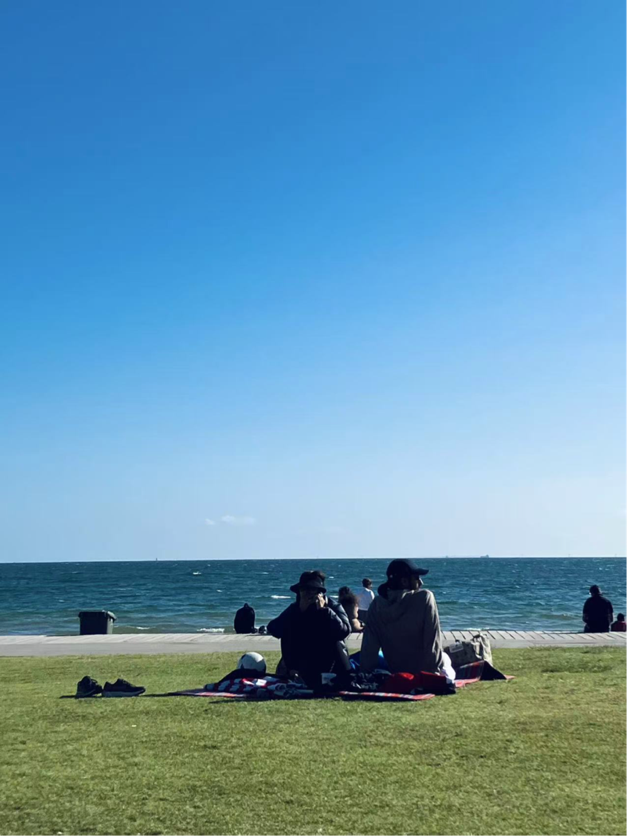
For me, the real blessing is that I never work more than 30 hours a week. I’m done with eight-hour days, the nine-to-five grind of sitting in an office. The café closes early, so by four in the afternoon I’m usually kicking back on the beach. By then, plenty of other people are already there too – chatting, walking the dog, or just lying flat in the sun.
If you’re not chasing big money, working 30 hours a week legally in Melbourne means you can genuinely enjoy a good work-life balance.
II. Not an Ad, But Uber Eats Has Been Pretty Good to Me
To start with, Uber Eats doesn’t set a strict delivery deadline, so I won’t be penalised for running late, and riders aren’t required to bring orders right to the doorstep either – most of the customers I meet simply wait for their food at the building entrance. Still, I hold myself to the principle of “not wanting to trouble anyone else” and work hard to deliver on time.
Melbourne weather is fickle – one moment it’s clear blue skies, the next it’s pouring. Add in tram delays, road works, strikes and protests, and the streets get even more congested. An order that should take ten minutes might mean an extra twenty on foot. Yet the customers I’ve met, young or old, never seem rushed. They just keep thanking me: You did a great job!
The worst situation I’ve run into is someone giving me a cold face to my face, not saying thank you, and leaving a couple of grumbles on the app about slow delivery. Even then, I don’t get docked pay.

Riders aren’t rushed, and the platform doesn’t dictate how long a restaurant should take to prepare food, but it does nudge efficiency in other ways – for example, by calculating an “estimated prep time” based on past order data.
If a store consistently takes longer than this benchmark, the system flags it as a “slow order” restaurant. That can lead to a lower ranking in the algorithm, so customers may see it further down the list and be more likely to leave a poor rating. It can also discourage riders from accepting the order – if a rider is kept waiting past the expected time, there’s no compensation.
Most of the food I pick up is fast food, so I rarely run into delays. Sometimes I rush to a restaurant only to find the order isn’t ready yet, and the staff simply say, “Have a seat – no rush.”
They always have “take it easy”, “no worries” and “have a good day” on their lips, and that philosophy has slowly seeped into my own life too. How much you earn comes second – earning enough to support yourself is already brilliant! When I have to wait ten to fifteen minutes, I don’t fuss – I just treat it as a rest. Of course, this sense of ease mainly comes from the platform having your back.

For instance, if a restaurant misses something from an order and the customer calls to ask whether it can be re-delivered, the process depends on the stage you’re at. If the rider has already marked the order as delivered, the customer should contact the restaurant for a refund; if they haven’t, the rider can go back to the store to pick up the missing item, and the platform will provide a delay allowance for the extra time.
Food quality issues are also handled by the restaurant first. Once, a bowl of noodle soup spilled inside my insulated delivery bag. I contacted customer support, and not only was I held harmless – I was given AUD 3 as compensation, probably a small gesture to comfort the poor soul scrubbing her bag clean.

I usually hand the food to the customer in person, enter the PIN code they show me, and the order is done. Once, a customer refused to give me their PIN code, annoyed that delivery was too slow. I simply set the food down at the door, tapped “Need Help – Delivered” in the app, and that was the end of it. For customers who don’t answer the phone, I just tell support I couldn’t find them – I absolutely refuse to wear myself out over a job.
III. Delivering by Bike – Felt Like I Was Risking My Life
Melbourne has quite a few hills, some stretches share lanes with cars, and on top of not being used to driving on the left, slippery roads after rain got me. I fell off twice. At those moments I genuinely felt like I was risking my life, and I stopped telling myself that delivering food was just exercise and fun.

For someone like me with zero sense of direction, even Uber’s built-in navigation can steer me straight into trouble. One rainy day, bad GPS data left me running very late. To my surprise, the customer was waiting for me at the door, handed me a AUD 10 tip, and kept saying thank you, mentioning how tough it must be delivering in the rain. Every time I meet a stranger like that, I feel a real sense of safety.
Rainy weather brings the busiest delivery hours. Uber’s map marks these hotspots in red and shows an extra AUD 1 to 5 per order. On one hand, I think the surcharge is only fair – delivering in the rain is genuinely hard work. On the other, I don’t think riders’ protections should stop there.
In Australia, whether delivery riders have workers’ compensation is up to the platform. Uber Eats provides workers’ compensation insurance, but cover is limited to active delivery hours and is far removed from what you’d get in a full-time job. Gig workers also miss out on superannuation, annual leave and overtime pay.

Some people are also trying to break this gig model.
The Australian Broadcasting Corporation (ABC) reported that former delivery rider Vishal Plato founded Fuel It Up, partnering with restaurants that pay a monthly fee based on delivery volume plus a flat AUD 6.99 per drop-off. Plato’s aim is to guarantee delivery riders a minimum wage through this structure.
State and territory governments are also strengthening riders’ rights. This past March, New South Wales amended the Industrial Relations Amendment, formally bringing delivery riders under the gig worker category, setting minimum pay for them, and establishing mediation support for disputes between platforms and gig workers.

A lot of people call Australia “the ceiling for gig work,” and I think it earns that title not because the safety net is flawless, but because the people doing the work are genuinely seen and respected.
IV. The Sunny Australians Who Cured My Anxiety
I suspect the people ordering food think the same. Getting angry doesn’t help – work moves at its own pace here, and the environment is what it is. People here don’t take convenience and speed for granted.
I often hear people abroad grumble that the locals are so slow everywhere. But could it be that it’s China that’s moving too fast? I’ve actually settled into the rhythm here completely – you don’t rush me, I don’t rush you. It feels as though this is the pace I was born to live by.

Delivery orders have also unlocked plenty of places I’d never have found on my own – I tell myself, “Once I’ve earned enough, I’ll come back and eat here.” Little by little, I’ve started to feel part of the city, and the anxiety of being new here has eased.
Still, I can’t imagine making food delivery my full-time job. Every time I see a rider tumble off their bike on one of Melbourne’s busy streets and scramble straight back on to ride off again, I’m instantly thrown back to similar scenes I used to see in Beijing. It reminds me that this delivery “experience” is no great wide-open – it’s simply a version of myself, blessed with a little youthful privilege, tentatively wading into the cruel river of reality.

Editor: Zeen