
Harvest Looming as ‘King of the Winds’ Strikes Western Guangdong Farmers
I. Typhoon Shifts South, Force 12 Wind Radius Closes In on Farmers

Hao Nan explained that Huajiasha’s track had shifted slightly to the south, cutting the Force 12 wind coverage area by nearly 90%, and the damage caused by a typhoon is directly related to its wind grade.
Moreover, even within the Force 12 wind radius, the destruction in urban built-up areas and in rural communities differed enormously.
Hao Nan noted that in general, urban municipal infrastructure in China is designed to a disaster-resistance capacity for Force 12 winds. Below Force 12, cities can generally recover quickly, but once the Design resistance level is exceeded, losses multiply. For rural areas, however, even a Force 10 wind radius is enough to inflict devastating damage on agriculture, forestry, animal husbandry and fisheries, and on their basic infrastructure. Such losses are hard to avoid – only reduce – and this is why vulnerable rural areas need to strengthen Climate resilience.
Between 8 a.m. on 24 September and 8 a.m. on 25 September, during Typhoon Huajiasha, wind speeds in Yangjiang city centre reached above Force 13, causing severe destruction. In the township and village areas of Hailing Island, Yangjiang, and the Shangchuan and Xiachuan Islands in Taishan, winds reached Force 14 to 17. Shangchuan and Xiachuan, both townships, were cut off from communications at one point.
II. Yangjiang: Fish Cages Shattered, Aquaculturists Beyond Tears
“Resuming production is out of the question. Wiping our tears, crouching on the fish rafts, we cry out to the sky: ‘Where is the justice?'” Zeng Xianguang, secretary-general of the Zhapo Cage Aquaculture Association, told Foodthink in a hoarse voice. He said many of Hailing Island’s aquaculture rafts had been smashed and battered – “the nets are all torn to shreds, and the fish have all scattered.”
Zeng still remembered vividly the date of 24 September 2008 – 17 years ago – when Typhoon Hagupit made landfall in Yangjiang. It brought winds of Force 16, the most devastating typhoon in Hailing Island’s 40-year memory of aquaculture. But Huajiasha was worse still.
In an interview with Red Star News, Zeng explained that among local aquaculture operations, cage aquaculture suffered especially heavy losses because there were no effective safeguards against extreme winds. At present, the timber used for the rafts is of good quality and can withstand winds of Force 11, but against Force 12 and above they are powerless. Before the typhoon, farmers could only make simple reinforcements with long cables and then sell off some of their pompano at a loss.
But selling wasn’t fast enough either. “Every household was trying to sell – it’s not as simple as wanting to sell and being able to.” He told Foodthink that normally the buying price for golden pompano ranges between ¥22 and ¥25 per jin. But before the typhoon struck, the price had dropped by ¥3.5 to ¥4 below the usual rate.
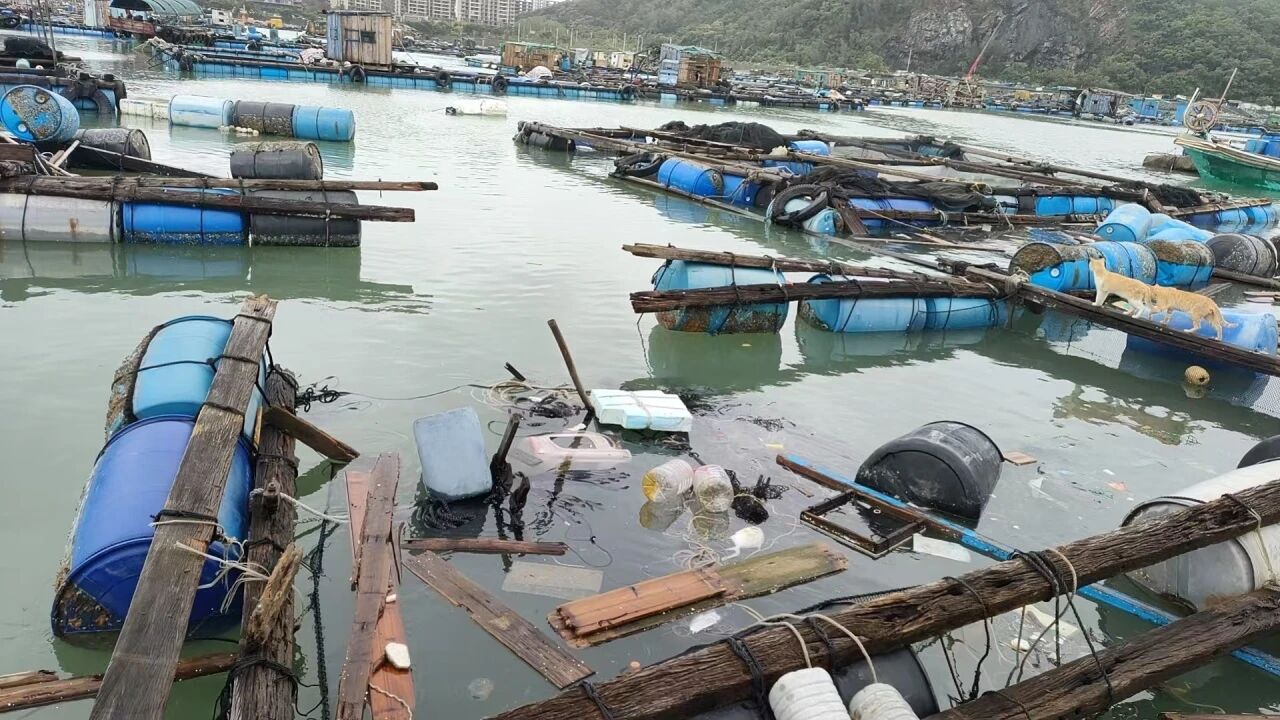
As for overall losses across the aquaculture sector, each farm had lost hundreds of thousands or even millions of yuan, but precise figures could not be calculated, he said: “No one has filed a damage report yet. Every department in Yangjiang needs to compile statistics – none can come up with a number for now.”
He gave Foodthink an example: a large Deep-sea aquaculture operator might have over 150 fish cages, each roughly 100 metres in length and width, holding 120,000 to 130,000 fish, with each fish weighing close to 1 jin – that amounts to a loss of 18 million jin.
Local fisheries experts also said that for 20 years they had been lobbying for aquaculture insurance, but ‘every year we push for it, and not once have we won it.’ The disaster risk was too great, and insurers were afraid of losing money.
The risk was high, yet returns were falling. “Year after year it gets worse – we run at a loss.” Zeng said that under the combined weight of multiple factors, in recent years the traditional near-shore wooden raft aquaculture had been unprofitable. Near-shore farming pollutes the ecosystem and degrades water quality; it is being phased out as a trend, and production costs have risen. In addition, feed prices had climbed by more than 20%, and suppliers demanded cash payment. Even more critically, the buying price for pompano kept being pushed down.
He said that only fishermen who own large vessels for Deep-sea aquaculture and can handle both transport and trade could turn a profit. But Hailing Island still has 462 near-shore wooden raft farms, while Deep-sea operations number fewer than 100.
In this situation, smallholders running aquaculture rafts must take out loans. Zeng said many farmers on Hailing Island had mortgaged their properties, but a house worth ¥1 million could secure a loan of at most a quarter of that. Some farmers had poured into their operations not only their savings but even the money set aside for temple offerings, yet they still hadn’t repaid their loans.
“Plenty of people who took out loans to raise fish are now in loss after loss – they can’t even bring themselves to speak. My dad just came back from the orchard; he said the fish farmers near the orchard are slumped down beside their ponds.” Huang Ting, a resident of another town in Yangjiang, had also observed the farmers’ plight.
Huang Ting’s father had been growing fruit trees locally for more than a decade, but all that experience and effort was no shield against natural disaster – the orchard was devastated. Local crop insurance costs over ¥400 per mu in premium; she asked around, and none of the affected farmers nearby had bought a policy. Now the township agricultural office has opened a channel for farmers to report losses, but it cannot guarantee any subsidies.
A rural and township documentary filmmaker and Bilibili content creator, “Yuzhen Chronicle”, visited Zhanjiang, Maoming and Yangjiang before and after the typhoon, interviewing many farmers and aquaculture operators. He found that losses across Yangjiang’s townships were far greater than in Zhanjiang, Maoming and other areas, and not confined to aquaculture alone. In Yangjiang, a couple from Xinyang, Henan who grew banana groves and a couple from Taizhou, Zhejiang with 50,000 sugarcane stalks suffered total wipeout. Their prefab shelters by the fields were also torn apart – walls toppled, roofs torn off. The bananas had been barely ten days from harvest. All the growers had been hoping to sell at a good price during the Mid-Autumn and National Day holiday.


III. Taishan: Power and Communications Cut, Ponds Overflowed
Taishan is renowned for its oysters. Zhang Qing’s family also told her that the oyster rafts along the coast from Haiyan Town to Guanghai Town had all suffered heavy losses.
People were still rallying their spirits, bracing themselves for the influx of visitors and business during the National Day golden week.
Along the coast, farmers practise cage aquaculture on fish rafts, while on inland waters not directly adjacent to the sea, they operate brackish-water ponds. But after the typhoon passed, the ponds were inundated, and thousands or even tens of thousands of mu belonging to dozens of operators merged into one expanse. Fish, shrimp and crabs all escaped.
One mud crab farmer in Xincun, Douhu Town, Taishan, lost every single crab in his 50-mu pond this way. He told Foodthink that the mud crabs had already matured, but all the farmers had been hoping to wait until the National Day holiday to sell at a premium; now the loss on each mu of pond was at least ¥20,000.
Official data show that total brackish-water aquaculture area in Xincun, Douhu Town, exceeds 6,000 mu.
For these farmers, there was simply no protective measure to be taken, because ponds cannot be reinforced in advance – ‘there is nowhere to put all that mud.’ On the 24th, the night the typhoon struck, they were ordered to evacuate their ponds. He paid for a hotel room in town himself; when he returned to the ponds on the 25th, ‘there was nothing left – only water and grass.’ His house, boat and ponds had all been destroyed.
Over a decade ago, he had come here from Guangxi to farm fish, signing a pond lease agreement with a villager at ¥2,000 per mu. Most local ponds are leased by outsiders. ‘They see typhoons so often – I suppose the locals don’t want to farm anymore.’ He let out a rueful laugh.
Taishan had been hit once before. Records show that Typhoon Tapah made direct landfall at Taishan, Guangdong, at 8:50 a.m. on 8 September, with centre winds of Force 11, compounded by the spring tide, causing severe seawater intrusion and wreaking havoc on aquaculture in Douhu, Haiyan, Lianzhou of Zhuhai and other areas.
‘We’ve had water come in before, but never this bad,’ said the farmer.
The water still had not receded. On the 25th, he paid for an excavator to rebuild the earthen bunds around the ponds.
Another mud crab farmer in Chixi Town, Taishan, sent a video showing the damage to his own farm. ‘It’s all over – I’ve lost everything.’ In the footage, the ponds had completely collapsed; the torn nets hung empty, with not a single crab inside, while some farmers stood dejectedly beside their toppled colour-steel-sheet sheds. The post-1980 farmer had once enthusiastically shared his crab-farming tips on his WeChat Channels account.
‘I don’t want to talk about it.’ That was the last thing he replied.
The people of Taishan have decades of experience weathering typhoons. In Zhang Qing’s memory, in the early 21st century, two large vessels from their home fishing port sank in the Spratly Islands during a typhoon, killing more than 200 people – her kindergarten classmate’s father was among the dead. Now that information flows freely, fishermen no longer stay aboard with their boats through a typhoon, ready to go down with the ship.
But faced with ever more extreme weather, how much longer can farmers and fishermen hold out?

IV. Seawater Intrusion: The Long Road to Rebuild, a Flicker of Hope
Based on satellite imagery and terrain analysis, Hao Nan noted that parts of Zhuhai’s Jinwan District, Jiangmen, Zhongshan and Yangjiang near the Pearl River Estuary were all hit by storm surge. Among them, Jinwan District has a small funnel-shaped topography where the terrain narrows sharply, making the storm-surge inundation the most violent. Even before the typhoon’s core reached the Pearl River Estuary and made landfall, the storm had already pushed seawater inland.

Compared with visible acute losses such as destroyed fish rafts and snapped fruit trees, seawater intrusion brings groundwater contamination, soil salinisation and wetland degradation – problems affecting a larger area, more hidden, and with a longer recovery process. Simply put, seawater intrusion not only causes soil salinisation but also disrupts or suppresses soil microbial activity, thereby affecting microbial-mediated cycling of carbon, nitrogen, sulfur, iron and other elements. Of course, even without knowing scientists’ research findings at the microscopic level, farmers looking at land that has been drenched by seawater can grasp how devastating the damage truly is.
Seawater intrusion also alters the distribution of heavy metals in soil. Researchers at the Guangzhou Institute of Geochemistry, Chinese Academy of Sciences, found through experiments that rising salinity affects the mobility of cadmium in soil, potentially leading to cadmium accumulation in rice. In other words, those affected are not only farmers but potentially consumers whose staple is rice.
Yet with climate change, such record-breaking storm surges will become more frequent, while rising temperatures are driving sea levels up – one acute, one gradual; combined, they will only worsen seawater intrusion in the future.
What now? “Keep going” (grinning-face emoji). A farmer from Dong’an, Hunan, growing sugarcane in Jiangmen, replied this way on his WeChat Channels account.
In a video he posted on 25 September, dozens of mu of sugarcane lay submerged under a few centimetres of standing water; fortunately, by a miracle, not many stalks had been blown down. Before the typhoon hit, he had reinforced the entire field with thick branches and fishing net. “I’ve done all I can! I just hope you – the typhoon – will have mercy!”
This year, he plans to go back to his hometown for Chinese New Year. Next year, the sugarcane fields will still be planted.

Huang Ting and Zhang Qing are pseudonyms in this article.
Editors: Ling Yu, Tian Le