
When Environmental Protection Becomes an Exhibition: The Green Illusion of an Eco-Village
I. The Viral Countryside as Exhibition

Just ten years ago, this was still a typical small mountain village in the process of “hollowing out.” Now, in standard official language, Lushui Village has found “a sustainable development path from lucid waters and lush mountains to ecological industry, with strengthening villages and enriching households further feeding back into the ecology.” In the name of nature conservation, it has attracted industries in design, tourism, cultural creativity, and traditional crafts, becoming a model village for rural revitalisation. Inspection visits, tours, and study trips come ceaselessly — from government departments at every level, teachers and students from various universities, study-tour organisations, companies organising team-building events, and so on.
In this sense, Lushui Village is not merely a village to live in but a large-scale exhibition organised at village level. The houses, roads, shops, and fields throughout the village — everything within sight — have been carefully designed and laid out to facilitate guided tours, catering to the outside world’s twin visions of an eco-pastoral idyll and rural revitalisation.

For visiting groups from outside, Lushui Village’s rural operations company provides a basic group reception and guided commentary service for 1,000 yuan. Visitors first listen to a 15-minute talk at the visitor centre, during which the story of how Lushui Village rewrote its own destiny is told over and over. Then the guide takes the group on a walking tour with commentary along the way. The route typically strings together the Villagers’ Assembly, the Lushui Nature School, a craft museum, a craft workshop, the entrance to a hiking trail, and the Youth Centre, ending at the reservoir nestled among the mountains — the “holy land” of nature conservation. Almost every day I see coach after coach on this route, following the same path, carrying all manner of people who stop at each point to listen to different guides delivering almost the same content.
Like exhibits in a gallery bearing label cards, the village has a set of designer-made wayfinding signage that, starting from the village name sign at the entrance, directs visitors’ attention to these key locations that constitute the model rural revitalisation village, each accompanied by a brief text description. Most of the signposts, however, point to the village’s growing number of restaurants, guesthouses, and other commercial establishments. The language used to mark locations serves outsiders. For example, the village’s traditional cluster of shops and street-stall vendors is labelled “CBD,” even though locals are more accustomed to calling it the Under-the-Bridge Market — the original place name.
Because the amount of information that needs to be conveyed to visitors keeps growing, these signs are now becoming larger and taller, quite a spectacle in themselves. The original wayfinding system actually featured a clean, low-saturation colour palette, with smaller panel areas and font sizes that blended well into the village’s hills and waters without feeling jarring or oppressive. However, these signs, legible only to pedestrians, cannot meet the footfall needs of the businesses; they require larger panels and bigger type to attract drivers.

II. Manufacturing the Green Illusion
From “polluted mountain village” to “village of the future,” Lushui Village’s green transformation story is often a favourite topic among outsiders. Yet a friend called Fish Tank, who returned to the village to farm, raised with me the question of whether Lushui Village truly qualifies as an “eco-village.”
The story of how Lushui Village became an “eco-village” goes like this: before 2015, for a long time villagers had relied primarily on managing Moso bamboo groves and selling bamboo and bamboo shoots from the area above the village reservoir as their main livelihood. In the pursuit of yield, they overused chemical fertilisers and herbicides, which ultimately caused non-point source pollution, including excess nitrogen and phosphorus in the reservoir.

At the time, an environmental organisation partnered with the government to lease several hundred mu of Moso bamboo groves located upstream of the drinking-water reservoir from the farmers, ceasing the use of chemical fertilisers and pesticides in the groves and thereby improving the reservoir’s water quality. The project raised donations from a tech giant and a financial firm to pay the bamboo grove rent. The tech giant could, in turn, use this to build its own “eco-friendly” public image, even though its e-commerce business generates vast quantities of plastic waste every year.
After that, as external funding and personnel arrived, the conservation project incubated the Lushui Nature School, guiding villagers to run guesthouses and farmstays to meet the growing visitors’ needs for food and lodging. At the same time, the conservation project formed a connection with a design firm through an exhibition they co-planned, which ultimately led the firm to relocate its entire operation to Lushui Village, bringing in dozens of employees and converting a derelict socialist-era auditorium in the village into a non-profit craft museum.
A few years ago, the village collective established a rural operations company, hiring a village CEO to attract more businesses and design studios to set up. The operations company has also planned to introduce art festivals, music festivals, sports events, and various other activities of different scales, bringing in play and art installations such as “Egg Castle Party” and “Cat Climbs the Sky” during holidays to adorn the whole village.

These emerging business formats have undeniably injected vitality into the village, yet they have seldom touched agriculture — the most fundamental sector of rural life, and the one most directly connected to nature.
Setting aside its viral-village identity, Lushui Village is also a bamboo-producing area and a rice-growing agricultural zone. In the low mountain areas, large tracts of Moso bamboo (grown for both shoots and timber) are widespread, while small patches of early-spring bamboo and buji bamboo groves can be found in the fields and behind houses. The flat river valleys between the mountains hold thousands of mu of farmland. In earlier years, owing to the corresponding subsidies and profits, much of the arable land was converted to seedling plantations. In recent years, under the permanent basic farmland protection policy, most of the flatland has been cleared of trees and returned to cultivation.
However, like many villages in China, Lushui Village is rapidly shedding the dependence on and stewardship of the land that characterised traditional rural life. In today’s Lushui Village, most young people work away from home, and villagers born in the 1980s or later largely lack farming experience, so this farmland has been consolidated and transferred to a few outside landholders who practise modern chemical agriculture, relying on chemical fertilisers and pesticides to achieve large-scale cultivation.
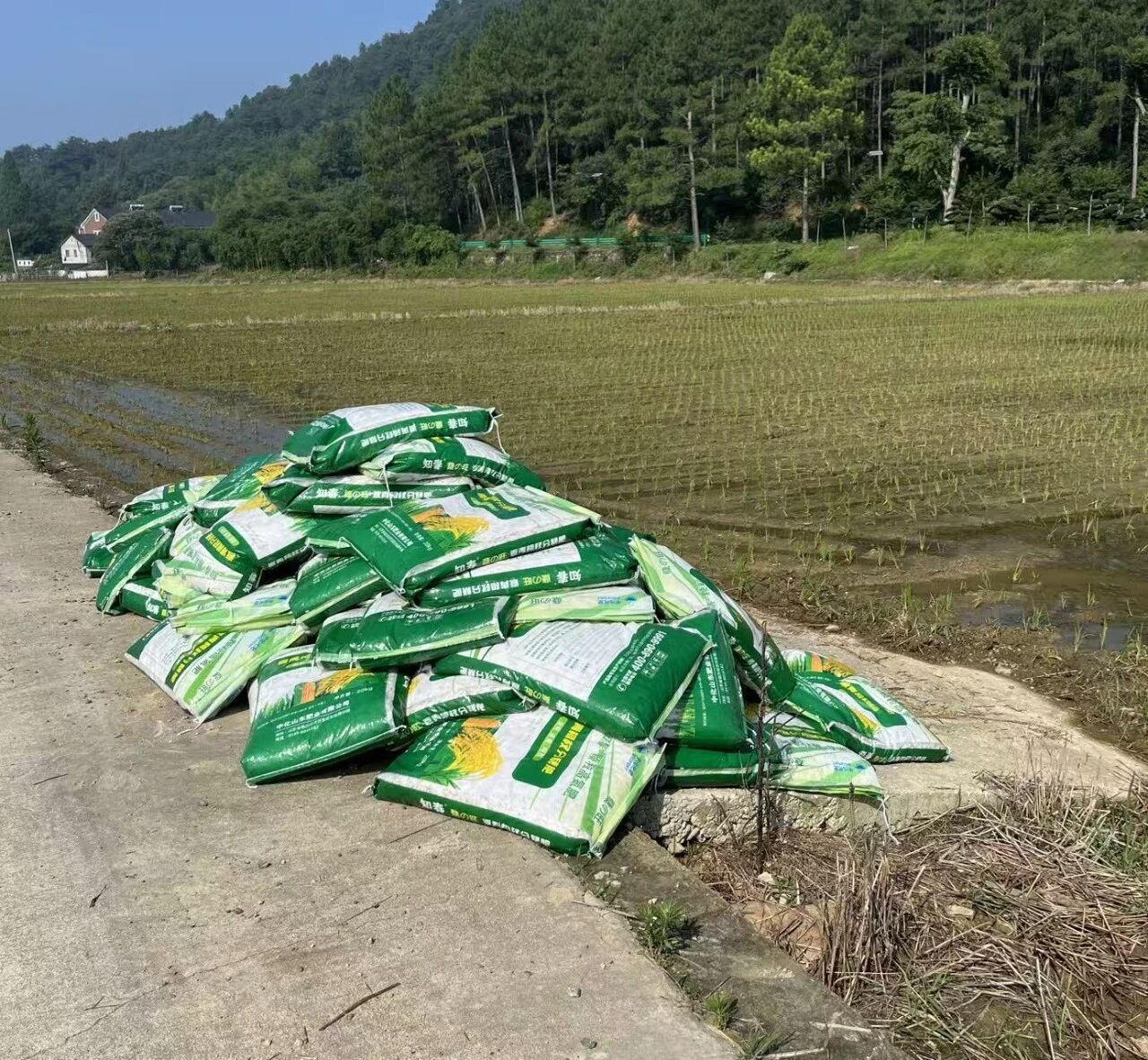
Therefore, on this land, when you see green or golden rice paddies, you might assume they are a landscape that heals the soul. But strip away the filter, and you will find scorched-black field ridges hidden beneath the rice ears — the result of excessive herbicide application or concentration. And the fertiliser bags and pesticide bottles scattered across the fields and along the field edges betray a growing estrangement between people and the land.
Lushui Village, which markets itself on ecological protection, still has not escaped the shadow of chemical agriculture. Whether in China or globally, intensive use of chemical fertilisers and pesticides leads to soil acidification and compaction, increased pests and diseases, declining organic matter content, and a vicious cycle of dependence on chemical agriculture among farmers — ultimately resulting in pesticide residues and heavy metal levels in the food that urban populations eat exceeding safe standards. Today, when we talk about ecology, the first thing we must face is this series of stark realities.

When the countryside no longer loves the land, no longer nurtures the health of a place’s soil and water from the root up, the title of “eco-village” begins to feel like a castle in the air.
Beyond agricultural production, Lushui Village’s way of life is increasingly resembling the high-energy, high-consumption pattern of urban living, without developing an alternative, sustainable model: public transport here is scarce, cars are the primary means of getting around, and many people commute long distances between the city and the village; the proliferation of e-commerce means delivery stations are piled high with parcels every day, generating vast quantities of packaging waste; in some areas, native vegetation has been cleared to make way for cherry blossom viewing groves and uniform green belts… Apart from the fact that you can still buy vegetables grown by local elderly in the direct-sale section of the market, this place even resembles the American suburbs — a lifestyle built on high per-capita energy consumption.
So when the guide tells visitors that “Lushui Village’s ecology is very good — you can still see fireflies in summer, and the Lushui Nature School offers a ‘Night Firefly Viewing’ course,” they overlook the fact that light pollution, hardening of ground surfaces, redevelopment, and pesticide-caused water pollution in the village are all on the rise, all of which are threatening the fireflies’ survival and reproduction. Visitors marvel at the “pristine” rural landscape, yet the negative impact of human activity on wild flora and fauna receives no genuine attention or discussion.
The starting point of Lushui Village’s success story is the improvement in drinking-water source quality — an achievement worthy of recognition. But on the subsequent development path whose core logic is “display,” the village has strayed from its original commitment to ecological protection, even obscuring the more urgent systemic issues within the village’s ecological challenges. And in the process of passing along Lushui Village’s success narrative, government, media, the village operations team, and tourists have collectively manufactured a green illusion in the sense of tourism consumption.
III. A Future Model for the Countryside?
Lushui Village’s self-presentation and commercial operations have undeniably helped attract resources such as capital, public attention, foundations, and official support, bringing economic growth and an overall visual transformation. But can this development experience genuinely be replicated by other villages? Does drawing on this experience truly point towards a more ecological, more endogenous exploration of the rural future?
Lushui Village’s public narrative of moving from nature conservation to rural tourism sounds simple and seamless, but it is not replicable everywhere. When the water-source conservation project stepped in, the timing, location, and human factors all aligned: the Moso bamboo groves on the mountain had already reached a situation where “the old can no longer manage them, and the young don’t know how to.” With the bamboo material market contracting and profits plummeting, the conservation project was able to lease the groves from villagers at a relatively low price and carry out protection work. Thanks to its convenient location and beautiful setting, villagers shifted smoothly from managing bamboo groves to tourism and services, with little loss and even additional income.

I once lived in a village where fruit farming was the primary livelihood. The heavy use of chemical agents had severely contaminated the well water that locals relied on for daily use. Many villagers, it is said, developed kidney stones, and some even chose to buy bottled water to drink. Yet fruit, as a high-value-added cash crop, allowed locals to stay in their hometown rather than migrate out for work. In many other places, people’s main source of income comes from activities that severely pollute the environment, and it is precisely these places that supply the metallic minerals, food, and materials that modern life cannot do without. Facing these broader and more complex realities, balancing community livelihoods with the overall ecological health of the countryside often means longer timeframes and repeated adjustment — the success path of Lushui Village cannot easily be replicated.
Another key topic frequently raised when Lushui Village’s case is discussed: unlike the decline of “hollowed-out villages” where only the elderly and children remain, young people are coming to or returning to Lushui Village. The arrival of new villagers, the return of second-generation villagers, and the incubation of new industries attest to the self-sustaining capacity of this development path: starting from water-source protection a decade ago, Lushui Village has naturally become a place where people stay and settle, rather than being deliberately developed into a tourist attraction through government planning or capital-driven land acquisition, as other villages have. The village operations team tries to create the impression that this is an organically developed community with a slow-paced rural life, not a “viral village” for people to photograph and check in at.
However, many “new villagers” and returning young people work in jobs directly tied to tourism, with little connection to the land. They run restaurants and coffee shops, work at tourism reception organisations such as the village operations company, or offer various intangible cultural heritage handcraft workshops and study-tour courses. Many “long-standing villagers” are also beginning to rely on tourism for income. They renovate villas on their homestead plots to run guesthouses, and set up stalls in areas crowded with visitors on weekends and public holidays. And many young people simply live in Lushui Village — some are digital nomads, others lead an urban-rural migratory life, working in town and returning to the village in the evenings or on weekends and holidays.
Whether it is rural tourism or an urban-rural migratory lifestyle, the countryside is merely an extension of the urban work and consumption system — the city’s backyard. Under this development model, although Lushui Village has achieved the goal of strengthening villages and enriching households, it raises concerns about whether it can truly deliver on its promise of “sustainability” in the future.
An organic countryside should of course not be limited to agriculture; it ought to have a richer range of activities and divisions of labour. But in catering to the external demands and gaze of artists, designers, consumers, and media from the cities — while neglecting the agriculture that binds people more closely to the land beneath their feet, and other industries endogenous to rural life — this display of the countryside often ends up driving the village further towards “real-estate-ification” and gradually departing from the “eco” vision that Lushui Village proclaimed at the start of its story.

Today, Lushui Village can still sustain an emotional bond with the land through the local knowledge of the older generation, barely achieving a balance with the village’s commercial operations. But two generations from now, when most villagers no longer farm or have settled in the city, where will this village’s culture and traditions head? And where will its natural ecology go?
Life in Lushui Village continues, still full of vitality. Only time will give us the answer.

All photographs in this article were taken by the author.
Editor: Zheng Yuyang