
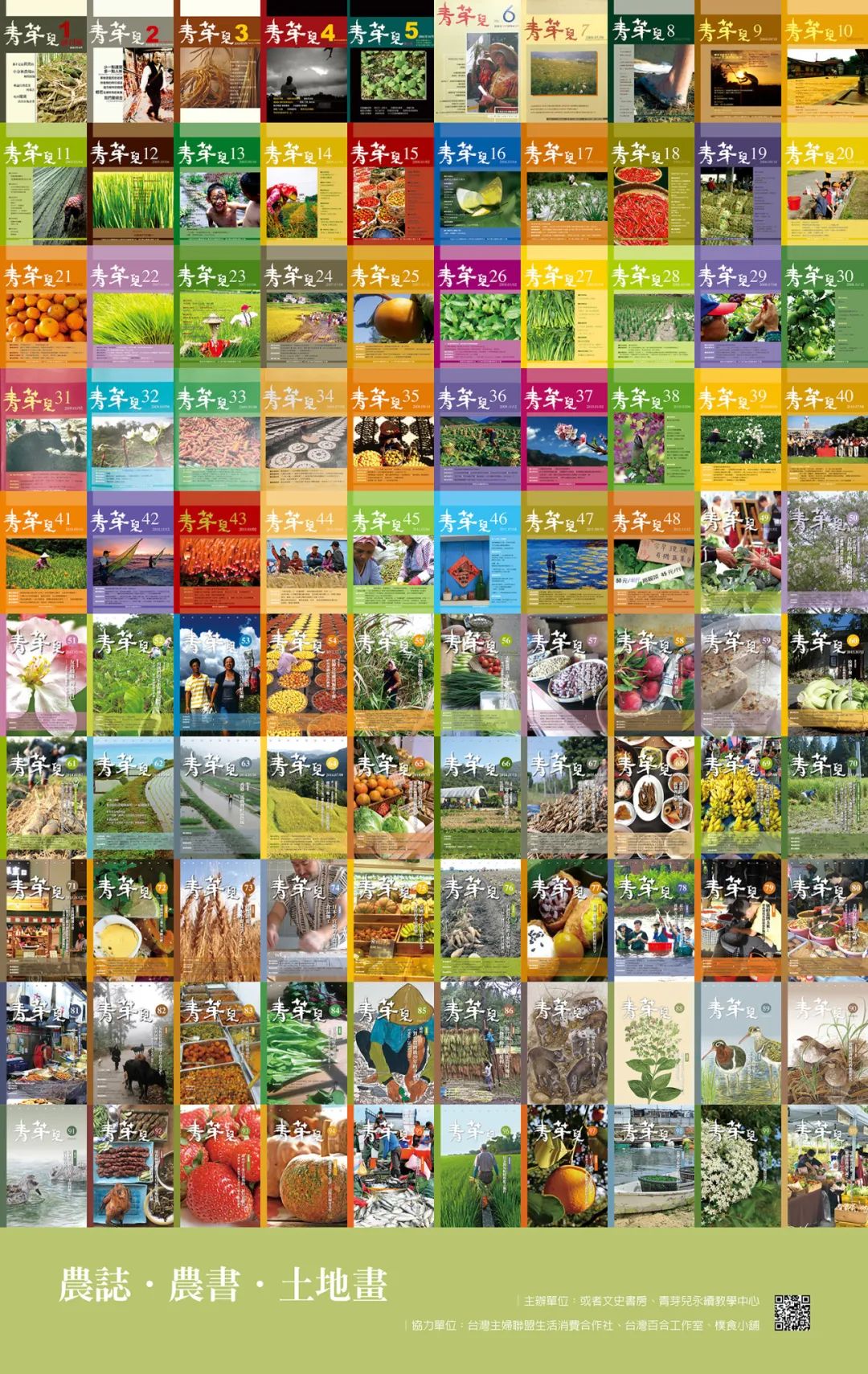
How Has a Taiwanese Food and Agriculture Magazine That Pays No Author Fees Made It Through 22 Years?
Foodthink Says
I. Three Circumstances
From 1993 to 2003, I moved from a Taiwanese city to rural life and stayed for ten years. Over those ten years, I worked with local villagers to set up associations and carry out projects such as stream protection, local landscape renovation, Hakka cultural and historical research, community education, and weekend cultural markets.
This rural experience gave rise to the idea of moving from “community” work into the “agriculture, rural areas and farmers” sector, after all, local industry and economy are an indispensable part of rural development. It also planted the seed for founding Qing Ya’er.
Another important reason that prompted me to found Qing Ya’er was my acquaintance with farmers in Taichung’s agricultural supply trade. After the 1999 921 Great Earthquake, I became involved in post-disaster reconstruction in the Taichung region and got to know many local farming friends and agricultural supply industry workers.
I found that these fruit farmers were highly skilled, able to precisely control fruit sweetness and tree growth cycles. As early as 1975, farmers had successfully grafted Japanese pear scions, giving rise to a new grafted pear industry that generated annual economic returns of up to four billion New Taiwan dollars (roughly 1 billion RMB at the exchange rate at the time).

But the impressive results came at a tremendous cost: long-term reliance on pesticides and chemical fertilizers led to soil degradation and environmental damage, seriously threatening farmers’ health – toxic mist hung in the air during spraying, and many farmers died of liver cancer around the age of fifty.
These experiences led some farmers to begin reflecting on the drawbacks of conventional agriculture. A few of them joined forces to open an agricultural supply shop called Sanheyi Agri-Supplies. They basically stopped selling pesticides and stopped pushing excessive chemical fertilizers. Instead, they went out to the orchards and, like a doctor, personally “diagnosed” the condition of the fruit trees, offering farmers scientifically based cultivation advice. They also promoted a year-by-year reduction in pesticide use, allowing the environment to gradually become cleaner.
Seeing how outstanding and deeply responsible they were, I felt strongly that all these stories were worth recording and that more people needed to hear their voices and share experiences with one another.

As a scholar, what I could do was use writing and publishing to give farmers a voice and chart a new path for the development of agriculture and rural areas.
It was under the impetus of these circumstances that Qing Ya’er was born.
II. Three Wishes
In both Taiwan and mainland China, the profession of farming has long been denied the respect it deserves, and farmers themselves often look down on their own work.
If someone asks, “What do you do?” many farmers find it hard to say they “grow fruit trees” or “grow vegetables.” This pains me – when farmers’ labour and produce are clearly the most important foundation of society, they are overlooked and belittled.

The second wish in founding Qing Ya’er was to present an authentic picture of rural life.
Before 2003, there was very little public attention in Taiwan to rural areas. Rural resources were continuously siphoned off by the cities, populations were declining, and the areas showed signs of decline. Urban people’s impressions of rural life came mostly from beautified promotional images – vast rice paddies, peaceful little villages – looking like an idyllic pastoral scene.
I am trained in sociology, and I knew that this was not the reality of rural life. I wanted to document the everyday life and challenges of the countryside, to show the unfiltered face of rural areas, and for us all to work together to improve things.


At the time, the term “organic agriculture” was barely mentioned in Taiwan, so I could only use “green agriculture” to express my vision. Publishing Qing Ya’er was merely the means; what I truly cared about was fostering healthy development in the agriculture, rural areas and farmers sector and building a symbiotic relationship between urban and rural areas.
Through this publication, I hoped to provide a platform for exchange among those who cared about these issues, while also serving a role in promotion and education. To achieve these goals, Qing Ya’er established four main columns:
• “Another Way of Thinking” – sharing cutting-edge ideas and explorations in the food and agriculture field
• “Sprouts Everywhere” – documenting new agricultural initiatives emerging across the region
• “A Global Perspective” – introducing agricultural experiences and models from abroad

Over the past two decades, Qing Ya’er has published many articles across these five columns. I can say with pride that I am one of the earliest authors in Taiwan to introduce new food and agriculture practices such as “Slow Food,” “Community Supported Agriculture” (CSA), “farmers’ markets,” and “ecotourism.”
III. Submissions and Funding
I later discovered that this goal was very difficult to achieve. Many farmers have ideas and deep farming experience, but they are not used to putting pen to paper – or rather, their affinity with the written word is limited. They feel that writing a hundred characters is harder than carrying two bags of rice.
As a result, our main contributors became younger “food and agriculture practitioners.” Most of them hold university or postgraduate degrees, have hands-on field experience, care about the subject, and can write about their own and others’ stories.

It is very difficult for farmers in Taiwan to organise themselves and have a voice. Most existing agricultural organisations were set up or assisted by the government. There are also some civil-society groups focused on food and agriculture, such as the “Taiwan Housewives Alliance Living and Consumption Cooperative” (hereafter “Housewives Alliance”) and “Upstream/Downstream News&Market” (hereafter “Upstream/Downstream”).
The Housewives Alliance initially had two or three thousand members. The outbreak of food safety incidents in 2007–2008 – including lean-meat-enhancing agents in pork and melamine in infant formula – caused membership to surge to 80,000–100,000 overnight. Many of the new members were not necessarily interested in agriculture; what they wanted was clean food. So the Housewives Alliance has been continuously training new members to raise their awareness of food and agriculture issues and the spirit of cooperativism.
Upstream/Downstream has also done excellent work. Their editors are all professional journalists, many with degrees in sociology or anthropology. They not only provide news and in-depth investigative reporting on public issues such as agriculture, food, and the environment, but also serve as a supply platform for smallholder farmers’ products, offering consumers healthy, locally sourced food.


The main contributors to Qing Ya’er are food and agriculture practitioners. For them, the writing process is not just sharing – it is also a way of sorting through and clarifying their own or others’ life experiences. Some authors had never written an article before; seeing their work published in Qing Ya’er filled them with joy, even without any author fee.
Someone once asked me: “A-Wei, how can you keep going for twenty years?”
In truth, I don’t think of it as “persisting.” If I had really found it that hard, I would have stopped long ago. Reaching this point has been partly by accident, made possible by the support and help of countless people along the way. That support comes from the authors who contribute to the magazine, and from readers who quietly sponsor it – they provide the two most essential material conditions for running a publication: submissions and funding.
When I pitch stories, many people agree, and I have become Taiwan’s biggest “creditor” – people owe me articles all over the place.
My requirements for submissions are relatively flexible. I often tell our authors: “If you dare to write 50,000 words, I dare to publish 50,000 words.” Of course, the point is not the word count – I want them to write with authenticity and vitality, telling their stories completely and richly.
Even when unexpected things happen – say, four or five out of ten commissioned pieces fall through at the last minute – I can quickly find friends to fill in. So I want to thank the contributing authors who have kept Qing Ya’er from ever running short of submissions.

The other side of the equation is funding.
I want Qing Ya’er to be a pure publication serving farmers, not a commercial magazine. We print 1,000 copies per issue, of which 700 to 800 are given away free of charge.
Since the magazine itself is free, its operations have always relied on sponsorship. Our principle is: if you like Qing Ya’er and can afford to contribute, please give more; if you cannot afford to, we give it to you. In addition, we basically do not accept donations from farmers, students, or people whose values do not align with ours. The main operational costs are printing, postage, and a small amount of miscellaneous expenses.

I once set myself a psychological floor of “100,000 New Taiwan dollars” (roughly 22,000 RMB) – if the annual loss exceeded that amount, I would stop publishing the following year. Over the past seven or eight years, despite a worsening overall economic climate, the loss has never exceeded that threshold, so we have continued.
We are now in the age of digital reading, and the magazine faces the question of whether to shift from print to digital.
Qing Ya’er has always insisted on print publication. On the one hand, I simply prefer physical books and magazines – they are tangible and concrete. On the other hand, it is more convenient for farmers to read. We deliberately use a large typeface so that farmers can read the content comfortably without needing reading glasses.
In recent years, with the help of a few new volunteer friends, we have also started putting the magazine’s content on “Vocus” (方格子), an online platform.
From January 2022, our volunteers have been holding an online discussion on the first Monday of each month to set that month’s theme. We then gather all articles from the past 100 issues related to that theme and publish them on Vocus for readers to access free of charge.
IV. “All Kinds of New Things Sprouting Up”
Those ideas took shape in practice, giving rise to the Guangxi AINong Association’s “Tusheng Liangpin” and Yunnan’s “Tusheng Shiguan”.
The “Tusheng Liangpin” restaurant in Liuzhou began with a focus on local agricultural produce and gradually developed into a rural practice with broader social impact. Its direct connection to Qing Ya’er may seem tenuous, but I feel its inspiration owes at least some debt to this publication.


There are quite a number of young people in Taiwan willing to go to rural areas and work in ecological agriculture. Some of them are second-generation farmers with family land; after returning home, they can restore the land and transition to ecological farming. Others need to rent land in the countryside.
Renting land has never been easy. If you spend three full years improving the environment and getting the land in good shape, only for the lease to expire and the land to be taken back, all your efforts come to nothing.
Against this backdrop, some people began exploring new models for agricultural development, bringing together young people who want to pursue ecological agriculture with available land – such as Lai Qingsong, who has promoted regenerative farming in Yilan and guided many young people into farming.

Initially, Lai Qingsong introduced the Japanese “Grain Shareholders’ Club” model to develop Community Supported Agriculture (CSA) in Yilan – shareholders pre-pay to commit to a share of the harvest and share the risk of natural disasters with the producers.
In practice, running a Grain Shareholders’ Club turned out to be extremely demanding – the pressure on one person facing the expectations of several hundred shareholders is easy to imagine. Lai Qingsong decided to pivot, devoting more energy to attracting young people into agriculture.
Through years of working alongside local farmers, Lai Qingsong earned their trust. They were willing to entrust their land to his management, which in turn provided young farmers with opportunities to learn and practice. He also partnered with “200 Jia,” founded by Yang Wenquan, a PhD from the Institute of Urban and Rural Development at National Taiwan University. Yang Wenquan was responsible for teaching young people agricultural techniques and finding ways to solve their land access issues.

Over time, the free-aid model also revealed some problems. So a few years ago, they established Slow Island Living Ltd., which charges a fee for its services so that the whole system can sustain itself.
Over the past two decades, Lai Qingsong has guided three or four hundred young people into agriculture in Yilan; in Shengong Village alone, more than a hundred have taken part. Older farmers have gradually stepped back, while younger ones have taken over their land and techniques. A new farming community is gradually taking shape, injecting fresh vitality into the whole village.
In the food and agriculture fields in Taiwan, Hong Kong, and mainland China, there are many similar new explorations.

Whatever the future holds, I firmly believe that social progress is driven by countless small forces – like Qing Ya’er – and by people who work earnestly and steadily. Though small, they are like wild grass, growing tenaciously alongside new things, bringing about change quietly and steadily.

Click “here“
or scan the code below to fill in the form
to receive the electronic table of contents for all 100 issues of Qing Ya’er

Unless otherwise noted, all photos are by Foodthink
Compiled by: Xiao Mao
Edited by: Zean