
What Is the Co-operative Economy? Let’s Take a Look at the Birthplace of Co-operatives
About This Course
The Sustainable Food course series is jointly launched by Shixueshe, a programme under Foodthink, in partnership with experts and practitioners in related fields. It aims to deepen both the public’s and sustainable food and agriculture practitioners’ understanding of key issues, and to help them find direction and tools for action.
In 2018, Foodthink launched the first theme in its Sustainable Food course series, “Understanding Food”. The second theme is the co-operative economy. The first session, “What You Didn’t Know About the Co-operative Economy”, is presented by Chen Yihua, a writer from Taiwan and a long-time participant and observer of the co-operative movement.
Written recaps of the four sessions are available by registering to join Foodthink’s co-learning community: http://lxi.me/xd0bp . On 3 October, the instructor for this course, Chen Yihua, will also host an online Q&A in the co-learning group. You are welcome to join.
I. What Is a Co-Operative?
In 1995, the International Co-operative Alliance (ICA) offered the following definition of a co-operative: a co-operative is an enterprise based on common ownership and democratic management, a voluntary and autonomous association formed to meet common economic, social, and cultural needs and aspirations.
Although credit unions were first pioneered by Germans, it was the British who established the first consumer co-operatives and, in 2016, applied for World Cultural Heritage status for the Seven Co-operative Principles. So you could say that co-operatives are old enough to be heritage.

So let’s head to the UK first and see the birthplace of co-operatives.
II. The Original Co-Operative: The Rochdale Society of Equitable Pioneers
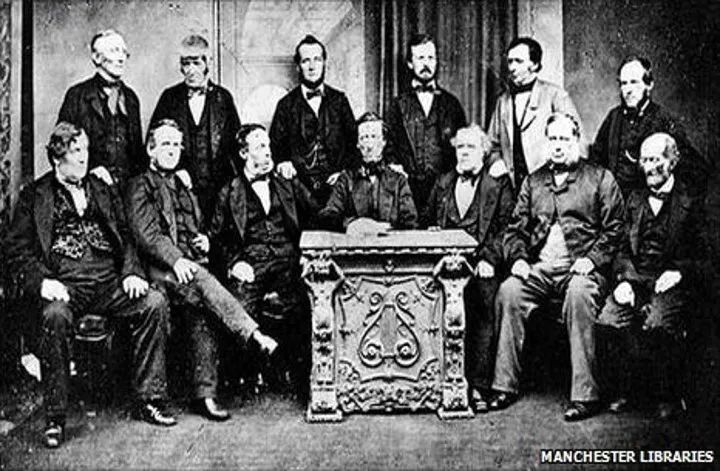
The Rochdale Society of Equitable Pioneers was founded on 22 December 1844, and by 2019 it will be celebrating its 175th birthday.
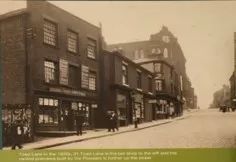
In 1844, as the Industrial Revolution swept through Britain, people flocked to work in factories. The immense wealth generated by industrial production flowed straight into the pockets of the capitalists, while the workers toiled day and night — the wages they collected with one hand were handed right back with the other to the boss or the capitalist, to buy the necessities of daily life.
A group of textile mill workers on the outskirts of Manchester found that, despite spending a great deal of money, the quality of the food they bought was terribly poor: twigs in the tea, small lumps of coal mixed into the coffee, lime in the flour, and so on — they were even short-weighed. They simply could not bear paying high prices for such shoddy food. So twenty-eight textile workers decided to cut out the unscrupulous bosses and supply themselves with safe, clean food. In the small workers’ town of Rochdale, they named their little grocery store the “Rochdale Society of Equitable Pioneers.” The workers laboured together and shared the store’s trading profits, made decisions about the direction of the business by one member, one vote, and gave every person the fullest possible protection of their rights and interests.
Since every member already had a heavy workload in the factory, the little shop opened only two days a week at first, selling a handful of daily essentials: flour, oatmeal, sugar, and butter. But the shop, funded by contributions from the workers, was short on capital. It could stock only a small quantity of goods at a time and could not compete with the larger private shops. In its first three years it attracted only a handful of members, and the outlook for the business was far from encouraging.
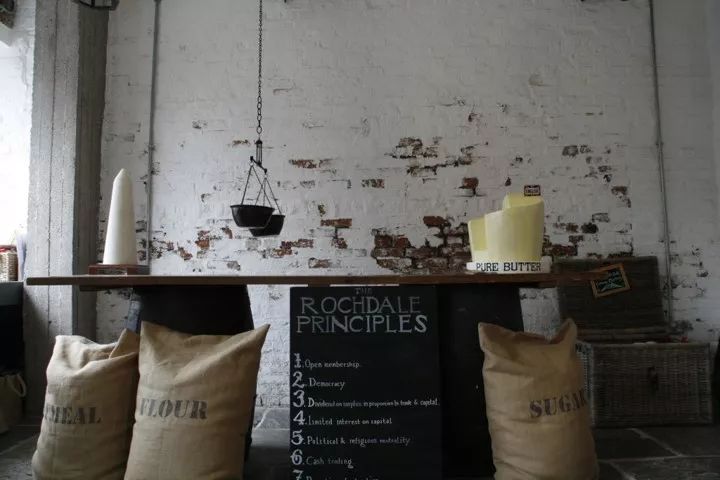
Members were both shareholders and consumers. The assurance of product quality was a major strength of the Equitable Pioneers. Moreover, having already suffered greatly from the poor-quality goods sold in private shops, they devoted much discussion and thought to how capital works and to the co-operative enterprise. Through continuous trial and error in running the business, they formulated the Rochdale principles of organisation and management — principles that marked them out in sharp contrast to other private shops. These principles would later become the foundation on which other co-operatives conducted their business.
First, the capital came from member contributions: the Rochdale Pioneers operated solely on funds provided by their members. Second, democratic management: members elected representatives, and important matters were discussed and decided collectively, with a one member, one vote system regardless of gender or number of shares held. Third, the surplus was distributed in proportion to each member’s trading. Fourth, dividends on share capital were limited to no more than 5 per cent. Fifth, the society remained politically and religiously neutral. Sixth, all transactions were cash only — no credit — to prevent workers from falling into debt, and goods were sold at the average market price. Seventh, the society promoted the education of its members and their families.
Guided by these principles and values, by 1880 the Rochdale Society of Equitable Pioneers had grown into a comprehensive co-operative with more than ten thousand members, multiple branches, and diverse business lines — and it was the predecessor of what would become today’s Co-operative Group. The original retail shop in Rochdale was converted into the Rochdale Pioneers’ Museum in 1931.
The success of the Rochdale Pioneers also spurred the growth of co-operatives in Britain and even in some other European countries, while marking the dawn of the modern co-operative movement.
III. The Seven Co-Operative Principles
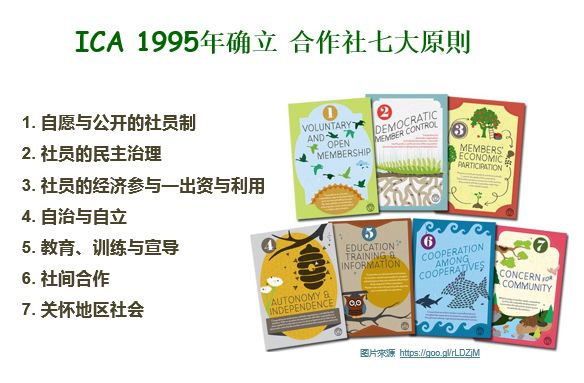
In 1966, the International Co-operative Alliance, building on the Rochdale Principles, formulated the Seven Co-operative Principles:
1 Voluntary and Open Membership
A co-operative is voluntarily organised by its members. Membership is open to all who can use its services and are willing to accept the obligations of membership, without artificial restriction or any discrimination of a social, political, racial, or religious nature.
2 Democratic Member Control
Co-operatives are democratically controlled by their members. Each member has one vote and an equal say. Operations and management are conducted openly and transparently. Emphasis is placed on members having not only the opportunity to participate in shaping the co-operative’s business policies but also the opportunity to make the final decisions.
3 Member Economic Participation
Members contribute share capital equitably and exercise democratic control over it. Limited surpluses may be distributed. A co-operative does not prioritise the pooling of capital or the aggregation of transactions; the purpose of members’ financial contributions is not to make a profit but to run the co-operative better. In the case of a consumer co-operative, it exists to meet its members’ own consumption needs. In the case of a workers’ co-operative, it is used to secure fair returns on its members’ labour.
4 Autonomy and Independence
Co-operatives are autonomous, self-help organisations controlled by their members. When they enter into agreements with other bodies, including governments, or obtain capital from external sources, they must ensure that members retain democratic control and that the co-operative maintains its autonomy.
5 Education, Training and Information
Co-operatives provide educational and training opportunities for members, member representatives, managers, and employees, helping them to contribute effectively to the development of the co-operative. This also includes outward-facing public communication to raise awareness among wider audiences and organisations about the nature and benefits of co-operation. If a co-operative does not continually remind its members that they are part of a co-operative and explain what it is doing — if it fails to keep building consensus and conducting education — it risks gradually becoming an enterprise held hostage by a few. Education must be sustained inwardly, and advocacy sustained outwardly, inviting everyone to learn about co-operatives and join the co-operative economy.
6 Co-operation Among Co-operatives
Co-operatives serve their members and develop the co-operative movement most effectively through co-operation at local, national, regional, and international levels. Compared with mainstream market players, co-operatives remain a relatively niche economy that few people know about or take part in. This principle therefore calls for co-operatives to strengthen their co-operation with one another, joining hands to make the co-operative economy a greater force.
7 Concern for Community
A co-operative seeks to pursue the greatest economic, social, and cultural benefit for its members. In theory, a genuine co-operative would not behave like a capital-controlled chain that simply conducts business in a region and channels the profits back to headquarters or into the hands of a few capitalists. Instead, it should build connections with the local community. Both members’ lives and the co-operative’s operations should be able to give back to and be rooted in the community, helping to prosper the local area.
Each of these seven principles is an essential requirement for running a co-operative, woven into every aspect of its operations. They serve as guiding principles for putting values into practice. For instance, when selecting upstream and downstream suppliers and partners, a co-operative should give priority to other co-operatives over ordinary businesses. There is also the question of giving back to the region: a genuine co-operative contributes to the prosperity of its local community. Only by strictly observing every one of these principles can an organisation truly be called a co-operative.
IV. The Organisational Forms of Co-operatives
1 Types of Co-operatives
A simple way to identify the type of a co-operative is to look at the noun phrase that precedes it.
If it is a workers’ co-operative, it means that the workers who labour within it are the members and also the owners of the co-operative.
If it is a community co-operative, then the members are the people who live in that community.
If it is a consumer co-operative, it is a co-operative composed of consumers, and it provides them with the products and services they need.
The situation in Taiwan differs somewhat from that in the UK. Under Taiwanese co-operative law, trading must take place within the co-operative relationship of a co-operative. For instance, if you happen to be travelling in Taiwan and find the goods at the Taiwan Housewives Alliance appealing and want to buy some to take home, you are not permitted to do so, as only members are eligible to make purchases.

2 Operational Form of Co-operatives:
To determine whether an organisation is genuinely operating in co-operative form, look at how work is distributed. From contributing capital to running day-to-day operations to making purchases, members should be involved at every stage. A consumer co-operative can easily slip into a situation where members pay in their share capital and then have no further involvement at all.
Take a consumer co-operative as an example: first, check whether members are actually taking part in its activities; second, whether they are contributing share capital; and third, whether they are regularly purchasing through it. Regardless of whether membership is growing or purchasing power is strengthening, these three conditions are absolutely indispensable. A workers’ co-operative is governed by a similar principle.
Under UK law, forming a co-operative requires at least three members; in Taiwan the minimum is seven; on the mainland, it is five. Different legal frameworks therefore also shape how co-operatives develop. During my interviews, I came across a workers’ co-operative of just three members whose work involved filming documentaries. If the law had required seven members to establish a co-operative, then for a small, newly formed one, the operational and administrative costs of seven people would be far higher than those of three. A single regulation may seem straightforward on the surface, but its impact is far from negligible.

3 Is a Co-operative Profitable?
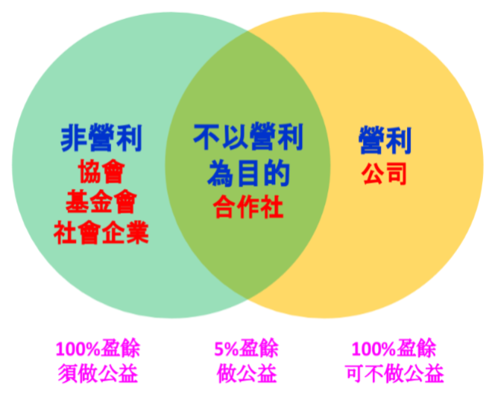
Ordinary companies pursue profit for the institution; non-profit bodies include foundations and associations. A co-operative, by contrast, can be described as a business entity whose purpose is not to make a profit.
Taiwanese legislation groups co-operatives alongside non-profit organisations, which may lead people to assume that a co-operative is a non-profit entity — but in fact, it is not. A co-operative is a jointly owned, democratically managed business entity that must maintain sound operations, so it is by no means a non-profit organisation. In Taiwan, the law requires co-operatives to set aside no less than 5% of their annual surplus as a public welfare fund, with the co-operative itself free to decide which areas of public good it will support.
V. Why Choose Co-operatives?
It is clear that in the more than 100 years since the birth of co-operatives, they have not become the mainstream form of economic and social organisation. But over the past decade, things have begun to change.
During the 2008 global financial crisis, many countries’ economies suffered to varying degrees. European nations such as Spain, Portugal, and Italy still have not fully emerged from the shadow of the financial crisis. When capitalism reaches its extreme, all resources tend to flow toward big capital — but when big capital withdraws, what is left?
The situation in the UK after the financial crisis was also far from optimistic. Small and medium-sized enterprises faced cash-flow problems and were closing down one after another. These SMEs typically served small and medium-sized towns or local communities, so when the financial storm hit, people had no choice but to find ways to help themselves. Against this backdrop, many new co-operatives were established in the UK.
So in 2016, we came to the UK again, very curious to see what had become of the co-operatives formed at that time, and how they were operating.
But after our interviews, we discovered another interesting fact: workers’ co-operatives made up a very large proportion. This also very much speaks to the times. Young people who have just graduated, when entering the workplace, often face unfair treatment wherever they go — lower wages, being tied up with all kinds of menial tasks for no good reason, and even design freelancers encounter being looked down upon. We came across the smallest co-operative at the time, one formed by two art workers to help young people establish workers’ co-operatives.
During the interview, they explained that the reason they did not use their own professional trade to form a co-operative was that they felt young people today seem to have no choice but to keep climbing the ladder of life — why not go sideways instead? They believed that workers’ co-operatives could allow young people to take back their right and dignity in employment, because within a co-operative everything is completely flat: there is no class hierarchy and no unfairness.
I asked the same question of every organisation I interviewed: Why did you choose to form a co-operative? The answers were almost identical: If we do not form a co-operative, is there any other option?
Indeed. Take, for example, a retail shop serving a community. If it is privately run, the owner or shareholders can easily decide whether it stays or goes, and community residents may find themselves having to spend more time and travel further to buy their daily necessities just because they have lost a local shop. But for community residents, a co-operative may well be the better choice, because a co-operative welcomes everyone as a member, all members can be its owners, and they can decide what products and services it offers and whether it continues to operate. No single person leaving affects the co-operative’s ability to carry on.
VI. Conclusion
Today, co-operatives have long been a global movement. The first Saturday in July each year is International Co-operative Day, and every year is given a corresponding theme, with the aim of drawing people’s attention to social issues and addressing them through co-operation.
Logos and Themes of Recent International Co-operative Days
2017 Theme
“Co-operatives Leave No One Behind”
2018 Theme
“Co-operation for a Sustainable Society”
2019 Theme
“Co-operatives Promote Decent Work”
The UN explains their choice of “decent work” as the theme for Co-operative Day 2019 as follows:
According to a recent estimate, more than 279 million people worldwide are employed by co-operatives or rely on them as their primary source of income, representing nearly 10% of the total labour force.
Furthermore, other research has confirmed that, compared with employment in other sectors, work in co-operatives is: 1. more sustainable over time; 2. characterised by a smaller income gap between high- and low-paid roles; 3. more evenly distributed between rural and urban areas.
Coming Up Next
In the next lesson, Ms. Chen Yihua will share with you several co-operatives she personally visited in the UK, using case examples to further explain the principles, philosophy, and practical methods of co-operation.
Author: Chen Yihua
A writer based in southern Taiwan. In the spring of 2016, through crowdfunding and with support from 80 friends, she travelled to the UK to interview 29 co-operatives and organisations. In February 2017, these stories were compiled and published as Wow! So This Is Also a Co-operative: A Great Britain COOP Field Survey Report.
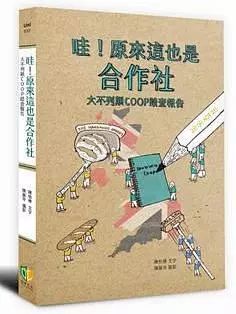
About Wow! So This Is Also a Co-operative
● From February to April 2016, the following were interviewed: 12 workers’ co-operatives, 6 community co-operatives
● 4 consumer co-operatives, 1 housing co-operative, 2 CICs, 4 co-operative development organisations
● A total of 49 co-operators interviewed, spread across 8 cities in 3 countries
Course Coordinator: Chang Tianle
Course Producer: Ma Xiaochao
Photography: All images by the author unless otherwise noted

The Future of Farming Co-operatives: Leaving No One Behind
Remarkable Mums in Chengdu: A Co-operative Path from Self-Help to Mutual Aid
From Consumers to Active Living: Japanese Mums’ Community Reform Journey