I Ate 30+ Durian Varieties in Penang: My Least Favourite Was Musang King

As a durian enthusiast, I had long heard that Penang, Malaysia, is home to several hundred different durian varieties. This year, by joining a durian tour, I tasted more than 20 different durians. While accompanying farmers as they worked, I also tried the day’s randomly fallen “durian blind boxes” — varieties unknown, each encounter one of a kind.
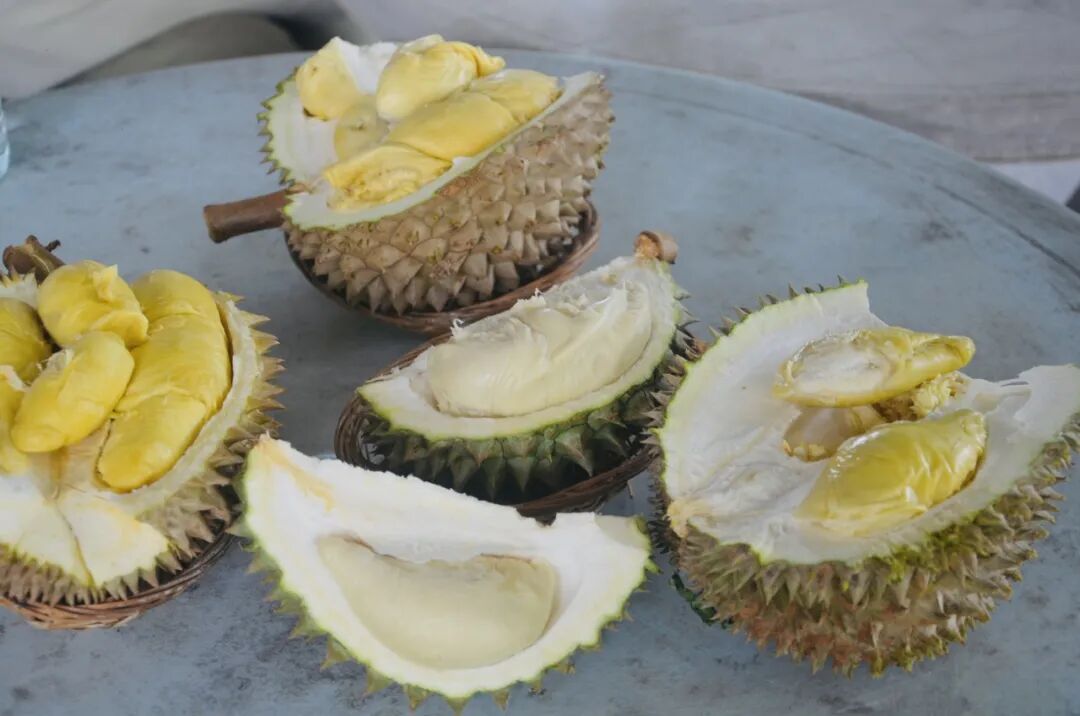
◉ With my “durian buddies”, we head to orchards to eat durian; each orchard offers 5 to 15 different varieties to taste.
In recent years, a particular way of travelling in Penang has become popular among Chinese tourists: going up into the hills to eat durian. It is less like buying at a traditional fruit shop and more like a private flavour exploration — whatever falls from the trees that day is what visitors eat. These durian tours were not originally a tourism product, but rather the way local connoisseurs sought out old-tree kampung durians. Later, as word spread on social media, more and more Chinese tourists made a special trip to Penang.
An old durian tree is one more than 30 years old. “kampung” is a transliteration of the Malay word “Kamping”, meaning native and local.
This experience truly gave me the thrill of eating durian in Penang, like opening a blind box: a bitter-sweet blend, creamy notes, peanut butter flavour, floral aroma, cheese, a tingling, numbing sensation, even whisky. Some people even taste cockroach… You never know what the next durian will taste like.

◉ Friends in the durian buddies WeChat group have unlocked new durian flavours.
Every year from May to July is Penang’s durian peak season. Tree-ripened fruit is fully ripe the moment it falls, has a short shelf life, and must be sold as quickly as possible; afterwards, the flavour declines. Countless food lovers fly in, naturally because such a seasonal bounty cannot be missed. This year, there is an additional reason: after the famous varieties supplied to the export market ripened across the country, output surged, causing local durian prices to plummet. According to the BBC, Malaysia usually produces about 550,000 tonnes of durian a year, but 2026 is seeing an exceptional harvest. Musang King and Black Thorn, the two benchmark varieties, are in oversupply, and prices have fallen to their lowest level in three or four years. The quality is excellent, yet prices are only half those of previous years.
This is also the flip side of the “surprise blind box” — for local durian orchard owners, the recent “Penang durian boom” is both the reward for years of quiet, diligent work and something that means the local durian market has to suffer the damage caused by swings in the large-scale, export-dependent durian market. As one orchard owner put it, “Lower prices are good for consumers, but they also expose a deeper problem that smallholder farmers in Penang must face.”
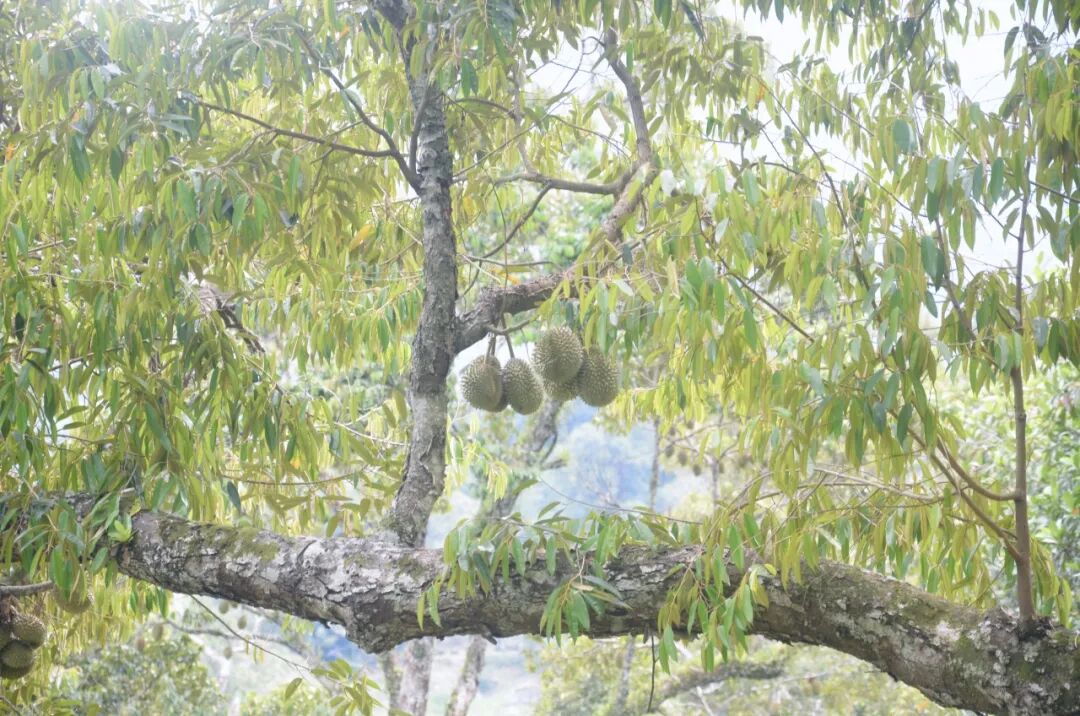
◉Photographed at a durian orchard in Penang.
Why Don’t Connoisseurs Chase Musang King?
Among the travellers who deliberately arrive in Penang during durian season, the vast majority come from China. Now that fresh durians of the famous varieties Musang King, Black Thorn, and Red Shrimp can also be bought in China, why still fly all the way to Penang, or even go out of your way to travel from the city centre to Fulu Shanbei in the southwest to eat durian?
An older man who has had diabetes for many years yet still comes to Penang every year to eat durian (not something I recommend imitating) told me: “People who come to Penang to eat durian are certainly not coming for the famous varieties! They are coming for old-tree kampung durians!”
I, who as a child only ate lychees straight off the tree and free-range chicken, can very well understand diners’ attachment to “kampung durian”. In addition, there is a local tradition in Malaysia of eating “tree-ripened durian”: unlike in Thailand or other regions that rely on large-scale cold-chain transport and export, where durians are cut down when only about 70 per cent ripe, the fruit is left on the tree until it ripens fully, its flavour has developed to the fullest, and then falls naturally. Today, Penang still has many old-tree durians left from those days, meaning durians from trees at least 30 years old, and even more than 100 or 200 years old.
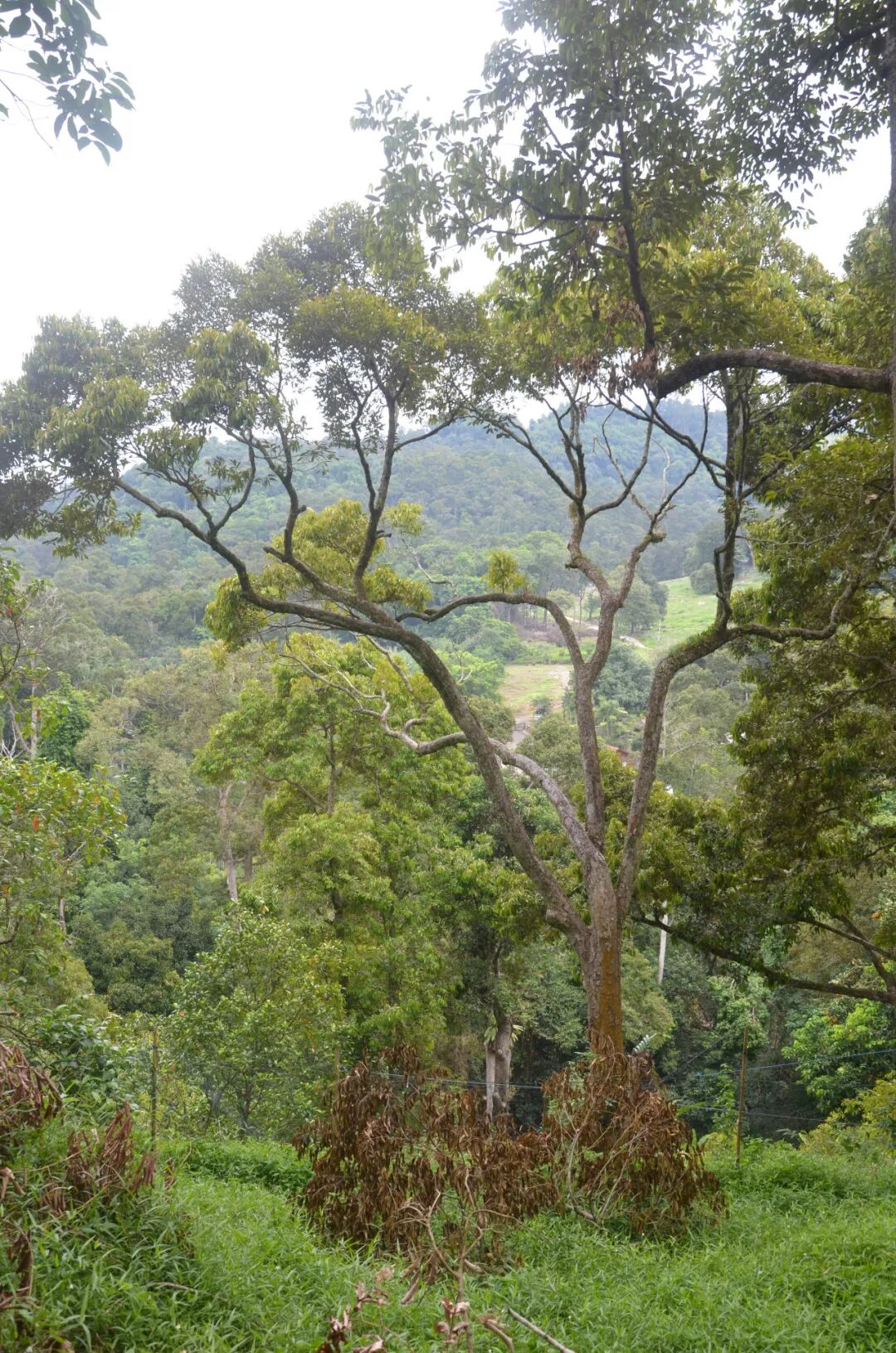
◉Photographed at Lin Brothers’ Durian Orchard. The orchard has several hundred old durian trees, and even the orchard owner cannot identify all their varieties.
And because of this uncertainty, in Penang the best way to eat durian is not to look at how many seed cavities it has or whether its sugar content reaches the standard that marketing vendors like to promote, but to go back to a relationship-based mode of social interaction — make friends with the durian orchard owners, and wait for the day when a good durian, from a tree old enough and with flavour rich enough, falls naturally; they will then save it for you first.
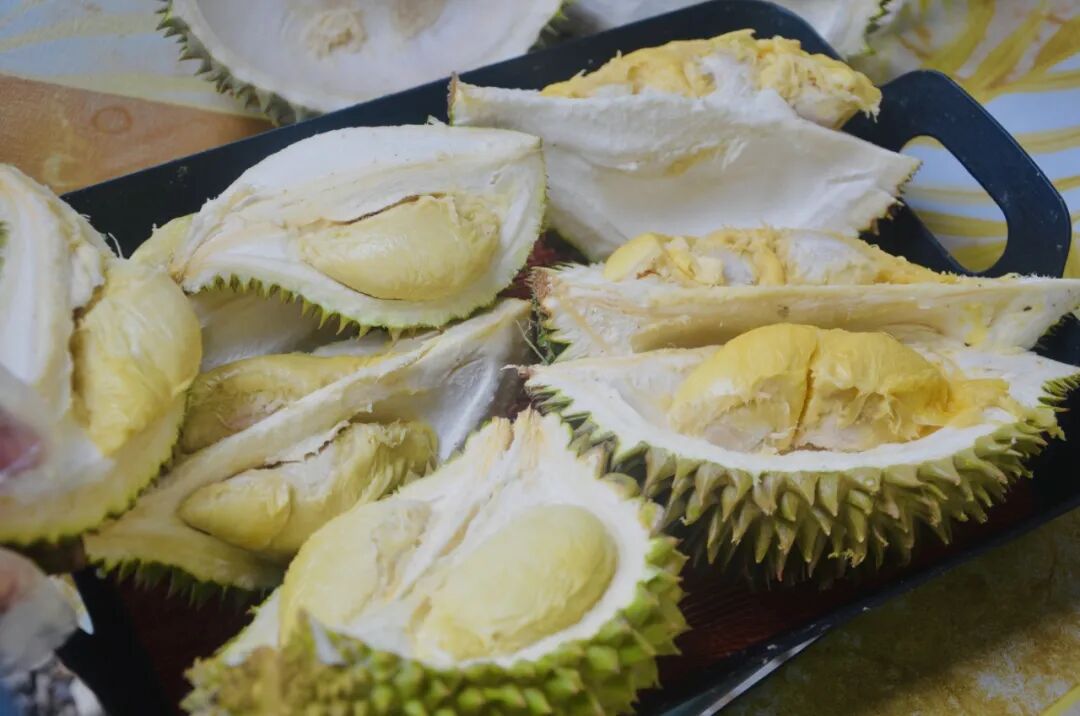
◉Photographed at Zhong Zhang Durian Orchard in Penang. For group trips up the hills in Penang to eat durian, what diners come for is a table of fresh kampung durians in different flavours
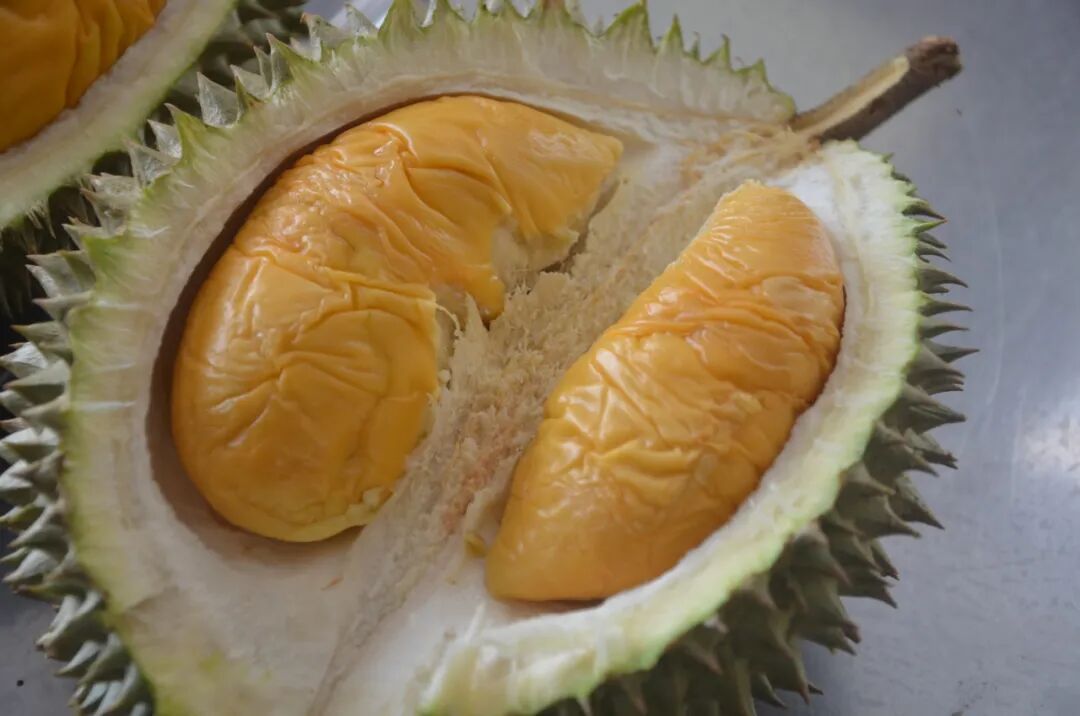
◉Photographed at Lin Brothers’ Durian Orchard: an old-tree Musang King. After eating dozens of kampung durians, I then ate Penang’s Musang King again, and I felt its flavour was indeed more regular and dull. Light sweet and creamy, but with not so many offbeat, layered flavours. When I came to this durian, I also understood what the orchard owner had said: “Many kampung durians taste better, yet they do not receive the same attention.”
One early morning, I stepped into a kampung old-tree durian orchard. The orchard owner, an auntie, was deftly cracking open durians, picking the flesh into a bucket. “These are all discarded; someone will collect them to make durian pulp.” The other orchard owner, an uncle, joked, “They are probably sold to China, aren’t they?” I picked one up out of curiosity and ate it. It was obviously sweet and tasty, and tasted very fresh; how could it have been thrown away? Seeing my puzzled face, the people in the orchard kept teasing me: “If you eat too much rubbish, you won’t have room for durian later!” Only when I tasted their true signature durian did I understand why durians whose flavours are not so richly layered are so casually labelled “rubbish” by them.
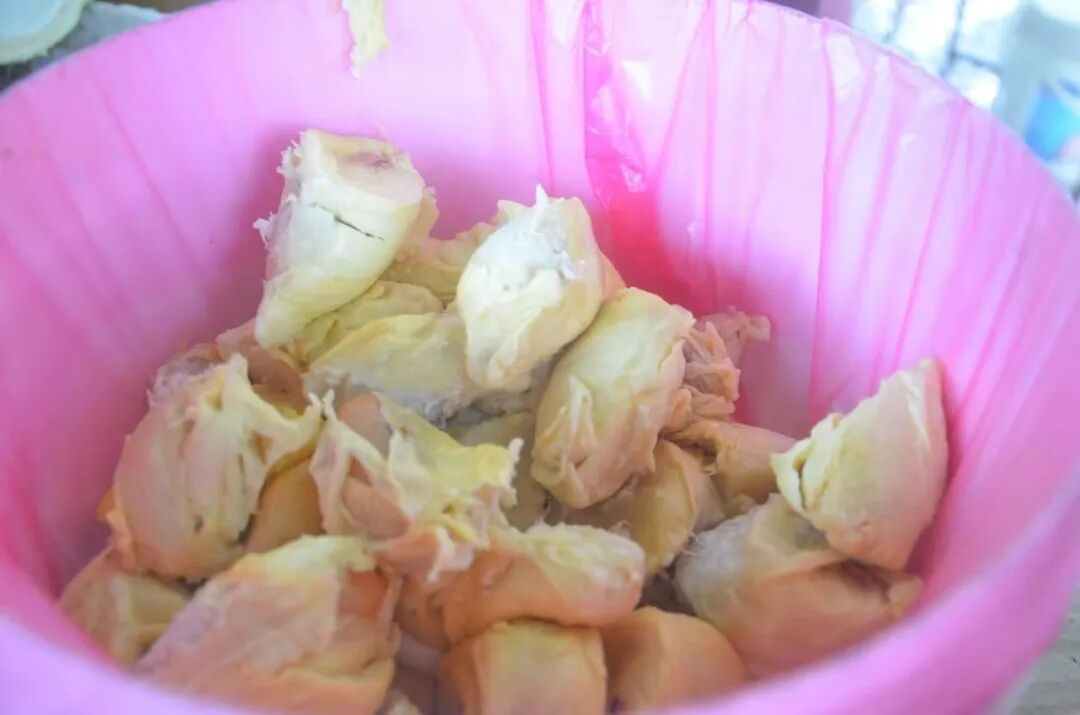
◉Durian rejects ready to be sent to the durian pulp factory are still sweet and pleasant.
That day, our group tasted 15 different durians in all. The orchard owner had arranged the tasting order according to the number of people: from light, sweet, and floral introductory varieties, all the way to bold, cheesy, numbing, and spicy old-tree varieties, the diners’ flavour spectrum was also gradually broadened.
Another orchard owner also explained, from a historical perspective, why Penang has so many and such a varied mix of durian varieties. This area is in northern Malaysia, close to Thailand; in early days, fruit growers often travelled back and forth between the two countries. At that time, grafting techniques were not yet mature, and many people planted durian seeds brought back from Thailand, only to find that some inherited the parental traits while others developed entirely different characteristics. This uncertainty, instead, has created Penang’s rich and unique flavours. For instance, there are more than 200 different durian varieties locally.
However, while diners enjoy the ultimate in flavour, they must also accept the uncertainty of the fruit’s flavour. Some regard it as fun, while others, feeling that what they ate does not match the descriptions on a certain Red Book, write a “warning post” in capitals.
It is quite telling that a friend from Thailand, accustomed to large-scale cultivation, uniform flavour, and the light sweet taste of Monthong durian, could not at all appreciate this Malaysian kampung durian, with its wine aroma, bitter-sweet and numbing flavours intertwined, soft, moist, and slippery, even sticky in the throat.
A connoisseur in the durian tour knew well which orchard and which tree were better. Under her guidance, we went to an orchard famous for “XO” (a kampung variety). The durians, when opened, were blackish-green — this colour often indicates a more intense flavour, a favourite with bold-flavour lovers. The wine aroma and bitterness were strong; XO lived up to its name. The orchard owner was peeling durians with bare hands, and around him, there was no shortage of diners who had come from far away and gathered to take photos of him. “Why is my XO better than others’? Because I water it more diligently!” The orchard owner was very proud of this treasure of the orchard.
In Penang, what makes eating durian interesting is not only opening a high-value durian blind box — for about 70 Malaysian ringgit (around 116 yuan) you can eat until you are stuffed, and it includes about ten different durians — but also getting to know capable, hardworking durian farmers. By looking at how fresh the stem is, the colour of the husk and the shape of the hard spines, hefting it to gauge its weight, and shaking it to listen to the sound, they can roughly judge a durian’s variety, tree age, whether it has dry flesh or wet flesh — whether the pulp has more or less moisture — and even its approximate texture. This whole body of experience relies solely on day and night “living with” the fruit trees, with no textbook to follow.
When I went to the Lin Brothers’ orchard, the most striking thing was a black wooden house — this renowned feast destination among durian diners from all over has a history of more than a hundred years. The building uses not a single nail; the black wall paint can repel insects and resist fire. Together with the dozens of century-old durian trees in the orchard, it has blessed three generations. Walking through the orchard, you can see various insects, birds, and snakes, as well as mangosteen, nutmeg, rambutan, and white cardamom — fruit trees also planted by earlier generations. The orchard owner cannot name all the durian varieties here, but he knows on which tree they grow and what they taste like, after all, he has lived here for more than 40 years.
Following these devoted connoisseurs up the hills to find durian, I cannot help but reflect: in Penang, durian is like a dictionary — you can never finish learning it, nor finish eating it.
Terroir: Why Fulu Shanbei?
Fulu Shanbei is situated in southwest Penang and covers about two-thirds of Penang. It takes its name from the continuous mountain ranges that surround it. In 1764 the British East India Company opened a port here, and it has since remained an agricultural town. Penang’s three famous products — durian, nutmeg, and clove — are all grown in these hills. Many Chinese immigrants cleared land here in the early days and ran orchards, and many of the durian orchards have now been passed down through three generations.
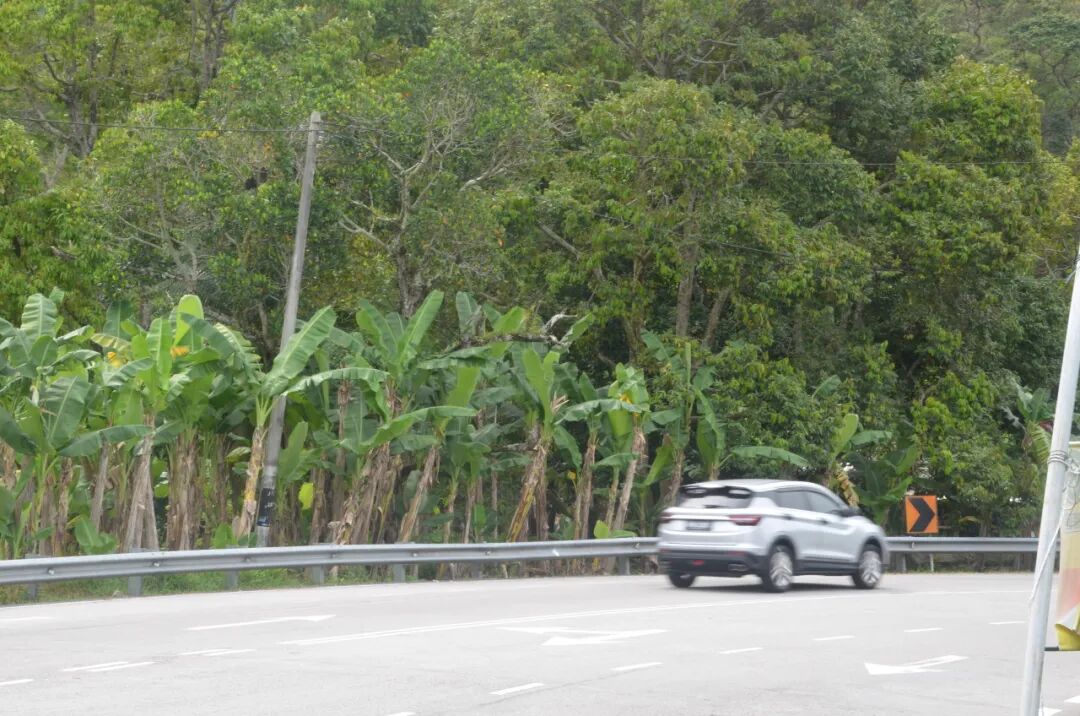
◉Fulu Shanbei. The highest point here reaches over 800 metres, with views over all of Penang and the seafront. Along the way, you pass many durian orchards run by smallholder farmers. Smallholder farming passed down through generations is the main operating model for the durian orchards here.
Durian orchard owner Uncle An (a pseudonym) has been growing durians for 30 years. He tends a kampung durian orchard the size of eight football pitches. The durian trees here are at least 50 years old, and two of them are over a century old. He told me that the secret to Penang’s delicious durian lies in “high hills, steep slopes, and lots of stones”. Durian trees need a lot of water, but what they fear most is waterlogging and rotting roots. Most orchards in Fulu Shanbei are planted on slopes steeper than 45 degrees. The soil is fine black earth formed from weathered granite, with good drainage, and the large boulders scattered across the hills help the roots avoid standing water. This terrain allows the roots to get enough water without being waterlogged.
Different altitudes, temperatures, and light conditions are suited to growing different durians. For example, Red Shrimp durian prefers high-altitude areas. Fulu Shanbei is on the side facing Sumatra, where sea breezes blow all year round; the salt they bring helps keep the leaves dry, which reduces pests and diseases and also helps the durian’s flavour accumulate. And every year from May to July, when durians ripen, is precisely the annual window when temperatures begin to turn cooler. This cooling period helps retain the polyphenols in the flesh — especially the anthocyanin in red-fleshed durian, which gives the flesh that touch of red-orange.
It is precisely for this reason that I have heard, time and again in Fulu Shanbei, the line orchard owners often say: whether the business does well is entirely in the hands of heaven.
A Blind Box for Consumers, or a Risk for Farmers?
Eating durian at Uncle An’s orchard, the greatest pleasure is “not knowing”. Unlike commercial orchards that can be booked in advance, once you have made your way over the hills and up to this orchard, all you ask is: “What fruit has fallen today?”
For Uncle An, however, this unknown is not the surprise tourists expect, but an uncertainty he has to face every day.
After we had got to know each other, I worked for two days with Uncle An and his wife, Auntie Bi. Uncle An had originally been a white-collar worker, and only after retiring did he come back to take over the orchard his mother had left him.
Uncle An works every day of the year, going out only on the first and second days of the Chinese New Year. In June, when the durian season is at its peak, his handwritten planner is packed every day with arrangements for hosting guests. He gets up at 5 a.m. every day to collect fallen fruit, doing so twice a day, just to make sure it can be opened at the best possible time. As well as collecting fruit, in between he has to reply to tourists’ messages and host diners who come up the hill.
During the growing season, he is busy weeding by hand and catching pests — he says looking after durian is harder than looking after children; if he does not come for a month, the durian will die. The orchard is large, and they have always insisted on traditional methods, believing that if pesticides are sprayed the fruit will have an underripe, starchy texture (the trees are also too tall to spray). They also insist on not using herbicide, believing that hand-weeding helps preserve the temperature and moisture in the soil, keeps the roots cool, and keeps the microbial communities in the soil alive.
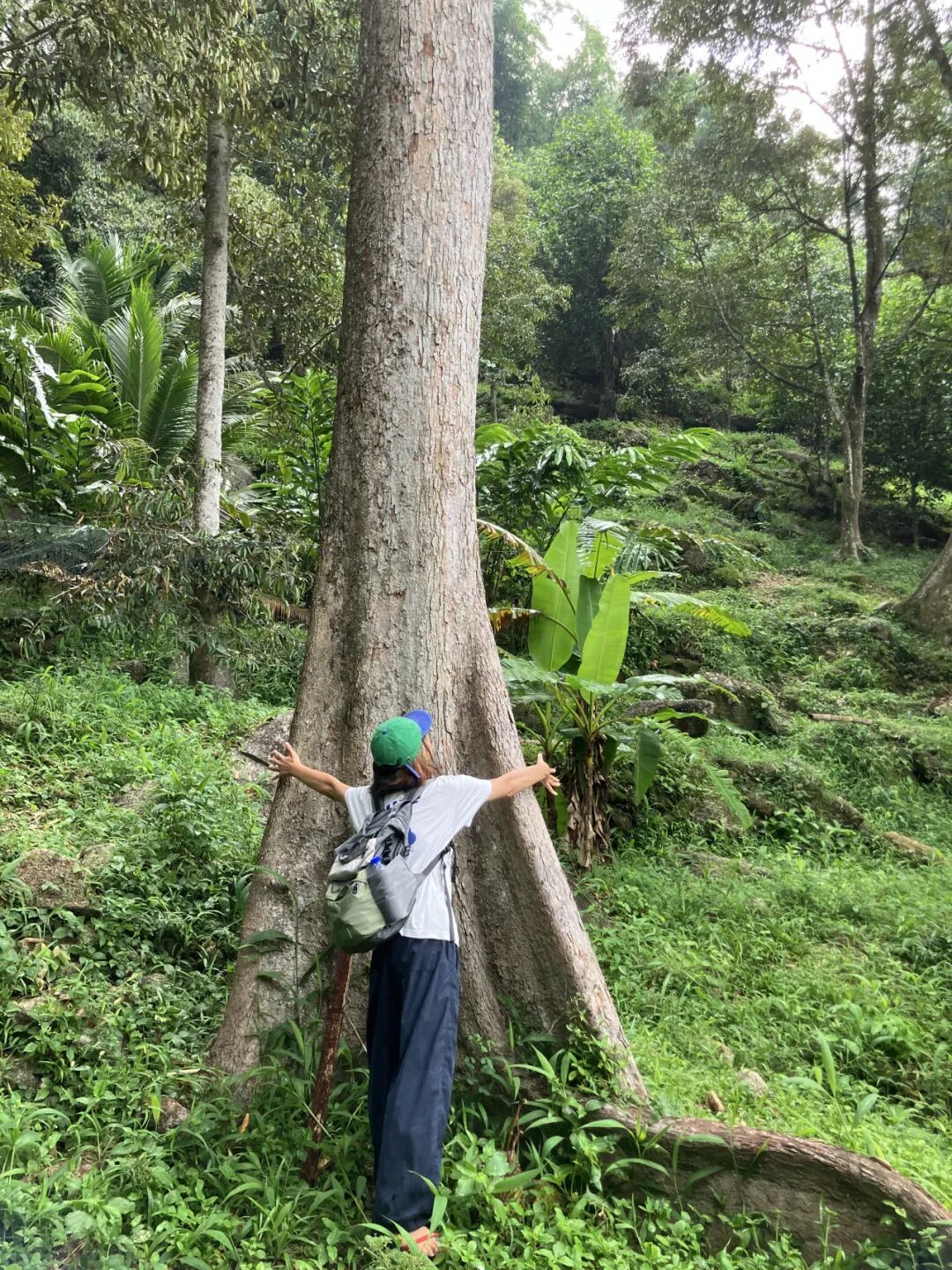
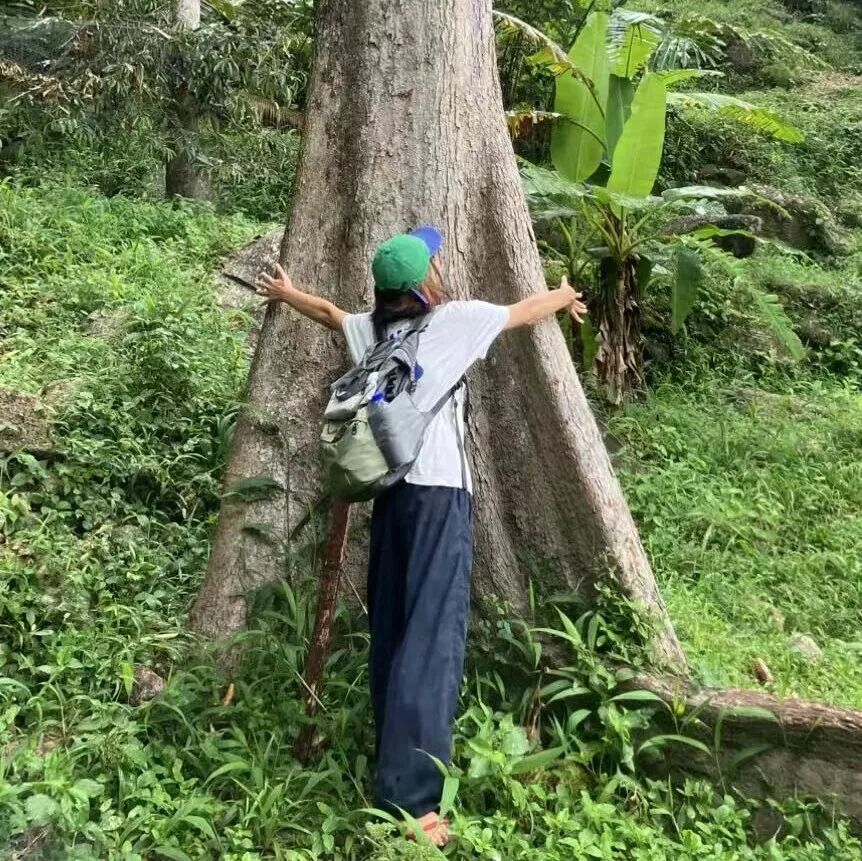
◉Photographed at Uncle An’s durian orchard, embracing a durian tree over 100 years old. Ordinary grafted durian trees only grow to the height of four to five storeys, but old-tree kampung durian trees can grow to the height of ten storeys.
Auntie Bi says her last rest was last year, when she injured her hand from opening too many durians. She says the orchard has over a hundred different durian varieties, and the ways of identifying, sorting, and opening them are all different. If they hired someone to help, “I suppose they would run off before they had even learnt.” That is indeed the case. Here I could only help with purely physical work, such as collecting fruit and sweeping mud, dust, and leaves off the fruit. Even just lifting a durian and using the opening knife was a strain for me, yet she could, with ease, score an arc into a durian and open one in two or three minutes.
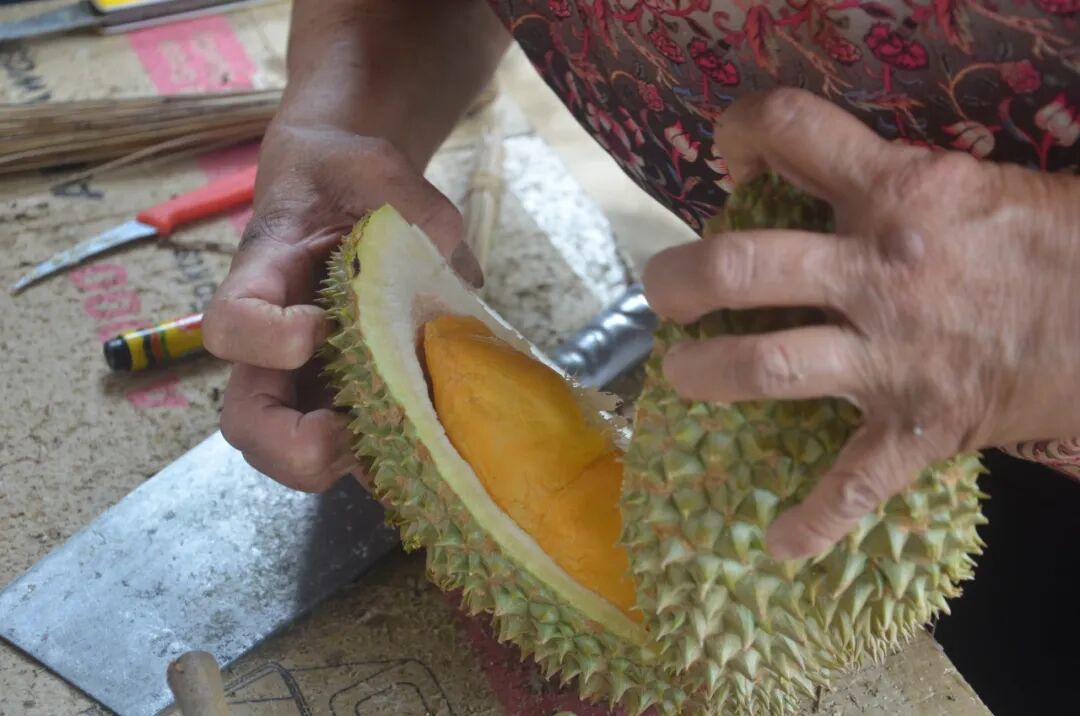
◉Opening durian requires a deft touch
This year the weather has been erratic, and nearly 80 per cent of the fruit in the orchard fell in a concentrated burst in the single month of June — fruit that should have ripened and been collected slowly over several months, all crashed down at once, causing heavy losses. Auntie Bi has to open hundreds of durians a day and simply cannot keep up, so some lesser-known varieties can only be sold in heaps at throwaway prices: a heap of about 20 kilograms for 28 Malaysian ringgit, roughly 45 yuan. Being tree-ripened has actually put the old-tree kampung durians at a disadvantage. The couple only sell fresh durians that fall on the day; kampung durians left overnight turn “watery” in texture and can only be thrown away or sold even more cheaply to a durian pulp processing plant. Renowned varieties such as Musang King and Black Thorn, however, often fall when about 90 per cent ripe and can keep for another two or three days. This is a fatal timing gap.
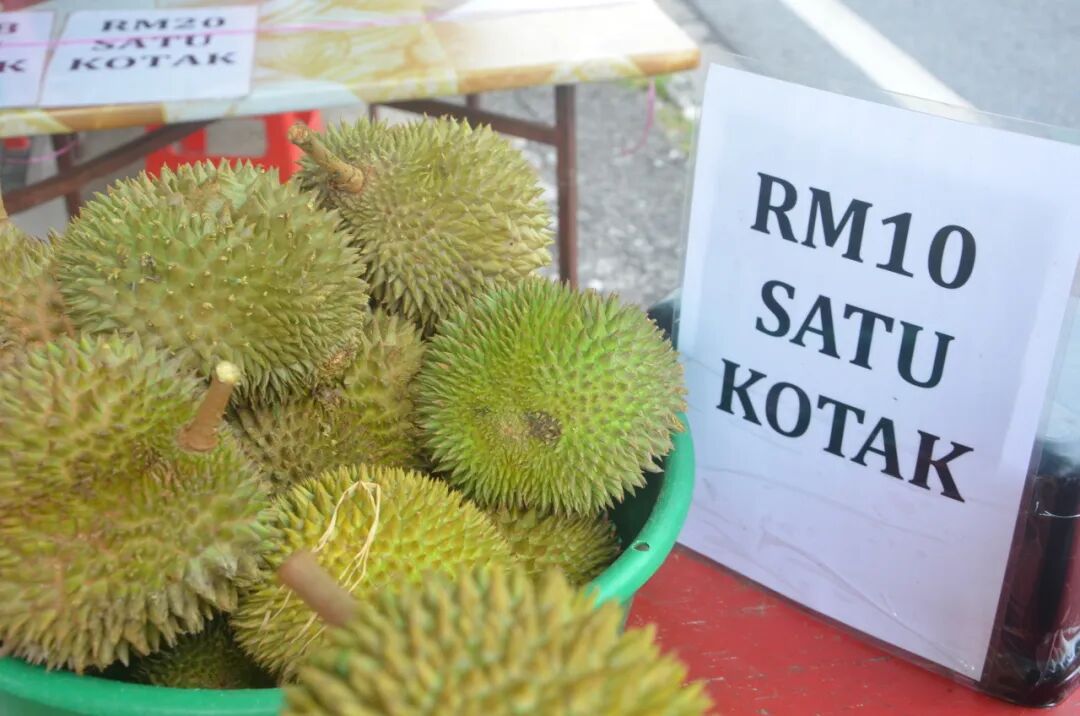
◉Packing up the old-tree kampung durians being “sold off cheaply”
Some durian stalls and durian orchards also serve overnight kampung durians to customers as usual; after all, it is only the texture that is more “watery”, and customers may not be able to tell the difference.
Sometimes Uncle An shares other customers’ delight with me: “You have no idea how happy that customer was today, because a fallen old-tree Zhujiao (a durian variety) happened to come their way! The moment they saw it, they took it straight away!” So I asked Uncle An, “Do you like growing durian?” He said frankly: “I really regret growing durian. Growing durian is so tiring!”
When it comes to these daily routines, the phrase on Uncle An’s lips is, “live at the mercy of the weather.” For example, during the flowering period, extreme weather is the biggest fear; too much or too little rain is no good. “Over the decades, there have also been years when it rained for days on end during flowering season, causing an almost total crop failure,” he says.
A set of flower-induction methods circulating in the industry — judging the tree’s growth state by leaf size, supplementing calcium before the dry season and then phosphorus, withholding water and lowering temperatures to stimulate flower buds — is mainly practised in orchards with grafted trees. Only grafted trees with uniform genetics can be compared against a “standard leaf size”; each old kampung tree has different genetics, so the standard itself is very difficult to apply.
In addition, storms can knock nearly ripe fruit down early, squirrels and monkeys may come to steal and eat it, and pest damage can sometimes kill half a tree — in the orchard, some trees withstand pest damage and keep growing, while others cannot hold on.
Why keep going if it is so hard? He says: “Do you know how poor my family was when I was a child? My mother planted durian seeds, but we had no money to buy water pipes, so she carried water up in buckets to water the trees. How could I bear to cut down the trees?!”
This reluctance to part with the trees is being worn down bit by bit by reality. Many farmers have chosen to cut down old trees and plant renowned varieties that appear to be more profitable — Black Thorn and Musang King. Through grafting, scions of superior varieties are joined to rootstocks; these renowned varieties can bear fruit in five or six years; fruit shape and taste can be highly consistent, stable, and controllable; the practice is more commercialised, and the economic returns are immediate. Trees grown from seed, by contrast, may take ten or twenty years to bear fruit; Uncle An even has trees that have been 50 or 60 years old and still have not borne fruit.
On the other hand, old-tree kampung durians still retain an advantage in flavour. Renowned varieties require fertilising seven or eight times a year, while old-tree kampung durians need it at most once or twice. One orchard owner told me that the fruit of these renowned varieties looks better and is bigger thanks to pesticide spraying. By comparison, the fruit of old-tree kampung durians is usually smaller, which allows the tree to take up more nutrients, and the flavour is more richly layered. “Durian Kingdom” (using the Malay-Chinese writing form for “durian”) says that the root systems of old durian trees, after decades, are long since deeply anchored in the ground and more vigorous; they can even reach the underground water table, absorb more minerals, and also contribute to flavour. In addition, such roots may also be more flood-tolerant, whereas grafted renowned-variety trees, such as Black Thorn and Musang King, have relatively shallow root systems, live much shorter lives, and are more sensitive to weather fluctuations. [1]
Sources?
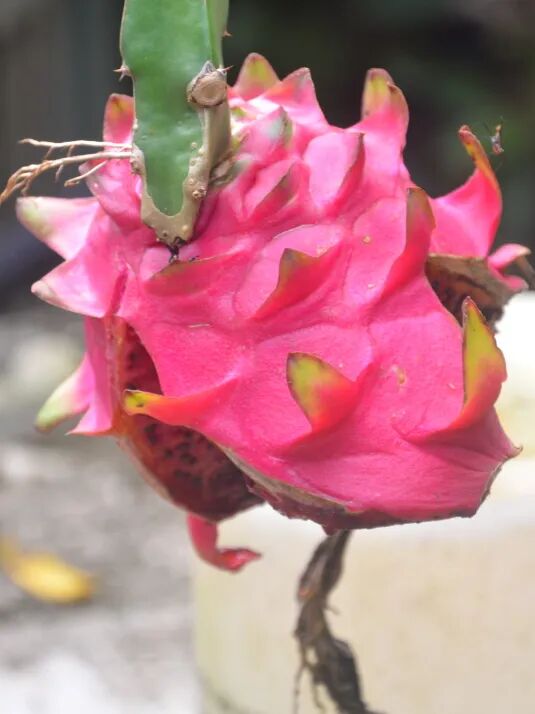
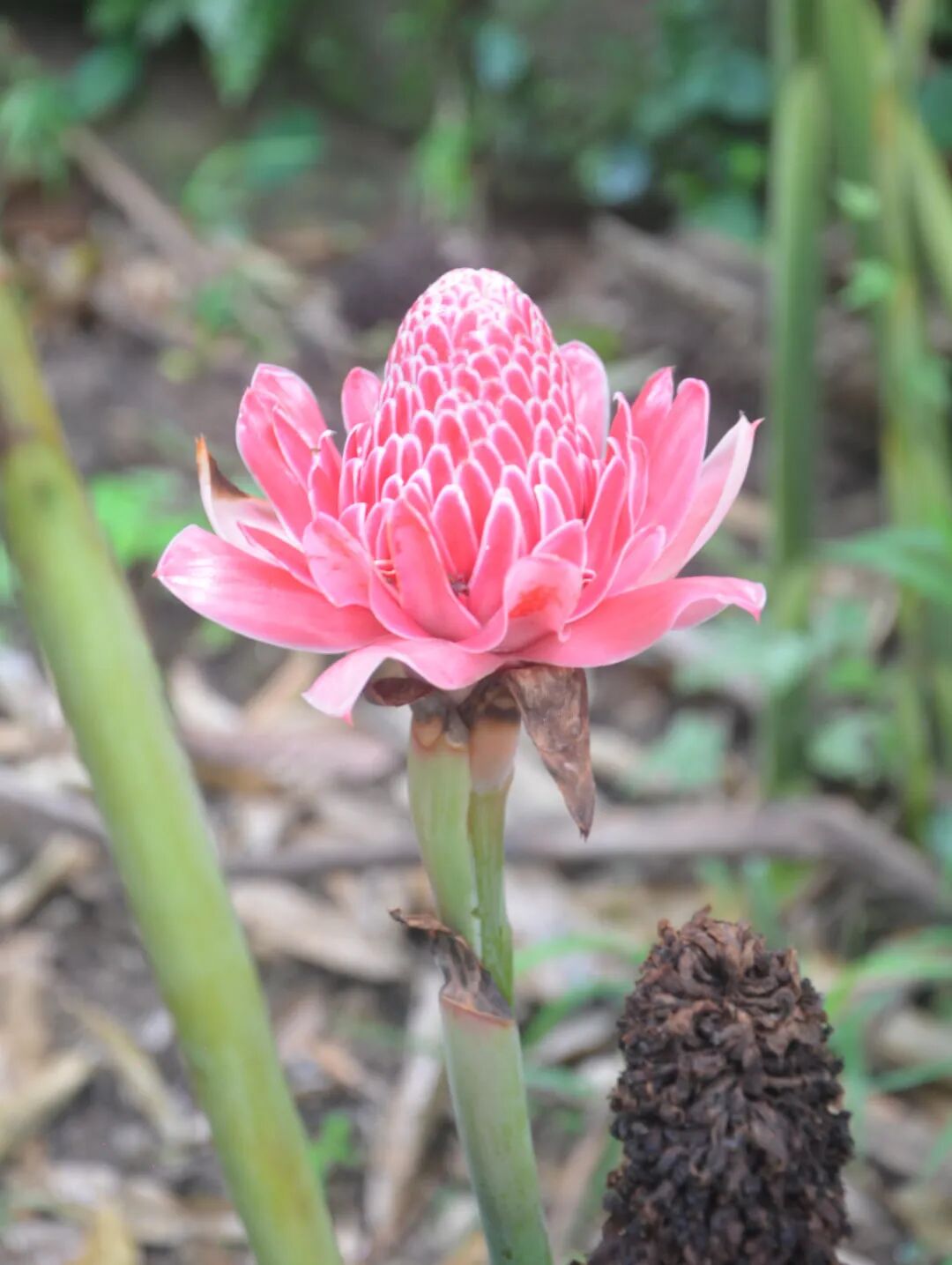
◉In the durian orchard there are plants such as dragon fruit and ginger lily that earlier generations also planted, as well as various insects, birds, and even snakes. A durian orchard is like a small tropical botanical garden. By contrast, renowned-variety orchards planted intensively to recoup costs quickly are often uniformly a single variety, intensively fertilised and sprayed with pesticides, with no such symbiotic relationship to speak of.
One day, I brought some cake to share with them. At first Auntie Bi declined. I teased, “You are already here opening durians at 6 a.m.; if I don’t bring it, when will you have time to eat?” She accepted, and in little details shared her life with me — for example, during the durian season there is no time at all to clean the house; when you go home after July, you find it as messy as a “pigsty”. Her son works in Kuala Lumpur and it is hard for him to help out at the durian orchard. I half-joked, “How about I inherit the orchard?” Uncle An burst out laughing: “You can manage a day or two, but you can’t even stand the mosquitoes!”
I felt a little uneasy; that was true. Life as a farmer is not easy, and all I can probably do is eat a few more kampung durians.
The Durian Tsunami: Behind the Price Crash
This year durian prices have fallen sharply across the board, and it has been called the “durian tsunami” — a strikingly apt name, because when a tsunami arrives, almost no one is spared.
The roots of the tsunami can be traced back ten years. At that time, Malaysia’s economy was booming, and the Chinese market’s enthusiasm for Musang King had only just begun. Large numbers of farmers cut down rubber and oil palm trees and switched to durian, especially Musang King and Black Thorn, which paid off faster and enjoyed higher market recognition. Ten years on, the trees planted then have now entered peak production all at once, and a large quantity of fruit has flooded the market.
Renowned varieties such as Musang King and Black Thorn set the price for all other varieties. Farmers growing lesser-known or even unnamed varieties have had to sell their fruit to middlemen at sharply lower prices. But their costs have not fallen by a penny, and small farms say making a living is getting harder and harder.
There are further problems. The Musang King and Black Thorn trees planted ten years ago have now all entered peak production at the same time. These young trees have had less time to establish roots and be fertilised, making them more prone to producing flawed fruit such as empty pods and underripe fruit. Much of it has not met Chinese export standards and can only be left in Malaysia, sold at low prices.
Chinese demand has directly affected Malaysia’s export-oriented producing areas such as Pahang, Raub and Kuala Lumpur. Between 2020 and 2024, China’s total value of durian imports increased fourfold. In 2023, nearly 90 per cent of durians from Vietnam and Thailand were also sold to China. Although Malaysia’s share of the Chinese market is still only 4–5 per cent, Pahang and elsewhere have long since developed a whole system around fruit shape, sugar content and export standards, and some orchards have even adopted IoT fertigation systems to carry out standardised, data-driven management.
Penang’s plots in Bukit Mertajam are fragmented, mostly run by family smallholders, and do not have the geographical conditions for large-scale expansion. Its durian output is also much smaller than that of Pahang and Johor. But Penang has not been left out — once prices fall, it is affected just the same.
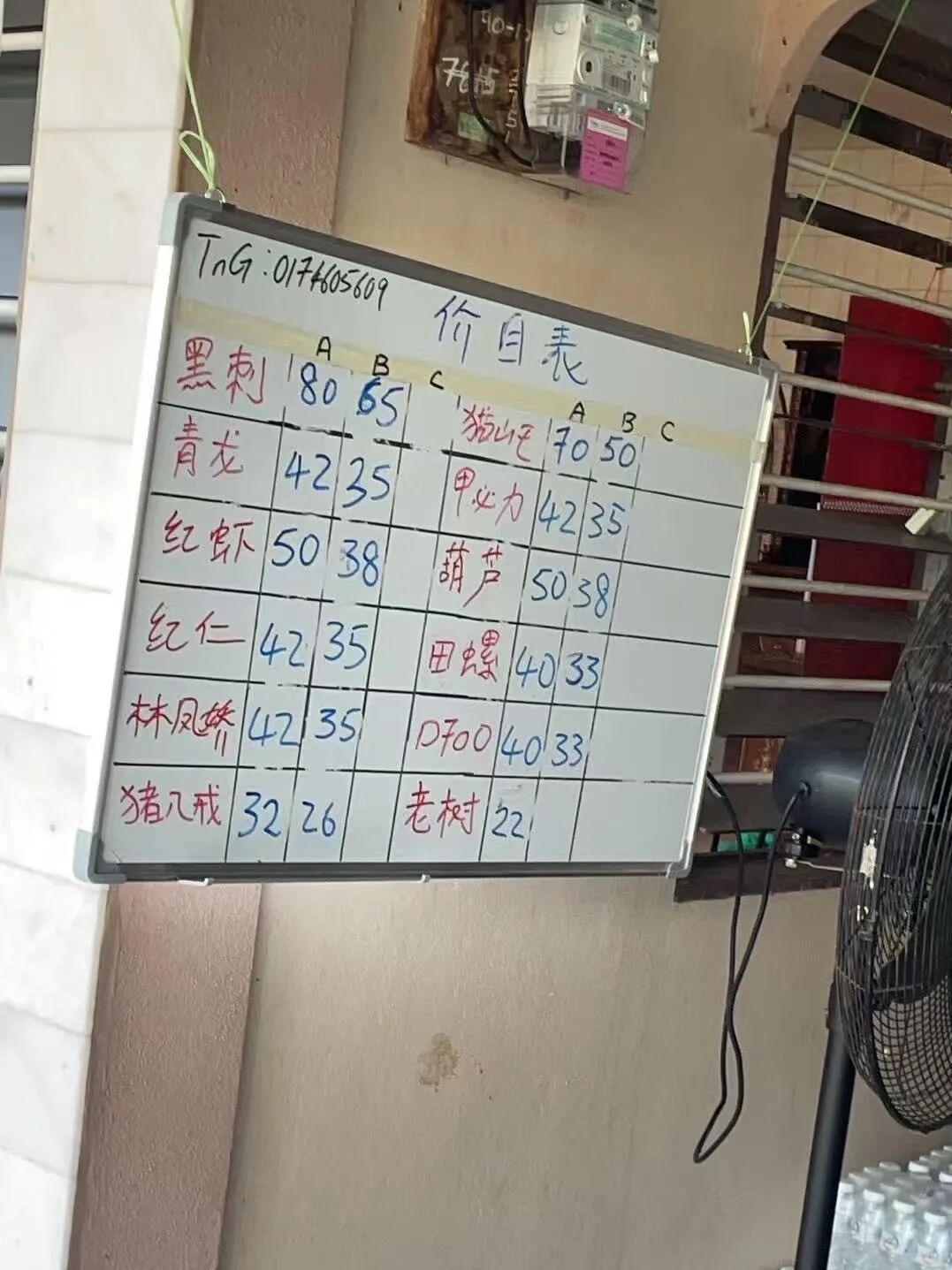
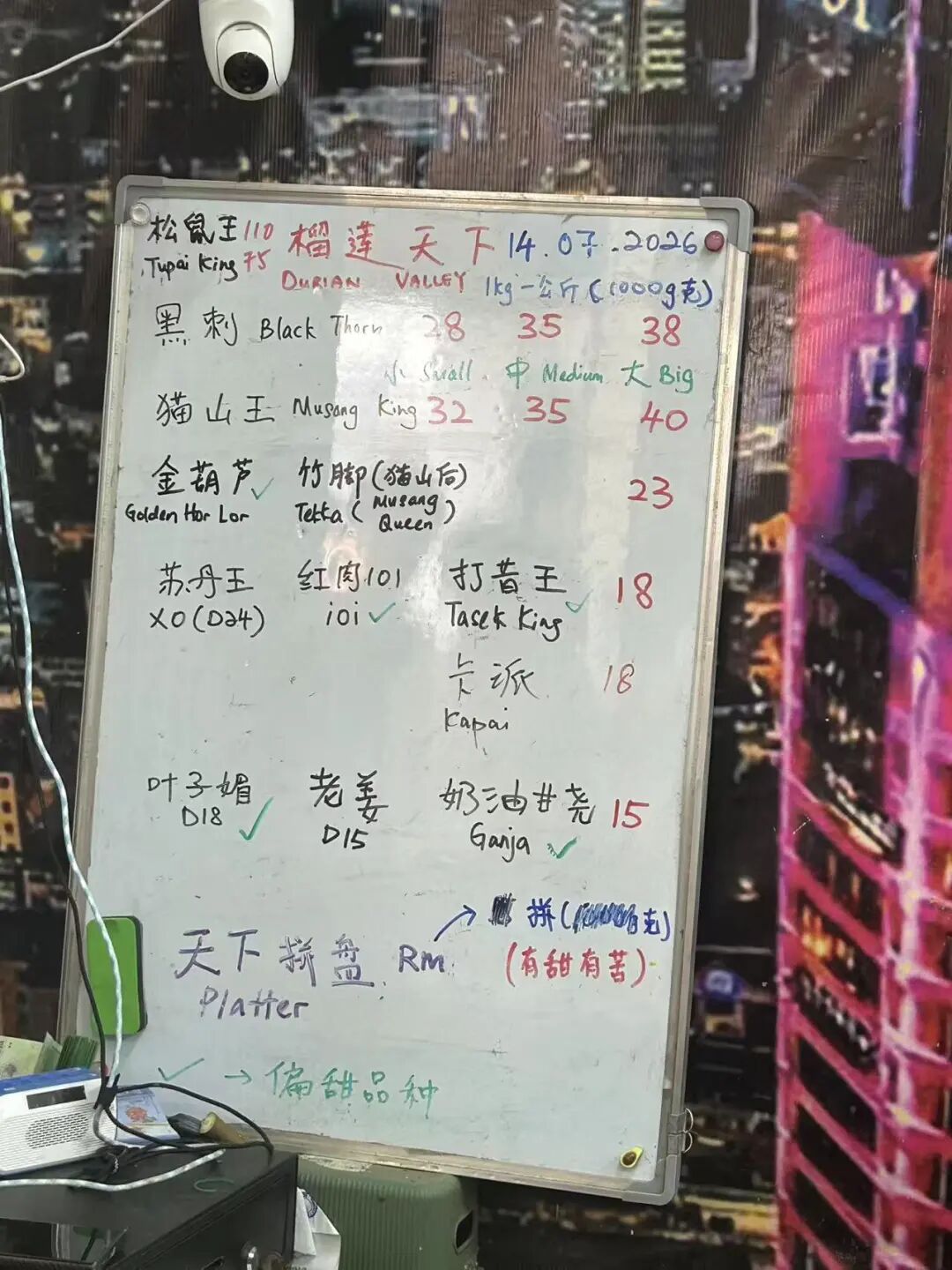
◉Changes in Penang prices last year and this year, photographed at a Penang durian stall. This year’s price is half of last year’s.
In the wake of this export-market-driven price crash, renowned-variety durian farmers in Malaysia are still divided over one question:
Should Malaysia stick with tree-ripened durian?
Malaysia’s signature has always been the richness and layered complexity of tree-ripened durian. But many farmers are beginning to seriously discuss whether they should follow Thailand and Vietnam in cutting fruit early: it gives a longer shelf life, suits cheaper transport routes, and extends the selling window.
Those who insist on tree-ripened durian argue that it is almost Malaysia’s only differentiating advantage in the Chinese market — in 2024, Malaysia had only just opened up fresh fruit exports, and that year, of the durian imported into China, 52.6 per cent came from Thailand and 46.7 per cent from Vietnam. They cannot win on volume, so they can only compete on “different” flavour characteristics. They also worry that Malaysia has already successively lost its global leading positions in rubber and palm oil, and if it also abandons the distinctiveness of durian, the same story may play out again.
Those who support cutting fruit early are more pragmatic: cutting fruit early transfers the risk from durian farmers to fruit buyers, farmers get paid earlier, and they do not have to watch helplessly as fruit crashes into a market that cannot absorb it. Moreover, most Malaysian orchards are made up of old trees to begin with; even if fruit is cut early, it ripens slowly over two or three days after leaving the tree, and the flavour can shift from sweet and dense to deeper, with a slightly bitter nuance, and quality is also higher than that of younger Thai trees that rely on hormones.
This debate is currently unfolding mainly in the arena of renowned export varieties such as Musang King and Black Thorn; Penang’s old kampung trees are not part of the import–export chain to begin with and are, for now, unaffected. But if “tree-ripened” one day stops being the standard for “good durian”, will the Penang experience of “eating whatever falls from the tree” be forgotten?
A Penang durian orchard, Bahang Terraces, not only grows kampung durian but is also promoting farm tours, hoping more people will learn about the terroir stories of Penang’s kampung durian. They say that, as farmers switch to higher-priced Musang King and Black Thorn to cope with market pressure, kampung durian in Penang will become increasingly scarce. If we do not become aware of the problem, some varieties may disappear. This is already happening.
“Penang’s durian should not be just Musang King; Musang King is actually produced in Pahang State,” a durian enthusiast from Penang told me.
Conclusion
By late July, Penang’s durian season was drawing to a close. I asked Uncle An what fruit was still around. He said not much was left — just eat whatever falls.
Whether in the off-season or high season, eating durian here is really all about “leaving it to chance”. After riding a motorcycle through the noisy town centre, over a stretch of mountain road, and through all that bother, you come to the orchard to ask: What has fallen from the tree today?
You don’t know what you’re about to eat, but you are still willing to pay for this mouthful of local bounty.
For the durian orchard owners here, this “uncertainty” has never been a romantic blind-box game. It is decades of making a living, day in, day out, at the mercy of the weather, and, alongside China’s durian boom and the wave of crops, an increasingly unfavourable market environment. Whether the fruit will be blown down by a storm just before it ripens, whether it will fetch a price, and whether their children are willing to take over — none of it is within their control. All they can do is continue tending the trees that are ageing with them.
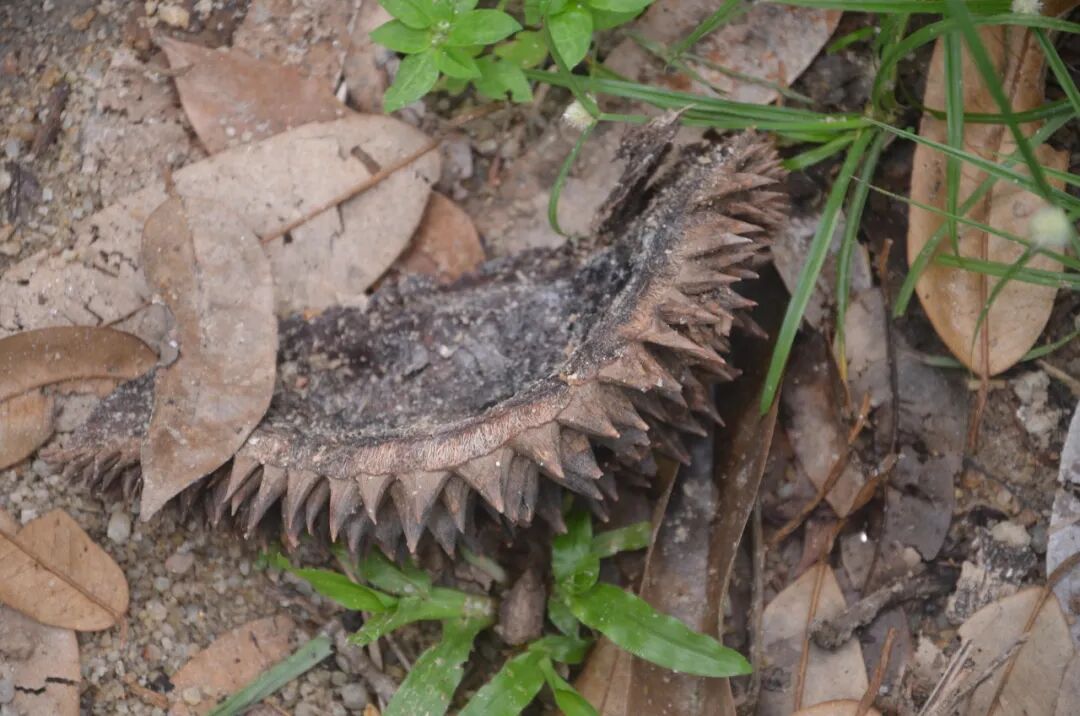
◉Photographed in a Penang durian orchard. They may be durians eaten by small animals, or durians “left to their own fate”, about to turn into new nutrients in the orchard.
– This is Foodthink’s 829 th original article –
Foodthink
Author
Renso
One of Southeast Asia’s three great gods, endlessly curious about anything not yet eaten.
Editor: Pei Dan
Layout: Xiao Shu
Scan the QR code to tip and support original food knowledge
▼

▼
Click the image to read related articles.
▼
Click a keyword to browse more article collections
Seeds | Agricultural Technology | Policy | Fermentation | Nutrition | Fruit | Fisheries | Events | Jobs | Food Delivery | Wet Market | Livestock | Food Talk | Sharing Session | Book Club | Harvest Festival | Smallholder Stories | Climate Change | Rural Development | Cooperative Economy | Urban Farmer | Food Safety | Digital Technology | Biodiversity | Pandemic and Food | False Solutions | Ecological Farming Internship Programme
Beijing | Hebei | Shanghai | Guangdong | Guangxi | Henan | Sichuan | Jiangxi | Xinjiang | Shaanxi | Hong Kong | Chongqing | Zhejiang | Jiangsu | Guizhou | Taiwan | Inner Mongolia | Philippines | Canada | Russia | Mexico | Italy | United States | United Kingdom | Germany | Netherlands | Thailand | Sweden | Japan