
In Search of Musang King: Malaysia’s Taste and Trade

This summer, Malaysia is experiencing a “durian tsunami” of oversupply. Bountiful harvests in durian-growing areas such as Johor, Penang, and Perak, combined with the concentrated release of previously accumulated production capacity, have sent durian prices sharply down. As reported by the Sin Chew Daily, prices for some lower-grade Musang King durians in Malaysia have fallen to an all-time low of 9 ringgit per kilogram (14.96 yuan), roughly one-tenth of their previous peak retail price.
And just two years ago, the story was almost the reverse.
Two years ago I settled in Thailand. One night, my Thai landlord came across a video while scrolling: a Chinese woman was selecting produce at a durian factory, ready for export to China. After watching it, she complained: “All the good durians have been bought up by Chinese people.” By “good”, she meant those that looked well-formed, large and plump.
That made me curious: is it really true, and just how huge is China’s demand for durian? What do locals think about it? Are the durians eaten in China even better than local Thai durians?
Durian originated in the rainforests of the Malay Peninsula and Borneo. The English name “durian” comes from the Malay word “duri”, meaning “thorn”, reflecting the spikes on its husk. Malaysia is the birthplace of the durian and is widely recognised as the region producing the highest-quality durians. There are more than 200 officially registered durian varieties in Malaysia, and the national planting area has expanded to over 90,000 hectares, with production steadily rising.
The famous Musang King durian comes from Malaysia and, with its distinctive bitter-sweet flavour, has become the “top-tier” durian variety. Malaysian authorities have even introduced a dedicated certification label to distinguish the genuine Musang King durians approved by Chinese customs from imposters. But for most Chinese consumers, the name has long existed only in various durian desserts made with jam. Genuine fresh Musang King durians first entered the Chinese market in August 2024. In 2024, Malaysian durian accounted for less than 1% of the durian imported into China, while the shares for Thailand and Vietnam reached as high as 57% and 42% respectively.
So, in August 2024, we headed south from Beijing to the core Musang King producing areas — Johor and Pahang in Malaysia — just as the first fresh Malaysian durians were about to be allowed to enter China. We wanted to see for ourselves what the orchards here are really like.
Large-Scale Durian Orchards
Flying from Beijing to Kuala Lumpur takes just over six hours. The cheap red-eye flight left us aching all over, but we could barely hide our quiet excitement: by that afternoon, we would already be eating fresh Malaysian durians.
Before August 2024, fresh Malaysian durians were not yet available in China. The only imported frozen Malaysian durians were Musang King and Black Thorn, and a single fruit could sell for three or four hundred yuan or even more—three to four times the price of Thai durians.
However, the preliminary research we had done before the trip showed that local durians were much cheaper than in China. Misshapen, lopsided fruit or smaller fruits could be had for just 40 or 50 yuan!
It is also said that frozen durian and fresh durian do not have the same flavour; the latter has a more intense aroma. Although August was already the tail end of the durian season, I had heard that we would be able to taste at least five or six varieties: besides the renowned Musang King and Black Thorn, also Zhujiao, Red Prawn, Super XO, Sultan, and others. Photos posted by netizens on social media opened our eyes: some flesh was orange-red and looser in texture, while some was pale yellow but glutinous. Durian is a tropical fruit; for people who have lived in the north for a long time, such a rich variety of textures and tastes is utterly novel.
Public transport in and around Kuala Lumpur is not very convenient. After landing, we splurged a whopping 800 yuan on a hired car. After about a two-hour drive, we went to visit a large local durian orchard—LKE.
LKE Group is a large agricultural developer in Malaysia. By the time we reached the entrance, quite a few local families had already brought their children to try picking fruit, treating the place as a tourist attraction.
My Malaysian alumnus, Brian, welcomed us. He had studied agriculture overseas and, after returning home, came to work at LKE. The durian orchard here covers about 13 hectares; we spent a long time just walking through the main stands. It is also quite modern: automatic sprinkler systems and insect-repellent devices were all in place. After looking at the main durian trees, we climbed the tallest building on the site and looked down over the entire grove. Brian pointed to the stands in the distance: some had only just been planted, others had already grown very tall. August was in the middle of the rainy season; even up high, it was so muggy that we were drenched in sweat.
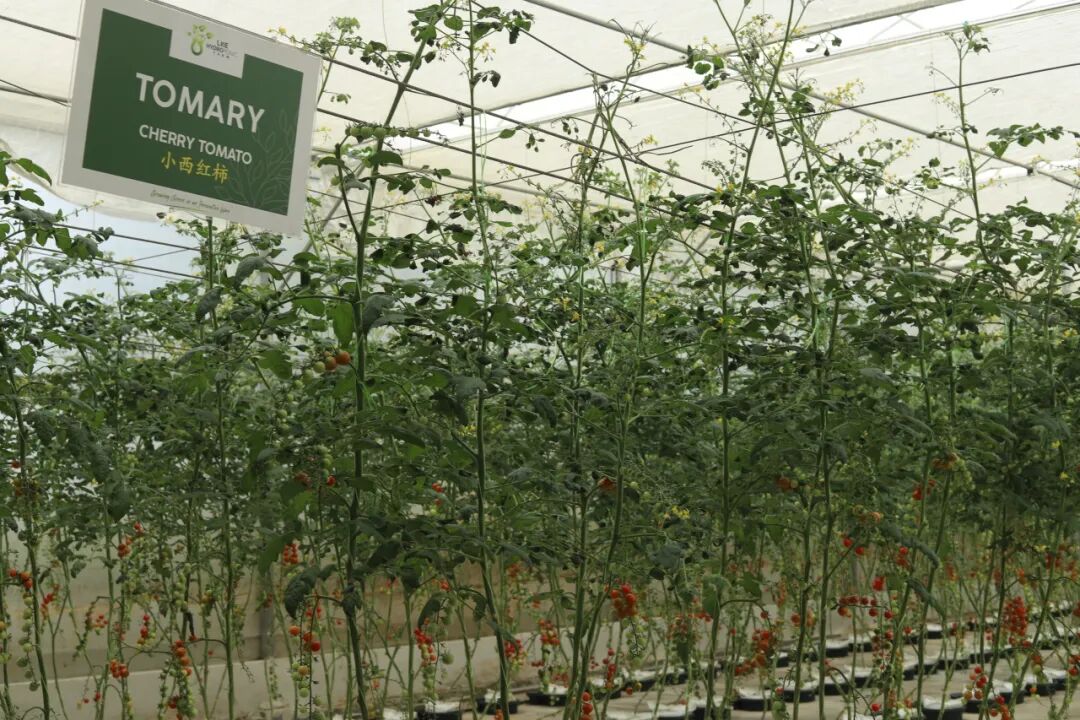
◉ The LKE site also has some vegetable-growing sheds.
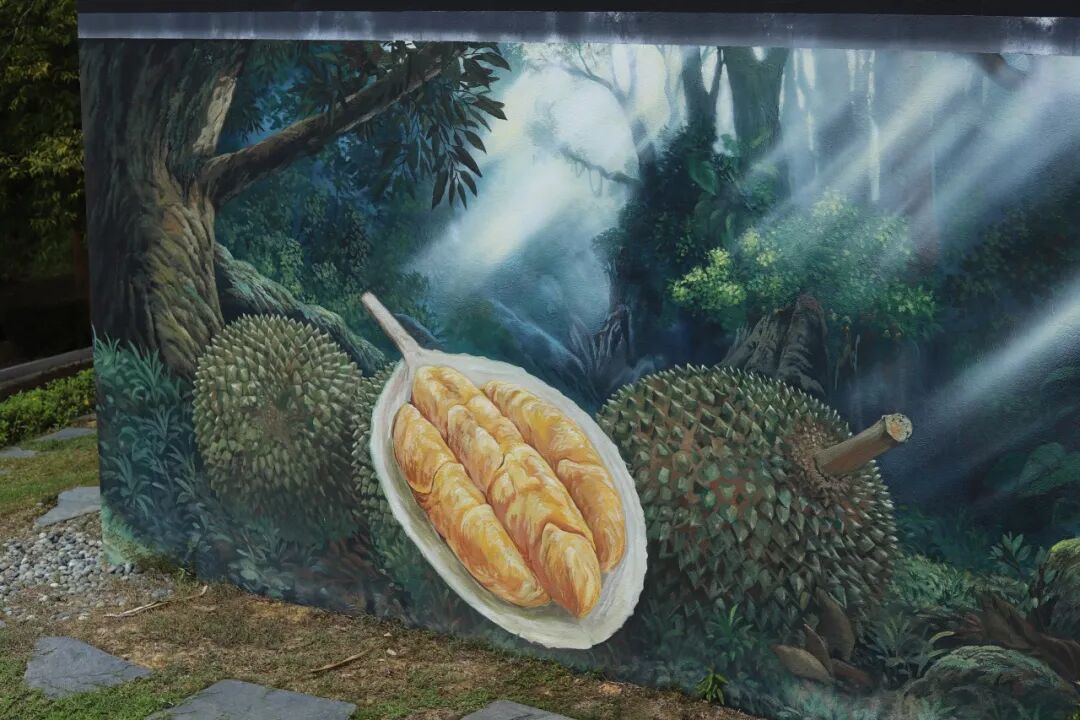
◉ A durian mural at the LKE site.
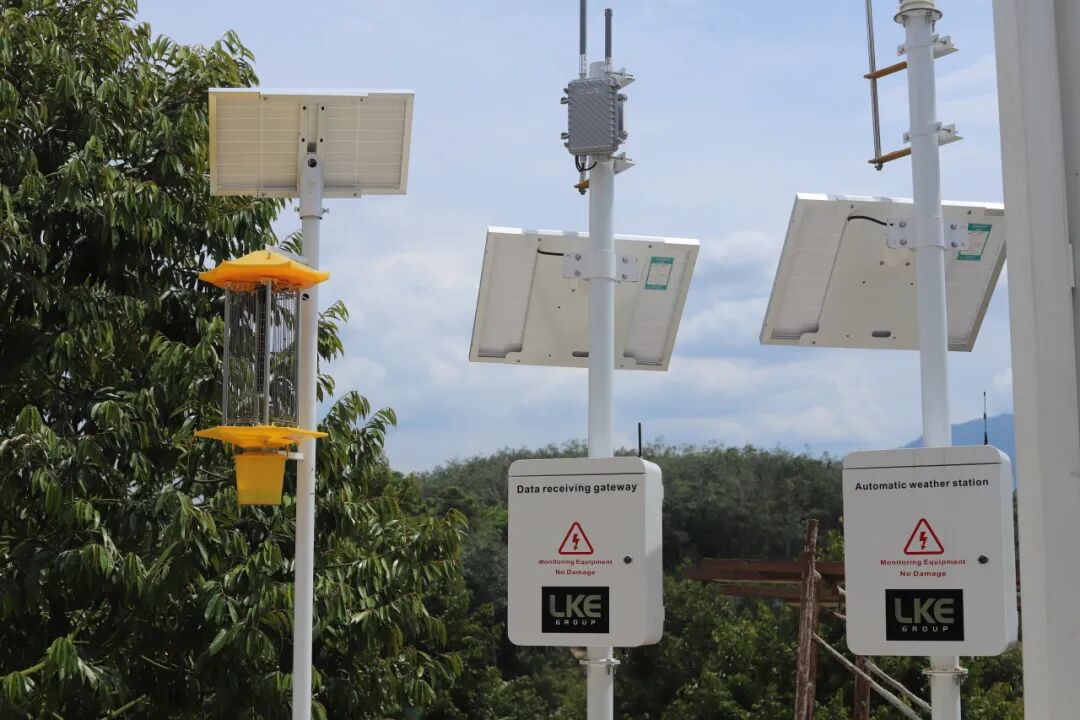
◉ The smart agriculture system at LKE: insect-killing lamps, field data sensors, and a small weather station for collecting weather information, all powered by solar panels for a self-sufficient power supply.
Durian trees are true natives of the Malay Peninsula. Old trees can grow to a girth of two or three people’s embrace and a height of nearly 100 metres. However, commercial durian trees in orchards are usually more than 20 metres tall. It takes seven years from planting a sapling until it bears fruit suitable for sale. Both flat land and small hills are suitable for growing this fruit.
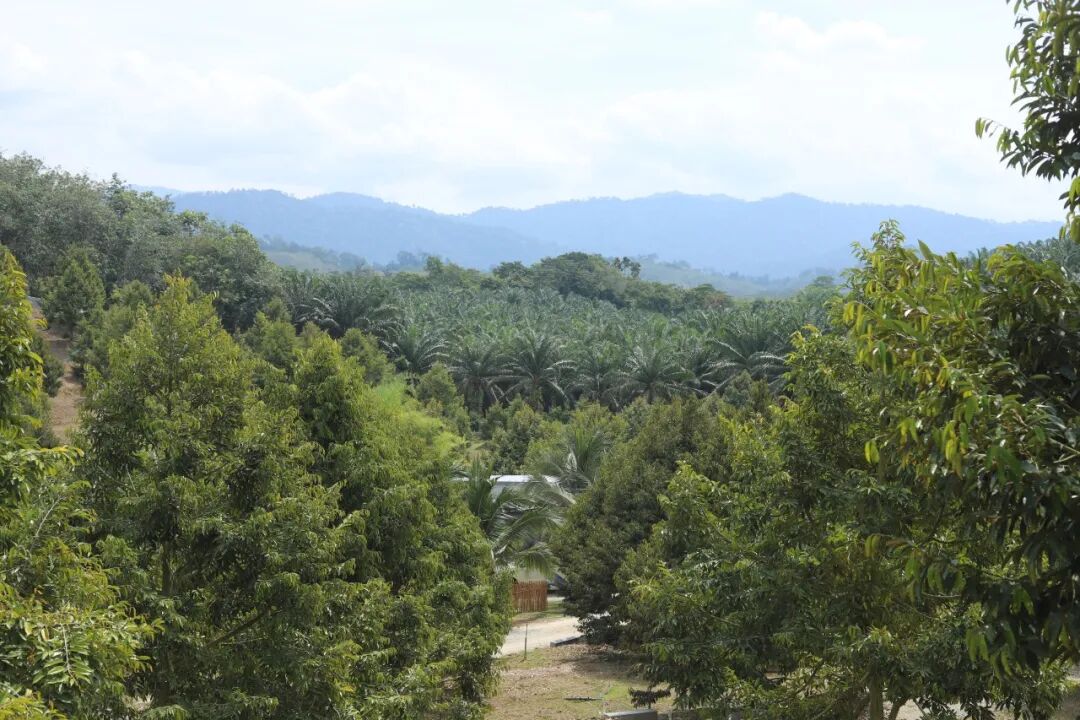
◉ The LKE site covers a large area.
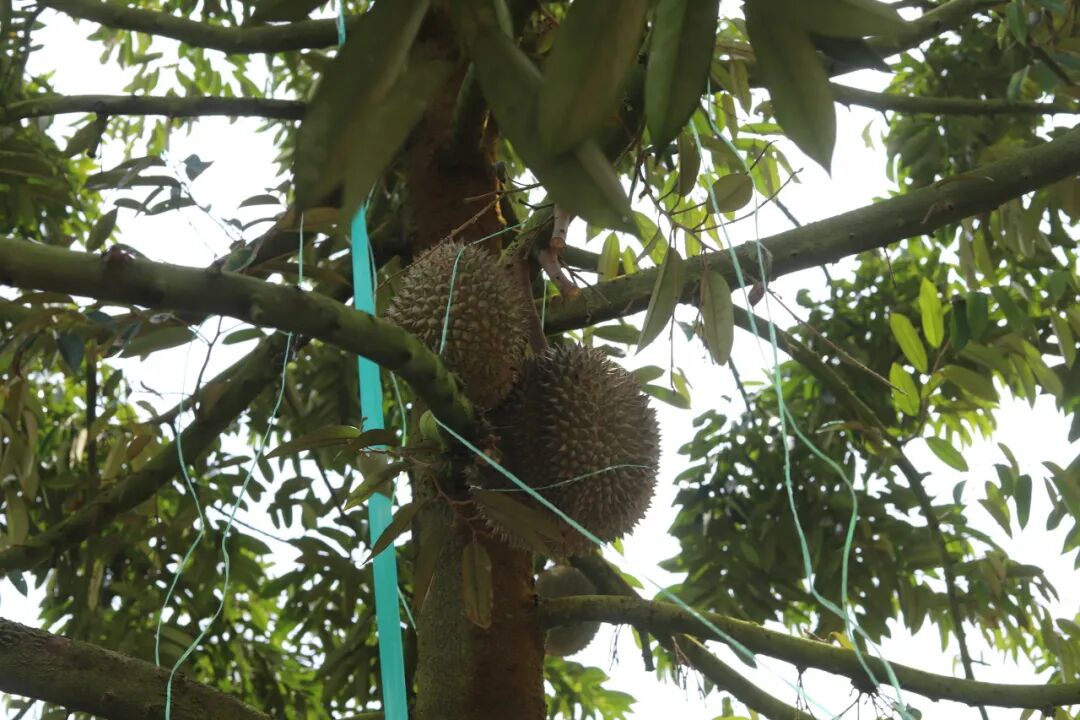
◉ Durians are tied up with rope so that when ripe they do not drop straight to the ground.
That day, LKE had a public event, with someone explaining LKE’s development history and the ever-booming durian investment market. Judging by outward appearance, the audience included Muslim women wearing hijabs and quite a few Chinese people. The presentation was delivered in English, and everyone listened attentively.
Afterwards came the durian-eating part. The investors who had attended the lecture settled at small tables. The site was far from the city centre, and many people had made a special trip by car. By the standards of city dwellers with high expectations of public hygiene, this was by no means a good place to eat. Flies were flying, there was no air-conditioning, and the tables and chairs were not exactly spotless. But the durians had just been picked from the orchard, and their first-rate freshness still made the guests on site rush to grab some.
Brian also bought four durians out of his own pocket to treat us to a taste. For a northerner who cannot tell crops apart and whose palate is not very acute, I could only sense the subtle differences in texture from one durian to another while eating, but I could not describe them precisely.
Before leaving Kuala Lumpur, we also visited a local durian market for consumers—SS2. The market is a 20-minute drive from the city centre. It is not quite like China’s farmers’ markets: most of it is made up of individual traders’ stalls or sheds, selling only different varieties of durian. Fruit is weighed on the spot and cut open, and customers can either sit down and eat or have it packed into clear plastic boxes to take away.
The cheapest durians cost only 20 to 30 yuan a piece; pricier ones cost 100 to 200 yuan. People of different ethnic groups were hefting the fruit, weighing and paying. I thought to myself: so it is true—durian transcends race and region; everywhere someone loves it.
Small durians mean less flesh and are suited to “eating for one”. When opened, they yield two or three pieces of flesh about the size of an adult’s palm, enough to enjoy for the novelty. Large durians look, by eye, about the size of an adult’s head. We spent 90 ringgit (about 150 yuan) on a well-proportioned Red Prawn durian; for two women, it was enough to eat until feeling a little cloyed.
Overall, Musang King durians in the producing area are not expensive. Musang King prices in China are probably ten times higher than producing-area prices.
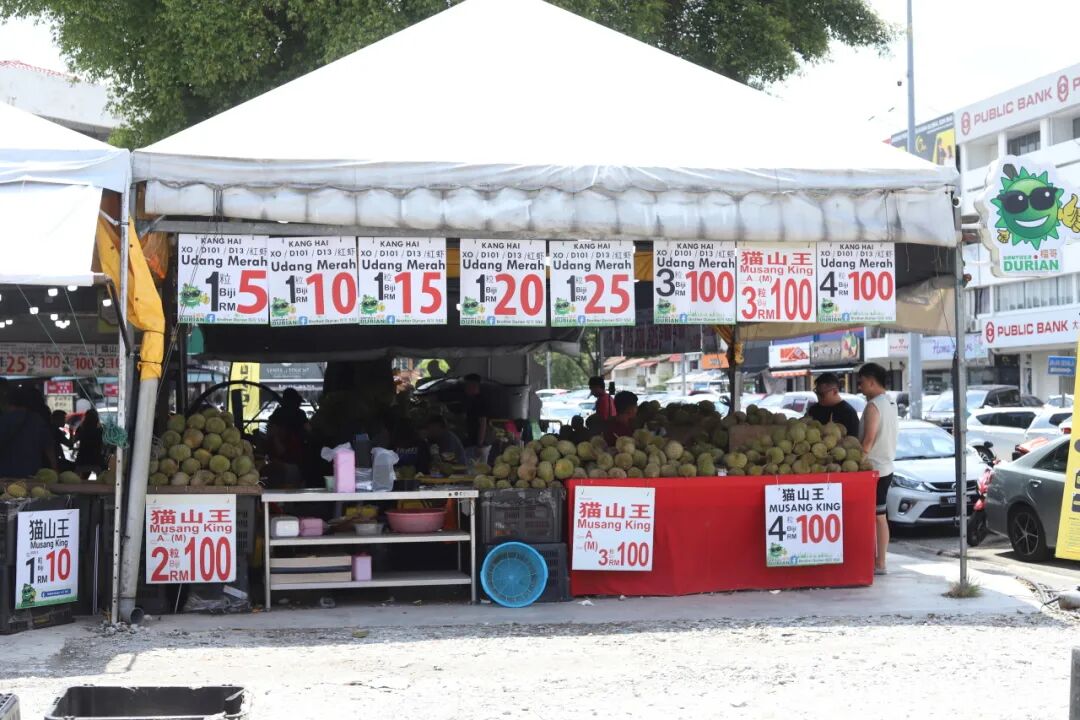
◉ There are many durian stalls in the SS2 market; the image shows market prices in August 2024, 100 ringgit = 165.76 yuan.
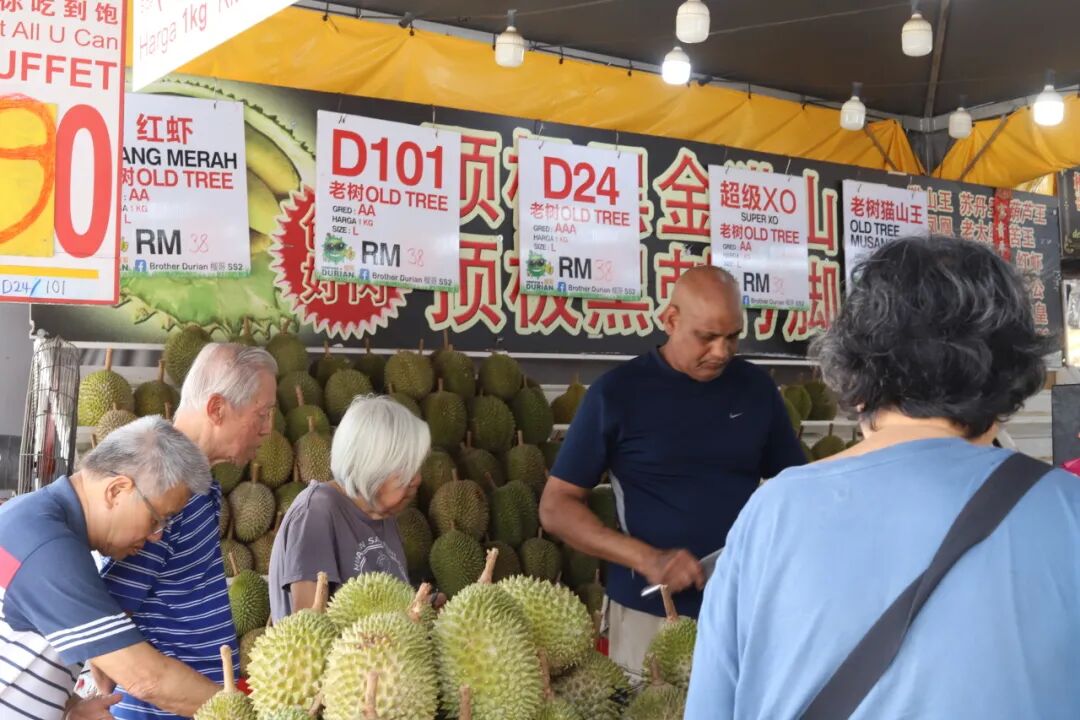
◉ Residents around Kuala Lumpur selecting durians at the SS2 market.
From a Modern Site to Local Orchards
Our second task was to head to Muar and find Lin, who is in the durian trade.
Muar is a small town in the state of Johor, Malaysia, about a two-hour drive from Kuala Lumpur. We stayed in the town centre, and for just over ten yuan one could have a bowl of char siu wonton noodles or flour kueh. The town is home to Malays, Chinese and Indians. There are churches with crosses, but no cinemas; to find bustling large shopping malls one had to head north to Malacca. The Muar River runs through the town. It is a quiet, commercially underdeveloped small town. In the same state of Johor, but unlike Johor Bahru, which is full of high-rises and shares a border with Singapore, Muar is like a person in their twilight years.
Lin is 30 this year and a “second-generation durian trader”: the elders in his family once made their first fortune through cross-border durian trade, and the business later passed to him. Lin’s child is just over one year old, and he has little time to share much of the childcare: making money in the fruit business requires night shifts, so his life and his child’s life are on different timetables.
Our meeting with Lin was full of twists and turns. He works in the wholesale export of fresh durians. After adding him on WeChat, he hardly ever replied to messages. I worried he was not interested in the visit, but when we met, it turned out to be completely the opposite. Lin’s routine was different from most people’s: he got up at three in the morning and worked until ten, went home for a nap, and then in the afternoon went to a frozen durian pulp workshop to supervise the work.
At a little after five in the morning, before dawn, Lin sent a location pin: he had already reached the “company”. We sprang out of bed at the guesthouse, hailed a car and headed straight for the destination. More than ten minutes later, when we got out, we found quiet streets and two-storey houses all around. The sky was just beginning to brighten, and durians at the company were being loaded.
There were five or six people on site, mostly Chinese. Lin usually does not do the hands-on work himself. A Chinese man in his fifties worked bare-chested, sorting, weighing and loading. “This is Musang King, this is Red Prawn, D24, D101.” A glance and a heft were enough for them to tell which variety it was. By then we were at the tail of the durian season, and fruit was scarce in the south. This batch had been harvested in Pahang and brought to Johor, waiting to be exported to Singapore. The varieties, apart from the best-known Musang King, included Zhujiao, Red Prawn and other common local varieties.
A durian’s freshness cannot wait. Lin is in the export trade: durians picked early in the morning have to be on the tables of Singaporeans in neighbouring Singapore by the afternoon, even though the land journey takes three or four hours. To get a good price, they must race against the clock to weigh, sort and load.
This, too, is a feature of fresh Malaysian durians. Unlike in Thailand, Malaysian durians are all sold immediately once they ripen and fall naturally, while Thai durians are often picked early at 70 to 80 per cent ripe, to make transport and keeping them fresh for export easier.
Thai durians are cheaper, and advances in logistics have made competition in the Southeast Asian market fiercer, but Malaysians still hold fast to their own way. This means they need to improve transport efficiency—durians should ideally be eaten within three days of coming off the tree, and after a week they spoil and are no longer fit to eat. On the day we met Lin, three truckloads of durians, worth about 100,000 ringgit (roughly 160,000 yuan), would head all the way south, reach Singapore three hours later, and be distributed to stallholders.
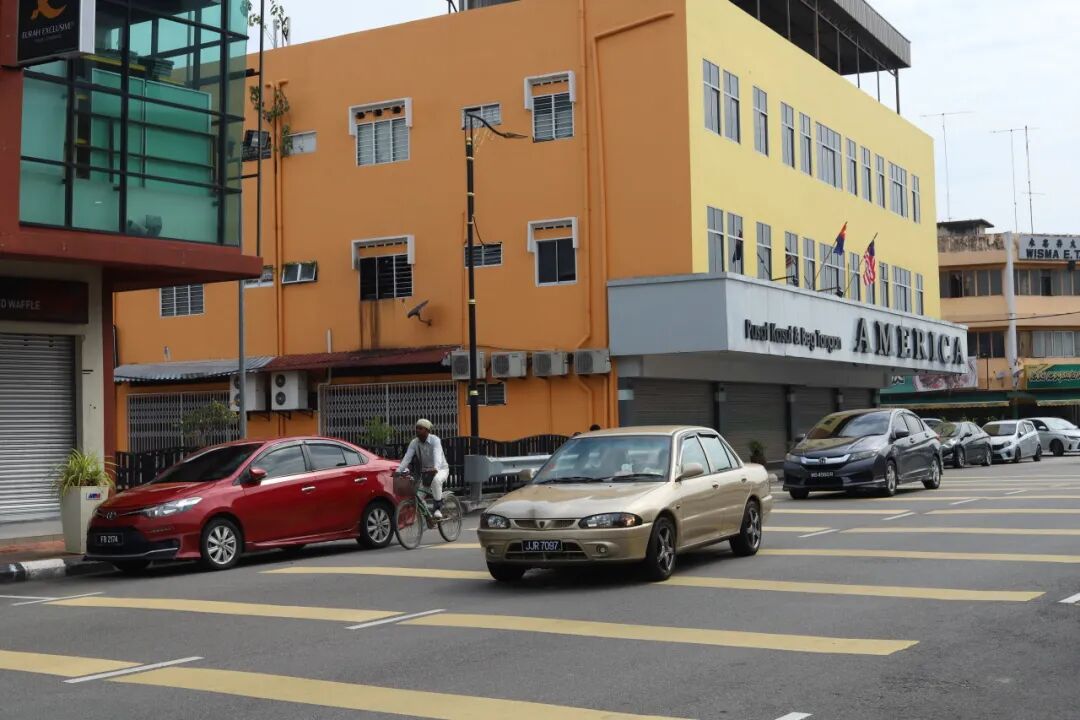
◉ The town centre of Muar.
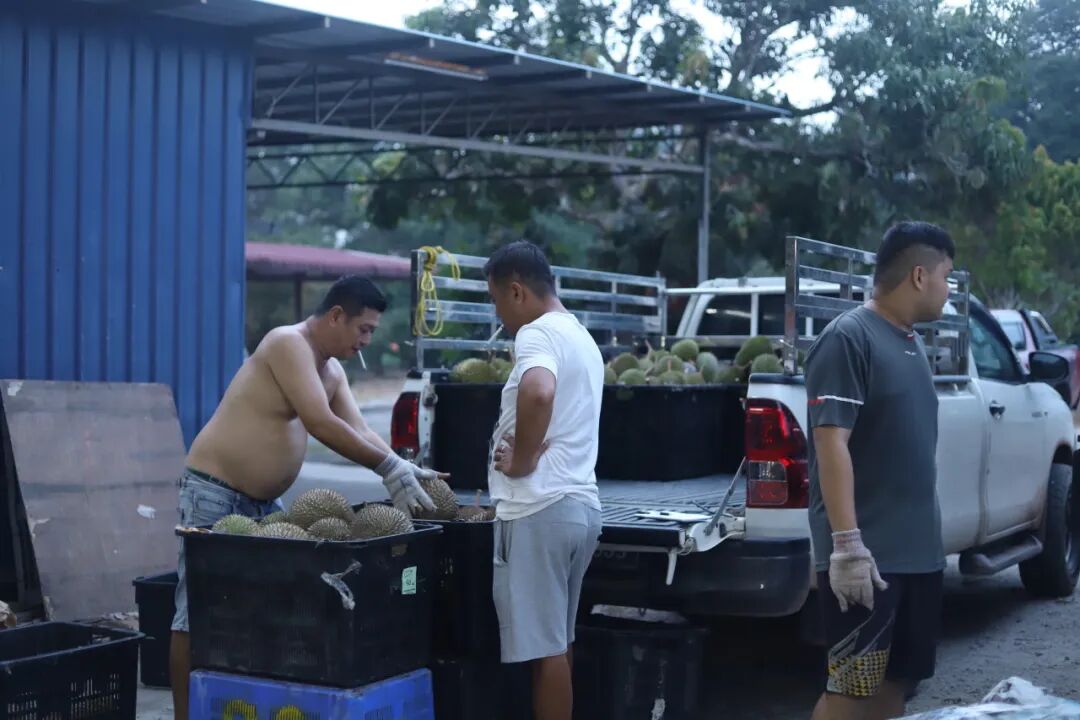
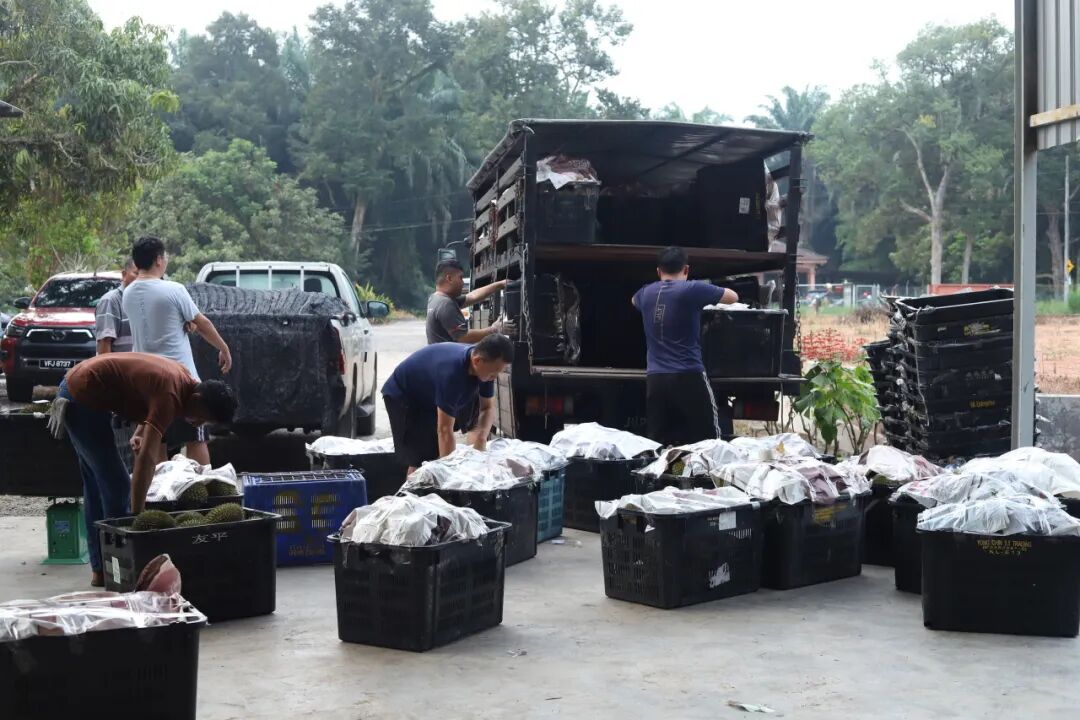
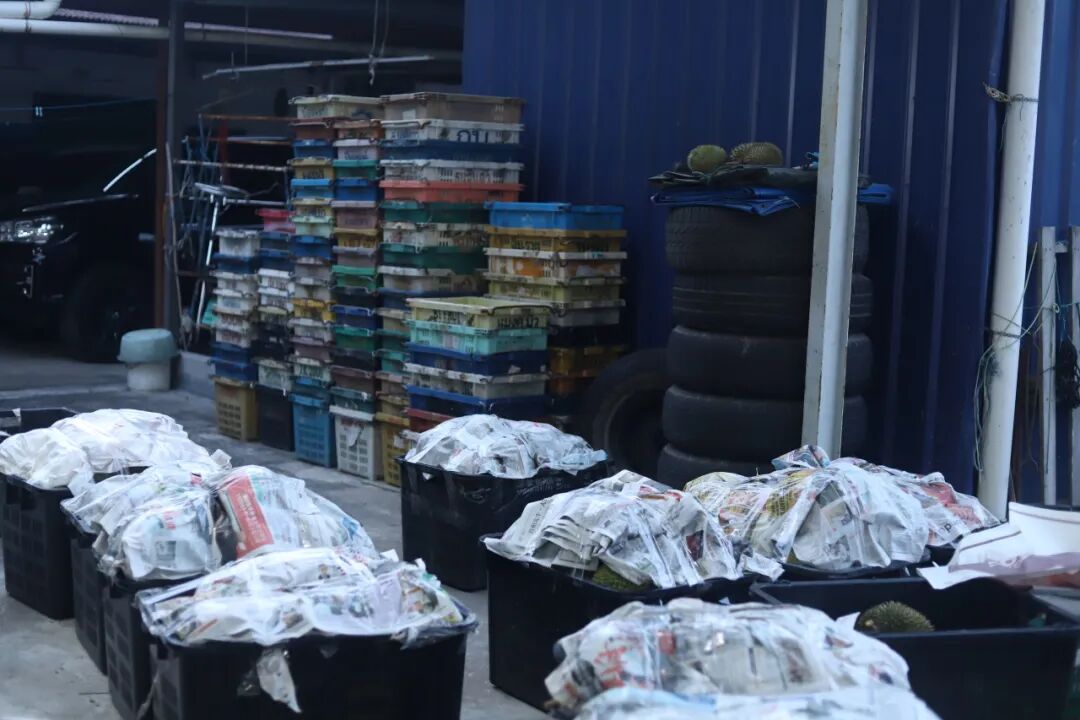
◉ Staff at Lin’s company sorting and loading durians.
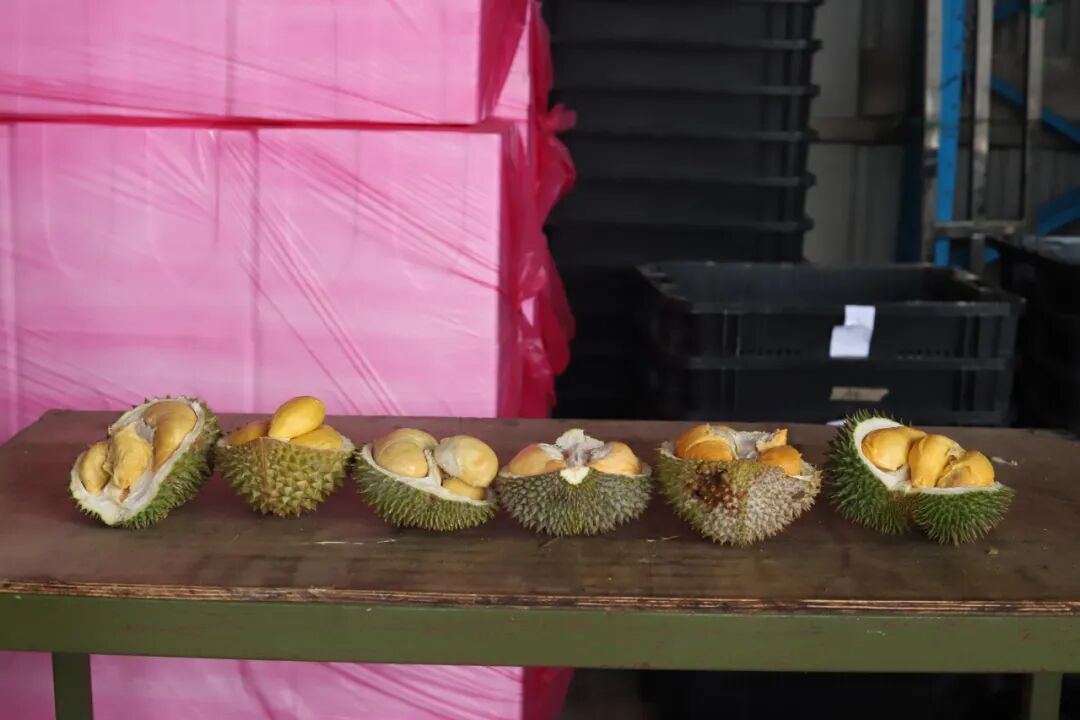
◉ The durians in this row are all different varieties.
Lin invited us to eat durian on the spot. When I said I felt awkward about it, they explained that some durians that were scarred, misshapen or cracked could not fetch an export price and had been sorted into the reject box. I knew this was a consoling reason—in the local market, such durians also sold, just cheaper.
Lin took over the business from his father, and the older man is also a long-serving employee. He said that when he was a child, the family’s fields also had durian trees, but there was hardly any need for pesticide or chemical fertiliser. Now, almost every month they have to spray pesticide and apply chemical fertiliser. The changes in cultivation methods also gave us a sense of the impact that today’s preference for good-looking, sweet fruit has on the production side.
The older men worked briskly; before dawn they had packed a truckload of durians, setting aside the less good-looking ones separately to be sent for making durian pulp. The frozen durian pulp factory was just across the way. Although it was called a processing plant, the equipment was simple in practice, and the migrant workers lived in the very same room. When we arrived, they had only just got up, and the room was full of sealed packs of frozen durian pulp.
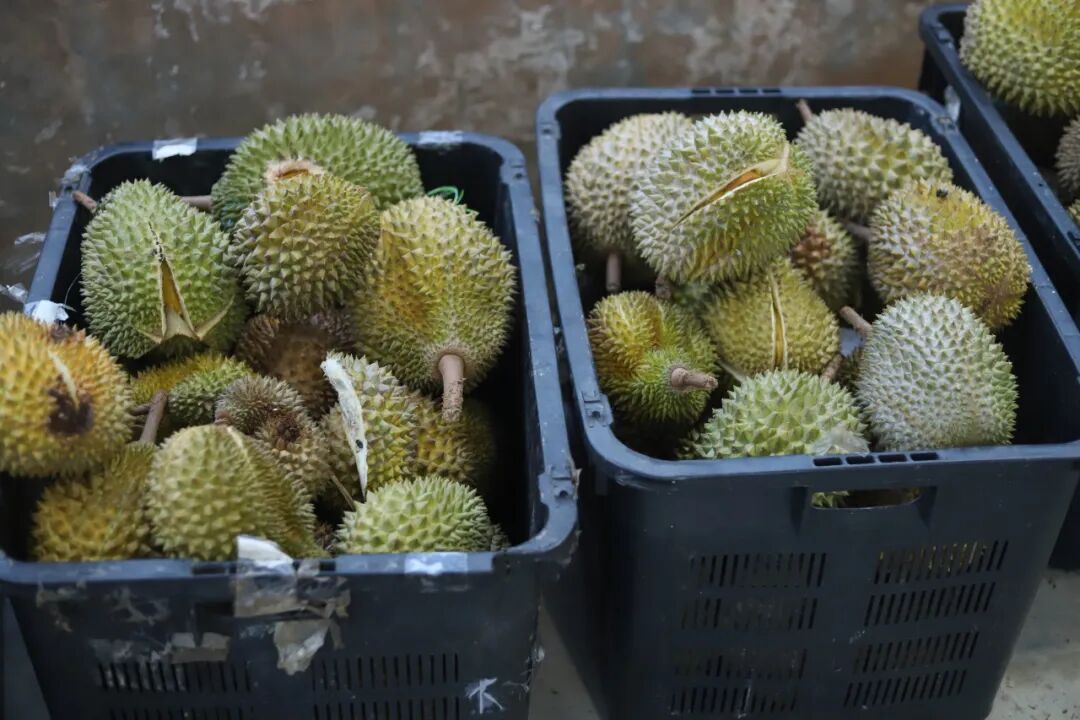
◉ Some durians with cracks were sorted separately.
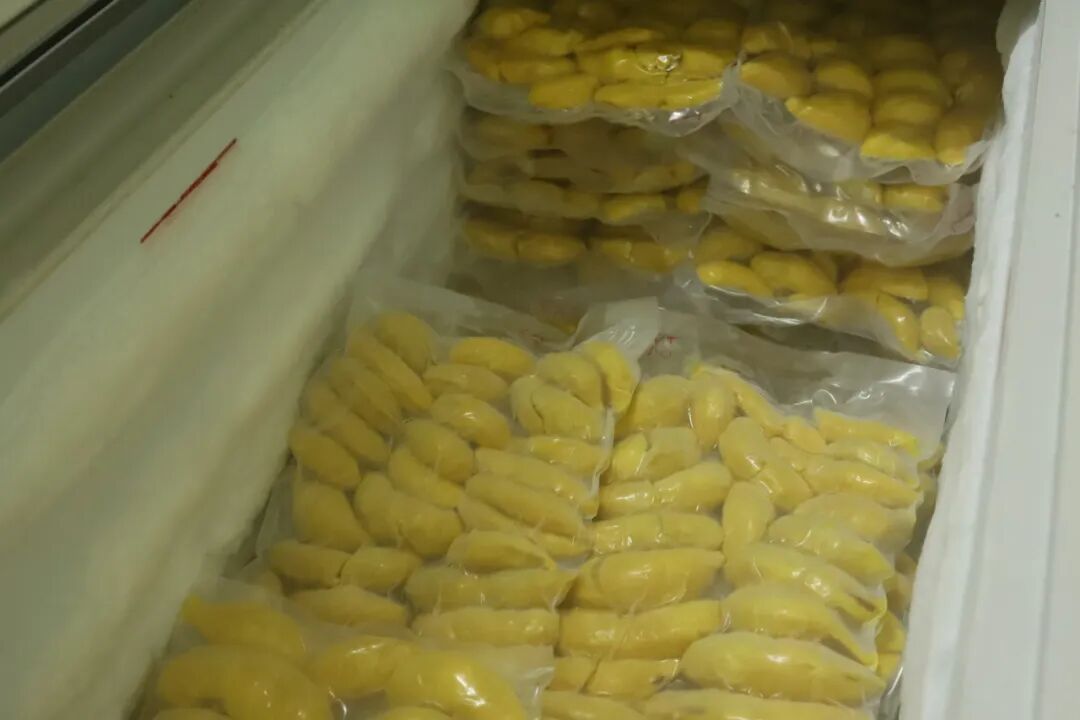
◉ Frozen whole pieces of fruit flesh.
Lin’s business has not been easy to run over the past few years. Market competition has become fiercer, with price wars and fights for market share. He once went alone to markets, stalls and kiosks in Singapore for ground-level promotion, hoping to sell the durians he handled in every place, and on another occasion lost several tens of thousands of yuan because he could not collect the outstanding balances on goods from small mobile traders.
The company’s sales volume and revenue were not proportional, and profits were even more dismal. After downstream customers paid a deposit, Lin shipped the goods; once the goods had sold, the final balance was collected. He later found that small business customers ran away too often, and final balances could not be recovered. Durian is a premium consumer product among fruits; once the economy turns sluggish, wholesalers can immediately feel the slowdown in durian sales.
Starting in 2019, frozen durian from Malaysia began to be exported to China, drawing more players into the local durian sector. Fierce competition has squeezed the profit margins of smallholders and small-scale traders. For the full year 2023, the company’s turnover was 30 million ringgit (about 49.66 million yuan); after Lin paid the workers’ wages, there was barely any profit.
Fierce market competition and a sluggish economy have pushed Lin to change the business model inherited from his father’s time. From 2024, he carved out a space of over 100 square metres for processing frozen durian. This was mainly to reduce waste. Only durians that are well-shaped, with no obvious knocks or blemishes and no cracks, can be exported. Rejected durians have their flesh removed or pulped, then frozen for storage; otherwise, fresh fruit keeps for only a few days and is left to rot in their hands.
Lin is preparing to invest 1 million ringgit (about 1.66 million yuan) in building a small frozen durian processing factory. However, he is still waiting for lengthy government approval, and it will not be operational until next year at the earliest. He said he could not afford to build a large processing plant: a liquid nitrogen system, freezing equipment, and continuous power for cold storage would cost 10 million ringgit (16.55 million yuan) up front.
After the visit, we chatted for a while in the yard, and he kindly fetched us some mangosteens. It had only just reached nine in the morning, and he was off to take the staff off work to have breakfast.
III. From Palm to Durian
After a brief stop in Muar town centre, we set out for Marcus’s orchard. The orchard is 44 kilometres from Muar town centre and about an hour’s drive. Not only could we not get a car, but the orchard was also hard to locate. On Google Maps, it was a country road called Jalan Raya, flanked by a grey expanse.
Growing durians is a long-term investment. In Malaysia, durian trees take at least six or seven years from planting to bear fruit in abundance, and a single Musang King durian takes about 120 days from flowering to full ripening. The ripening cycle for Thai Monthong durian is similar as well.
The slow growth cycle once kept the durian industry in a relatively stable, traditional state. However, as Chinese demand for durian has surged, cultivation methods and the industry ecosystem in Malaysia’s durian-producing areas are undergoing significant change. Marcus, who farms in Muar, has lived through the transition firsthand.
Marcus is in his forties, a Malaysian Chinese whose ancestors migrated from Guangzhou to Nanyang. His family has farmed in Muar for generations. They began in the rubber trade, then gradually expanded into the more popular and more profitable oil palm and durian.
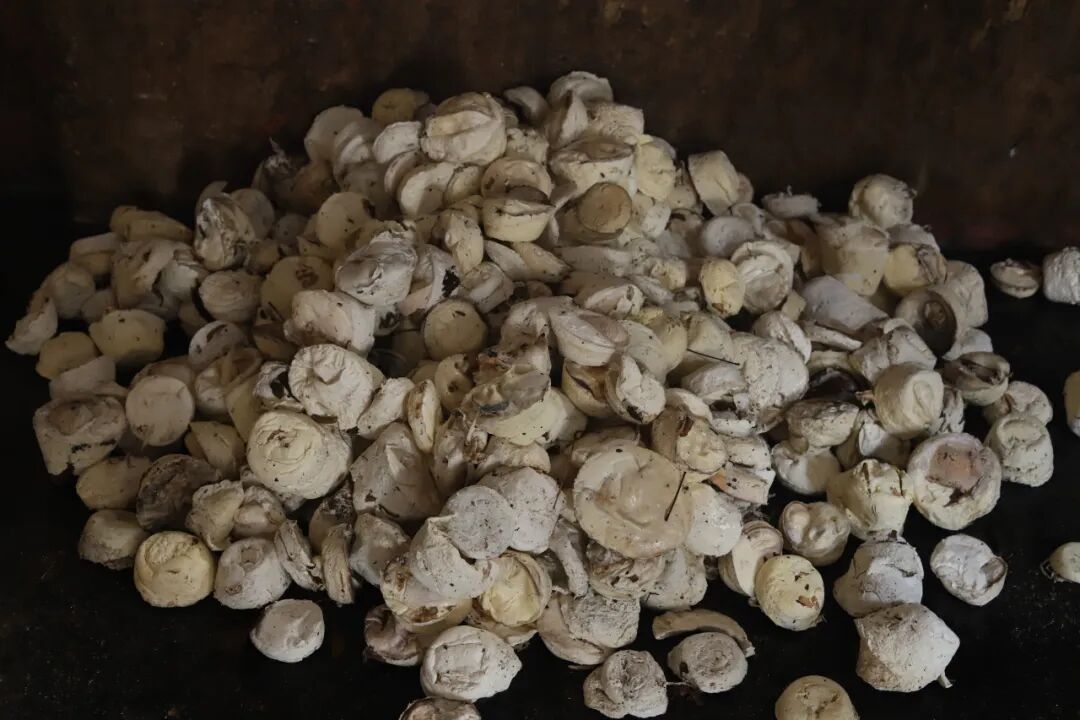
◉ Harvested rubber in the warehouse.
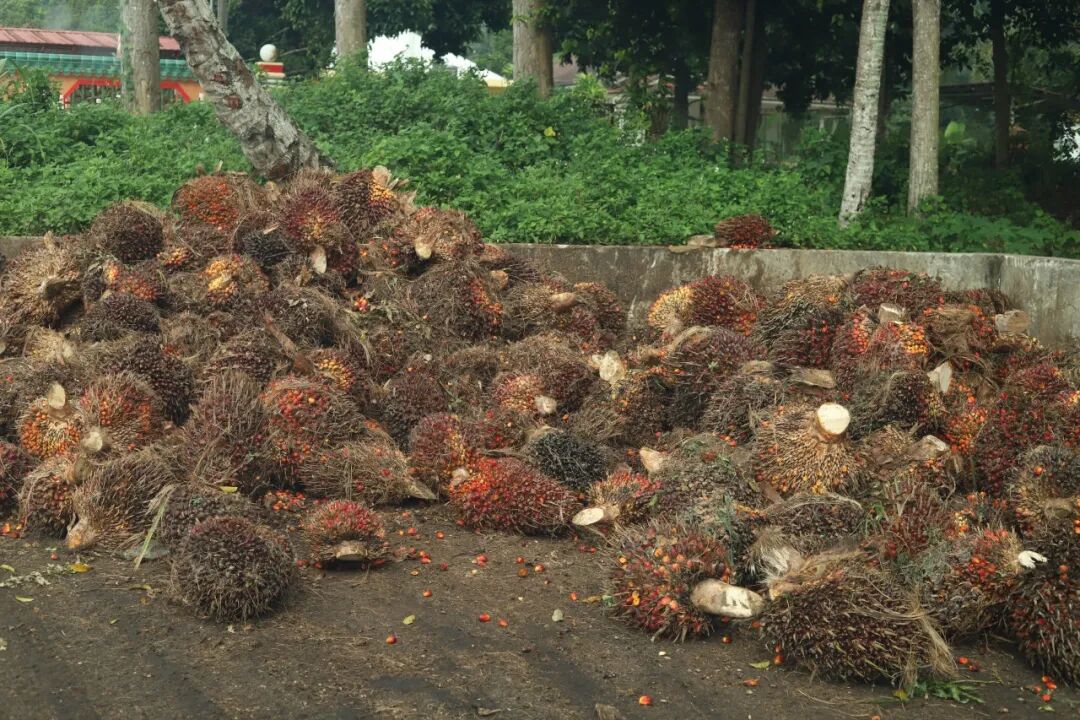
◉ Scattered oil palm fruit.
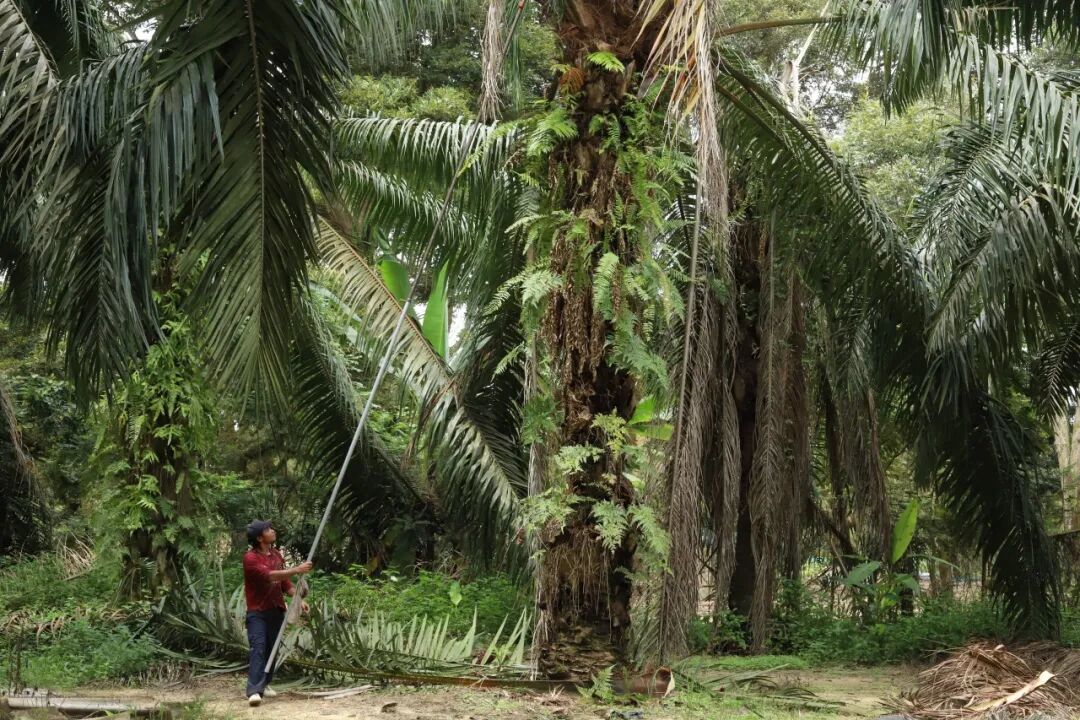
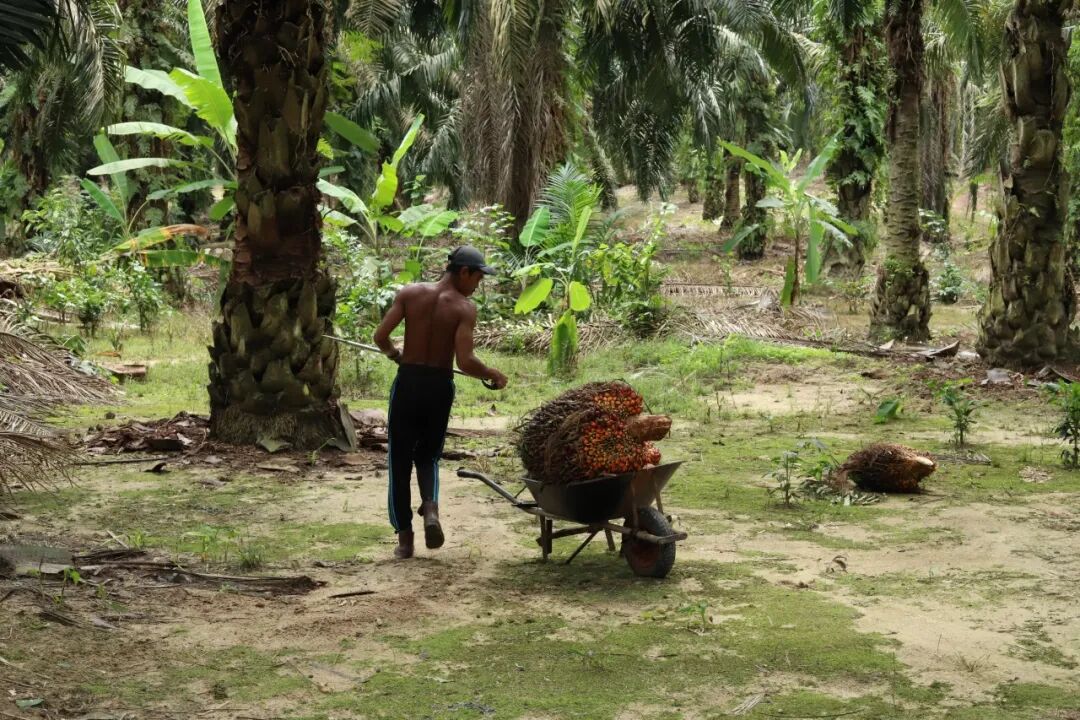
◉ Workers harvesting oil palm fruit.
Every morning, Marcus’s father, who is over 80, goes out with him for “work” and sits in the office of the rubber trading company, chatting with friends. In the small warehouse behind the office, the rubber tapped that morning is piled up, only ankle-high. Marcus says there are fewer rubber traders here than before.
This is a natural progression: whatever is profitable is what they do.
Marcus’s main business is oil palm. Durian is a new business he only entered in the past two years: he has taken on a new durian orchard, bought two liquid nitrogen processing machines, and built a small frozen durian processing plant. But too many people are now entering the durian industry, and his investment of over 1 million yuan has not yet paid for itself.
When we met Marcus, he was driving a black drop-side pickup. Marcus says most local farmers drive this kind of vehicle, because farm tools fit easily into the drop side and it is convenient for loading harvested fruit.
From first planting the seedlings, it generally takes seven or eight years for a durian tree to bear good, marketable fruit. During this time, water shoots that grow during the rains need pruning; if insects eat the leaves, pesticide spraying is needed; if the fruit sets too densely, nutrients must be spread, so the fruit is thinned by hand; once the durians set fruit, ropes are tied around them or nets are hung so that they do not fall to the ground when ripe. Daytime temperatures in Malaysia are above 30°C all year round, and farmers have to work outdoors in the heat.
It is not only a matter of attention to detail; it also requires continuous investment. Marcus says he has a durian orchard covering 80 mu in total. One round of pesticide spraying, including labour, costs 2,000 ringgit (about 3,315 yuan). Each mu is planted with about 20 to 30 durian trees, and the cost of irrigation equipment is 5,000 to 6,000 ringgit per mu (about 8,000 to 9,000 yuan). Whether it is fertiliser, pesticide or irrigation equipment, farmers bear the cost themselves; there is no government subsidy.
In hot Malaysia, clothes are quickly soaked with sweat. Marcus is not very particular about how he dresses, but that is not because he is short of money—whenever he travels to China, he orders thick clothes online in advance and has them sent to the front desk at the hotel in China. This is a small town where the Chinese community is concentrated and the population is severely ageing; Marcus does not often meet outsiders.
In Marcus’s durian orchard, what impressed us most was an ancient durian tree, its branches like outstretched arms; and another tree, split in half by lightning in a thunderstorm. As we walked through the grove, Marcus sometimes stopped to check for wild durians, or pointed at a fruit and said, “This one is edible.” By then the southern durian peak season had passed; the trees occasionally bore one or two fruits; some had fallen to the ground. Marcus picked out a few unidentified varieties from the native durian orchard, put them in the pickup, and brought them for us to try.
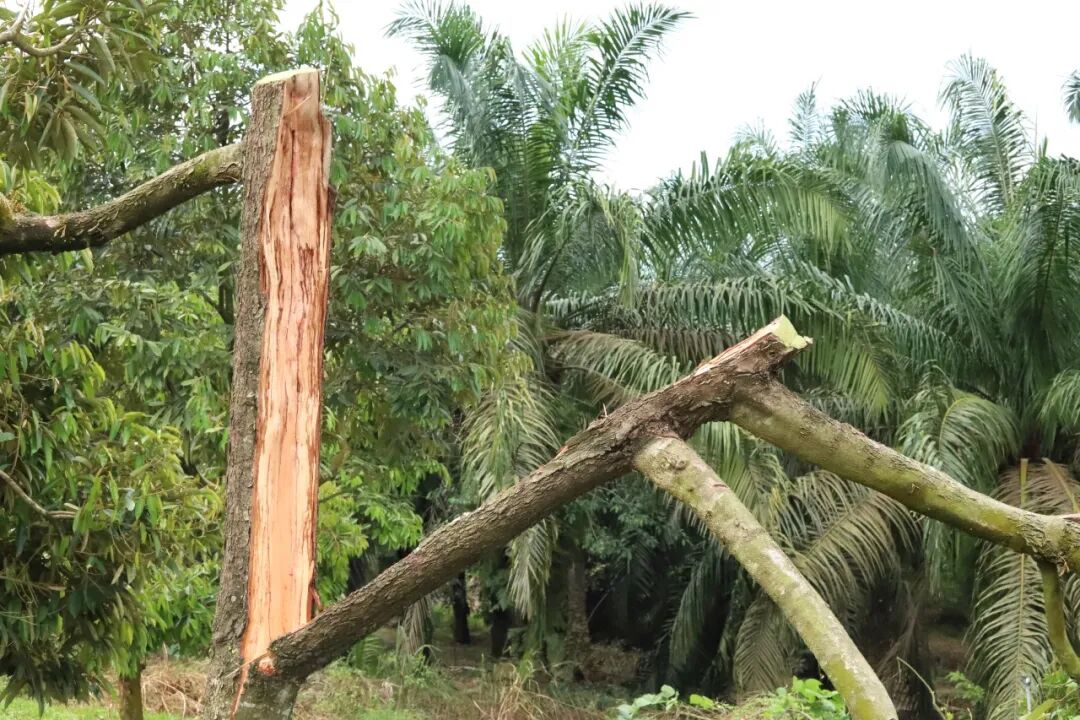
◉ A durian tree split in half by lightning in a thunderstorm.
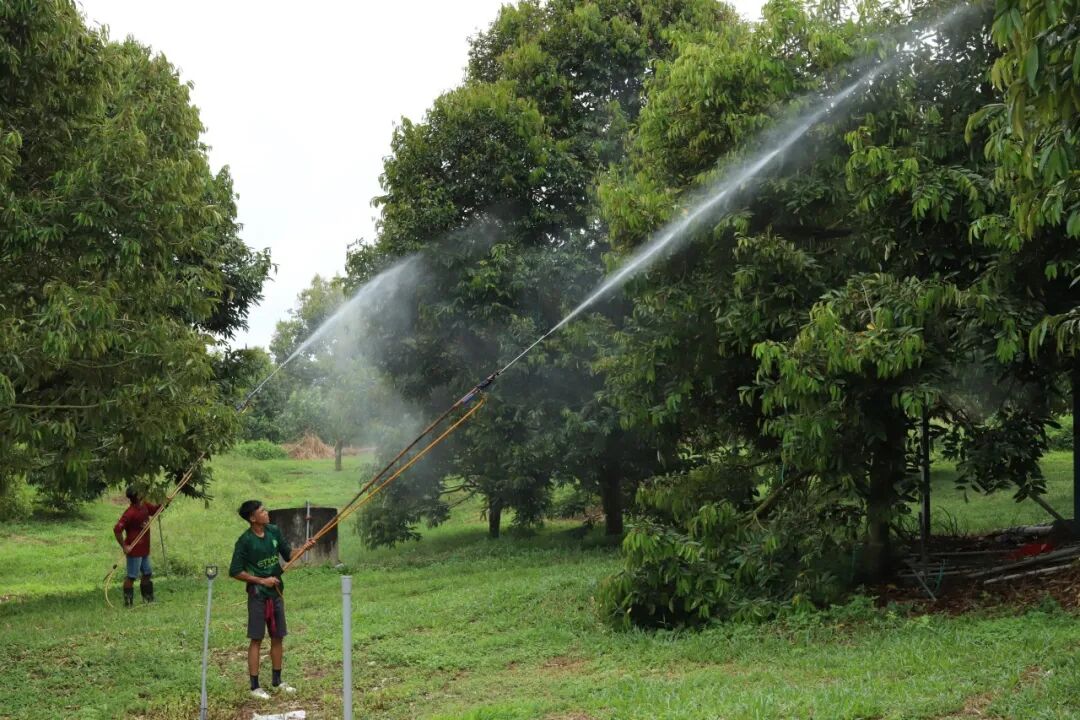
◉ Indonesian migrant workers spraying pesticide in the durian orchard.
The fruit is cheap, but the taste is not bad. It does not fetch a high price mainly because it has no catchy brand name, and its sweetness and aroma are not consistent enough. Marcus says he and the Chinese friends who come to visit are not particularly keen on native durians. We could not eat much and were worried about wasting them. He said that was not so: “Later we will take it all to make durian pulp.”
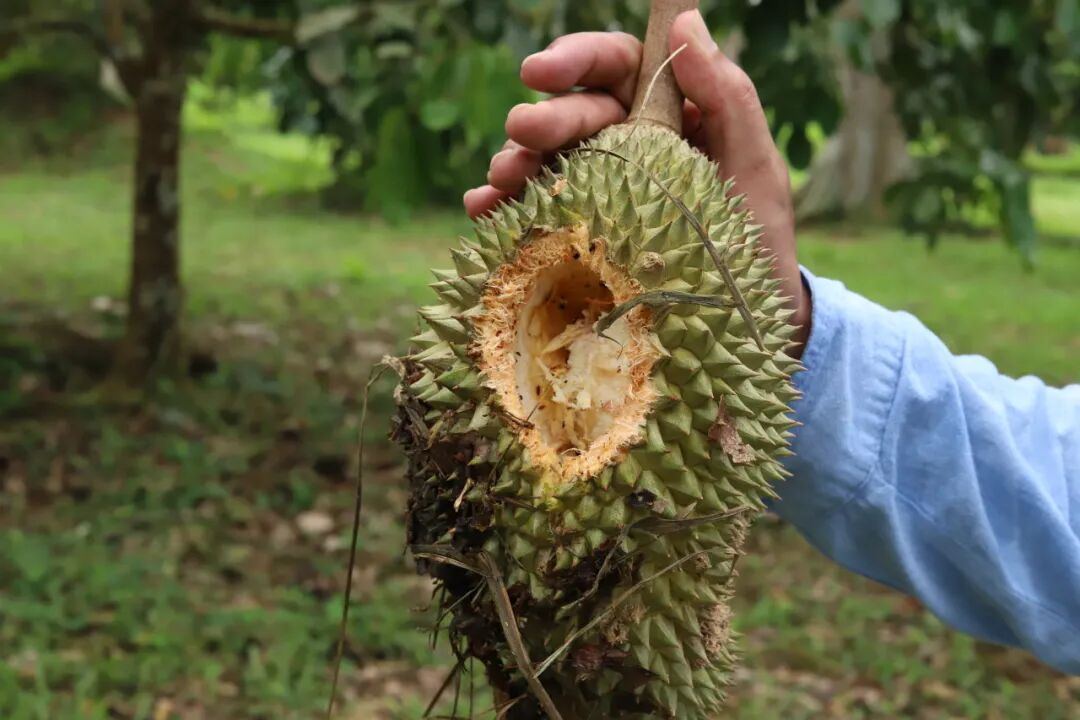
◉ Local native durians.
The peeled flesh is frozen and exported to China; on e-commerce platforms such as JD.com, you can buy Malaysian frozen Musang King flesh. Many people think frozen durian is not as good to eat as fresh, and its aroma is not as strong, but I find it has an ice-cream-like texture. Fruit frozen with liquid nitrogen must be intact A-grade; any cracks mean it does not meet export standards.
He took us to the cold room. I had not been inside long before I began shivering all over. When I came out, my glasses and camera lens were covered in a thick mist, and it took a while to clear. Marcus took two durians out of the freezer—Musang King and Black Thorn—still in their original pre-export condition. I thought that in China these would sell for 1,000 yuan each, but at that moment they were just lying scattered on the ground.
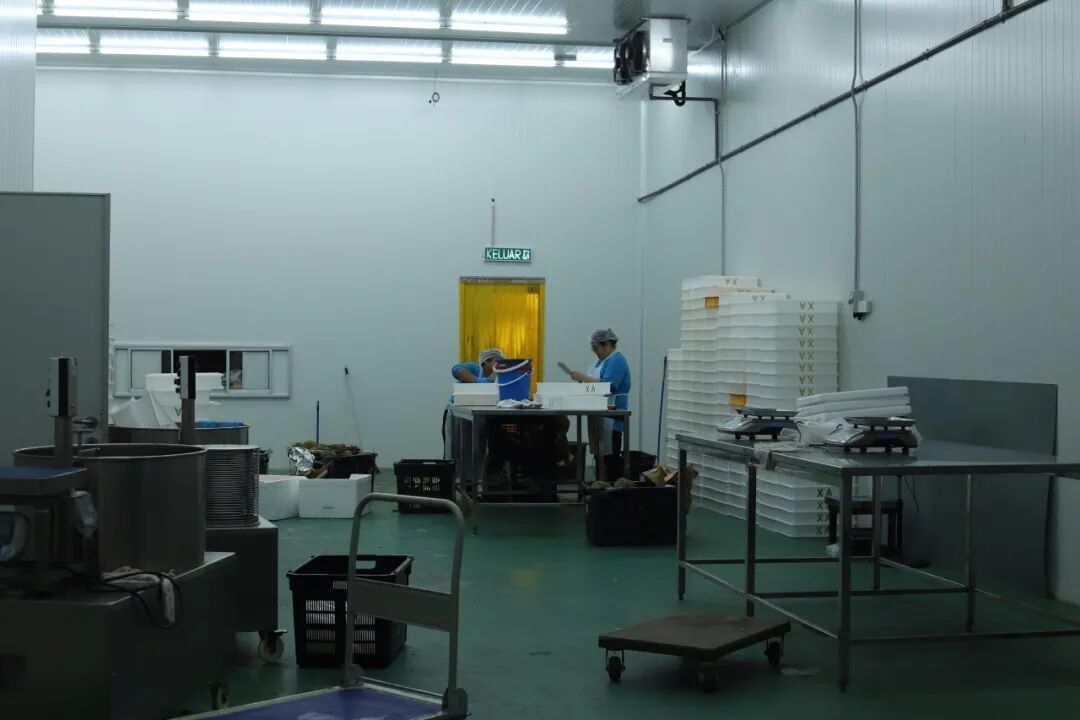
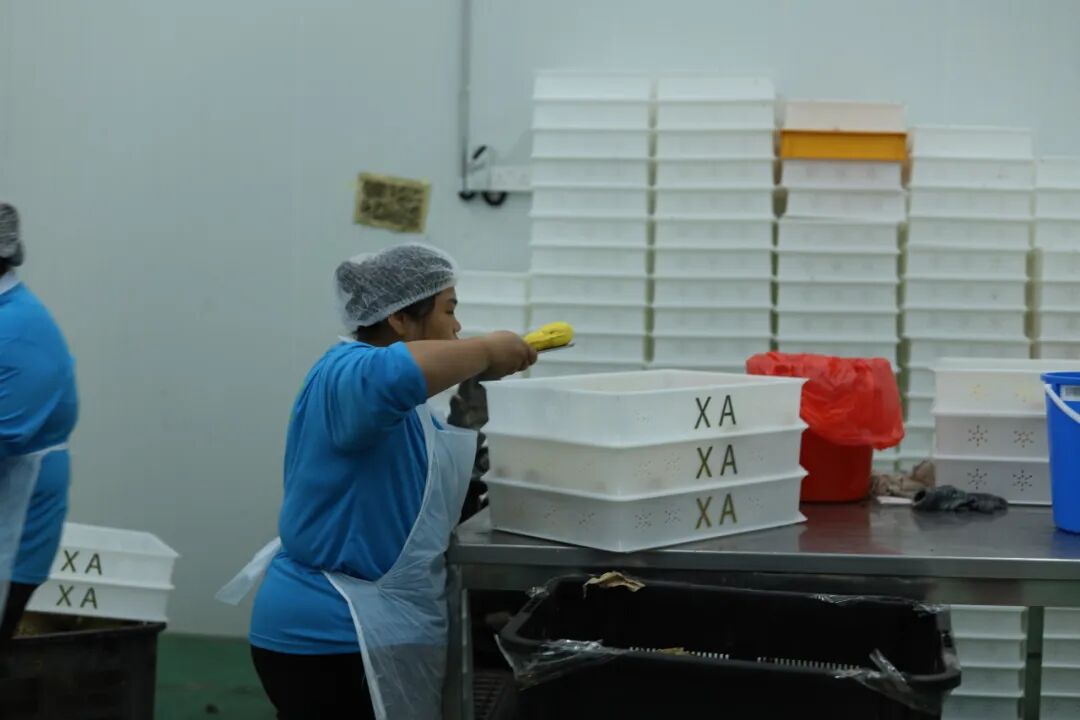
◉ Workers handling durian flesh.
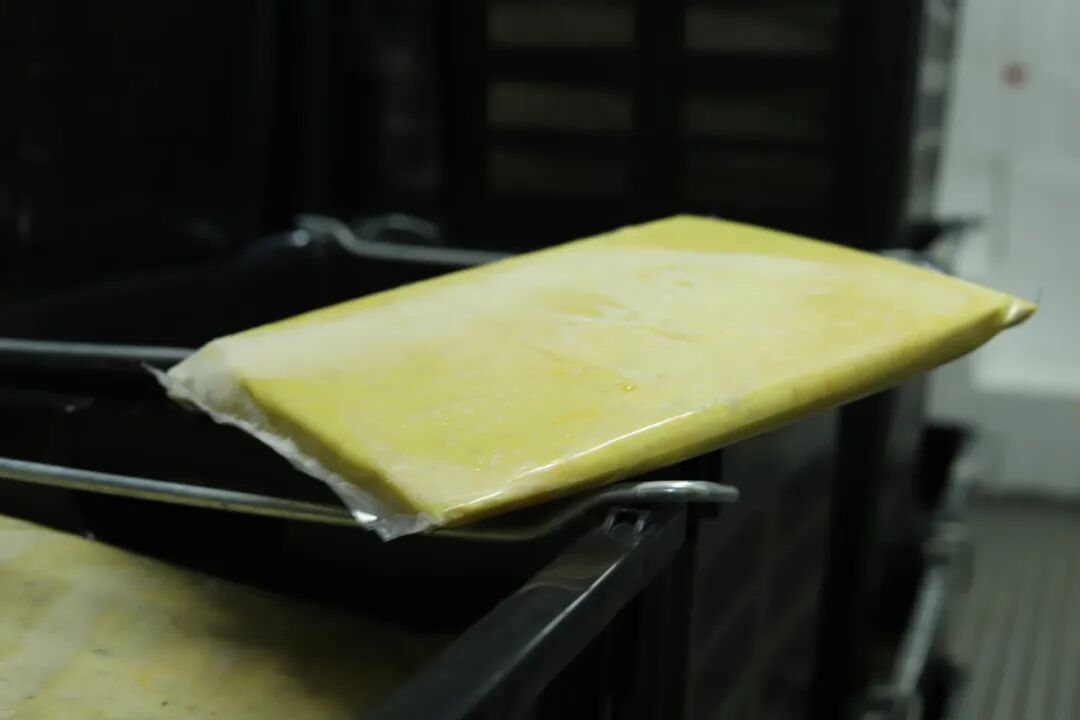
◉ Frozen durian pulp.
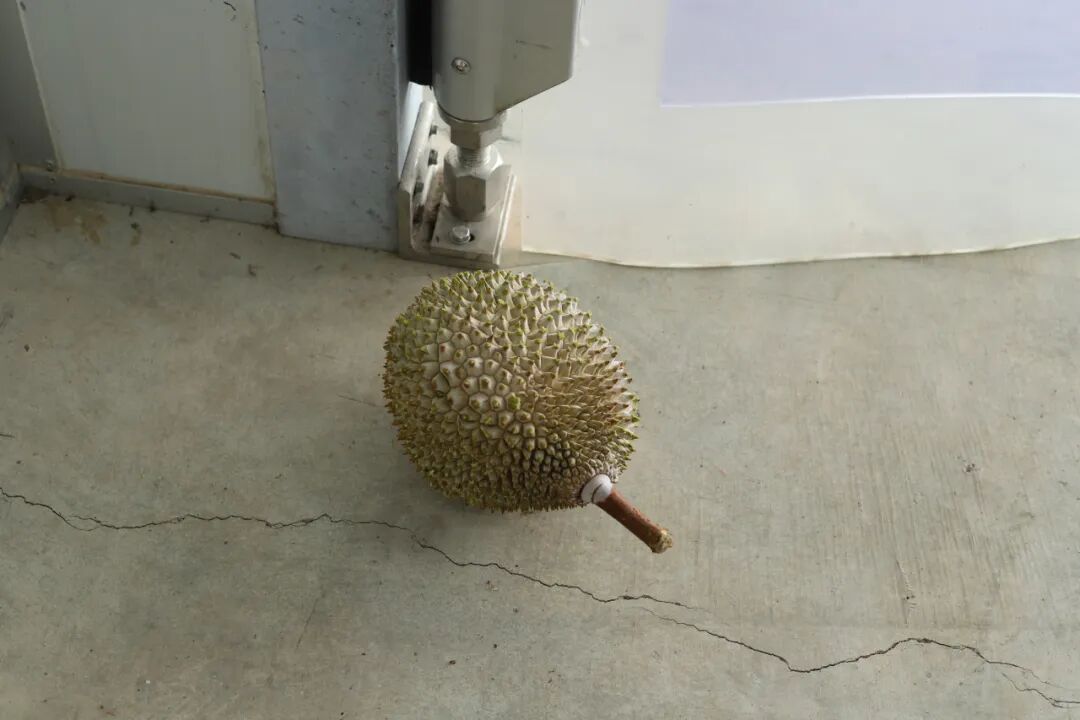
◉ Durians frozen with liquid nitrogen on the factory floor.
Durian’s Financial Market
From the modern LKE park, to small farmers’ orchards, to busy Chinese buyers, everyone is pushing this fruit towards the market, each at a different pace.
If we had come to Malaysia a little earlier, in July or August, we would have caught the harvest season exactly, and the whole line would have been frantic. A Chinese buyer told us that during the harvest season he travels 400 to 500 kilometres a day, visiting orchard after orchard, just to secure his supply of A-grade durian. The A-grade fruit that Chinese consumers favour represents quality you can see at a glance: a flesh yield of 30 per cent or more, thin skin, ample flesh, and a regular shape.
Durian’s value is not limited to fresh fruit and frozen pulp; there are also promised long-term economic returns on investment.
Looking back on the first day, the first durian we ate at LKE was in fact not an ordinary fruit-tasting event but a durian investment pitch.
TOM, a Chinese male presenter and “investment adviser”, was not tall. He was fluent in Chinese and English; by local convention he also spoke Malay, the national language, and a certain Southern Chinese dialect. His language advantage gave him a natural air of confidence: before twenty or thirty people, he smiled and spoke with ease. To introduce the group’s newly launched project, he made a special trip from the Kuala Lumpur office to the durian orchard. The group invited long-time members who had already invested to gather and eat durian; it was billed as a gesture of appreciation, but its real aim was to pitch the new project.
Much of the presentation was about durian investment. Durian investment projects fall into two broad categories: investing in a whole tree, or investing a certain sum.
In 2020, LKE developed its first project in Pahang State, the main production area for Musang King durian. The early projects accepted small investments, with a minimum of 5,000 ringgit (about 8,200 yuan) and a 15-year contract. LKE’s investment adviser said that in the early projects, investors had to wait three to six years before they could start earning returns, because after seedlings were planted it took about seven years for them to bear marketable fruit. In the latest project developed in 2024, each tree is an investment unit, and investors must invest at least 28,000 ringgit (about 45,000 yuan) each time, under a 12-year contract. The difference is that a whole-tree investment can begin earning returns in the second year.
To treat a single fruit as an asset spanning more than a decade is to bet that Chinese appetite will remain strong—and that is exactly what everyone on this chain is counting on. For people in the durian industry in Malaysia and, indeed, other Southeast Asian countries, China’s steadily growing demand for durian is the opportunity they see.
What if one day Chinese consumers no longer like durian? Lin voiced an optimistic note about the local durian trade. He believes that, at present, most of Malaysia’s durian is still sold mainly locally and has not yet entered the export system on a large scale. It is worth noting that the total durian planting area across Malaysia is about 90,000 hectares, with annual production of about 500,000 tonnes, but exports account for less than 10 per cent. China’s import policy is rapidly encouraging Malaysians to invest in the industry, and wealthy Singapore is also an important export destination. Yet 90 per cent of the fresh fruit in Malaysia actually remains local—locals are still the most avid consumers of durian, and the country with the highest per-capita durian consumption in the world has always been Malaysia.
– This is Foodthink’s 828th original article –

Foodthink
author
Wu Bingcong
Jiemian reporter who loves Malaysian durian

Foodthink
author
Liu Yi
loves Black Thorn durian
About the Lianhe Creative Programme
To understand the current state of food and agriculture, and to support more people in exploring the complexities behind food and agriculture issues, Foodthink, together with several public-interest and media partners, jointly launched the Lianhe Creative Programme in 2024 and 2025 to support media creators and researchers in carrying out research in the food and agriculture field and to fund the production of public-facing content.
After several interviews by the judging panel, the Lianhe Creative Programme supported 18 creative projects in 2024, and supported 20 creative projects in 2025. Currently, some of the supported works have been completed and publicly released:
A-Mei the Cleaner Wants a Proper Meal | The Workers’ Table
In Malaysia, Chinese Merchants Want Only A-Grade Durian
Fake Meat Drives Out Real Meat: Herders, the Table, and Amazon
Watermelons Guaranteed Sweet, Growing Watermelons Guaranteed Bitter
Ma Lan in Shenzhen, Without a Meal Buddy
Why Has the Sweetness of Childhood Disappeared?
Why Guizhou Can’t Do Without Sour Soup, and Sour Soup Can’t Do Without Guizhou?
Will Fresh-Food E-Commerce Make Wet Markets Disappear?
When Drones Become New Farm Tools: Who Is Defining Scientific Farming?
The Braised Goose in Overseas Chinese Remittance Letters, 100,000 Yuan a Bird
Photography: Liu Yi
Editor: Auntie Xiong
Layout: Xiao Cun
Scan to tip, support original food knowledge
▼

▼
Click the image to read the related article
▼
Click a keyword to open more article collections
Seeds | Agri-Tech | Policy | Fermentation | Nutrition | Fruit | Fisheries | Events | Recruitment | Takeaway | Wet Markets | Livestock | Food Talk | Sharing Sessions | Reading Groups | Harvest Festival | Small Farmer Stories | Climate Change | Rural Development | Cooperative Economy | Urban Farmers | Food Safety | Digital Technology | Biodiversity | Pandemic and Food | False Solutions | Ecological Farming Internship Programme
Beijing | Hebei | Shanghai | Guangdong | Guangxi | Henan | Sichuan | Jiangxi | Xinjiang | Shaanxi | Hong Kong | Chongqing | Zhejiang | Jiangsu | Guizhou | Northeast China | Taiwan | Inner Mongolia | Philippines | Canada | Russia | Mexico | Italy | United States | United Kingdom | Germany | Netherlands | Thailand | Sweden | Japan