
North Becoming South: Farmers Scramble to Dig Ditches
What Foodthink Has to Say
The floods have claimed lives and dealt agriculture a severe blow. Two days ago, Foodthink told the story of How a Miyun Farm Was Wiped Out by the Floods; fortunately, the farm’s workers escaped the water. But people can run — how do you run with your crops? In areas where the damage was not the worst, vast stretches of land turned to mud, and farmers must face their ruined fields and rebuild their livelihoods.
Over the past three years, Foodthink has been closely following the impact of abnormal summer rainfall in northern China on farming. In 2021 and 2022, an ecological farm in Luanzhou, Hebei Province, was hit by consecutive rare downpours that destroyed the majority of crops across 70 mu of land; in 2023, the Beijing-Tianjin-Hebei region was struck by a once-in-60-years downpour of extreme intensity, and farmers in Beijing and Hebei found not only their entire harvests rotting in the fields but some almost had even their homes flooded; the summer of 2024 brought sustained high temperatures and heavy rain, with cumulative rainfall from June to August roughly double the long-term average for the same period. For some farmers, the combination of intense heat and humidity, saturated soil with nowhere for water to drain, proved even worse than the extreme rainfall of the previous two years.


I. Dig Ditches! Dig Ditches! Dig Ditches!
Starting about two or three years ago, every summer when the flood season arrived, Liu Gang would marvel that in all his years of farming he had never seen so much rain. But then the following year, his record would be broken again. In the 2023 once-in-60-years downpour that left the entire Beijing-Tianjin-Hebei region in shock, Shunyi was not a worst-affected area, yet Xiaoliushu Farm’s open-field vegetables were still wiped out completely, and acidic substances in the rainwater had turned the produce both astringent and bitter. Liu Gang, who had always been proud of his own vegetables, felt he could hardly recommend them to customers anymore.
Last year Beijing did not experience an extreme downpour, but the summer rain simply would not stop, and total precipitation actually broke the record. For Liu Gang, that was even more devastating. A violent storm, though intense, comes and goes quickly; but nearly a month of sustained rain turned the soil to complete mush. Liu Gang had no tears left to shed.
Reflection born of suffering led Liu Gang to finally recognise that the northern climate was increasingly “going southern.” Digging ditches was the most urgent task — the earlier work began, the sooner the benefit. Early this spring he reorganised the land: in addition to clearing the drainage channels, he used the natural topography to lower the southernmost part of the field by half a metre, and hauled the excavated soil to the north side of the farm. This artificial slope helps direct water flow; a few waterlogged patches can be pumped dry in roughly two days.

So after this latest downpour, although many open-field vegetables were still waterlogged and some farm infrastructure was damaged, at least the autumn seedlings survived, and Liu Gang’s mood seemed a little more optimistic than in the previous two years. “There will be losses, but it’s better than last year’s total wipeout,” he said.
Pingren Farm, in Xingshou Town, Changping District, sits on low-lying ground and is prone to waterlogging. Zhao Fei, who oversees production, said that in 2018 and 2021, when the drainage work had not been done properly, they rushed out in pouring rain to dig ditches, but last-minute efforts could not prevent a total loss of the crops in the fields.
It is now corn harvest season. After this latest downpour, 10 mu of organic corn lodged, representing a loss of 40,000 to 50,000 yuan. Fortunately, organic farms like Pingren practise diversified cropping; sweet potato, okra, peanuts and other crops escaped unscathed.
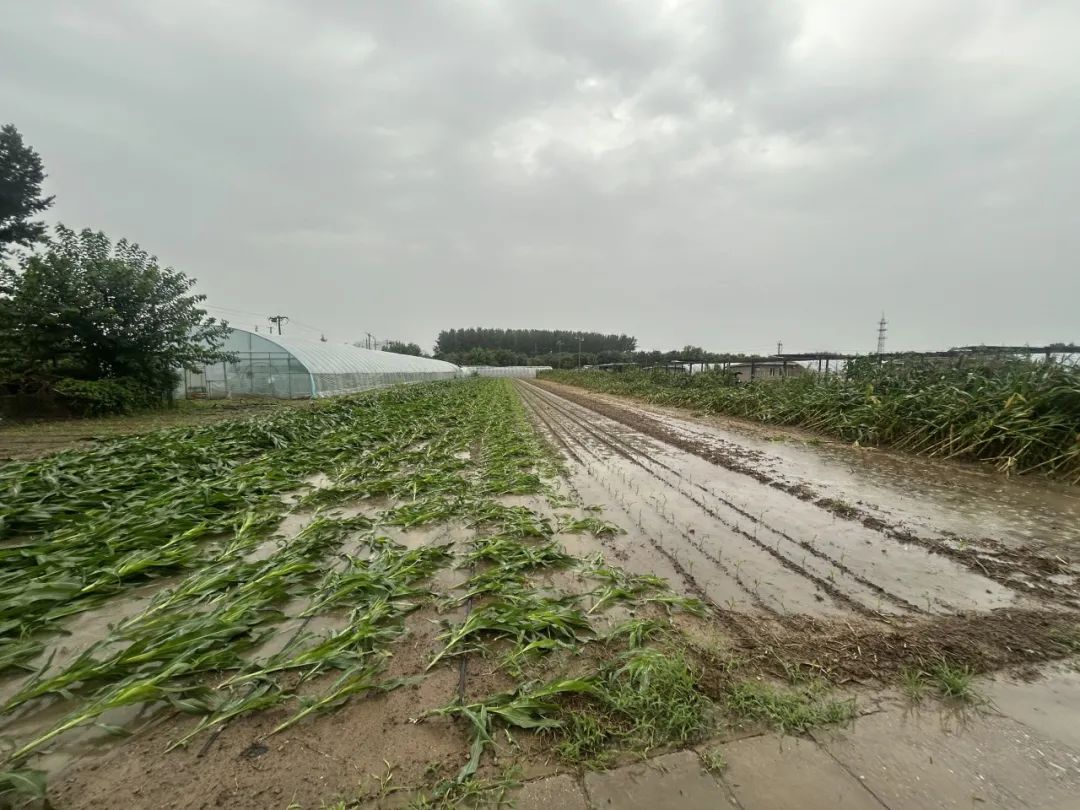
In recent years, to prevent a repeat of the 2018 flooding, Pingren Farm has dug drainage ditches in front of and behind every polytunnel and continues to maintain and renew them. The farm’s internal drainage system is now fairly comprehensive. Beyond infrastructure, the farm draws lessons from each disaster to improve its management. For example, the farm’s terrain slopes downward from north to south; last year’s heavy rain rotted all the vegetables in the two polytunnels on the south side, so this year they have decided not to plant in the southern fields during the rainy season.
Xiankong of Kongkong Valley showed a little impatience at Foodthink coming around again this year to ask about the damage. “You can’t dodge the rain; no matter what you ask, there’s no point in any prevention or control,” Xiankong said. “Unless you move away.”
Kongkong Valley is in the hills of Pinggu, at a higher elevation, making drainage relatively easy. That said, when Xiankong made raised beds for vegetables this year, he still dug drainage ditches so that water could flow down along the road.
Even so, the aubergines and chillies at Kongkong Valley have largely rotted in the ground and need to be dug up and removed. Land that already yields only limited harvests now has little left to sell. All that remains is to wait until the weather cools and plant a crop of Chinese cabbage and leafy greens. But this brings its own problem: the heavy rain has not only delayed subsequent sowing, but the soil is also so saturated that carrots, white radish, Chinese cabbage and others cannot yet be sown or started in trays.

As rain-related disasters have grown more frequent in the north over the past few years, farmers are beginning to appreciate the importance of digging ditches. Yet many have not acted in time. For one, digging ditches costs labour and money; farming already yields razor-thin margins, and some feel that continuing to pour in extra investment might as well be giving up. Another reason is that drainage has never been a problem a single household can solve; it depends on the improvement of surrounding public infrastructure.
Take Pingren Farm: although its internal drainage is now largely in place, getting the water out of the farm is still an open question. The village began taking flood protection of public land seriously last year and dug drainage channels, but the channels have since grown over with grass and are prone to blockage. For the surrounding strawberry growers who are on summer fallow, drainage is not a major concern, but this kind of infrastructure does not serve farms that are growing vegetables in summer. Pingren Farm’s staff have to go into the channels themselves to clear out the silt, yet in heavy rain, water still backs up and flows back in.

But water does not simply disappear, and it always flows downhill. For the past three years, every time it rains, the few households on lower ground are always the ones that get flooded. The village no longer has any water-management infrastructure, no one is in a position to mobilise people to dig drainage ditches, and there is no young labour to do the work. When these households are flooded, they have nowhere to turn.
II. North Becoming South: What Can Farmers Do
Waterlogging in the fields, crops lodging or drowning, damage to farm infrastructure — these are only the acute effects of a rain disaster. Over the much longer term to come, the problem of saturated soil moisture will continue to plague farmers: soils with smaller pore spaces between structural particles hold more water, but the dense aggregate structure also reduces air circulation. Kongkong Valley’s soil is exactly this kind of clay. Xiankong raised his ridges higher to compensate, yet still cannot overcome the problem.
Also in mountainous terrain, the soil at Lianxiang Farm in Pingquan City, Chengde, is a little better. The topsoil was filled in by the village during the “Learn from Dazhai” campaign. It was originally loess, of very poor quality, but after years of composting it has been improved into loam and sandy soil, which drains better than clay. However, sustained wet weather has over-saturated the soil, damaging plant root systems and weakening their ability to take in oxygen. Rainwater percolating downward has also carried nutrients deep into the profile, leaving the corn short of fertiliser and suffering from waterlogged root rot.
This raises a further question: once extreme weather exceeds a certain threshold, can ecological farming still demonstrate its advantages? The core of ecological farming is healthy soil — soil with high organic-matter content that retains water while staying aerated, serving as an important buffer for agriculture in the face of climate change. Yet in recent years, farmers’ experiences have shown that after a rain disaster of this extremity, soil takes longer to recover than it used to. And as the likelihood of extreme precipitation events increases going forward, how are ecological farmers to face this “new normal”?

Common sense would suggest that the north’s relatively dry, clear weather should be favourable for corn pollination, but with increasing rainfall, humid air is causing uneven pollination and kernel deficiency. What else worries farmers in the north: soil so wet it cannot be worked or sown. As the farming proverb goes, “drought breeds pests, wetness breeds disease” — increased humidity also brings soft rot to Brassicaceae vegetables and downy mildew to lettuce and asparagus lettuce. At this point, the crops that basically survive are water spinach and garden amaranth, along with large scallions, which are unfazed by disease.
Every rainy season, Yingying at Lianxiang Farm worries about vegetables rotting at the roots and tomatoes splitting. At the same time, however, the farm will not switch to moisture-loving crops simply to adapt to the rising humidity — after all, droughts are still more common in the north. It is a case of fixing one problem only to create another. “As for how much rain there will be, that’s up to the sky,” Yingying says. Any unfavourable weather will reduce crop yields, and all a farmer can do is plan as carefully as possible and keep producing. Liu Gang, on the other hand, after consecutive seasons of disaster, has tried growing taro over the past few years — a moisture-loving crop that has introduced a new category for Beijing consumers.
The solar terms are losing their reliability. Last summer, sustained rain kept Pingren Farm’s seeder from getting into the fields, and across all of Changping, not a single plot of Chinese cabbage had been sown by the Start of Autumn. Chen Ziyu, based in Baoding, says that two weeks of continuous rain have prevented aubergine and green pepper seeds from germinating. He can only let them rot in the soil and wait for the weather to improve before re-sowing.

III. Rising Costs
Beyond the ditch-digging and replanting mentioned above, reinforcing infrastructure and maintaining crop diversity are also common strategies for ecological farms to cope with waterlogging. Whatever area they invest in, the farm’s operating costs go up.
Xiaomei at Pingren Farm says that to deal with heavy rain, they need to free up land for drainage infrastructure. Making more raised beds in the fields means compromises in both planting area and density. On the labour front: digging drainage ditches, clearing channels, reinforcing polytunnels, adding rain-proof film to the tops, and stationing people to keep watch — all of these add to costs. In addition, to replenish nutrients that rain washes into deeper soil layers, they need to increase their use of liquid enzyme preparations.
Kongkong Valley practises entirely open-field cultivation — no polytunnels, no fertiliser, no machinery. Compared with Pingren Farm, it is even more “at the mercy of the weather.” The advantage is low input, mainly labour. After heavy rain, weeds grow rampant, causing weeding costs at Kongkong Valley to spike — accounting for 80 per cent of labour costs.
Even when some food survives the rain disaster, much of it has a degraded flavour. The farmers themselves are put off: tomatoes rot as soon as they are picked; green peppers and aubergines are so waterlogged they taste of nothing. This takes a big bite out of one of the key selling points of ecological produce: “deliciousness.” Xiankong says consumers are increasingly attentive to how vegetables look, but natural disasters inevitably take a toll on their appearance. Should farms lower their usual standards and sell “headless” celery stalks, half heads of cauliflower? Can consumers accept “ugly vegetables”? These seemingly trivial questions become critically important at times of hardship.
An ever-growing body of research confirms the link between extreme weather and reduced crop yields — though of course, researchers need not build complex models before people understand this connection by common sense. Do not wait until there are no vegetables left to eat before you miss these “ugly vegetables.” Likewise, do not wait until farmers have all been forced to give up farming before you regret not finding a way to reach out a helping hand today. In the face of the shared crisis of climate change, how to support food producers so that they can weather it with greater confidence is something everyone should think about carefully.

