In the End, It Was Still Burned: What Detours Has Crop Residue Incorporation in the Northeast Taken?

In late April, farmers in Heilongjiang Province are busy with spring ploughing. Following local farming custom, they first carry out stubble burning (that is, burning crop residue), then carry out rotary tillage and sow. Driving along, one can now and then see small wisps of white smoke from burning. The aftermath of stubble burning—blackened maize roots and rice stubble—is everywhere to be seen.
At this point, the burning season is already in its final stage. Over the past month or so, patch after patch of crop residue in the fields of Northeast China has been burned, becoming a major driver of local air pollution this spring. On 1 April, the Suihua section of the He-Ha Expressway also saw a multi-vehicle collision and fire caused by crop residue burning in the surrounding area.
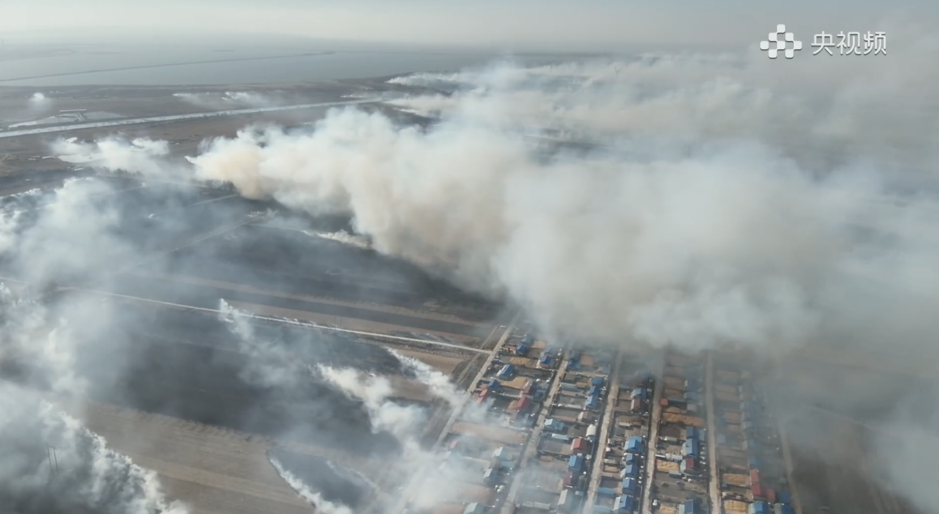
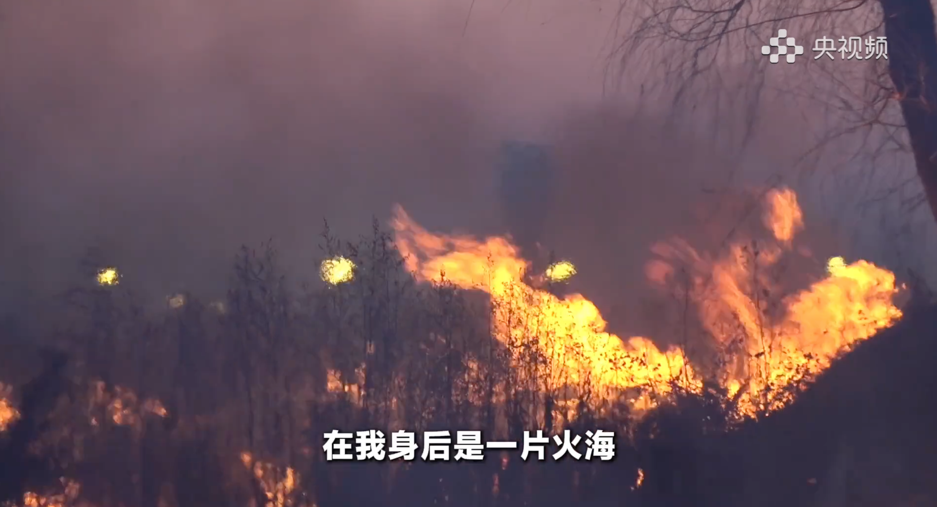
◉ In March this year, CCTV reported dense smoke from crop residue burning near Harbin Taiping International Airport. Image source: CCTV Video
The other side of the story is the farmers’ relief: since last year, things have finally been opened up, and they no longer have to burn in secret and in fear. The village Party secretary also breathed a sigh of relief: who dares stop ordinary people from farming the land?
In the autumn and winter of 2015, severe smog hit the three provinces of northeastern China. Crop residue burning was regarded as a major source of pollution. So, from autumn 2016, a ban on crop residue burning became a major political task in the Northeast. For example, the Jilin Provincial Party Committee and Provincial Government personally arranged the work, established a three-tier county-township-village grid system for the ban on crop residue burning, and formulated assessment measures, requiring that “pressure be transmitted layer by layer, forming an implementation mechanism in which everyone shoulders a share of responsibility”. Heilongjiang and Liaoning also issued special plans to establish grid-based responsibility systems, marking a new stage in the Northeast’s ban on crop residue burning, moving from earlier publicity and mobilization to strict accountability.
Strict policies mean financial and labour costs. In a certain town in Hulan District, Harbin, a village Party secretary recalled that every year after the autumn harvest, to prevent crop residue burning, the village had to spend about 10,000 yuan and hire four or five people to keep watch in the fields day after day. The village also had a collective account; once satellite images detected a fire point, money would be deducted from it, and village cadres would also be warned or disciplined by association.
Beyond the burning ban, the government has also actively sought ways to make use of crop residue. After trying measures such as incorporation and off-field use, poor results and widespread public discontent meant that, in the end, it could only return to the old path of burning. There has been progress, however—from the disorderly burning of the past, it has evolved into what policy documents describe as “precise”, “scientific” and “orderly” burning. The Ecological and Environmental Code, adopted by the National People’s Congress this March, also contains the following top-level guidance: “Local people’s governments at all levels shall, in a scientific and precise manner, strengthen the organisation, guidance and management of the burning of crop residue, fallen leaves and the like.”
The change ordinary people have felt is that the government now consults weather forecasts and, for days with favourable dispersion conditions, gives advance notice of the burning window; after the notice has been passed down layer by layer, the village Party secretary informs the villagers, and they then burn the crop residue.
From the political task led by the provincial Party Committee in 2016 to this year’s actual “opening up”, what have farmers in the Northeast been through in the decade of detours in the ban on crop residue burning? Why have they continued to resist using crop residue, or is it that they would rather simply burn it and be done?
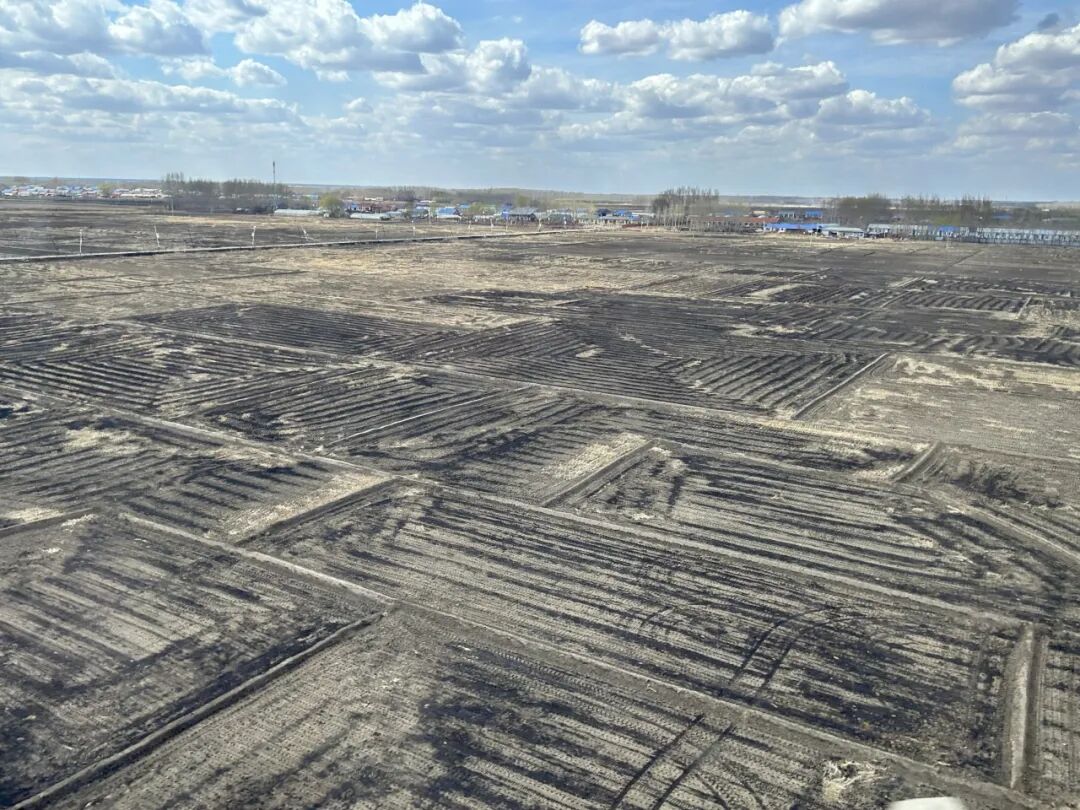
◉ A high-speed train enters Harbin from the south; outside the windows are burned fields awaiting sowing.
Failure at the Ridge
The farmers we visited on this trip are mainly maize growers. Following local custom, once spring begins and the ground thaws, it is dry and windy, so farmers carry out stubble burning, then use rotary tillage to work a layer of wood ash and crop stubble into the soil, after which they can sow. The mandatory requirement for the incorporation of crop residue means first adding an extra farm operation: shredding the crop residue and deep ploughing it into the field. It also brings a second operation: ridging, that is, making a ridge.
This is a key reason why the incorporation of crop residue, specifically maize residue, ultimately failed. Several of the farming households we interviewed all said the same: once the ridges are upset, no one can accept it.
“Deep ploughing” means turning the shredded long maize stalks and tail stubble into the soil. It usually requires a ploughing depth of 30 to 40 cm, so that the crop residue is sufficiently buried in the soil layer; otherwise it will affect the rooting of the seed. Because there is so much maize residue, it is especially important to ensure that shredding and deep ploughing are done thoroughly. Some agricultural technology instruction videos specifically warn that if the maize residue is not shredded sufficiently, the machine has to carry out secondary shredding.
After deep ploughing, the soil is uneven and contains clods of various sizes, so it cannot be cultivated directly. Operations such as crumbling the soil and rolling are therefore needed to level the field. The main problem with deep ploughing is that it eliminates the ridges that existed before. Both deep ploughing and ridging require special machinery, which farmers cannot do themselves.
The blades on an ordinary rotary tillage machine only go to a depth of about 20 cm. This means that, in order to carry out deep ploughing, extra deep ploughing machinery fitted with a “big plough” has to be purchased, for example a large mouldboard plough (reversible plough), with prices often running to 100,000 yuan or more. In addition, the machine operator’s fee is 400 yuan per sheng (15 mu) of land. Take a certain village we visited, for example: the village has nearly 10,000 mu of land, and in a single year the cost of deep ploughing alone is 260,000 yuan.
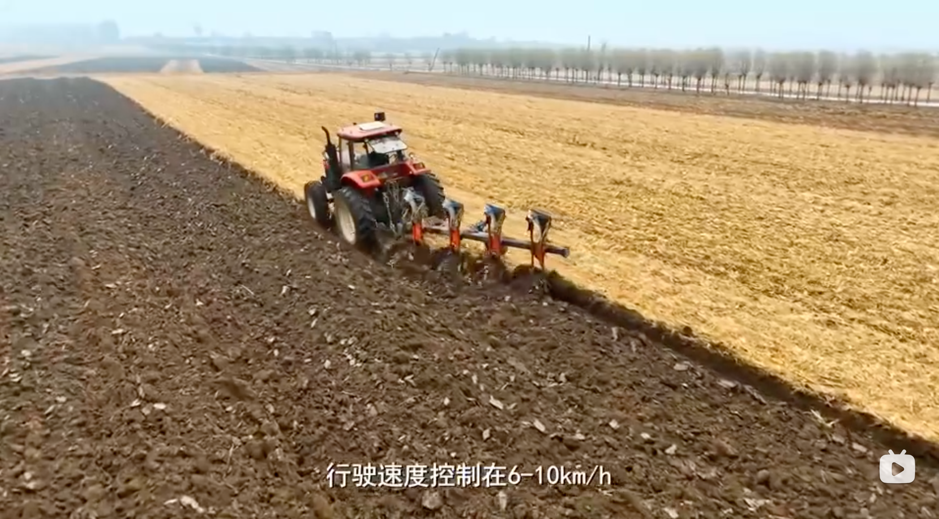
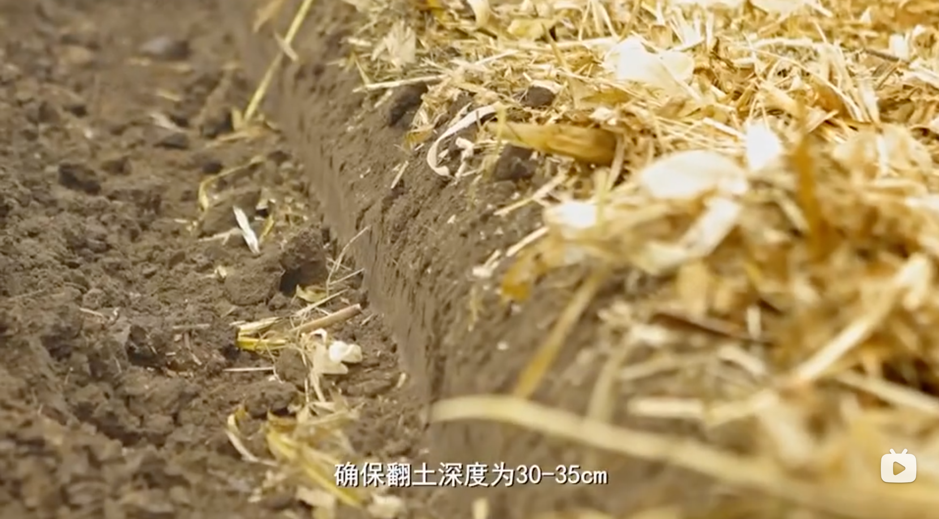
◉ A semi-mounted large mouldboard plough (also known as a reversible plough) for deep ploughing. Image source: Bilibili uploader Lü Jie Xing Nong Crop Residue 100
So, to promote the incorporation of crop residue, this whole set of services is carried out by machine operators who are subsidised by the government. The attitudes of the farmers we met were polarised. Farmers in Hulan District, Harbin generally said that deep ploughing makes the soil pores larger. If there is little snow in winter and strong winds blow in early spring, the soil moisture content falls, soil moisture conservation is compromised, which affects seedling emergence and can also cause lodging after the crop has grown. If there is too much stubble that has not been completely shredded, turned under and buried, the situation is worsened.
But further east, some farmers in Bayan County and Bin County approve of deep ploughing. “With so much fertiliser, the land has all developed soil compaction,” one old man said. At least deep ploughing can loosen the soil. As for the aforementioned problems caused by the soil becoming loose, he thought simply using a roller to press the land down again would be enough.
But as for the final step, ridging, the farmers were unanimous in opposing it. It could even be said that the ridges not being made properly became the most important reason for their opposition to the incorporation of crop residue.
Standing by the roadside and gazing at the large stretches of bare soil that extend to the horizon during spring ploughing, one can fully appreciate the sense of “vast land and sparse population”. But the land as farmers see it is not the same as what an outsider sees. The stretch of several hundred mu in view may be a patchwork made up of the land of a few, or even a dozen or so, families. They divide the land by ridges, not area. Not only must the number of ridges stay the same; the width and spacing of the ridges should also stay the same, because the latter affects crop growth.
In years past, after crop residue was burned, farmers would drive rotary tillage machines along the old ridges, work the maize stubble (that is, the maize roots that could not be burned) into the soil, and then sow. It was only after several years or even longer, when the village organised everyone to carry out deep ploughing, that re-ridging became necessary; even then, they generally called on trusted machine operators from the village or nearby. The incorporation of crop residue means re-ridging every year, and the machine operators who can get a subsidy for doing this work are often outsiders. The ridges formed are uneven—some wide, some narrow. In a certain village in Hulan District, villagers have plenty of complaints whenever ridging is mentioned.
The village Party secretary also has a headache: “There are major disputes—if one family’s ridge is too wide and another’s too narrow, then they look for fault with you (the village committee); no one can bear it. If we cannot settle it for them, what if it triggers a petition? What are we to do?”
The War of the Ridge
On the afternoon of 30 April, by a road outside Hulan District, a group of older people were quarrelling around a field bank. They were fighting over how to lay out the ridges. It turned out that the small plot of land in front of them was two families’ land joined together. The electric pole, serving as a boundary marker, became the focus of the dispute. A middle-aged man named Hu Shunyi, who was riding an electric scooter, told us, with some resignation, that he was the village Party secretary and had been called over to mediate at 9 in the morning. But the group had still not reached a resolution.
In the middle of the crowd stood a tall man in a hat, who looked to be in his fifties or sixties, and from time to time he interjected: “Auntie, is this electric pole your family’s?” “Once you’ve sorted this out, I’ll start the rotary tillage!”
This is the machine operator who has served the village for many years. Hu Shunyi said of him that he has a good feel for the machine, is extremely meticulous, and is trusted by the villagers. Forced to watch the dispute, the machine operator had been unable to start work for a long time and was rather anxious.
In the end, an older woman could stand it no longer. Wearing leather shoes, she stepped into the field, each footfall landing on a ridge, counting one ridge with every step. By the time she reached the electric pole, it was 32 ridges, providing a solid factual basis for the dispute, and before long the two sides reached agreement. The machine operator said to one of them, “Tonight, my family is putting away 10,000 yuan.” He jumped onto the rotary tillage machine and, with a roar, began working back and forth along the field bank. The crowd dispersed.
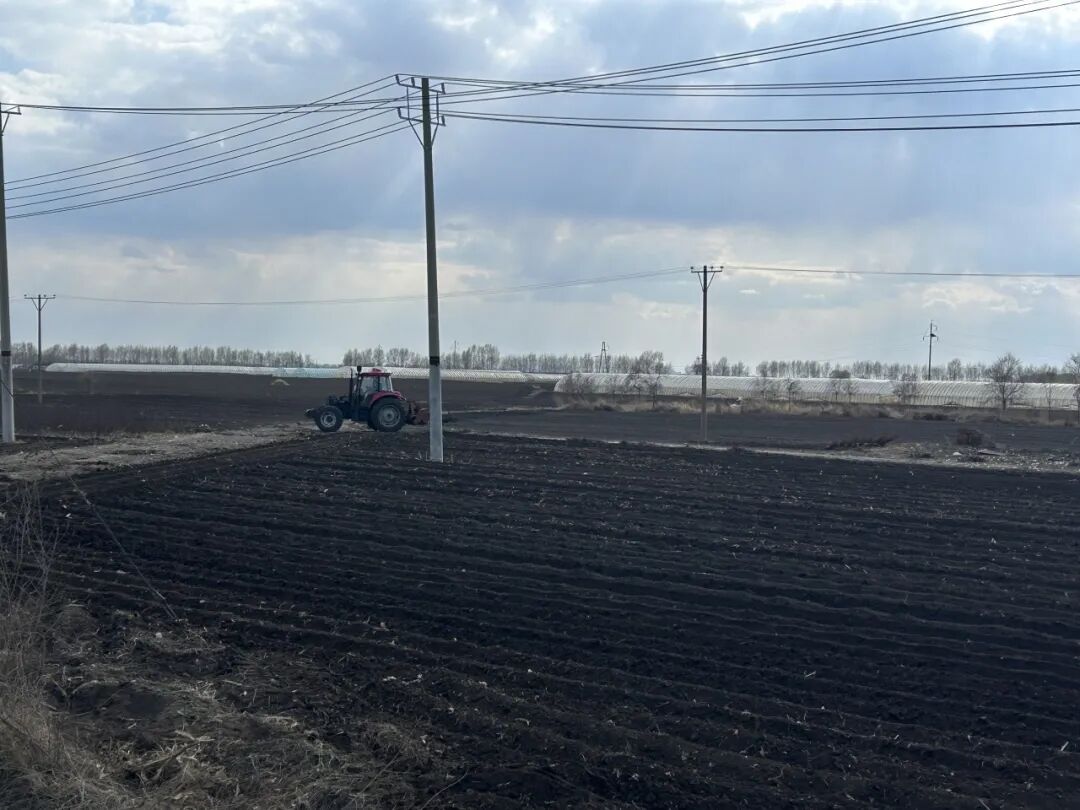
◉ A machine operator at work.
A scene like this instantly showed us, as outsiders, just how important the ridges are. Ridges determine whether an extra row of crops can be grown; they also mark boundaries and determine land rent. Often, after the machine operator has laid out the ridges, he allocates them to a few neighbouring households according to the ledger, and the matter is settled only when everyone has no objection.
The intricacy of affairs in the fields and on farms, the farmers’ meticulous accounting for and defence of every inch of land, and the backlash that any top-down, unified mobilisation can generate at the grassroots may go far beyond what policymakers in distant cities imagine: even a machine operator from the village whom farmers themselves hire may cause disputes when laying out the ridges, let alone an outside machine operator whom they can neither control nor trust?
Hu Shunyi also admitted that many machine operators were simply “er wu zi”; even with satellite positioning, they could not lay the ridges straight. After one machine made a pass over and back, the ridge width could be off by seven or eight centimetres, so the ridges would not line up. Sometimes, while the ridging was going on, a family ended up one or two ridges short.
Rice Farmers’ Worries
Rice fields do not require ridges. Sister Chen, a rice farmer we met, said that in the years when the burning ban was strictest, they could only use boats to rake out the rice straw.
The combine harvester only cuts off the rice ears, leaving the long, fine, soft stalks in the field. Sister Chen had not heard of any machine anywhere that carries out shredding and incorporation of the rice stalks into the field, nor had anyone come to do the baling and take it away; all the rice stalks stayed in the field and had to be fished out by hand.
The work often cannot be done until early spring. After autumn begins, it gets colder and colder, and the hired workers all go to work in the maize fields; no one is willing to come in wading through the water in boots.
They use vehicles to haul the rice straw out. If there is heavy snow in winter, the wet straw can only be scooped out by boat. “It’s hard work, really exhausting.” Workers are paid at least 200 yuan a day, and up to 280 yuan. Five or six workers, a few boats, a week’s work—all this is extra expenditure borne by the farmers themselves.
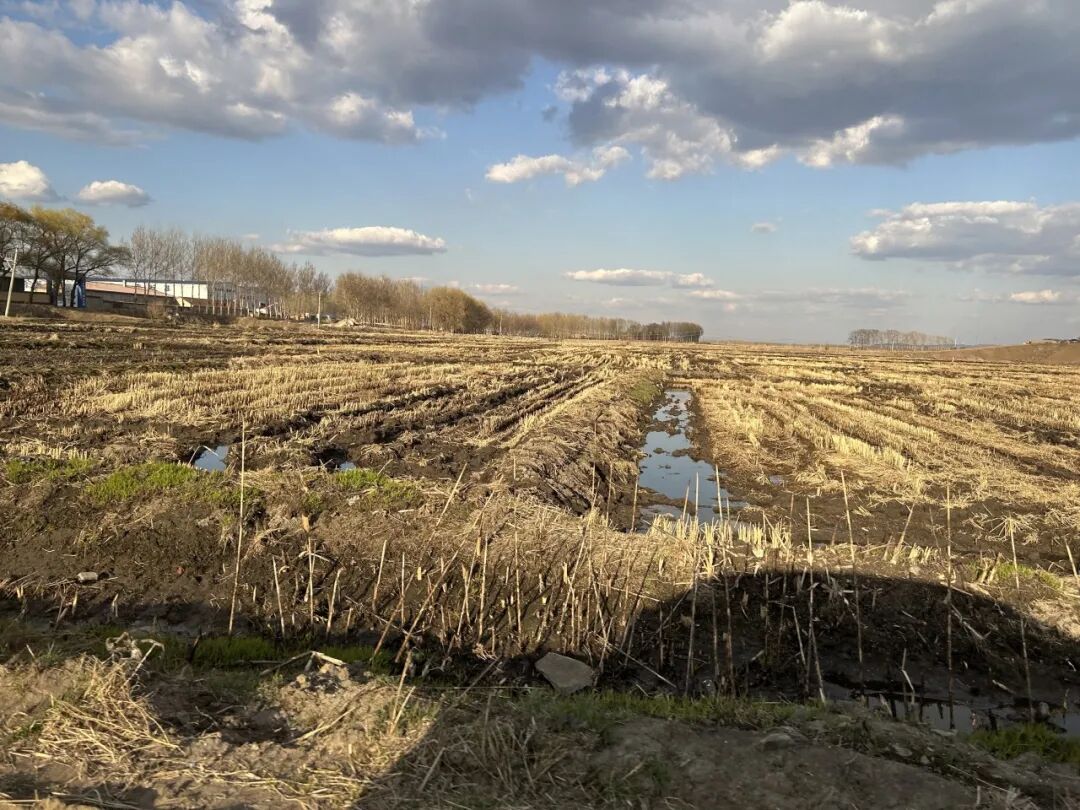
◉ A rice field after burning.
Even so, the rice straw stalks cannot be cleared away completely. Sister Chen said that, when carrying out rotary tillage in spring, they could only force the rice stalks and the rice stubble at the base into the field together. Even then, “Even when one leg goes down, it goes ‘ku cha ku cha’ and there is nothing but straw.” Once the weather warms up, the rice straw soaking in soft, decayed mud also rots and bubbles rise. More than one rice farmer said that the hydrogen sulphide gas produced by the anaerobic decomposition of crop residue “poisons” the rice, blackening the roots and killing seedlings.
In such land, Sister Chen said, the transplanted rice seedlings cannot take root, and pest damage has also increased—when crop residue was still allowed to be burned, at most one or two pesticide sprayings were needed in a season; since then, six or seven sprayings have been needed.
The tighter the burning ban is enforced, the more fertiliser is used. Two years ago, Sister Chen used 10 to 11 bags of fertiliser per qing. Since last year, as the burning ban began to relax, after the field had been burned, she applied only 8 bags of fertiliser. “Wood ash counts for something,” she said.
IV. Getting Crop Residue off the Field Is Also Hard
In fact, besides incorporation, baling the crop residue and hauling it away for use as fuel, compost and substrate is also a way out. The resource-based utilisation of crop residue in the Northeast should have had a ready market—the heating season lasts for almost half a year, and several village cadres and villagers said that power plants and heating plants are happy to take it in for burning.
But in the several counties and districts east of Harbin that we visited, just as talk of the ridges brought out complaints, farmers also have many grievances as soon as baling is mentioned.
The reason is, almost absurdly, as simple as “the ridges not being laid well”—baling does not clear the field completely. Generally, machine operators receive subsidies according to the area baled. In reality, when a baler (that is, a pickup baler) goes into a maize field, it always leaves behind broken stubble. These fragments of stubble do not form continuous patches. Farmers cannot even burn them off in one fire any more; they can only hire people to pick them up again. Workers are paid 100 yuan a day. Because the crop residue has been compacted into the soil, they cannot rake up even one mu of field in a day.
Village Party secretary Hu Shunyi recalled that about six years earlier the village had begun coordinated baling and removal of crop residue from the field. To deal with the root stubble left in the ground, the villagers harrowed the field again and again. “The seedlings have already grown this high,” he said, stretching his thumb and forefinger to indicate the distance, “and there is still crop residue being picked out of the field bit by bit. The villagers did not like it: ‘You rotary-till my field, and I have to pick it up seven times!’”
They had never received a single cent, and had to pay for the labour as well; no farmer is willing to have their crop residue baled and hauled away any more. Sometimes, before the baler arrives, villagers secretly set it alight. In Bin County, there were also outside machine operators who wanted to come and earn the off-field subsidy, but the locals kept a close watch during the day: “they can only sneak into the villagers’ fields in the middle of the night to bale.”
Another reason farmers oppose baling is that the baler and the trucks drive in and compact the cultivated land, making it extremely hard. They then have to loosen the soil again themselves, with rotary tillage, before they can sow.
An older man in Bayan County recalled that, in the early years, before crop residue incorporation, removal from the field was promoted first. But once baling began, farmers objected strongly. Some were even afraid that the machine operators might return for baling and hurried to burn the crop residue before they arrived. “They earn the money, and all that is left for the old farmers is trouble,” he said.
He went through one failed year of removal from the field. The following year, the government, having learned the lesson, switched to deep ploughing and incorporation, but whether the machine operators were skimping on fuel and cutting corners, or there was some other technical problem, in the end the deep ploughing did not go deep enough. The maize seeds landed on top of the crop residue, could not take root, and no seedlings came up. That year the yield per mu was only about 900 jin (in a normal year, 2,100 to 2,200 jin), a disastrous loss.
After that, the older man refused, whatever they said, to let the government touch his land, and returned to burning the crop residue.
Data published by the Ministry of Agriculture and Rural Affairs in 2018 indirectly reflected the difficulties in implementing removal from the field: nationwide, the area of crop residue incorporation was 743 million mu, and the area of crop residue picked up and baled was 88 million mu—incorporation accounted for a far higher proportion than removal from the field.
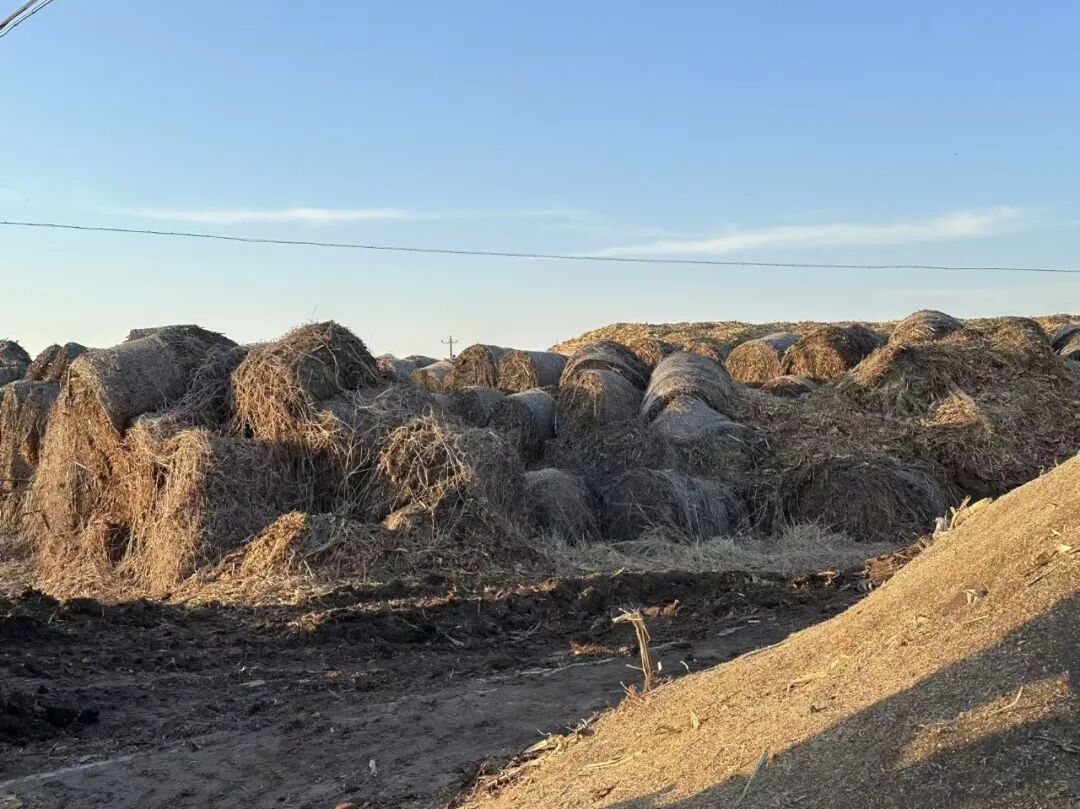
◉ Crop residue baled for use as feed. However, for a number of reasons, the feed use of crop residue has also proved difficult to scale up.
Who Is Sticking with Incorporation?
In view of all these factors, although the tasks for removal from the field and for incorporation have been passed down to every village, they are not easy to roll out. “Farmers do not have to pay, but they do not want it,” Hu Shunyi summed up.
Enforcement of the crop residue burning ban has been uneven. Of the farmers we met on this trip, most, after experiencing the trouble brought by incorporation or removal from the field, have returned to burning the crop residue; a minority have always simply burned it off, and even when the ban was strictest, they burned it on the sly.
Grassroots departments have gradually adjusted their strategies in response. In the end, before spring ploughing every year, there is always a two-day window period. It is notified in advance, and farmers are allowed to burn off the fields. On those two days, the environmental protection office (the township-level environmental protection department) does not intervene either. “Who dares stop the villagers from farming?”
It is said that state farms are still sticking with incorporation, but farmers all choose to burn. We had hoped to find farmers who recognised the benefits of incorporation and still carried it out of their own accord, but on this trip we met not a single one.
This is also a rather puzzling thing: crop residue incorporation has been publicised as a good thing for the country and the people, increasing soil fertility, carbon sequestration and emission reduction, and raising yields and income… but farmers are not buying it. They believe that even if deep ploughing is done properly, crop residue incorporation does not increase yields; they still have to apply that much fertiliser and spray that much pesticide (or even more). If it is not ploughed properly, the seedlings do not even come up.
In short, crop residue incorporation has brought them no benefit in agricultural production, and the subsidies do not get to them either; instead, it has left them with a whole heap of trouble.
In addition, the amount of crop residue and its characteristics vary from crop to crop. “There is little soybean crop residue, and incorporation is not a problem, but maize is not the same; the residue is too thick and must be burned. Otherwise the maize borer overwinters in the crop residue, and the following year there are far too many pests,” a farmer in Fuyuan summed up.
Research has found that the rapid expansion of maize planted area in the Northeast over the past twenty years is related to the large-scale imports of soybeans after China joined the WTO. Domestic soybeans find it hard to compete with them, so farmers switched to the more profitable maize, which has also made crop residue incorporation more difficult.
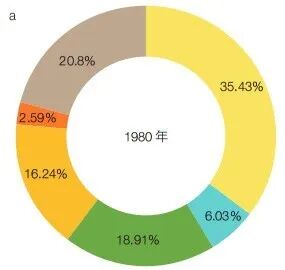
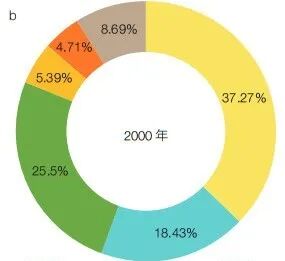
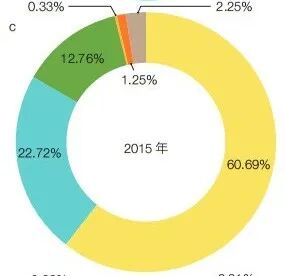
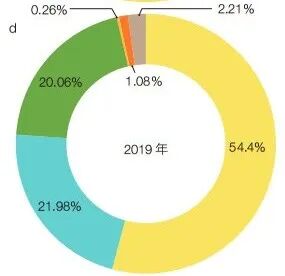
◉ Changes in the grain crop structure in the Northeast, 1980-2019. Yellow is the proportion of maize area, green is soybean. Source: Li Baoguo et al. (2021)
Those still carrying out incorporation are to be found only in the fragmentary oral accounts of villagers—they either have land along major transport roads or in the vicinity of cities, where they cannot burn because controls are strict; or they have connections through which subsidies can be earned. Of course, because the subsidies are paid to machine operators rather than growers, these people are often large-scale farmers who own agricultural machinery and have contracted large areas of land.
West of Bin County, we heard several villagers discussing the business know-how of such a large-scale farmer. The farmer set up a grain professional cooperative, contracted large areas of land from many villager households to plant crops such as maize and soybean, and has already carried out deep ploughing and incorporation for two or three consecutive years. He has also been covered by local media.
In the villagers’ view, this large-scale farmer insists on deep ploughing in order to get subsidies. Moreover, for the large-scale farmer, the subsidies he can receive are not just one item; it is almost a winner-takes-all affair. The villagers count them up one by one: crop residue incorporation, there is a subsidy; maize-soybean rotation, there is a subsidy; wide-ridge planting, there is a subsidy; large agricultural machinery—”all of it is subsidised by the state”—rice transplanter, combine harvester… “He has ‘people’, and knows where to (apply for) subsidies.”
But not all subsidies make it safely into their pockets. In a village in Hulan District that we passed through, the agricultural machinery cooperative has already stopped operating—in the process of ploughing and ridging, forming the ridge, the cooperative is responsible for hiring machine operators, providing equipment, and fronting fuel and labour costs. Village Party secretary Guo Quanshan said that the district’s deep ploughing subsidy has been long overdue; after fronting costs for five or six years, it has been owed several million in all. Even if any farmer wants to carry out crop residue incorporation, there is no one left to provide the service.
We Just Want to Burn It
“Just write it down: the ordinary people of the Northeast say we just want to burn it!” After talking with us, more than one farmer or village Party secretary made such a bold declaration.
Sister Chen remembers the grand spectacle of the whole village turning out to burn the crop residue: according to the weather forecast, the village gave a unified time; if there was only one day, each household would round up a few extra relatives to help, set torches in place, and light it with the wind. If they wanted to hurry, they would pour on oil and burn.
But Guo Quanshan also remembers that one year, when the wind was strong, the crop residue fire in a nearby village got too fierce, burning from one hamlet to the next, and three people died.
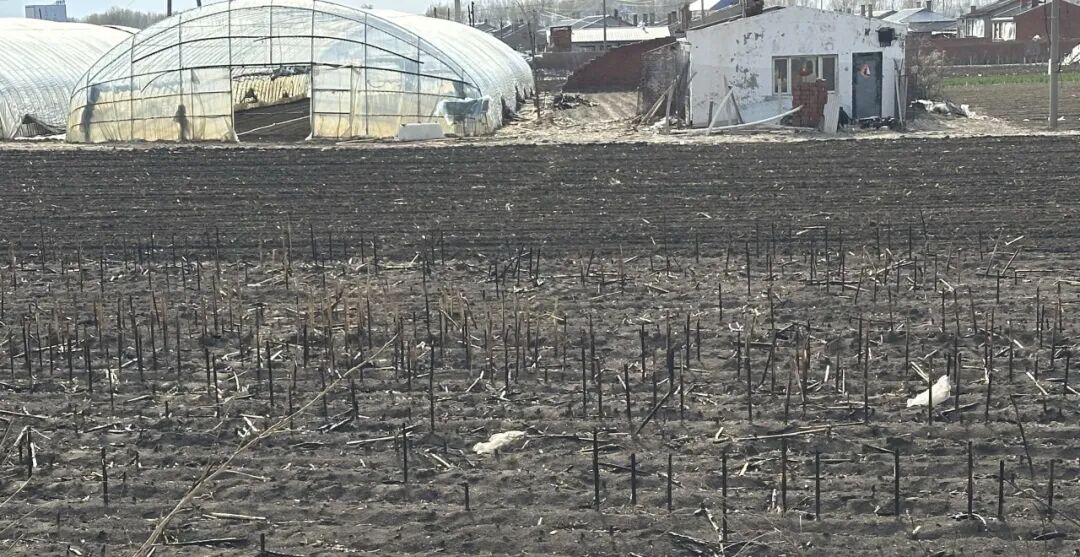
◉ Although the farmers all say the crop residue just has to be burned, we have also from time to time heard of accidents in which villages were burned down and people died. In the picture, the burnt land is right next to polytunnels and houses, making it especially dangerous.
At the end of April this year, crop residue burning near Harbin Airport disrupted aircraft take-offs and landings and caused widespread delays at the airport. On another occasion, a crop residue fire in Jilin was “burning red hot”, high-speed trains were suspended, and the villagers involved were detained. Real-time air pollution data and satellite remote-sensing monitoring also show that this spring, several cities in the Northeast experienced severe air pollution due to crop residue burning.
Several village Party secretaries who have been driven to their wits’ end by crop residue burning also believe that this is a case for easing rather than clamping down. “The more people are told not to burn, the more nervous they get, and they light it on the sly.” The result is that, for fear of missing spring ploughing, everyone burns wildly like headless flies, which is very dangerous in strong winds. Now crop residue burning is allowed, but everyone must follow the unified arrangements from above. Once farmers know it will not hold up their own farming, they are much more at ease.
But will all the benefits of crop residue incorporation promised in policy talks—loosening the soil, replenishing organic matter, restoring vitality to the black soil…—also vanish into thin air with a single fire? We have still not drawn enough lessons from ten years of crop residue incorporation.
After our trip to the Northeast, Foodthink headed south and, on the North China Plain, saw an entirely different story of crop residue incorporation. The regional differences in crop residue use make one deeply aware of the complexity of farming conditions, the scale of policy impact, and how difficult it is for farmers to manoeuvre within such a limited range of choices. We welcome your comments: please share the realities of crop residue use you have seen.
– This is Foodthink’s 808th original article –

Foodthink
Author
Pei Dan
Editor at Foodthink and writer, focused on the individuals at the centre of climate and environmental change.

Foodthink
Author
Kong Lingyu
Project director at Foodthink, former media professional, public-interest practitioner, focused on climate, environmental, and food and agriculture issues.
Hu Shunyi, Sister Chen, and Guo Quanshan in the article are pseudonyms.
Unless otherwise stated, all photographs were taken by the authors.
Editor: Lingyu
Layout: Minglin
▼
Click the image to read related articles.