
Without Fungi, How Could the Agricultural Ecosystem We Depend on Even Be Possible?
Foodthink Says
These life forms, so different from plants and animals, quietly offer us guidance on our path towards coexisting with nature—present in ways that are mysterious, powerful and routinely ignored. How do fungi cooperate with plants to thrive together? As the link between plants and soil, what critical role do mycorrhizal fungi play in agricultural ecosystems? And in the relentless pursuit of maximum yields, how has this foundation of agricultural ecosystems been destroyed?
We have selected an extract from the new book Entangled Life. By delving deeper into the interactions between fungi and plants in the soil, we may come to see that agriculture’s future might not lie in ever more chemicals, but in rediscovering and nurturing the subtle, intricate symbiotic relationships within soil ecosystems. 🍄🟫
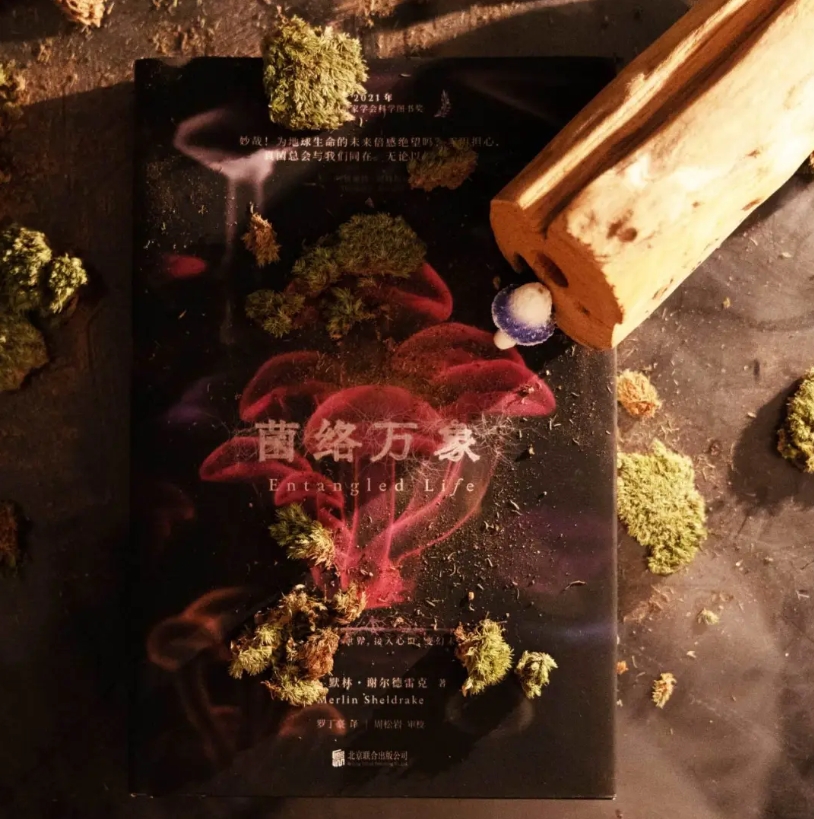
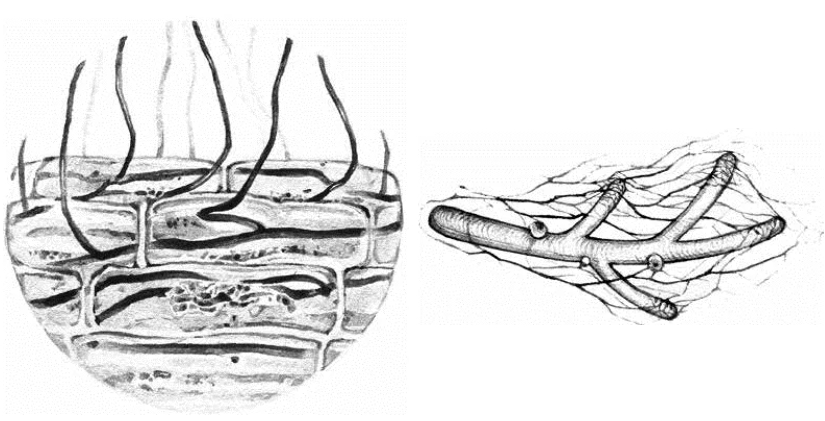
“Human health and wellbeing necessarily depend on the functional efficiency of this mycorrhizal partnership.” So wrote Albert Howard, one of the founders of the modern organic farming movement and a passionate advocate for mycorrhizal fungi. In the 1940s, Howard proposed that the widespread application of chemical fertilisers would sever mycorrhizal connections, and that “it is the mycorrhizal network…… which so intimately joins the fertile soil and the tree it nourishes”. The damage wrought by chemical fertilisers could run deep. To cut those “living threads of fungal hyphae” was to harm the health of the soil. Then the health and yield of crops would suffer, and the animals and people who consumed them would follow. “Can man regulate his behaviour so as to maintain his greatest asset, the fertility of the soil?” Howard asked. “The future of human civilisation depends on the answer.”
Howard’s tone was somewhat exaggerated, yet over the following eighty years, the questions he raised grew ever more urgent. By some estimates, modern agriculture has been remarkably efficient: crop yields doubled in the second half of the twentieth century. But the single-minded focus on yield has exacted a severe toll. Agricultural development has caused widespread environmental destruction and accounts for a quarter of global greenhouse gas emissions. Despite heavy pesticide use, 20 to 40 per cent of crops are still lost each year to pests and disease. Although fertiliser application increased seven hundred-fold in the second half of the twentieth century, the growth of global agricultural output has plateaued. Every minute, an area of topsoil equivalent to thirty football pitches is eroded and degraded worldwide. Yet humanity wastes a third of its food, and demand for crops is set to double by 2050. The urgency of this crisis cannot be overstated.
Could mycorrhizal fungi offer part of the solution? That may sound like a foolish question. Mycorrhizal relationships are as old as plants themselves, and for hundreds of millions of years they have been shaping the fate of the Earth. Whether we think of them or not, mycorrhizal relationships have always profoundly influenced the harvest of food crops. For millennia, traditional farming practices in many parts of the world paid close attention to soil health, silently sustaining plants’ fungal relationships. But throughout the twentieth century, our neglect of them brought trouble. In 1940, Howard’s greatest fear was that the technological advance of modern agriculture would ignore “the life of the soil”. His fear has become reality. Farming practices have treated the soil as a near-lifeless space, devastating the underground communities that sustain edible life. There are telling parallels here with much of the medical science developed during the twentieth century—which conflated “germ” and “microbe”. Of course, some organisms living in the soil can cause disease, just as some microbes in our bodies can; but most microorganisms have the opposite effect. Disturb the microscopic ecology of the gut microbiome, and our health suffers—and many diseases afflicting humans today are linked to the over-elimination of “germs”. The soil is the Earth’s gut; disrupt the complex ecology of its microorganisms, and plant health suffers.
In 2019, researchers at Agroscope, the Swiss Federal Agricultural Research Institute, published a study that measured the scale of the damage by comparing the impact of organic and conventional “intensive” farming on fungal communities around crop roots. By sequencing fungal DNA, the researchers were able to assemble networks showing how fungal species interconnect. They found “striking differences” between organically and conventionally managed farmland. On organically managed farms, mycorrhizal fungi were not only more abundant but also formed more complex communities: the team identified 27 highly interconnected “keystone species”, whereas on conventionally managed farmland, no keystone species were found at all. Many studies have reported similar findings. The combined pressure of tillage, chemical fertilisers and fungicides has drastically reduced the abundance of mycorrhizal fungi on intensively managed farmland and altered their community structure. Whether organic or otherwise, more sustainable farming practices generally nurture more diverse mycorrhizal communities and richer fungal mycelium in the soil.
Do these differences matter? A large part of agricultural history is a history of ecological sacrifice. Forests were cleared to make way for farmland, scrub was removed to expand it. Why should soil microbial communities be any exception? We add fertiliser to the fields to “feed” crops—surely that replaces the mycorrhizal fungi? If we have made the fungi redundant, why should we care about them?
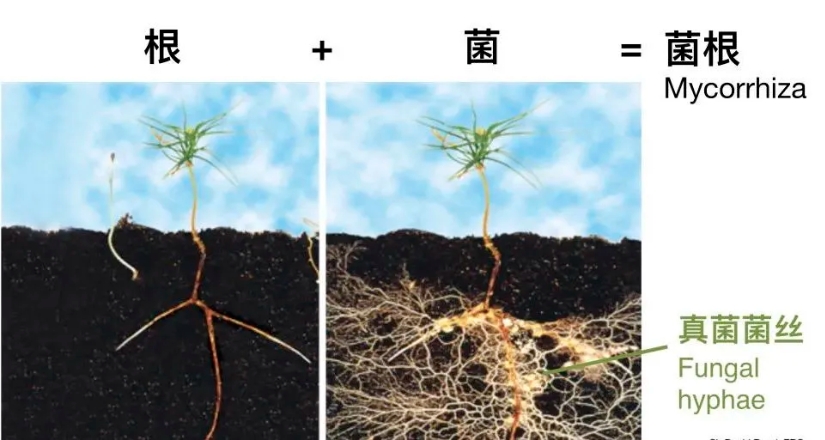
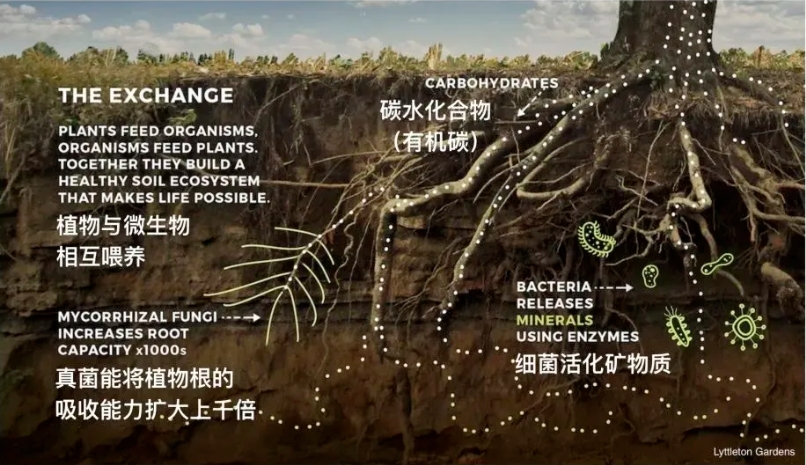
Mycorrhizal fungi do far more than simply feed plants. Some researchers at Agroscope describe them as keystone species, while others prefer the term “ecosystem engineers”. Mycorrhizal mycelium is a living, sticky needle-and-thread stitching through the underground, anchoring water and preventing erosion; remove the fungi, and the soil washes away. Mycorrhizal fungi increase the soil’s capacity to absorb water, reducing soil-nutrient loss through rainfall runoff by as much as half. A substantial portion of the organic carbon stored in soil (astonishingly, twice as much as in plants and the atmosphere combined) is locked within the tough organic compounds produced by mycorrhizal fungi. The organic carbon channelled into the soil along mycorrhizal networks supports complex food webs. In a single teaspoon of healthy soil, alongside hundreds or thousands of metres of fungal mycelium, there are more bacteria, protists, insects and other arthropods than there have been humans throughout all of history.
There are now many projects aimed at developing fungal solutions to agricultural challenges, and Katie Field is one of the researchers funded through them. “The whole relationship is more variable and more susceptible to environmental influences than we casually assume,” she told me. “Often, fungi don’t help crops absorb nutrients. The effects of mycorrhizal relationships are highly unpredictable, depending entirely on the species of fungi and plants, and the environment in which they grow.” Several studies have reported similar unpredictability. In the breeding of most modern crop varieties, the plants’ ability to form efficient mycorrhizal relationships has been overlooked. We have bred wheat that grows quickly when fertiliser is plentiful, producing “spoilt” plants that have almost entirely lost the capacity to collaborate with fungi. Field points out: “It is nothing short of a small miracle that any fungal colonisation remains around the roots of such crops.”
The subtlety of mycorrhizal relationships lies in the fact that the most obvious intervention—supplementing plants with mycorrhizal fungi and other microorganisms—is a double-edged sword. Sometimes, as Sam Gamgee the hobbit in The Lord of the Rings discovered, introducing soil microbial communities can not only support the growth of crops and trees but also bring damaged soil back to life. However, whether this practice truly works depends on ecological fit. Poorly matched mycorrhizal fungi may do more harm than good to plants; worse still, introducing opportunistic fungi into a new environment could see them outcompete native fungal species, with unforeseen ecological consequences. The rapidly growing commercial mycorrhizal fungi industry often overlooks this reality, marketing commercial mycorrhizal fungi as a one-size-fits-all solution. As with the booming human probiotics market, many species are chosen for the shelf not because they are particularly well suited, but because they are easy to produce industrially. Even with sensible guidance, applying fungal inoculants to the environment is no panacea. Like all living things, mycorrhizal fungi can only flourish under specific conditions. Soil microbial communities are in a constant state of assembly, and if they are continually disturbed, the connections between them will not endure. For microbial interventions to work, farming practices must undergo more fundamental change—much as we adjust our diet or lifestyle when trying to restore the health of a damaged gut microbiota.
Other researchers approach the problem from a different angle. If humans have inadvertently bred crops that form dysfunctional symbiotic relationships with fungi, surely they can turn that thinking around and breed crops that attract efficient symbiotic partners. Field is researching precisely this approach, hoping to develop crop varieties with stronger symbiotic cooperation—”a new generation of super-crops that form remarkable connections with fungi.” Kiel is equally fascinated by these possibilities, though she approaches the question from the fungi’s perspective. Rather than breeding plants more likely to form symbiotic partnerships, she is cultivating fungi that are more beneficial to crops: strains that hoard fewer nutrients for themselves and, where possible, prioritise the plant’s needs.
Howard observed in 1940 that we lacked a “complete scientific explanation” of mycorrhizal relationships. Today, our scientific understanding remains very incomplete, yet as the environmental crisis intensifies, there is growing hope that introducing mycorrhizal fungi can reshape the trajectories of agriculture and forestry, and restore degraded ecosystems. At the dawn of terrestrial life, mycorrhizal relationships evolved to meet the survival challenges posed by barren landscapes and harsh weather. Plants and fungi co-evolved a form of agriculture—though we cannot say whether the plants learned to cultivate the fungi, or the fungi learned to cultivate the plants. Either way, we face the challenge of changing our own behaviour so that plants and fungi can better cultivate one another.
……
—from the Preface to Entangled Life
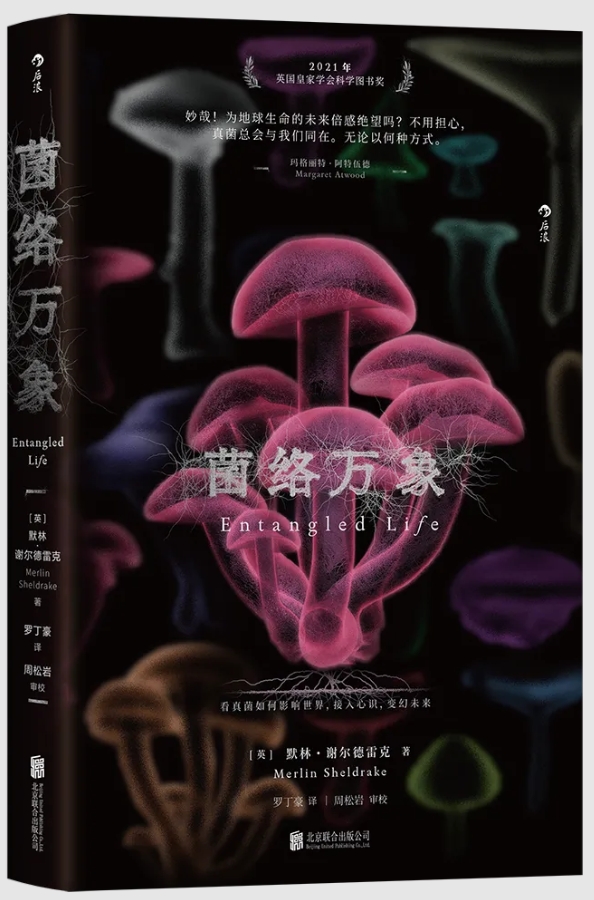
Author: [UK] Merlin Sheldrake
Translator: Luo Dinghao; Editor: Zhou Songyan
ISBN: 978-7-5596-7775-4
Beijing United Publishing, First Edition, October 2024