
Ma Lan in Shenzhen, No Meal Companion
Editor’s Note
Few food cultures are as thoroughly defined by religion and woven into ethnic life as “halal.” After spending time with Muslim friends from the northwest, I realised that once they leave Muslim-majority areas and come south to work, “Lanzhou hand-pulled noodle” is often the only affordable halal restaurant option open to them.
How do they sustain a halal diet that honours both doctrine and faith? Can they expect adequate respect and convenience? Or must they compromise? At Ma Lan’s table, we see that eating is like a chronic pain that lingers but is never severe — a constant reminder that her choices are limited and, at the same time, invisible to the mainstream.
“The Worker’s Table” is a series of observations and records of workers’ lives, supported by Food Think’s “Lianhe Creative Programme”. The first piece, “A-Mei the Cleaner, Who Wants to Eat a Proper Meal”, follows the cleaner A-Mei through a day of three meals, letting us feel the rhythm of her labour and her life. The second piece records the halal life of Ma Lan, a Muslim girl far from her Ningxia hometown, in Shenzhen.
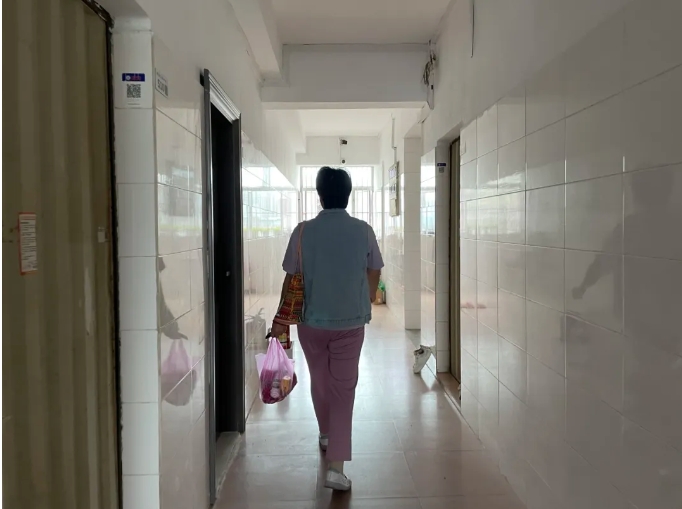
Three points connected by a winding, L-shaped line, one kilometre in total.
Sometimes, three points reduce to two: the rental flat and the office. Because Ma Lan cooks for herself, she no longer needs to eat at a Lanzhou hand-pulled noodle restaurant.
Sometimes she steps off this fixed track to add a temporary point: the wet market. A 1.5-kilometre walk from home, she goes at most once a week, buying enough vegetables to last the whole week.
There is also a farther point: a halal food shop nine kilometres away, where Ma Lan buys her meat. She only needs to go once a month.
Every one of these points in Ma Lan’s life is connected to eating.
I. From Xihai’gu to Shenzhen
In the south-central part of Ningxia, there is a region known as “Xihai’gu.” In 1972, the United Nations World Food Programme described it as “one of the least habitable regions on Earth.”
Xihai’gu is a Hui-majority area, and Ma Lan’s hometown is Xiji County, within Xihai’gu. According to the 2020 seventh national census, Xiji County had a registered population of 475,000, of whom 284,000 were Hui.
Eight years ago, Ma Lan left Ningxia; four years ago, she transferred her household registration to Shenzhen. Under the talent-recruitment regulations at the time, her bachelor’s degree entitled her to a municipal-level settlement grant of 15,000 yuan once she was registered as a resident.
From Xiji to Shenzhen, the barren loess plateau and the thriving coastal metropolis are separated by 2,000 kilometres. Everything in Shenzhen is different from home. The summers are hot, humid, and long, and Ma Lan finds them unbearable. “Just sitting there doing nothing, and the sweat pours straight down.” It is not only the climate she finds difficult; the food is, too.
Shenzhen gathers cuisines from every corner of China and the world. The diverse culinary landscape caters to the food needs of more than 17 million people. Halal restaurants are part of that landscape.
Yet for Ma Lan, the foundation of this “diversity” is “Han-centricity.” In eight years in Shenzhen, walking the streets and alleys, Ma Lan has rarely paid much attention to what kind of restaurants are there. What most people take for granted — snail rice noodles, wooden-bucket rice, malatang, hot pot, Hunan cuisine, Cantonese cheung fun, cakes and bread — none of it falls within what she can eat.
For most Muslims, Lanzhou hand-pulled noodle is one of the few everyday food choices available.

III. “Lanzhou Hand-Pulled Noodle”
“The first time we went to that place, the person who was showing us around said there was no food Hui people could eat, and he would get us some biscuits, instant noodles and things like that.” They were wandering outside the factory when one of her classmates suddenly burst with excitement — not far away, a Lanzhou hand-pulled noodle restaurant had appeared, its sign marked with the word “halal.”
*Note: In Arabic, “halal” means “permissible under Islamic law.” Trade and population movement have made it harder for individuals to verify halal compliance on their own, and halal certification has emerged to protect the rights of Muslim consumers.
After that, she made a note of it: in the south, unless you were in some particularly remote corner, you could always find a Lanzhou hand-pulled noodle restaurant within a few kilometres.
Halal noodle restaurants appeared alongside the southward movement of Muslim workers from the northwest. A 2022 report recorded that there were around 2,000 halal restaurants in Shenzhen, of which halal noodle restaurants made up over 80 per cent.
Halal noodle restaurants have underpinned the mobility of Muslim workers in southern Han-majority areas. After graduating from university in 2016, Ma Lan went straight to Shenzhen to look for work, and from then on, noodle restaurants ran through the entirety of her life away from home.
In countless Lanzhou hand-pulled noodle restaurants, Ma Lan worked through every item on the menu — soup noodles, noodles with topping, rice with topping, stir-fried dishes — until she felt that “they all tasted the same.”
For a while, the sight of Lanzhou hand-pulled noodles filled her with aversion. “By the time I’d walked up to the door, the smell of that broth made me not even want to go in.”

Now, Ma Lan works at a grassroots unit in Shenzhen. Because she never eats in the canteen, a colleague asked why, and she told them, “There’s hardly anything in the canteen I can eat.” Once they gradually learned that Ma Lan was Hui, someone pressed the question: “Is it just pork you can’t eat? Or is it any meat at all? Then how are you still so sturdy?”
Ma Lan felt helpless. She had tried to explain, wanting the other person to understand that it was not that she did not eat meat, but that she did not eat non-halal food. In Hui communities in the northwest, any food outside the halal table is collectively called “Han food,” and pork is referred to as “big meat.” These terms are hardly known outside that community.
When the unit organised a team-building day or a group meal, Ma Lan would go to a nearby Lanzhou hand-pulled noodle restaurant, get a takeaway portion, and bring it along. Her colleagues ate the dishes on the table; she ate the takeaway food in front of her, and the gathering ended without a hitch.
This unremarkable marginality is rarely seen. An invisible wall stretches between her and most people. “I eat alone every single day — I cook alone and eat alone, and even when I go to a Lanzhou noodle restaurant, I eat alone.”
During the pandemic, when Shenzhen was under lockdown, “even the Lanzhou noodle restaurants were shut. I had to scan codes and do community visits every day — there was so much to do. Because of the pandemic, the conditions at the sub-district canteen became really bad. The only thing I could eat was green vegetables, and even those tasted terrible.”
It was over the whole business of eating that Ma Lan’s emotions broke.
This is the only time, on the subject of eating, that she has used the word “breakdown.” She poured her frustration out on WeChat Moments, and Hui friends she had met at the mosque saw it and sent her some good food.
“After all, who doesn’t love good food?” She craved the egg-stuffed flatbread, oden, and xiaolongbao from street stalls. She had eaten halal versions of these snacks up north. Now, when she comes across a halal restaurant she likes, Ma Lan makes a point of going back often. “I hope the owner’s business thrives and the place stays open for a long time.”

III. Food as Faith
In primary school, her older cousin took her to a Han classmate’s home as a guest. Ma Lan watched the classmate’s mother wash the wok several times before starting to cook, and when the dishes were finally served, Ma Lan — seared by the pull of contradiction and self-reproach — ended up not eating a single bite.
To this day, Ma Lan’s mother still performs the daily prayers, and her father goes to the mosque on Fridays for Jumu’ah (Note: the congregational prayer held by Muslims every Friday). For her, faith is a matter of belief and sincerity of thought, while daily life is the form in which it is expressed — eating is one such form.
Were it not for this interview, Ma Lan would not emphasise identity or faith in her everyday life. Asked what “halal” is, her first reaction is, “Why do people always have to turn the ordinary routines of life into some conceptual thing?”
“Halal means cleanliness.” She still voiced her understanding. “It has to be clean and hygienic, and it has to conform to doctrine.” No pork, no carrion (animals that have died of illness, a fall, old age, or similar causes), no animal blood, no animals slaughtered without an ahong reciting the blessing, no alcohol — these form the basic principles of halal eating.
*Note: In China, ahong is a term of respect used by Hui and other Chinese Muslims for religious clerics.
Ma Lan understands that the halal values of cleanliness, health, and respect for living beings are grounded in faith, not in any absolute scientific explanation.
Walking into an unfamiliar halal restaurant, Ma Lan quickly scans the surroundings and the staff. Once she spots a member of staff setting vegetables on the floor during prep, she concludes the place is not clean enough and turns around to leave.
With dining-out options so limited, cooking for herself becomes the natural course — by Year Two of primary school, the rural child Ma Lan had already learned to cook.
In the self-built housing of an urban village, the kitchen is always next to the bathroom. Ma Lan’s large single room, which rents for 750 yuan, is no exception. It sits wrong with her, so she has moved all her ingredients and crockery onto a shelving unit in the room; the kitchen holds only the gas hob and a small fridge.
From one end of the single room to the other, everything is visible at a glance: two wardrobes, a bookshelf, a shelving unit, a desk, a bed, a washing machine — that is all her major furniture.

Her smaller belongings are kept neatly in order.
By the window stands a shelving unit: the top two shelves hold ingredients and seasonings, the bottom two hold crockery and cooking utensils.
Before bed, Ma Lan grabs a handful of purple rice and glutinous rice, rinses them clean, and puts them in the rice cooker. Then she washes some dried jujubes, corn, and Chinese yam, places them on the steamer tray set on top of the rice cooker, presses the timed congee function, and by the time she gets up the next morning, breakfast is ready.
For lunch and dinner, she cooks at least one a day; on the more industrious days, she makes both. “I’ve developed a method now — I put rice, meat, and vegetables, I mean potatoes, carrots, things like that, all in the rice cooker together and cook it all at once.”

When the meat in the fridge is nearly gone, she rides her electric scooter for forty minutes to the halal shop.
Before she’s even parked the scooter, the shop owner’s wife spots her. Once inside, Ma Lan takes the mutton pie that is offered without any ceremony. More than a year of buying beef and mutton has made the couple familiar faces. The owner’s wife drops her voice and asks how the young man she introduced last time turned out; Ma Lan says straight out, he wasn’t the one for her.
The couple are from Gansu Province. They opened the halal shop here in 2019, supplying meat and grains, oils, and side provisions to the halal restaurants in the neighbourhood. A price list is pinned to the wall; beef and mutton are barely more than thirty or forty yuan a jin at the regular markets.
The two of them work in tandem at the cutting machine, slicing a large cut of imported Malaysian beef into three-centimetre cubes, rushing to deliver an order to a catering company. Behind them, the walk-in cooler holds racks of lamb ribs and legs, and next to it a large chest freezer is packed with meat cut into portions. China’s Muslim population exceeds thirty million, making it a primary destination for Malaysian halal food exports.
The shop owner has a steady confidence. “The Han people who know about this place all come to me specifically to buy meat. First, the slaughter — you can trust every aspect of it. Second, our meat isn’t water-injected.”
Each time Ma Lan comes, she picks up two or three jin of beef and two or three of mutton, plus some chicken, and hauls it all home to freeze — enough to last a month.

When she was little, during Ramadan, Ma Lan would get up before dawn for a full month to eat, then abstain from food and drink during the day until sunset. Now, after four or five days of fasting, she stops. “Mainly I just can’t get up in the morning.”
Since leaving home, apart from keeping up her dietary habits, she feels she has “not much faith left.” “The books on the shelf, I haven’t really looked at them either. Now I can’t say I believe, and I can’t say I don’t.” Faith reveals its undercurrent in daily life, yet when pressed on belief and sincerity, it runs aground.
IV. Breaking the Precepts
Take bread, for instance. “Some of it uses shortening, and I didn’t know that before, so I just bought whatever. Then someone told me that shortening is mainly made from lard. Now I check whether it contains shortening or meat.”

But the principle applied to “Han food” — “if you can avoid it, you don’t eat it” — has also been breached.
Two years ago, in the sub-district where she once worked, outsourced staff were also allowed to enjoy the “five yuan, three meals” subsidy: “one yuan in the morning, two at lunch, two at dinner as well.”
“Poverty broke through my bottom line.” Ma Lan is not ashamed to admit it. She began eating in the canteen, taking only the vegetable dishes, fish and seafood, and eggs. “Eat what we can eat.”
In the turbulent years, Ma Lan had not managed to save any money. “My heart was so anxious, so full of insecurity — I couldn’t even bring myself to eat properly.” A bowl of Lanzhou hand-pulled noodles costs twelve yuan, and every time she eats one, a guilt she cannot shake follows. “Spent money again.”
Extending her own experience to others, Ma Lan does not want to harshly judge Muslims drifting in a foreign land who end up eating Han food. “My younger cousin came to Shenzhen to work. As long as it isn’t big meat, those vegetable dishes stir-fried alongside the non-halal beef and mutton — sometimes he eats those, too.”
Is this akin to a vegetarian who eats “pot-edge vegetarian” dishes? On the spectrum of halal eating in non-Muslim countries, is “pot-edge halal” permissible?
Someone told Ma Lan that in the factory recruitment notices around Dongguan and Shenzhen, there is a specific requirement for Hui workers: no dietary restrictions. In industrial zones where floating populations gather and eating habits are a jumble, “no dietary restrictions” has replaced “halal,” dissolving a food culture into vagueness.
Last year, when Ma Lan moved to the unit where she works now and the canteen stopped providing a meal subsidy, she cancelled her meal card. After work at midday and in the evening, she walks two hundred metres back to her place — enough time to put together a simple meal.
On rest days, occasionally one or two close friends will join her of their own accord, seeking out the halal restaurants scattered across the city. When the whim strikes, her feet even carry her to a neighbouring city.
Over eight years, the effort to maintain a halal diet has been turbulent — there has been persistence, there has been retreat, there has been self-determination, and there has been loss. But few people have ever asked her, as a Muslim, whether eating in Shenzhen is convenient. Ma Lan says she does not think she needs special consideration.
Rather, she is somewhat worried that sticking to a halal diet in Shenzhen makes her stand out too conspicuously, so she keeps emphasising, “This is my personal choice.” Over these past few years, one clear change is that Ma Lan has become more sensitive to “cultural confrontation.”

V. Seeking a Meal Companion
The white-and-green main building stands out among the surrounding darker-toned buildings, gleaming with a clean whiteness. Its modern architectural style, infused with Islamic culture, fits neatly alongside Shenzhen’s self-image as “a diverse and inclusive international metropolis.”


The mosque’s functions cover every aspect of Muslim life — prayer, scripture recitation, study, communal meals, matchmaking introductions…
Ma Lan has attended a few social events organised by the mosque, and some of her Muslim friends were met there. The metro ride from her flat to the mosque takes an hour and a half. Last year she even signed up at the mosque to study Arabic.
Coming out of the mosque, Muslims who are lost among the millions turn up in comfort-zone WeChat groups. Foodie groups, second-hand exchange groups, board game groups, dating groups, flat-sharing groups… A single greeting of “as-salamu alaykum” and Muslims can recognise one another.
*Note: “As-salamu alaykum” means “peace be upon you.” It is the most common greeting among Muslims and a way of expressing friendship, goodwill, and blessing toward one another.
In the foodie group, someone fished out the scattered halal restaurants and put together a list of halal food spots in Shenzhen. On weekends, someone organises a group meal, and quite a few people sign up. The appetite that has been building up from growing tired of Lanzhou hand-pulled noodles finds its release at the table.
Ma Lan goes, not just driven by the food. “The board game group was set up this year. I just want to get out and see if I can find a Hui partner.” She describes a “deep longing” to be with people of the same kind.
In the past, she dated a Han man. In terms of food, he was willing to eat according to her habits. Over time, though, Ma Lan felt it was not fair to him. “The differences are always there.” She also knows that some Hui-Han couples, to deal with the food question, keep two pots in the kitchen — one for Han cooking, one for Hui cooking, each pot to its own task, neither interfering with the other.
After they broke up, Ma Lan was resolute that she would find a Muslim to build a life with. “Not being able to eat at the same table is a real problem.”
But it is not easy.
Three years ago, she met a Hui man and tried a relationship, only to find out later that he was a con artist. “He also swindled me out of tens of thousands of yuan.” After the breakup, Ma Lan was so worked up that she filed a lawsuit against him in court.
On a weekend morning, a new message pops up on WeChat; in the board game group, someone is rallying people for a whole roast lamb dinner. This time she does not want to go. “I can’t bear the thought — one round of whole roast lamb costs a hundred or two hundred yuan a head.”
Her parents keep urging her to go back to Ningxia. She once went back briefly and worked as a substitute teacher at a rural primary school for half a year. Then she parted again and returned to Shenzhen. In late 2020, armed with a professional qualification certificate she had passed, she found her job at this grassroots unit.
With her income stabilised, Ma Lan “lends” her university-going sister 1,500 yuan a month for living expenses. Subtract her own spending of less than two thousand, and the nearly twenty thousand yuan she sends her parents each year for all manner of things, and she can still save a little.
She says she now often “treats herself to a feast” — on weekends at the Lanzhou hand-pulled noodle restaurant, she orders two stir-fried dishes, a meal that comes to sixty or seventy yuan. “I just want to have two dishes. One person ordering two dishes — you can’t finish it all. It would be great to have a meal companion.”
The day after Women’s Day, Ma Lan made a trip to Guangzhou for another singles social event. Finding a meal companion may be the only urgent thing on her agenda right now. “At least we could eat together.”

Author’s note 1: In 2024, the global Muslim population reached two billion, accounting for 25 per cent of the total population. Domestic media have cited figures from Malaysia’s Halal Industry Promotion Bureau showing that as early as 2014, the annual global halal food trade had already reached 500 billion US dollars.
Author’s note 2: “In order to align with and achieve mutual recognition of halal standards in Muslim countries around the world” (Xinhua), in 2013 the five provinces and autonomous regions of Gansu, Ningxia, Qinghai, Shaanxi, and Yunnan jointly formulated the General Rules for Halal Food Certification. In 2018, they were successively declared revoked.
*To protect the interviewee, Ma Lan is a pseudonym.

After multiple rounds of interviews by six judges, 18 creative projects were ultimately selected to receive support from the Foodthink Lianhe Creative Programme, of which 5 have been published:
“A-Mei the Cleaner, Who Wants to Eat a Proper Meal | The Worker’s Table”
“In Malaysia, Chinese Traders Only Want Grade A Durian”
“‘Fake Meat’ Ousts Real Meat: Herders, the Table, the Amazon”
Editor: Xu Youyou