
The Braised Goose in the Qiaopi – 100,000 Yuan a Bird

The 100,000-Yuan Braised Goose
This is a Qiaopi (overseas Chinese remittance letter) written on 12 July 1946, posted from Seremban in Malaysia to Huamei village in Chao’an, Guangdong – over 4,000 kilometres away. It is now held in the collection of the Qinghui Building, Caitang Qiaopi Museum, in Chaozhou’s Chao’an county.
The sender was Shen Dongyan; the recipient was his mother. Like the vast majority of Qiaopi letters in real life, this one is filled with concrete day-to-day matters: enquiring about the harvest of the early-season rice crop, asking how much of the grain rent his brother had collected, and touching on a family member’s schooling – transferring schools, as well as the handling of tuition and boarding fees. He notes that once “shipping is running smoothly and unobstructed”, he will send back some “clothing for everyday wear”. At the end, he brings up one further matter:
“I count the days, and the anniversary of ancestor Yongzu’s birthday approaches apace. Your son reflects that we have certainly had no occasion to purchase a large goose for worship these past few years. This year I think we might buy one, though I do not know whether the price per bird will suffice. For now, I am sending ahead one hundred thousand yuan in national currency to meet household needs; the balance I shall remit by later letters as required. With my most respectful regards, I trust you are in continued good health.”
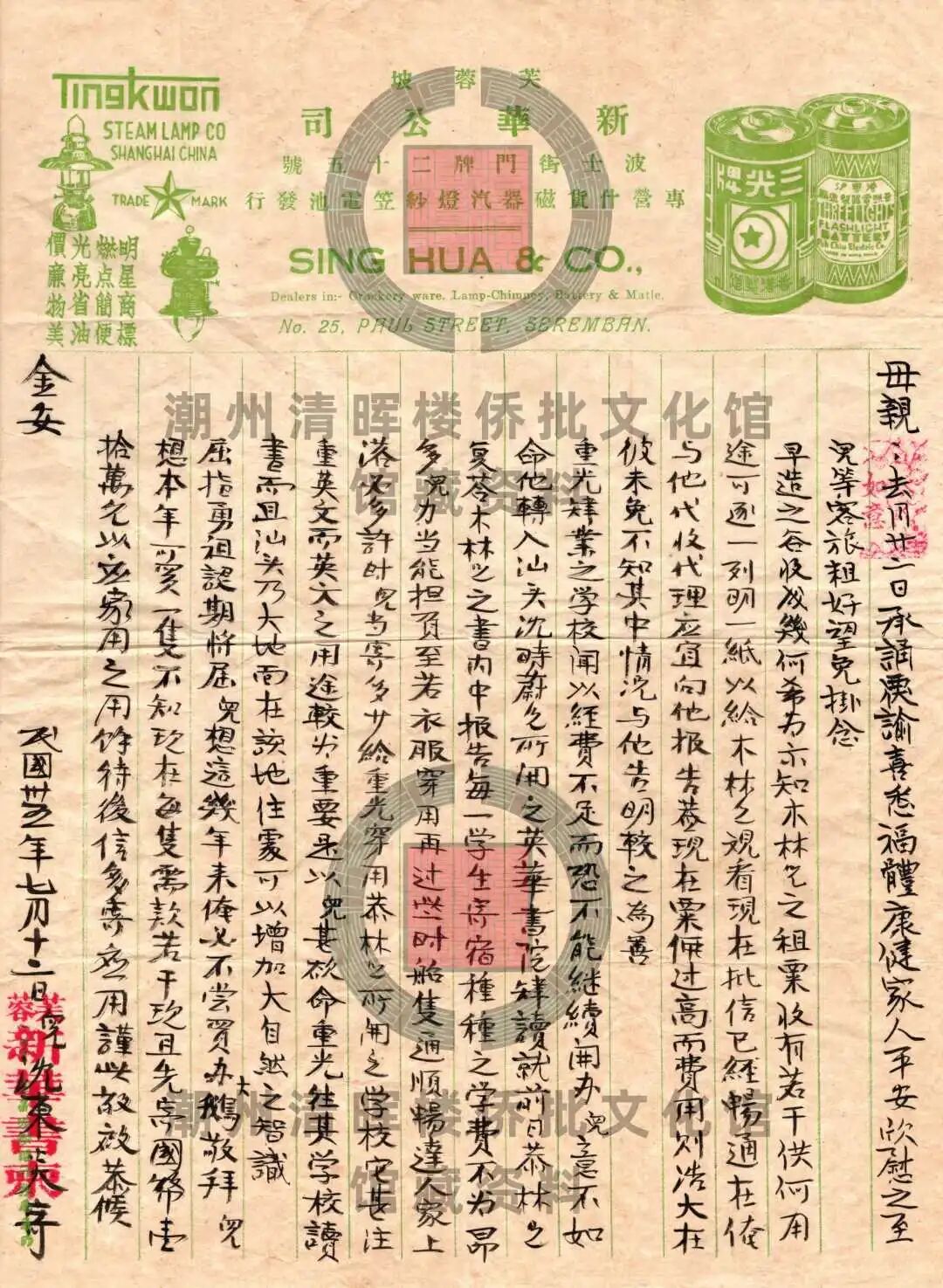
◉ Various localities across Guangdong have overseas Chinese or Qiaopi museums that preserve many of the remittance letters sent home by people like Shen Dongyan, Nanzhi and Musheng. Image source: Qinghui Building, Caitang Qiaopi Museum.
One need not be well versed in literary Chinese – a handful of keywords would be enough for any Chaoshan person to understand: a forebear’s birthday is approaching; in recent years the family may not have had the means to buy a braised goose for the ancestral rites; and the sender wonders whether the money enclosed with the letter will be enough to purchase one.
In Chaoshan, whether for Spring Festival deity worship or everyday ancestral rites, the braised goose holds the highest rank among all offerings. This Qiaopi confirms that the tradition was already deeply ingrained in the 1940s. At that time, Shen Dongyan, thousands of miles away in Malaysia, kept this in mind with the utmost care; the 100,000 yuan in national currency he enclosed with his remittance letter to his mother was most likely his estimate of what a single braised goose cost then.
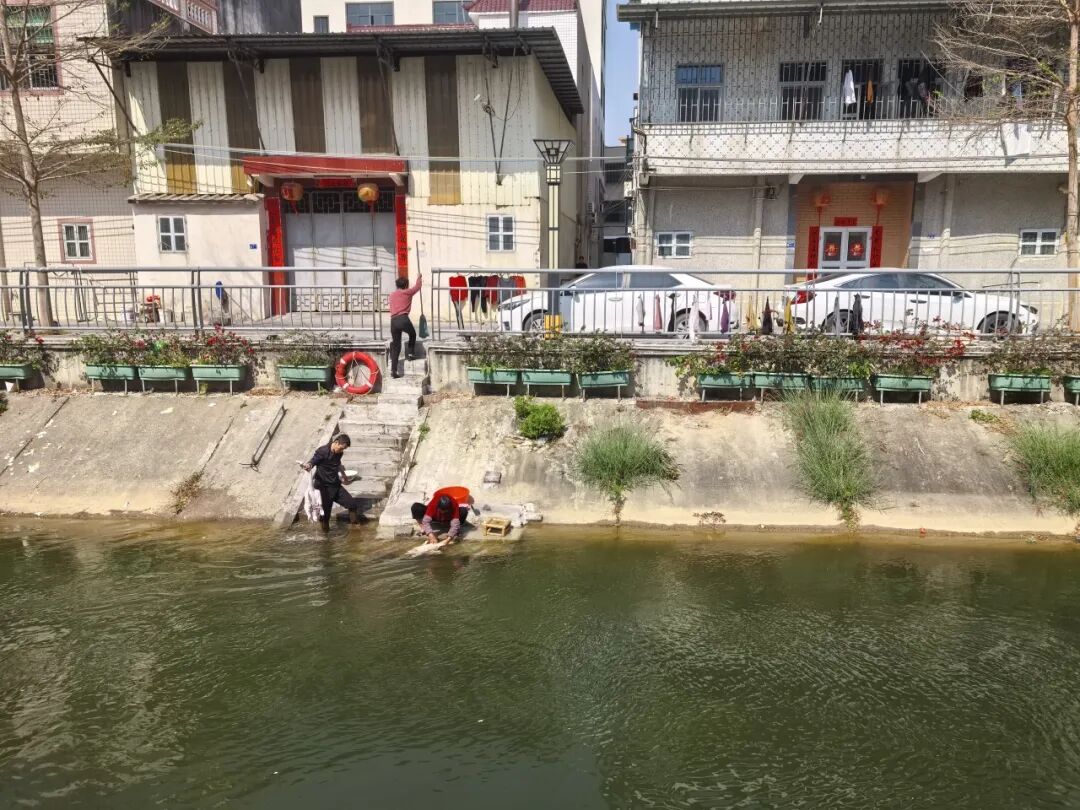
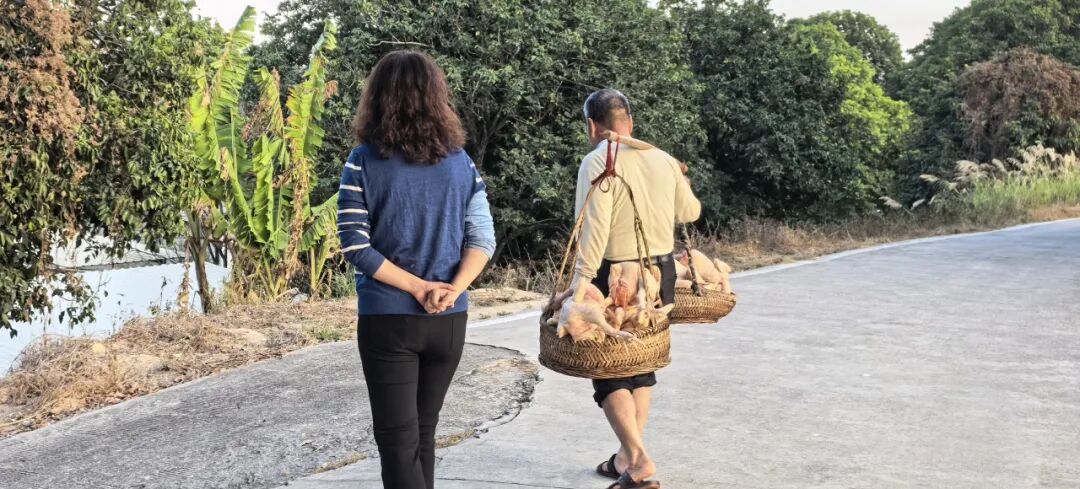
◉ During the Spring Festival in Chaoshan, one can see people along the canal banks all around washing geese and preparing the traditional three- or five-offering sets for worship and holiday feasts.
Yet that year fell squarely in the most violent bout of hyperinflation in modern Chinese history. In early 1946, 100,000 yuan could still buy two cows; by the end of 1946, its purchasing power had already plummeted. By early 1947, the same sum could barely buy a single chicken. This Qiaopi was written in July 1946, when 100,000 yuan represented roughly the purchasing power of one braised goose. On reflecting on this, I cannot help but feel for Xu Dongyan – with national-currency inflation running rampant, if the 100,000 yuan had been delayed in transit even a little longer, who could say what it would be worth by the time it reached home, or whether it could still afford a braised goose at all.
Suppose those 100,000 yuan had not been held up en route. Even then, its purchasing power that year would have bought only a few dozen jin of cooking oil or slab sugar, or perhaps a hundred to two hundred jin of rice, or a length of ordinary cloth for a simple shirt. Clearly, a braised goose was far beyond what an ordinary household could casually afford for ancestral rites. For the Chaoshan people who crossed to Southeast Asia, the surest sign of financial success – of having truly lifted one’s family to a better standard of living – was placing a braised goose on the offering table.
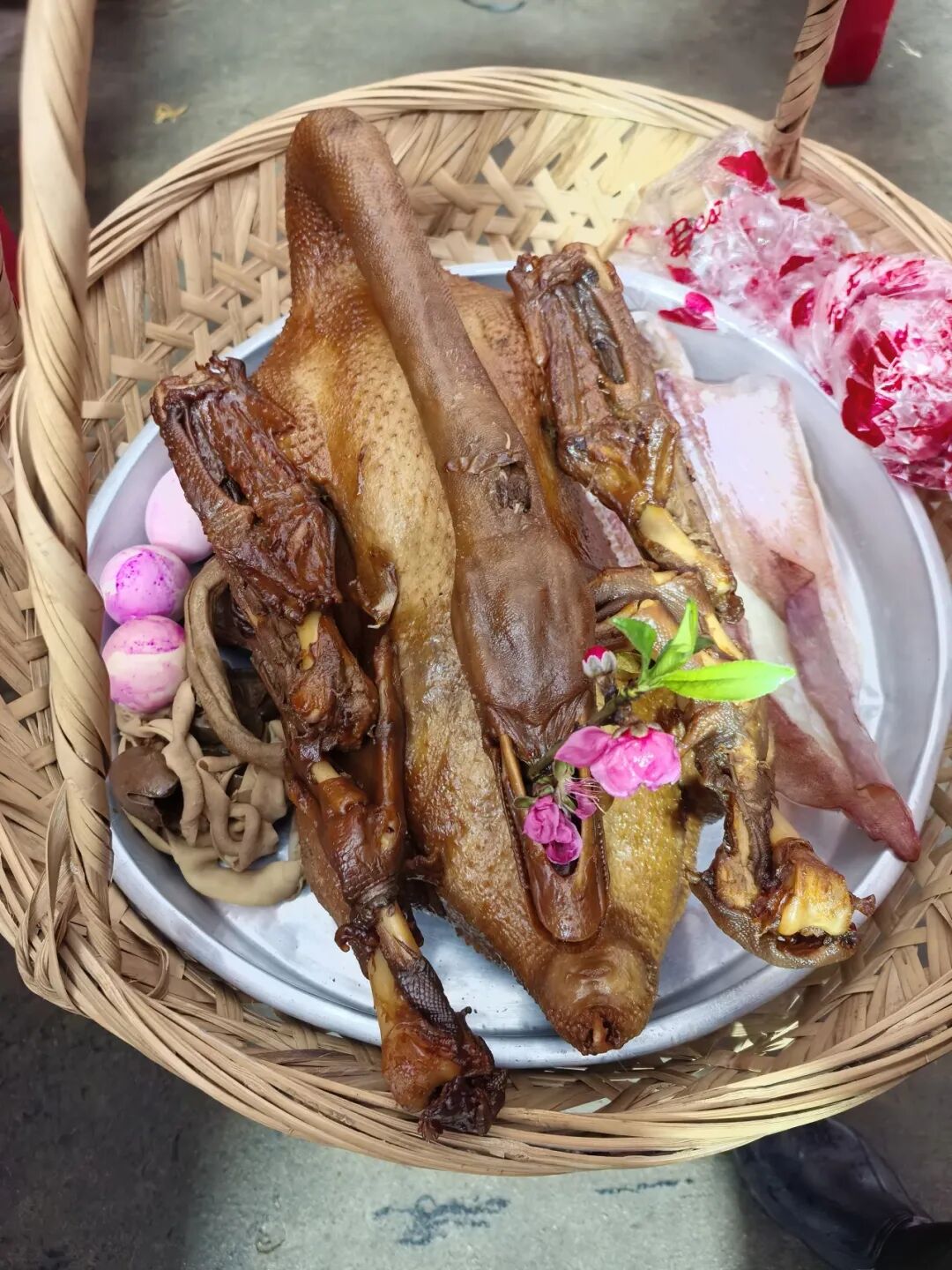
◉ Discerning Chaoshan families will even arrange sprigs of peach blossom among the braised goose presented as an offering.
Culinary Homesickness After Crossing to Southeast Asia
Then, as emigrants who had crossed to Southeast Asia, could Shen Dongyan and his compatriots actually eat braised goose from home? On this point, Director Xu of the Qinghui Building at the Caitang Qiaopi Museum is unequivocal. He says the Chinese community in Southeast Asia was so vast that someone was bound to be making braised goose – though not with the authentic Lion-head goose breed, and the flavour would inevitably have been shaped by local ingredients. Director Xu also recalls that in the 1980s and 1990s, when overseas Chinese members of his own clan came back to Chaoshan for family visits, they would go out of their way to bring braised goose back with them to Southeast Asia – another sign that the taste of the homeland and the taste of braised goose made in Southeast Asia were still distinguishable.
In the era when Shen Dongyan was writing his Qiaopi, did anyone carry braised goose from home across to Southeast Asia? The writer Qin Mu, a native of Chenghai in Guangdong, penned an essay simply called The Goose. In it, he recalls: “In the old days, when a villager setting off on a journey needed to take a large goose along, he would often tie its feet with a rope, sling it from the handle of a large oilcloth umbrella, rest the umbrella on his shoulder, and set off at an unhurried pace. The goose, for its part, was remarkably serene – it made no struggle all the way, merely craning its neck now and then to peer about, as though long accustomed to travelling in this manner.” The image is delightfully whimsical. One cannot help but wonder: among those who crossed to Southeast Asia during the Republic era, was there perhaps a braised goose that, in just such a fashion, made its way from the Chaoshan hinterland onto a red-prowed ship and was carried across to Southeast Asia?
In a recent episode of the podcast “Dissenting Views Room”, titled “Grandmothers and Qiaopi in the Hidden Rivers of History”, the Chaoshan-born writer Li Jielin mentioned coming across just such a Qiaopi: in 1936, a couple in Raoping sent three baskets of lychees to their son in Siam (present-day Thailand). I put this detail to Director Xu at the Qinghui Building, who reckoned that the lychees might have arrived within a week – stale, perhaps, but not yet spoiled. A braised goose, however, would certainly have gone off after just two or three days on the road.
No Braised Goose, No Grandeur
Back to the braised goose at Shen Dongyan’s household. Of all the foods of Chaoshan, braised goose is perhaps the most symbolically potent. Its presence on the table marks a meal as grand, sumptuous, and steeped in ritual; people use it, too, to express their deepest reverence for ancestors and gods. There is a customary saying in the Chaoshan region: “No braised goose, no grandeur.” “Grandeur” here means sumptuousness and solemnity.
Everyone knows that in the Chaoshan region, families hold their religious observances – “baibai”, as they say – whenever a festival rolls around. The offerings include three- and five-animal sets; the three-animal set is further divided into a small and a large version. But whatever the number of animals, there must – must – inevitably be a braised goose. This is most magnificently on display at the deity’s altar (also called the shrine platform) during village processions. Every household carries its offerings to the shrine; each family’s “mystery box” of offerings may differ, but every single one will surely contain a braised goose. If you walk past the deity’s altars in the Chaoshan countryside during the first lunar month, you will see offering tables laden with countless braised geese, forming a silent phalanx of geese.
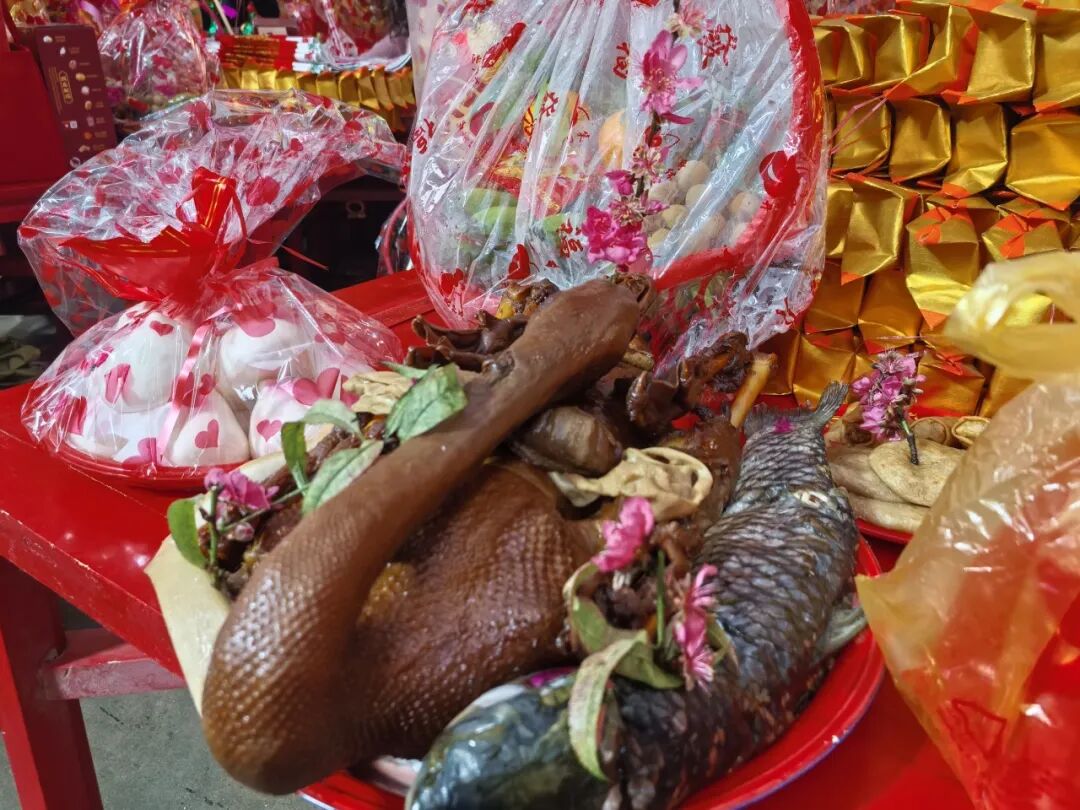
◉ The braised goose holds the centre position among the three-animal offerings.
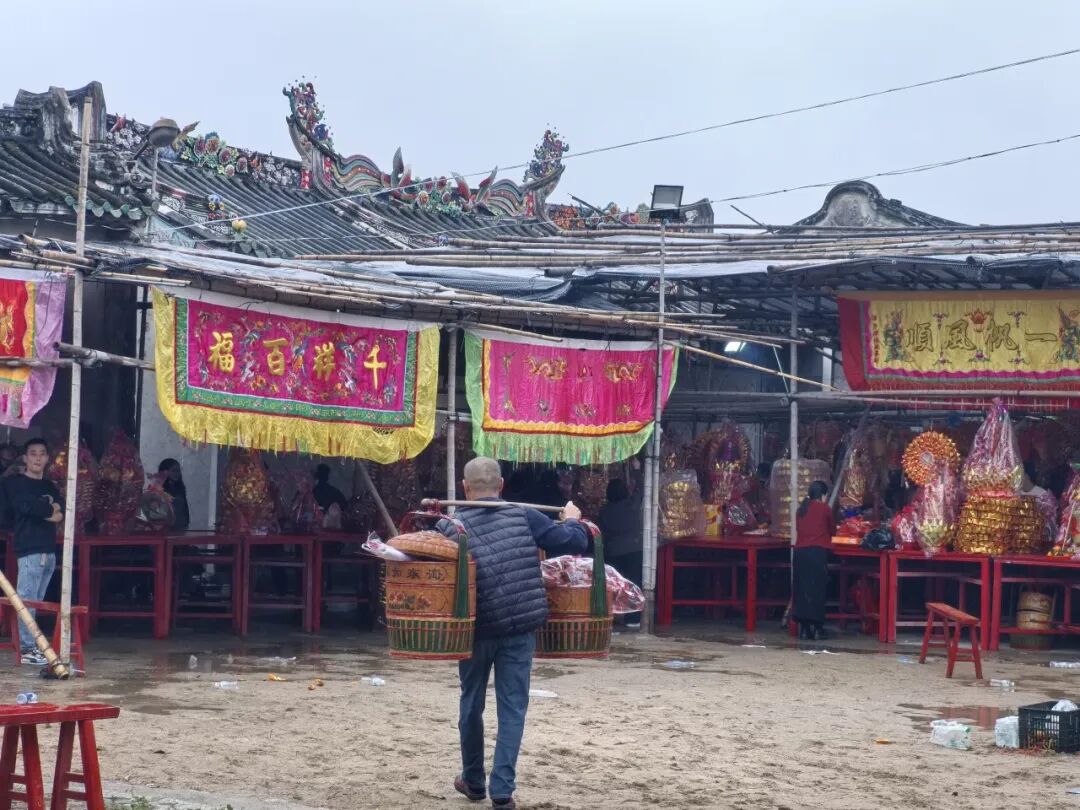
◉ Ordinary folk in Chaoshan carrying their braised geese to worship the gods.
Take Xikou Village in Linxi Town, the “Home of Braised Goose”: during the New Year period, four braised geese are required for worship – one for Sending the Gods to Heaven on the twenty-fourth of the twelfth lunar month, one on New Year’s Eve, one for the Sugarcane Lane procession on the sixteenth, and another for the Patron Deity’s Birthday on the twenty-third. Widen the view to the whole year, and there is another for Mazu’s Birthday (the twenty-third of the third lunar month), and yet another for worship at the ancestral hall at Mid-Autumn in the eighth month. Sometimes even the Winter Solstice calls for one. And then there are the everyday occasions: ancestral rites, the Leaving the Garden coming-of-age ceremony, weddings and funerals. Ten fingers aren’t enough to count them all.
Nearly a century has passed, and braised goose has become everyday fare for modern Chaoshan people, too. Shops selling it line every high street and alley. If unexpected guests drop by, you dash to the end of the lane and “chop up” two plates of braised goose to enrich the dining table – a perfectly ordinary thing to do. But a few decades ago, for Chaoshan households it was simply unthinkable to eat such a grand and solemn dish as braised goose outside of ancestral rites and deity worship. Indeed, families of modest means would substitute duck for goose.
If, that year, Shen Dongyan’s mother had managed to honour his wish and use the remittance to place a braised goose on the offering table, the family would still have had to wait until the gods and ancestors had “eaten” their share before they could partake. Mercifully, braised goose is rich and succulent even when cold – no need to return it to the heat – so it can be shared in full communion between the human and the divine.
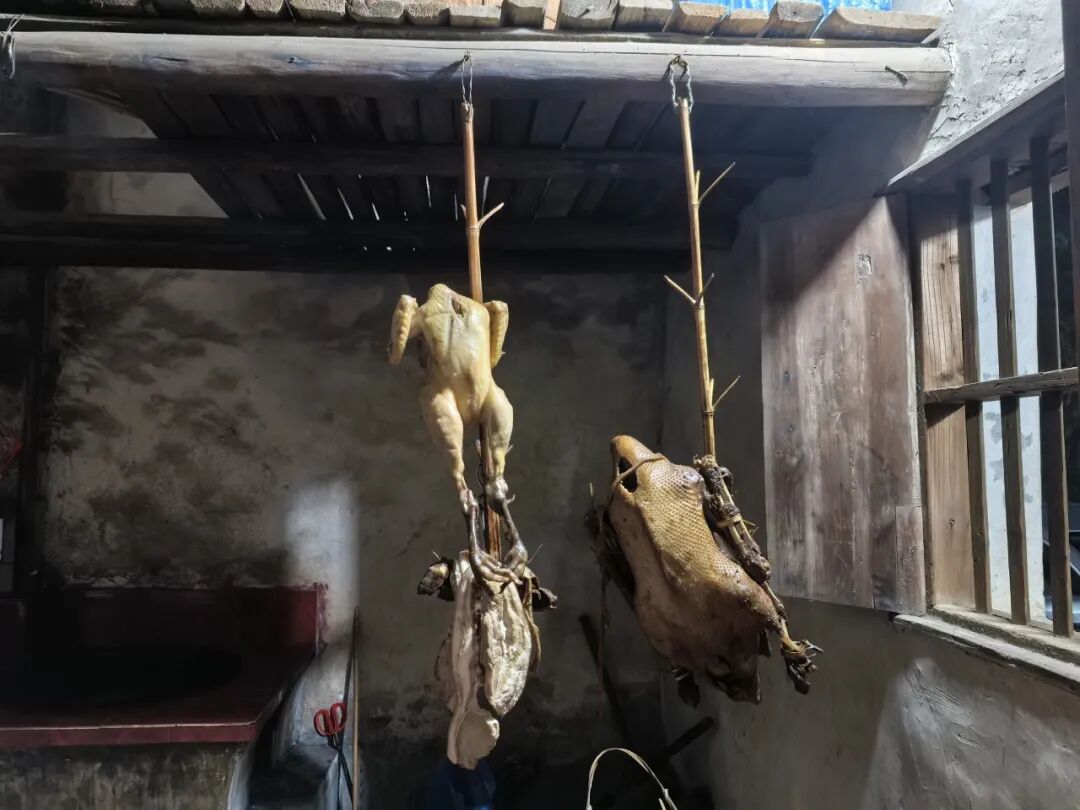
◉ After worship, the braised goose hangs suspended in mid-air, to keep the family fed for many days to come.
Today’s Braised Goose
These days in Chaozhou city, braised goose shops line every street and alley – sometimes two or three on a single short lane alone. Prices and flavours shift from shop to shop, and fluctuate at different points in the year. Prices also vary by cut. Based on rough market rates, the current price of an ordinary braised goose in Guangdong is: the goose neck with head attached, 45 yuan a jin; the kidney, the most expensive cut, 80 yuan a jin; the middle section, where the meat is thickest, sometimes reaching 50 yuan a jin; the hind legs, 42 yuan a jin; goose feet and goose wings, 60 yuan a jin; Goose intestine, 20 yuan a piece. But the stretch from shoulder to wing root – all bone, very little meat – is cheap enough that the shops themselves call it “half-selling, half-giving”.
The “ordinary” braised goose described above is typically made from a Lion-head goose aged around 140 days, at which stage the price is still within reach. But once a Lion-head goose matures to three, five years or more, its head becomes an extraordinarily expensive delicacy, with a single one commanding up to a thousand yuan.
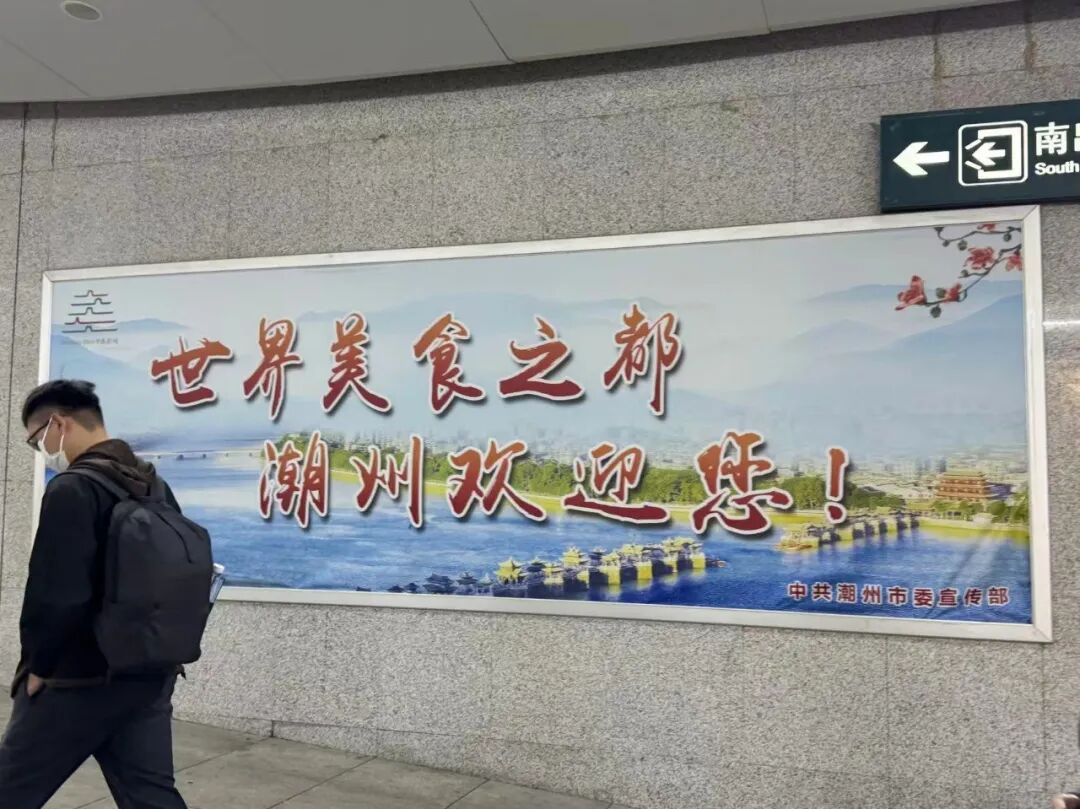
◉ Step out of the Chaozhou high-speed rail station and you are greeted by a Publicity Department banner – warm, proud, and just a touch provocative. Photo by Wang Youzao
As for flavour, the Chaoshan region – a designated “City of Gastronomy” (in the words of the Chaozhou high-speed rail station; see image above) – naturally pursues perfection in a dish as important as braised goose. Each township and every village has its own taste. Around Chenghai, for instance, Lion-head goose farming is highly developed and the local braised goose is renowned; there is even a master stock hotpot – and the braised goose from that area tends towards the savoury side. In Xikou, Linxi – the “Home of Braised Goose” – the flavour skews sweet, perhaps connected to the area’s historical prosperity in sugarcane cultivation and sugar-making.
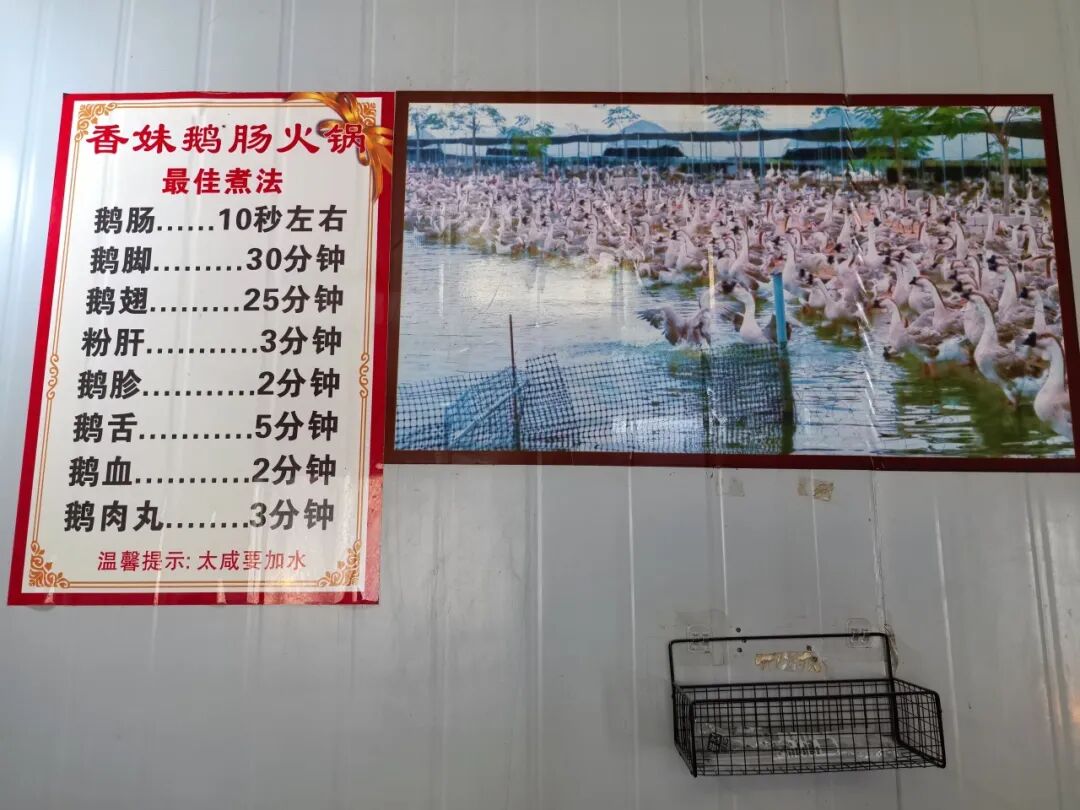
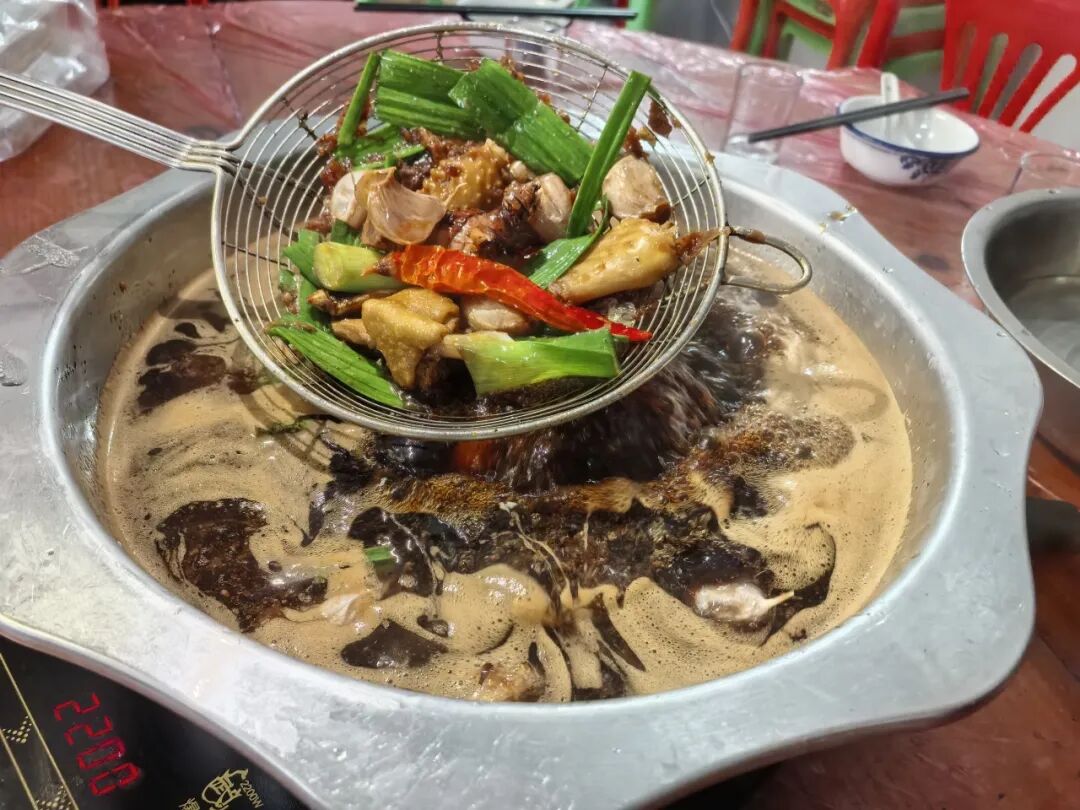
◉ Chenghai’s master stock hotpot.
In Xikou, I came to know Brother Liu, who excels at making braised goose. Here is his method: first, sugar is fried in the wok until it melts and caramelises; the whole goose is then glazed in this caramel colour before being lowered into the master stock for braising. The result is a stunning presentation – the goose gleams with a lustrous caramel hue. Most shops, however, simply season the master stock, drop the goose straight in, and use Dark soy sauce for colour. The finished product is comparatively subdued – not the gleam of caramel but a yellowish brown.
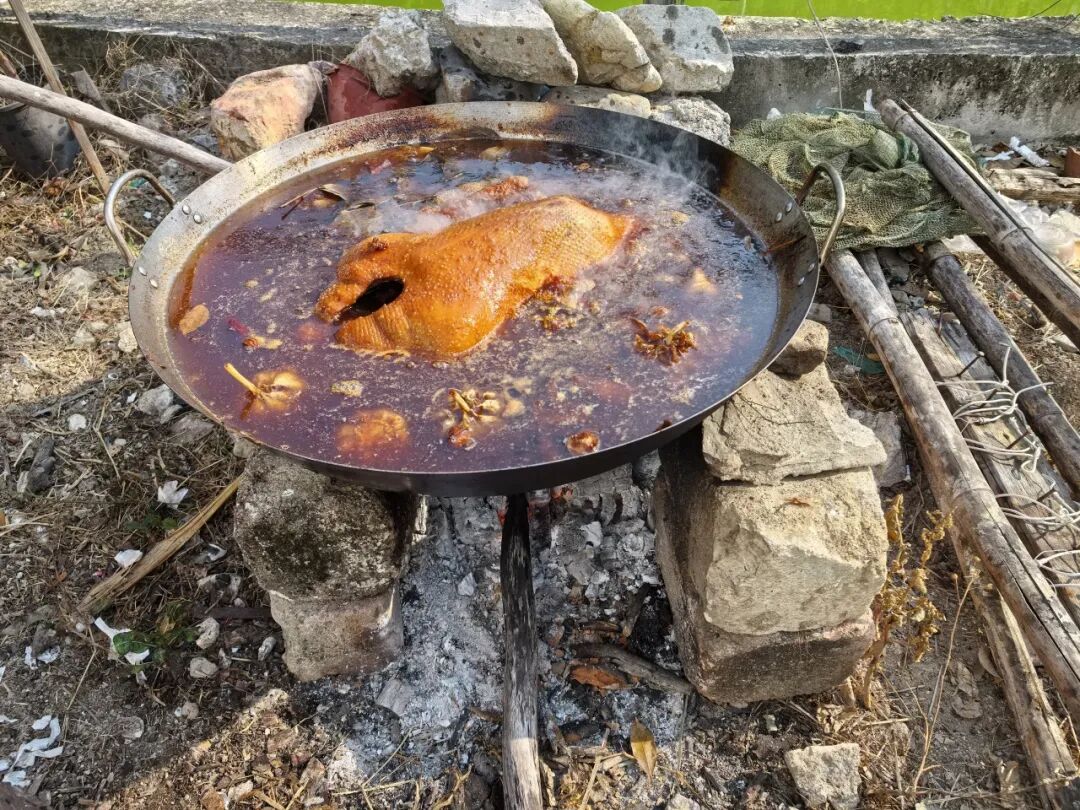
◉ Many rural Chaoshan households still keep the tradition of building their own stoves for braising goose.
As I mentioned, for Spring Festival ancestral rites every Chaoshan household must have a braised goose. Once the rites are over, the whole goose is either hung beneath the eaves or somehow crammed into the fridge. And for the days that follow, every single meal will feature a course of braised goose. How long it lasts depends entirely on how many mouths there are to feed.
Delicious as it may be, eating it every single day throughout the Spring Festival is bound to bring on a bout of fatigue. Many people, deep in the thick of the New Year, come to regard that once-supreme, once-sacred delicacy as something of a burden. So they begin devising all sorts of strategies to “work through the stock” of braised goose.
Because a Lion-head goose is far too large to fit whole into a fridge, the meticulous Chaoshan people disassemble it by part: bones and meat are separated – bones into one bag, meat into several – and the goose neck, goose wings, and offal are bagged individually. Then each meal, one bag is fetched out: first the neck and wings, then the bones paired with plain congee for breakfast, and finally the stripped goose meat. The goose meat can also be stir-fried with dried radish or ginger to turn it into a brand-new dish – at least mitigating a little of that “leftover” feeling.
All the same, the Chaoshan people’s reverence for food and their culinary ingenuity have remained unchanged from 1946 to the present day.
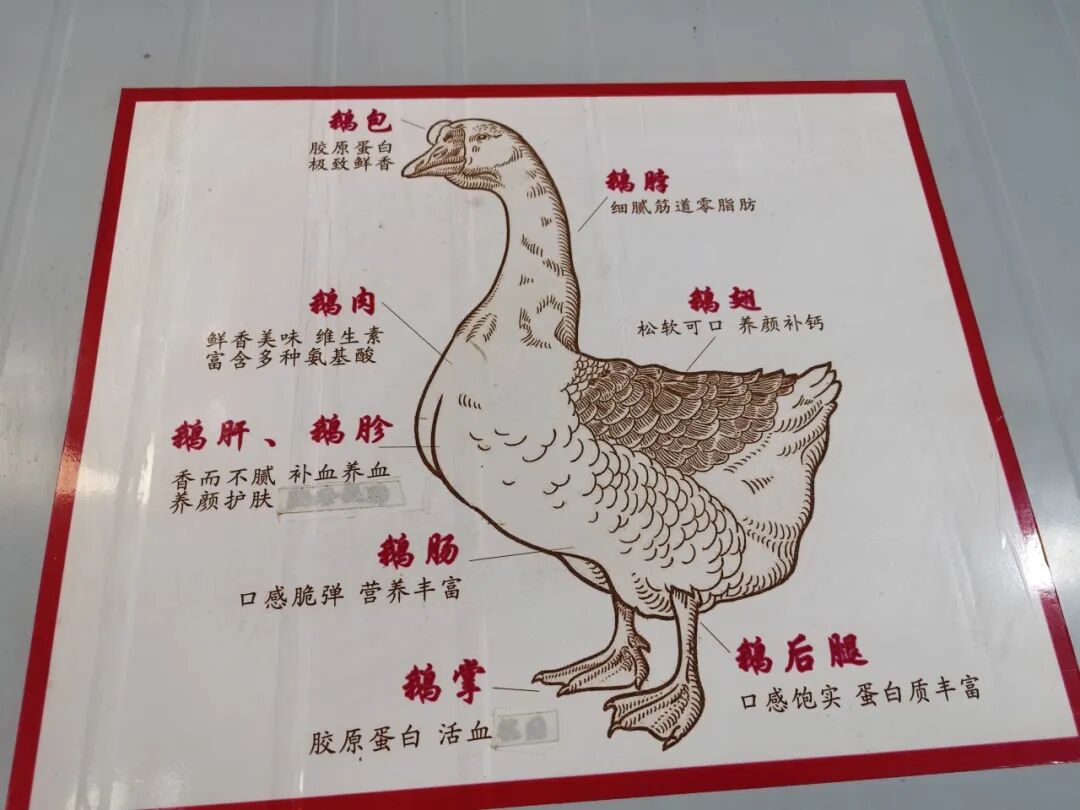
◉ Different cuts of braised goose, different prices.
– This is Foodthink’s 809th original article –
Foodthink
Author:
Chen Sicheng
A writer based in Guangzhou, focused on the environment, ecology, and food systems. Her non-fiction work The South on the Treetops, exploring the landscapes and customs of the three Lingnan regions, will be published this month by Huacheng Publishing House.
About the Lianhe Creative Programme
To better understand the current state of food and agriculture, and to support more people in exploring the complexities behind food and farming issues, Foodthink joined forces with a number of charitable and media partners in 2024 and 2025 to launch the Lianhe Creative Programme, which supports media creators and researchers in conducting fieldwork on food and farming topics and funds the completion of public-facing content.
Following multiple rounds of panel interviews, the Lianhe Creative Programme supported 18 creative projects in 2024 and 20 creative projects in 2025. Several of the supported works have now been completed and published:
“Cleaner A Mei Just Wants to Eat Properly | The Worker’s Table”
“In Malaysia, Chinese Merchants Want Only Grade-A Durian”
“‘Fake Meat’ Drives Out Real Meat: Pastoralists, Dining Tables and the Amazon”
“Guaranteed Sweet Watermelons, Guaranteed Bitter Farming”
“From the Guoshan Yao to the ‘Chosen Mushroom Pickers’: the Termite-Mushroom Frenzy”
“Ma Lan in Shenzhen, with No One to Share a Meal”
“Where Did the Sweetness of Childhood Go?”
“Technology, Pesticides and Drone Pilots: the Other Face of the ‘Tech Revolution'”
“Why Guizhou Can’t Live Without Sour Soup – and Sour Soup Can’t Live Without Guizhou”
“Who Drove Out the Wet Market?”
“Will Online Fresh Food Retailers Kill the Wet Market?”
“When Drones Become the New Farm Tool: Who Defines ‘Scientific Farming’?”
Unless otherwise noted, all photos were taken by the author.
Edited by: Tian Le