In August this year, the film Another Hopeful Day was released in cinemas – not only the most in-depth and far-reaching film yet made on the subject of food delivery and algorithms, but also a rare masterpiece of realism in recent years.
On 4 September, Foodthink invited the film’s director, Liu Taifeng, and producer Zhu Tong to co-record an episode of the “Food Talk” podcast. This article is compiled from the interview with director Liu Taifeng.
In this piece, the director speaks to the social concerns behind the film’s creation. The profound changes that algorithms have brought to society are not only issues that delivery riders must face; indeed, one could say that “we are all trapped by algorithms.” Director Liu Taifeng hopes that the film will ultimately portray the predicaments faced by people across different social strata and serve as a valuable record of this era.
Foodthink’s editors have previously recommended this film to our readers. The film is still being screened in major cities – we welcome you to come watch it and share your thoughts with us.
– Scan the code to listen –
Liu Taifeng
Director and screenwriter of Another Hopeful Day
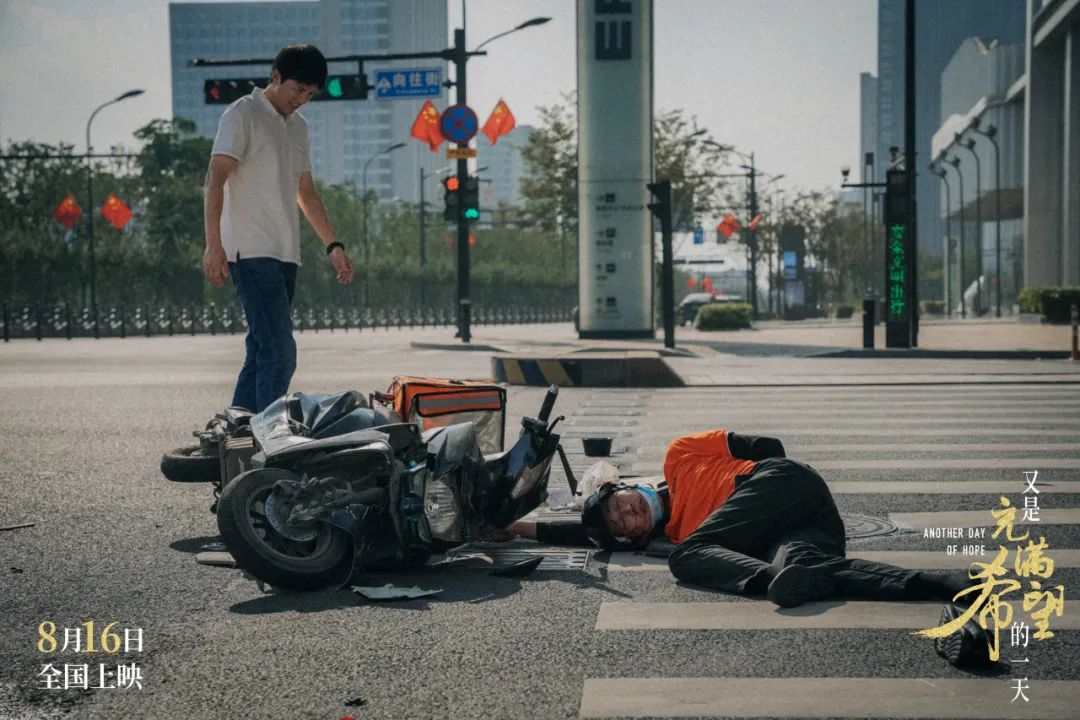
● Still from Another Hopeful Day. The film opens with a traffic accident: an algorithm engineer at a food delivery platform hits a rider who works for his own platform, unravelling the crises of two families from different social strata.
In 2021, while I was sitting at a red light at an intersection in Beijing, I nearly hit a delivery rider.
It was summer. The countdown numbers on the traffic light kept ticking down, and a sense of irritation crept in. Everyone around me was either running the red or poised to lurch forward the instant it changed. The light turned green, and I instinctively pressed the accelerator – just as a delivery rider running a red light and going the wrong way shot past the front of my car, close enough to graze the number plate. I could feel the force of his body transmit through to mine. Had I been a fraction of a second faster, I would have sent him flying.
A chill ran down my spine, and I immediately thought: if I actually had knocked him down, what legal liability would I bear? As the driver of a motor vehicle, I had failed to check the road properly, but he had run a red light to make it in time to deliver an order. The question of liability is an extremely delicate one.
It just so happened that I had always wanted to make a film about people’s livelihoods – one that reflects social reality – but I needed the right angle to approach it. All these elements suddenly came together in my mind. At the time, I said to my screenwriter, Cai Zhiling, who was sitting beside me: why don’t we write a script – a programmer who designs algorithms for an internet platform hits a delivery rider who works for that same platform – and see what kind of story unfolds. That was how the script came to life.
From that moment on, we started fleshing out the characters and their relationships. I met with many delivery riders – of different ages, different genders – some who had worked as station managers, some who did dedicated delivery, and some who did crowdsourced delivery. This kind of groundwork is an essential part of filmmaking. My screenwriter also spoke with friends of hers who work at major tech companies. I chatted with the cleaners in my residential compound, even the old men walking their dogs, gathering material from everyday life through open, unstructured conversations before slowly refining the script.
From the moment we decided to make the project to the start of principal photography was less than three months. We began filming in Hangzhou in the summer of 2022 and shot for a total of 40 days.
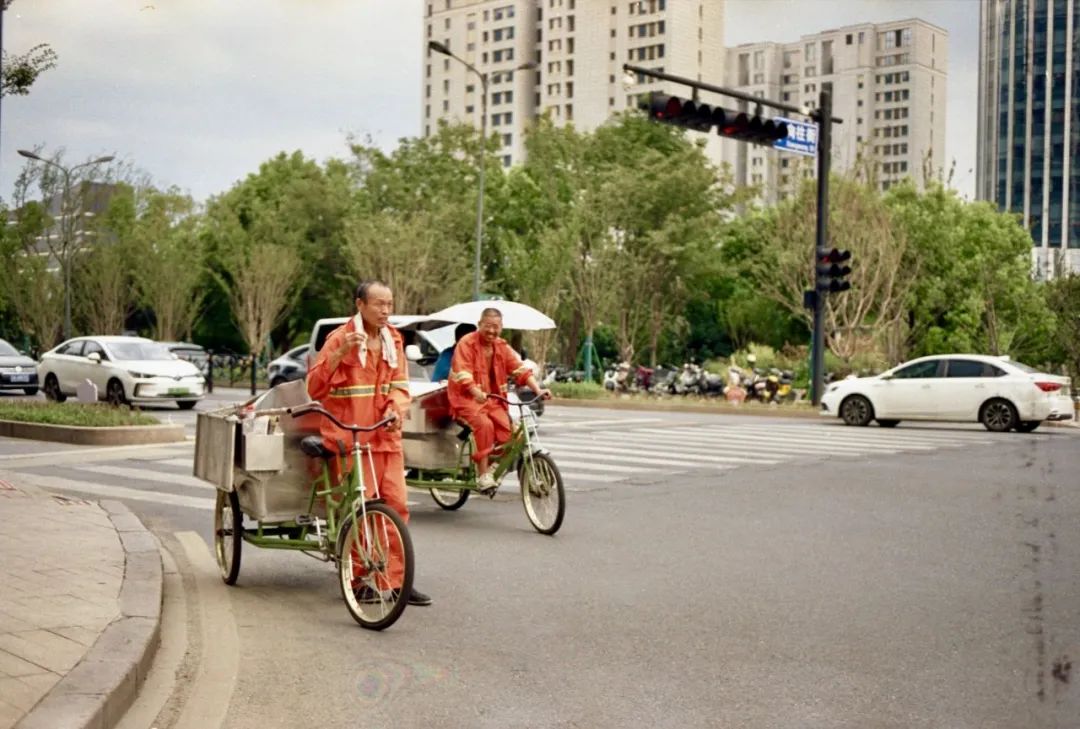
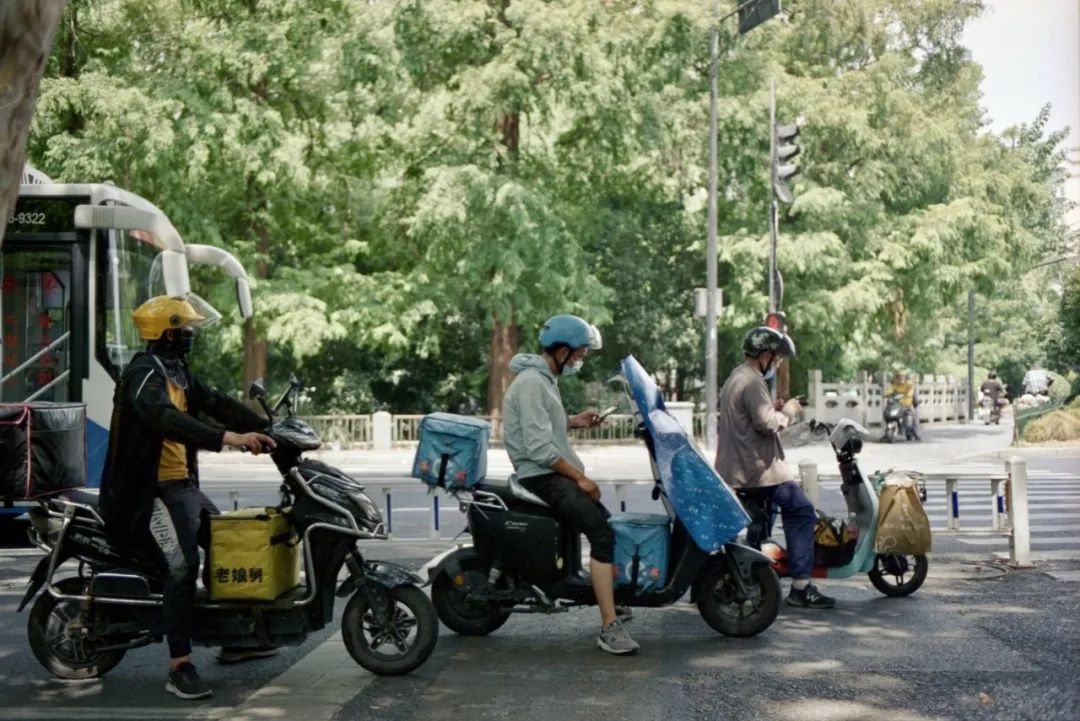
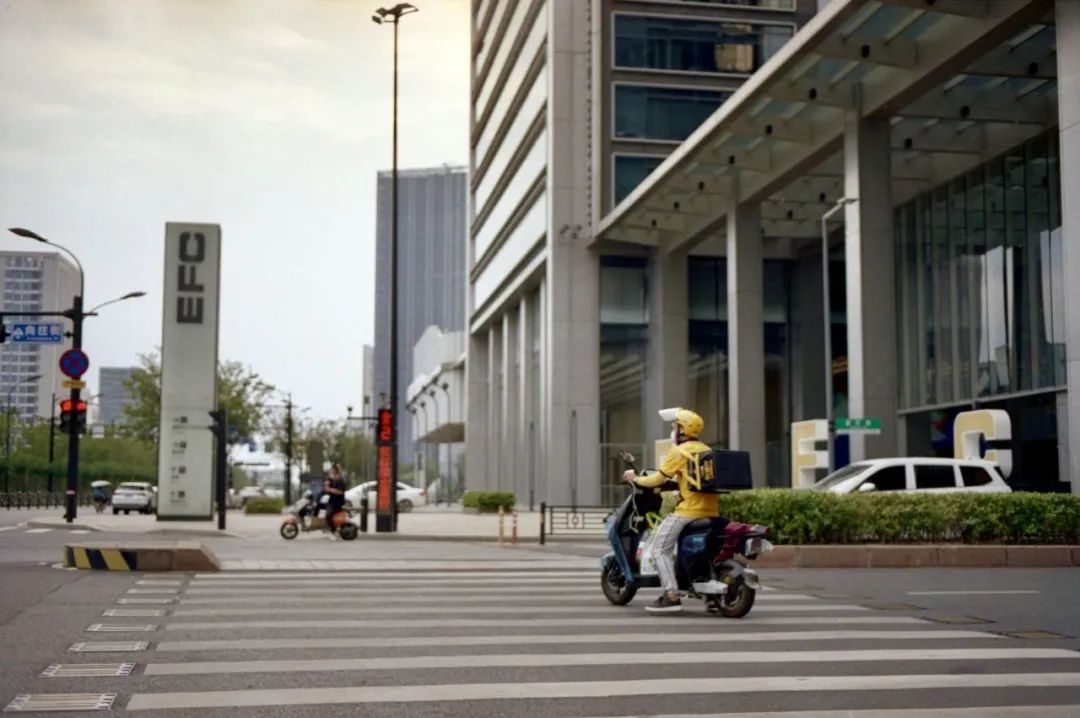
● The film was shot in Hangzhou in the summer of 2022. Extensive location shooting allows audiences to see on screen the texture of daily life during the pandemic.
I. Is Being a Delivery Rider Really “Zero Cost”?
In reality, many of the traps of being a delivery rider are invisible to outsiders. When recruiting riders online, the terms offered always include food and accommodation – “zero cost” onboarding is their slogan. They want as many people to sign up as possible. But onboarding is not actually free. There is a hard rule for dedicated delivery riders: you must give one month’s written notice before leaving, and your salary for that month is split half-and-half with the station. So the moment you join a dedicated delivery team, you are locked in for at least a month and are expected to deliver a full month’s worth of value to the station. This means the station is guaranteed its return no matter what. Some people work for a while and decide they cannot keep it up – in that case, the month’s pay goes straight to the station.
The riders’ equipment is not provided by the station either. You have to buy your own uniform, and you rent the electric scooter and the battery. Behind all of this is an enormous supply chain. Before you start, the station will tell you they provide accommodation. What actually happens is they take you to a place to rent, have you sign a tenancy agreement. You do not have to pay these costs out of pocket, but they are deducted directly from your wages.
So it is not zero cost at all. It means you take on debt first, you cannot walk away, and the only way out is to buy your freedom back.
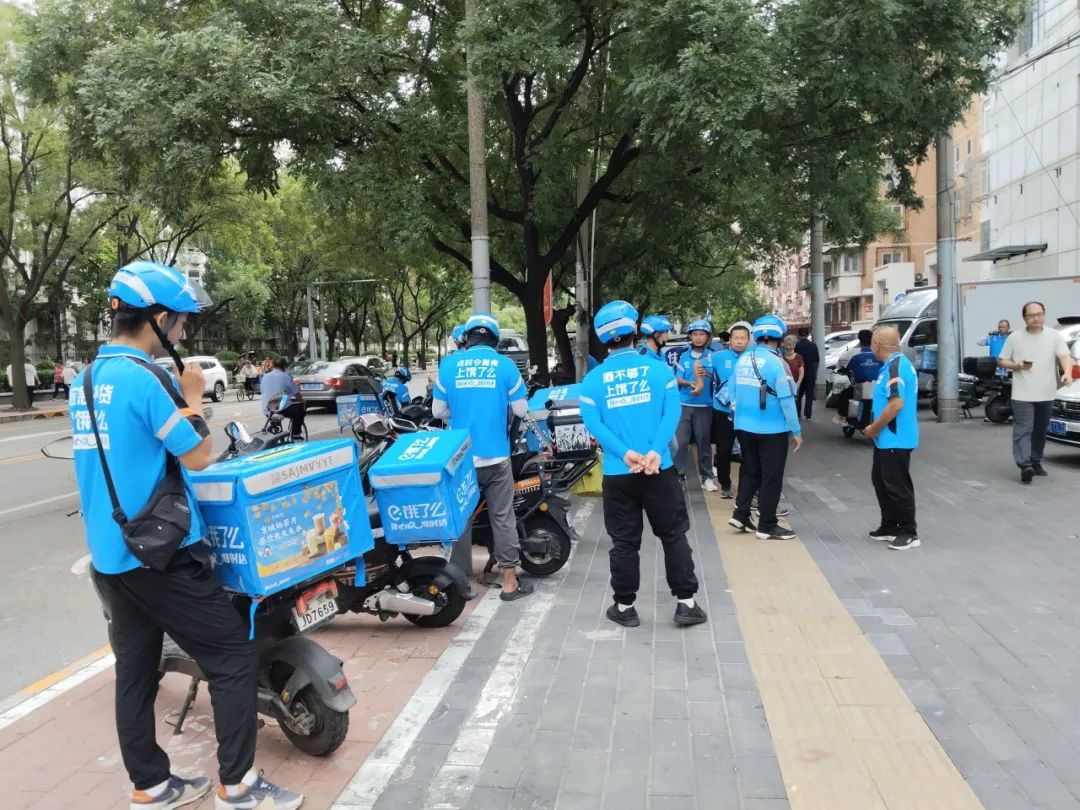
● A delivery station holds its morning briefing on the roadside. Platform-level staff management, order coordination, and other operations all depend on these grassroots stations. Photograph: TianleDuring the interview, many station managers expressed how helpless they felt, because they are under pressure from the platform’s performance appraisals. The reason the platform hands a station over to a manager is that the manager can supply the platform with a steady stream of quality new riders. Beyond that, the platform does not manage anything. They have no employment relationship with the delivery riders – the contracts are merely cooperation agreements, signed electronically on a phone. This makes it very easy to exploit loopholes, because it is impossible to read every single word carefully. Yet this is the very contract that determines a rider’s future social security protections and compensation in the event of an accident. But most job seekers have only one goal: to start earning money, and every other concern can wait. For this job, most of the delivery riders I interviewed either see it as a transitional phase in life or as a way to quickly build up a lump sum of disposable capital in a short period.
In the film, I wrote the following line for Weilì:
“This is a part-time gig. Do you know how many registered riders there are? If we had to enrol every single one of them in the five social insurance contributions and housing fund, could this company even keep its doors open? They have signed up voluntarily – they earn money per delivery, and if they do not run a delivery, they can rest. They do not have to face daily reports, weekly reports, year-end performance appraisals, or any of that kind of pressure.”All of these are the price of being a “part-timer”: you have no relationship with the platform whatsoever, and the cooperation agreement is signed only with a third-party labour company. Everyone knows what a cooperation agreement means – no social security protections, including the five contributions and housing fund. Some of the clauses, in the riders’ words, are outright unconscionable terms, because all the leverage sits with Party A. Here is a detail: as you all know, riders pay three yuan a day in insurance, but it only covers damage caused to others by the rider’s fault. If the fault lies with the other party, then their insurance covers it. But there is a third scenario: if the rider injures themselves through their own negligence, there is no remedy at all – the rider receives no compensation. This is exactly the situation depicted in the film.
II. We Are All Trapped by Algorithms
In truth, the delivery rider and the platform’s algorithm engineer are merely the entry points for this film. Rather than saying the film is about delivery riders trapped by algorithms, it would be more accurate to say that we are all trapped by algorithms. Besides the accident involving the rider, there is a parallel storyline in the film: the programmer is made redundant. Both families live in a contemporary Chinese city, yet across different social strata, even when we pass each other on the street, we do not even glance at one another. Why? Because the demands of our hectic work have caused relationships between people to become distant, cold – and eventually to harden into an unbridgeable hostility.
It is easy to imagine: had the accident never happened, this programmer would never have had any contact with a delivery rider in his entire life. Because the system tells him he is not allowed to engage with them, not allowed to bring any sympathy for them into his work.
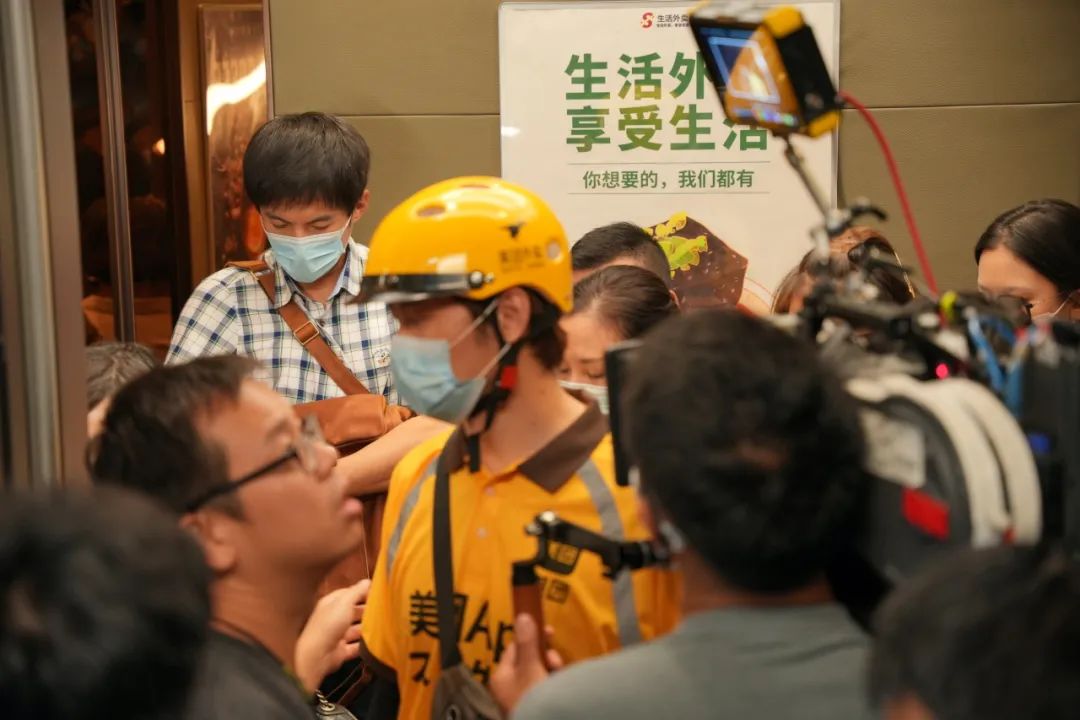
● In this scene, the programmer and the rider pass each other in a lift – a scenario we all experience every day. Interestingly, in the finished film, none of the riders in their yellow uniforms bear the Meituan name or logo.The algorithm engineer’s goal is to optimise the system – this is a function deeply tied to his professional identity. His purpose is not to study the plight of delivery riders and design a mechanism to protect them. A competent algorithm engineer must follow the logic of the algorithm to maximise commercial interests while simultaneously avoiding labour disputes. In the film, the programmer Weilì works at a frantic pace with no time to consider what others might be thinking. The only things weighing on him are those few things: KPIs, performance appraisals – they determine whether he gets promoted and a raise or is made redundant. He does not consider whether the algorithm causes harm to others, whether slightly or significantly. He must have absolute faith in the work he does, because the work environment demands that faith – otherwise he would be the one made redundant.
It is only the moment he hits the delivery rider that a seed of doubt begins to sprout – but at first it is not about the algorithm. It is simply a flash of humanity: he has hit this person, and he wonders whether he should bear some responsibility.
This awakening is a slow process. If I were to say an algorithm engineer like this could genuinely stand against the company, I do not think that would be realistic. A university classmate poses a question that goes to the soul: “At our age, what problems do we have besides money?” Given that premise, the fact that he can ultimately refuse the company’s high-paying rehire offer already speaks to that flash of humanity, because he recognises that some things cannot be measured in money or material terms. So when the company offers him the position back, he says:
“People are not oranges. You cannot eat an orange and just toss the peel on the ground and walk away.”In the end, although the wife of delivery rider Jin Peng chooses to withdraw treatment, the representing attorney decides to redirect the litigation from the programmer to the platform. This is, in essence, a tragedy, yet it triggers a subconscious awakening in people from two different social strata.
III. Where Does the Value of Work Lie
In the film, there is an elderly man who was a film projectionist in his youth. He tells Weilì about the time when he was young and went to the countryside to show films for the villagers – back then, tickets were practically unobtainable. He later experienced the market reforms and was laid off in the 1990s. This old man could really be any worker who lived through that era. He is telling Weilì: the redundancy you went through, I went through it too. And the work I did in my youth filled me with such pride, because I was serving the people – every task had value, had meaning.
And now? Today, all the value we create can be measured in profit. But in the film, the delivery rider who creates that profit is lying in the ICU, and no one is looking after him. There is a conversation in the film between Weilì and the rider’s attorney:
“We created this software and brought so much convenience to people. Do you not use food delivery at work? How much time did it save you? That is its value – we have even introduced an entirely new way of living. You cannot deny that.” “I do not deny that you created value. But have you considered that the people who actually created that value are now lying in the ICU?”
Weilì says: food delivery saves you time – that is its value. But where does all the time saved by food delivery actually go? You will find that time is never enough. Everyone longs for a moment of leisure outside work, to be with loved ones and friends, to travel happily, to do meaningful things – yet most of our time is consumed by what we call work, or by commuting. We can only use the fragments of time left over to do the things we actually want to do.
What are we rushing around for every single day now? Compared to the past, we have smartphones and cars, so why are we so exhausted on a spiritual level? What is the cost behind it all? This is also what I want the film to communicate to the audience.
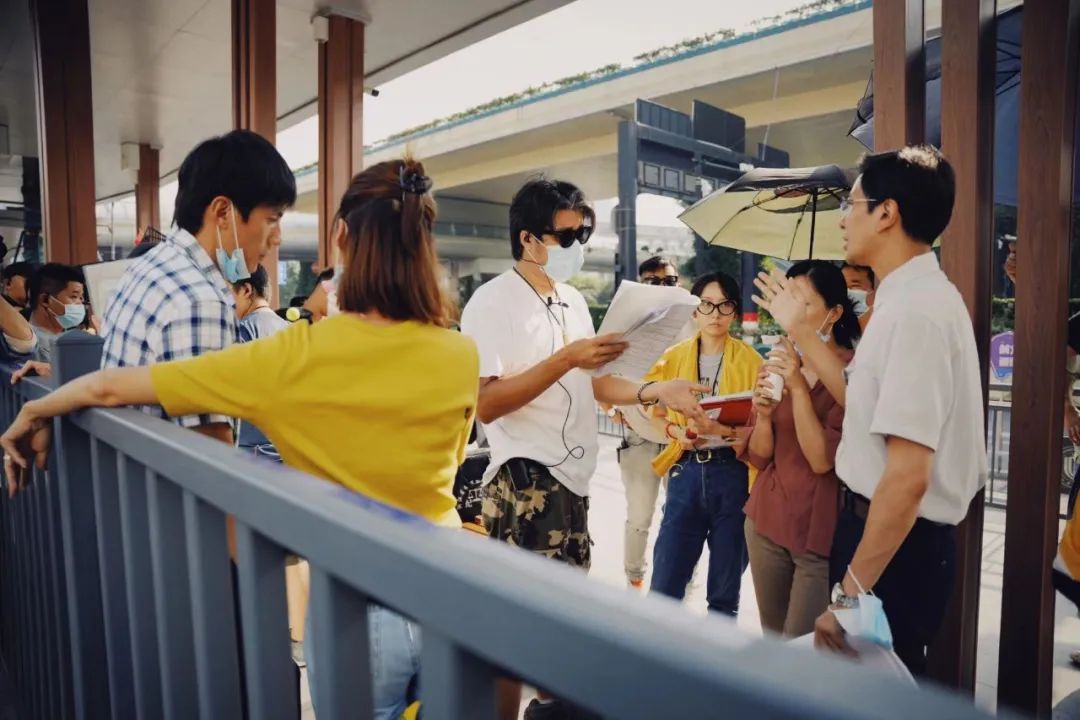
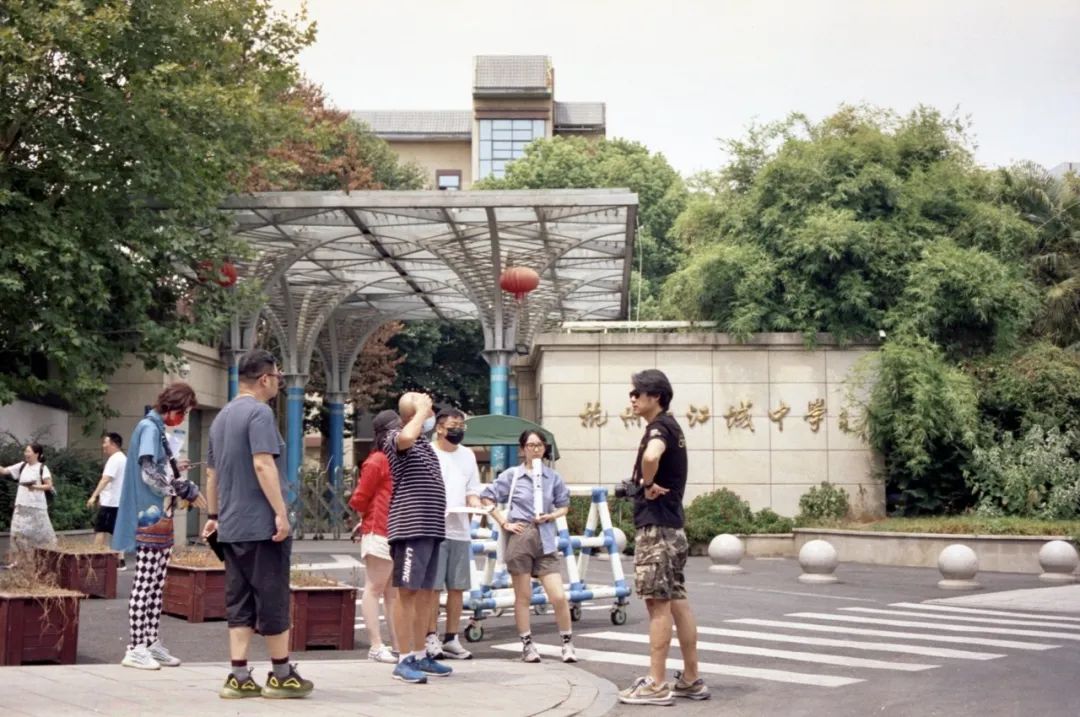
● Some behind-the-scenes stills. The film uses many shots to capture the reality of Hangzhou in 2022. Director Liu Taifeng also mentioned in the interview that sitting by the roadside, observing and recording different ordinary people, is one of his key ways of gathering material for his work.
IV. The Grind Is Only Getting Worse
It has been two years since the film was shot, and the situation in the food delivery industry has not only failed to improve – it has worsened. More and more people are entering the trade. Riders’ per-order pay keeps dropping; reportedly, the three-yuan daily insurance has been cut to two and a half yuan. A couple of days ago, we were on a roadshow in Shanghai and went to a restaurant for soup buns. The place had an extremely high rating on the platform. Once we arrived, the manager said: if you just check in and leave a positive review, each of you can take home a free side dish worth ten or so yuan. After the few of us checked in, a table full of small plates was brought out. The manager said, “Oh, there’s nothing we can do about it – that’s just how every restaurant on this street operates now. If we don’t boost our ratings with positive reviews, our score will drop and the platform won’t push us to customers.” But when we tasted the main dishes, they were not any good, despite the restaurant’s glowing reputation on the platform.
This is a vicious cycle, and so the dine-in experience will only continue to deteriorate. But I don’t blame the restaurants, because they, too, are trapped by the algorithm – without doing this, they cannot make money. Many restaurant owners have said: every single delivery order is a loss, but we do it to keep our customer base alive. If we stop, we simply vanish from the platform.
● The restaurant industry under the platform economy: Data from the Beijing Municipal Bureau of Statistics shows that in the first half of 2024, total profit in Beijing’s above-designated-size (i.e. annual revenue exceeding 10 million yuan) food service sector was just 180 million yuan, a year-on-year decline of 88.8%, with a profit margin of a mere 0.37%. Over the same period, Meituan’s local commerce division generated 60.7 billion yuan in revenue, with an operating profit of 15.234 billion yuan and an operating profit margin of 25.1%. Photograph: Tianle
The film industry is no different. The criteria for judging a film or TV series are equally data-driven. This control can be refined down to every plot beat, every scene, every character, and even the casting – the assumption being that if everything is designed according to big data, audiences will come. But how are the data and the traffic generated? Well, you can always find ways to “serve a complimentary dish.” This is a widespread phenomenon across all industries; it is simply most conspicuous in food delivery.
In the past, restaurants could hire their own delivery riders, adding a small delivery fee to each order to get the meal to your door. Cinemas served the surrounding neighbourhoods – people came on weekends and holidays, with clearly posted prices. Neither restaurants nor cinemas had it this hard back then; the ecosystem around them was healthy.
What the platforms have done is consolidate all of these resources. In fact, platforms do not merely profit from the services they operate – they care even more about polished financial statements and growth figures. With those in place, the capital behind them and the dynamics of the stock market can generate dividends. I think this is the underlying logic. Beyond it, whether it is physical labour or mental labour, the value people contribute is not nearly as important. But now, the people who improve the algorithm’s efficiency and the people who execute it are all strapped into the same great chariot, hurtling forward in pursuit of profit.
A few years ago, when an order took 40 minutes to arrive, we did not find it slow. Now we grumble if it takes more than 20 minutes. That is a shift in how people think – but it may not be something we brought about ourselves. Many consumers could be patient: I know I will be eating in 40 minutes, so I can simply calculate the timing and order in advance, right? But why does this impatience persist? In truth, some powerful force is gradually changing the way we think and the way we live. You might say these have become our consumption habits, but there is a problem lurking behind those habits.
I have met a great many Didi drivers and delivery riders. Their frustrations stem from unreasonable systems. These systems need significant humanising reform – not merely because riders or drivers work for the platform, but to restore the dignity they are owed as human beings.
As a film, Another Hopeful Day can hardly change anything, or mount a strong critique. Behind it all lies a systemic problem. I have simply distilled from everyday life the predicaments we each face, placed them on the screen, and written a big question mark.
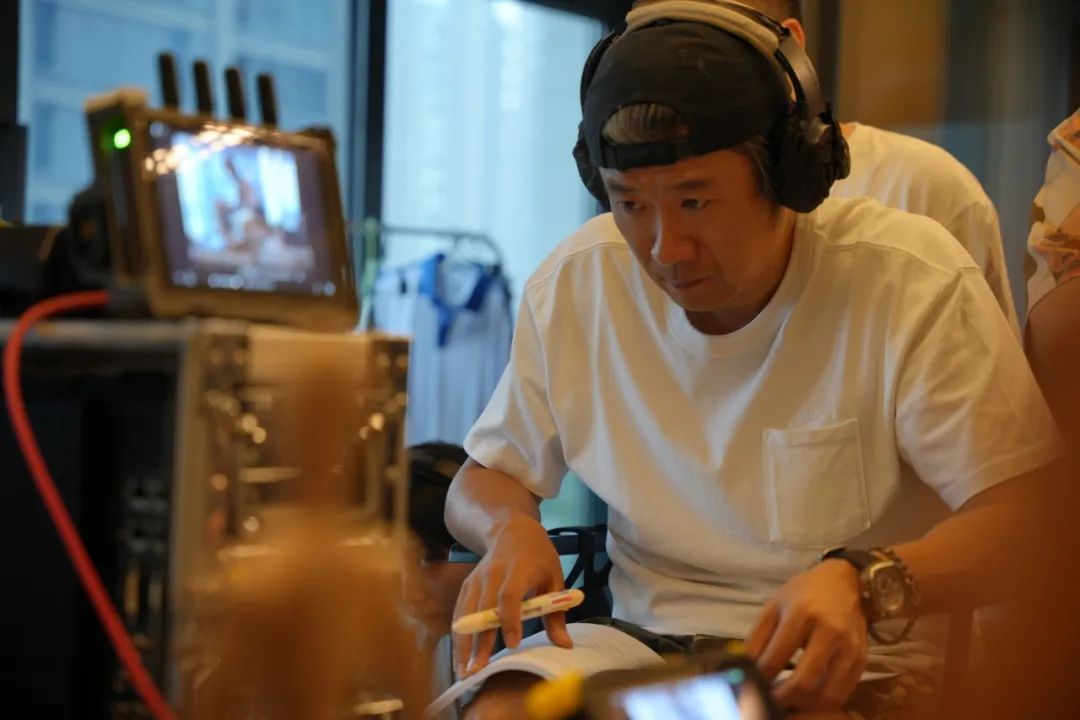
● A behind-the-scenes photograph of director Liu Taifeng on set.
Unless otherwise stated, all images are provided by the production team of Another Hopeful Day.

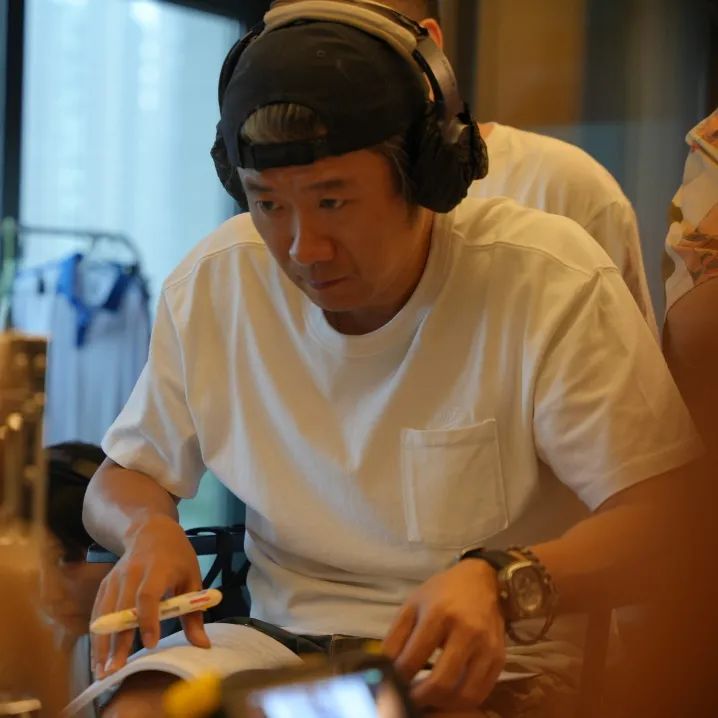 Liu Taifeng