10 yuan an hour: the livelihood fallback and “freedom” of Yunnan’s female strawberry workers

Foodthink says
Matu Town in Qiaojia County, Yunnan Province, is the country’s second-largest summer strawberry-growing base. A few years ago, the area had only just been removed from the deep poverty county list. Here, the author of this article met a female strawberry worker born in the 1990s, who stood out as rather unusual among rural women doing casual work, most of whom are middle-aged or older. She had once lived alone in the county town and gone through postpartum confinement by herself. She dreamed of “standing in a classroom”, but in the end walked into a strawberry field.
What does the strawberry field mean for her, and for the many middle-aged and older women who have been pressed into the land by the demands of making a living?
It had just rained on the plateau in June. The wind rolled down from the mountain ridge, bitterly cold, carrying the smell of damp earth and strawberry leaves. Looking into the distance, patches of white polytunnels stretched between the lush green hills, like lines of silkworms resting on a mulberry leaf.
This is Matu Town, Qiaojia County, Zhaotong City, Yunnan Province. The high altitude and low temperatures, the large differences between day and night temperatures in the mountains, and terrain that is flatter and more open than the surrounding area — making use of these natural conditions, Matu became the country’s second-largest summer strawberry-growing base. In 2025, the town’s official planted area reached 25,000 mu, supporting more than 9,000 person-times of employment.
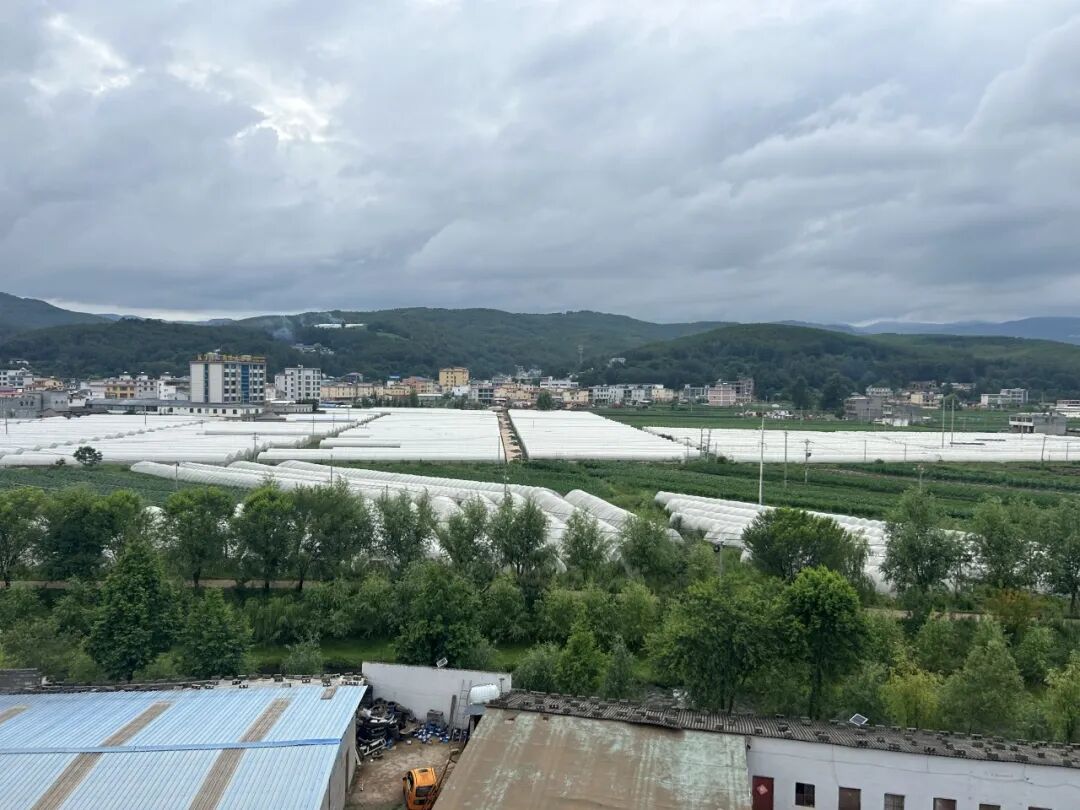
◉ At the centre of Matu Town, strawberry polytunnels are laid out between the roads.
Strawberry growing is a typical labour-intensive form of agriculture. The delicate fruits are hidden among the leaves and can be damaged by the slightest carelessness, so every stage requires human labour. Inside the polytunnel, you will see people bent over working among the ridges, almost all of them women.
In May this year, two traffic accidents involving rural women workers occurred in quick succession across the country. In Dandong, Liaoning, a minibus full of blueberry-picking workers overturned, killing 8 and injuring 13. In Hechi, Guangxi, a pickup truck carrying sweet potato workers plunged into the water, and 10 people eventually died. The female pickers working under large-scale cultivation, and the hardships and risks they bear, are gradually becoming known to the public.
The female strawberry workers in Matu Town also belong to this group. Some are in their fifties or sixties and, while their bodies can still work, they earn enough to get by and to save for old age; others are local left-behind mothers, trying to strike a balance between caring for their families and working independently. In the strawberry field, they work 10 to 11 hours a day, pressing vines, weeding and picking fruit, and with hands covered in mud, earn a wage of around 100 yuan.
For these rural women, the strawberry industry provides an opportunity to step outside the home and earn their own money without having to travel far. Yet they still occupy the most “bottom-layer” jobs in the industry. Under rural transformation, as smallholder farming collapses and men go away to work, they either lack education and skills or shoulder the responsibility of caring for their families, and at one point were passive left-behind residents on the land. The strawberry field has given them a fallback for making a living, but can this fallback lead to a measure of freedom?
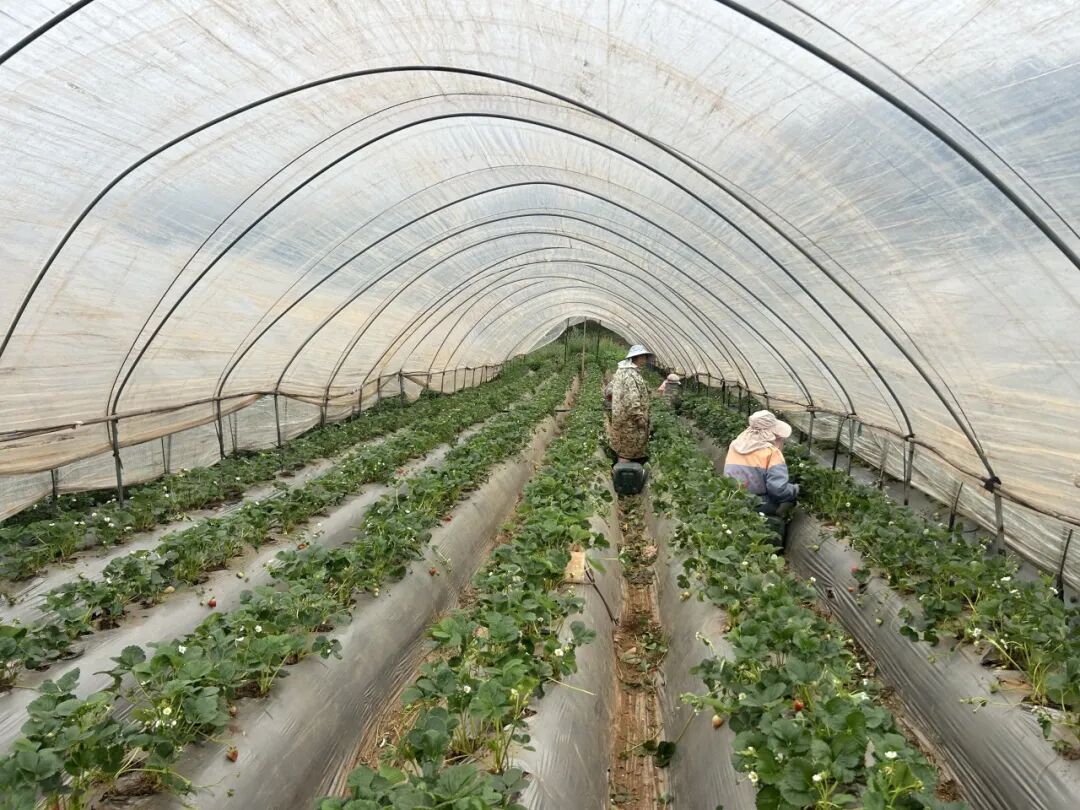
◉ Liu Yingcai and other women workers in a strawberry polytunnel. It had rained on the day of the interview, and the plastic sheeting between the ridges was wet and slippery.
A Left-Behind Mother’s Decision
This Chinese New Year, 27-year-old Lu Yinghong decided to go and work in the strawberry field with her husband’s aunt.
The strawberry industry in Matu Town, where her husband’s family is from, began about ten years ago. At that time, most of those who contracted the land were outsiders who had had growing experience in Dai Bu Town in neighbouring Huize County and other places, and who had come to Matu, where the geography and climate were similar. The land near the town centre was first cleared of maize and potatoes, and polytunnels were erected.
In the following years, strawberry fields sprang up like mushrooms after rain. Caopidi Village, where Lu Yinghong’s in-laws are from, was about a half-hour’s drive from the town centre. Around 2022, locals and outside contractors also began growing strawberries here, one of the plots right behind Lu Yinghong’s house. Middle-aged and older women in the village were hired to work — 10 hours a day, 10 or 11 yuan an hour, with work available for about five or six months a year. The wages were not high, but they were still better than farming at home.
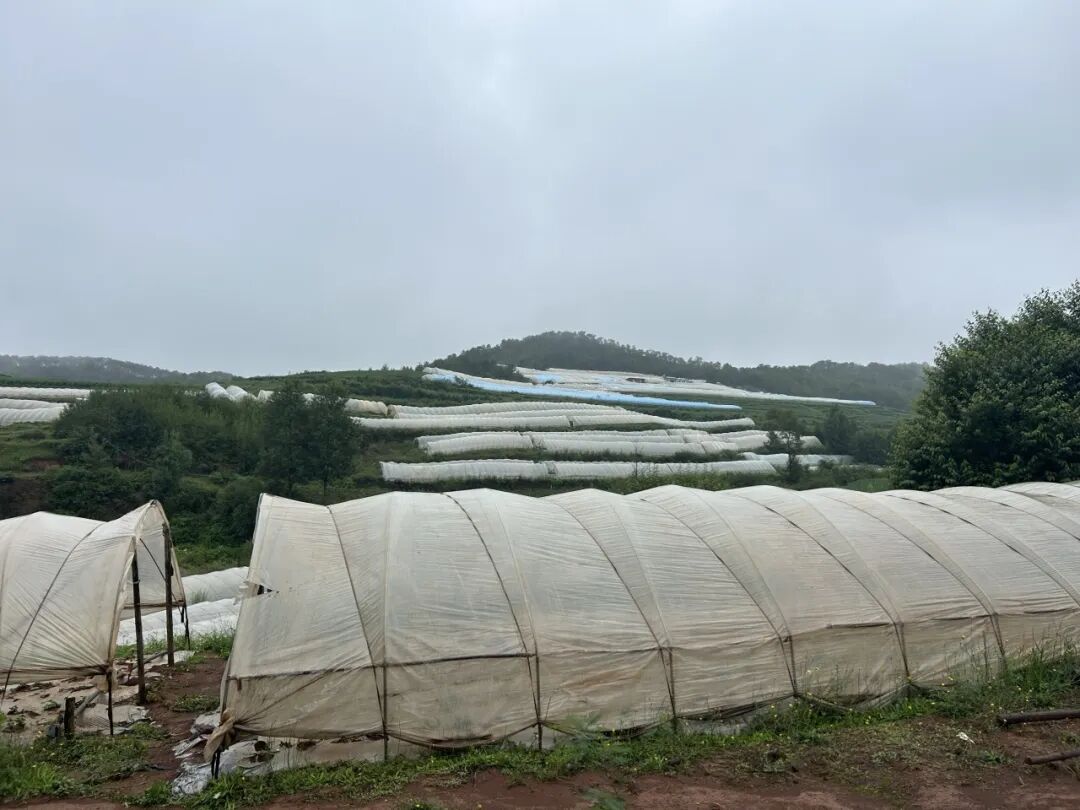
◉ Beyond the centre of Matu Town, flat land is scarce, and polytunnels are more often built along the hillsides.
Lu Yinghong saw this and was tempted. But at the time her elder daughter was only three and still needed looking after, and she soon became pregnant again. It was not until early this year, when her second daughter turned two and was weaned, that she actually started work in the polytunnel.
“I originally wanted to stand in a classroom, but never imagined I would be trapped in a strawberry field of several dozen mu.” Lu Yinghong was young and had been educated, and among the female workers in the strawberry field, she seemed a little unusual. Half a year after starting work in the polytunnel, she posted a WeChat Moments update like this.
She was born in a mountain village in neighbouring Chongxi Town, where the mountains were steeper and life more arduous. When she was little, she was a left-behind child. Her grandparents could provide for her food and clothing, but did not pay much attention to her studies or interpersonal relationships. She said she had originally been a good student and was good at Chinese, but later her grades slipped, and her family did not support her in time, so she somewhat gave up on herself.
Even so, after finishing middle school, Lu Yinghong still passed the entrance exam for a vocational school in the county town, where she studied early childhood education — that year, Qiaojia County’s overall gross enrolment ratio for senior secondary school was only 42%. But, like many girls from mountain villages, she met a boyfriend in the county town. When her boyfriend, a militia member, finished his training, Lu Yinghong decided to leave school and go to Fujian to work with him. Her parents did not object either; their view was simple: “If you choose not to study, what kind of life you lead afterwards is none of our business.”
The work in Fujian lasted only three months. After that, the two of them returned to her boyfriend’s hometown, where they married and had a child. That year, Lu Yinghong had just turned 20.
In the seven years after their marriage, Lu Yinghong said that “80% of the time I was a left-behind woman” — her husband first worked in a factory, then went to Anhui and Kunming to do business in scrap metal, while she lived with her parents-in-law, washing clothes, cooking and looking after the child at home. Farm work was also unavoidable. She was in charge of feeding the chickens and pigs, and in harvest season she had to help her mother-in-law harvest potatoes, “every day from morning till night.”
She was unfamiliar with the people and places in Matu, had no relatives or friends, and lived only within the small circle of her family. Friction with her parents-in-law was unavoidable, and their separation also led to quarrels with her husband. “Some things were never resolved. Every time I would bring them up and go over them with him again, but he never really changed.”
In her husband’s family’s view, however, Lu Yinghong’s life was already quite “happy”. Matu’s natural conditions were better than those in her parental home. Her father-in-law did concrete pouring work between the town and surrounding townships, which counted as a good income in the local area. Her husband was honest and quiet; even when there were conflicts, he would not hit or shout. When he worked away, he sent money home every month, and the family built a new house with tiled floors. In their eyes, Lu Yinghong was “making a fuss for no reason”.
In such a life, negative emotions welled up. “I kept putting myself down, feeling that I could not look after the child well, could not do the housework well, or do the farm work well.” Sometimes she also felt lost: “If I hadn’t been so willful before, and had studied properly, would things be different now?”
Lu Yinghong had tried to change things. Seeing other couples out in pairs, she had also thought about going out to work with her husband, to strengthen their relationship and also improve their finances. But when she thought that their child might become a left-behind child because of it, repeating her own childhood experience, she dismissed the idea.
Before and after the birth of her second daughter, she often needed to go to the hospital in the county town, and she also had conflicts with her parents-in-law, so she proposed to her husband that she take the children and rent a place in the county town by herself, and send her elder daughter to a kindergarten in the county town as well. Her husband reluctantly agreed and sent her money each month. Although she was looking after her elder daughter herself, going through postpartum confinement, breastfeeding and cooking, she felt that period was “a little easier” — she only had to look after the children and did not have to cope with more farm work and housework. But after only a year and a half, her husband’s income became unstable, and asking him for rent and living expenses became difficult for Lu Yinghong.
Under financial pressure, she and her daughters went back to the village to live with her husband’s family again.
Work at the strawberry field gave Lu Yinghong a path that let her be with her children and also step out of the home — previously, in the county town, which lacked industry, even hotpot restaurants and snack stalls would not employ mothers who had to juggle childcare as waitresses. And the strawberry field was only a 10-minute walk from home, so she was finally able to earn money.
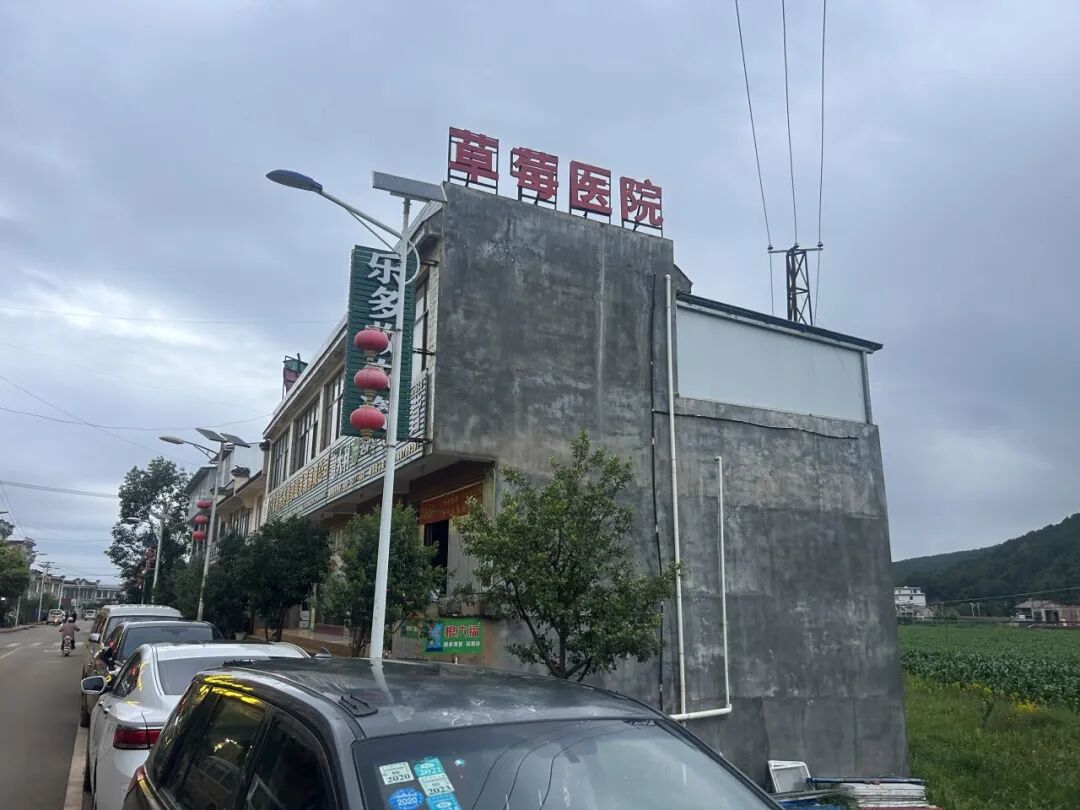
◉ In Matu Town, strawberry-related agricultural supplies and buyers can be seen everywhere.
When she first went to the strawberry field at the beginning of the first lunar month, Lu Yinghong was anxious, because after leaving school she had only done five or six odd jobs — working in a factory in Fujian and hardening road surfaces around the village — none for long. She was afraid she would not do the job well or that the boss would make things difficult. Even though a relative was showing her, she kept asking, “Is this the way to do it?”, and soon learned to remove old strawberry leaves.
She did this job for only 18 days, earning 2,000 yuan. After the winter maintenance at the strawberry field ended, there would not be work again until close to summer. But when she received her pay, Lu Yinghong “gave herself a minute of self-affirmation”. “I just felt that I could rely on myself, too. As long as I was willing to take the first step, there was nothing I could not do.”
She recalled the days from two years earlier, when she had been alone in the county town with the children — her younger daughter was only four months old. One time both children fell ill, and she had to look after them at the same time while they were receiving IV drips in hospital. “At that time, I felt like I was falling apart, as if whether or not I had family, whether or not I had a husband, didn’t matter. Only money could give me a sense of security. But what I lacked most was money.”
Fallback Work, Left to Women
The strawberry field where Lu Yinghong works employs about 10 workers a day. Most of them are left-behind mothers and middle-aged and older women. The only two men are both middle-aged and older men with special circumstances — one has never married, and the other injured his leg while building a house and can no longer do heavy work.
Why are most of the workers women? Lu Yinghong told me that, on the one hand, young and middle-aged men can choose to work in other provinces, earning more; on the other hand, gender norms also hold them back: “Some men may have their eyes set too high, think the wages are low, and also feel that this kind of work is a little embarrassing… because they think growing strawberries is something women should do, and if men do it they will be laughed at and lose face.”
Women are the main workforce in strawberry growing, but they are often not the managers or contractors of the strawberry fields. Many of the local middle-aged and older women are illiterate. The work they take on is repetitive, hard, and low in technical skill.
In another strawberry field in Caopidi Village, Ma Guoguang, who runs it, told me he was a local villager. A few years earlier, he and his wife had been growing polytunnel vegetables in Luliang County, Qujing. But they came across poor vegetable market conditions and made no money, so three years ago they returned to their hometown. Relying on a 15,000-yuan agricultural loan, and together with a relative, they developed this strawberry field. Their own land plus the contracted land amounted to a dozen or so mu. After deducting pesticides, chemical fertiliser, and labour, in the first year they earned seven or eight thousand yuan per mu.
Ma Guoguang now employs five or six workers, all middle-aged and older women from the village. He says that work in the strawberry field requires a fine eye and steady hands, and that women do it better than men.
Chen Minglian is one of them. One of her two daughters married someone in the same village; her child is only just over two. The other daughter married into the neighbouring county, and no one knows where her son-in-law is working — “They have their own burdens; to be honest, they can barely look after themselves” — she does not expect her children to help her. Since last year, Chen Minglian has come to work at Ma Guoguang’s strawberry field, while her husband stays at home to feed the livestock and look after her parents-in-law.
She is 56 this year, her hair has already turned grey and white, and her face is deeply lined. During the interview, she was wearing an apron, its front pocket full of small red plastic forks, and she was propagating runners. Bending down, she tore an opening in the film beside an existing plant, pulled out a sprawling strawberry runner, and used the small fork to pin it into the soil at the opening — this is the most effective way to propagate strawberry seedlings. Once the runner’s roots have taken hold, the connection to the mother plant is cut back. Chen Minglian repeats the same movement hundreds of times a day.
The technical jobs, however, are still left to the “bosses”. When Chen Minglian was pressing the runners, Ma Guoguang was just about to apply chemical fertiliser in the field. He said that this kind of work is always done by him and the relative with whom he has a partnership, and is not handed over to the workers.
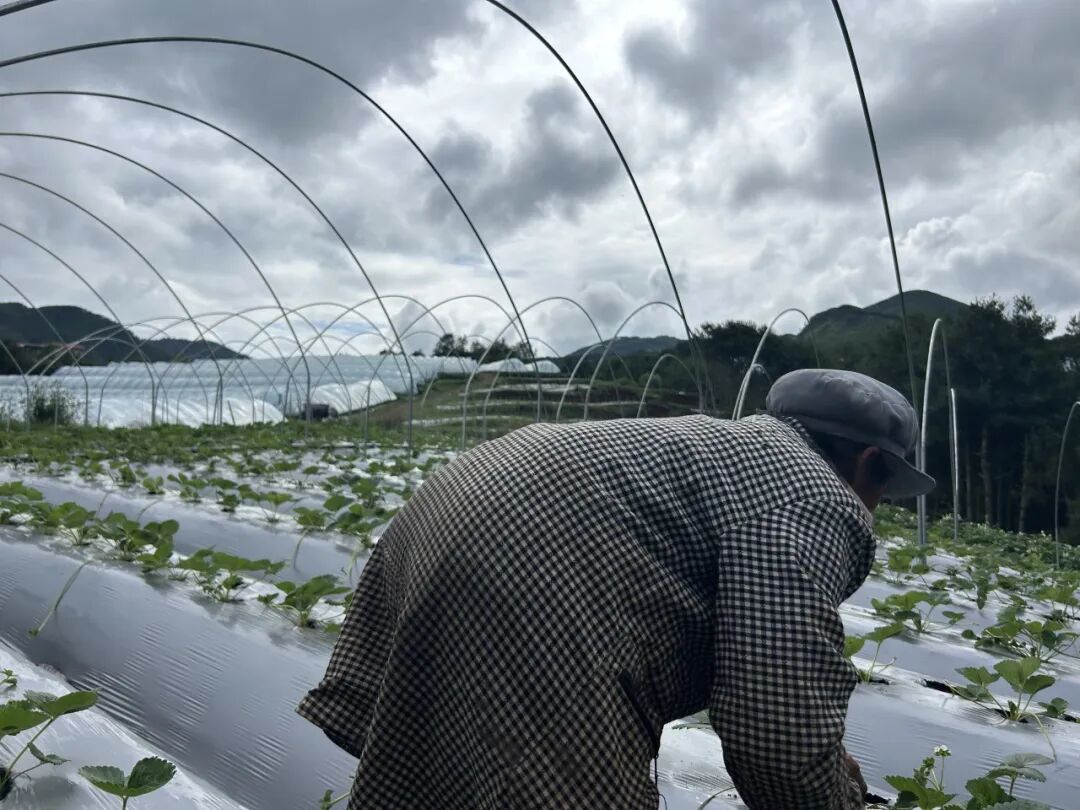
◉ Chen Minglian bends over to “press the runners” in the strawberry field.
Outsiders “Pushed” In
As the strawberry industry expanded, a shortage gradually emerged in the labour market. Many strawberry fields, especially those contracted by outsiders on a large scale, began recruiting workers from surrounding townships.
Li Chaodong comes from Huize County, Qujing. He has contracted about 50 mu of land in each of Matu Town and the neighbouring Laodian Town to grow strawberries. By his estimate, local labour had already become insufficient four or five years ago, and today, of the seven or eight thousand strawberry workers across the town, nearly half come from elsewhere.
Now, at Li Chaodong’s strawberry field, the busiest season requires employing more than twenty people, all of them female workers from elsewhere — “This is hand work; men are not as quick at it as women.” He had a simple tin shed put up, fitted with a washing machine, and the workers live there as a rule. They work 11 hours a day at 10 yuan an hour, and pay a further 10 yuan for food and lodging. Sometimes they do not go home for several months.
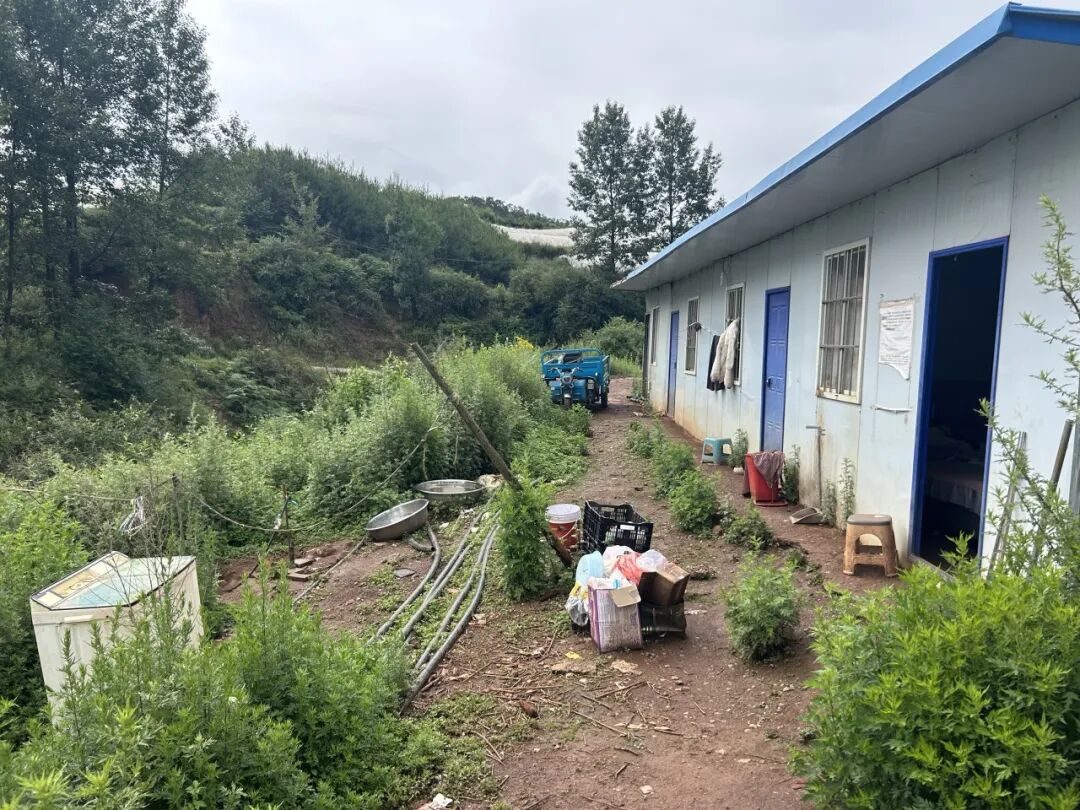
◉ The accommodation at Li Chaodong’s strawberry field for female workers from elsewhere, including Liu Yingcai.
For these female workers from elsewhere, of course, the wages at the strawberry field form the pull that draws them to work here. The decline of agriculture in their hometowns is an important push driving them to leave home.
In one polytunnel at Li Chaodong’s strawberry field, four female workers in their fifties and sixties are clearing weeds. Sitting on plastic buckets between the ridges, they move the buckets forward a little each time they clear a stretch, and they do not stop the work in their hands, even when they are chatting.
Two of them said that green Sichuan pepper trees had once been grown in their home areas, but over the past few years the price of Sichuan pepper has fallen sharply, and their annual income is no more than two or three thousand yuan. Because of the climate, this year the Sichuan pepper yield is down even further — “it is not bearing fruit” — so they came to a strawberry field not far from home: “It is just to earn some money; mainly, there is no other work to be found away from home.” Another female worker’s hometown is at a higher altitude, where they “cannot even grow Sichuan pepper”; she has contracted her land out to others and come out to work.
In their lives, coming to the strawberry field has been the first time they have left home to work. Their husbands and children are mostly away working elsewhere, doing mainly physical labour. Liu Yingcai, 60, told me that her son is “doing heavy manual labour, hauling soil for people and the like”, and that her daughter-in-law has to take the grandson to school. Their burdens are heavy, and she can only “come out on her own to make a living.” Her husband had died more than ten years ago, and she had no ties holding her back when she left home: “I pull the gate at home, lock it, and come here just to make ends meet.”
But some still have their eyes on the land at home. Another female worker said that she had come here just to “scrape together money for chemical fertiliser.” Once the boss pays this month’s wages, she may still go back, to catch the summer harvest and pick the Sichuan pepper at home.
After Entering the Polytunnel
When the sky has just begun to lighten, Lu Yinghong gets up. At 6:30 she arrives at the strawberry field and starts the day’s work. In the morning she sometimes has to pick strawberries; she slings a basket over her back and moves back and forth inside the polytunnel, looking for berries that have turned red. The lunch break starts at 12. Some workers take out the meals, potatoes, or instant noodles they have brought, heat them in the boss’s rice cooker, and eat at the edge of the field. Lu Yinghong lives nearby and rides her electric bike home to eat. Since she started working, her mother-in-law has been responsible for preparing lunch.
At 1 p.m. the work continues. The workers sit on stools between the ridges and remove weeds and yellow leaves. In summer the polytunnel is often stifling, and the afternoon is when drowsiness is at its worst; Lu Yinghong puts on Bluetooth earphones and listens to music to keep herself alert. At 5:30, when work finishes, Lu Yinghong goes home, cooks for the big family, and does the housework in her own household. She is busy until 9 p.m., when she collects her eldest daughter after her evening self-study, helps her with homework, then bathes her two children and puts them to bed.
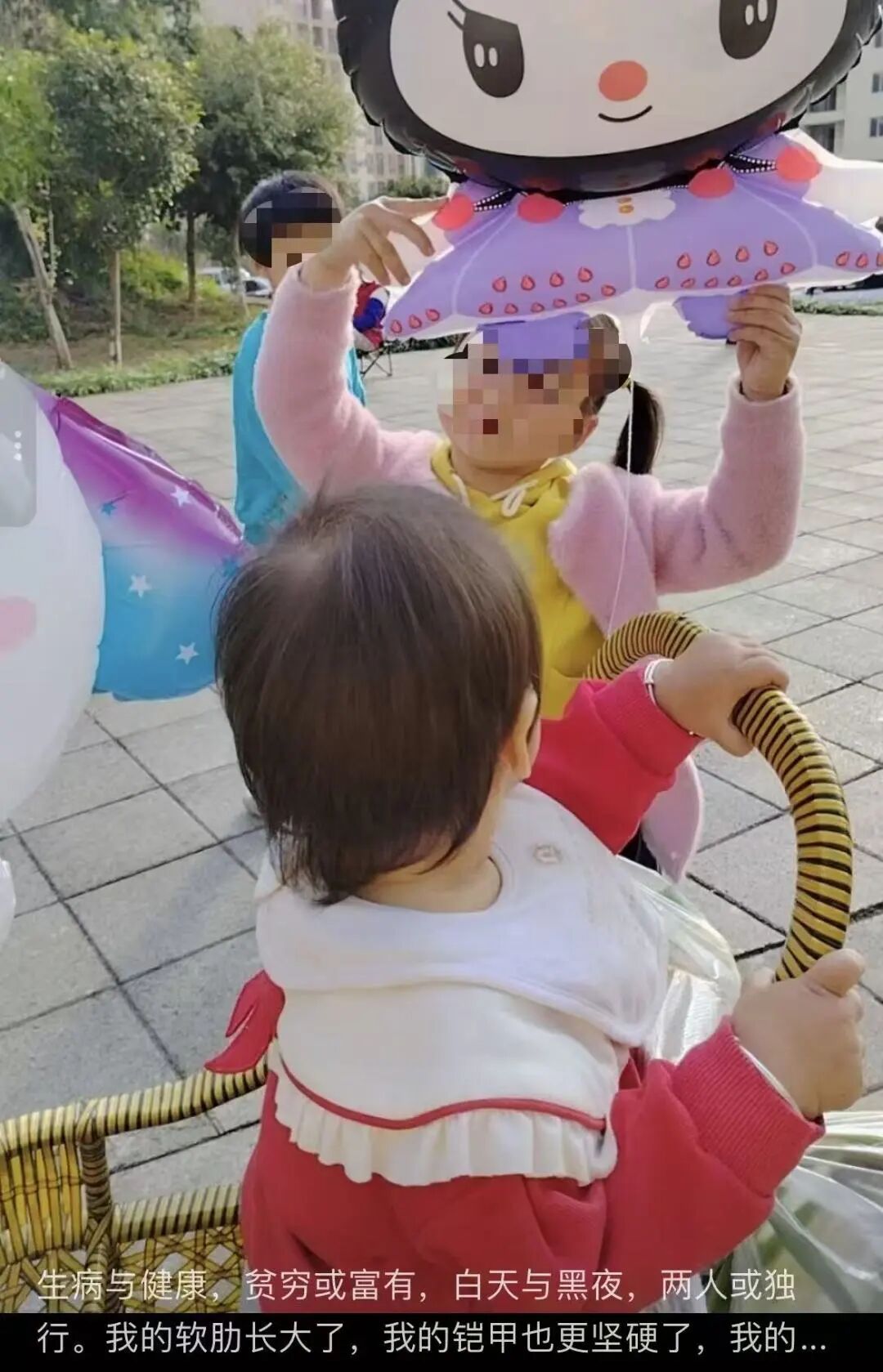
◉ Photos of Lu Yinghong’s two daughters from her video account, from the period when she was renting in the county town. She bought them pretty birthday cakes, documented her two daughters sitting side by side in a little house in the village, painting watercolours, braided little coloured pigtails in their hair, and bought cartoon balloons.
Since May this year, Lu Yinghong has lived almost every day by this schedule, with virtually no rest. When there was no work in spring, she went to learn to drive, thinking it would make it easier for her to visit her parents’ home, and that later she could drive to collect and drop off her daughters, so they would not have to be cold in winter. By the time she got her driving licence, it happened to be the busy season for strawberry growing, so she went back to the strawberry field.
As the novelty wore off, Lu Yinghong felt the hardship of the work more keenly. “It is quite hard on the back; sometimes the legs ache too.” The fine hairs on strawberry leaves can be drawn into the lungs, setting off coughs; in summer the polytunnel is hot, and older workers often feel dizzy. In addition to hurting the back, the legs also ache, and the work is monotonous, but “if I can earn a little money, it does not matter.”
For middle-aged and older workers, the toll the work takes on the body is also more obvious. The work in the strawberry field involves sitting for long periods or bending over; by the end of a day, Chen Minglian always feels her lower back aching and her back sore, “my feet keep aching and dragging, and they hurt at night too.” She sometimes needs to rest because of this, but “there is no income to speak of, is there? There is no other way; I have to carry on.”
Female workers from elsewhere have even more difficulties to overcome. Liu Yingcai is “not used to the food or the lodging”, but “what can one do if one cannot adapt? Working away from home is just making do.” At the same time, growing Sichuan pepper at home may be hard, but if she is hot or tired, at least she can rest for a while herself; working for someone else, even if stripping leaves makes her fingers ache, she cannot stop during work hours.
Because work is busy and scattered across the various strawberry fields, in Matu Liu Yingcai gradually lost contact with the other women from her home area who had come to work, and she never saw anyone she knew at the town market. After finishing work, she rests in the tin shed, waiting for dawn the next day to start work again.
What Can Be Escaped, What Cannot
Besides the money, the strawberry field has also given Lu Yinghong an emotional outlet. She can talk with the other female workers about the weather, the harvest, and the everyday business of family life. Sometimes she confides in them about her conflicts with her husband and his family, and talks about the difficulties she faces with the children; the older women can offer a few words of counsel drawn from their own experience. Previously, when she was alone at home, she felt stifled; she had also lost a common language with her classmates and gradually lost touch with them.
“So I feel that working with strawberries has given me not only an income, but also an added sense of home.” Lu Yinghong said.
But not everyone felt the same. On the day of the interview, because of the rain, the strawberry field where Lu Yinghong works gave the workers the afternoon off, and they naturally lost their hourly pay. She mentioned a woman who worked with her: ‘She said it would be better if it did not rain, because she also needs the money, her child has not yet married, and she is also under quite a lot of pressure. Perhaps they themselves do not want to go, but for the sake of making a living there is no choice.’
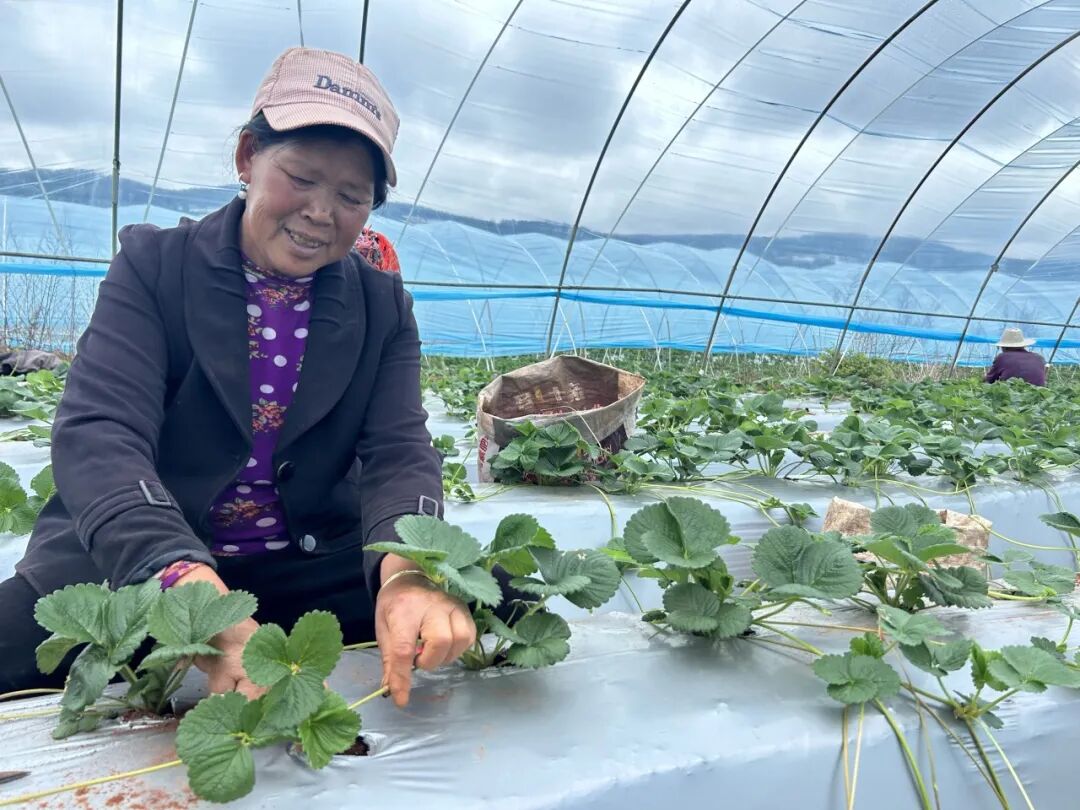
◉ Several workers from Laodian Town are at work.
Despite such hard work, the female workers cannot save much money. Chen Minglian said that, compared with the maize she used to grow, which sold for four or five jiao a jin, she would of course rather come to the strawberry field. But now prices are high; a round trip from the village to town to go to the market and buy things costs 60 yuan in fares, and she does not expect to save for old age or medical care: “At this age, being able to keep yourself going is already good.”
A female worker from Laodian Town said that, compared with life in her home village, life at the strawberry field means having to buy vegetables and other things on top, and “money does not go far.” In addition, although she is away working, the social obligations in her home area cannot be neglected. If a relative or friend has a wedding or a funeral, she has to ask for leave and take the bus home. The journey costs over a hundred yuan, and the cash gift is also a considerable expense — “if it is less than 100 yuan, she would feel embarrassed to go.”
Most of Lu Yinghong’s income from the strawberry field is spent on the children — clothes, groceries, snacks, and milk powder for her younger daughter. “Although it feels as if I have not spent any large sums, I earn something every day, but every day I have no money.” The children’s expenses have always been paid by her; before, she relied on the living expenses her husband gave her, but now she earns them herself.
This year the scrap iron business has been poor, and her husband has returned from Kunming to their hometown. He is working with her father-in-law, pouring concrete. The financial pressure has increased sharply. For this reason, her family also encourage her to carry on.
I asked her whether, now that she has an extra two or three thousand yuan a month in income, her husband’s and parents-in-law’s attitudes to her have changed because of it. The question rested on a judgment that local people take for granted: if you have been eating and being clothed by your husband’s family, then even doing the housework and bringing up two children does not count for much.
“No,” Lu Yinghong answered decisively. “Maybe I myself feel a little freer, and a little more confident in myself, but for others there should be no change. Because, to others, there are far more people more capable than you, and you do not count for much either.”
The Unknown Road Ahead
By the third year, the strawberry field where Lu Yinghong had originally worked had fewer people; the 20-mu plot now had only eight or nine workers. In July, when I contacted Lu Yinghong again, she said the boss had already transferred the land, and she had moved to work at another strawberry field.
In fact, this is a general pattern in the local strawberry industry. After strawberries have been grown for three to five years, there are ever more pathogens in the soil, the fruit gets smaller and smaller, and the seedlings also gradually wither and die. A joint study by the Yunnan Academy of Agricultural Sciences and the Beijing Academy of Agricultural Sciences explained: “The particular cultivation model in the Huize area has led to soil acidification, soil salinisation, organic matter deficiency, and imbalance in the structure of the soil microbial community, which in turn causes soil degradation and reduced strawberry yields.” After that, operators either move to another plot or have no choice but to switch to growing something else.
Much of the strawberry industry in Matu was, in fact, transferred from Huize. And if the land here is used up, the strawberry fields may also move elsewhere.
The bosses are even clearer about this point. Ma Guoguang said that, with soil degradation, pesticide and chemical fertiliser costs have also risen sharply this year. In addition, owing to the impact of a mild winter, yields have fallen, and returns are probably lower than last year’s. He estimates that strawberries can be grown for no more than five years. What will make money in the future, and what will happen to the workers? Ma Guoguang also has no answer.
Li Chaodong is also worried. He originally grew strawberries in Daibu Town in Huize, but later “the soil was no good”, and it was not until 2021 that he came to Matu to lease land. He said he had invested 500,000 or 600,000 yuan and borrowed another 500,000 or 600,000 yuan; now “all of it has been lost”, and he can only wait until this year’s produce is on the market to see whether he can recover his costs.
“Of the 1 million yuan you earn through hardship, at most 100,000 yuan is left. The rest is all wages, fertiliser, and land rent.” He said that last year he paid 780,000 yuan in wages alone, accounting for 60 per cent of costs. In addition, because leasing land has to go through middlemen, the costs are also huge — they took on wasteland from the government at 50 yuan per mu and cultivated land at 200 yuan per mu, but when the land is passed on to growers it becomes 600 yuan per mu — “What they pocket is all our ordinary people’s money, and the losses fall on us growers.”
The problem of soil degradation has come up again. This year, he started trying to plant small areas of sunflowers and ginseng fruit, but neither has shown any return.
The female workers from elsewhere in the polytunnels are not aware of these things. They hope the boss will sell the produce soon and pay their wages promptly. In their view, across the whole county, apart from the strawberry industry, there is no other place that can accommodate people like them, these “old, weak, sick, and disabled”.
Lu Yinghong has similar thoughts. “If strawberries continue to develop, I should still keep going. For me, at present, only strawberries are the best suited to me.” At 6:30 the next morning, she will step into the strawberry field again, in the morning glow or mist.
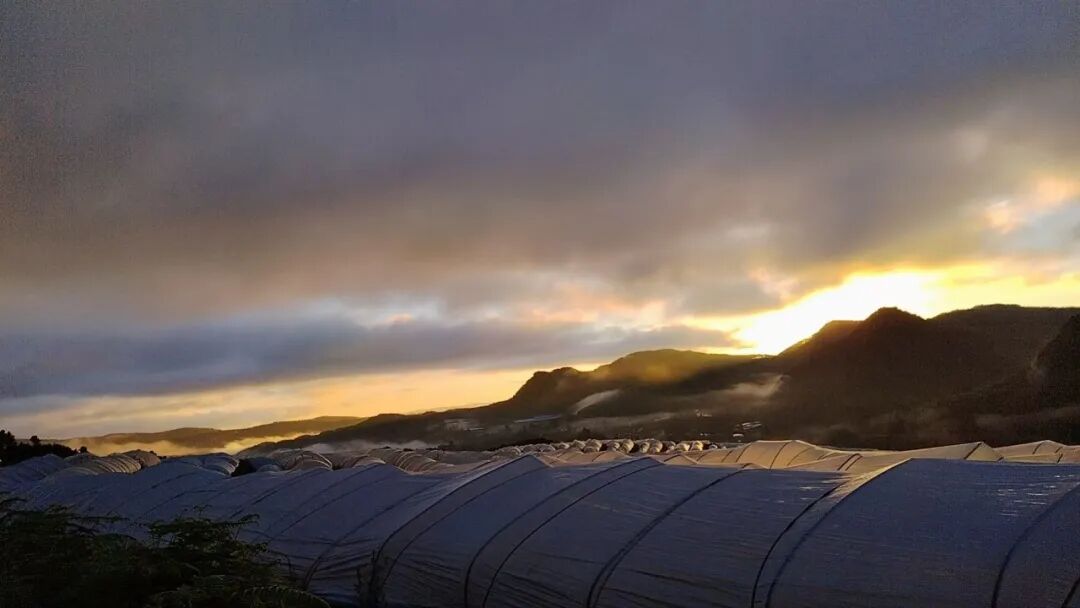
◉ The distant morning glow, seen from the strawberry field at the start of the morning shift. Photograph: Lu Yinghong.
– This is Foodthink’s 834 th original article –
Foodthink
Author
Xiong Renkai
A teacher supporting rural education in Qiaojia County, Yunnan
About the “She and the Land” column
This year is the United Nations’ “International Year of Women in Agriculture”. Foodthink has launched the “She and the Land” content column, focusing on women in agricultural and food systems. We will go into fields, markets, fishing harbours, pastures, kitchens, laboratories and urban streets and lanes to see the women who are often overlooked yet always present — who take part in production, research, cooking, distribution and care, and whose working experience and wisdom underpin our everyday lives. They are not only cultivators of the land but also important builders of rural areas and food systems. Through interviews, writing and workshops, we hope to tell their stories, understand how women’s participation shapes our food systems, and invite everyone to explore: for women working in food and agriculture, how can a fairer and more dignified future come about?
Except for Li Chaodong, all people in the article are referred to by pseudonyms.
Unless otherwise stated, all photos were taken by the author.
Editor: Pei Dan
Layout: Xiaoshu
Scan the code to leave a tip and support original food knowledge
▼

▼
Click the image to read related articles.
▼
Click the keywords to access more article collections.
Seeds | Agritech | Policy | Fermentation | Nutrition | Fruit | Fisheries | Events | Jobs | Takeaway | Wet Markets | Livestock | Food Talk | Sharing Sessions | Book Club | Harvest Festival | Smallholder Stories | Climate Change | Rural Development | Co-operative Economy | Urban Farmers | Food Safety | Digital Technology | Biodiversity | Pandemic and Food | False Solutions | Ecological Agriculture Internship Programme
Beijing | Hebei | Shanghai | Guangdong | Guangxi | Henan | Sichuan | Jiangxi | Xinjiang | Shaanxi | Hong Kong | Chongqing | Zhejiang | Jiangsu | Guizhou | Taiwan | Inner Mongolia | Philippines | Canada | Russia | Mexico | Italy | United States | United Kingdom | Germany | Netherlands | Thailand | Sweden | Japan