
Through the Lens: Change and Choice in Herders’ Lives
In late September, a hint of cold creeps through the Greater Khingan Range. Perhaps thanks to warming temperatures, the birch forests around Jiagedaqi have yet to turn yellow. Just a few decades ago, these woods were still the hunting grounds of the Oroqen people.
A group of filmmakers has gathered in the forest. This year’s World Nomadic Film Festival is being held deep in the Greater Khingan Range, in Jiagedaqi. The festival was jointly founded in 2021 by documentary filmmakers Gu Tao and Gu Xue; its predecessor was the Inner Mongolia Youth Film Week.
Traditionally, some ethnic groups practise pastoralism through seasonal migration, making use of grasslands and water sources in a manner very different from settled agrarian societies, and this has shaped a distinct cultural worldview. Much of Gu Tao’s earlier documentary work has focused on traditional nomadic communities. He has therefore extended the concept of “nomadic” to a broader sense: through the film festival, he draws attention to forms of free, fluid, and authentic living as portrayed in visual storytelling, in both contemporary and traditional contexts. Compared with other film festivals, the World Nomadic Film Festival attracts a greater number of filmmakers and works focused on pastoral themes. It also offers a concentrated view of how creators depict the transformations of pastoral life on screen.
How to tell the story of the grassland and of the lives of the people who dwell on it has long been a subject close to my heart. Supported by the 2024 Lianhe Creative Programme from Foodthink, the documentary Whose Table, Whose Pasture, directed by Jiao Xiaofang and Qiong Wu Danzeng, has also been selected for this year’s festival. So I joined Director Jiao Xiaofang in attending the festival.

In the tide of urbanisation, traditional life in pastoral areas is undergoing dramatic change. These life experiences, which go unsaid in mainstream narratives, need more visual storytellers who have lived in pastoral communities or who are genuinely drawn to them, to immerse themselves and fold their own observations and understanding into their work, letting the stories grow from the heart. As more and more filmmakers use the camera not just to tell but, more importantly, to question, these marginal nomadic experiences can be seen and understood in a more vivid and deeply felt way.
I. Camels on a Mongolian Pasture

Yet, compared with the old nomadic life of following water and grass, herders’ grazing practices have changed considerably. Aolunna has observed that, decades after the implementation of the dual grassland-and-livestock contract system, herders in local pastoral areas now divide their own grasslands into separate fenced sections according to their needs. The camel’s role in herders’ lives is also shifting: now, the transport function once served by camels and horses is gradually being replaced by cars and motorbikes. Some families use vehicles to move furniture ahead to the next pasture during transhumance, then drive the camels, cattle, and sheep over afterwards.
As she grew up and pursued her education, Aolunna drifted further from pastoral life. She is currently reading for a master’s degree in ethnic minority arts at Minzu University of China. In recent years, she has been conducting research and filming in the pastoral area of her hometown. This has become a process of reacquainting herself with home, and through the work she feels a responsibility, as a young Mongolian, to document and understand local traditional culture.
Aolunna chose to enter the story through the local Camel Culture Festival. The Mongolians in Haixi Prefecture have been hosting the Camel Culture Festival for about seven or eight years. Compared with the horse, which carries rich cultural connotations and symbolises the Mongolian spirit, the camel is more of a utilitarian animal, used primarily for long-distance hauling of heavy loads and for producing camel hair, camel milk, and other livestock products that herders need in daily life.
At the festival, the camel’s role in herders’ daily life is showcased in a concentrated form, with camel-related customs and skills distilled into several competitions: camel racing, similar to horse racing, in which riders compete to see whose camel is fastest; a camel beauty contest, judging the best-looking camel based on coat colour, coat quality, and overall spirit; and a camel craft competition, in which participants have a set time to make handcrafted items such as camel nose rings and reins, with the finished work assessed on its overall quality.
The most thrilling part is the camel-taming segment. A camel that seems docile, once it goes wild, cannot be restrained even by a crowd pulling at it. Young camels must go through a taming process before they can be put to use in daily life. In the Camel Culture Festival competition, the organisers select young, untamed camels (mostly males). Without a saddle, contestants mount them bare-handed, and the one who stays on the longest wins. In the film, watching contestants thrown off again and again, I cannot help but marvel at their determination. In recent years, a women’s camel racing event has also been added to the festival.
Even the pastoral practice of moving house with camels has been turned into a competition: contestants load furniture onto the camel, which carries it along a set route and back, then the furniture is unloaded, and the different contestants are timed on their completion.
Today, in Aolunna’s hometown, most herding families still keep the tradition of raising the Five Animals, adjusting the mix according to their own circumstances. People use the animals seasonally, according to each species’ particular qualities. In Aolunna’s view, the relationship between people and livestock in pastoral areas is more like a “contract”: humans care for the animals so they can live well, in exchange for the animals providing what people need to sustain their lives. In pastoral life, “the mutual intervention between humans and animals is a necessary way of surviving on the grassland.”
The relationship between nomadic peoples and their livestock is a blend of taming, exchange, and mutual care. But once this relationship enters the modern market, it begins to break apart.
II. The Imported Meat Upheaval and Herders Drawn into the Market
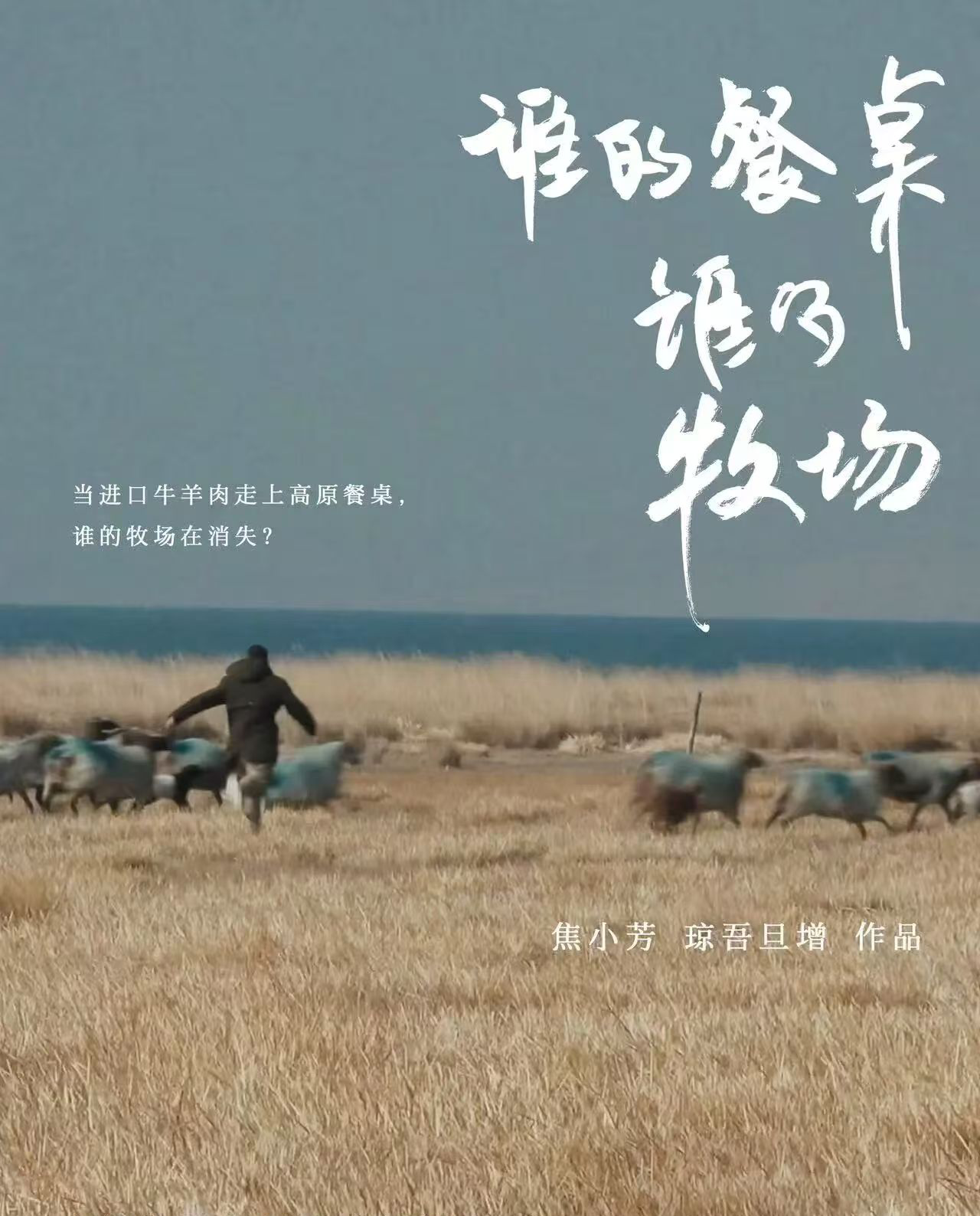
On screen, we see how people in different roles within a complex meat supply chain respond to this shock: frozen beef and mutton that has crossed oceans from the other side of the world turns out to be cheaper than what local herders are selling. In the film, people offer their own rationalisations for this state of affairs. Some argue that imported meat carries the “grain-fed” label, making it seem more premium. Others contend that local meat production lines are not up to standard, and that by comparison, imported meat meets clear quality standards—”the production line is very well regulated.” These different discourses collide, reflecting the many frictions underlying a shifting reality.
Imported meat has also triggered a chain of reactions. Many customers now choose the cheaper imported meat, dragging local cattle and mutton prices down repeatedly. And herding, as a traditional livelihood on which herders have depended for survival, has been drawn into an ever more complex meat supply chain. The herder’s role has gradually shifted from that of an active producer to a passive link in the chain. In the documentary, Manai, the sheep buyer, voices the herders’ current dilemma: “If you sell, the price isn’t enough; if you don’t sell, there isn’t enough grass.”
Behind this phenomenon lies a tangle of complex realities. In recent years, the modernisation of pastoral life has increased herders’ need for cash in everyday living, making them more dependent on their own cattle and sheep for income. Under the pressure of imported meat prices, local cattle and mutton have depreciated, and herders need to raise more livestock than ever to earn a sufficient income, which in turn intensifies the strain on the grasslands. Many herders lease other people’s pastures and buy feed to make ends meet, only to find themselves sinking deeper into debt.
We can also glimpse, in the documentary, the paradox faced by Tibetan herders when drawn into the larger meat market. Traditionally, herders graze and slaughter their own cattle and sheep for household consumption and to earn cash, but in Tibetan Buddhist belief there is the precept of “non-killing,” and so a unique division of labour has emerged in the market—most of the slaughtering and selling of cattle and mutton is carried out by Hui people. The result is a peculiar situation in the pastoral areas: herders are reluctant to kill, so they sell their cattle and sheep to Hui buyers, take the money, and then go to the market to buy meat—sometimes even imported meat.
The traditional extensive grazing method has also moved further toward industrialised meat production, with the finishing stage brought into being by the market. Finishing cooperatives buy cattle and sheep from herders, then feed them large quantities of grain intensively over a short period in holding facilities to fatten the animals before selling them on to the market, turning a profit.
Under this trend, it is increasingly difficult to tell whether the local meat on sale was raised through traditional grazing or went through a finishing process. This method of rearing directly affects the quality of local cattle and mutton, and people’s willingness to buy local meat.
Beneath the complexity of the issues, what moves me are certain moments in the documentary: a young herder deftly throws a lasso to rope up a yak; when the sheep buyer is about to drive the cattle and sheep away, the young herder points to two sheep, introducing them as twins, a reluctance audible in his voice. After the sale, he says, “If I had the money, of course I wouldn’t want to sell. We can’t bear to part with these animals either—after all, we’ve been good friends for several years……” After years of living alongside their livestock, herders have formed intimate bonds. In their eyes, every cow and every sheep has its own distinct character, while in the eyes of the sheep buyer and within the meat supply chain, each is nothing more than a piece of meat on a cutting board.
And from these details we can catch a glimpse of what traditional pastoral life looks like before it is superseded by modern commercial logic: a young Tibetan herder can both need to sell his cattle and sheep and be reluctant to part with them. Many herders, after selling their animals, will go to a monastery to light butter lamps in their honour and ask monks to recite sutras for them.
Although herders have always sold cattle and sheep to earn a living, even before being drawn into the modern meat market chain, this relationship was never a simple exchange of value. Modern market logic reduces everything to commodity value. Under the pressure of that logic, the relationship between herders and their livestock is gradually changing. As the film shows, the plain, unadorned affection that herders feel for their own animals is becoming increasingly useless and increasingly rare.
III. The Nostalgia of the Nomadic Generation

The narrative short film There Is a Sea on the Grassland presents a silhouette of a Mongolian boy who has moved to city life, returning to his pastoral hometown for a few days. Through a child’s eyes, the film captures everything in the pastoral area that is both familiar and strange: Mongolian-language textbooks he can no longer read; a few playmates frolicking on a wide, snow-covered stretch of grassland; adults at the dinner table discussing the falling prices of cattle and sheep. At the end of the film, the boy, about to return to Shanghai, dyes the family’s flock blue—like a sea—to keep company with his playmate who stays behind in the pastoral area.
The family in the film is a microcosm of several generations of Mongolians moving from the pastoral areas into the city. The story in the short film comes from director Tong Cheng’s own experience. He grew up studying in the city, returning to his family home in the pastoral area during winter and summer holidays. His hometown is the Wuqi Military Horse Farm in Horinger, a semi-agricultural, semi-pastoral area where Mongolians and Han Chinese live side by side. There, herders were drawn into modernisation earlier. From the 1990s, many young people from the pastoral areas began going to the city for work, finding employment at the coal mines in Horinger.
Growing up, Tong Cheng frequently shuttled between the city and the pastoral area, which made him more attuned to the life experiences caught between these two entirely different worlds. He has carefully distilled this change into the languages used by three generations of Mongolians: the grandparents live in the pastoral area, speak Mongolian, cannot speak Chinese but can understand it; the parents shift between a Mongolian-Chinese mixed language; by the grandchildren’s generation, they can only understand Mongolian but can no longer speak it. So the film includes a strange yet logical scene: communication is carried out in two entirely different languages—the grandson speaks Mandarin to his grandparents, and the grandparents speak Mongolian to the grandson.
The boy’s small queue in the film is likewise an important symbol. Mongolian boys leave a traditional Mongolian queue at the back of the head, which is cut off when they turn thirteen. Tong Cheng deliberately included this detail. In his view, it is the only trace of Mongolian identity remaining on the little boy as a member of the new generation, but when it is cut at thirteen, the last thread connecting him to his “Mongolian” identity is also erased.
At the end of the story, an unaccompanied song (drawn from the classic Mongolian song Father’s Grassland, Mother’s River, known and sung by all) echoes the sense of loss felt by the new generation of Mongolians: “Although I can no longer speak in my mother tongue, please accept my sorrow, my joy. I, too, am a child of the plateau; in my heart there is a song, and in the song there is my father’s grassland, my mother’s river……”
In his story, pastoral life has receded from a direct, bodily experience to a background, nostalgic presence. Compared with the pastoral areas of Tibet, herders in Inner Mongolia were drawn into urbanisation earlier. How do those caught between the two life experiences of city and pastoral area understand, adapt to, or reshape the environment around them? Do they stay in the pastoral area or move to town? This may be the question that looms over every contemporary herder’s life, and an issue Tong Cheng will continue to explore in his future work.
Tong Cheng told me that whether in the city or the pastoral area, people adjust themselves to the existing external environment in order to better adapt to the life they are living. People “migrating” from the pastoral area to the city is another form of adaptation: “People change themselves through their environment,” and some people “will migrate to soil and a culture that better suits them.”
However, I have always been somewhat sceptical of interpreting the migration of people from the pastoral area to the city as another form of “nomadism.” Is this truly nomadism, or is it yet another unoriginal replica—similar to rural urbanisation—in the great tide of urbanisation? Or perhaps it is a contemporary commercial misuse of “nomadic” culture? In what sense can a true “nomadic spirit” transcend the context of traditional pastoral life and travel with people’s bodily experience into a more contemporary way of living?

Through these films, we can see the transformations and predicaments facing traditional pastoral areas today. In these frames, the small, easily overlooked emotions beneath enormous social change are amplified and made visible, and it is precisely these emotions that form the deep texture of traditional nomadic culture.
Beyond these three short films, the World Nomadic Film Festival also featured several other shorts set against the backdrop of nomadic life: in Ama, director Suolang Quzhen turns her lens toward her own mother, telling the bodily experience of a traditional pastoral woman; Hanggai tells the story of a herder who, due to external circumstances, has lost his own pasture and now drifts on the margins of a traditional pastoral area; The Silent Dihahan, through the oral accounts of several elderly Oroqen people, recreates the inner rhythm of the Oroqen people’s former life of hunting in the forest. These films are like prisms, refracting different perspectives on pastoral life.
Regarding nomadic culture and the pastoral areas of different regions, there remains vast narrative space to tell of the emotions behind these real lives. In the narrative space of film, the complexities and confusions of reality are gently received, slowly lifted up. Perhaps this is the meaning of cinema.

Editor: Xiao Dan