
Bumper Lychee Harvest, but Why Is Buying Online Still Not Cheap?
I. Branches Laden with Lychees
My hometown is in Lufeng, Guangdong Province, where the family has a lychee grove of nearly a mu (about 670 square metres). As far back as I can remember, lychees have been grown there; the youngest tree was planted the year I was born and is now thirty-one years old.
In past bumper years, once Mum and Dad had sent their share to the four of us siblings and given a few to relatives, there was basically nothing left. Last year was a small year — there were barely any fruits on the trees, just enough for the family, and the two boxes I used to receive shrank to a small carton. This year is a big year, and not just any big year but one of the best in decades. The family grove has produced a bumper crop, so my husband Antian and I decided to go home for a few days and be fruit farmers.


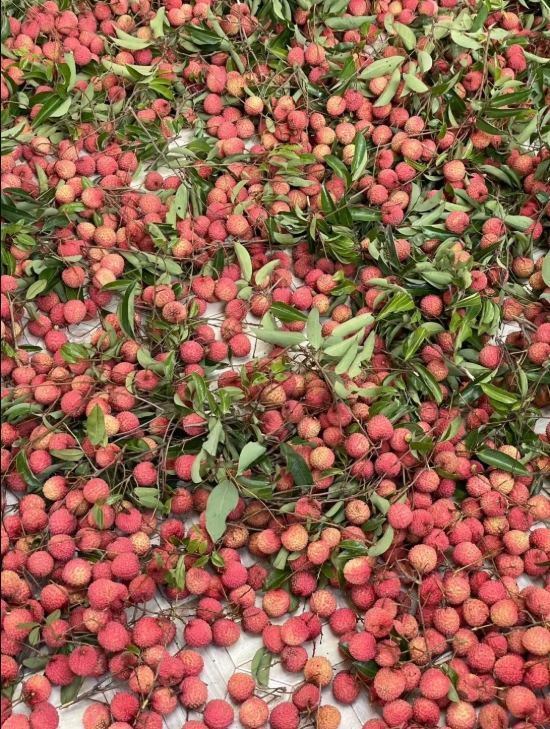
Antian and I returned to the family grove in late June. Although we had braced ourselves, it was only when we stood there in person that we truly felt the scale of the harvest — some branches were bent almost to the ground, and even the small lateral shoots growing from the trunks carried a good crop. The lychees up high had already turned a deep red; where the sun was scarce, the fruit still held a hint of green.
Because our lychees are free-growing, with no fertiliser applied, the fruit is smaller than that from conventionally managed orchards and does not fetch a good price at the local market. When the lychees first came out, they were going for about 10 yuan per 500 g at the local market; Mum, eager to shift them quickly, sold ours at 8 yuan per 500 g. Once the bulk of the crop hit the market, our lychees went unsold even at 5.5 yuan per 500 g. For customers, big and cheap is all that counts — no one cares whether pesticides have been sprayed or not.
On top of that, our area lacks a central buying point like the one in Maoming, and with such small volumes it is hard to contract with a supplier. If we wanted to earn more, our only option was to find buyers online.
Fortunately, when we moved to Longyan, Fujian, in October last year to set up our own farm, we had opened a Weidian shop to sell our produce and gradually built up WeChat groups where we shared our daily life. So, two days before going home, we mentioned in the WeChat group that we would be selling lychees. Within no time, three or four friends had placed orders, which meant we could be busy shipping right from day one.
Antian took some photos of the lychees on site to use as product images in our Weidian shop, then kept advertising on WeChat Moments and in the groups. We had no idea how many people would buy; we figured every sale counted, so the price was not set at the premium for ecologically grown fruit. In the end, we priced it at 54 yuan for 1.5 kg and 88 yuan for 2.5 kg.
When setting the price, we looked at what Fuzhou supermarkets were charging — around 16 yuan per 500 g. Antian and I had been working in Fuzhou before coming home, so we thought friends there were most likely to order. But we had underestimated delivery costs and had not factored in the difference between shipping within the province and shipping out of it. It was precisely this oversight that made our first shipment such a headache.

II. Shipping Costs More Than the Lychees
The first shipment caught us unprepared and a little flustered. We had no cardboard boxes, no styrofoam boxes — just trees full of lychees. Lychees are also notoriously difficult to keep fresh; if you pick them and do nothing, at that day’s temperature the skin will turn black and dry out by the next day, and customers might think the fruit has gone off and file a complaint or request a refund. So we decided on the spot to take them straight to the SF Express depot to get them packed — they were bound to have everything we needed there.
Conghua, Guangzhou, where the farm we once interned at is located, is one of the country’s main lychee-producing regions. During the lychee season there is a dedicated SF Express drop-off point for shipping lychees there, and the rates tend to be a bit lower. But our village is full of smallholders growing lychees, and we only have an ordinary SF Express service point. By the time we got there, quite a few people were already queued up, and there was just one member of staff. He was so busy he had no time to answer questions. The scene was briefly quite chaotic.
Just as I was asking about styrofoam boxes, the auntie next door jumped in: “We sell styrofoam boxes here too — what weight do you need?” A lot of farmers had been coming to ship their produce over the past few days, and her styrofoam boxes and ice packs had been selling steadily.
Once we had packed everything and were ready to send it off, the courier handed us a sticker to place the order so he could keep working through the other parcels. Antian was in charge of scanning the code to confirm it. He said, with a note of shock in his voice, “Thirty-six to Fuzhou?!”
“We’re selling for 54, shipping is 36, and that’s the standard express rate.” Antian kept running the numbers under his breath. With everyone busy packing, the scene was a bit chaotic, and my thoughts were scattered too. He had mistaken the 2.5 kg parcel we were shipping for the 1.5 kg one.
My head was going round in circles. There were so many people, and Mum was waiting beside us. She couldn’t understand why we hadn’t placed the order yet and were taking so long — she couldn’t follow Mandarin. My mind was a jumble, but I couldn’t think of any other way. Even if we made nothing on it, we had to get it shipped.

On the way home my mind cleared up a little, and I realised that what we had actually shipped was the 2.5 kg pack, priced at 88 yuan. Shipping to Fujian was 36 yuan, ice packs and box came to 5 yuan, so we would be left with 47 yuan. For destinations any further, the shipping would be even higher — to Shandong, 2.5 kg standard express cost 54 yuan. That meant delivery and packaging would swallow roughly two-thirds of the revenue from a single lychee order.

By then Weidian had already received over ten orders — from Sichuan, Shandong, and Fujian. With the shipping cost problem leaving us at a loss, that evening we split the product listing into two price tiers: within the province the prices stayed at 54 yuan for 1.5 kg and 88 yuan for 2.5 kg, while out of province we raised them a little, to 68 yuan for 1.5 kg and 108 yuan for 2.5 kg.
Many customers couldn’t understand why the lychees were still so expensive when this year was clearly a bumper crop, but once you work out the shipping costs from a fruit farmer’s perspective, the answer becomes obvious.
Later we switched to JD.com for shipping. The rates were no different from SF Express, but there were plenty of coupons to grab, so it worked out a bit cheaper overall. In the end, we did the sums: 51 items sold in total, revenue of 4,503 yuan, shipping and packaging combined at 1,526 yuan. Delivery and packaging ended up accounting for roughly a third of total revenue — and that does not include the labour costs for picking, sorting, and packing that came with the shipping.
III. Farmers Racing Against the Clock
This is, in fact, the thing I worry most about when shipping by courier. Looking at the trees bowed under fruit, Antian wanted to sell as many as possible, as quickly as possible. But for me, how many of the fruits on the trees we could shift was not the most important thing. What worried me more was that the lychees would be rotten when they reached a customer’s hands. The lychees I have eaten since I was a small child are delicious; I do not want them to become a pile of rotting fruit in someone else’s hands. I hope they can taste lychees that are just as good as the ones I grew up with.
If you want to keep lychees fresh, then we, as fruit farmers, must seize every minute and second during picking and packing. Lychees should be picked in the cooler part of the day, when temperatures are lower and freshness is easier to hold. So every morning we have to be at the grove bright and early. The fruit must also be dry at the time of picking; if it is wet, sealed in a styrofoam box it will spoil easily. I remember one evening it started raining — and then really pouring. In the middle of the night I could hear the rain hammering down, and a bad premonition settled over me. The next morning, when I got to the grove just after six, the lychees were still dripping wet, and every plan we had made fell apart. We had no choice but to wait for the sun to come out and the fruit to air-dry before we could even begin picking.

The packing process after picking is also a real test of speed. Antian and I can average about twenty boxes a day between us. We head out to pick at seven in the morning and are back around ten. Then comes the sorting — any fruit showing insect damage gets removed, and anything not looking particularly good on the outside goes too. The leaves and small stems get trimmed a little, but not all of them, because keeping a few on helps preserve freshness. By midday we can have worked through more than half. After lunch we keep going, and basically every lychee that goes into a box gets a quick once-over, which eats up a lot of time. We need to finish packing by three in the afternoon and get the parcels to the courier depot so the lychees can catch the first van out.
A few days flew by. After we went back to Longyan, Fujian, Guangdong had several more bouts of rain. I imagine that in every lychee grove on this land, there are farmers just like us, weaving in and out among the green and red fruit, doing everything they can to beat the clock and get the picking done. I also thought back to the first day of shipping, when Mum was standing there waiting with that anxious look. Shipping costs really are steep, but there is nothing we can do about that. All we can do is, before the lychees leave our hands, race against the clock to keep them as fresh as possible. As small fruit farmers, this is all we can manage.


Photos: taken by the author unless otherwise noted
Editor: Yuyang