
Why, With More Than Enough Food, Are 800 Million People Still Going Hungry?
Author | Sun Tianshu
Because eating is the only subject on which I can sustain a long, high-octane interest, I have set myself on the path of exploring “how to eat better” as a lifelong pursuit. I currently work in international development aid, sustainable agriculture, and the culinary research of shredded chicken cold noodles.
People feel hungry two or three times a day — were that not the case, we probably wouldn’t need to eat three meals a day, nor would we need to download a food delivery app that, at every turn, earnestly asks you, “Hungry yet?” For most people, “hunger” is like “drowsiness”: it arrives so regularly and unremarkably that “being hungry” never registers as a problem.
Not only on the level of personal experience, but on the scale of all humanity, hunger is no new thing. Part of my day-to-day work involves gathering news of food crises and famines from around the world. The bad news comes in a steady stream:
“Hunger risk escalating in East African and Near Eastern countries; 37 countries now require external food aid.”
“Affected by drought, the number of famine victims in Ethiopia has reached 350,000.”
“Rohingya refugees require more than 12,000 tonnes of food aid per month.”
“In the Democratic Republic of the Congo, more than 4.6 million children are severely malnourished.”
……
Every day, new figures bear painful witness to new suffering, until you gradually become desensitized to numbers in the millions, and a mass famine reduces to a distant, rapidly pulsing red dot on a map.
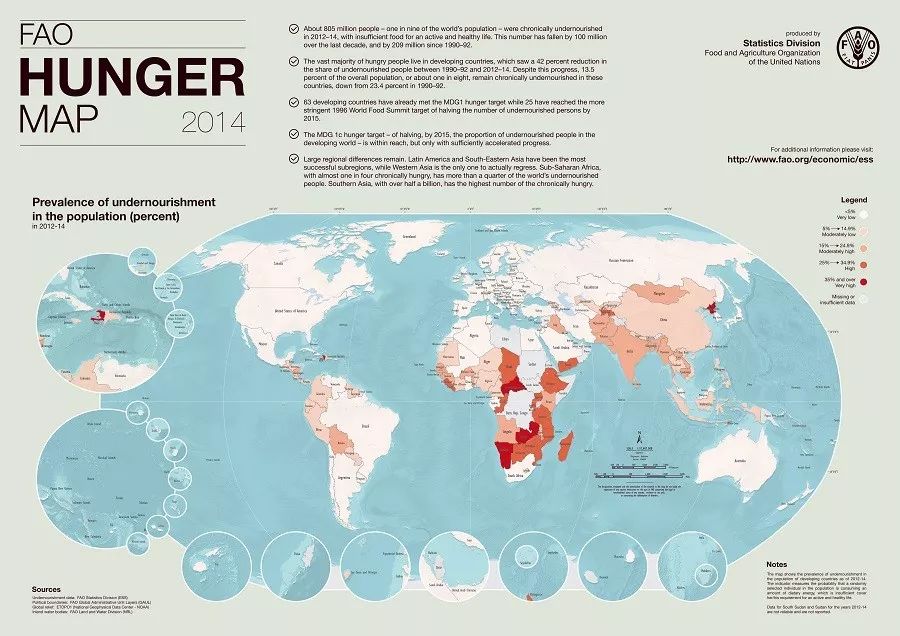
This is the World Hunger Map, published by the United Nations Food and Agriculture Organization (FAO) in 2014. Several sets of abstract data accurately capture the distribution of famine and malnutrition across the human world, but it is hard to say that these figures help us intuitively grasp the true meaning of hunger. Source: FAO.org
“In 2016, the number of undernourished people worldwide reached 815 million,” reported five United Nations agencies, including the Food and Agriculture Organization (FAO) and the World Health Organization (WHO), in their 2017 report, The State of Food Security and Nutrition in the World.
It sounds serious.
“……up by 38 million on 2015.”
It looks like things are getting worse.
But what is the difference between 815 million undernourished people and 777 million? Both figures sound appalling, utterly unacceptable — and yet both are just as vague, as vague as “153 million” or “212 million.” In the best case, suppose we bring the malnourished population down to 100 million. That would be a tremendous improvement over 800 million — but would it be more acceptable for 100 million people to be weakened by hunger and thus denied equal opportunities for development?
“Some people say, ‘What’s the point of talking about hunger? It changes nothing, and it’s boring.’ So I decided to write a book about hunger.” Martín Caparrós, Argentine journalist and author of Hunger, put it just so.

Martín Caparrós, Argentine journalist and author of Hunger.
1
“Anyone who wasn’t here, please raise your hand.”
One reason the issue of hunger has grown so painless is that, across the many conversations about it, we rarely hear from the 815 million mentioned above. The people who truly suffer from hunger are simply not in the room, because they are too hungry to make a sound, or too worn out by the struggle to scrape by to spare a moment to raise their voices for themselves. Most of the reports we see come from the spacious, immaculate offices of research institutions, and the facts gathered in the field are tidied into neat figures and charts. This is a trial in which the plaintiff cannot be present. Discussing hunger without the hungry in the room is like saying, “Anyone who wasn’t here, please raise your hand.”
What does hunger actually mean? Where does it rage? What causes it? To find answers from those who are absent, Caparrós travelled to seven countries: from drought-stricken Niger in the Sahel, to India, which ranks tenth in the world by economic output yet first by malnourished population, from the United States, where capital and machinery strip agriculture clean round the clock, to Argentina, the soybean nation, which “produced enough food for 300 million people yet could not feed its own 4 million citizens”…
He goes to where hunger actually happens — under thatched roofs, on mountains of rubbish, in fried-food shops, on the trading floor of the Chicago Board of Trade — and talks with those who witness it. Someone is futilely trying to cook a few beans in hot water; someone has just blankly wrapped the body of a child on the verge of death in a cloth; someone has fished a discarded frozen chicken from a fast-food shop’s waste heap and is elated. Dozens of stories from seven countries, each one about human beings as real as you or me, and the long, grinding hunger they live through. Missed meal after missed meal accumulates into a resigned, silent, aching normalcy. These small but real conversations peel “hunger” away from the macro-scale numbers.
Caparrós is not content to work within the framework of “structural hunger” — he argues that the concept breaks the causes of hunger into separate categories: climate, resources, population, production capacity — without ever touching what hunger actually means. He says: “There is no such thing as ‘hunger.’ What exists is the fact that people do not get enough to eat. It is hard for us to understand what it is like to survive in those conditions, so I decided to go to different places, to find the hungry, to listen to them tell me about their lives, and to write it down.” Short-term hunger is an unsettling physical sensation; long-term hunger is a state of grinding, diminished existence, a fate one cannot push back against: “The most extreme poverty is the kind that steals your imagination and your courage to reach for a better life.”
You are ill. You feel weak, drowsy, unable to bring yourself to work, yet you still have to struggle to look after yourself. For some people, every single day of their life is like this — except that they have no prospect of getting better.
This is the “hunger” we are talking about. The daily reality of 815 million people.
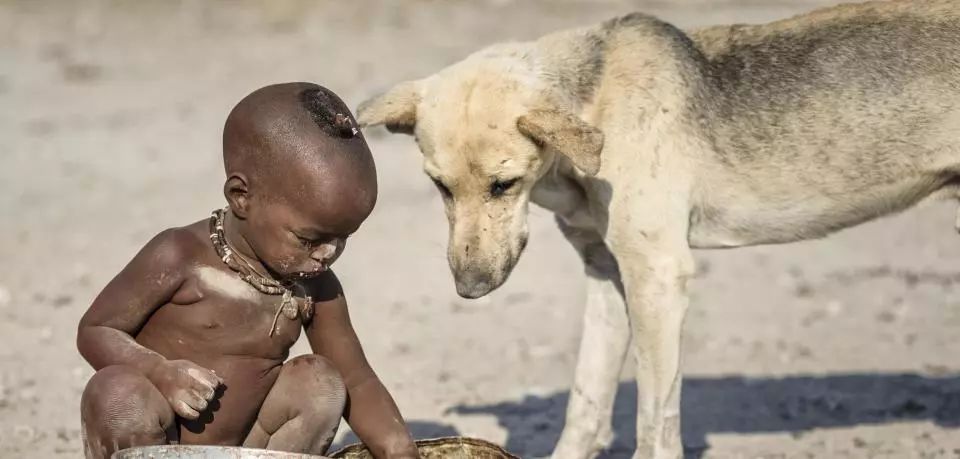
Do the figures on hunger in textbooks or official reports really make the issue clear?
2
Hunger: Never Simply a Food Shortage
How does hunger come about? The most obvious explanation is a shortfall in food supply. For example, where natural and social endowments are lacking, harvests cannot meet the population’s food needs. The FAO’s Global Report on Food Crises, published in March this year, also identifies the severe disruption that climate change and armed conflict cause to agricultural production as the primary drivers of food crises. But in fact, the world’s current food production is sufficient to feed 10 billion people. This may sound absurd: our food production is actually in surplus.
Why doesn’t surplus food feed a finite population? First, there is food waste: in its 2013 report Food Wastage Footprint, the FAO states, “1.3 billion tonnes of food are wasted worldwide each year — equivalent to one-third of the food we have already produced.” One kind of waste occurs at the production stage, during harvesting and storage; another at the consumption stage — after purchase, food bought in excess rots at home and is eventually thrown away. The FAO’s 2012 report notes that consumers in Europe and the United States waste 100 kilograms of food a year. The residents of the world’s twenty richest countries waste a combined 220 million tonnes of food annually — the equivalent of the entire sub-Saharan Africa’s total food output. “Everyone throws away what some people need; some people lack what others have in surplus.” In Caparrós’s account, on a vast rubbish mountain in Buenos Aires, thousands jostle and shove to find discarded sausages, chips, dog food, and tins. “This city threw away 200 to 250 tonnes of food every day in 2011.”
Second, not all food is meant for human consumption. A large share of the world’s food production goes towards livestock feed and biofuel. In the United States, the livestock industry consumes 70% of grain. Biofuel is an even more intensive consumer of grain: filling an E85 tank requires ethanol made from 170 kilograms of corn — enough to feed a Zambian for a year. Caparrós points out in his book that humanity needs ethanol to fill nearly 900 million tanks of that size every year; if the agricultural biofuel consumed by American cars were converted into food and distributed to every hungry person on the planet, each would receive half a kilogram of corn a day.
At this point, let us set aside the question of whether biofuel has a significant advantage in terms of cost and greenhouse gas emissions. But the figures above tell us two things:
First, although 800 million people currently go without enough to eat, solving their survival problem does not seem to be our top concern;
Second, if we continue to put the production of livestock feed and biofuel ahead of solving the hunger problem, then even if we upgrade agricultural technology, open up new farmland, and increase agricultural investment so that food production doubles by 2050, as the United Nations has called for, we still cannot solve the hunger problem.
If we wish to solve the hunger problem, there is no doubt we are capable of doing so. But are we truly willing to?
When food supply is ample yet cannot fully meet food needs, Nobel laureate in Economics Amartya Sen calls this a “failure of entitlement” in Poverty and Famines. An individual can acquire goods through production, trade, or a combination of the two; this is a person’s “exchange entitlement” to goods. Hunger, by contrast, means that a person can neither produce enough food nor obtain enough through exchange — in other words, a “decline in exchange entitlement.” Sen argues that shifts in entitlement relationships and the imbalance of distribution are the true causes of hunger. What he does not explain, however, is why famines occur when the total food supply is sufficient.
By tracing the participants at every stage of the food value chain, Caparrós attempts to answer this question, identifying one major cause as the financialization of food — the purpose of the current food system is to generate profit, not to feed people. In this system, food is stripped of its essential purpose — “for human consumption” — and transformed into highly complex financial derivatives. He points out that those who, on bulk grain trading markets, claim the market is the best regulatory tool are in fact artificially creating market “abnormalities” and profiting from every moment-by-moment shift in prices. The American scholar Frederick Kaufman also notes in Food Bubbles: How Wall Street Drives Hunger and Walks Away: “Food has become more commercial — it has turned into an investment, like oil, gold, silver, or any other commodity with a price index. The more investment flows in, the more expensive food becomes, and those who cannot afford it can only go hungry.”
These figures help us understand the problem more clearly: in 2003, investment in food commodities was $13 billion; by 2008 it had reached $317 billion — a 25-fold increase. Wheat trading volume on the Chicago Board of Trade is 50 times the world’s annual wheat production; every grain of wheat in the world is traded 50 times over here. Grain, as a basic necessity of life, should have very low market elasticity, yet in fact the price of a tonne of wheat in 2008 was three times that of 2005.
Meanwhile, globalization has propelled international trade, and international relations are increasingly interconnected through grain trade deals; developed countries have gradually seized control of grain production. Grain flows to where capital is concentrated, rather than reaching the hands of the poor according to need, and is increasingly becoming a tool of political intervention. The profit-seeking drive of trade and inflated grain prices have disrupted what Amartya Sen defines as the entitlement to food. People with limited purchasing power can no longer afford staple food, and smallholder farmers, facing extreme asymmetry in market information, are forced to bear enormous production risks. In 2008, the price of bread in Egypt rose fivefold — and then came the Arab Spring.
Caparrós says that hunger is not an agricultural or technical problem. It is a question of power and politics.
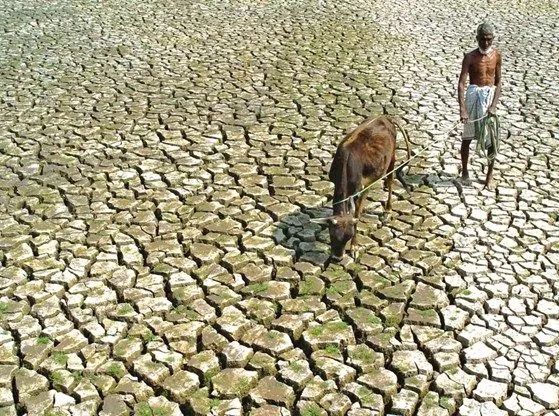
Famine and food surplus coexist — this is not merely an agricultural problem.
3
What Can Well-Fed People Do for the Hungry?
Caparrós admits he cannot offer a definitive answer to hunger, because it is an overwhelmingly complex subject. But that does not mean people who have enough to eat and wear cannot do something about it. What follows are a few of the most basic things I believe are possible after reading Hunger.
First, try to understand hunger. Food means satiety, relaxation, togetherness, and joy; hunger means weakness, illness, early death, and even rape, enslavement, and revolt. Hunger is ugly, and when we enjoy our food, hardly anyone wants to think about what it is like to have no food at all. But at least one thing must be understood: having a full stomach is a privilege that not everyone can enjoy; and equally, no one “deserves” to go hungry.
For decades, a popular refrain has been this: the poor are poor because they are lazy, stupid, and unable to keep up with the times, so it is all their own fault. Poor Economics (by Abhijit V. Banerjee and Esther Duflo) puts forward the argument that what traps “the poor” in their deprivation is not laziness or stupidity, but the fact that they spend enormous amounts of energy on things “the rich” simply never have to worry about: How do I get tomorrow’s staple food? How do I walk to another village several kilometres away to buy seed? How do I drink the only murky well water available without falling ill? … When city dwellers reach out to fill a glass from a water dispenser at a comfortable temperature, or scan a QR code to order a wide selection of ready meals, we have really no right to stand on a moral high ground and judge those who are desperately short of resources and exhausted from the struggle to survive by whether they are “diligent” or “smart” enough.
Second, support local agriculture and eat produce whose origin you can see. Eat less industrially processed food; buy ingredients directly from farmers at farmers’ markets or through CSA schemes rather than shopping at supermarkets or ordering online. The ever more sophisticated supply-chain technology means we can obtain food from far away faster than ever, at barely any extra cost, but this utilitarian convenience is driving a deeper wedge between us and where our food comes from. It also exposes agricultural production to an increasing number of distortions beyond simple supply and demand, making farmers’ risks harder to manage. Buying directly from farmers shortens the supply chain: the price consumers pay for produce goes more directly toward improving farmers’ livelihoods, without being divided up layer by layer by procurement, processing, packaging, and distribution. Consumers can also gain a clearer picture of the quality and provenance of their food.
Third: reduce meat consumption. On the one hand, livestock farming is the single largest driver of soybean cultivation — 97 per cent of the world’s soybean meal goes into animal feed. Driven by the livestock industry’s demand, soybean output grew tenfold between 1961 and 2009, with land originally used for staple food production converted to soybean; on the other hand, fuelled by rising meat consumption, ever-expanding livestock farming is devouring more and more land and water resources, further degrading the conditions for growing staple food. Controlling meat consumption does not mean going vegetarian; rather, it is a suggestion for consumers to think more about the impact their meat choices have on the food system and to reduce their overall meat intake. The 2016 Dietary Guidelines for Chinese Residents recommend that adults’ weekly intake of poultry and livestock meat should be between 280 and 525 grams — roughly 50 to 100 grams a day.
Fourth, reduce food waste and buy with restraint. Whether ordering at a restaurant or buying groceries, stick to what you can actually use, and put a stop to food waste. To take myself as an example, I have a bit of a hoarding “fixation” with food, and the market is a fair distance from home, so every trip to the shops I end up buying more than the fridge can hold. But I set myself two challenges: after each big shop, to stick to preparing and eating all three meals at home, or bringing packed meals, from Monday through Friday; and to wait until the fridge is nearly empty before the next big shop. This has cut food waste dramatically and also given me far better control over what I eat.
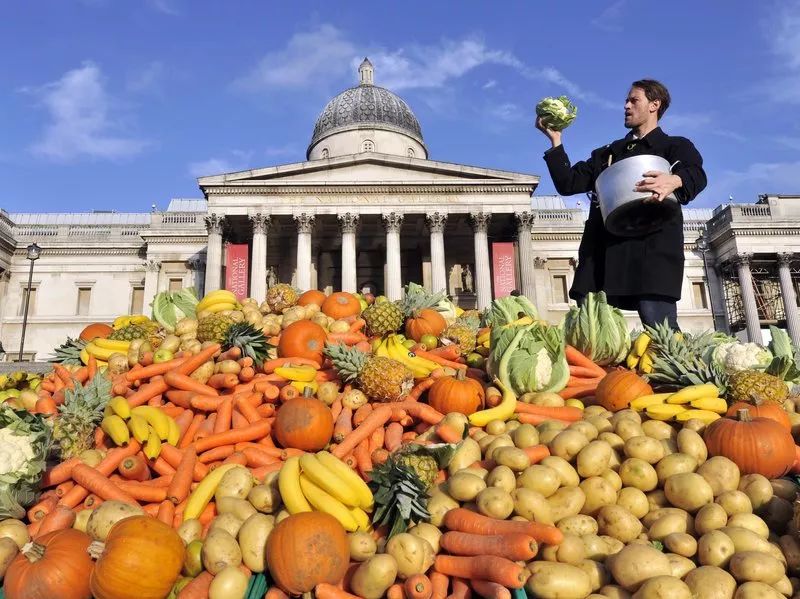
Various practices and movements to reduce food waste have emerged worldwide, including “Disco Soup” — where organizers collect supermarket food discarded for failing to meet cosmetic standards, prepare it into meals, and share it with the public at open events, while promoting sustainable food values. Image source: NPR/Feed the 5000
4
The Metaphor of Hunger
Hunger is an uncomfortable book to read — Caparrós’s narrative shifts rapidly between somber and elevated cadences, driven by the sleepless, unrelenting passion and fury of a social activist. For instance, he satirizes our habit of slotting “hunger” into all manner of -isms, as if coining the term “structural hunger” fulfils the task of understanding it. For instance, he argues that most efforts touting a humanitarian solution to hunger amount to nothing more than leveraging global mechanisms, never questioning the order or the entitlements. And for instance, he never ceases to remind you: people are still going hungry, people are still dying — and we, as participants in a failing food system, know almost nothing about it yet remain complicit, and cannot escape our share of the blame.
In India, Caparrós went to ask a widow in a village: “Doesn’t enduring hunger cause you suffering?”
He was immediately ashamed of his question: “I felt ashamed, like a lump of shit. An old monkey was calling out from the roof, and I felt it was telling me to stop talking.”
This gave me some measure of relief: it seems I am not the only reader who, while reading, felt anger, powerlessness, and shame at the hunger described in the book. It reminded me that if you genuinely care about poverty, hunger, and related issues, then experiencing all three of those intense emotions is probably simply the norm.
I cannot sum up this book in a few thousand words, sum up the hunger that Caparrós has narrated. Because those conversations, reflections, emotional catharsis, cowardice, and fury cannot be distilled or compressed, nor can they be rendered in charts and reports — and “hunger” is, precisely, pain that cuts to the bone.
Hunger is not merely hunger; it is a metaphor about humanity, interests, and power. “Hunger is a metaphor of division: a stark barrier between them and us, between those who have and those who have not, between the fact that some have and some do not. Ecological theory and climate change create a sense that everyone shares responsibility equally, but hunger is the exact opposite — it is the most class-based of threats. Many of us know full well that this is not our problem. So why has it become our problem?”
Hunger will make us take this question seriously and sit with it: “Why, knowing full well that these things are happening, can we still go on living as if nothing at all were wrong?”

Author: [Argentina] Martín Caparrós
Publisher: People’s Literature Publishing House
Translators: Hou Jian/ Xia Tingting
Published: June 2017
Price: 58.00
ISBN: 9787020126682
References:
[1] World Food Programme: Zero Hunger, http://www1.wfp.org/zero-hunger
[2] Livestock’s Long Shadow, UN FAO, 2006, p43
[3] The State of Food Security and Nutrition in the World 2017, FAO, http://www.fao.org/3/a-I7695e.pdf
[4] Dietary Guidelines for Chinese Residents. http://dg.cnsoc.org/
Today’s little easter egg: what exactly is “famine”? This song will tell you. Click “Original Link” at the bottom of the article to jump straight to the lyrics.
If you enjoy Tianshu’s articles, you can also follow her personal WeChat public account — it is full of beautiful writing! 👇
Witness the wonder and joy beyond the ordinary
Whalewatch Guide whalewatch
– You might also like these articles –
A Taste You Must Not Miss in Spring (Part 1): Thunder Rumbles, Bamboo Shoots Grow
“One-Pot Abbess” and Her Culinary Creed: Attuned to Place and Season — Just Right!
Species Vanishing, Soil Degrading — If Humanity Ignores This Report, It Will Be Too Late!
Have you ever seen Beijing’s Xinfadi agricultural produce wholesale market at 3 a.m.?
Without Clean Rivers, There Is No Safe Food
The Transformation Master of the Wheat Fields: He Turned Farming into Flashy Showmanship
From Laughing Stock to Eye of the Storm: Small Machines Rattle California’s Tomato Industry
A Popular North American Supermarket Strategy: Stick to the Edges, Stay Out of the Middle!
China’s “Green Era” in Agriculture and the Ecological Transition of Smallholder Farmers
Smallholder Economies in a Great Power: What Jack Ma Couldn’t Do, They Did!
Remarkable Mothers of Chengdu: A Cooperative Path from Self-Help to Mutual Aid
Tianfuyuan: From Urban Gold-Collar Professional to Rural Village Woman — Farming Is Now Her Life
CSA Conference on the Ground (Part 1): Farmers, Consumers, Markets, Schools, E-Commerce — Not One Can Be Missing
CSA Conference on the Ground (Part 2): Sales and Certification for Ecological Smallholders?
CSA Farm Survival Forum: Transcript (Part 1)
Food and Farming Education in CSA — CSA Conference on the Ground (Part 4)
How Do Delicious Strawberries Come About? Take a Look at the Crazy Farmer Wang Xin’s Field Secrets
The Right Way to Tackle Smog? Support Ecological Agriculture!
Rooted in the Soil, Free as a Bird — A Homecoming Youth’s New Year Vision
At the Filming Location of Little Forest in Japan, I Sneaked Into an Abandoned School
Schools and Development of Natural Farming and Organic Agriculture in Japan
Gourmand’s Guide to the Future World (Part 1)
Gourmand’s Guide to the Future World (Part 2)
US-Style Mega-Farm “Invasion” of Britain Sparks Controversy
What Makes Organic Farming Good? Can It Feed Us?
New Study Finds: China’s Organic Farming Yields 2 Billion Yuan in Annual Environmental Benefits
After Slow Food, Slow Thinking: Speaking for Farmers or Backing Commercial Capital?
Why Eat Slow? They Gave These Answers at the Slow Food Congress