The Modern Person: Craving Nature in the City and Air Conditioning on the Land

Having completed my undergraduate studies in 2025, I did not rush to find a stable job. Instead, I wandered round and round, exploring what I had assumed to be a good life. As the years went by, having grown up amid cramped buildings and concrete, I began to realize that nature could soothe and hold me. Entering nature meant relaxation, but the moment I left it, I felt burdened, as if the anxiety pervading human society suddenly flooded my body.
Of all lines of work, agriculture is relatively close to nature. So I signed up for Foodthink’s 2026 ecological agriculture internship programme and came to Baicaoyuan in Guigang, Guangxi, in early March this year.
Does Peach Blossom Spring Exist?
Within the bounds of Baicaoyuan, a small ecological Peach Blossom Spring has formed: kitchen waste and faeces for composting; plastic waste is taken to town to be thrown away; all cleaning and personal-care products are ecological products, so when washing, they simply go straight down with the water, quite unselfconsciously, following the brick-and-stone slope into the ground and joining the soil runoff; no pesticides or chemical fertilisers are used on the crops or fruit trees, letting them grow “wildly”.
But at the edge of Baicaoyuan’s Wogan orange trees, a mere few metres away, lies another orchard, another world.
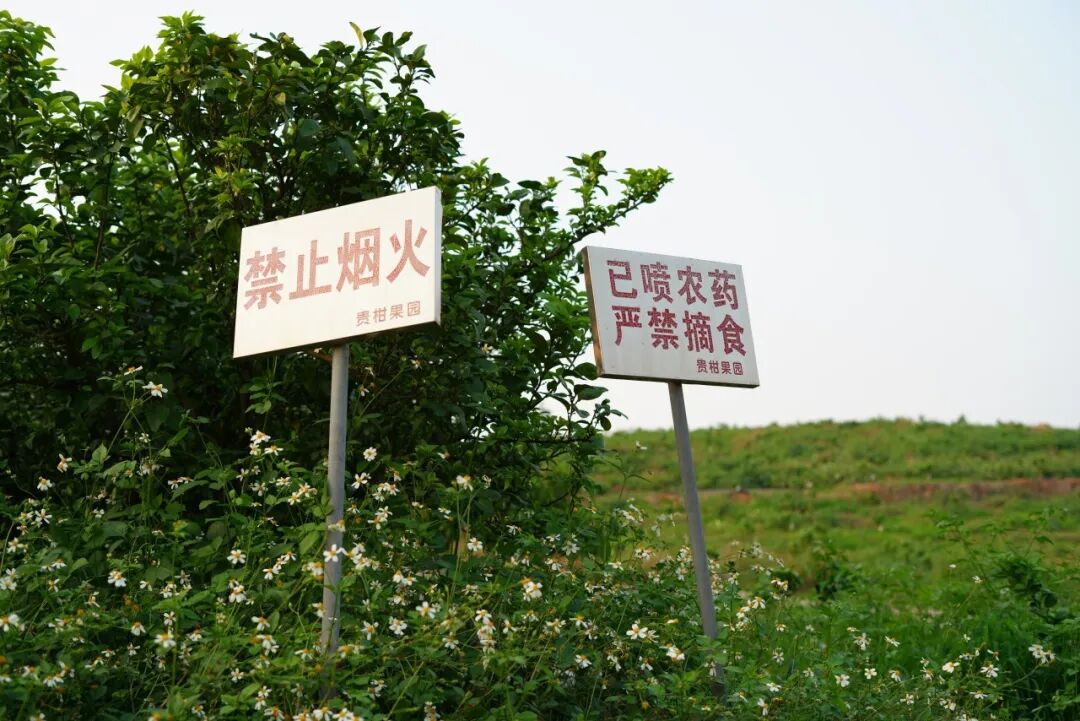
◉ Signboard in the neighbouring orchard.
The branches of the fruit trees are studded with large, golden-yellow fruit; almost no grass grows at their edge, just a bare yellow expanse. On Baicaoyuan’s fruit trees, a few false fruits remain. Weeds surround the trees, and some grow even close to the roots, their stems winding among the branches of the fruit trees. This is the most obvious visual difference I have perceived here between conventional planting and ecological planting. Even more subtle is the difference in taste. The Wogan oranges from conventional planting have a sweetness that lodges in the throat, sticky, cloying, unable to enter the body; Baicaoyuan’s Wogan oranges are fresh and sweet, delicious, moistening the inside of the body without leaving a trace. This difference has to be savoured and tasted slowly, felt with the whole body.
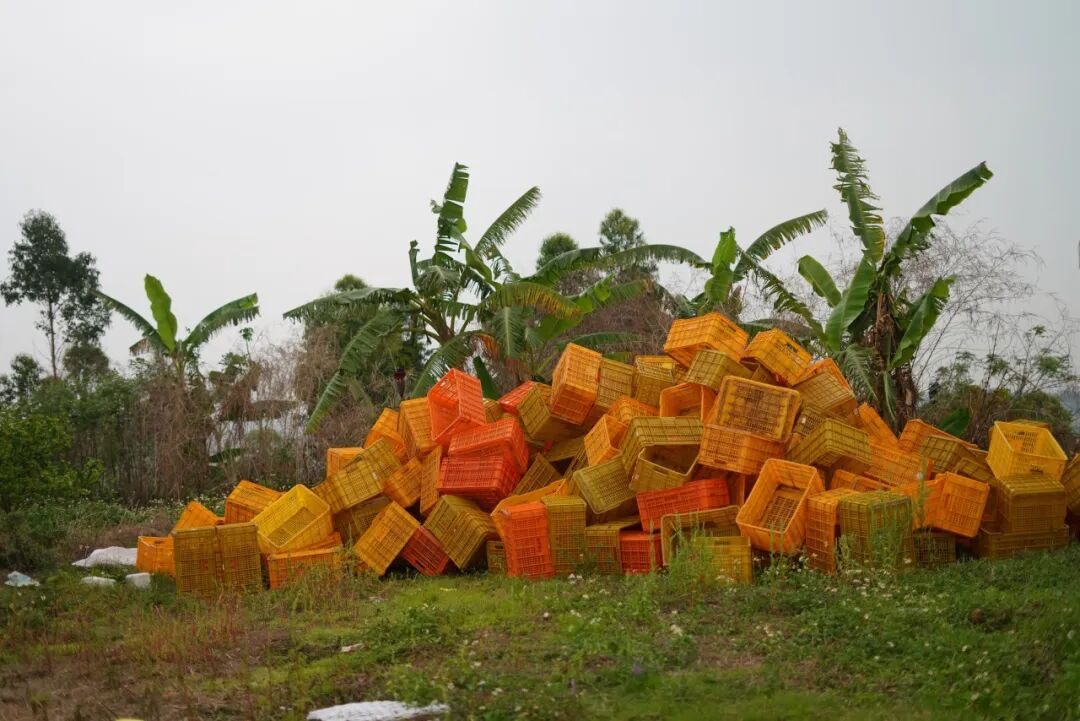
◉ Fruit box in the neighbouring orchard.
On another small hillside not far from Baicaoyuan, every tree and every blade of grass has been pulled up by the roots and wiped out. In the end, it is likewise a bare yellow expanse. In April, fruit trees were planted on this land; drip-irrigation pipes lie horizontally and vertically across the ground, entrenched in place, and the plastic waste in the soil has been laid bare.
One morning, we set about clearing a field that Sister Yan Ping had newly rented, and the first thing we did was pick up waste. The waste in the soil consisted mainly of plastic film, plastic bags, plastic bottles, bags that had held pesticides and chemical fertiliser, and woven plastic sacks. Some had been buried so deep that I could not even sense its end. Some was so tangled that it could not be cut free or untangled; as it was pulled up, it slowly crumbled—countless white fragments flew out from the point where it broke. Picking up waste is something that saddens me. The plastic waste in farmland can never be picked up completely; I joke that I am Sisyphus, picking up waste.
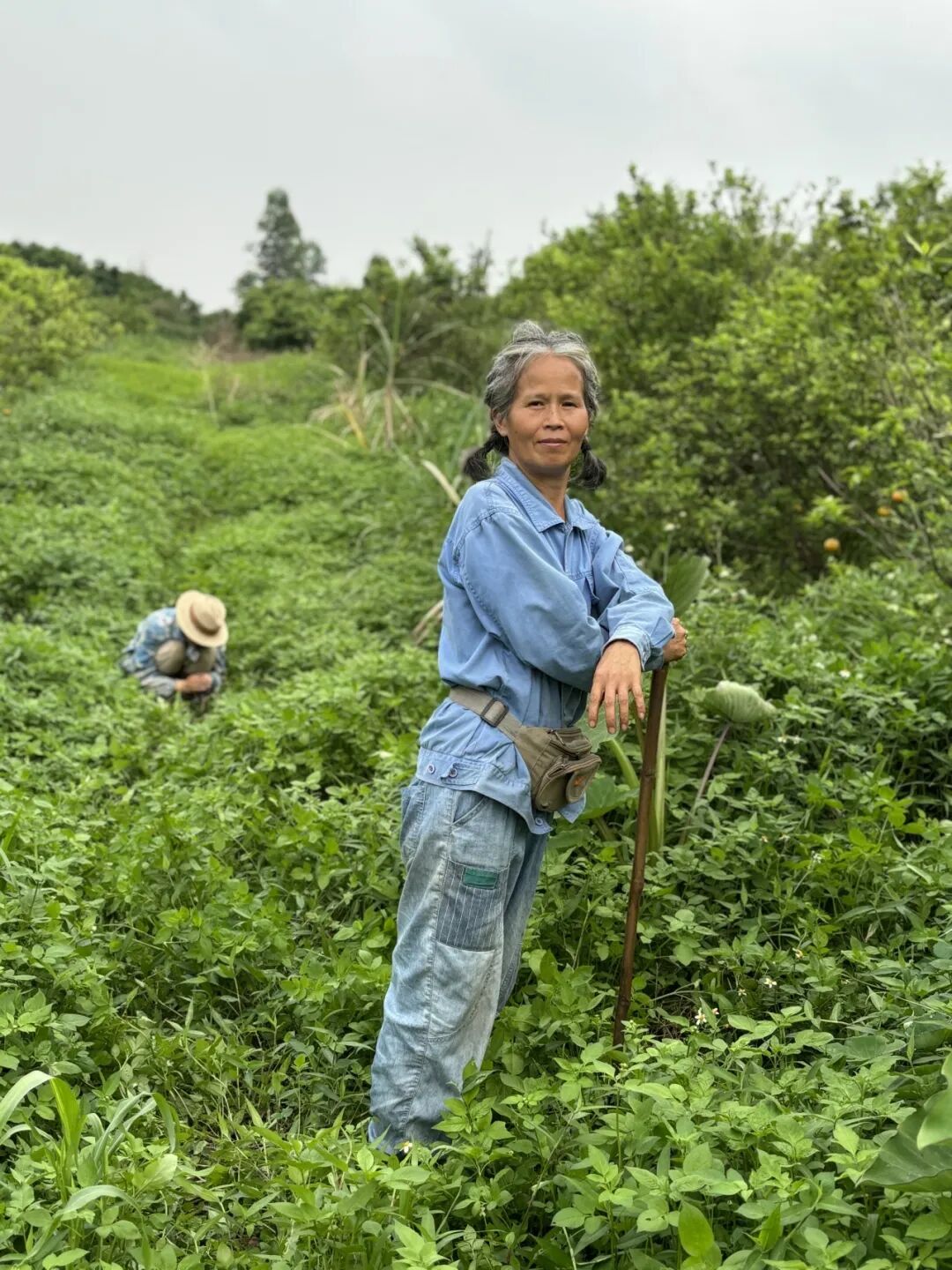
◉ Sister Yan Ping at work. Photo by Chen Yujun.
Sisyphus and the Slowness of Agriculture
When I first started doing farm work, I often felt like Sisyphus, too. At first, I found farm work repetitive, boring, slow, and endless.
When I hoed the ground at Baicaoyuan, it was the first time I had ever held a hoe. I did not know how to hold it or carry it, so I could only silently watch Sister Yan Ping or Xiaona, observing and learning from their movements. Then I clumsily picked up the hoe and clumsily hoed the ground, feeling awkward all over. With my strange movements, the hoe veered off in crooked directions, making it hard to dig a deep hole. Before long, my body had begun to tire, and a faint sense of frustration rose in my heart.
Agriculture is inherently slow. I am slow when doing farm work because I have not yet truly mastered the technique; skilled farmers can plant a seedling in just a few seconds. Their “speed” is in fact built on a long accumulation of “slowness”.
But there are differences between one slowness and another.
There is a kind of slowness that is low quality. When one is not in the present and not fully engaged in what one is doing, one becomes scattered and listless. Time is stretched out, but it neither settles nor enters into the matter itself. This slowness is, essentially, a kind of drift and drain. But another kind of slowness is good. For instance, pacing and thinking slowly, letting thoughts gradually unfold; or doing things neither rushed nor drawn out, with body and attention both present. This slowness is a time with density. So the question is not whether one is fast or slow, but whether one has truly entered into time.
Later, as my body gradually came into a good working relationship with the farm tools, I occasionally felt a sense of ease—I would lift the hoe lightly and let it fall under its own weight, and a small hollow would open in the soil; then I would draw the hoe toward me, and a little pit would appear. A small sense of accomplishment followed.
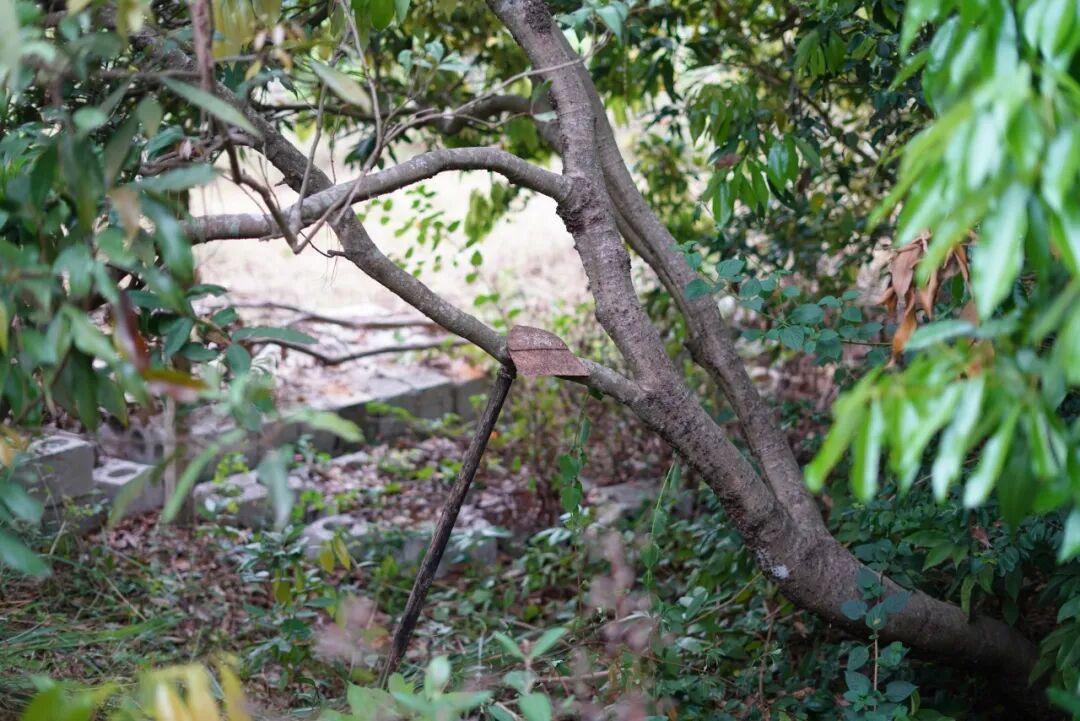
◉ A worn-out hoe.
But the land will also give you other problems. Sometimes the hoe strikes a stone in the soil. If it is a small stone, you can angle the hoe slightly and dig it out; if it is a large stone, you either back off in the face of the difficulty, or step back a little, dig away the soil clinging to it, expose the stone, and then remove it by hand.
As for stones, brute force is ineffective. It is the same for other things.
After adapting for a while, when I worked in the land again, time always seemed to be drawn out, and now and then a calm state of flow would emerge. Attention on the land is not constantly fragmented, so farm work produces a kind of mental relaxation.
At Baicaoyuan, I carried water with a carrying pole for the first time. The rounded part of the bamboo carrying pole pressed against my right shoulder, and the curved hooks at either end gripped two small, half-full buckets of water. I crouched in the middle, my left hand guarding the front, my right hand steadying the back, and rose slowly, slowly. My right shoulder gave a slight pang, and then I shifted my feet and moved forward, step by step.
It is physical work, but when I realised that my body was not frail and feeble, that it could still carry water on the pole, I felt a subtle satisfaction and a trust in my body.
Baicaoyuan’s only mechanical farm tool is a brushcutter. To use it, you have to carry one end on your shoulder and raise the other end, the one with the blade, to a certain height, and move forward slowly.
The brushcutter is very heavy for me and makes a great deal of noise. It is often Sister Yan Ping who uses it to clear a path. When the brushcutter is working, I need to wear earplugs, or move away from it to reduce the noise.
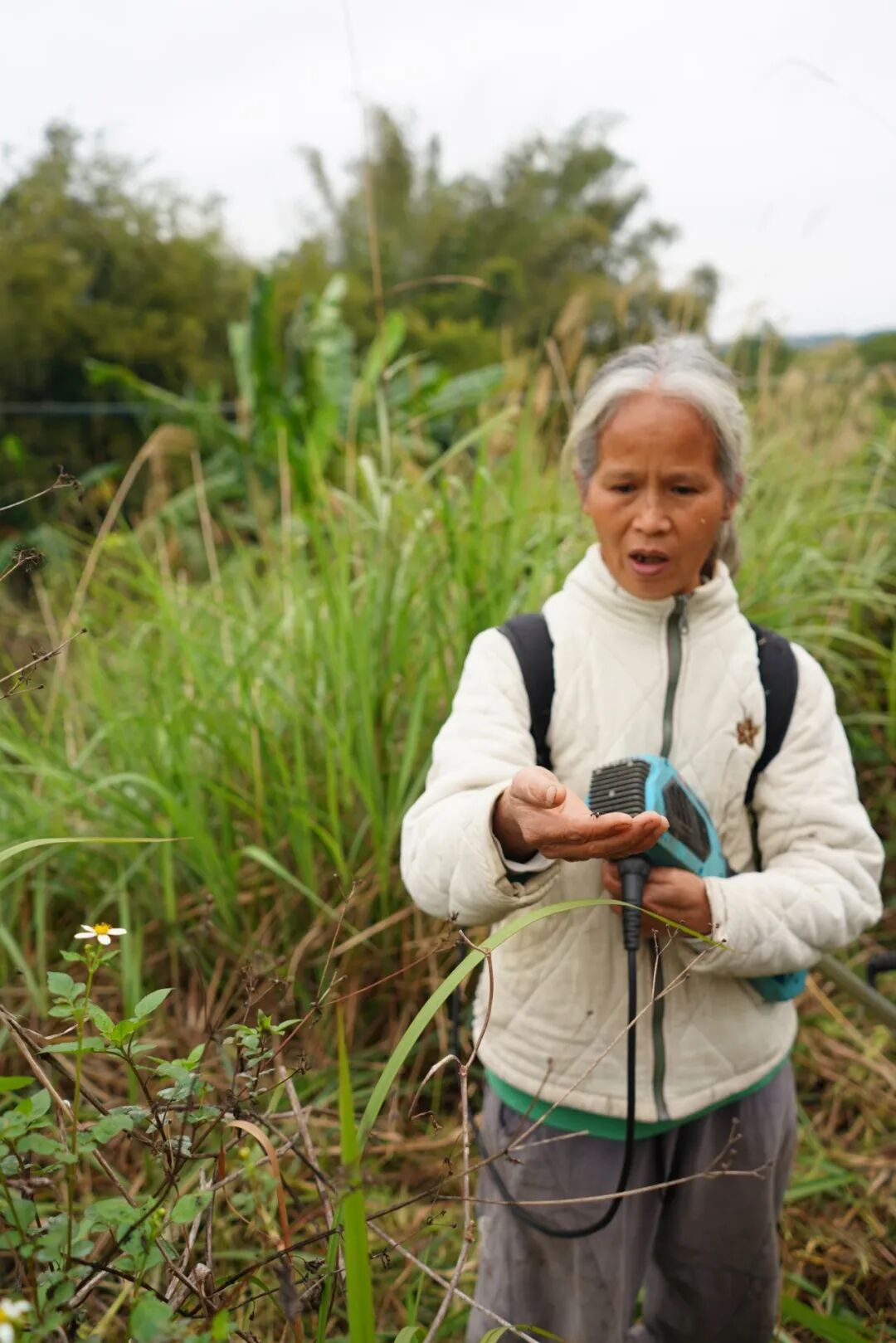
◉ Sister Yan Ping finds an ant nest while cutting grass.
I even feel that a mechanical farm tool such as a brushcutter is more exhausting than traditional farm tools. It has to remain perfectly still on the body; the only part that moves is its blade—which puts great pressure on the shoulder. Later, after using the brushcutter for several days in a row, Sister Yan Ping felt pain in her shoulder. I helped her hold the handlebars of the three-wheeled motorcycle, and we went into town together to see a doctor.
When one uses a traditional farm tool such as a hoe, one’s body and the tool form a single linked whole. Force is continually transmitted among the body, the tool, and the land; one moves with the rhythm of the tool, and the tool, adjusted by the person, works better with the soil. Once one has learned to do farm work without strain, one is less likely to feel tired and sore, and one may even feel light and comfortable.
III. Surrender to Nature
At Baicaoyuan, I experienced a life entirely different from anything I had known before. When life is so close to nature and the land, the body is bound to surrender—to the ghost-needle grass whose burrs cling to my shoes, socks, and trouser cuffs; to the marks insect bites leave on my arm; to sudden downpours with fierce winds; to prolonged drought; to the weight of the carrying pole laden with water; to the rugged, uneven paths that are hard to walk; to the wild grass that covers hills and fields; to the mice that scurry along the roof beams every day and the cockroaches that dart through the rice jar; to the colonies of microbes that cause food to ferment and mould—but I will not surrender to the plastic agricultural film in the soil or the rubbish beside the graveyard.
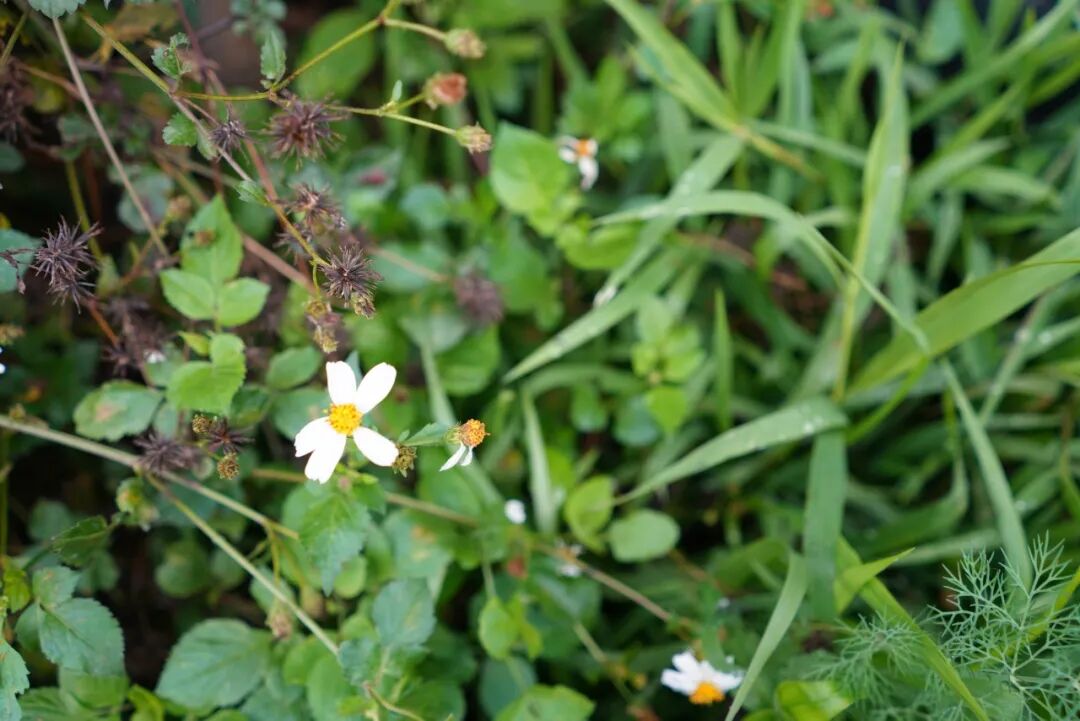
◉ Ghost-needle grass.
Looking back now, what left the deepest impression was that sudden stormy day. This is the storm scene I wrote down that afternoon:
“After the thunder and lightning, the sky changed in an instant, darkening and turning grey; the sound of rain and wind merged into one, and the plants slanted in every direction. I hurriedly brought in the clothes hanging on a tree branch outside. The rain blown into the room fell fine and chaotic, the wooden floor marked by patch after patch of damp, and a dampness crept over me, accompanied by a faint chill spreading through.”
“A few aunties working on the neighbouring farm were sheltering from the rain at the doorway and began singing mountain songs. Sister Yan Ping warmly invited them in. We set out the small wooden stools and sat in rows. As the rain grew heavier, people’s movements grew hurried—quickly gathering the mulberries and Job’s tears stalks drying under the eaves, pulling up the bamboo blinds, moving further in, warming by the fire. The wind bent the flames to one side, and people hurriedly moved away. The small space was soon crowded full. There were mountain songs, chatter, and the sound of wind and rain. I gradually found it hard to settle my hearing; my whole ears, auditory nerves, and brain were on the verge of collapse. I raised my camera and tried to record all of it; it seemed to work. Through the lens I watched the people, plants, wind and rain, and fire, and gradually calmed down.”
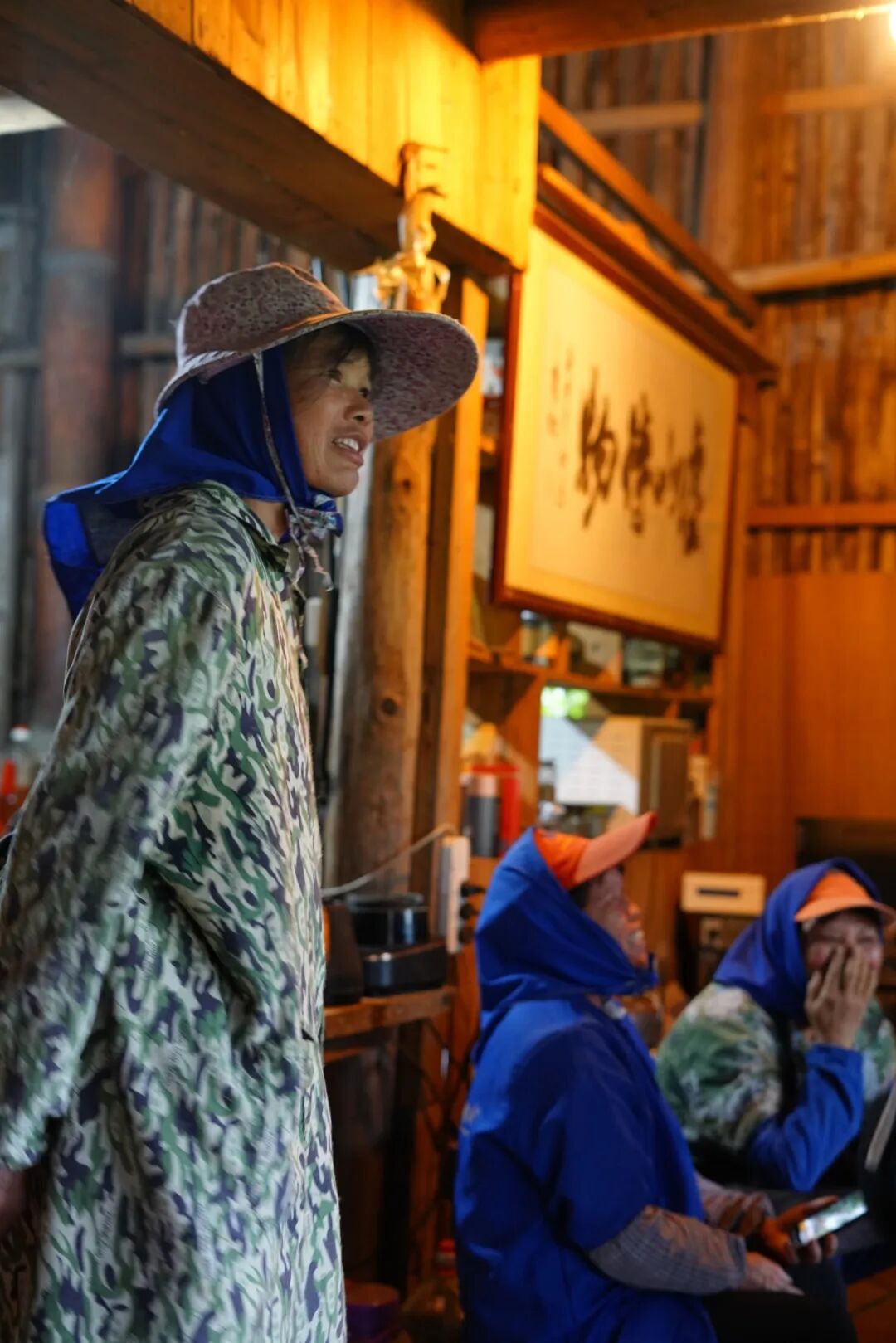
◉ The aunties sheltering from the rain.
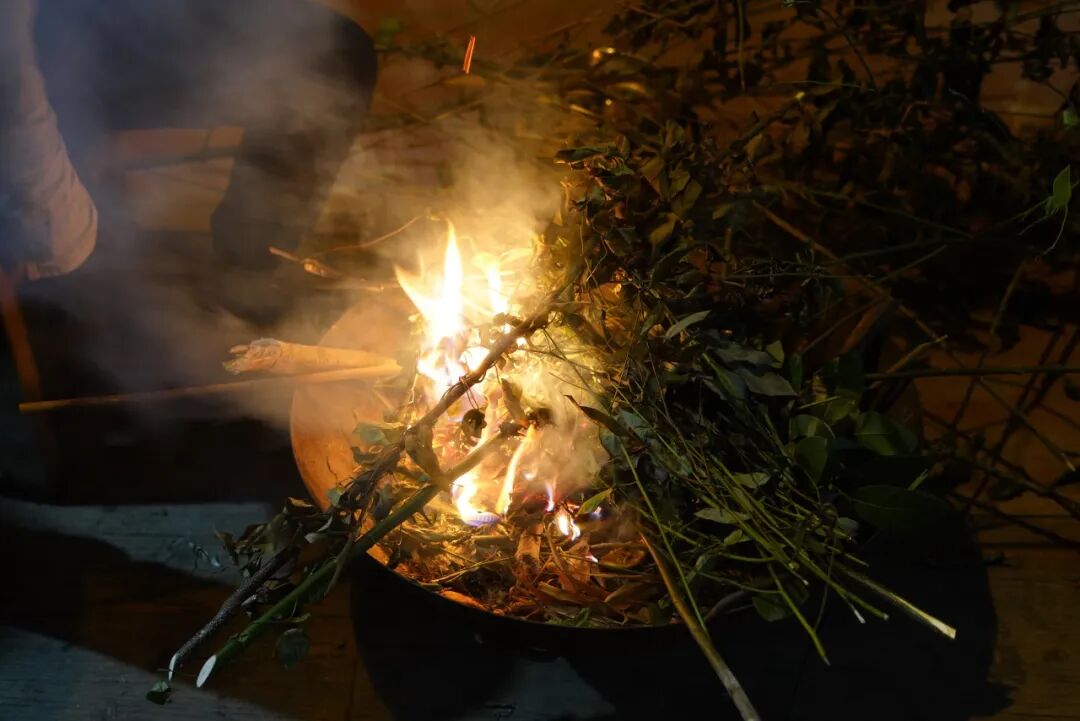
◉ A day of torrential rain, warming by the fire indoors.
Later, another torrential downpour came in the dead of night, equally sudden. The sound of rain instantly filled the whole ear I had pressed against the pillow; I woke with a start and could not sleep again. I went downstairs by the wooden ladder and found that the wooden floor had been soaked and the odds and ends on the table were damp. I quickly moved them into a small room that was relatively dry.
After going through such times, one rediscovers a sense of awe before nature.
Here, too, I experienced a role close to that of a producer. Food was either gathered or cultivated by myself, or exchanged with farming friends; the three daily meals were prepared by myself, sometimes beginning with making a fire. All travel was to places reachable by electric three-wheeler, such as going into town to collect a parcel, or going to nearby Yulin City to tend another field. Food, clothing, housing, and travel returned to a small scale.
In remote, impoverished parts of the countryside, one undertakes production work, willingly or not. In the city, one’s time is fragmented by work, and one often passively becomes a consumer.
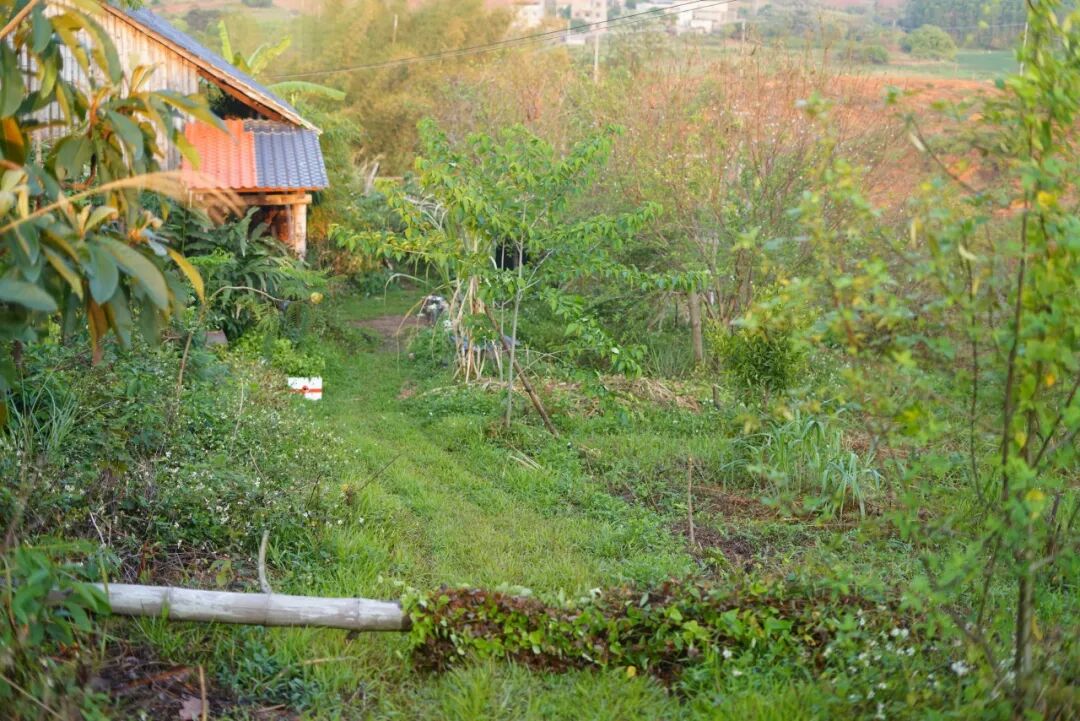
◉ A corner of Baicaoyuan.
IV. The Day I Left
After a month of living and working at the farm, I found the summer heat unbearable and decided to leave.
On the day I left, Sister Yan Ping took me to the high-speed rail station on the three-wheeled motorcycle. The afternoon was muggy, and the sunlight was dazzling. As the speed increased, a wind rose and blew away some of the heat. Halfway there, Sister Yan Ping and I swapped seats, and I took over the driving. The light reflected from the road shone straight into my eyes; I narrowed them and stared intently ahead. The experience is completely different for the driver and the passenger.
I remember the first time I rode this three-wheeled motorcycle; I took turns practising with Xiaona. Starting from the doorway of the wooden house, ahead was a narrow slope, with a bamboo frame set up alongside. Further down was a slightly wider sloping road. After turning left and driving a short distance, I reached the flat ground in the village. The slope was bumpy. I was trembling, but I kept my fear in check, controlled the speed, and drove forward slowly, slowly. When I reached the stretch of slope leading onto the flat ground, the vehicle suddenly jolted violently, and I tried my best to steady myself. Believing in myself and in the stability of the three-wheeled motorcycle, I finally made it onto the flat ground.
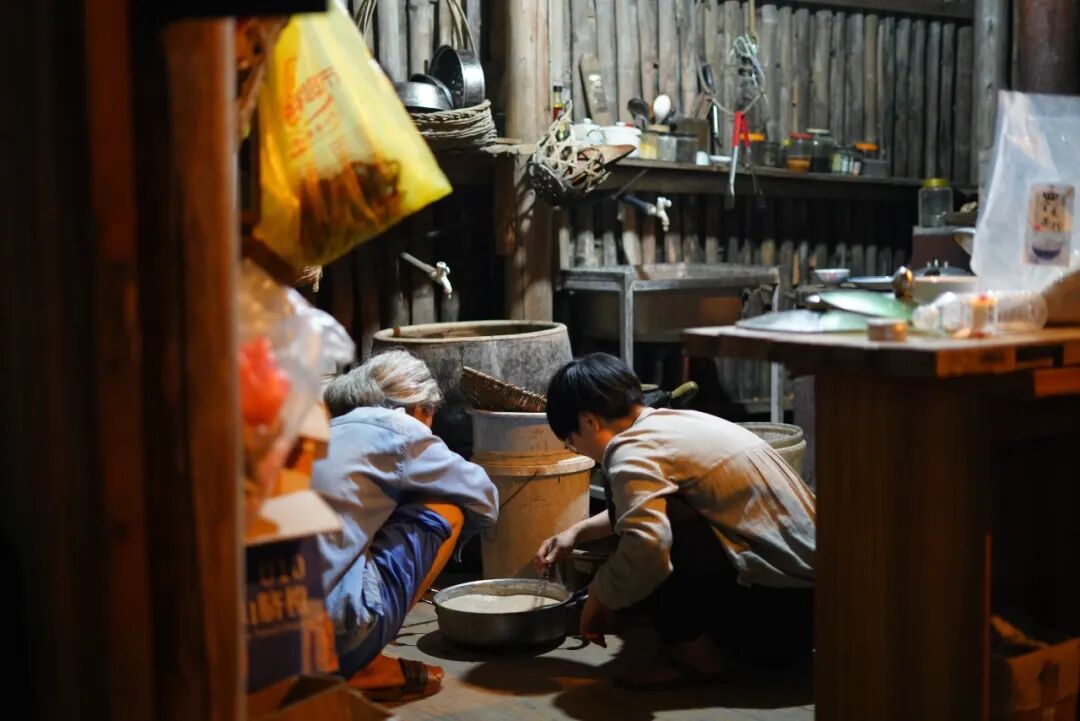
◉ Xiaona is on the right, looking with Sister Yan Ping at the bean paste that has been fermenting for several days.
It was Xiaona’s turn to take over. I stood to one side, and before I could react, she suddenly sped up. The vehicle darted off, and just as it was about to turn into the small path, Sister Yan Ping and I hurried after it. After it turned into the fork, she still had not controlled the speed. In an instant, the vehicle had hit a tree by the roadside. Xiaona probably had not handled the fear inside her well, and that tension made her movements flustered, which is why the accident happened. It seems that going slowly has its benefits.
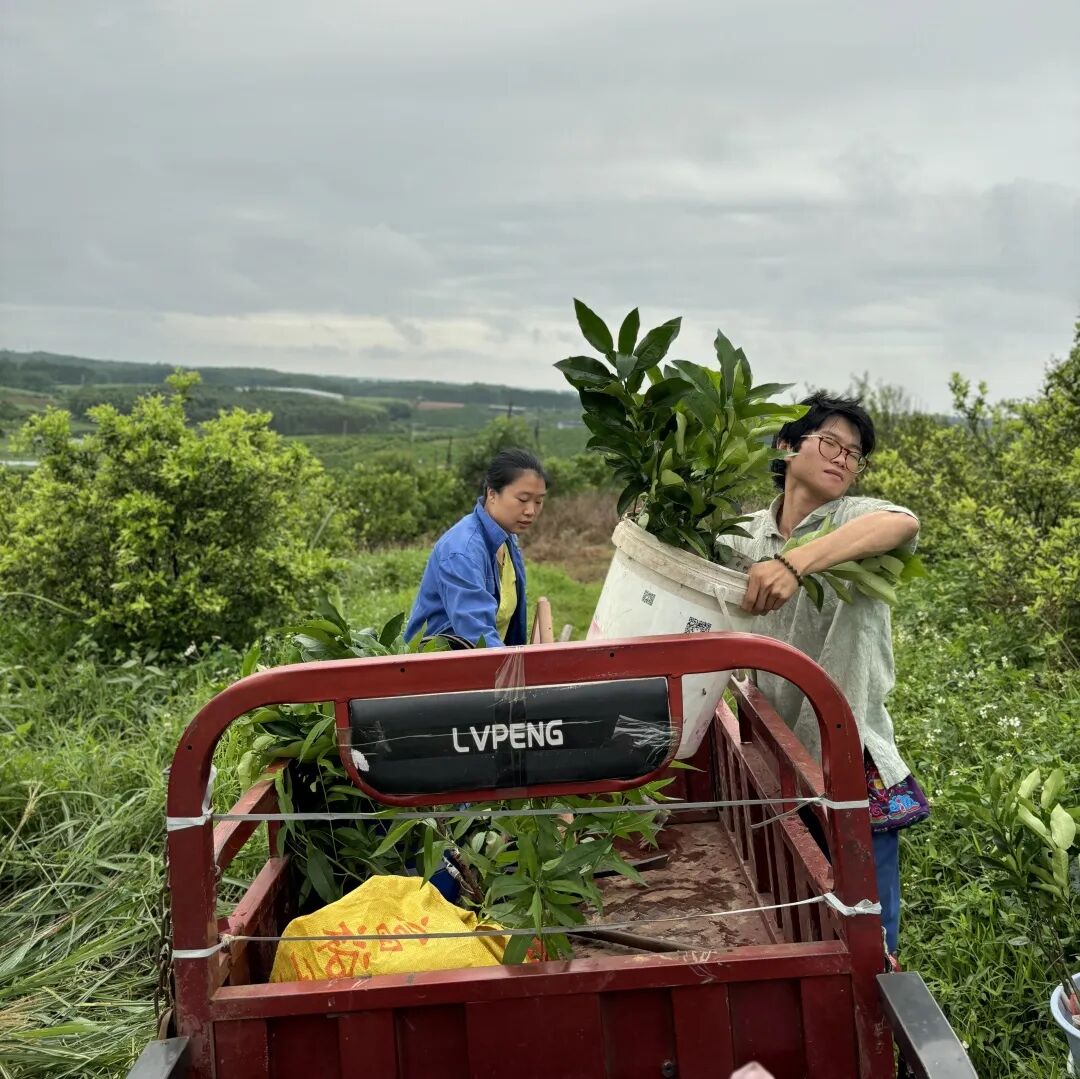
◉ The three-wheeled motorcycle at Baicaoyuan. Image source: Chen Yujun.
Driving on the flat road to the high-speed rail station was within my comfort zone. As long as there was no oncoming traffic, I gradually accelerated to top speed. If there was oncoming traffic, I slowed down in advance and moved over whenever I could. However, I am not someone who can bear the summer heat. For the last stretch, Sister Yan Ping drove again, and I dozed off beside her.
In April, Guangxi had already become a bamboo steamer. During the last few days at Baicaoyuan, the summer heat seemed to glue my head shut. I felt my mind was muddled and my body weary and heavy; it was very hard to bear, like a kind of brain fog caused by the heat. It was not like the emptiness in the head during work, but more like a mass of hot paste in the brain. I think my brain and nervous system really do need the right environment in order to function.
Postscript
The Modern Person Craving the Land
By the time I wrote these words, I had already returned to the crowded, cramped urban space. I could immediately feel the difference between nature and the city—at Baicaoyuan there was no gap between people and nature, whereas in the city people have to go to parks, to man-made things, to seek out a nature that has been carefully tended. The city is a vast top-down system to which people’s time is handed over, and because people are kept far from first nature and the site of production, they gradually lose their sensitivity to weather and to the rhythms of nature.
Yet during my time at the farm, I also often felt lost. I always felt that, apart from working, there was just cooking, eating, and resting or sleeping; I no longer had time for reading, writing, or learning. I could only steal time in fragments, striving and thirsting to absorb some words. I was also sometimes afraid that I might be wasting time.
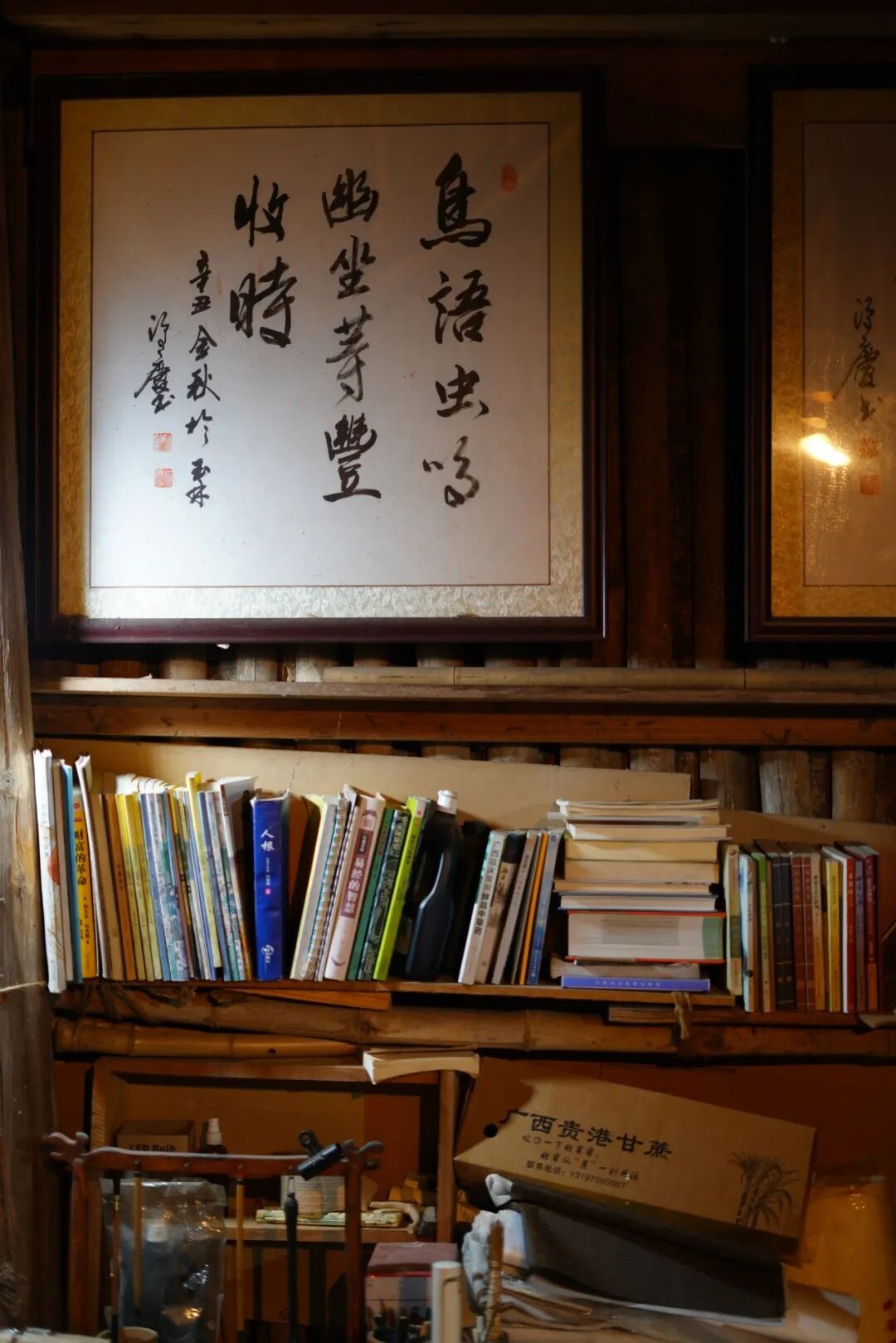
◉ A corner of the desk.
Farming is an ongoing, repetitive cycle, and it gives you a certain amount of immediate feedback—plant one, then the next. But crops take time to grow, and this silent growth feels unfamiliar to me. I often wonder how farmers can endure plant growth cycles that last months, even years.
I am unable to get any feedback or emotional stirring from the growth of the crops. For me, it does not amount to “meaning”.
I did not make the ecological farm my final base; it is a potential part of my ideal life. During my time at the farm, I was still dealing with other work at the same time. Sister Yan Ping then said, “Do not try to do two things at once.” For the time being, I am unable to stay in one place the way Sister Yan Ping does. I, too, want to do things single-mindedly, but at this stage of my life, I must put out different feelers so that I can better reach the life I want. For the time being, I am unable to stay in one place the way Sister Yan Ping does.
Looking back now on my time at Baicaoyuan, I think it allowed me to savour, truthfully and afresh, in body and spirit, the life and labour of people in nature, and to appreciate more deeply how precious food is and how hard-won it is. I have also come to realise that I am still a modern person, not a person of nature: I cannot get away from air conditioning or the city, and I cannot truly live as farmers do. But in my own way, in the spaces between city and countryside, tradition and modernity, and consumption and production, I will explore a good way of living.
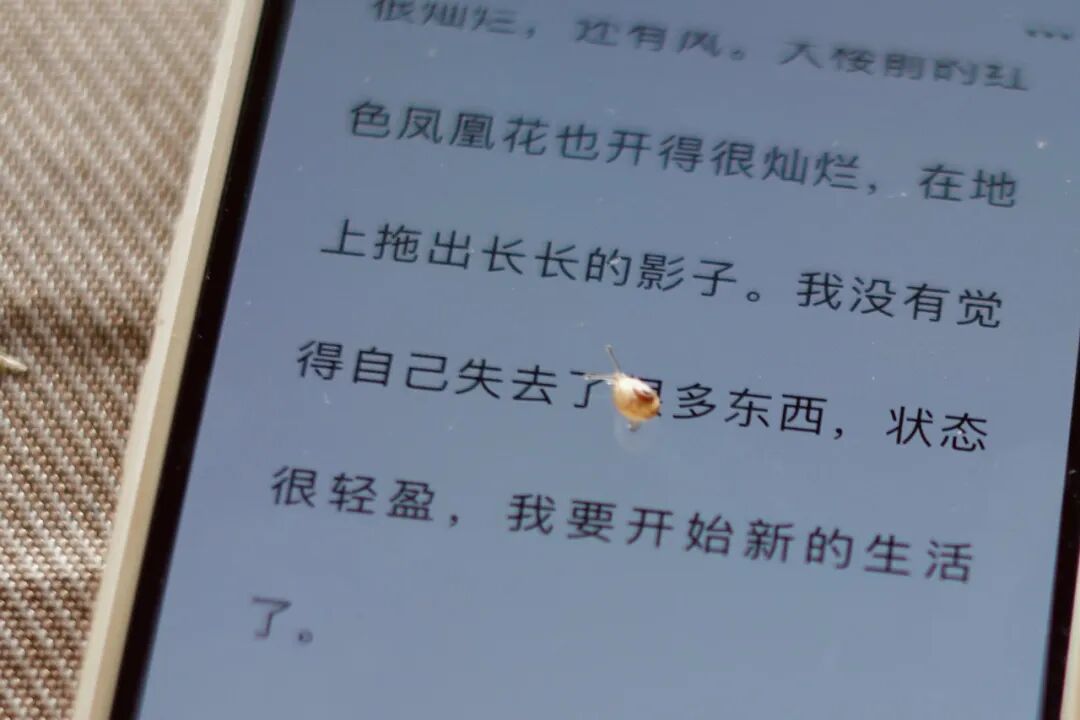
◉ While reading at Baicaoyuan, a little snail crawled among the words.
– This is Foodthink’s 821st original article –
Foodthink
Author:
chisel
Walking slowly through the world, writing and observing.
Unless otherwise noted, all images are by the author.
Edited by Yuyang
Layout by Minglin
Scan the QR code to tip and support original food writing
▼

▼
Click the image to read related articles
▼
Click the keywords to explore more article collections.
Seeds | AgTech | Policy | Fermentation | Nutrition | Fruit | Fisheries | Events | Jobs | Takeaways | Wet Markets | Livestock | Food Talk | Sharing Sessions | Book Clubs | Bumper Harvest Celebration | Smallholder Stories | Climate Change | Rural Development | Co-operative Economy | Urban Farmers | Food Safety | Digital Technology | Biodiversity | Pandemic and Food | False Solutions | Agroecology Internship Programme
Beijing | Hebei | Shanghai | Guangdong | Guangxi | Henan | Sichuan | Jiangxi | Xinjiang | Shaanxi | Hong Kong | Chongqing | Zhejiang | Jiangsu | Guizhou | Taiwan | Inner Mongolia | Philippines | Canada | Russia | Mexico | Italy | United States | United Kingdom | Germany | Netherlands | Thailand | Sweden | Japan