Don’t Let Rice Straw Become the Last Straw for Village Cadres

The Strictest Straw-Burning Ban Season
Everyone could feel that the straw-burning ban had suddenly become serious.
This is Village A in 2025, in the heart of the Dongting Lake area in Hunan Province. The terrain is flat, and it is a major rice-producing area. The village has several thousand mu of farmland, mainly planted with single-crop rice, sown in spring and harvested in autumn. In winter, crayfish are farmed and oilseed rape is grown. In addition, about a third of the farmland lies in winter fallow, or a small area is planted with double-crop rice.
“My bosses all called me: ‘Do not burn, whatever you do, do not burn!'” Zhao Hai, who has helped farm several hundred mu of land for people in Village A, remembers it vividly. Previously, year after year he had seen people going into the fields to publicise and persuade, but the straw was burned all the same.
The old village secretary, Sun Weimin, understood that this year was different. Although the national straw-burning ban policy had been in place for more than a decade, enforcement in practice had been loose in some places and tight in others. Village A had been on the looser side. In the past, the county would issue notices to the village office, and the townships would carry out controlled burning in staggered time slots. For many years, that was how it had worked.
However, from 2022 to 2024, Hunan Province’s air-related indicators failed to meet assessment requirements for three consecutive years, resulting in Hunan “continuing to slide down the ranking in the Central Assessment of the Effectiveness of the Pollution Prevention and Control Tough Fight and having points deducted in the province-wide Comprehensive Performance Evaluation of High-quality Development”. By the end of 2025, Hunan’s heavy pollution days had already exceeded national assessment requirements; “the situation for air pollution control was extremely severe.”
In June 2025, Hunan Province released a plan, for the first time at provincial level, designating no-burning zones and restricted-burning zones for straw. Changsha and the cities and counties of Yueyang, Yiyang and Changde in the Dongting Lake area are all Category I control zones; the proportion of arable land subject to the no-burning ban is “in principle not less than 90 per cent”.
Village A happened to fall within a Category I control zone. At the end of August, the county in which Village A is located issued a notice and began tightening controls: all arable land in the county was subject to an area-wide open-burning ban, and burning was not allowed “at any time, under any meteorological conditions and air quality conditions”. The notice is valid for five years and joint inspections are organised and carried out by the County Ecological Environment Protection Committee Office.
Pressure was passed down layer by layer. The township government also issued a special work plan. The township comprehensive law enforcement brigade formed a full-time straw-burning patrol team to “immediately stop” burning and carry out “on-site punishment”. Village A prepared a dedicated straw register and set up a patrol team of five or six people. The team tallied each household’s planting area and went door to door, household by household, to have farmers sign no-burning undertakings.
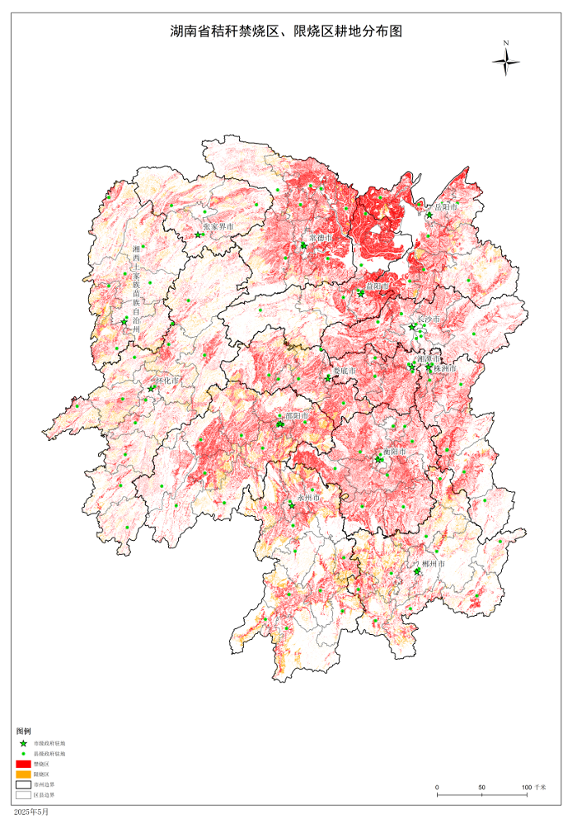
◉ Map showing the distribution of arable land in Hunan Province’s straw-burning ban zones and restricted-burning zones. As can be seen, major grain-producing areas on the plains are largely within no-burning zones, leaving no opportunity for staggered, controlled burning in time slots. Image source: Notice on the Designation of Zones Prohibiting Open Burning of Crop Straw
Still Patrolling into the Night
In September, when the autumn harvest began, the patrol teams went down into the fields. Zhao Hai still clearly remembers: the village service team, the township agricultural office, urban management and public security all came, the village was quite a scene, and the old secretary’s voice was broadcast again and again over the loudspeaker:
“For the next two days, patrol teams will be out. Absolutely no burning — listen carefully, absolutely no burning, and even tonight between eight and nine o’clock, do not burn!”
Liu Xiao is a member of the village service team and a village committee cadre. After receiving the task, he began patrolling around every day, and whenever a fire point was found, he ran over to put it out. By the end of the day, the battery on his electric bike had gone flat.
He would take some work photos showing that he was still out at eight or nine in the evening and send them to the work group, with the time and location included. Sometimes the photos only showed the road: it was too dark, and even photos of the fields would not show much, but he had to prove that he was still patrolling.
According to policy requirements, the township had two teams: one was a county-level unit paired with the township government, and the other was the Blue Sky Office’s full-time supervision team. Every day they had to go down to the villages for inspections. In addition, city- and provincial-level unannounced inspection teams occasionally carried out surprise inspections.
At the grassroots level, satellite remote sensing and tower video had long become mature technologies for monitoring changes in the use of arable land, and were just right for monitoring straw burning. The former took photos as satellites passed overhead, detecting thermal imaging anomalies within a range of about 100 kilometres; the latter used 24-hour high-definition cameras to scan plots within a few kilometres, triggering an alarm whenever a suspected fire was detected. This had almost become the most important tool for the township law enforcement brigade to monitor real-time fire situations.
A typical real-time monitoring and firefighting process probably went like this: at about 6 p.m., the township duty officer posted a photo in the work group and tagged a certain village cadre: “There is a fire to the north-east of Tower No. X in a certain village. Please deal with it.” The same officer also sent a photo, noting “the cameras have all been moved away” — probably so that no fire point record would be left. In just ten minutes, the two village cadres both replied in unison that it had been dealt with.
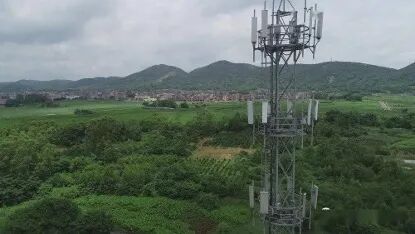
◉ “Tie Ta Tian Yan” monitoring system, developed by China Tower. Image source: C114 Communications Network
If even a small fire point appeared in the village, officials at all levels could be disciplined. From 2023 to 2025, feedback from the ecological and environmental protection inspection in Hunan Province showed that several cities and counties had at various times been put on notice and summoned for talks over inadequate handling of fire points. Near Changsha, it is said that a certain township had three recorded fire points, while another township had only two; the city-level patrol wanted to pick a typical case, and removed an official from the agriculture department. The county where Village A is located has also removed two section-level cadres.
However, “You can discipline the township, you can discipline the village, but you cannot do anything about ordinary people; there is hardly any constraint,” Sun Weimin said.
In the end, all the pressure came down to the village committee. Even when asleep at home, Sun Weimin kept his mobile phone with him, message notifications on; whenever a new message appeared in the group, he would check whether the tower in the photo was the one in his village.
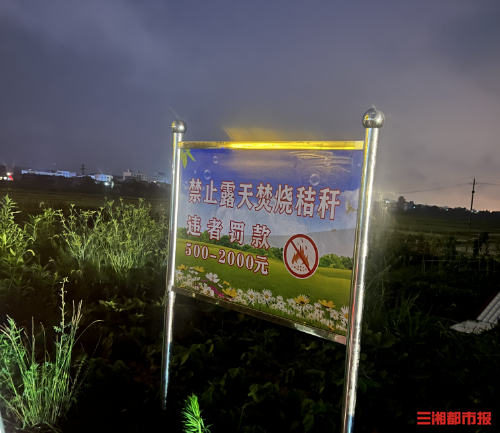
◉ A warning sign about fines under the straw-burning ban in a certain city in Hunan Province. Image source: Sanxiang Metropolis Daily.
Although the policy clearly stipulates “fines of 500–2000 yuan”, Sun Weimin said that in the end each village could only apprehend one or two people just to go through the motions, and there was even a farce in which an 80-year-old was detained, but his son took a long time to come and pick him up. In the end, after doing an enormous amount of work and even calling the village committee in at one point, they still could not levy a fine.
There was a reason the old secretary repeatedly stressed over the loudspeaker that “even between eight and nine o’clock, do not burn!”—at that time of day, a full day of sun had dried out and softened the straw, and the patrols had gone home to eat. Sometimes, the cameras had already quietly turned their heads away. So by eight o’clock, flames had sprung up again in the fields.
“Can I be honest? In the end, it was all burned.” A villager said. Liu Xiao, who was in charge of the patrols, also admitted that his own family’s small plot of a few mu had been burned as well.
But the arduous and futile patrols lasted a full three months. Paying someone to patrol the village for a day cost at least 100 yuan. A village group leader explained that as long as a patrol team was arranged, when government inspectors came to the door, the village could say that people had indeed been assigned and the work had been done properly. “They were the ones who insisted on burning; I couldn’t stop them.”
Zhao Hai felt further that, whether at village or township level, sending people down to patrol was merely a formality. “If there were no one to patrol at all, they would really be in for a scolding. It is not easy for them either, so please try to understand.”
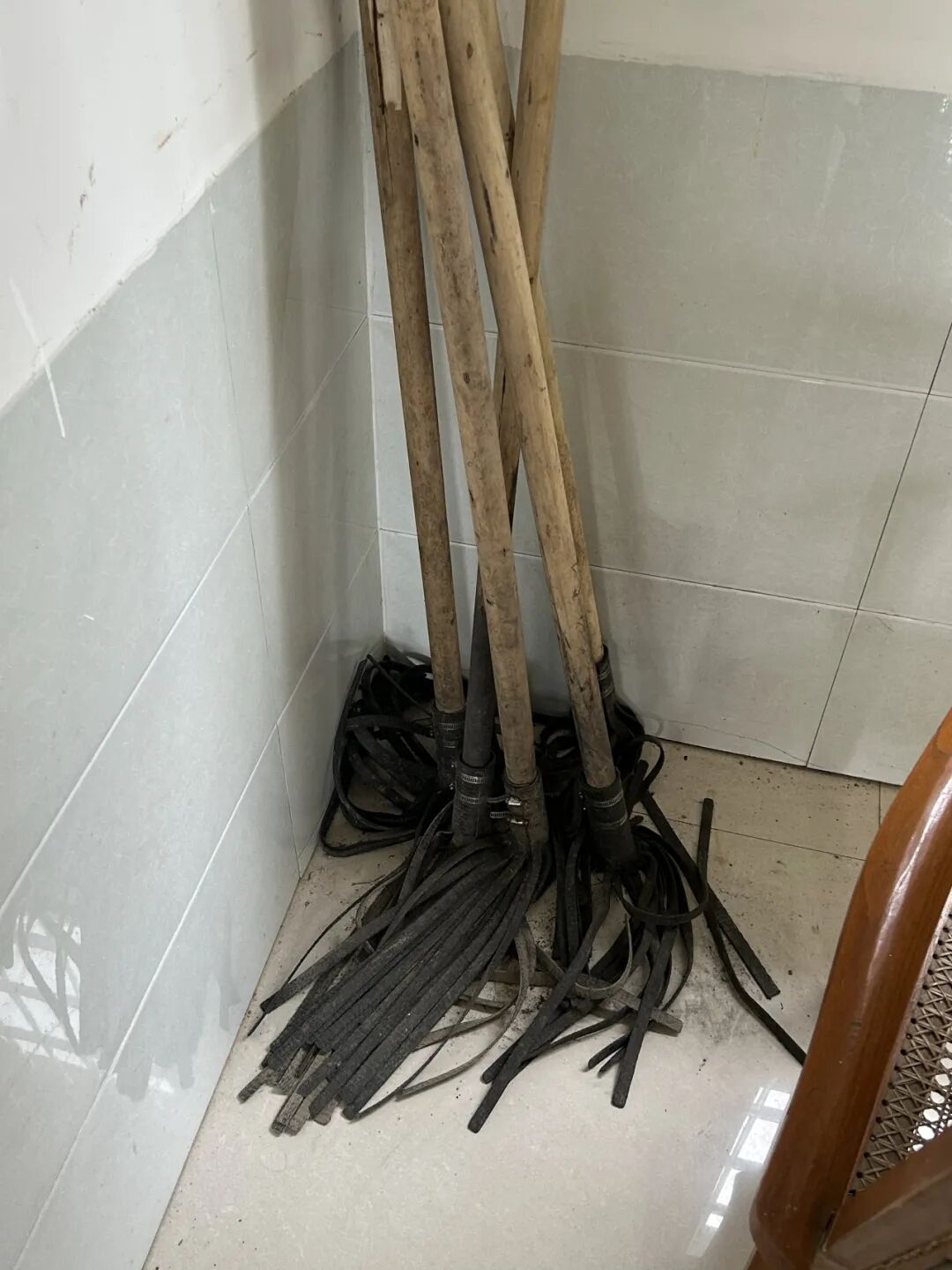
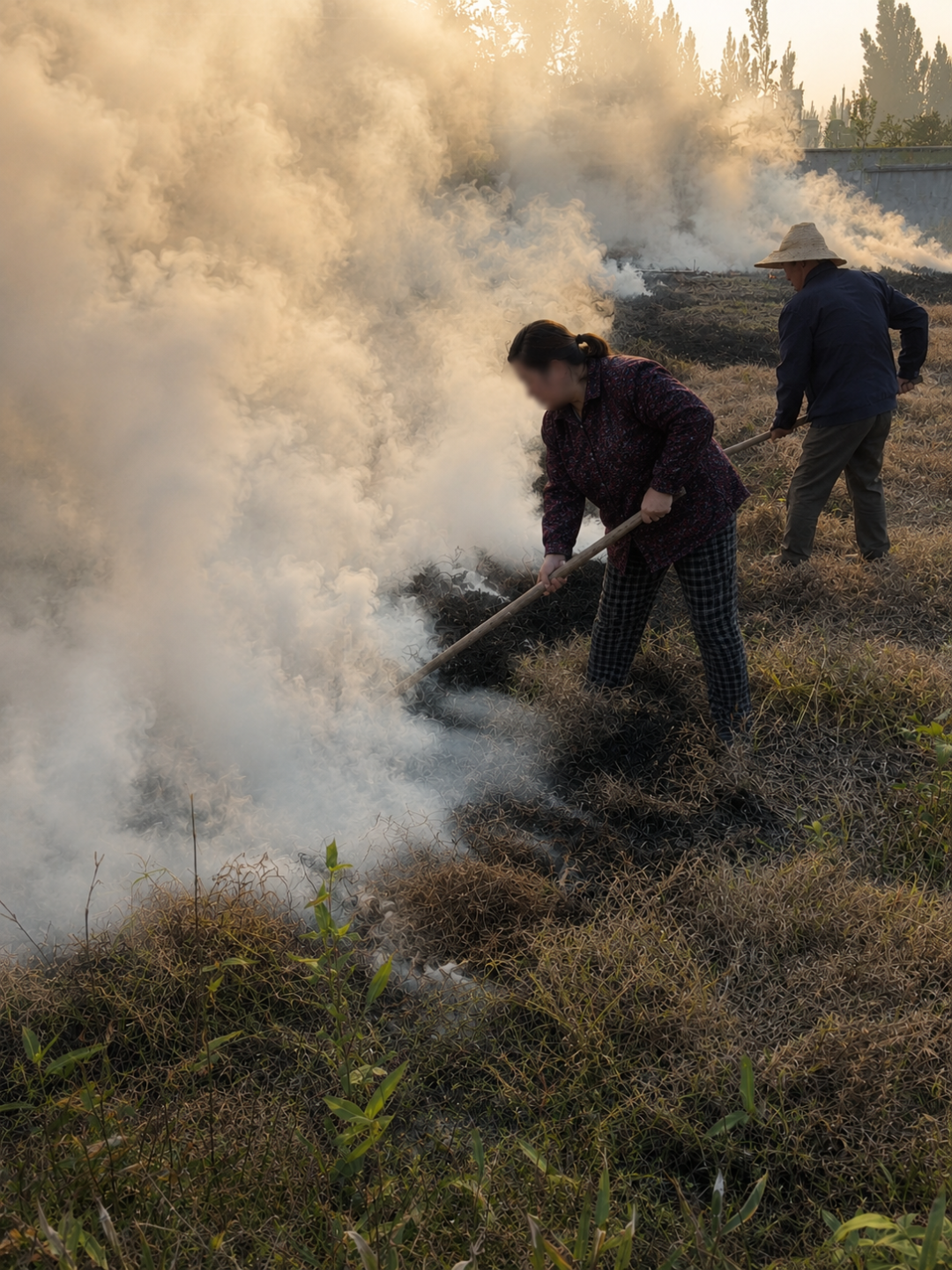
◉ Left: brooms used by the village patrol team to put out fires; Right: a village committee cadre in charge of finance assisting with fire-fighting (to protect the privacy of the interviewee, the right-hand image is AI-generated based on an image supplied by the interviewee).
What to Do with Rice Straw?
Township and village cadres were also racking their brains to find a way to deal with the straw. In Village A, the biggest task during the 2025 autumn harvest was to engage buyers and farm machinery to sort out the straw.
One way was to bale it and haul it away; the other was to shred it and rotary-till it into the ground, or spread it over the surface. In technical terms, these are “off-field removal” and “return to the field”.
What Village A tried first was baling for off-field removal. In September, a baler was driven into the village, but in the end only two or three hundred mu were baled.
In promotional videos online, the moment large balers entered the field, they cleaned everything up in a few moves; some integrated models could even harvest and bale at the same time. But in Zhao Hai’s view, the machines that came to his own village were “nowhere near that advanced”; often they broke down mid-job, and the straw had to be pulled out of the machine by hand.
Smallholder households also harvested at different paces. Although it was all single-crop rice, planted in April and harvested in September, some households had already finished harvesting and drying, waiting to flood the fields and farm crayfish (about a third of the village’s arable land was used for crayfish farming, the most important source of income for the villagers), while neighbouring plots might have only just begun to be harvested. When the baler arrived for the baling, if it rained again, the rice straw could not be collected, and the trip would be a complete waste.
In addition, although the farm machine operators who came for the baling were subsidised, they were not responsible for transporting or selling the rice straw. Large quantities of straw were piled in front of and behind the houses in the village and along the farm tracks. The village committee sought out an agricultural company that had built a straw collection and storage centre locally, and the two sides agreed that it would be turned into feed through shredding and sold to livestock farms.
At this point the agricultural company told Sun Weimin that the machine had broken down, could not shred the straw, and that a transformer had to be installed. Once the mechanical problem had been solved, the company said it could not be sold. They had no choice but to haul the rice straw collected from over 100 mu of fields to the factory. By then, the factory was already piled high with large and small bales of rice straw from several neighbouring villages. This rice straw had still not been sold by summer this year. Sun Weimin said that several such straw collection and storage sites had failed to find a market for the straw.
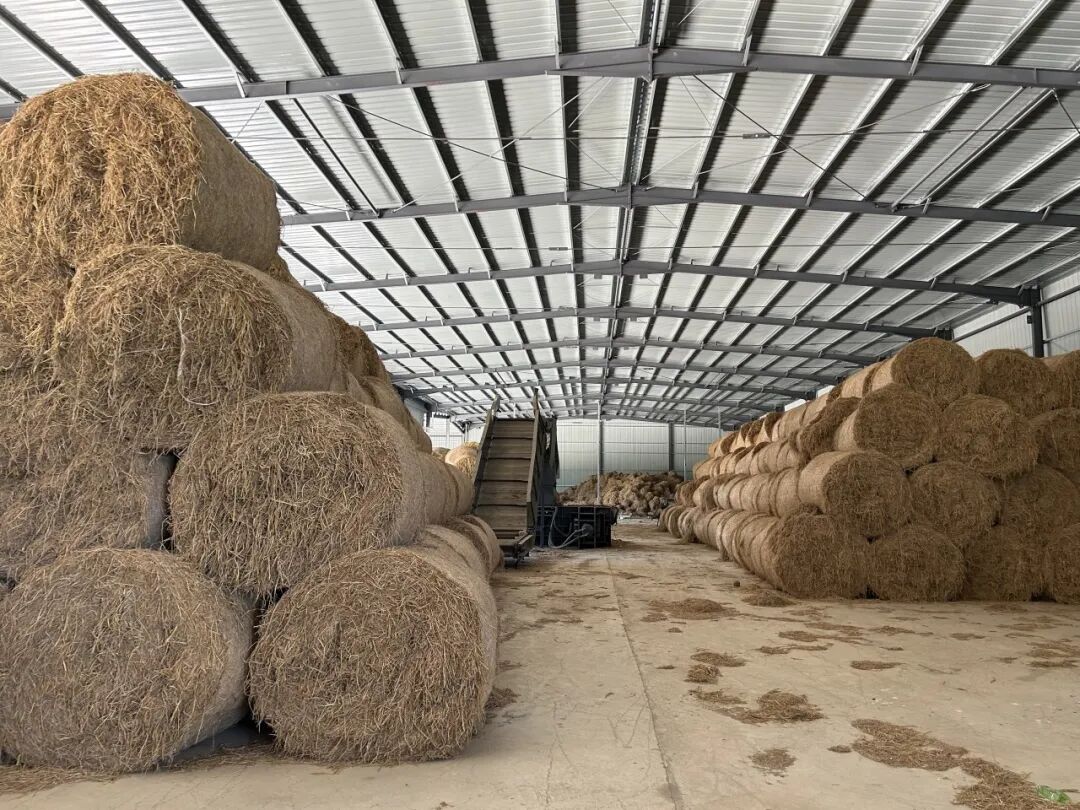
◉ Inside the agricultural company’s warehouse, the steel roof was brand new; large quantities of straw were stored on an open lot, reportedly made by pouring concrete to harden basic farmland.
Farming season waits for no one. In early October, oilseed rape sowing machinery reached the field edge. The company did another favour, moving the remaining bales of rice straw from about 150 mu of fields and field edges onto the village road. During the National Day holiday, the village spent another thousand or so yuan hiring a tractor to drag the straw to an open space behind the village committee. The village committee was racing against the clock every day.
The hardships of the process were hard to put into words unless one had been through them. A farmer recalled that the weather was still hot at the time; he had only three or five mu of land, and hauling the straw home using his own vehicle took three days.
Alas, the weather would not co-operate. Soon, after days of rain, the straw that had not yet been baled rotted in the fields; soft mud was everywhere, and vehicles could not get in. Sun Weimin still remembered that some crayfish farmers’ straw had not yet been taken away, and they came to the village committee every day, making trouble. Straw was piled up in front of the village committee, and the office and warehouse were crawling with lice.
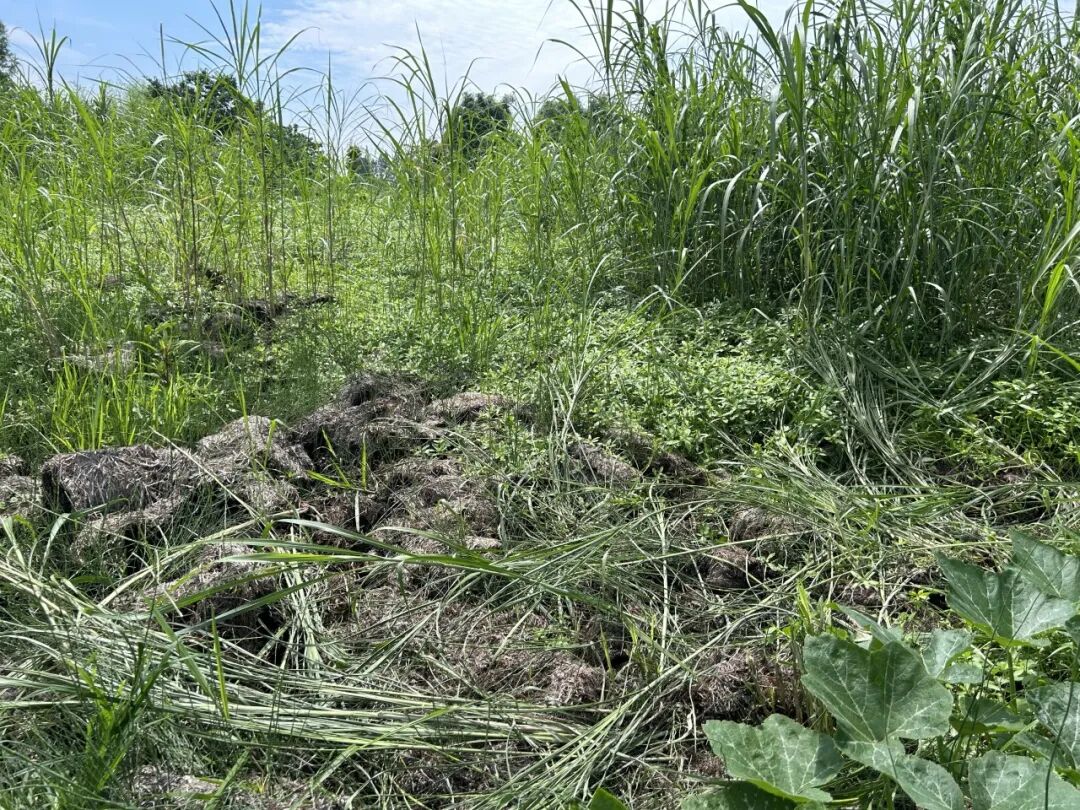
◉ In early June 2026, a pile of rotting rice straw at the village entrance, with wild grass already taller than a person.
When the weather finally cleared, villagers, afraid of delaying next season’s farm work, could not help starting to burn straw again. The village committee hurriedly sent the straw shredder dispatched by the township into the fields to press on with land preparation. Villagers complained one after another: the straw was too thick to shred; it was too late, and delaying the sowing of oilseed rape would affect the harvest; the large balers, plus rice straw bales weighing more than 100 jin, were too heavy and had already compacted the soil, making it impossible to farm…
By then, the pile of rice straw in front of the village committee had rotted and wild grass was growing. One day it suddenly caught fire — a neighbouring township once had a giant pile of rice straw, and no one knew whether someone had deliberately set it alight or whether an accident had started it; it burned for a whole week.
But this time only black smoke rose. The rice straw had been soaked by rain and, because it had been baled, was tightly packed inside, so it simply would not burn. There was nothing to be done, so people hurriedly watered it and hired people to level it off.
“When they were doing it, I felt like laughing, but I could do nothing about it,” Zhao Hai reflected.
By this time, of the village’s several thousand mu of land, apart from two or three hundred mu that had undergone off-field removal, only just over a thousand mu had had shredded straw returned to the field. Large amounts of straw were still piled in the fields, but October was already more than half over. Villagers, unable to wait, started burning again every few days.
Window Period
An opportunity suddenly came.
As mentioned earlier, the high-definition cameras on the tower could sometimes be swivelled away. Although there was no written rule specifying when or who operated them, villagers knew there were often such gaps in coverage.
A rumour, said to have come from inside the government system, spread. “There are a few hours today!” The village committee immediately notified each villager group leader, who then passed it on to one household after another, anxious about where to store their rice straw, waiting to sow oilseed rape and flood the fields to farm crayfish: from what time to what time, the cameras would not be watching, so hurry and burn!
Rain had stopped for days; the rice straw that had not been baled had long since dried out. The dry rice straw was neatly piled in a line, and once someone set it alight at one end, the fire could burn straight through in one continuous stretch.
A village ten kilometres away started burning first; Village A followed suit, then another village to the south. “It all caught fire at once!” “You could see it from tens of kilometres outside the county seat; a lot of public security officers came, but what could they do? The law does not pursue a crowd!” villagers sighed.
It was not known how much land the other villages had burned, but this time in Village A, at least over 1,000 mu was set alight, lasting three to four hours. Villagers described the sky as blazing red.
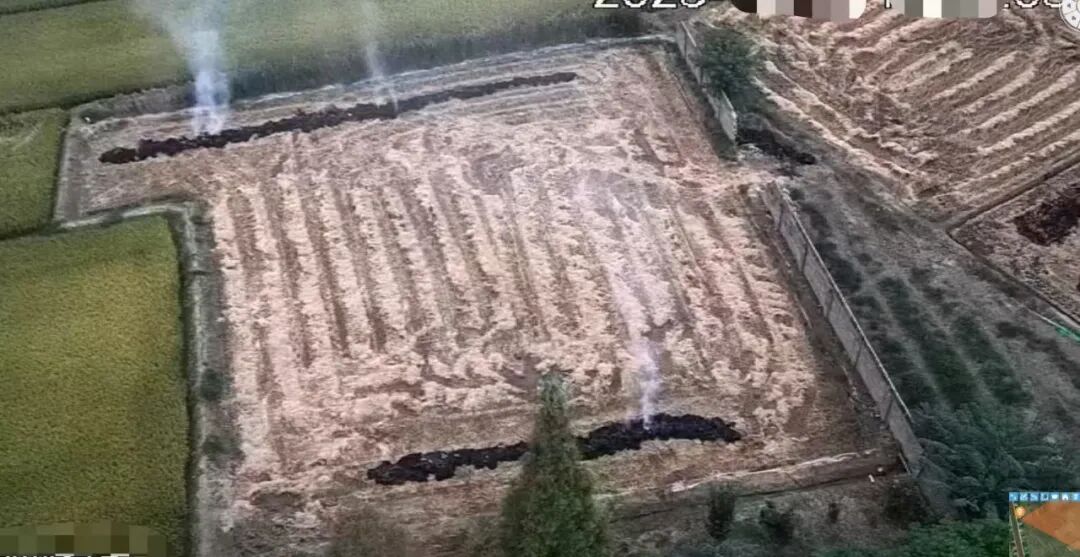
◉ In a photo from another tower camera, traces of burning are clearly visible. Image source: interviewee
Hearing others say, “The ordinary people are grateful to you,” Sun Weimin felt bitter. He had worked in the village committee for decades, had seen the agricultural tax, had experienced flood control, and was used to spending the day in the branch office, taking a midday nap, being interrupted at any moment by villagers, and dealing with and mediating all sorts of matters for them. But on the straw-burning ban, he had nothing more to say and only felt a headache.
Sure enough, people came down from above. The next evening, the village to the south had only been burning for two hours before it was called off. Fortunately, Village A had finished burning. It was then that they learned that a day later, provincial authorities would come to inspect.
This time it was not so easy to fool the cameras on the tower. Provincial verification relied on satellite image patches; large tracts of charred black land would be impossible to hide under the satellite’s “sky-eye”. The higher-level government hurriedly conferred with Village A, and overnight organised 16 large rotary tillers to turn the scorched topsoil into the ground. That night cost 60,000 yuan, reportedly paid by the township government. The matter was finally over.
But Sun Weimin’s work was not yet over.
By the end of October, it rained in the township, and in the straw-burning ban work group someone quipped: “At last we can sleep well! If anyone were so industrious (burning in the rain), they should be given a thorough commendation.”
By December, the oilseed rape had all been sown, and the young crayfish had begun to grow, but villagers in the winter fallow period still wanted to burn the grass in the fields and around their houses to reduce pest damage in the following year, or burn some rubbish, dead branches and fallen leaves, or set off some firecrackers. All of this was prohibited: by the statistical criteria used by the tower and environmental departments, any fire was counted as a fire point.
Messages continued to be posted in the group:
“On X December, the province reported that our city had X fire points. Today, the meteorological bureau issued a yellow haze warning signal, with severe haze expected within the next 24 hours; the situation is currently extremely serious.”
“The municipal bureau’s seconded supervision team moved in last night; at 10 p.m. it still carried out spot checks on duty arrangements in X township and at village level. Patrol and duty personnel at township and village level are asked to strengthen patrols during key periods…”
“I ask everyone to overcome difficulties, carry out duty and standby arrangements, strengthen patrols and control, and put a complete end to the open burning of straw. The city will send an unannounced inspection team to conduct unannounced inspections, so please do not let your guard down; hold on for the final five days, and protect the results of more than three months of effort.”
“Only three days remain of the year-round straw-burning ban!”
Who Foots the Bill?
Sun Weimin calculated that Village A had spent 400,000 yuan on straw-related work that year. This included baling, hiring people to patrol and monitor, transporting straw, shredding straw, and calling in 16 rotary tillers overnight to till the ground. It also included, in late October, spending a further 80,000 yuan to buy the village a new small baler—although it was never used. Most of the money was paid by the higher-level government, but “that is also taxpayers’ money,” and he was pained: why could it not be used to build roads and bridges, and improve infrastructure?
Given how much rice straw a mu yields, and having personally experienced the process of spending money to transport rice straw out, he estimated that the aforementioned agricultural company that operates a straw collection and storage centre had transport costs alone of over 4 million yuan.
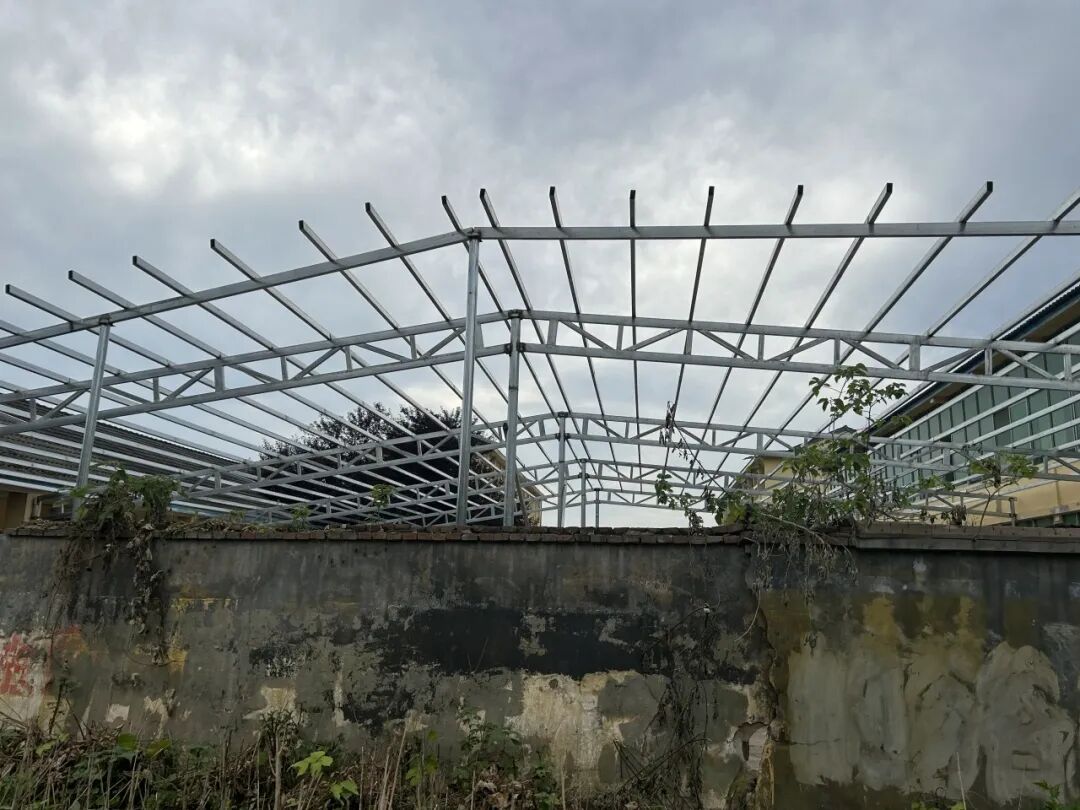
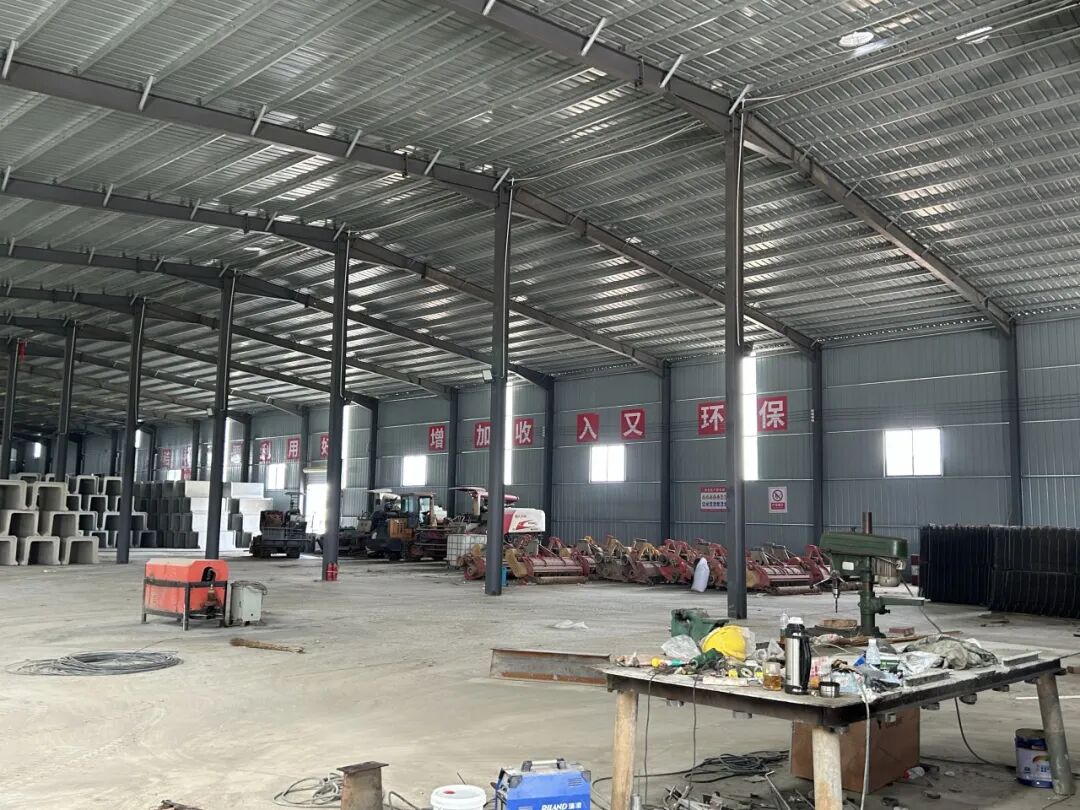
◉ (Top) Another large-scale straw stockpile site in the township where Village A is located. Locals said that a larger quantity of straw had been stacked there last year; it had been cleared by then, while the steel canopy frame had not yet been erected. (Bottom) A straw collection and storage centre in another city or county in the lake district. It is said that the straw has been transported out, and the centre has temporarily been rented out to others for storing precast construction components.
But over more than a decade of the straw-burning ban, the experience of many provinces exploring off-field removal of straw has shown that, because straw itself has a low calorific value and low nutritional density but exists in huge volumes, power plants, livestock farms and other businesses are not keen on buying straw, and are even less willing to pay high transport prices for it.
Chen Jing, an associate professor at Northwest A&F University, once conducted a field survey on off-field removal of straw in Anhui. He found that most straw collection and storage centres could not even achieve the recycling and utilisation of 30% of the straw in their areas, and that government subsidy incentives had consistently failed, ultimately because profits were too low.
When businesses could not “collect all that should be collected”, Sun Weimin heard that two villages in the township had found other sales channels themselves, but even just transporting the straw from the fields onto the buyer’s straw-hauling trucks had resulted in losses of tens of thousands of yuan.
In addition, off-field removal of straw still relies to a large extent on subsidies. With many local governments facing tight finances, scholars estimate that long-term support will also be difficult. This is consistent with what our research has found. Two interviewees confirmed to us that a local company engaged in straw collection and storage has still not received all of its subsidies. Farmers in Village A and another village near Changsha who took part in off-field removal and straw-return operations had applied for subsidies last year, but as of early June this year, the city and county authorities had still not approved them.
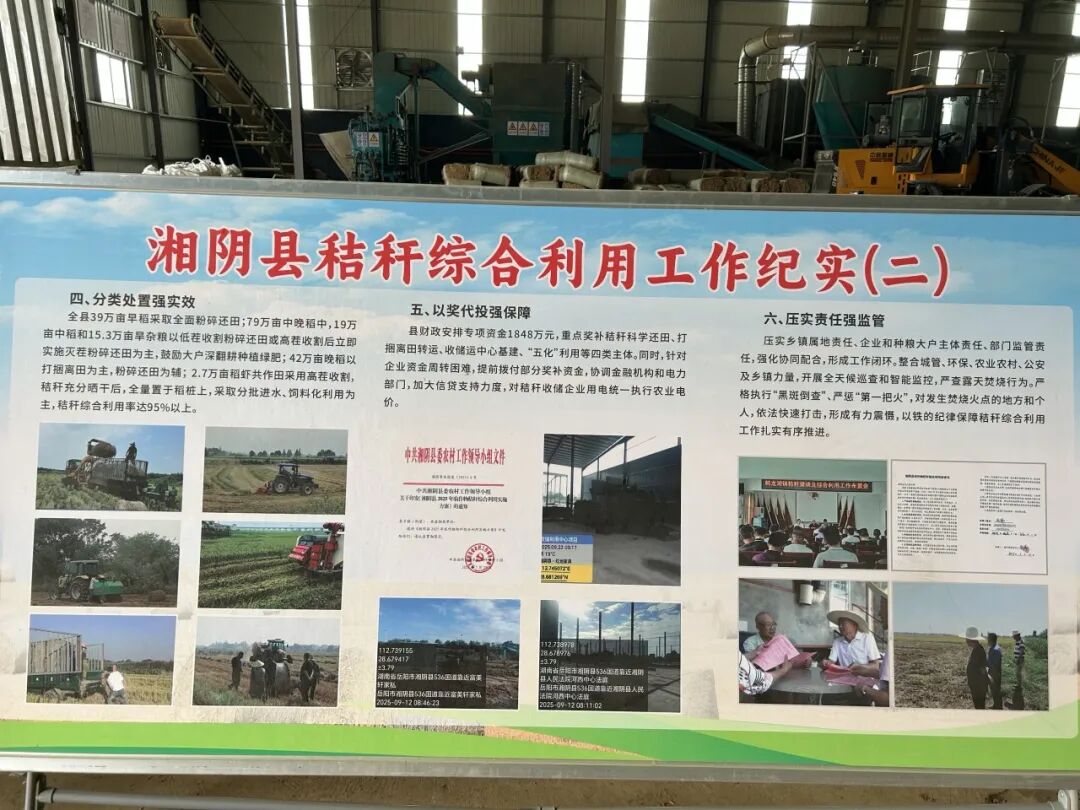
◉ A promotional notice from a straw collection and storage centre in Xiangyin County, Yueyang City. The owner said its collection and storage volume was over 10,000 tonnes, and this year’s selling price was 650 yuan per tonne.
In fact, in January 2025, the Standing Committee of the Hunan Provincial People’s Congress passed the “Several Provisions of Hunan Province on the Comprehensive Utilisation of Straw”, the country’s first provincial-level regulation to standardise the comprehensive utilisation of straw, which explores “controlled burning” of straw. In particular, in response to the problem of pest outbreaks caused in Hunan over the years by returning straw to the fields, it specifically provides: “For straw in a no-burning zone that carries pests and diseases which, following quarantine, are confirmed to require burning, open burning may be carried out after the competent departments of the county-level people’s government for agriculture and rural affairs and for ecology and environment have taken safe and controllable measures.” Some commentators see this as a positive attempt to shift the straw-burning ban from “ban” to “restriction” and to relax it in an orderly manner.
But a township agriculture official revealed that the regulation had barely begun to be implemented before it was suppressed within the government system under pressure from environmental inspections. Hunan entered the “strictest” stage of the straw-burning ban in history.
In April 2026, the oilseed rape was harvested. In Village A, work on the straw-burning ban, patrols and mobilisation began again. The village committee had bound a new ledger and placed it in the office for inspection by higher-level authorities.
– This is Foodthink’s 819th original article –

Foodthink
By
Pei Dan
A woman writer, back on track, covering climate change, the ecological environment, and the individual people living through change.
In this article, Zhao Hai, Sun Weimin and Liu Xiao are pseudonyms.
Unless otherwise stated, all photographs were taken by the author.
Editor: Ling Yu
Layout: Ming Lin
Scan the QR code to tip and support original food knowledge
▼

▼
Click the image to read related articles.
▼
Click a keyword to open more article collections.
Seeds | Agritech | Policy | Fermentation | Nutrition | Fruit | Fisheries | Events | Recruitment | Food Delivery | Wet Market | Livestock | Food Talk | Sharing Sessions | Book Club | Harvest Festival | Smallholder Stories | Climate Change | Rural Development | Cooperative Economy | Urban Farmers | Food Safety | Digital Technology | Biodiversity | Pandemic and Food | False Solutions | Ecological Agriculture Internship Programme
Beijing | Hebei | Shanghai | Guangdong | Guangxi | Henan | Sichuan | Jiangxi | Xinjiang | Shaanxi | Hong Kong | Chongqing | Zhejiang | Jiangsu | Guizhou | Taiwan | Inner Mongolia | Philippines | Canada | Russia | Mexico | Italy | United States | United Kingdom | Germany | Netherlands | Thailand | Sweden | Japan