
Japan’s Rice Prices Doubled, Yet Farmers No Longer Want to Grow
Foodthink Says
But is Japan truly short of rice? In fact, Japan’s rice output had already exceeded domestic demand by the 1960s. Rice has become the only major agricultural product on which Japan can be self-sufficient, even as the country’s Food self-sufficiency rate has slid to 38%. Yet this is not because rice yields are particularly high, but because per-capita rice consumption has been steadily declining since the war. While the Japanese still treasure rice — one of the most important symbols of Japanese culture — modernisation, shaped by American influence in the economy, culture, and diplomacy, long ago Westernised the nation’s diet and diversified its staple-food choices.
How rice, a food of which the Japanese are proud and one of the most important emblems of their culture, has arrived at today’s predicament is a question rarely asked. The deeper problems behind this price surge have received even less attention.
I. What Actually Happened?
Since last summer, rice prices in Japan have been rising while supplies dwindled. The initial trigger was the 2023 heatwave, which caused white opacity in rice grains and reduced the yield of table rice. From August onwards, many consumers, worried about shortages, began stockpiling; purchases of rice at Japanese supermarkets and other retailers rose to 1.5 times their usual volume.
Beyond the climate-driven drop in output, the Japanese government also attributed the price surge to the sharp increase in inbound tourism, which drove up rice consumption and further tightened supply.
At the time, the government’s conclusion was that the problem would sort itself out once new-crop rice hit the shelves in October. But after the new crop arrived, prices did not return to normal levels; instead, they kept climbing. By November 2024, rice prices remained 60% higher than the same period a year earlier.

According to price data published in June by Japan’s Ministry of Internal Affairs and Communications, in Tokyo’s 23 special wards the tax-inclusive price of 5 kg of Koshihikari was 5,072 yen — 102 yen higher than in May. This marked the fourteenth consecutive month of rice price increases, a rise of 2,511 yen on the year-earlier figure, more than a doubling.
II. Is Japan Running Out of Rice?
Ding Wei, who lives in Kobe, has noticed that the supermarket near her home still stocks rice, but at more than twice the 2023 price. Fortunately, her own diet is varied and she does not need much rice day to day, but she thinks the price rise must put considerable pressure on a family of four or five.
Zhang Manqing, from the Field Science Education and Research Centre at Kyoto University, likewise said she had not noticed any shortage — shops restock every day — though the price hike has been steep. For comparison, she noted, between 2015 and 2020 rice in Japan cost roughly 2,000 yen for 5 kg; the current price sits between 4,000 and 5,000 yen, a two- to two-and-a-half-fold increase.
Behind the spike in prices and the apparent shortage of supply lies a long-standing Japanese agricultural policy designed to curb output and prioritise the maintenance of rice prices. This brings us to Japan’s “acreage-reduction policy”.
Japan’s Food self-sufficiency rate peaked at 88% in 1955. From the 1960s onwards, shaped by geopolitics, international trade, and social change, agrarianism as both a philosophy and a policy framework drifted steadily away from Japan’s mainstream thinking. Japan was not alone: South Korea and Taiwan also saw their economics, politics, and culture heavily influenced by the United States during this period, pivoting towards export-oriented manufacturing while importing large quantities of wheat, maize, and other staples from America. Agriculture and rural life were marginalised from that point on.
As industrialisation accelerated, huge numbers of people left the countryside for the cities to meet the demand for labour, and dietary habits began to shift. The Westernisation of diets has often been regarded as one benchmark of a country’s modernisation.
On one hand, Japan’s trade and economic ties with the United States deepened; on the other, America’s food-diplomacy strategy encouraged the Japanese to eat American produce. The US exported vast quantities of wheat, meat, and soybeans and maize for animal feed to Japan. During this period, the Japanese began to accept the American yardstick of judging nutrition by animal-protein intake, and their eating habits moved closer to a Western diet centred on meat, eggs, milk, bread, and pasta, with a corresponding reduction in rice consumption.
The numbers tell the story: by the 1960s Japan’s overall Food self-sufficiency rate had dropped well below 50%, yet the self-sufficiency rate for rice stood at 100%. Soybeans and cereals other than rice were almost entirely imported, with external dependence exceeding 90%. In 1962, per-capita rice consumption in Japan was 118.3 kg — roughly 5.4 bowls of rice per person per day. Thereafter, demand for rice declined while consumption of meat, eggs, and dairy rose. By 2020, per-capita rice consumption had fallen to 50.8 kg.

By the 1970s, the Japanese no longer needed so much rice, and the country began to adjust its agricultural structure and policy. To prevent price collapses caused by overproduction — which would hurt small-scale farmers — Japan introduced the “acreage-reduction policy”, controlling the area devoted to paddy cultivation and subsidising farmers to switch to large-scale cash crops in order to keep rice prices stable and safeguard farm incomes.
Under the heavy hand of the “acreage-reduction policy”, Japan’s rice output fell markedly. Production dropped from over 13 million tonnes in the late 1960s to 8.5 million tonnes in 2010, and further to 7.76 million tonnes in 2020. Yet even with declining output, Japan still produces enough rice to feed itself. Taking 2020 as an example, per-capita rice consumption stood at 50.8 kg, or roughly 2.3 bowls of rice per person per day. Wheat-based staples such as bread and pasta had squeezed out rice’s former place.
III. The Policy Shadow Cast Over Rice Paddies
In 2023, the impact of climate change drove output down to 6.61 million tonnes; 2024 saw a slight recovery to 6.83 million tonnes. Production has halved from its 1960s peak of 13 million tonnes — but has that brought price stability? Have paddy farmers’ incomes been stable?
While to a Chinese eye Japanese rice seems expensive, the ex-farm purchase price of Japanese paddy rice has long been low. In recent years, the production cost of 60 kg of rice in Japan has been around 15,000 yen (about ¥750), while the purchase price is only 12,000 yen (about ¥600); the government must then top up 3,000 yen per 60 kg to cover the farmer’s loss.

Zhang Manqing noted that before this “Reiwa rice riot”, the prevailing view in Japanese academic circles was that the average price of 2,000 yen per 5 kg of rice was low — farmers made little from it — yet with prices now at 4,000–5,000 yen per 5 kg, consumers also find it hard to bear. She believes that a price of around 3,000 yen per 5 kg would probably strike the best balance for both farmers and consumers.
IV. Who Sets the Price?
Beyond agricultural services, JA also provides financial services and is one of Japan’s largest regional financial institutions. Meanwhile, because it binds together the overwhelming majority of farm households, it wields considerable political influence — it can not only sway agricultural policy but even shape election outcomes. In practice, today’s rice prices in Japan are set by JA.

Different farmers hold sharply contrasting views of JA. Larger-scale farmers find it convenient, as it offers support from seed to sale. For farmers without their own sales channels in particular, JA is the only option.
Commissioning JA to sell one’s produce incurs a fee of 15–20%. For smaller farmers, this is difficult to absorb. Moreover, JA’s purchasing standards are exacting, and securing a high purchase price is far from easy.
Zhang Manqing told Foodthink that JA has a host of bizarre regulations when it comes to purchasing. It grades not only on flavour but also strictly on appearance. Take cucumbers, for example: they must meet JA’s exact specification — a centimetre shorter or longer will not do. Anything outside spec is classified as “Grade 2” and fetched at a lower price. A curved cucumber doesn’t even qualify for grading at all; it can only be sent off for pickling, at the lowest possible price. People often marvel at the stunning array of flawless fruit and vegetables in Japanese supermarkets, but in reality, achieving that standard is extraordinarily demanding for farmers.
As a result, a growing number of farmers are exploring new sales channels and attempting to break free from JA’s monopoly.
Some smallholders have begun pursuing a premium route, supplying boutique supermarkets with low-volume, high-quality produce, or trying to connect directly with consumers. CSA (community-supported agriculture) is one such model. Travelling through Japan’s countryside, visitors commonly encounter farm-direct rice from various regions — these products have been relatively insulated from the wider market pressures during this rice shortage.

V. Rural Decline: Where Is Agriculture Headed?
The declining birthrate and ageing population affect every sector in Japan, but the problem is especially acute in agriculture. In 2020, 70% of farmers were aged 65 or over, while just 11% were 49 or younger. By 2023, the average age of Japan’s farmers had reached 68.7.
With farmers growing older year on year and increasing numbers retiring, the labour shortage is worsening. This deeply skewed age profile poses a severe challenge to agricultural production.
According to a 2020 census published by Japan’s National Institute for Agricultural Policy Research, more than 70% of farm operators have “no successor yet identified” for the coming five years, and among operators aged 70 or above whose successors may be needed imminently, fewer than 30% have “a successor already identified”. In sectors such as fruit-tree cultivation, rice farming, and open-field vegetable growing, the proportion of operators who “have no successor” is as high as roughly 70% — clear evidence that the crisis of agricultural succession is growing ever more severe.
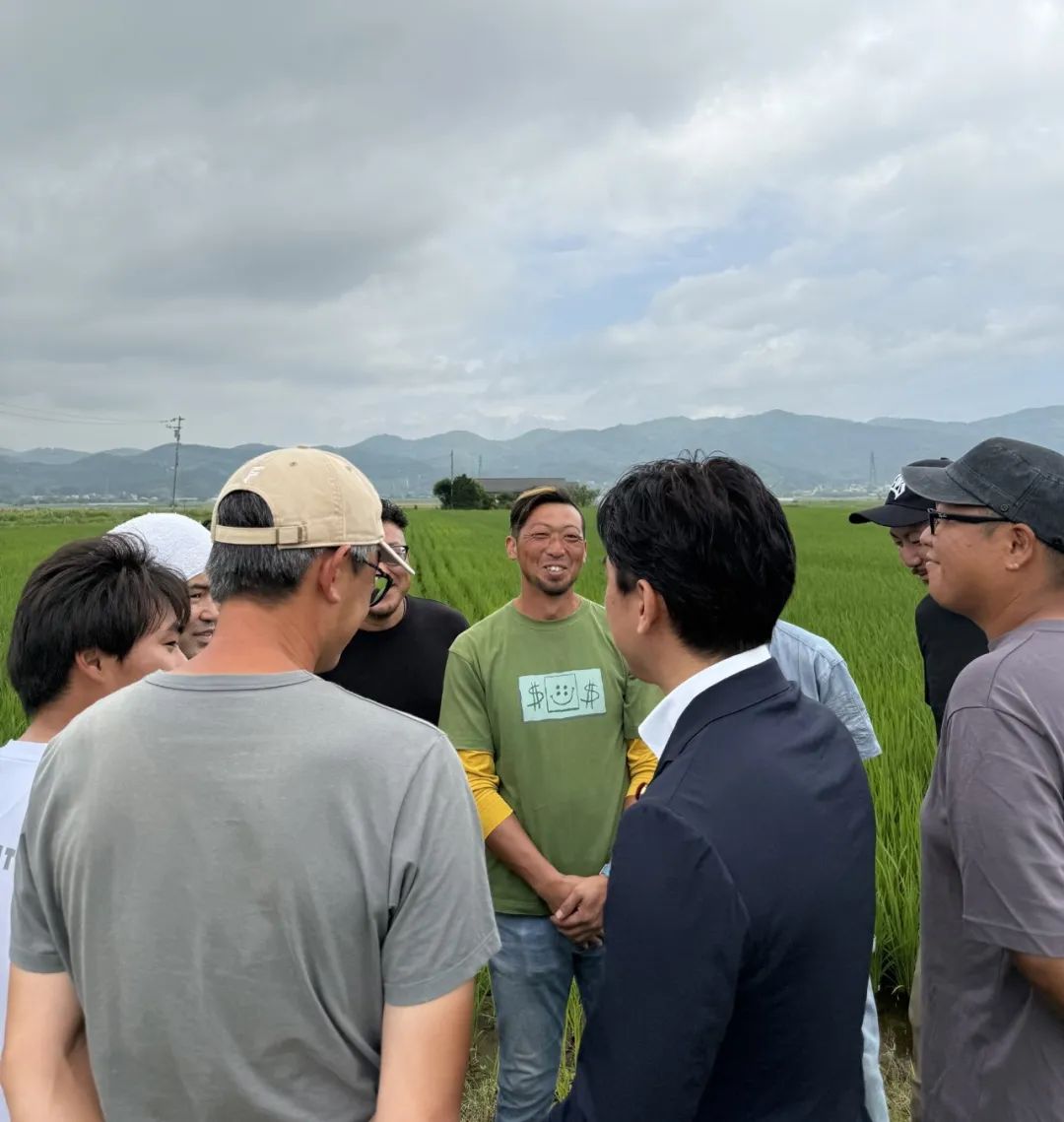
Agriculture in Japan is often described as “hard, dirty, and dull” work. Young people feel that the effort and income are wholly disproportionate: for the same time and energy, a job in the city pays far better, so they would rather migrate to urban areas than take up farming. Older farmers, too, are reluctant to see the next generation go on working the land.
According to data from the Ministry of Agriculture, Forestry and Fisheries, full-time rice farmers who rely solely on paddy cultivation for their household income earn an annual profit of between 2.5 million and 3 million yen (about ¥125,000–150,000 RMB) — by no means a high income by Japanese standards.
An extreme example: in 2022, a collapse in rice prices drove the average income of all Japanese rice farmers down to just 10,000 yen for the year; divided by hours worked, that amounted to 10 yen an hour. That year, “Rice farmers earn 10 yen an hour” became a trending topic in Japan. This was an estimate derived by dividing 2022 average farmer income by annual working hours — while it cannot capture the full picture, it illustrates just how severely rice prices bear on paddy farmers’ earnings. In March this year, farmers in several Japanese cities staged demonstrations demanding that the “10 yen an hour” wage standard be raised.
By 2023, as rice prices recovered, the average hourly wage across all rice farmers reached 63 yen (about ¥3.15). For full-time farmers — those for whom agriculture is the primary occupation — the hourly rate was around 1,000 yen (about ¥50). At first glance this seems high, but it is on par with Japan’s minimum wage, and it is calculated on the basis of full-time farmers running large-scale operations; smallholders still earn far less than this.

Low rice prices, the ageing rural population, and the lack of successors in agriculture have all contributed to the loss of more than 10,000 hectares of rice paddies every year.
According to data published in 2022 by the Ministry of Agriculture, Forestry and Fisheries, Japan’s total arable land stood at 4.325 million hectares, down 24,000 hectares, or 0.6%, from the previous year; paddy-field area was 2.352 million hectares, down 14,000 hectares on the year.
There is another link between ageing and abandoned farmland. Zhang Manqing told Foodthink that as rural populations shrink, wild animals from the mountains descend on villages more frequently and destroy crops. For safety reasons, farmers tend to abandon the terraced paddy fields on mountainsides or plots close to wooded areas first. Because around 70% of Japan’s terrain is mountainous, and many of those terraced paddy fields grow rice, giving up mountain land directly reduces rice production.
When the population of a rural settlement falls below a certain threshold, its everyday functioning collapses, and essential services such as hospitals, schools, and transport grind to a halt. Professor Eiji Yamaji, Professor Emeritus at the Faculty of Agriculture, The University of Tokyo, once remarked at a public lecture that depopulation and ageing had led to the disappearance of approximately 7,000 settlements in Japan over the past 30 years.
If this continues, rice shortages may become an annual occurrence, and it is feared that by then, not only will prices spiral once more — the Japanese public will also lose their farmers and their countryside.
In September this year, Japan will welcome another rice harvest. Will prices rise again? Will farmers benefit from the higher prices this year? We will continue to follow this story.

Editor: Tianle