
In the Countryside, Learning to Be a Living Seed
I have written about how people who live on the land hold the earth close to them, heard in films the whisper of wind across wheat fields, and read of the deep bond between farmers and their soil, yet I cannot feel the countryside or the land through the food that passes through my body each day. This contradiction sometimes produces a kind of inexpressible cognitive dissonance.
This spring I signed up for Foodthink‘s “Ecological Agriculture Internship Programme” and made my way to Yinlin Farm in Conghua, Guangzhou. Passing beyond the supermarket shelves, warehouses and cold chain, I tried to step onto a piece of real land, to understand food and the living memories it carries.
The journey from Guangzhou’s old town to Yinlin Village is a slow one. Only when the green belts outside the car window give way, weeds push tenaciously through cracks in the concrete, and the trees begin to diversify, do I truly feel the breath of the countryside. After stepping out of the car, April’s heat wave hits me full in the face, accompanied by the hum of swarming insects. I feel my body wake up, and so begins a vibrant stretch of days at the farm in Guangzhou.
I. Chickens, Birds, and Blueberry Bushes
By now the blueberries are in full harvest, and it is not only people trampling on the plastic mulch film—there are clucking chickens, too. The chickens in the valley walk out of their coop, dash across the grass, leap toward the blueberry bushes, and wander among the young plants, waiting quietly and intently for fruit to drop. A blueberry dislodged by a bump must land with a tremendous thud, for in an instant a dozen chickens sprint over, beaks snapping open in a scramble. Later the chickens learned to follow people: the moment someone comes near they fall quickly into step, and if a person stops they peck at shoes to make their interest known. As people walk along the row paths, their limbs brush the branches, and overripe blueberries drop. Follow people, and there is fruit to eat—this is the chickens’ consensus in May.
The movement of chickens is also emphasised in permaculture: Move the chickens! Move the flocks! Let them eat overwintering pests in spring, overripe fallen fruit in summer, and scattered grain in the fields in autumn. Ruffling the topsoil loosens the land further. Perhaps we should learn to look down at the earth from a chicken’s vantage. After wandering outside long enough, the chickens develop lives of their own. They love to drop their droppings everywhere; the blue-black excrement after a blueberry feast catches the sun, and we often feel this is yet another way blueberries return to the soil. Occasionally we discover smooth-walled sand pits beneath the blueberry bushes, a few fallen leaves at the bottom, chickens loitering around. We imagine these are pits the chickens dug, and that an egg once fell among the leaves.

The density of the blueberry bushes also draws fruit-eating birds. We once tried to shoo them away with bird calls played through a speaker, but the strangeness of language between species still far exceeds our comprehension, and the birdsong never pauses for it. Blueberry bushes love light; in the rainy April at the foot of the hill you can barely find a single one—only up on the hill might there be two or three here and there. The birds always spot the ripe blueberries on the hilltop a few steps ahead of us, chirping among the bushes as they start to eat. You can see the chickens; of the birds you can only hear the sound. By the time your eyes track the noise, only bare, emptied branches remain. At the end of April, blueberries break out all over the hilltop in a wild scatter, the birds call out even more joyfully, and Master Ma is so riled up that she takes the aunts and hides among the blueberry bushes herself, searching every direction for traces left by the greedy birds. Sometimes you go up the hill and have not yet seen a soul, but you hear Master Ma’s calling voice first.
Master Ma cups her hands into a megaphone and shouts “hu-du-du”, or sometimes “hu-lu-lu”, to drive the birds off. She says it is birdsong. We remain sceptical, but after a round of the calls the fruit-eating birds do quiet down for a while. In May the hills are drenched in rain; the weather and the mood are both muddy. The blueberries, soaked in too much water, turn waterlogged, and more are knocked to the ground by the downpour. Neither birds nor chickens can get to them in time—all of it is left for the soil. June is nearly over, too. The blueberries are gone. The lychee trees in the valley have fruit now, and birds and chickens return to the lychee trees. The sand pits remain beneath the blueberry bushes.

II. Biotin: The Black Goats’ Top Pick

The world seen through spanish needles’ eyes must be vertical and three-dimensional. Its roots plunge downward into darkness and moisture; its stems reach upward, chasing sunlight and wind; while its seeds scatter horizontally in all directions, hitching rides on anything that moves, exploring ever more territory. It entrusts its future, without a shred of reserve, to us passing by.

The black goats are the farm’s fellow “colleagues” in the weeding, yet they eat almost anything, which causes no end of trouble for the rest of us. They like to materialise silently, two or three at a time, like a shifting shadow of black. Working alongside the black goats is at once delightful and exasperating. In the morning we might still feel pleased that they have mowed down a patch of weeds; by afternoon, we may break our hearts to discover that a companion’s freshly planted seedlings or thriving herbs have also become their fine dining. The black goats’ true favourite, however, is the spanish needles. They are gourmands of the wild grasses, sidestepping the tough, coarse old growth, and with their supple lips, precisely plucking the very topmost, tenderest leaves of the Biotin—that is precisely the part where its life force runs strongest, poised to bloom and set seed.

III. Corn Like Water

From the city’s vantage point, corn is always presented kernel by kernel—golden and plump. I never considered that it too could be incomplete, shaped by wind and rain: the tassel at the top of the corn stalk must sway on the breeze to shed its pollen down onto the ears below. The maize silks of the ear catch the powder, each silk nurturing a single kernel. And yet, days of furious rain soaked through the corn silk, cutting off this pollination.
Picture it: on a cob, the kernels should nestle tightly in the limited space, forming a perfect tessellation. But when pollination is missing—like a vessel of water suddenly developing a crack—the order collapses. The kernels begin to “flow” outward toward the open borders, spreading apart. Every kernel is a living seed.

“But this kind of corn is sweeter, with a richer flavour!” Brother Feng, who once worked at a film company for many years before returning to the countryside, chuckled. He casually picked up another cob, peeled back the husk, and revealed the uneven kernels—big and small—scattered across its surface.
IV. Trees You Can Never Fathom

Pengcheng told me that in recent years he has been practising natural farming and once undertook “dwarfing” on the lychee trees, hanging half a bag of sand from the branch tips to pull the limbs away from the sky. “It shortens the distance nutrients have to travel, lets in more light, and the trees can carry more fruit.” At the tea table, Pengcheng talks through these years of experiments, a note of resignation in his voice. “The results, well… not up to scratch.” He raises a hand and points to a lychee tree in the distance. “Look at that Huaizhi lychee over there. I planted it originally as a windbreak against pesticide drifting over from the neighbour’s plot. I never bothered with it, let it grow wild. And yet this year it has borne more fruit than ever.” He lets out a soft laugh. “Trees, truly, are beyond all understanding.”


This year, he is also planning to use enzyme-based farming—harnessing the enzymes produced through fermentation and a complex microbial community to protect and nourish the fruit trees. How it will work remains to be seen; everything is still a matter of feel. In his quieter moments, Pengcheng also told a story about having a “dialogue” with all things. The place had long suffered from termites, which spread from the lychee trunks all the way into the kitchen corner. One quiet afternoon, Pengcheng resolved to open his heart and spoke sincerely to the termites—about what had been happening, his troubles, and the boundaries for coexisting. The termites kept bustling about just as before, and he sheepishly let it drop. Yet the next day, the termites on the main trunks had noticeably thinned; a few days later still, they had withdrawn entirely, leaving behind even the nests they had built. In those drifting words, the intention to seek respect and understanding seemed, somehow, to have truly found its way through.

V. Lychees Off the Branch

The Nuomici lychee and Guiwei lychee trees before us were planted by the aunts back when they broke the ground. Guo Rui, the person in charge at Yinlin Farm, studies the thick roots and estimates the trees must be about fifty years old. But the aunts who were there, speaking with quiet certainty, say: “Fifty? No such a long time. We planted them on a fine day in the eighties—thirty years, that’s all!” They and Guo Rui are nimble on their feet; in a few deft moves they are up on the thick branches, snipping off limbs heavy with fruit. Under the trees you have to watch your head—one careless moment and a falling lychee, a broken limb, or even a wasp’s nest or bird’s nest hanging between the branches could land on you. And the fruit hanging highest on the branches, closest to the sky, always has the richest flavour.

These lychee trees are the same age as I am—planted on this planet at the close of the twentieth century, and now, twenty-five years later, we have met on this fertile ground. For Guo Rui, learning to tend the twenty-odd lychee trees his parents planted is a challenge he must face head-on.
For years, Guo Rui has followed the “wuwei” (non-action) path of natural farming with his family’s lychee trees: letting them grow freely, intervening as little as possible, and mostly just continuing to observe. He points to a patch of bare, strip-marked bark on the trunk. “This tree once had large areas of bark eaten away by insects. Once we noticed, we cut back the top branches and let the sunlight flood in, and that is what drove the pests off. The fruit it bore that year was sour and astringent—terrible quality.” Picture the tree’s nutrient vessels clogged, the sourness and astringency pooling in the fruit; the lychees of that year were like tears rolling down the tree, one by one. Now, new bark is healing upward from the wound’s edge, slowly enveloping the old injury.


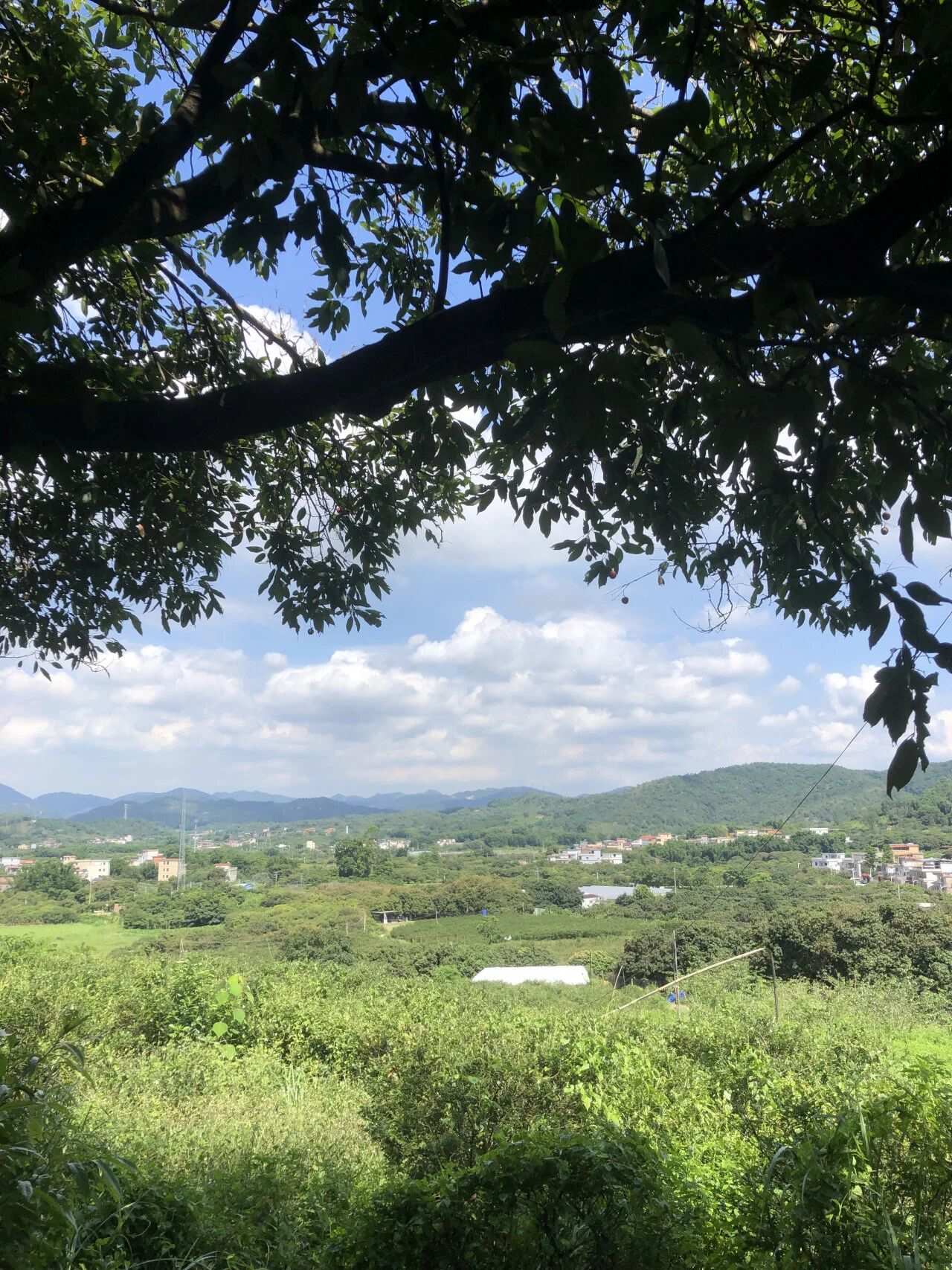
Guo Rui recalls that this stretch of green ground in front of the café was once planted thick with citrus trees, the twenty-odd lychee trees interspersed among them. A lychee tree needs seven to eight years before it bears fruit; to bridge that long gap, his parents had counted on the citrus trees for some income. In conversations with another old villager, Brother Zhong, we pieced together the story of Yinlin Village’s cash crops. In the eighties, before Huanglongbing struck, the village was blanketed in citrus groves; and before the large-scale switch to citrus, the original crop had been rice. Today, lychee prices fall far short of the cost of picking labour, so villagers have chosen to leave and seek other work elsewhere. “We old lychee trees have all been forgotten now! No one picks them, no one looks after them.” An old villager told us beneath a three-hundred-year-old lychee tree at the foot of Guanyin Hill, its canopy stretching wide overhead.

VI. Back in the City

I began to learn to read the vegetables and the soil: on which patch of ground the plantain grows lush and soft, which fruit’s skin thickens under the heat. And I gradually came to understand that the shared meals at Yinlin are more than simply eating together; they are a relationship of mutual care: we take in what the land gives, and we must also tend to the land’s weariness.

Later, on some afternoon back in the city, I was wandering aimlessly through an air-conditioned supermarket. When I picked up a perfectly shaped tomato, a familiar pause struck me—where did this tomato come from? Had it too swayed in wind and rain, ripened amid the chirping of insects? What did its seed look like?
The supermarket label offered no answer. I stood at the self-checkout, scanning the tomato. The price displayed on the screen was, after all, still merely its exchange value as a commodity. And the vast story of life erased behind it all—the warmth of the soil, the turning of the seasons, the tender bond between people and the land—cannot be measured by any number.


Ecological Farming Internship Programme
To date, four rounds of recruitment have been completed, supporting more than 80 participants in entering over ten ecological farms nationwide for internships lasting from three months to a year.
Editor: Zheng Yuyang