
The 30-Minute Delivery Myth of Online Fresh Grocery Begins with the Picker’s Three Minutes

Foodthink Says
In January this year, a Beijing resident ordered fresh lily (bulb) from Hema but received toxic narcissus bulbs instead, poisoning her 71-year-old mother and 12-year-old son, who were both rushed to hospital after eating them. Regarding the mis-picked item, Hema explained that during the picking process, a picker had mistakenly placed narcissus bulbs from another order in the same time slot into this customer’s parcel.
Are pickers’ mistakes simply a matter of chance? As online fresh grocery delivery has become a key battleground for platform giants—Meituan (Xiaoxiang), Alibaba (Hema), and JD.com (Qixian)—competing for the local life (services) market, delivery speed for riders and picking speed for pickers are critical factors in sustaining traffic and user retention. The author of this article, Yakou, discovered while working part-time at Xiaoxiang Supermarket that pickers on online fresh grocery platforms are perpetually under high pressure constructed by algorithms, data, and piece-rate pay, making mis-picked items and missed items an unavoidable structural problem. On one side is alienated labour; on the other, unsafe food consumption. Before falling into the binary opposition between workers and consumers, perhaps we should first examine the escalating “speedism” on online fresh grocery platforms.
“Don’t the others eat dinner?”
“They… eat after they finish work. Part-time jobs don’t come with dinner time, after all.”
After the Spring Festival, in March, I found a part-time job as a picker at Xiaoxiang Supermarket in a first-tier city in Guangdong. The work mainly involved picking goods after customers placed orders, packaging them, and handing them over to delivery riders.
I had planned to work at least two weeks, but after six consecutive hours of intense labour on the third day, I developed a fever. It might have been from repeatedly entering and leaving the cold room to handle frozen goods, or simply from the sheer volume of work. That day, had I not insisted on having dinner, the station manager had planned for me to work from 4:30 in the afternoon until 10:30 at night, without a single break.
My body simply couldn’t take it, so I quit. But after I left, I knew there would always be a few full-time staff members there pushing themselves to the limit: working six days and resting one, working at least twelve hours a day, carrying heavy loads while logging tens of thousands of steps, with only one meal a day.
With competition in the food delivery market growing ever more fierce and regulation tightening, Xiaoxiang Supermarket’s ability to tap into and fulfil online fresh grocery demand has become a new weapon for maintaining Meituan’s traffic advantage in local commerce. But the foundation of all this is efficiency and convenience underpinned by intensive labour, and the price is the picker’s body and work, so tightly controlled.
The Invisible Xiaoxiang Supermarket
The Invisible Pickers
Nowadays, more and more people are getting used to shopping for groceries on Xiaoxiang Supermarket. Open the Meituan app homepage and the Xiaoxiang Supermarket entry is very prominent, located in the first column, second row, right below food delivery.
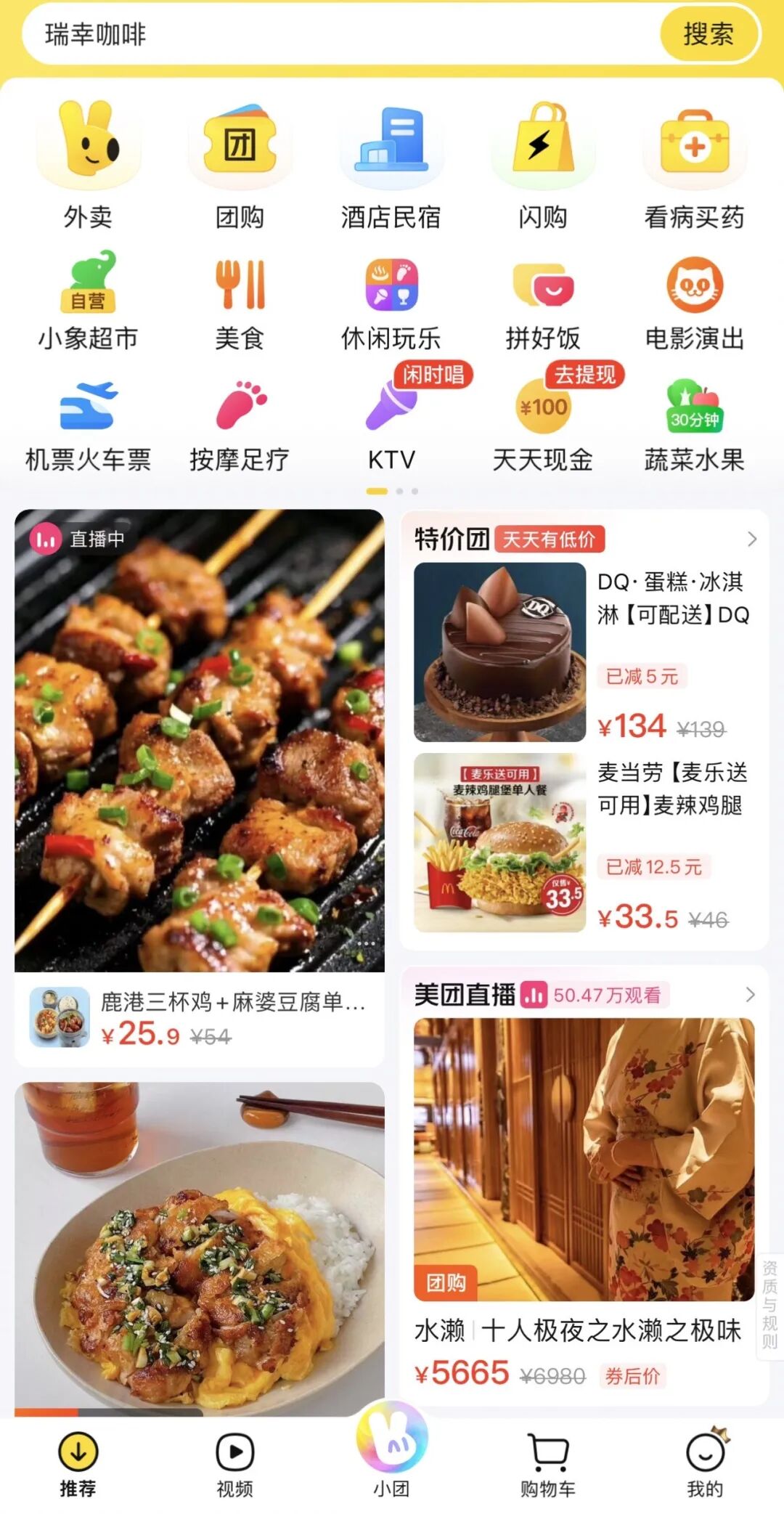
◉ Meituan app homepage. Xiaoxiang Supermarket currently has nearly a thousand stations across 20 core cities nationwide. Source: Screenshot of Meituan app.
But in offline life, Xiaoxiang Supermarket often hides in plain sight within residential communities or narrow alleys; even if we pass by daily, we may not even notice it.
The day of my interview was also the first time I saw a Xiaoxiang Supermarket station. Under a huge green logo sign, three delivery riders in green uniforms sat squatting, all appearing to be in their early twenties. One had his head down, dozing with half-closed eyes, while the other two were chatting. At the entrance, a few more riders stood waiting for orders to come through. Walking down the narrow alley leading into the station, I noticed “Riders Only” written on a damp wall. A row of electric scooters was parked along the wall, and four or five riders squatted there, scrolling through their phones.
Unlike Meituan’s riders in yellow uniforms, these riders in green are dedicated exclusively to Xiaoxiang Supermarket orders. It is their daily high-speed, life-or-death dashes through traffic that sustain the myth of Xiaoxiang Supermarket’s “30-Minute Express Delivery.”

◉ October 2025, Beijing. A Xiaoxiang Supermarket rider, travelling too fast with an overweight load, skidded forward after emergency braking and collided with an electric scooter crossing the road; the mineral water being delivered scattered across the ground. Source: Foodthink.
But the workers behind this myth are not just delivery riders. It was only when I stepped into this station that I realised: in that not-entirely-clean alley, in that fresh-goods warehouse lit day and night, I too—as a picker—would become a cog in the 30-minute myth. And the time allotted to me was just three minutes.
The Ultimate 3 Minutes
“Everyone calls me Sister Lin.” On my trial day, the veteran employee Sister Lin walked me through the station’s product layout and workflow at a fast clip. The shelves on either side whooshed past the edges of my vision.
The entire station is a large warehouse of two or three hundred square metres, with shelves occupying the vast majority of the space, densely packed with products. Ambient, Cool, Refrigerated, Frozen—temperature divides the warehouse into four zones. A picker’s job is to receive an order on the PDA, then dart back and forth between different zones, quickly grabbing every item on the list, then heading to the packing station to bag it all up. The whole process must not exceed three minutes. Each time a picker finishes one order, the PDA displays the next. The moment they press “Accept Order,” a new race begins. And so the picker loops endlessly through heart-pounding three-minute sprints.
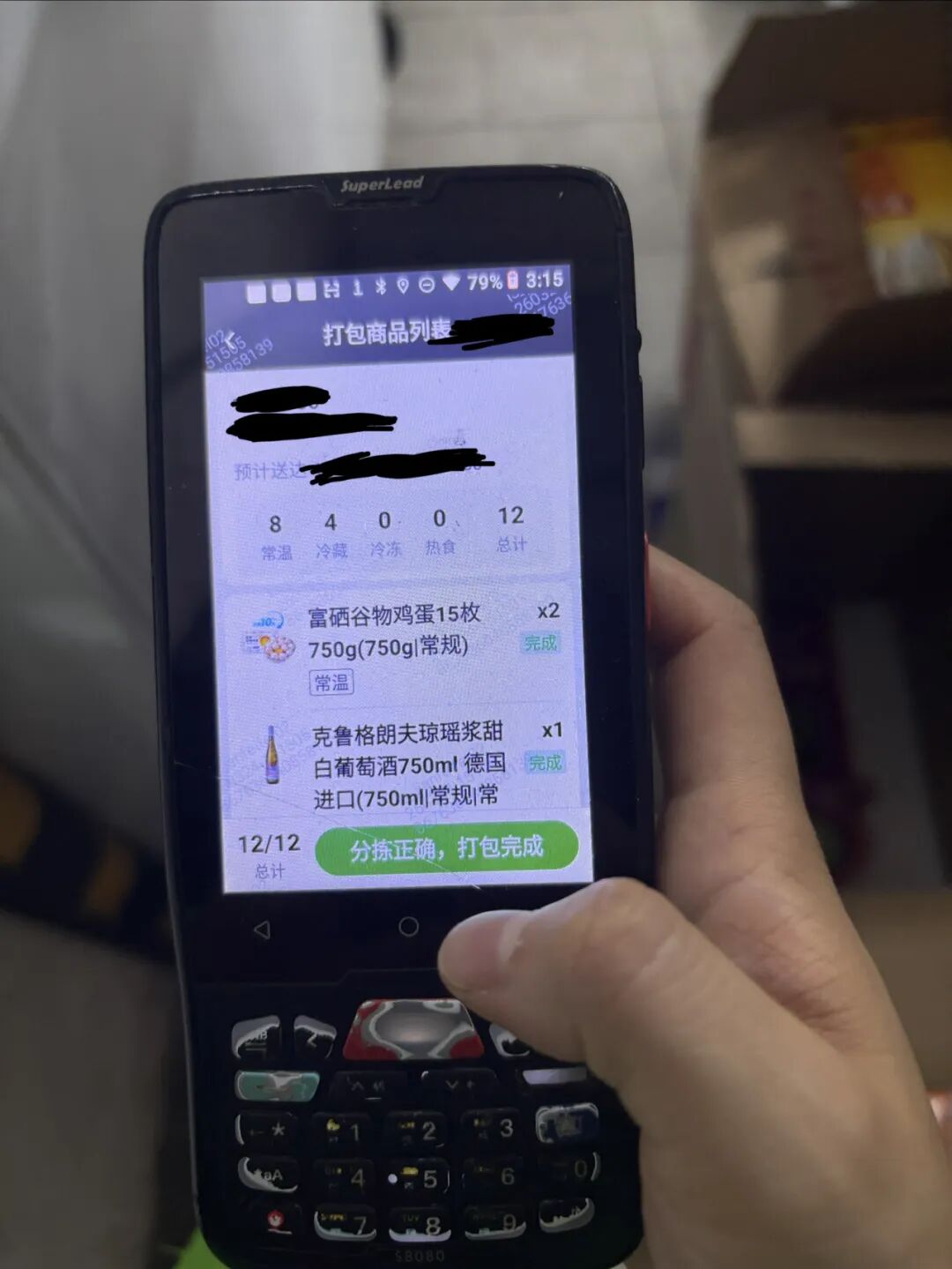
◉ A PDA is a handheld device used to receive orders and scan products. In a front-end warehouse, the PDA functions like a conveyor belt on a factory floor, dictating the speed and direction of both the picker’s body and the goods.
Let me use a specific order I picked as an example to show how much one person can get done in three minutes under extreme conditions.
At this point, an order appeared on the PDA. There was no way to know in advance how many items it contained, but I pressed “Accept Order” without a moment’s hesitation.
Item one: cantaloupe, Cool zone, 03-02-02-01. This string of numbers combined with “Cool” is the stock code for the cantaloupe—in a warehouse this vast, you need a code to find anything. Aisle three, column two, shelf two, slot one. I found the cantaloupe, scanned the QR code on the shelf with the PDA, then scanned the QR code on the cantaloupe’s packaging. The first item secured; the plastic bag on my arm instantly grew heavy.
Item two: bird’s eye chilli, Cool zone, 03-01-06-01. The sixth shelf is the topmost level, and I can’t reach it. The shelves stand about 1.8 metres high; products on the top shelf are usually in plastic crates, and my outstretched hand can only just touch the rim. Stepping on a stool would work, but finding one, dragging it over, climbing up, grabbing the item, scanning, stepping down—that whole sequence takes close to thirty seconds, and I can’t let a single item consume a sixth of my time.
In the end, I chose to climb the shelves—standing on the second shelf and reaching up with my hands to grab items from the top—something I’d learned from other pickers the same height as me. At first I thought it was dangerously reckless, but so many people were doing it, and it did save time. Sometimes I even balanced with one foot on each of two shelves, because that gave me a more stable centre of gravity. Though a nagging worry that the shelf might tip over never left me, I still chose to climb and drop down with speed, anxiety and all.
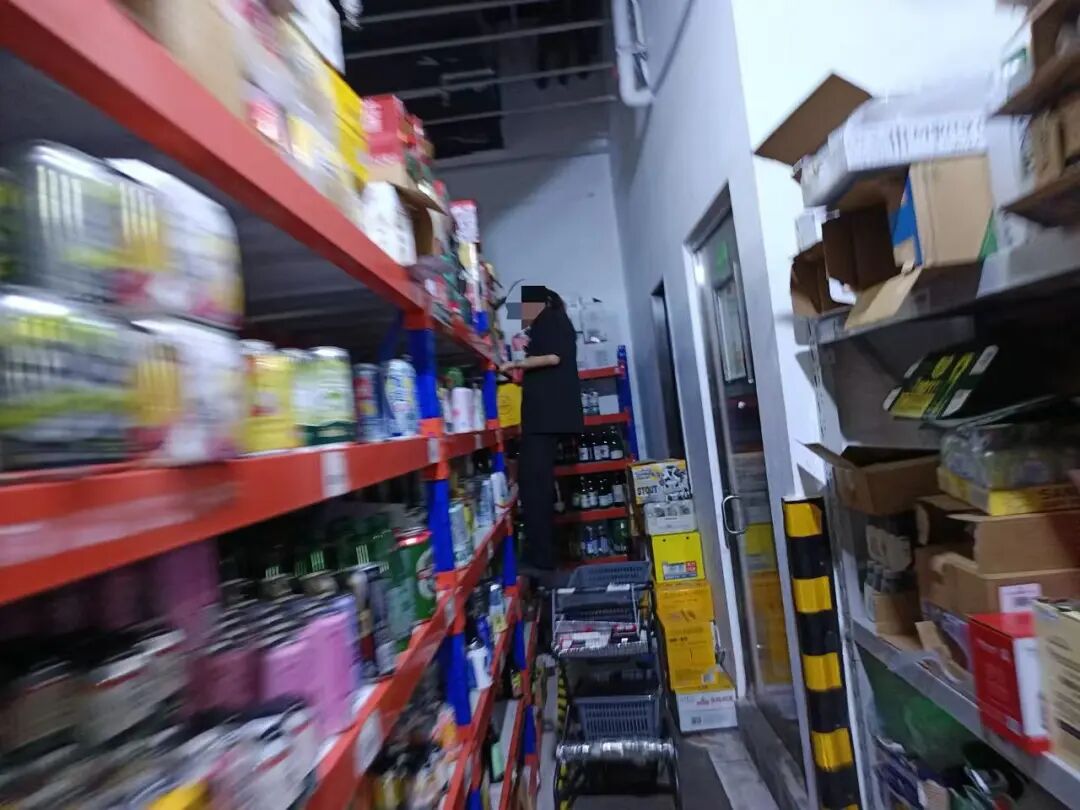
◉ Warehouse shelves are typically marked “No Climbing,” but under the very real pressure of order deadlines, pickers have no choice but to take the risk of climbing.
Item three: blueberries, Refrigerated, 07-02-04-03. Item four: ice cream, Frozen, 02-03-01-06. I let out a deep sigh—time to enter the cold room. Thick curtains hung at the entrance, caked with several layers of ice. Inside, a dozen or so cooling fans were working overtime. I tensed my neck and bent slightly at the waist. If humans had the ability to roll forward, I would have curled myself into a ball on the spot.
Spending more than a minute and a half in a minus-20-degree environment brings thoughts of death. A few times, after frantically rummaging through cardboard box after cardboard box for the target item to no avail, I imagined whether I might freeze to death or lose consciousness right there. In those moments, the will to survive and the anxiety over the deadline go to war in my head. To avoid frostbite, even when the order was already well past its deadline, I chose to step outside for a breather before going back in.
Item five: bread, Ambient, 11-04-06-01. Top shelf again. I climbed up. By now, two minutes had already passed. The PDA in my hand reminded me: “Order about to expire.” Two items left. It looked hopeless, but I still broke into a run—like the other pickers, running in every corner of the warehouse. I still remember, on my trial day, watching others rush past me, some power-walking, some jogging, the sound of “Order about to expire” still rising and falling all around. Now, I was part of it.
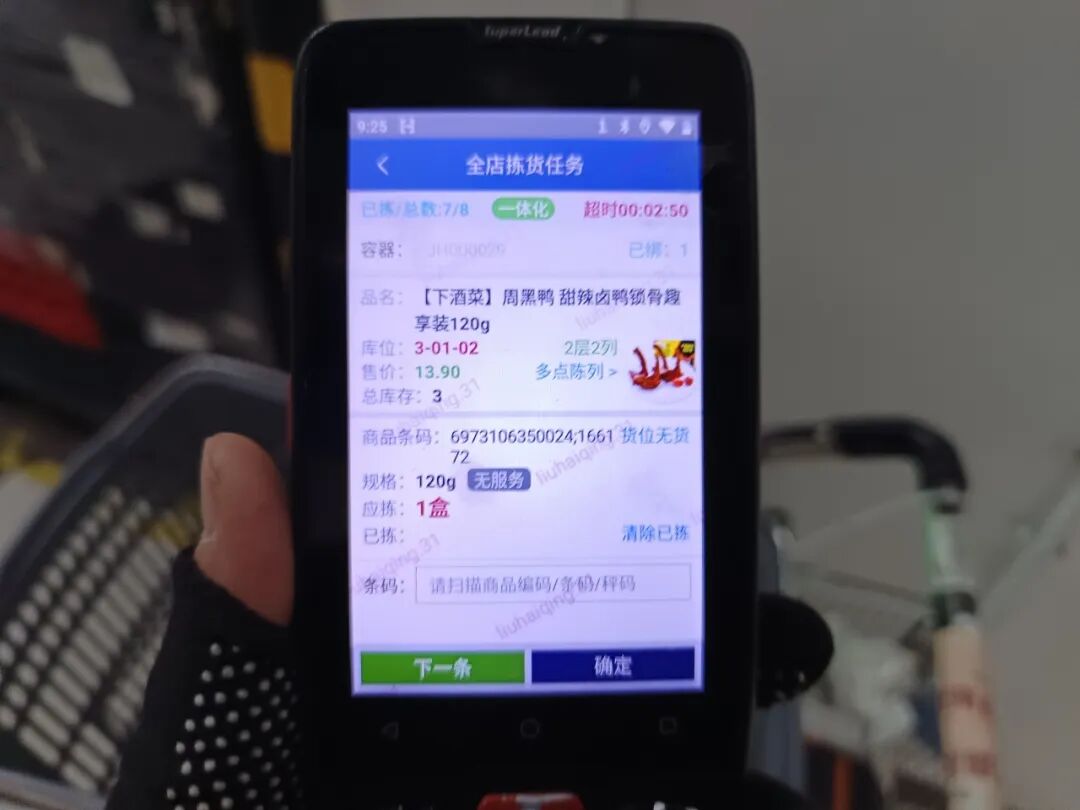
◉ The red number in the top-right corner of the PDA screen indicates that the picker is already over time. Photography: He Siqi
Item six: mineral water, Ambient, 03-01-02-01. Honestly, this was one of the last items I wanted to see. Mineral water, cooking oil, rice, beverages—these products are big and heavy. The heaviest order I ever encountered was four 5-litre bottles of mineral water, a big bag of rice, a bottle of oil, plus six smaller items. Oil in one hand, a plastic bag and a big bag of rice in the other, I puffed my way round to the packing station, doubled back, then shouldered four bottles of mineral water. By then I didn’t care whether I was over time or not—I just wanted to put everything down and catch my breath.
“Effective Working Hours”
Rushing about, feet barely touching the ground—that is the scene most of the time. But during off-peak hours, pickers will sometimes drift over to the Cool zone or the Refrigerated zone, a fair distance from the station manager’s workstation, to chat and joke. Once, when I had gone into the Cool zone to find some vegetables, I happened to overhear a young picker venting to a stocker: “The pay is this meagre and I’m not stupid, you know.” The stocker agreed: “Yeah, it’s like this every single day, damn! Anyway, when it comes to deductions, he takes the big share and we only get the small one.” The person they were talking about was the station manager, ten metres away. But with two temperature zones in between, the thick door curtains created a relatively safe little bubble.
A single city has many Xiaoxiang Supermarket stations, and they compete against one another on metrics such as on-time delivery and low customer complaints. When a station’s data underperforms, it is actually the station manager whose pay takes the biggest hit.
But the station manager does not bear this anxiety and loss alone. A large monitor hangs in the station, displaying the on-time rate, the 30-minute delivery rate, and other data for the entire station. Every second of every person’s time seems to be held accountable to those numbers.
Beyond that, every employee’s real-time work output is displayed in crystal-clear detail: average picking time per order, items picked per hour, real-time order breakdowns, on-time picking rate, effective working hours rate… and picking volume rankings, plus a list of priority-attention staff. Pressure travels down layer by layer from the platform through this stream of data.
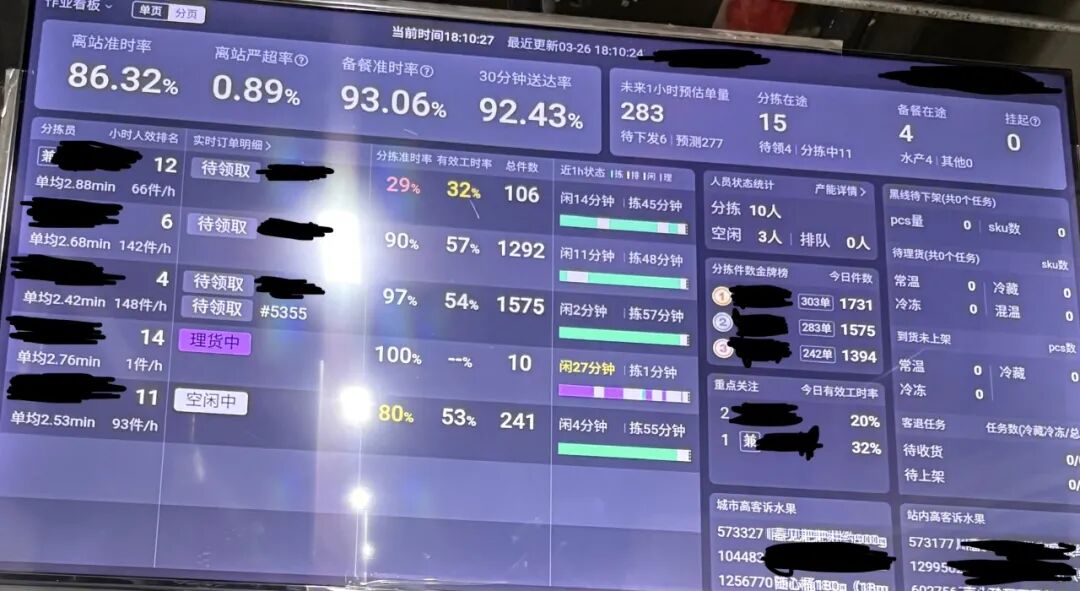
◉ On the large screen, data generated by everyone running about in this warehouse updates in real time.
Part-time shifts are generally scheduled on weekends and during the daily peak, from 4:30 p.m. to 7:30 p.m. In that window, order volume surges and nearly everyone is running at full speed.
The job listing on the recruitment app says part-time, 20 yuan an hour—but that is only if you are fast enough. If I cannot pick 100 items per hour, my rate drops to 13 yuan. Under this system, even without a boss cracking a whip, employees will run for more pay on their own.
On my first day at work, I ended up on the “priority-attention” list. Fortunately, as a newcomer, the station manager did not single me out. On the screen, my “effective working hours rate” was below 30%. The very concept of “effective working hours” left me utterly baffled. We were already working on the job—why did those hours still need to be divided into effective and ineffective?
It was only later that I learned: if you confirm an order as complete but do not immediately accept the next one, the time in between is logged by the system as “idle time”—that is, ineffective working time. But to avoid going over time, pickers typically press “Packing Complete” before they have actually packed, then spend a minute or two at the packing station. If there are fruits or vegetables that need careful inspection, that means even longer stretches of “idle.” No matter how little idle time there actually is, it gets logged as “idle.” We have no choice but to keep moving without breaking stride—not even time to catch our breath before we are already running for the next order.
In this efficiency-first environment, I also felt a sense of loneliness.
Once, while picking, I accidentally knocked over a box of tangerines and more than a dozen rolled across the floor. I hurriedly set down whatever I was carrying and started gathering them up one by one. In my haste, I was all hands and fluster. There were two or three pickers right nearby, but nobody came to help. Everyone was too busy with their own order.
I asked myself: if another picker needed help, would I set down what I was doing and go? The moment I realised the answer was “uncertain,” I understood what was truly frightening about this job. It rewards competition, chases efficiency, wears down mutual aid, and deepens isolation. It makes asking for help feel like a burden, and reaching out to help someone else feel like self-sacrifice.
Who Makes Our “Perfect” Life Possible?
“That won’t do—every single one has a problem.” On my trial day, Lin-jie asked me to help her check a box of oranges. I went through them once and thought nothing was wrong, but Lin-jie pointed to the blemishes and scratches on the peel and said that sort of appearance could result in a customer complaint. She told me to go get a different box. I was taken aback—those spots and scratches didn’t affect the fruit’s quality or taste at all. If anything, they were just normal growth marks.
Items like eggs, and fruits such as blueberries, strawberries, and grapes, can’t be assessed by sight alone, so we’re required to check each one individually before packing for any rot, damage, or scratches. This alone often takes at least a minute.
The problem is that, to reduce the risk of going over time, pickers often press “Packing Complete” before they’ve actually finished packing. Once they do, the delivery rider receives the pickup notification for that order, and the time pressure that has lifted off my shoulders transfers straight to theirs.
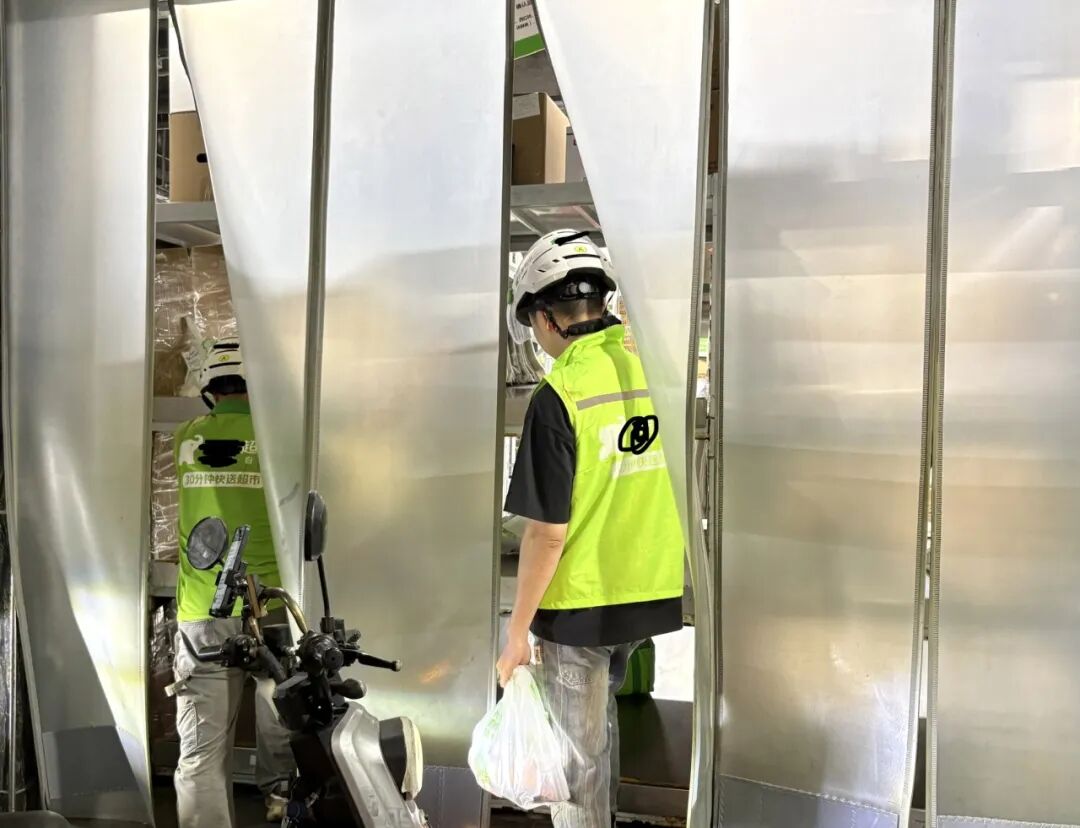
◉ A delivery rider waiting for a picker to finish packing.
In that moment, my interests and the rider’s were diametrically opposed. If the picker doesn’t press “Packing Complete” early, the order will definitely go over time; if the picker does press it early but the rider is left waiting and the items aren’t ready, the system may flag a late pickup. Lin-jie reminded me: “Hurry up, okay? If the rider waits more than a minute, they might tap ‘Appeal’ and you’ll lose five yuan on that order. If you’re running behind, just keep your tone sweet, alright? Say a few kind things and ask them to hold on.”
In most cases, riders don’t actually file an appeal. The most I’ve seen is a “nudge” or a “ping,” while the picker keeps working at full speed with a pleasant tone. Roughly fifteen pickers work in the station each day, three-quarters of them women, and the riders who come to collect orders are almost all men—I realised that what Lin-jie was teaching me was a highly gendered survival strategy.
On my last day, I still received a customer complaint. Ten yuan was deducted, with no room to negotiate. If each order runs eight to ten items, a part-time picker earns less than two yuan per completed order. A single complaint means the equivalent of five orders worked for nothing.
Beyond the appearance of the products, mis-picked items and missed items are also all too easy triggers for complaints. Once you’re past the new-hire period, you move from picking one order at a time to two, which means that while running around, we need to work out which items belong to the first order and which to the second, then drop them into the right plastic bag. Because the whole process prioritises speed, putting an item in the wrong bag is only too easy to happen.
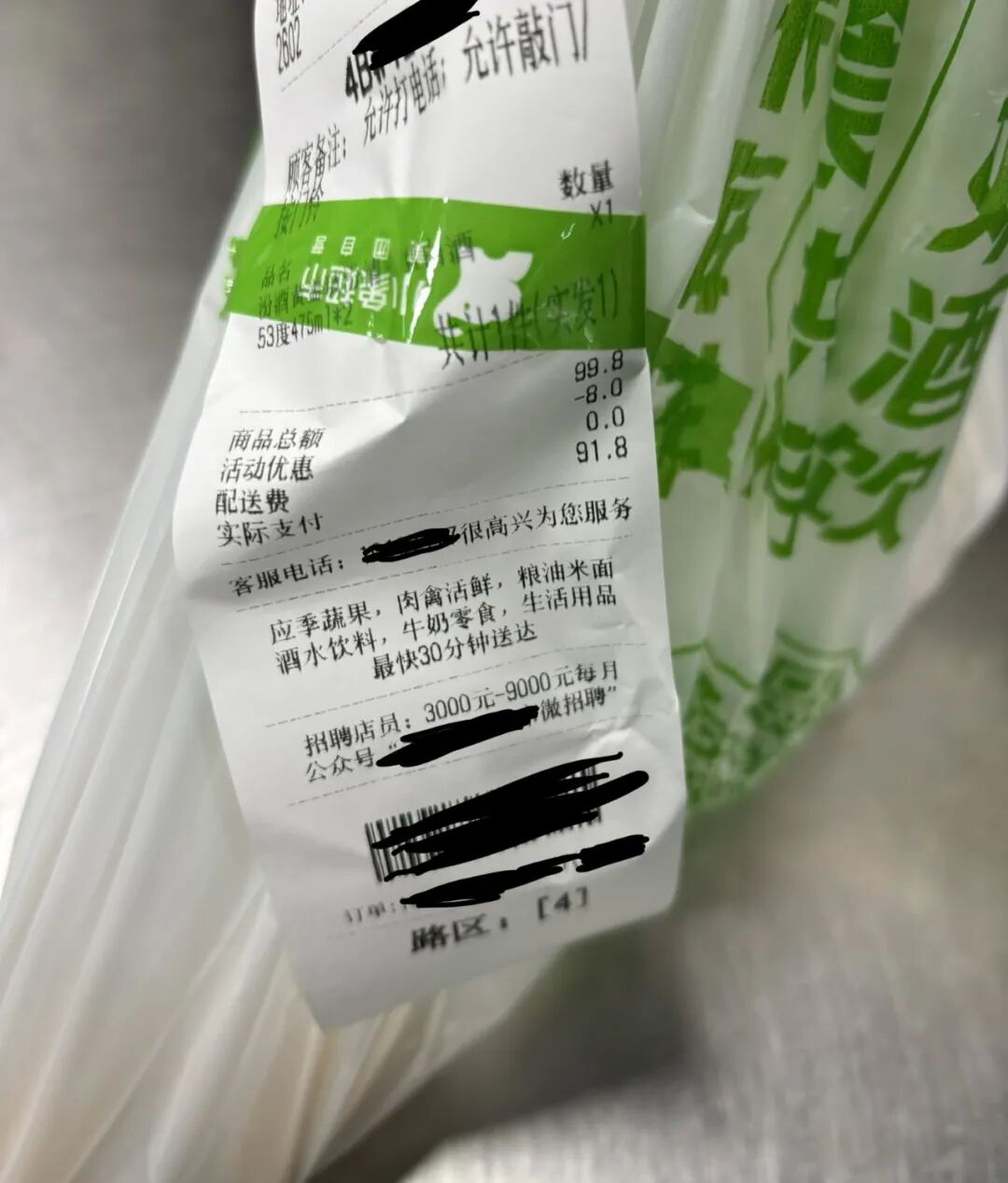
◉ On the receipt the customer receives, the picker’s name is printed after the order number.
It suddenly occurred to me that I, too, had tapped “Complaint” on the platform’s interface when I hadn’t received the items I’d ordered. But I never really understood what was happening behind the scenes, or what my complaint actually meant. When I was no longer the consumer wielding the “power to punish” that the platform lends out, but had become the one being punished—I understood.
In this era, people truly do live in different spaces and settings, and this kind of separation has only become more entrenched and invisible in a world where everything is so conveniently at our fingertips.
We want “perfect” fruit, a “perfect” life, yet we don’t really grasp how many hands a batch of fruit passes through before it reaches ours. What do the people who grow it, store it, transport it, and pick it have to give up, and how must they reshape their bodies and their lives, to collectively produce this kind of “perfection”?
But is this life really perfect? Who gets to define perfection? Is fruit without blemishes the perfect fruit? Is a life built on efficiency and convenience the perfect life?
At the very least, when we recognise that behind every meal are countless workers—riders, pickers, and others—serving this notion of perfection amid tension and anxiety, we need to ask again: what does a perfect life actually look like?
– This is the 798th original article by Foodthink –

Foodthink
Author
Ya Kou
No full-time job—just gig work that calls on both mind and body. I’ve recently picked my fieldwork and creative writing back up. In a world full of regrets, this is a little light no one can take away.
Unless otherwise noted, all images in this article are provided by the author.
Edited by: Yu Yang
Layout: Xiao Shu