
Whose Mechanisation? Upgraded Combine Harvesters and Unemployed Farmers
I. A Post-2000s Youth’s Memories of Agricultural Machinery
The combine worked field by field, and families queued up waiting for their turn. When rain was on the horizon, they would work through the night in a rush harvest. The operator’s food and lodging were the village’s responsibility. Whose field was being cut at midday, that was where the operator ate, and at night he stayed with whoever had arranged for him to come. Once the rice was harvested, we spread it out on the threshing ground in front of our door – a flat expanse of earth, levelled with a stone roller, used for drying grain. As a child, I would often stand where the stone roller was anchored, hands on the four wheels, patrolling my domain.
It was not until 2009 that our family bought a combine harvester. The first was a Kubota 488. That same year we also bought a second-hand green combine, a model that was the most common one at the time. The green combines that came to our village all looked alike, and they stood out vividly against the golden fields.
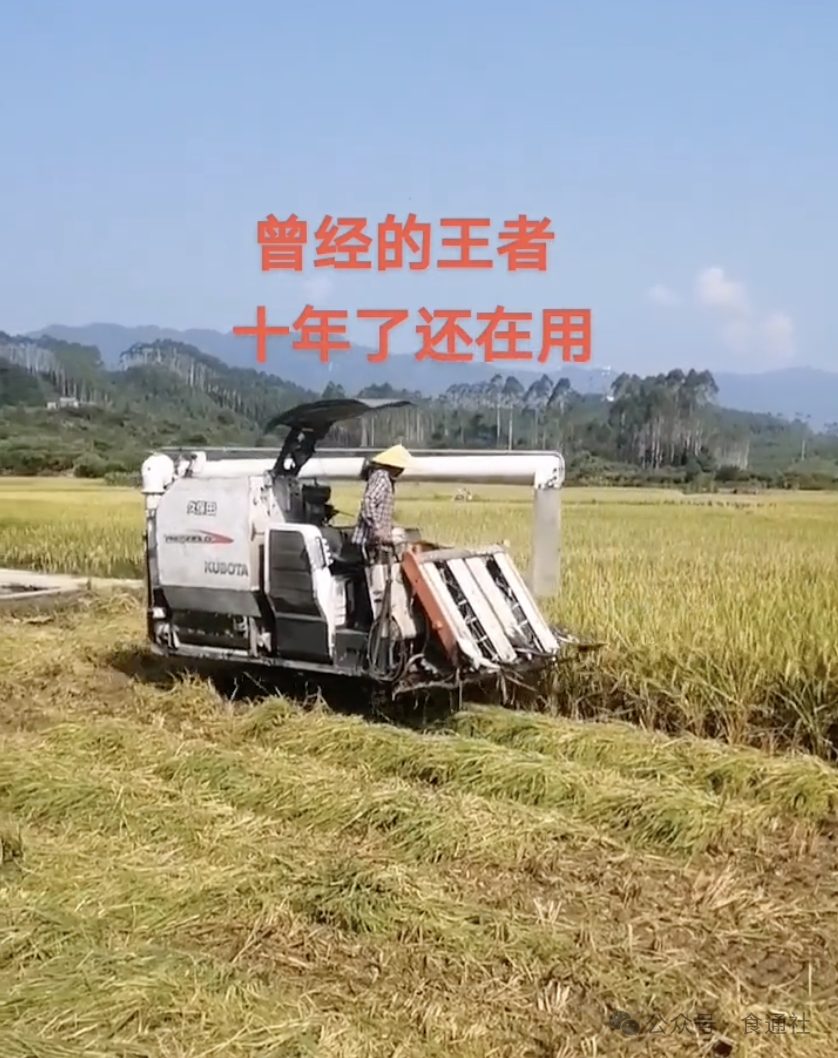
After the green combines disappeared from the scene, Kubota harvesters, which lost less grain, became the villagers’ favourite. But the Kubota 488 had its own drawback: the grain tank was small. On both the Kubota 488 and 588, someone had to tie bags onto a metal frame by hand, then open the grain discharge port and release the grain. Once a bag was full, you gave it a quick tie and set it on the ground. Each bag held about 100 jin (50 kg). So in addition to the operator, you needed a “bag-catcher.”
Most people doing this work at the time were men. A single mu yields at least 1,200 jin of rice – that is 120 bags – and northern Anhui is mostly flat plains with large fields, so during the rush harvest the workload was enormous.
Back then, during harvest, you would often see a vast rice paddy with a single combine crawling along. The operator sat in the cab taking in dust, while another person caught bags and simultaneously used an instrument to measure the field area. In the field lay uncut rice and bulging sacks – yellow urea bags, and Hong Sifang bags in a pink-and-yellow two-tone. Farmers and their three-wheeled trucks waited at the field’s edge, ready to collect the bags.
II. Fourth Uncle, Out of Work
Because the machine met the requirements for cross-region operation (holding a cross-region operation permit, with the permit details matching the machine, and the vehicle within legal limits and not carrying mixed cargo), combines doing cross-region work were exempt from motorway tolls. In those days, my father would drive a large truck carrying a combine that needed a bag-catcher, with Fourth Uncle in the passenger seat and a thick map of China spread out before him. In the age before GPS, veteran machine operators navigated the country with nothing but a paper map.
Fourth Uncle used to do construction work in other towns, but he would come back during the farming rush to help with the harvest. In those days, when land contracting and family farms were not yet widespread, there was a shared belief: even if you went out to work for wages, the family’s fields could not be left fallow.
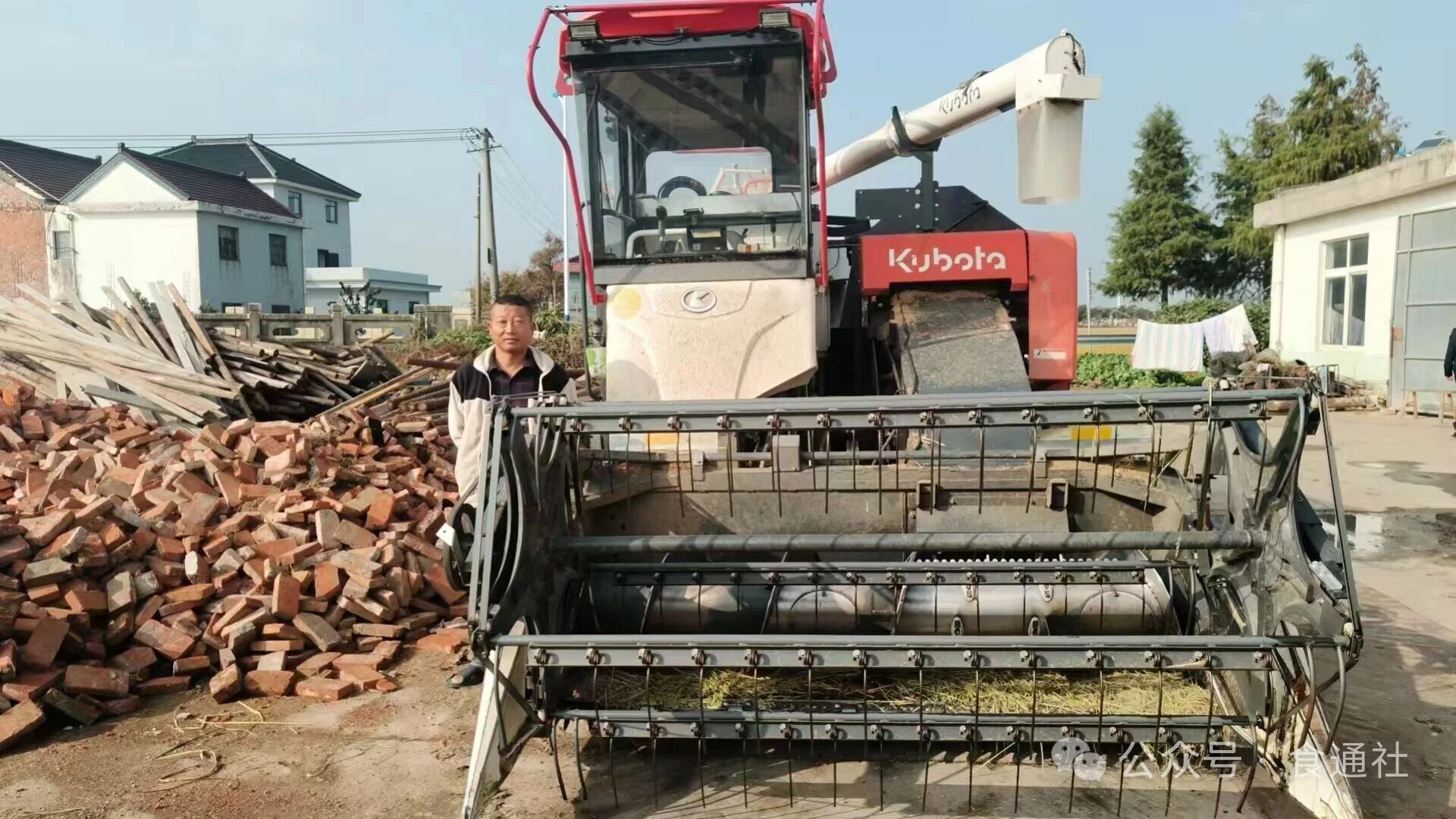
But eventually, Fourth Uncle lost his work. He was too old for the construction sites, and the rush harvest no longer needed a bag-catcher. Modern Kubota combines have air-conditioned cabs; sealed glass panels keep out dust and help prevent respiratory illness. A large grain tank has also become standard, so farmers no longer need to carry bags across the field to their vehicles. They simply position a three-wheeled truck with a large cargo bed at the right spot when the tank fills up.
The bag-catching job simply ceased to exist, and Fourth Uncle was left with little to do at home, occasionally taking on odd jobs for neighbours – drying their grain or helping build a house.
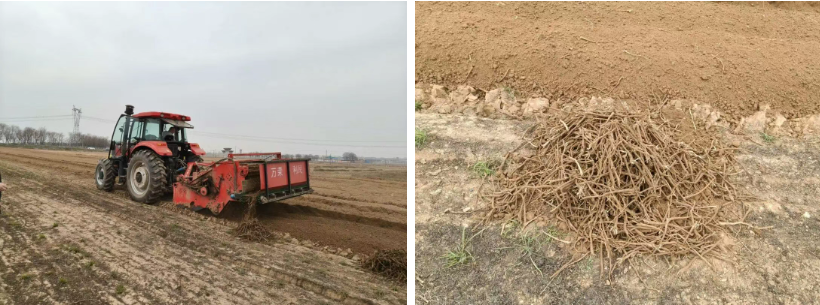
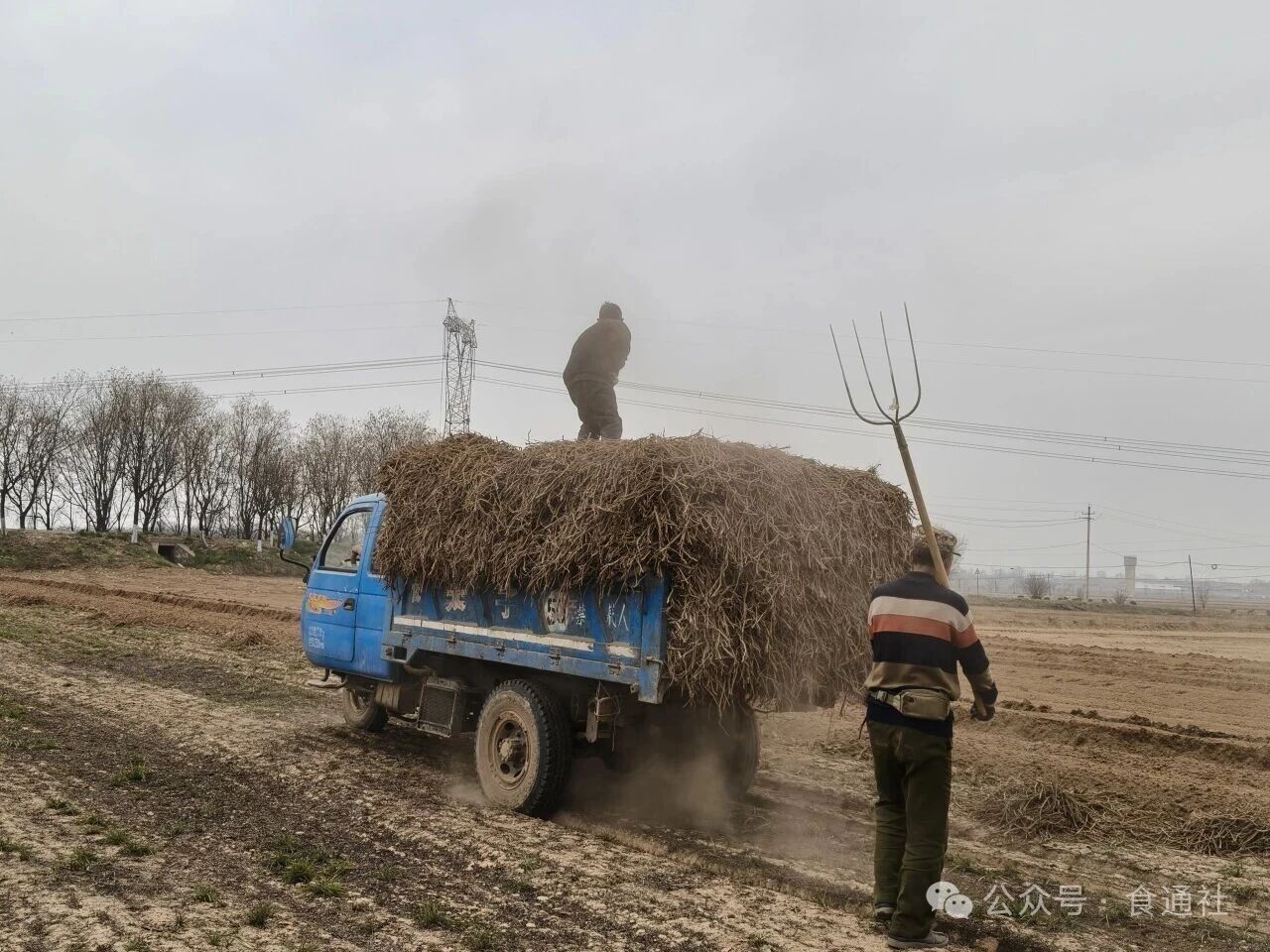
Once the rice harvest was over, it was time to plant wheat. Red wheat seed (note: wheat soaked in pesticide to protect against soil-borne pests and bacteria that can inhibit germination; the seed coating agent is usually red, which is why the seed appears red) was spread across the fields. Planting rice was more troublesome than planting wheat. Rice required transplanting, which used to be done entirely by hand, paid per mu at an average rate of 220 yuan per mu, food and accommodation included. Later, rice transplanters appeared, dramatically improving efficiency and saving both time and effort. But transplanters could only work in shallow water; deep-water areas and small plots still required manual labour.
In recent years, during the rush harvest, government officials still pull combines over at motorway junctions, escort the operators to the fields, and hand them a cross-region operation service package containing a towel, soap, bottled water, face masks, heat-relief supplies, and an operations information sheet. The government provides operators with consultation and operational guidance, which also helps ease the shortage of machinery in some areas to some extent, making it easier for operators to arrive where there is work and to leave smoothly when they are done.
Most people in this trade were men, self-employed, with the strength to take on odd jobs here and there. Spreading fertiliser meant slinging a full basket over your shoulder, pulling on gloves, and walking out to the field, scattering it evenly handful by handful. For spraying pesticides, you would either carry a knapsack sprayer on your back, or lay a long hose along the path beside the field and drag it through the crop while spraying. The sprayer was heavy, and dragging the hose made walking difficult. Before agricultural drones became widespread, spraying and fertilising could take half a month to finish; with a drone, 30 mu can be covered in eight to ten minutes.
The evolution of agricultural machinery runs through my entire childhood memory. Technological progress has brought tremendous development to farming, and drying grain is no longer as laborious as it used to be – there are grain suction machines, grain turners, and dryers. The threshing grounds were gradually replaced by concrete surfaces. The stone roller was set under the eaves, as if quietly proving that dripping water wears through stone. Then the eaves were demolished. The new houses have no eaves, and the stone roller lost its last resting place.
And perhaps the wind of smart agriculture will eventually reach every village. The agricultural drones working overhead and the wind turbines standing in the fields will become the first impression of farming for children in remote areas: Look, the big windmill is spinning up in the sky, and the drone is flying down in the field.
III. New-Energy Tractor or Diesel?
Longkang Farm is located in the west of Huaiyuan County, Anhui Province, and is one of 20 large and medium-sized state-owned farms directly under the Anhui Provincial Reclamation Group. As the coach rattled its way into Longkang Farm, an endless stretch of wheat field unfolded before us, blurring the eyes. This was not the patchwork of small plots I was used to in northern Anhui, where one strip of land abutted the next, but vast, orderly expanses of cultivated fields. What really took my breath away was the lineup of giants parked in the warehouse – John Deere, Claas, and Yanmar self-propelled full-feed combine harvesters.
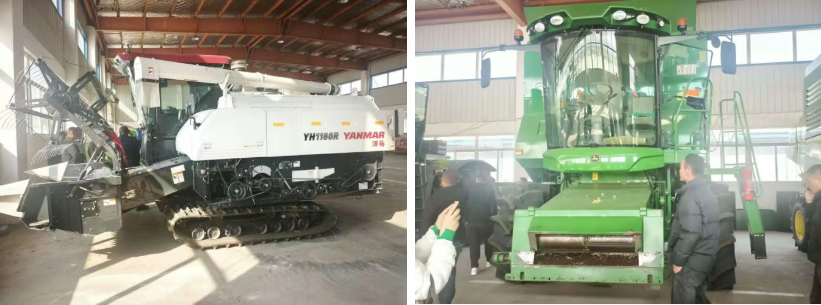
The cabs of these large harvesters were bright and spacious, complete with air conditioning and Bluetooth. The most striking was the driverless combine: no operator needed, it harvested precisely along the field ridges, cutting not a fraction too much and missing not a single row. All it took was a light click of the mouse at the command centre, and a tractor several kilometres away would drive itself out into the field. Once the job was done, you could see on the screen that the plots in the system had turned green – those were the fields that had been harvested.
In the second half of the agricultural machinery training, I also visited Wuhu Zoomlion. As a machinery manufacturer, Wuhu Zoomlion also produces and exports agricultural machinery and runs its own farm. The yard at Wuhu Zoomlion was full of machines with green bodywork. A company representative explained: “This is the latest model of tractor – new energy. The combine next to it is new energy, too.”
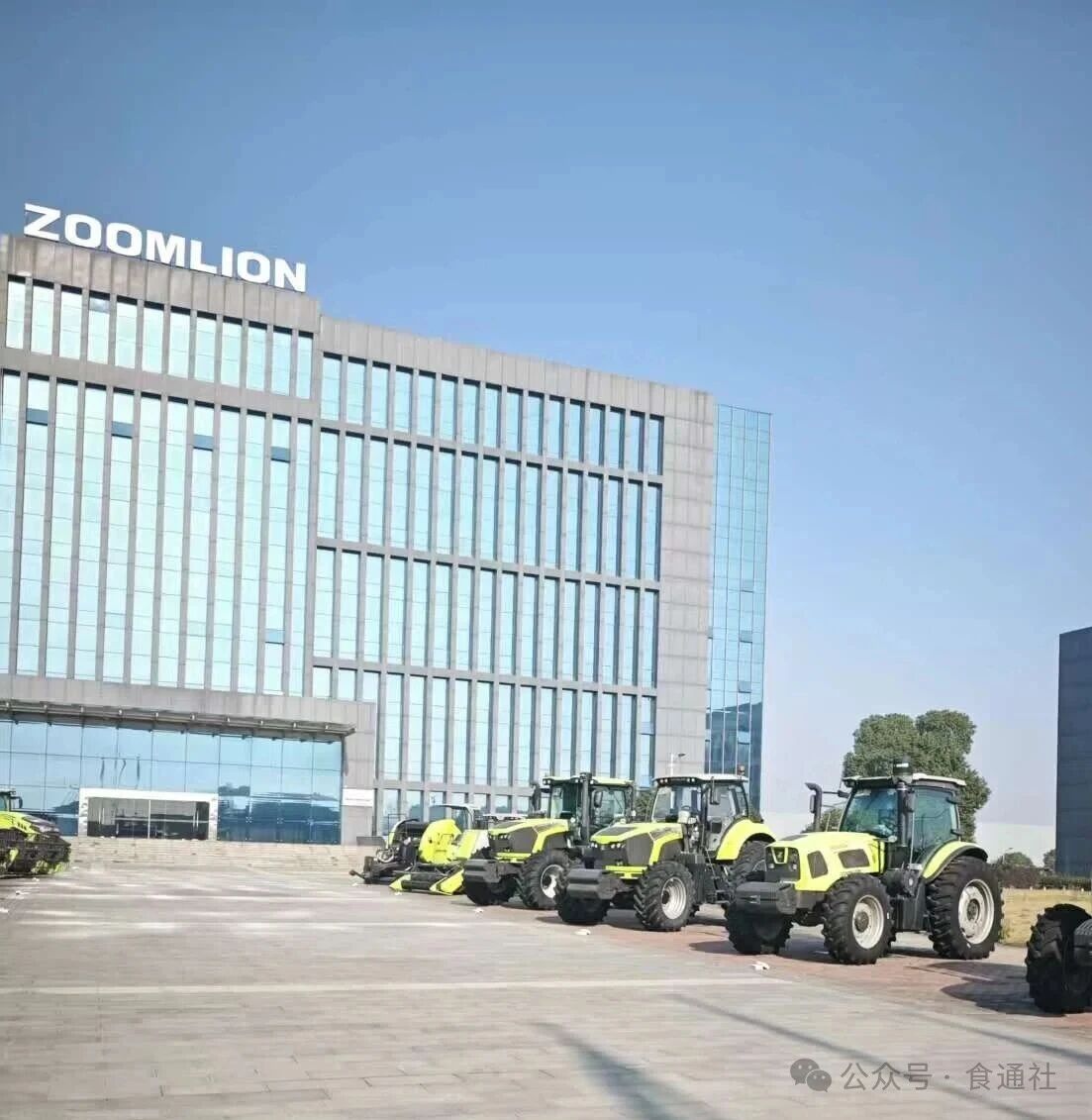
In my mind, the collective intake of breath from the crowd overlapped with the sigh my father had let out years ago when he decided to sell that old green combine.
I know that in Fuyang, most farmers will still buy diesel tractors – because they are cheap, easy to fix, and “there are petrol stations everywhere.”
Some would argue that large-scale farmers, cooperative leaders, and similar groups, with their advantages in capital, organisation, and information, were the first to hop on the “express train” of mechanisation; while small farmers with limited funds and little technical capacity were marginalised, further widening the income gap and narrowing development prospects within rural communities. This phenomenon, like the uneven distribution of education, is an objective reality.
But small farmers are also exploring mechanised production; they are not relying on traditional ways of farming. Take my village, for example. The total cultivated area is over 9,000 mu, most of it contracted to family farms. The village has one agricultural machinery cooperative and a dozen or so family farms. In my section alone (note: the village is large and divided into different sections, roughly like neighbourhoods in a city), there are two combine harvesters, three tractors, and two agricultural drones, all owned by family farm operators whose farms are 100 mu or more in size. Other farmers, who cultivate smaller plots, hire machine operators – and the operators’ own machines – for harvesting, settling at around 68 yuan per mu.
In my village, there is a surplus of combine harvesters, tractors, and agricultural drones, so some people team up to do cross-region operation in other areas. But the village has no smart agricultural machinery such as driverless combine harvesters or tractors. Smart agricultural machinery is expensive and “not practical” for small family farms and small agricultural machinery cooperatives. The price of one piece of smart agricultural machinery is enough for us to buy two to three ordinary machines.
Farmers have their own ledger when it comes to buying agricultural machinery. In my village, people generally opt for second-hand tractors, with a preference for the Dongfanghong brand, on a budget of 40,000 to 60,000 yuan. The budget for a new tractor is around 100,000 yuan; with the 10,000 yuan agricultural machinery purchase subsidy, the out-of-pocket cost comes to just over 90,000 yuan. For combines, people generally buy Kubota, though Lovol is also an option. Take the Kubota EX118MQ-s, for example. This model features a chassis height-adjustment system, which allows the chassis height to be adjusted on uneven ground. It is priced at 240,000 yuan, with a 29,000 yuan subsidy, bringing the out-of-pocket cost to just over 210,000 yuan. When buying a combine, people tend to go for a new one – with the subsidy it works out better. They use it for a few years, sell it, then buy a newer model.
Perhaps in the future, everyone will be able to use smart agricultural machinery. My generation is fated to be the ferryman between the last “craftsmen” and the first “commanders”.
Editor: Xiaodan