
A Decade Across Half the Globe, Just to Record Vanishing Foods
Foodthink Says
“Stories about food are the best stories we can tell.” This was how veteran BBC journalist Dan Saladino put it, when interviewed by Foodthink at the 3rd International Congress on Agricultural Biodiversity this May.
Saladino specialises in food and agriculture reporting. Over more than a decade, he has visited more than 30 countries and regions, recording the stories of 40 foods at risk of vanishing. These stories were published together in 2021 as Eating to Extinction, which met with an enormous response. The Chinese edition was translated and published by Beiye Books.
Discussing vanishing foods is not an exercise in nostalgia, but a re-examination of the relationship between humanity and nature, and between agriculture and food. Saladino urges us to strive to understand food diversity and the global food system, and to build a connection between the food on our tables and the ecosystem in which we live. Only by saving diversity can the Earth and humanity have more choices. This article is a written transcription of Foodthink’s interview with Saladino, and we hope it will serve as a reading guide for our audience.
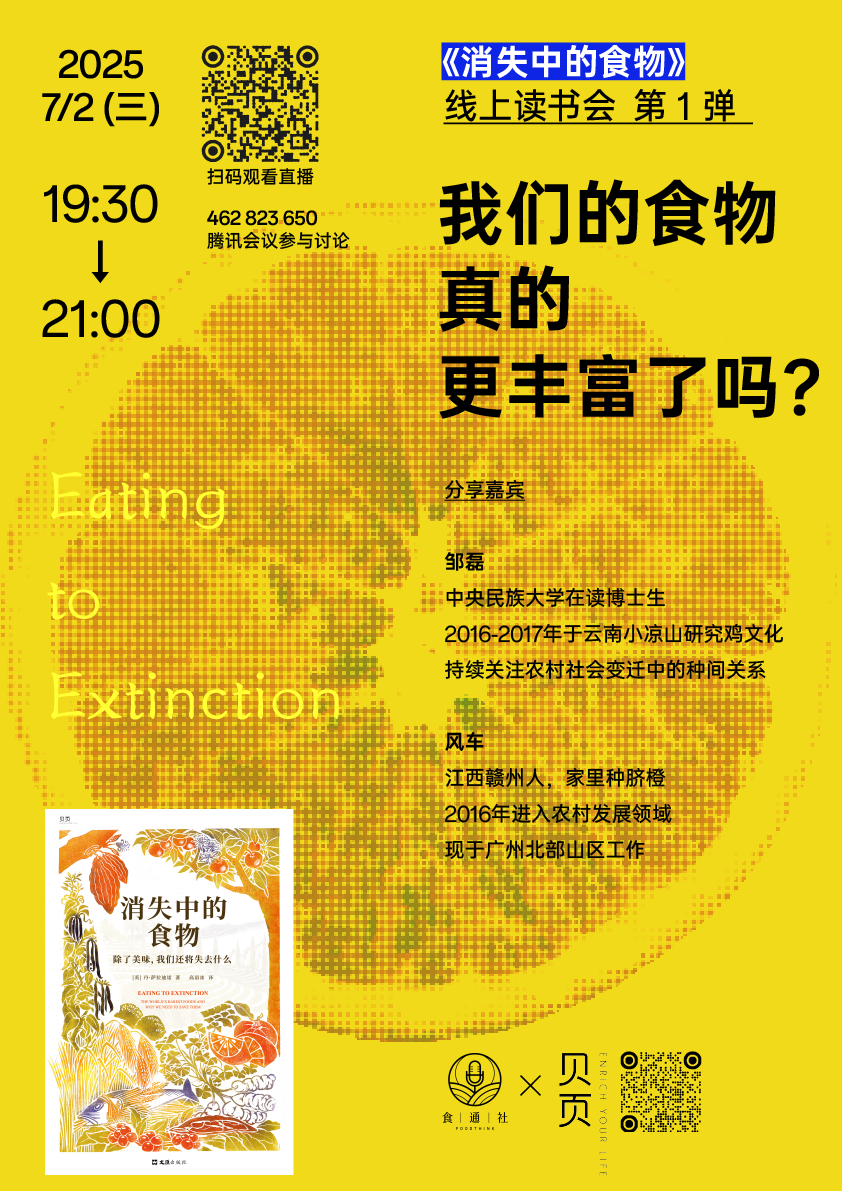
This Wednesday (2 July) at 7.30 pm, Foodthink will partner with Beiye Books to host the first online sharing session on Eating to Extinction. You are welcome to book a place for the livestream, buy books at Foodthink’s Weidian Store, and support more great books on food and farming!

As a Food Journalist, How Did You Come to Focus on Agricultural Biodiversity?
To me, this is the most consequential story in human history; it utterly transformed the Earth. These stories should be in school textbooks. The more we understand, the more we care about diversity. The radio programmes I make, the books I write, and the work Foodthink does are all inspiring people to think about their relationship with food.
Even from a purely self-interested standpoint, food is intimately connected to our health. A growing body of scientific evidence shows that a diverse diet benefits health without any downsides.
In China, the heavy responsibility of protecting agricultural diversity seems to fall on farmers – a vulnerable group. This is simply not fair. In the distribution stage, produce traders mainly buy commercial varieties rather than old varieties.
It goes to show that breaking free of conventional supply chains and creating alternative ones is possible, and that digital technology can be used to share their stories.

Saladino: The epilogue of the book is titled Thinking Like the Hadza, and the book itself opens with the story of the Hadza people. By the age of six, the Hadza already know where to find food. Try to think like the Hadza – get to know the food diversity around you. This is not a call to return to hunting and gathering, but an invitation to take a more active interest in food and to consider how we can support farmers and producers within our means.
For consumers, it is important to be aware of these lesser-known foods, but most people’s daily food still comes from the industrialised system. We recently published an article examining how imported Brazilian meat affects ranchers, and industrialised food production is one of the causes of the drastic decline in diversity.
Now, many regions and cities are discussing how to ensure food self-sufficiency while also supporting farmers in the surrounding area. Scientists, chefs, and urban consumers can all help rural communities protect diversity together. Restaurants can sell these uncommon crops, returning the proceeds to the community, while chefs share stories about food diversity with urban consumers.
Even if these small initiatives cannot transform the entire food system, they help sustain the vitality of these rural communities.

In the Introduction, You Mention Attending the 2019 UN Climate Action Summit in New York, Where Global Food Giants Were Also Talking About Food Diversity. How Do You View These Large Companies’ Shaping of the Global Food System? Are They Really Willing to Change the Status Quo?
To return to the summit mentioned in the book. At the time, Emmanuel Faber, CEO of Danone, stated that 99 per cent of the dairy cows kept by the dairy industry were Holsteins, and that they recognised the need to restore the original diversity of breeds – he spoke very candidly about diversity. Interestingly, he lost his job just 18 months later.

Saladino: In the last two years, many food companies have also begun talking about “regenerative agriculture“. Some measures do genuinely help restore diversity and improve soil health, such as intercropping. But in my observation, very few people believe that these food companies’ innovations will bring about a qualitative change. These projects are destined to remain niche products and could never replace their core business model.
At present, much of the public purse is still subsidising unsustainable food and farming systems, and we heard no shortage of examples at the 3rd International Congress on Agricultural Biodiversity. When this system causes public health crises and environmental damage, it is the public purse again that has to pick up the pieces. This is precisely our opportunity to go back to the grassroots and to farmers.
We need to hold the line and ensure that local food systems which preserve diversity do not collapse. In turn, these local systems can inspire greater innovation; the complexity they demonstrate has never been replicated by the big food companies, nor could it ever be.
You Frequently Take Part in International Discussions and Food Movements on Climate Change and Biodiversity. What Positive Impact Do You Think These Discussions Have Had on Farmers Who Protect Endangered Crops?
At their core, these stories are not academic. On the contrary, they are deeply grassroots – much like Eating to Extinction, which is inseparable from the Ark of Taste initiative launched by the Slow Food movement. It was only because people had catalogued all manner of endangered crops in the Ark of Taste that I was able to trace the threads of food diversity and tell their stories. I would go and contact these people, and if I was lucky, visit them in person. These grassroots voices are where my storytelling begins; the international discussions provide the background context of the stories.

Saladino: When I was writing this book, I knew very little about international discussions on climate change and biodiversity. I simply loved these stories, and on that point you could call me naive. I cared about these stories and wanted more people to read them. I imagine the scientists who organised the conferences, and the people at international institutions, found me something of an oddity. The way I tell stories is completely different from the mainstream scientific approach.
All in all, I believe storytelling matters enormously. People love telling and listening to stories, and stories about food are the best stories we can tell.
How Can Government Policy Protect Food Diversity? Are There Any Good Examples to Share? In China, It Seems Very Difficult to Push Through Such Policy Changes, Because People Always Say: Organic Food Is Too Expensive for the General Public to Afford.
I completely understand the debates you mention. But I believe we need to build the concept of True Cost Accounting. We have already channelled billions in public money into conventional food systems, and the resulting public health and environmental problems impose further burdens on the public purse. In the long run, we need to understand the true cost of cheap food.
Chinese Readers Often Joke About Britain’s Dreadful Cooking, Calling Britain a “Food Desert.” At the Same Time, We Have Also Heard That Britain’s Homegrown Food and Farming Movement Is Booming. What Stories Can You Share with Us?
It is true that a homegrown British food culture has all but vanished – many of Britain’s orchards and apple varieties have disappeared, and crop diversity has plummeted. We need to build a new food culture.

Saladino: The 1970s were the decade when British diversity began to recover. The Rare Breeds Survival Trust reintroduced endangered livestock breeds, and farmstead cheeses were made once more. From just a handful of varieties to over 1,000 today, we have regained the knowledge of how to make and store cheese.
Another example is the Perry pear. Perry is England’s equivalent of Champagne. This pear is not suited to eating fresh, but when fermented it produces cider. In the eighteenth century, Perry pear trees were grown extensively across Worcestershire, Gloucestershire, and Herefordshire. In the nineteenth and twentieth centuries, local farmers began switching to cereals, and the orchard landscape was transformed.
Some people have travelled the length and breadth of the English countryside in search of surviving old-variety fruit trees for making cider. In this way, the Perry pear has been revived. Fifteen years ago, hardly anyone had heard of it; now we are drinking perry.


Saladino: Britain also has the Oxford Real Farming Movement, which brings together a passionate group of young people who want to get into organic farming and explore alternative food production. For them, the biggest barrier to returning to agriculture is how to access land.
Britain is a small country, and land is concentrated in the hands of a few, so it is not easy to find a patch of land on which to practise regenerative agriculture, agroecology, or diversified cropping. Some people are exploring new cooperative models, leasing parts of larger estates to these young growers.

Saladino: When it comes to staple foods, there is also the “Bread Revival.” Some people are making bread from Britain’s endangered grain varieties. A few of London’s most popular bakeries – e5 Bakery, for instance – work directly with farmers, and some even have their own farms. These stories of actively protecting diversity make me feel that we should remain optimistic about the future.
Eating to Extinction Has Been Out for Four Years Now. Over These Years, What Changes Have Taken Place in the Vanishing Foods You Documented?
In the chapter on The Wild Forest Coffee, I discussed our dependence on just two coffee varieties, Arabica and Robusta. Since the book was published, I have witnessed the revival of some of the vanished varieties. Just last week, I visited the Royal Botanic Gardens, Kew, where I met many cutting-edge scientists researching coffee diversity. Thanks to the collaboration between scientists and farmers, the species I wrote about in the book – Coffea stenophylla – has been brought back into cultivation.
I also got to try Excelsa coffee at Kew (a rare variety discovered in Chad, West Africa, in the twentieth century) – the very one I mentioned in my talk at the 3rd International Congress on Agricultural Biodiversity.

Saladino: I think people are increasingly understanding the importance of agricultural biodiversity and vanishing foods, and there are ever more innovations in local food systems. These innovations can be woven into local economies, and they can also be integrated into larger markets and digital supply chains.
On top of that, research into vanishing foods such as tuber crops and grains has been growing. These crops are drought-resistant and can withstand extreme temperatures, and people are keen to learn more about their nutritional value too.
There are quite a few of these more positive stories, but the bad news is out there too. Wild Atlantic salmon populations, for example, have been declining steadily and do appear to be on the brink of extinction.

Saladino: I really wish I had more time to revisit these crop varieties. Recently, I was invited to the north-east of India to film a 20-minute documentary about Indian citrus.
My next book will explore the interplay between humans and food landscapes, starting from different ecosystems such as forests, mountains, and grasslands. I believe these endangered species are the points at which we connect with ecosystems; they reveal how, as part of nature, humans cooperate with it – or how we dominate and reshape it.
One Final, Personal Question. How Do You Eat Day to Day? Do You Cook at Home?
Every week, my household orders a veg box from an organic farm, and in future I may well also source fish the same way, through a fish box. Refusing to be satisfied with the usual choices in supermarkets and actively seeking out alternative supply chains – I am a living example of that myself.
▼
In your hometown or the city where you currently live, are there any foods you used to eat but can now barely find? What do you think caused their disappearance?
Leave us a comment below, and we will select one outstanding response to win a copy of Eating to Extinction

Written and compiled by: Ze’en, Tianle
Zhou Chen also contributed to this article