
Have Dietitians Become Big Food’s “Lackeys”? A Registered Dietitian Weighs In
“Are the supplements recommended by XX, the influencer dietitian, actually any good?” a friend whispered to me at a party.
As a registered dietitian in the United States, I am long since accustomed to being my friends’ “last line of defence” on all things nutrition — when high-traffic influencers’ recommendations come laced with advertising, people need a neutral voice to draw the line between science and marketing.
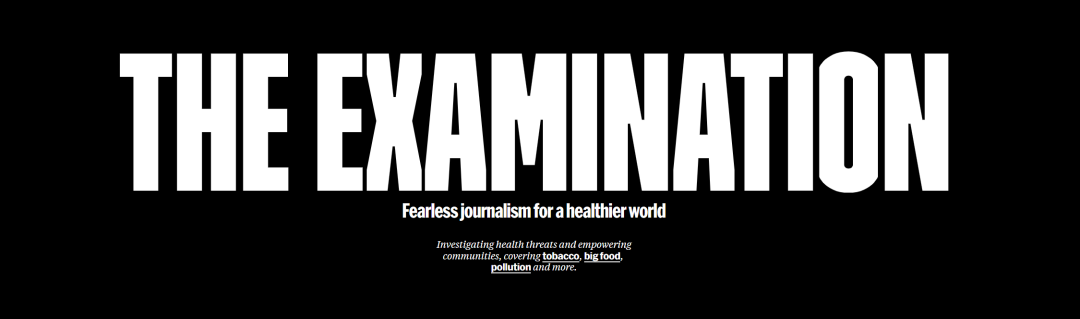
My friend’s concern was well founded. In 2023, the independent journalism outlet The Examination and The Washington Post co-published an article accusing dietitians of being Big Food’s “lackeys” (original title: “The food industry pays ‘influencer’ dietitians to shape your eating habits”, hereafter “Food Companies Buy Off Dietitians”). The report revealed that my peers — North America’s influencer registered dietitians — were not only embedding native advertising into their videos, but that even the seemingly neutral, objective nutrition knowledge they shared could be packaged commercial promotion. They could earn anywhere from a few thousand to tens of thousands of dollars for a single sponsored video.
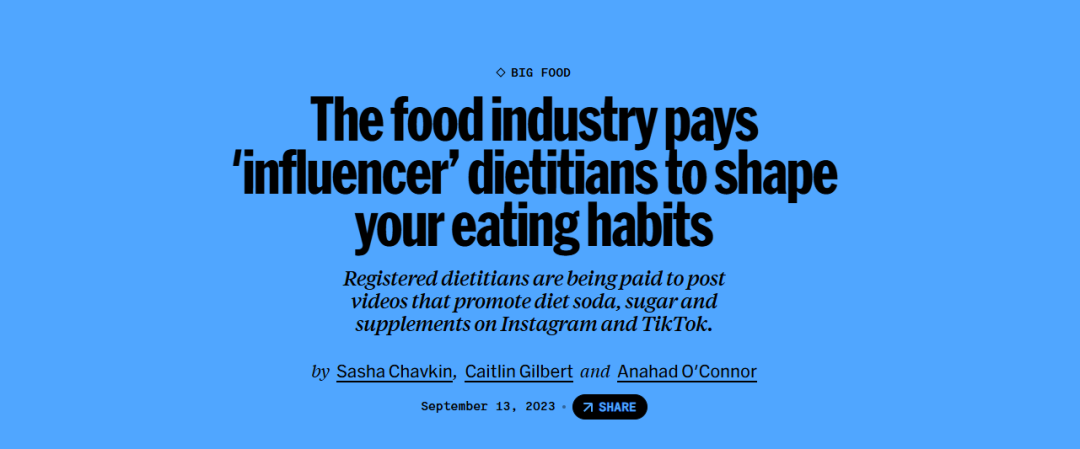
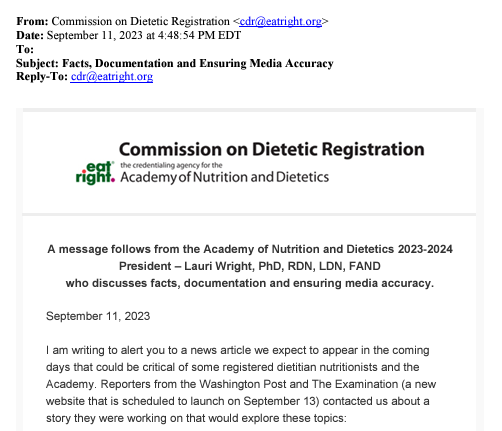
The explosive exposé prompted the Chair of the world’s largest dietetics organisation, the Academy of Nutrition and Dietetics (AND), to urgently issue a PR spin piece, sending a mass email two days in advance to over 110,000 registered dietitians, including myself.
Yet I felt a flicker of relief, thinking: someone had finally called out the “elephant in the room”.
I. Sugar or Sugar Substitutes: Who Should You Listen To?
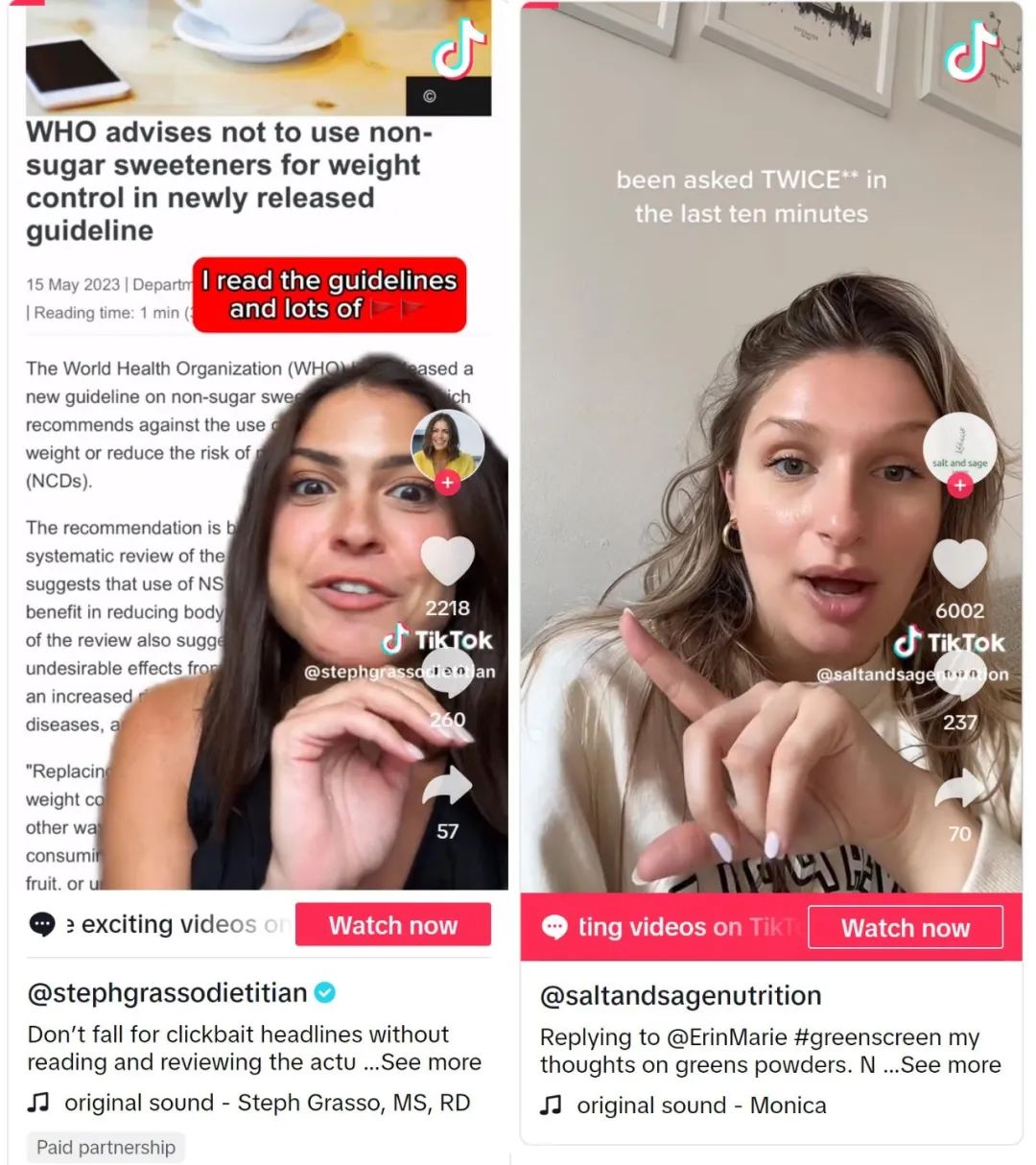
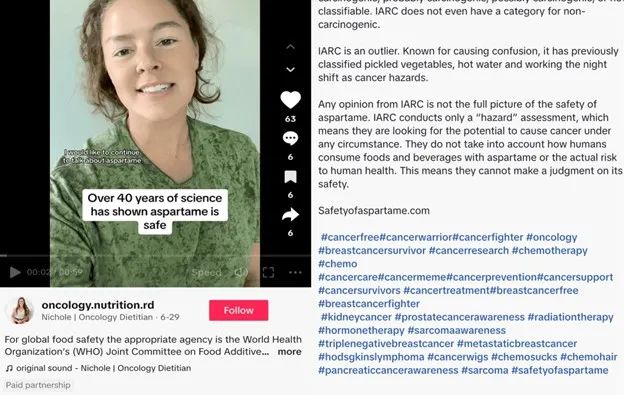
In May 2023, the World Health Organization (WHO) issued guidance stating: Artificial sweeteners are not beneficial for weight loss and may even pose a cancer risk. Beverage giants, sensing the threat, quietly began pouring money in to sway public opinion. The hashtag “Aspartame Safety” (#safetyofaspartame) flooded health creators’ feeds overnight. And so, Instagram and TikTok were soon filled with content like this:
Steph Grasso, a registered dietitian with 2.2 million followers, told her TikTok audience that the WHO’s warnings about artificial sweeteners were an “attention-grabbing stunt” based on “low-quality science”;
Dietitian Cara Harbstreet reassured her Instagram followers not to worry about “scare headlines” about aspartame, because “the evidence does not suggest any reason for concern”;
Mary Ellen Phipps, a dietitian specialising in diabetes care, sipped a soft drink while telling her Instagram audience that artificial sweeteners can “satisfy the craving for sweetness” without affecting blood glucose or insulin levels.
The investigation found that, including the influencer dietitians above, at least ten dietitians with followings exceeding ten thousand had publicly vouched for aspartame — yet none of them disclosed that they had been paid by the American Beverage Association. This trade association represents Coca-Cola, Pepsi, and other major beverage companies; it is not only the puppeteer behind the scenes but also lobbies on their behalf. One cannot help but question whether the integrity of dietitians as professionals has been eroded by capital.
One dietitian, eating ice cream on camera, declared that “refusing to eat sugary foods will only make your cravings stronger”; another sponsored dietitian held a donut and joked that the “best” way to cut sugar was to “slice it with a knife, tear it with your hands, or even bite into it with your teeth”. Both videos were sponsored by the Canadian Sugar Industry Association, yet neither post carried a disclosure.
II. Dietary Supplements: Native Advertising Violations
This was no surprise, yet it still broke my heart.
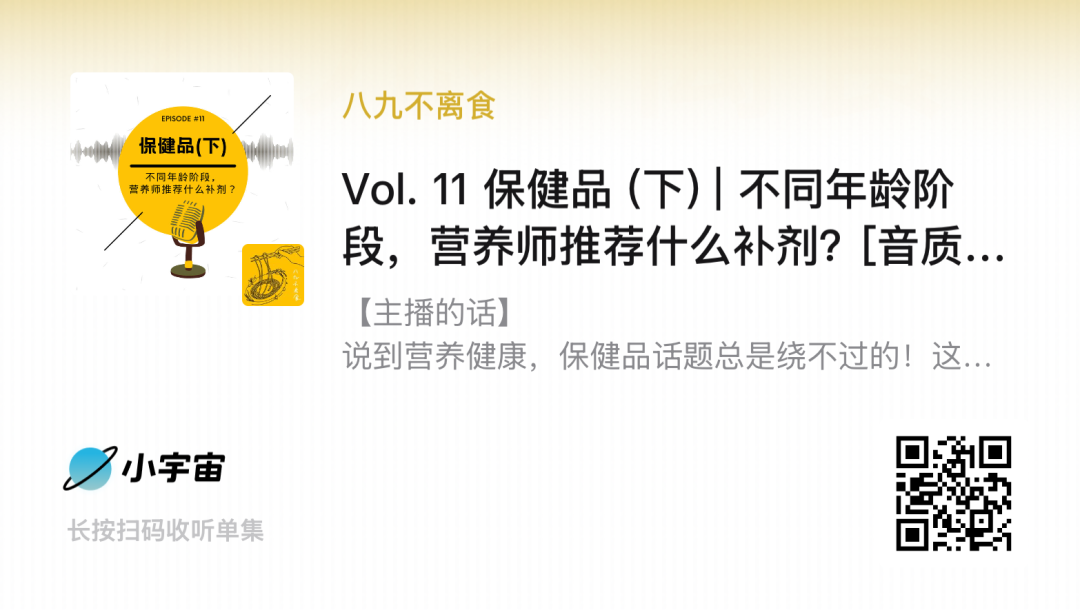
I believe a dietitian with genuine scientific literacy should take a conservative stance on dietary supplements, for two reasons. First, there is a glut of journal articles riddled with conflicts of interest, small sample sizes, wide individual variation, and flawed study designs — and some supplements derive their entire scientific rationale from precisely these publications. Second, dietitians know full well that the Food and Drug Administration (FDA) regulates dietary supplements in a way that is little more than a formality. Under circumstances where evidence is scarce and product quality is questionable, encouraging consumers to spend money on potentially harmful “placebos” not only violates my professional conscience but tarnishes the integrity and sense of duty I hold as a registered dietitian.
In fact, whether it is science communication or product promotion, failing to disclose the source of sponsorship already constitutes a breach of relevant regulations and professional codes of conduct.
On the regulatory side: under the Federal Trade Commission (FTC) guidelines, these influencer dietitians are required to disclose their financial relationships, including explicitly stating who is paying for their promotional content. Deliberately omitting such disclosure amounts to the wilful concealment of an “undisclosed material connection”.
On the professional ethics side: they have not adhered to the Code of Ethics established by the Academy of Nutrition and Dietetics, which requires registered dietitians to truthfully disclose potential conflicts of interest and prohibits accepting gifts or services that could actually influence, or appear to influence, their professional judgement.
III. Covert Food Power: The Sponsorship Controversy at the Dietitian Association
The Association itself has long been closely intertwined with the food industry. “Food Companies Buy Off Dietitians” revealed that AND’s principal sponsors were the American Beverage Association and Tate & Lyle, a supplier of food ingredients.
As the old saying goes, “Accept a gift and your hand grows weak; eat what you are given and your tongue grows silent.” Just before “Food Companies Buy Off Dietitians” was about to go live, AND sent out a mass response email pledging to defend the professional ethics of registered dietitians, stating that while it could not regulate individuals’ social media, it would investigate and address any misconduct. On the critical issue of sponsorship, AND claimed its corporate sponsorship vetting was strict and transparent, accounting for just 7% of its revenue — yet the email sidestepped the challenge about food companies’ influence over industry discourse entirely.
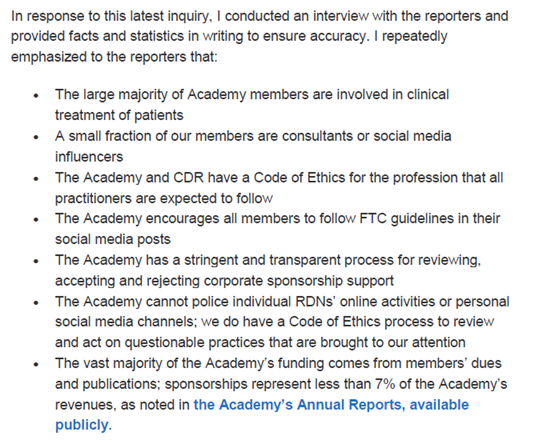
These findings stand in sharp contrast to AND’s claim of strict and transparent sponsorship vetting, revealing that companies exert deep influence over nutrition organisations not only through funding but also through policy, governance and research direction.
Marion Nestle, Professor of Nutrition at New York University and author of Food Politics, offered a sharp commentary on AND’s equivocal stance after the exposé was published:
Yet reform initiated from within the industry proved painfully slow. In 2013, the coalition launched a petition calling for AND to sever commercial ties with junk-food companies, gathering over 20,000 signatures. They pointed out that companies such as Coca-Cola, McDonald’s, Pepsi and Hershey’s were not only funding nutrition conferences and influencing public health policy, but also providing dietitians with “continuing education” courses that told them “soda is unfairly vilified” and “sugary cereals are a healthy way for children to start the day”. But the coalition was quietly disbanded in 2018 — it felt as though they had been punching a pillow.
Fortunately, however, the debate over dietitians’ conflicts of interest with Big Food shows no signs of fading.
During my master’s studies at Columbia University, I recall my professor devoting an entire class to the sponsorship issue, asking us to read materials comparing the sponsorship policies of different nutrition organisations and to evaluate their transparency. At the time, I thought it was all groundless — I could not see why so much ink was being spilled over what seemed a rather peripheral matter. But unbeknownst to us, a seed of awareness about food power had already been quietly sown in the minds of future dietitians.
Looking back now, its significance is unmistakable.
IV. How Do We Defend Nutrition Voices Free from Commercial Influence?
Reading the article again over a year later, I felt less raw emotion and a deeper admiration for the journalists behind it. Yet journalistic exposés alone are not enough. Addressing the entanglement of interests between dietitians and Big Food requires concerted effort from many quarters.
As Marion Nestle has urged: “Nutrition advice must not be swayed by commercial interests!” I wholeheartedly concur.
I believe dietitians should not limit themselves to providing nutrition advice. Actively shaping public discourse and helping people recognise how Big Food moulds nutritional narratives is a responsibility no dietitian can shirk. After all, our food choices have never been merely personal preferences; they are the product of interactions between power, capital and science.
Speaking up is the first step towards change.
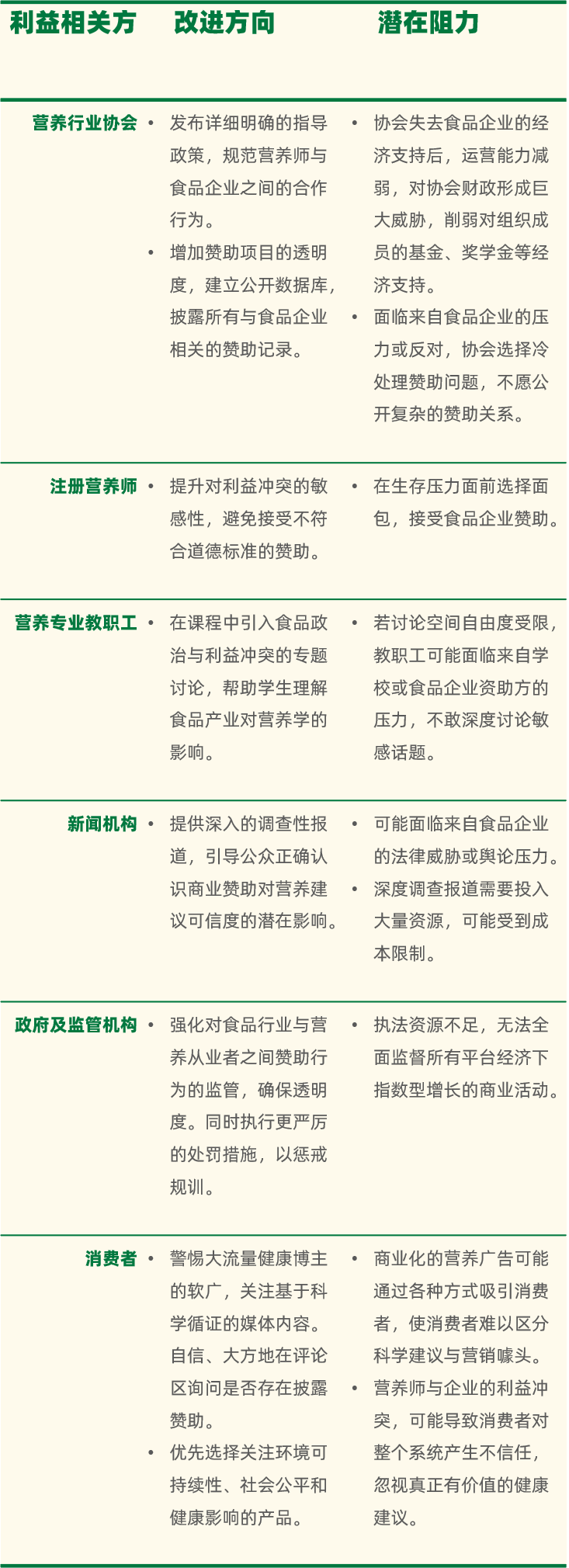
Below are, in my view, the areas for improvement and potential obstacles facing each key stakeholder:
Dr Jiang Qianzhi, a US registered dietitian specialising in child health, firmly opposed the overly permissive attitude towards sugar promoted in sponsored content. She noted that parents “do not need every meal to score a perfect 100 for their children”, but should “create a healthy eating environment by consistently offering nutritious options”.
In her own home, sweets are not forbidden, but fresh fruit and vegetables, biscuits with simple, low-sodium ingredients, and energy bars low in added sugars are always within reach. She stressed that this approach helps children see sugar and treats as part of everyday food rather than special rewards or forbidden fruit, avoiding the distorted relationship with food that overindulgence or strict restriction can create.
Whether for children or adults, rather than fixating on “good food” and “bad food” labels, it is better to focus on cultivating a balanced eating environment where food naturally becomes part of daily life. Picking apples in an orchard, baking biscuits at home, experiencing the transformation and creation of real food — these all nurture a healthier mindset towards eating.
References
1. Chavkin S, Gilbert C, O’Connor A. The food industry pays “influencer” dietitians to shape your eating habits | The Examination. [accessed 30 December 2024]; Available from: https://www.theexamination.org/articles/the-food-industry-pays-influencer-dietitians-to-shape-your-eating-habits
2. Ni J. WHO advises not to use non-sugar sweeteners for weight control in newly released guideline [Internet]. [accessed 1 January 2025]. Available from: https://www.who.int/news/item/15-05-2023-who-advises-not-to-use-non-sugar-sweeteners-for-weight-control-in-newly-released-guideline
3. FTC’s Endorsement Guides: What People Are Asking [Internet]. Federal Trade Commission. 2017 [accessed 5 January 2025]. Available from: https://www.ftc.gov/business-guidance/resources/ftcs-endorsement-guides-what-people-are-asking
4. can you trust tiktok dieticians? [Internet]. [accessed 5 January 2025]. Available from: https://www.tiktok.com/@prettycritical/video/7278702395264077098
5. Ba Jiu Bu Li Shi. Vol. 11 Dietary Supplements (Part 2) | At Different Life Stages, What Supplements Do Dietitians Recommend? [Improved audio ✔️] [Internet]. [accessed 5 January 2025]. Available from: https://eatoclock.fireside.fm/24
6. Nestle M. Food companies pay dietitian-influencers to hawk their products [Internet]. Food Politics by Marion Nestle. 2023 [accessed 31 December 2024]. Available from: https://www.foodpolitics.com/2023/09/food-companies-pay-dietitian-influencers-to-hawk-their-products/
7. Simon M. And Now a Word From Our Sponsors: Are America’s Nutrition Professionals in the Pocket of Big Food? [Internet]. Eat Drink Politics; 2013. Available from: https://www.eatdrinkpolitics.com/wp-content/uploads/AND_Corporate_Sponsorship_Report.pdf
8. Carriedo A, Pinsky I, Crosbie E, Ruskin G, Mialon M. The corporate capture of the nutrition profession in the USA: the case of the Academy of Nutrition and Dietetics. Public Health Nutr. 25(12): 3568–82.
9. Bellatti A. The Academy of Nutrition and Dietetics, corporate sponsorship and the alternative: dietitians for professional integrity. Br J Sports Med. 1 August 2019; 53(16): 986–986.
10. Chavkin S, Tsui A, Gilbert C, O’Connor A. Big Food and dietitians push “anti-diet” advice, despite rising obesity. [accessed 5 January 2025]; Available from: https://www.theexamination.org/articles/as-obesity-rises-big-food-and-dietitians-push-anti-diet-advice

In our next article, we will continue to explore the different attitudes of dietitians towards commercial sponsorship. Whether you are a dietitian at home or abroad, or a self-media creator in the health space, you are welcome to leave a comment or scan the QR code to join our group and get in touch. Readers in general are also welcome to share their views on sponsored posts by health bloggers.

Click “here“ to read The Examination and The Washington Post’s article
Editor: Wang Hao
Graphics: Z X