
Is Food-Delivery Work a Form of “Short-Lived Labour”?
Riders shuttle ceaselessly through the “last mile” of the food supply chain, at the cost of their own health. Few realise that those who rush about to deliver meals to customers are often the ones least able to sit down to a healthy meal within the very system they serve.
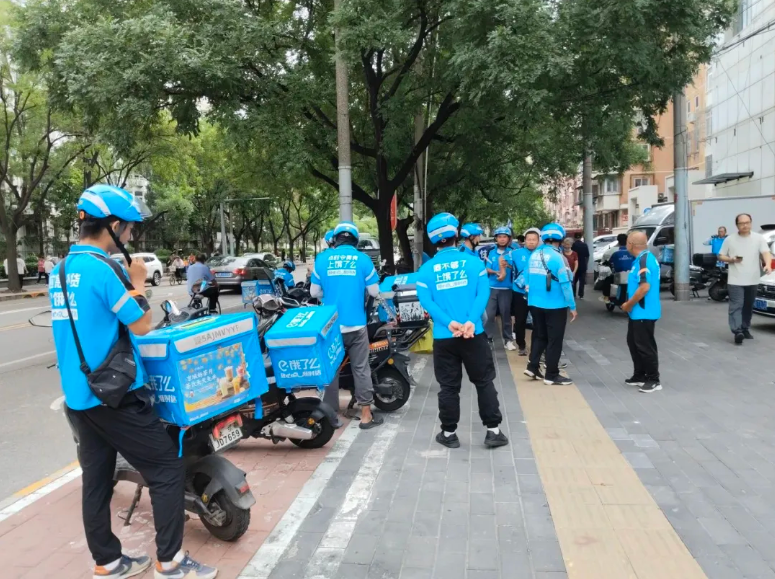
“Delivery riders often manage only two meals a day, and many of them suffer from stomach problems.” Transitional Labour This remark by author Sun Ping, made on the podcast Random Fluctuations, has left me deeply unsettled. Not out of surprise, but out of empathy. As a nutrition researcher, this contradiction made me realise that what warrants attention is not only the food on the table and the health it nurtures, but whether those who deliver meals can eat properly themselves.
I. Regular Meals Sacrificed to Work
The very nature of food-delivery work makes riders’ routines unpredictable. Their mealtimes and the quality of what they eat depend not on whether they “know how to stay healthy” but on order volumes, shift lengths, and even whether a pickup location is conveniently accessible. In reality, the pace of their work simply does not allow them enough time to prepare balanced meals. The health struggles riders face stem not from a lack of will to eat well, but from working conditions that deny them the ability to make better choices.
It is therefore both presumptuous and futile to prescribe “three regular meals a day” as a nutrition remedy for riders’ stomach problems, for such advice is incompatible with the survival imperative of being paid per order. The kind of expert tips frequently circulated on social media – “drink fewer fizzy drinks”, “eat more vegetables and fruit”, “exercise more” – may sound specific enough, but in the real world they often stumble against a web of social factors and remain all but impossible to follow.

Xiaomin: a female rider who weathered the pain of divorce. “She works ten hours a day; to squeeze in more deliveries she rarely eats lunch, carrying biscuits and dried flatbread crisps she bought on Pinduoduo.”
Wu Zhifeng: in order to cope with the lockdown’s “exit-only, no return” policy, he chose to sleep rough on the streets while continuing to deliver. Every day he cooks himself two meals on a portable butane stove and a small pot. “I boil noodles or rice noodles for myself; sometimes I make tossed noodles and eat them with chilli sauce.”
Brother Hong: “He unzips his breakfast bag to reveal two roujiamo, their skins golden and crisp, steam curling up as he bites into one while drinking Pepsi.”
For some riders, “eating” barely registers as a priority in daily life. In a post on the public account “Riders Have Something to Say“, one delivery team leader reported that weight gain after taking up riding is extremely common, while the absence of weight gain – or even weight loss – may actually signal conditions such as hyperthyroidism. Xiao Bai, a crowdsourced rider who took part in the dietary survey, put it bluntly: he gives no thought to “meal balancing”:
“There’s no thought involved, no fancy lifestyle, no considerations. If there’s a flood of orders today, you just keep running – you don’t feel like eating, you just want to make money. A lot of riders only stop when the orders dry up; they won’t go offline on their own. As long as there are orders, you stay excited and forget the hunger.”
Eating healthily is no privilege, yet for riders who feel they must keep running orders “as long as they are alive”, two meals a day has all but become a prerequisite of a “successful” rider. The pressure of making a living erodes, day after day, their ability to choose what they eat and how they stay well.
“Sometimes – for example when my child is eating or just getting home from school – it’s exactly the delivery rush, so I’ve no time for him. At best I order a takeaway for him.”
The clash between the role of “rider” and that of “mother” keeps Fangli awake at night, making it all the more clear how gender and labour together shape the health of an individual and a family. When the boundaries between work and life blur ever further and constant change becomes the norm, the pressure of working for a living turns “eating healthily” into an exhausting trade-off. Health ought to be the most basic line that cannot be crossed – yet it is the easiest thing to sacrifice.
II. Does Gig Work Make You “Short-Lived”? What Medical Research Says
Medical research shows that, in the gig economy, the very nature of how one works has become a significant determinant of health – “a person’s employment status predicts the risk of dying from coronary heart disease better than any of the traditional risk factors.”
An article published in JAMA Cardiology states:
“The gig economy work environment should be considered a new social determinant of health, and possibly a modifiable cardiovascular risk factor. Researchers, policymakers and employers should systematically assess the health status of gig workers and develop targeted health interventions.”
(1) Studies from the 1950s showed that occupations involving low levels of physical activity (such as bus driving) carried roughly twice the coronary heart disease mortality rate of high physical-activity occupations (such as manual labour).
(2) A survey of 130 taxi drivers in San Francisco found that 35% had four or more cardiovascular risk factors (including physical inactivity, smoking, an unhealthy diet and chronic stress); 36% smoked, and 33% engaged in no regular exercise.

Yet systematic research into the health of gig workers remains limited. What health challenges the 200 million gig workers in China face is, more than ever, a gap the public health system urgently needs to fill. Future health policies and labour regulations must confront this group’s health struggles head-on and adopt systematic protective measures, so as to prevent the widening chasm of health inequality.
III. “Digital Resilience” and “Health Resilience”
In such work, irregular meals have become the shared plight of millions of labourers. The riders’ predicament prompts us to ask: why have food security and economic development not made it any easier to eat well?
Behind the convenience of the digital economy often lies a hidden health cost borne by workers. I greatly admire the bottom-up approach of Transitional Labour, and I am particularly struck by the various labour strategies digital workers employ to resist algorithmic management – what Sun Ping calls “digital resilience”. This makes me wonder: beyond “digital resilience”, should we pay still greater attention to workers’ “health resilience“?

From a nutritionist’s perspective, I hope that every rider can eat well and enjoy the same health equity (health equity) as workers in every other profession. In the future, as we consider issues such as riders’ labour protections and fair compensation, should we also incorporate “health resilience” into the conversation? This is a question that everyone concerned about workers’ well-being ought to reflect upon.
Fanzhou Yiheyuan. “Street Flavours: The Health Challenges Facing Delivery Riders”. Accessed 22 February 2025. https://www.wyzxwk.com/Article/gongnong/2024/01/485889.html.
Random Fluctuations. “Feeding the Algorithm with Our Bodies: Food-Delivery Riders, You and I Are All ‘Human Batteries'”. Accessed 23 February 2025. https://www.stovol.club/143.
Sun Ping. Transitional Labour, 2024. https://book.douban.com/subject/36985251/.
Kim, Min-Seok, Juyeon Oh, Juho Sim, Byung-Yoon Yun and Jin-Ha Yoon. “Association between Exposure to Violence, Job Stress and Depressive Symptoms among Gig Economy Workers in Korea”. Annals of Occupational and Environmental Medicine 35 (2023): e43. https://doi.org/10.35371/aoem.2023.35.e43.
Mulhollem, Jeff. “‘Triple burden’ of invisible labor major stressor for farm women, study finds | Penn State University”, 2024. https://www.psu.edu/news/research/story/triple-burden-invisible-labor-major-stressor-farm-women-study-finds.
Rodriguez, Fatima, Ashish Sarraju and Mintu P. Turakhia. “The Gig Economy Worker: A New Social Determinant of Health?” JAMA Cardiology 7, no. 2 (1 February 2022): 125–26. https://doi.org/10.1001/jamacardio.2021.5435.
Rose, G., and M. G. Marmot. “Social Class and Coronary Heart Disease”. British Heart Journal 45, no. 1 (January 1981): 13–19. https://doi.org/10.1136/hrt.45.1.13.
Waynforth, David. “Unstable employment and health in middle age in the longitudinal 1970 British Birth Cohort Study”. Evolution, Medicine, and Public Health 2018, no. 1 (27 March 2018): 92–99. https://doi.org/10.1093/emph/eoy009.

Editor: Wang Hao