
Book Extract | From the 18th Century, the British Ate Meat on a Mass Scale
Foodthink Says
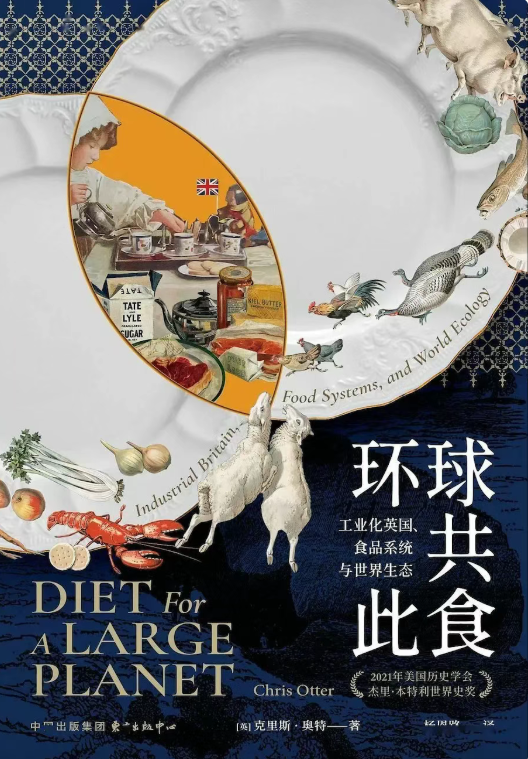
The book’s original English title is Diet for a Large Planet (Diet for a Large Planet) The author, Otter, uses the term “Large Planet philosophy” to describe an approach that outsources grain production, premised on the idea that “the whole earth can serve as a potential resource for material wealth and capital investment, enabling Britain to ‘no longer depend on the fertility of its own soil to maintain its rate of profit,’” and instead rely on “the soils of the whole world.” This international agricultural–food system, aligned with liberal economic thought, links British consumers to the “commodity frontier” of the New World and Oceania, and makes “the pursuit of a system that exchanges more caloric supply per unit of labour” a global benchmark — but is this the only option?
The following is an excerpt from the “Power” section of the book’s preface.
Power

Another dimension of slow nutritional violence is famine. It is now commonplace to regard famine as a “rights crisis.” Famine is not caused by an absolute shortage of food but by a lack of purchasing power — by structural powerlessness and economic dislocation, which are the natural outcomes of the slow development of the food system. Through its control of the resource frontier and the agricultural–food system, Britain began to direct, distribute and consume vast quantities of animal and plant foodstuffs. It could refuse to provide food to the hungry, or it could provide food by stipulating the conditions of distribution. The famines in Ireland (1845–1850) and India (1876–1878, 1896–1902, 1943–1945) were products of “slow violence.” Crises were initially triggered by plant disease or climatic disaster, striking populations in a state of extreme economic precarity. The British exploited these crises as opportunities to further marketise and de-peasantise these fragmented regions, depopulate them, and absorb them into their agricultural–food system. Hobson observed that imported grain enabled some countries to “evade [their own] population problem” by “aggravating the population problems elsewhere.” In effect, famine was outsourced. By conservative estimates, approximately 13 million people died of famine in nineteenth-century Ireland and India. Britain’s command over the global food system also created problems of its own. In 1898, Rear Admiral Beresford argued that, owing to the volume of imports, Britain’s global commercial structure had developed a vulnerability “precisely where our system is most capable of generating great force.” During the two world wars, Britain abandoned economic liberalism, and readjusted its control over the global and domestic agricultural–food system through a range of technical means, including the restoration of domestic agriculture and rationing, the use of escort fleets, and the armed protection of merchant shipping. From the British perspective, this effort was highly successful: in both world wars, Britain never faced the threat of famine. In the First World War, it mobilised its control over the agricultural–food system, intelligence networks and logistical transport capacity to impose a blockade that killed approximately 800,000 Germans and 400,000 Austro-Hungarians — clearly one of the causes of the Axis powers’ collapse. Hitler’s vision of ruling Eastern Europe and Ukraine and carrying out genocide was born precisely of his fear of potentially facing famine in the future.
Control over the agricultural–food system also involved the restructuring of power relations across the “commodity frontier“, typically achieved through purchase, occupation, conquest or the signing of treaties. For example, Australian land was taken by declaring or assuming a legal vacuum of power, or by designating it as no man’s land (terra nullius). Europeans invoked a variety of justifications — sometimes even contradictory ones — for their appropriation of territory, particularly the philosophy of Locke: those who improved “unassisted nature” had fundamentally enhanced productivity and created value, and thereby acquired ownership of the land. In Australia, British colonists, finding no farms, declared that the local peoples who hunted and gathered stood at the lowest level of socio-economic development — that the local Indigenous inhabitants were virtually no different from animals or plants. Ownership and productive use were inseparable: merely occupying land did not mean possessing it. This view gradually solidified during the nineteenth century, though it never fully achieved dominance. The enforcement of individual property rights was deemed essential for the improvement of land and the accumulation of productive surplus. This was strikingly manifested in the colonists’ forcible killing and displacement of Indigenous peoples: the Highland Clearances provided an early model. In fact, many Highlanders emigrated to Australia, where they displaced those local Indigenous peoples considered unproductive. The Tasmanian Indigenous people were swiftly exterminated by the colonists and then replaced by flocks of sheep; many perished in camps on Flinders Island that were nominally intended to provide shelter and missionary work. The process by which colonists established royal tea plantations in Assam was accompanied by violent military conquest. In 1885, the resistance of the Métis in Canada was crushed by the North-West Rebellion; in the early 1870s, the gauchos of Argentina were subjugated by the Buenos Aires government. The Indigenous Patagonians were driven to designated settlements and forbidden to continue their former way of life. The gaucho way of life began to disintegrate from the 1870s onward, their existence hemmed in by fences and barbed wire. The gauchos were forced to submit to labour-sparse capitalist agriculture and ultimately reduced to forced labourers.
Yet human violence against animals took a faster, more mechanised form. Before 1800, slaughter was a small-scale, commonplace, even social activity, producing a relatively modest quantity of meat and other animal products. However, as demand for meat grew, the traditional slaughter system hit a bottleneck. In the end, people opted for industrialised slaughter, isolating it from human communities at a scale that was without precedent and growing ever more astonishing. This slaughterhouse system was pioneered in France, spread in Germany, and reached its apotheosis in the large slaughterhouses of the New World and Australia. These complex systems employed a triple separation and concealment: first, slaughter was entirely isolated from society, though this was a gradual process; second, within the slaughterhouse, slaughtering was separated from non-slaughtering activities; and finally, the animals themselves were penned in holding yards set apart from the slaughter area. Meat consumption and meat production were completely separated in both space and perception, and slaughter became a silent, invisible process. As Rebecca Woods puts it: relocating slaughter to the distant “commodity frontier” was the most successful technique of misdirection. “Slaughter… was moved to the margins of the Empire — truly to the ends of the earth.” The deepest violence within the agricultural–food system has largely become imperceptible, a point equally evident in the growth of global chicken consumption in the twentieth century.

Contents
Preface i
The Large Planet Philosophy iv
Meat, Wheat and Sugar xiii
Power xvii
Ecology xx
Chapter One: Meat 1
Meat Consumption: Concepts and Trends 2
Domestic Meat Production 4
The Dispersal of Animal Husbandry and the Globalisation of Livestock 6
The Nature of Livestock 12
Slaughter 18
By-products 22
The Logistics of Meat 25
Chapter Two: Wheat 33
The Rise of Wheat 34
The Globalisation of Wheat Production 35
The Transformation of Wheat 42
Bread-Making 45
Controversy 50
The Political Economy of Bread 53
Wheat and the World Economy 56
Chapter Three: Sugar 61
The Sugarcane System 65
Sugar Beet 71
Confectionery, Jam and Biscuits 80
Chocolate 86
Energy 90
Chapter Four: Risk 97
Adulteration, Laboratory Analysis and Regulation 100
Animal Disease, Parasites and Free Trade 104
Milk and Tuberculosis 110
Meat Products 117
Emerging Foodborne Pathogens 125
Chapter Five: Violence 135
The Politics of Death in Ireland and the Nutritional Transition 136
India 145
Food Safety 152
The First World War 156
Britain Between the Wars 165
The Second World War 168
Chapter Six: Metabolism 177
Living Standards 179
The Metabolism of Society 184
Metabolism Across Genders 190
Infants and Children 199
Chapter Seven: The Body 209
Evolution and Civilisation: The Western Diet as a Primary Pathology 210
Teeth and Jaws 213
Stomach and Intestines 220
Blood and Heart 228
Fat 232
Anorexia Nervosa 238
Chapter Eight: The Earth 245
Nitrogen and Phosphorus 247
The Frontier, Machines and Monoculture 255
The Land Crisis 264
Pigs, Chickens and Eggs 272
Debates 280
Chapter Nine: The Great Acceleration 291
The Collapse of the System 292
Revisiting the British Diet 302
Acknowledgements 309
Notes 313
Index 409