
Challenging the Mainstream: Italy’s Food-and-Farming Movement Beyond Ecological Agriculture
A Note from Foodthink
In what context did Agroecology emerge? What transformations has it undergone? In Italy, which communities are practising Agroecology? On 18 July, Chiara Bartoletti (Mu Jiale), a doctoral student at Ca’ Foscari University of Venice, shared her participation in and observations of the Agroecology movement with Foodthink. This article is compiled from that presentation.

I. From the Green Revolution to Agroecology
In 1968, when William Gaud of the United States Agency for International Development (USAID) first coined the term “Green Revolution”, dwarf wheat became a symbol of anti-hunger humanitarianism, and technological development became the standard-bearer for universal pacifism. Two years later, Borlaug was awarded the Nobel Peace Prize for his scientific contributions.

It is undeniable that the high-yield wheat varieties of intensive farming helped many people escape hunger. Yet at the same time, Green Revolution practices in Latin America, India and elsewhere brought harm to local social and ecological environments.
The beneficiaries of intensive farming were largely multinational corporations and large landowners. Once export-oriented structures replaced smallholder farming systems, many farmers lost the land that had been their basic means of subsistence, along with their indigenous farming wisdom.
Monoculture cropping also threatened local ecological balance. High yields from hybrid varieties typically required heavy use of chemical fertilisers and pesticides. On one hand, the high input costs deepened smallholders’ competitive disadvantage and social inequality; on the other, organic matter in the soil was greatly depleted, and biodiverse farmland ecosystems were destroyed.
As agricultural production became ever more unsustainable, the importance of Agroecology became apparent.
In the 1930s, the Russian agronomist Bensin first proposed the concept of agroecology. In contrast to conventional agronomy, which focuses on crops themselves, agroecology emphasises a systems-based approach: by mimicking natural ecosystems, it seeks to build agricultural systems that protect soil health and biodiversity while maintaining crop yields. Its methods include long-term observation and measurement of local ecosystems, management of pests and diseases through cover crops, and the design of circular farming systems that integrate crops and livestock.

Agricultural technology is inseparable from the political and economic system in which it operates. Changes in the global food system highlighted the scientific importance of agroecology and laid the groundwork for its social dimension.
Scientists began to reflect on who their research was ultimately serving. They wanted to embed knowledge within society, and in agroecological practice this meant reducing external inputs and making the most of the smallholder resources and techniques already available locally.
A typical example is the Indigenous Three Sisters planting method of the Americas. Maize, squash and beans complement one another: the maize provides a trellis for climbing, the beans fix nitrogen, and the squash vines spread over the ground to retain moisture. This is similar to traditional Chinese practices such as rice-fish co-culture and the mulberry-dyke fish pond system, which make resourceful use of local conditions — only by marrying “local” wisdom with “Western” science can actions be taken that serve both the people and the environment.

In 1962, Rachel Carson’s Silent Spring alerted the public to the ills of modern agricultural technology. Before its publication, there was virtually no public awareness of the damage chemical pesticides inflicted on the environment and human health.
Through the advocacy of Carson and other scholars, activists and civil-society groups, US authorities responded. In 1970, the Environmental Protection Agency (EPA) was established, and in 1972 the highly toxic pesticide DDT was officially banned.
Spring Should Not Be Silent | Reading Club Sign-Up
Rachel Carson: The Fearless Life Behind Silent Spring
Against this backdrop, Agroecology gradually evolved from a practice among scientists into a framework for farmers striving for food sovereignty and ecological restoration.
From the 1980s onwards, many farmers, mobilised through La Via Campesina and Brazil’s Landless Workers’ Movement (MST), used the principles championed by agroecology to voice demands for environmental and social justice.

II. The Agroecology Movement in Italy
Most farms in Italy are family-run, giving them no advantage over intensive farming operations in the global market, and income from agricultural employment is 30 % lower than in other industries. In areas hit by rural depopulation and the decline of traditional farming, the political dimension of the agroecology movement is especially pronounced.
I would now like to share a few agroecological practices I have observed in Italy.
The Commons
Mondeggi
After the operating company went bankrupt in 2009, the government attempted to transfer the land to a private enterprise, provoking resistance from local residents. From 2011, surrounding residents began occupying the land, and in 2014 they established Mondeggi bene comune (common land).

The Commons spans about 120 hectares, of which roughly 73 hectares are cultivated. More than 450 members and volunteers jointly manage the farm. Starting from ecological restoration and social mobilisation, they resist the encroachment of monoculture farming and big agribusiness capital on the village.
Years of intensive cultivation had left the land depleted, overrun by invasive plants and devoid of biodiversity. The members of the Commons apply agroecological principles to restore the soil. They have set up a farmers’ base and collectively tend more than 5,000 olive trees and over 20 vegetable gardens, harvesting directly the produce that corresponds to their own labour.
In addition, the Commons practises crop rotation with cereals, pulses and fodder crops, grows heritage wheat varieties rich in genetic diversity, and has introduced livestock farming and beekeeping.
To access mainstream markets, producers must drive down land rents and labour costs. But at the Commons, the land is collectively owned and members contribute labour voluntarily, greatly easing the economic burden of operations — making it far easier for agroecological practices to take root.

Mondeggi holds regular general assemblies for democratic discussion and organises technical exchanges to explore ways of improving cultivation methods. Their slogan — “Mondeggi commons, a farm with no bosses” — perfectly embodies the diversity of agriculture.
Farmers and newcomers keen to learn can enrol in the biennial Farmer School at the Commons, which offers free courses lasting several months in beekeeping, carpentry and other crafts. Since last year, the Farmer School has also introduced a theory course called Farming Gaia, covering agroecology, political philosophy, sustainable farming practices, food sovereignty, and care practices oriented towards public affairs and collective action.

Independent Organic Farmers’ Community (Open Fields)
Campi Aperti
All participants in Campi Aperti share a commitment to the solidarity economy. Rather than relying on official certification systems, they adopt a Participatory Guarantee System (PGS), visiting farms directly to rebuild trust between consumers and producers.
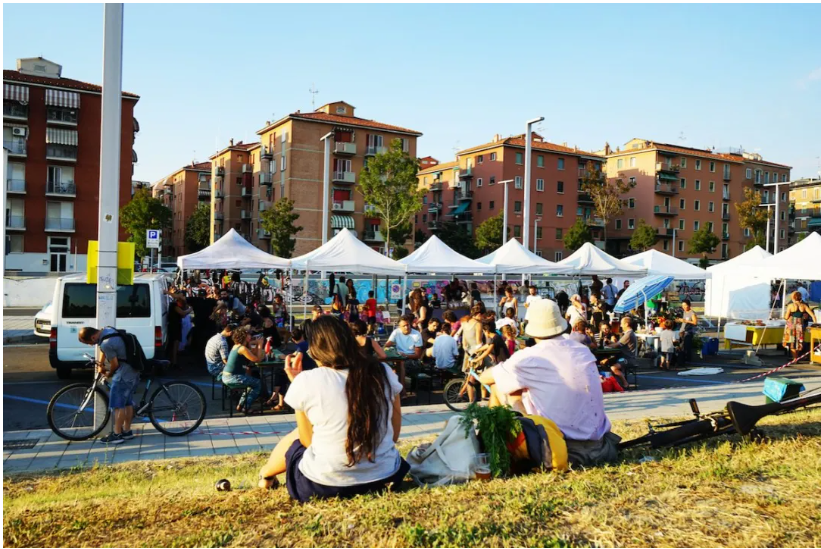
Visitors to the market can see that, compared with conventional produce from large agribusinesses, food grown by organic smallholders is fairer to both the environment and labour. They do not use chemical fertilisers or pesticides, do not exploit cheap labour, and prioritise seasonal and locally sourced production.
Those involved in Campi Aperti are not simply greengrocers and shoppers; they are a community of producers and consumers who care about the food system and consciously protect the natural and community environment. Through this economy built on mutual trust, Campi Aperti has, over the past twenty years, established an alternative to the mainstream industrialised food system.
Because processed foods such as homemade jams and bread made by partner farmers lack production licences, Campi Aperti cannot hold its markets in the city’s public squares. Seizing this as an opportunity, organisers launched the independent certification system Genuino Clandestino (meaning “a true secret”) in 2010, bypassing the bureaucratic procedures and high costs of the official system.

The organisers argue that it is deeply unfair for government agencies to impose the same production standards and inspection criteria on smallholder produce as those applied to industrialised food. Smallholders simply do not have the resources to make such investments, and their production does not carry the risks inherent in industrialised processed-food assembly lines.
Genuino Clandestino has spread the values of Campi Aperti across all of Italy, gradually forming a radical network of food-sovereignty communities.
Within this community, farmers are neither a passive “underclass” nor capitalist landowners, but citizens who can find belief and social value through agroecology. Each year, Genuino Clandestino convenes smallholders from across Italy for an annual meeting to discuss the network’s present state and future development. They hope to draw more people into the food-sovereignty movement, open farmers’ markets in new cities, and organise gatherings for growers to exchange experiences, seeds and more.
Beyond these two grassroots organisations, people are also seeking to transform the existing food-and-farming system from other angles. Terra! (Land!) promotes the development of ecological agriculture within a framework of social justice through research and policy advocacy. Cambiare il campo brings together farmers, social activists, scholars and rural residents to explore the possibilities of alternative food systems.
These examples vividly demonstrate that the interconnections between plants, animals and the environment emphasised by agroecology extend well beyond agricultural science and reach directly into the social sphere.
Those who participate in the agroecology movement believe that farmers, consumers, and nature itself — which cannot speak for itself — are all unable to benefit from the mainstream food system. Consumers and producers must unite, armed with their faith in a better future, to resist unjust agrarian institutions and relationships.

Unless otherwise noted, all images are from the guest’s presentation slides.
Compiled and edited: Jieni, Ze’en