
74-Year-Old Grandmother Searches Eight Hills, Only to Earn 3,000 Yuan for Her Pension

My grandmother, Yang Xiuying, is 74, weighs less than 80 catties, and stands under a metre and a half. Before Qingming, she began going into the mountains every day to dig for and gather bamboo shoots, combing through seven or eight nearby small hills, and was busy for over a month on end. Once home, she was busy making dried bamboo shoots, without allowing herself a moment’s rest. She must earn a year’s worth of pension from bamboo shoots.
Into the Mountains
Just after six in the morning, the sky was still faintly light. My grandmother skipped breakfast, changed into her worn grey shirt and trousers, put on her wellingtons, and called on Grandma Deng Lian, a 70-year-old from the same village. The silver-haired pair, one tall and one short, set off, carrying woven polypropylene sacks and curved knives.
My home is at the foot of a great mountain. Its ridge cuts down from the northeast to the southwest, and beneath the main peak follow a series of ridge lines, with curving bamboo groves scattered about. Many of the groves do not grow on flat ground; instead, they sprout in clumps along the valley sides, streams, and rock crevices in a wild tangle. Every spring, these bamboo plants yield the great mountain’s most abundant “fruit”. My grandmother says: “Qingming brings the chaos, Grain Rain the end; once Qingming arrives, bamboo shoots thrust up everywhere, growing in a wild tangle.” Likewise, the mountain people’s steps grow hurried and aimless.
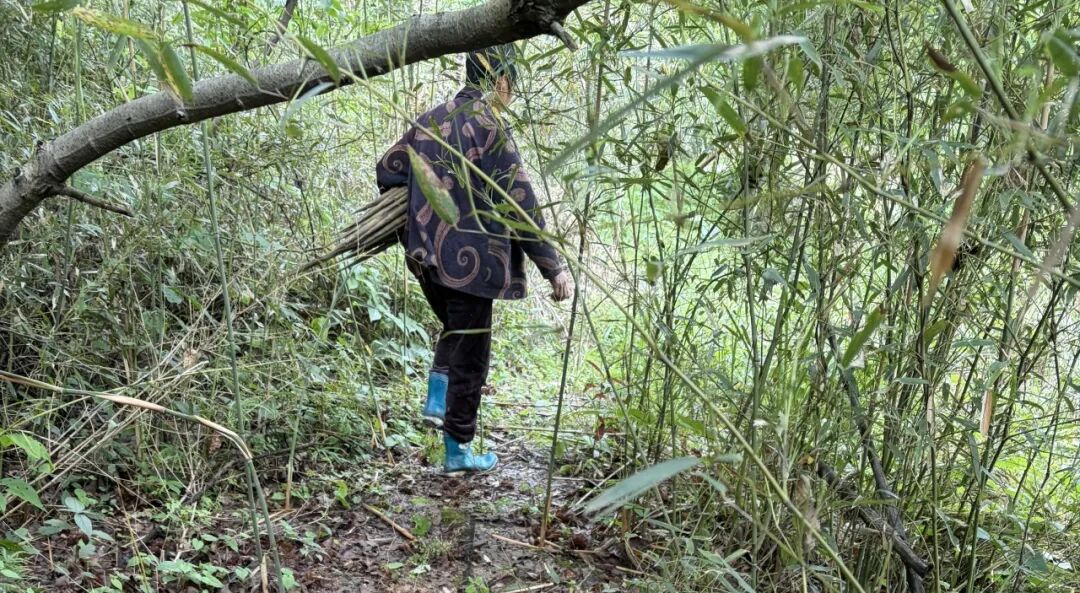
◉ Grandmother on the mountain path.
When I went home for the 1 May holiday, I followed my grandmother and my aunt into the mountains twice.
From the outside, those small hills are thickly covered with mixed trees and shrubs, and you simply cannot find a path. But none of that stops Grandmother; she can find every entrance and exit. The moment she slips into a fold of the mountain, she can feel her way along a little trail. She also has a “spring bamboo shoots” map in her mind: on Boluo Ridge the small bamboo shoots appear earliest; the bamboo grove by the small pond at Dongcun is flat and easy to harvest; Bazao Mountain has bamboo shoots, but you have to push through thorny thickets; on the steep slope at the pond there are few bamboo shoots, but they are large.
There are hardly any proper paths in the mountains, and there is no shortage of climbs up and drops down. Following her deeper in, I, in my twenties, could not keep up with her at 74. On those slopes of nearly 90 degrees, she would grip branches and vines and be up in a single stride; her movements in finding and gathering bamboo shoots were quick, too, and she could clear a small bamboo grove in ten or so minutes. While I was still lingering in the bamboo grove, she had already crossed several patches of woods.
The hardest part is not finding bamboo shoots, but carrying them out of the valley. One person can gather two or three hundred catties of fresh bamboo shoots in a day, all by human effort. When I first tried, I carried only one bundle of bamboo shoots; the moment it was on my shoulder I nearly could not bear it, and I had to force myself to move it out. Grandmother, though her fingers were cut, still carried three bags, and my aunt four. All along the way, we held the woven polypropylene sacks balanced on our shoulders with one hand, pulled at branches with the other, and trudged out over the wet, slippery muddy paths.
Carrying bamboo shoots down the mountain is not only exhausting but also dangerous. In Grandmother’s words, it is “very easy to get injured.” The terrain is complex and slippery; one has to climb up and down holding onto bamboo branches and vines, and with a load on one side of the body, balance is hard. It was only the two times I went up the mountain with Grandmother that I truly experienced it. At the time, I missed a step and slipped, and my bottom landed on a sharp bamboo stub, slicing a gash. I could only pretend nothing was wrong, carry the sack and keep going, and deal with the wound when I got home.
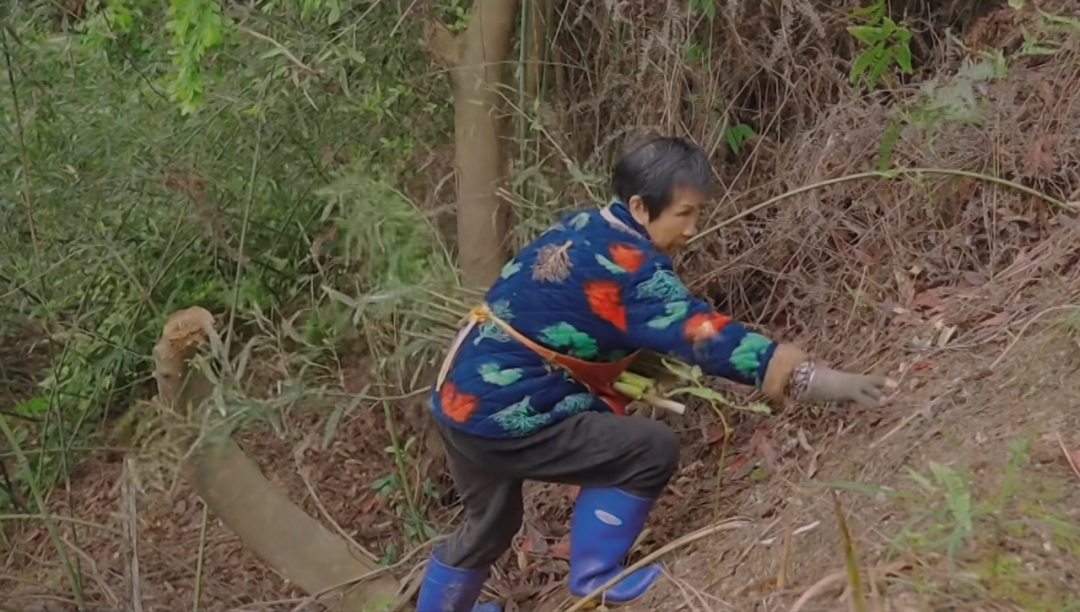
◉ Climbing down, holding onto bamboo branches.
Even with great skill and care, physical injuries and knocks cannot be avoided. In 2022, while Grandmother was up the mountain gathering bamboo shoots, a bamboo branch pierced her right palm, leaving a cut. She hid it from her family, gave it a simple treatment, and continued up the mountain. Last year, Grandfather and Grandmother were digging for large bamboo shoots in the back mountain. On a rainy day the paths were slippery, and Grandfather fell and was hospitalised for a fracture. But he could not bear to spend money; after taking some cheap medicine, he insisted that he was fine. This year Grandmother was injured again. While peeling bamboo shoots on the mountain, she sliced off a small piece of flesh from her right index finger, wrapped it in a strip of cloth and kept working, and the next day went back up the mountain again.
That day, the three of us loaded eight woven polypropylene sacks in total. Together with the bamboo shoots Grandma Deng Lian had dug, the small car’s boot and rear seat were completely stuffed, with a total of seven or eight hundred catties. The aunt who had carried the most that day also said her legs hurt. The next day, the three of us at home rubbed liniment on one another.
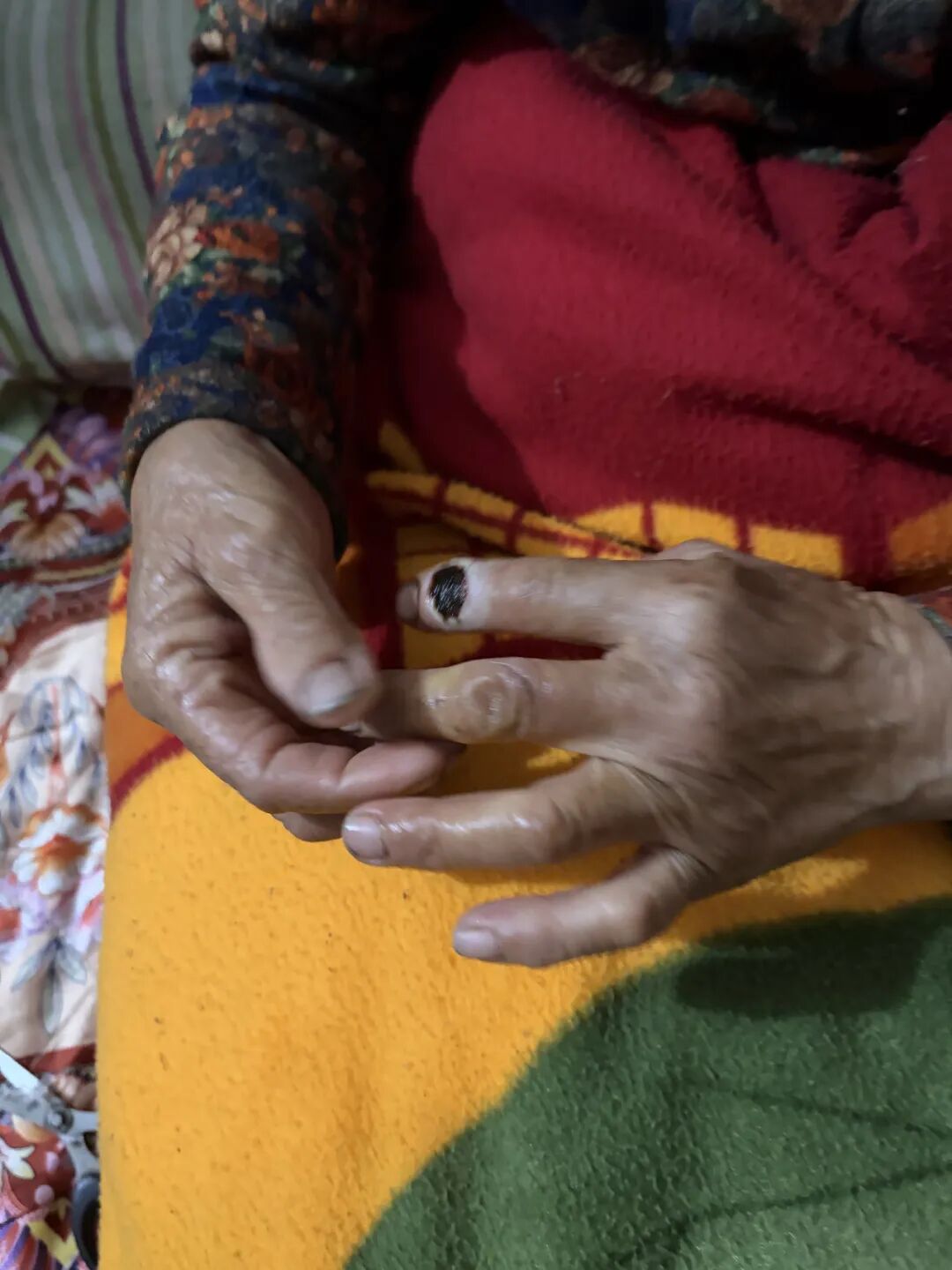
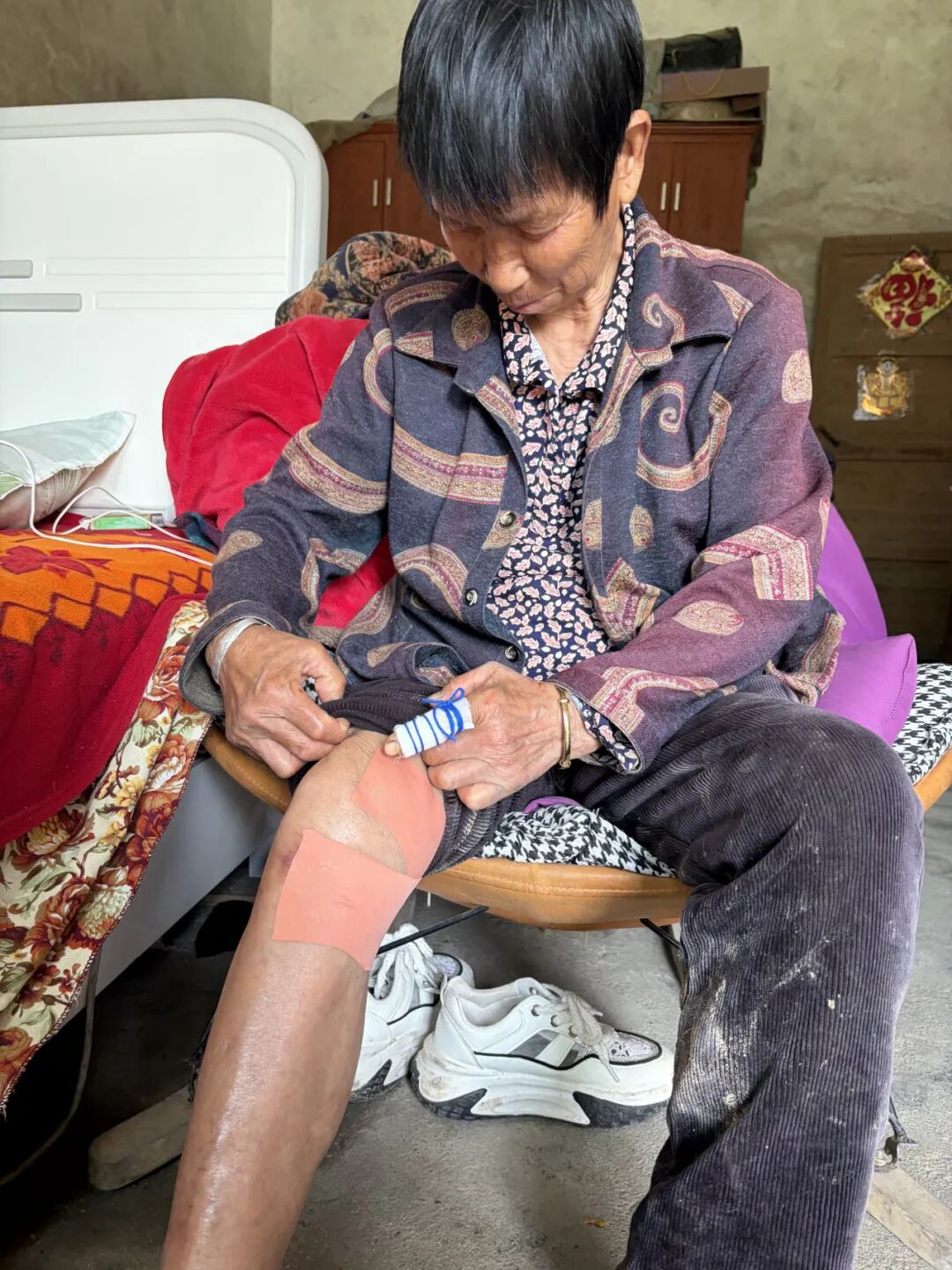
◉ Grandmother’s hands and legs are injured from gathering bamboo shoots.
This was my day of “experience.” But Grandmother and Grandma Deng Lian had already been doing this for over a month. Everyone in the village said the two of them were full of energy when looking for bamboo shoots; by contrast, some of the younger uncles thought pushing through the woods to gather bamboo shoots was too hard and simply gave up.
The Need to Find Money
Only in recent years has selling bamboo shoots become Grandmother’s main source of income.
Some years ago, Grandfather and Grandmother still grew a few mu of paddy rice, groundnuts and sweet potato. After deducting seed, fertiliser and labour, they could earn four or five thousand yuan a year. In the year Grandfather was 80 and Grandmother 70, their children had agreed on old-age support payments and gave the two of them money for living expenses each year. Grandmother then hardly farmed at all; she grew only enough to eat, and sold the remaining small farm produce for a few hundred yuan.
But the old-age support payments were not stable. For the first two years, each family paid 6,000. Later, my eldest aunt fell seriously ill, the grandchildren were married, and wages at a construction site went unpaid… Out of consideration for her children, Grandmother accepted two-thirds less, and what she actually received was only five or six thousand a year.
But spending cannot be cut. Social obligations in the village weigh heavily, and the money for funeral and wedding banquets comes to nearly ten thousand yuan a year. Mum feels under pressure and often argues about it. Grandfather and Grandmother insist on attending, and have even fronted some of Dad’s contributions first; at the end of the year, two or three thousand still comes out of their own pockets. On top of that, their age means they are constantly plagued by minor ailments. Since the village clinic was closed down, they have had to go into the town for treatment, and these assorted medical bills add another one or two thousand yuan a year.
Grandmother must find the money herself.
She tried growing maize, but the harvest was too heavy, and her body could not cope; in the end it sold for 0.8 yuan a catty, and the income was not even a few hundred yuan. Grandfather’s health has been getting worse year by year, so they can no longer grow the paddy rice and groundnuts that demand heavy physical labour. Grain prices are low, too, and both seed and fertiliser cost money. They also tried keeping a few more chickens and ducks, but the coop space is limited; once the numbers grow, they are prone to illness and difficult to manage.
Besides, “the weather has turned bad, too” is a phrase Grandmother has been repeating for the past few years. Rainfall has started to become less even; winters have become dry, and springs again bring too much rain. The changes in the weather have made crops harder to manage. She grumbles: Plant groundnuts, and the groundnuts die; plant sweet potatoes, and the sweet potatoes die; plant luffa, and even once the luffa seedlings have reached the trellis, the vines can still die back. Last autumn and winter, they had to water the rapeseed painstakingly just to keep it alive. But this spring, in Hengyang, Hunan, it rained for nearly a month on end. All the rapeseed rotted at the stalks, and quite a few vegetable seedlings and crops in the field were also spoiled. Pest damage became more severe. Last autumn and winter, as soon as the soil was turned over, insects had eaten more than half of the sweet potatoes and groundnuts. The luffa in the garden ripened, and it reached the point where you had to put out several sticky traps. When she planted sweet potatoes this year, she had already begun putting insecticide into the ground while transplanting the seedlings.
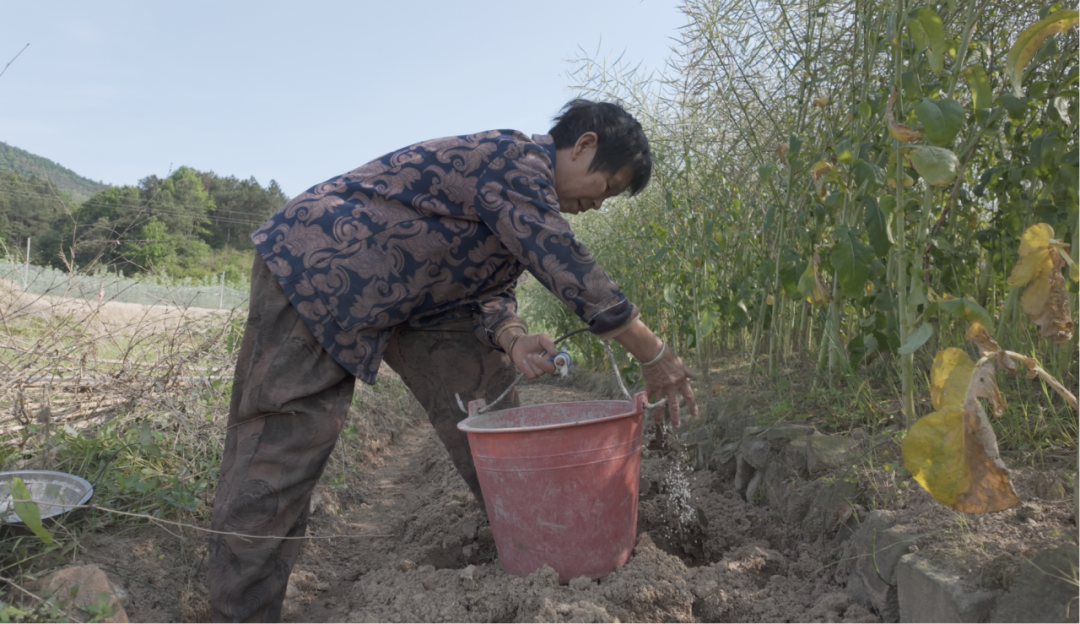
◉ Grandmother planting sweet potatoes, next to the rapeseed that lodged and gave a poor harvest this year.
In the end she chose bamboo shoots. They grow naturally and are nurtured by the land; the mountains have them, so you just need to go and gather them. There is no need to buy seed, fertiliser, or chemicals, and no need to worry about irrigation either; it all comes down to whether one is willing to put in the effort. Grandmother says: “Gathering bamboo shoots is already very good; no capital is needed, only labour.”
Altogether, in these four or five years, Grandmother has earned just under 10,000 yuan from selling dried bamboo shoots, winning the admiration of many of the younger uncles in the village. In 2025, the dried bamboo shoots made from large bamboo shoots sold for 10 yuan a catty; she sold a little over 100 catties, for just over 1,000 yuan. Uncle Yang, a relative, was considerate of her hard work and bought 30 catties at 15 yuan a catty. The dried bamboo shoots made from small bamboo shoots sold for 12 yuan a catty, bringing in more than 1,700 yuan. Her total bamboo-shoot income for the year was about 3,000 yuan. In 2024, Grandmother’s total bamboo-shoot income was about 2,800 yuan. The year before that, it was 2,000 yuan.
Grandmother says that the increase in bamboo-shoot income over these past few years is really thanks to my aunt; otherwise, 40 catties of dried bamboo shoots in a year would already count as a lot. My aunt helps Grandmother for about ten days, and lets Grandmother keep all the money. In fact, once the costs are shared per head and the cost of the car is added, it is hardly worth it.
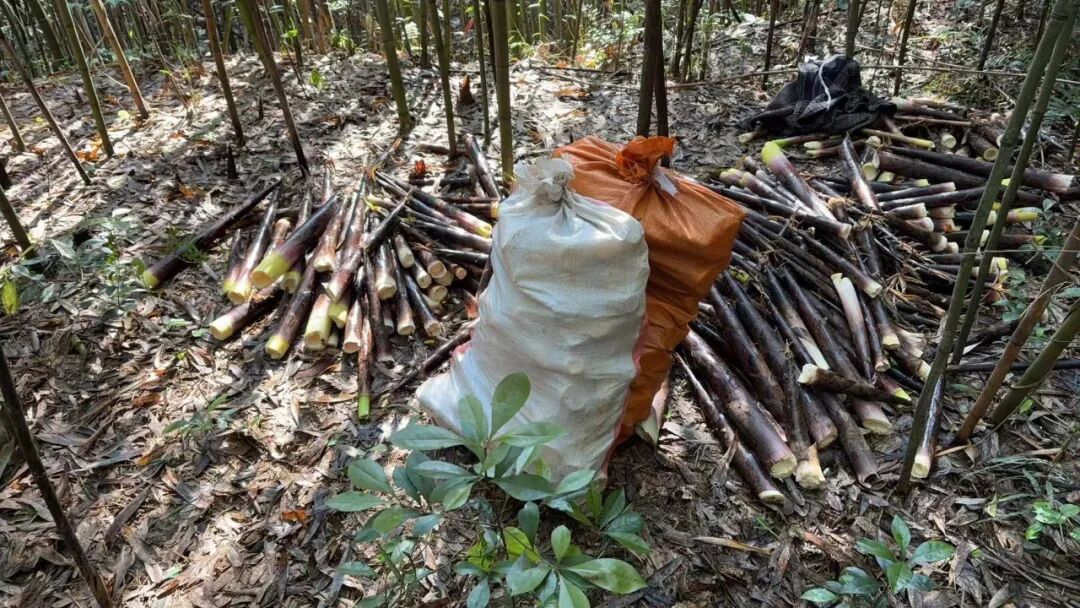
◉ The bamboo shoots gathered on the mountain have to be packed into woven polypropylene sacks and carried down the mountain.
Losses
The bamboo shoots the family had brought home with such great effort still await lengthy processing and considerable shrinkage losses.
As the saying goes, “One basket of bamboo shoots, two baskets of husks.” Peeling is the first step: the shoot tips are twisted off, torn open, and peeled away with the husks rolled back, then the white shoot skin is carefully picked away, and by the end of a whole day the fingers are badly swollen.
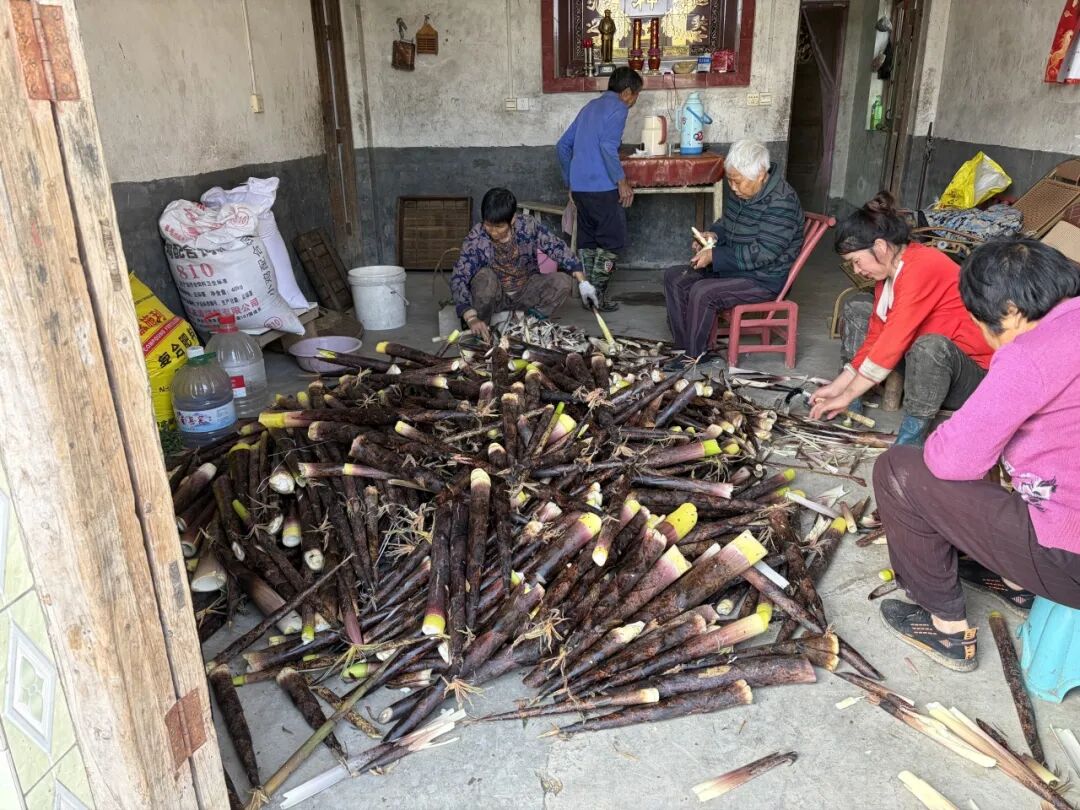
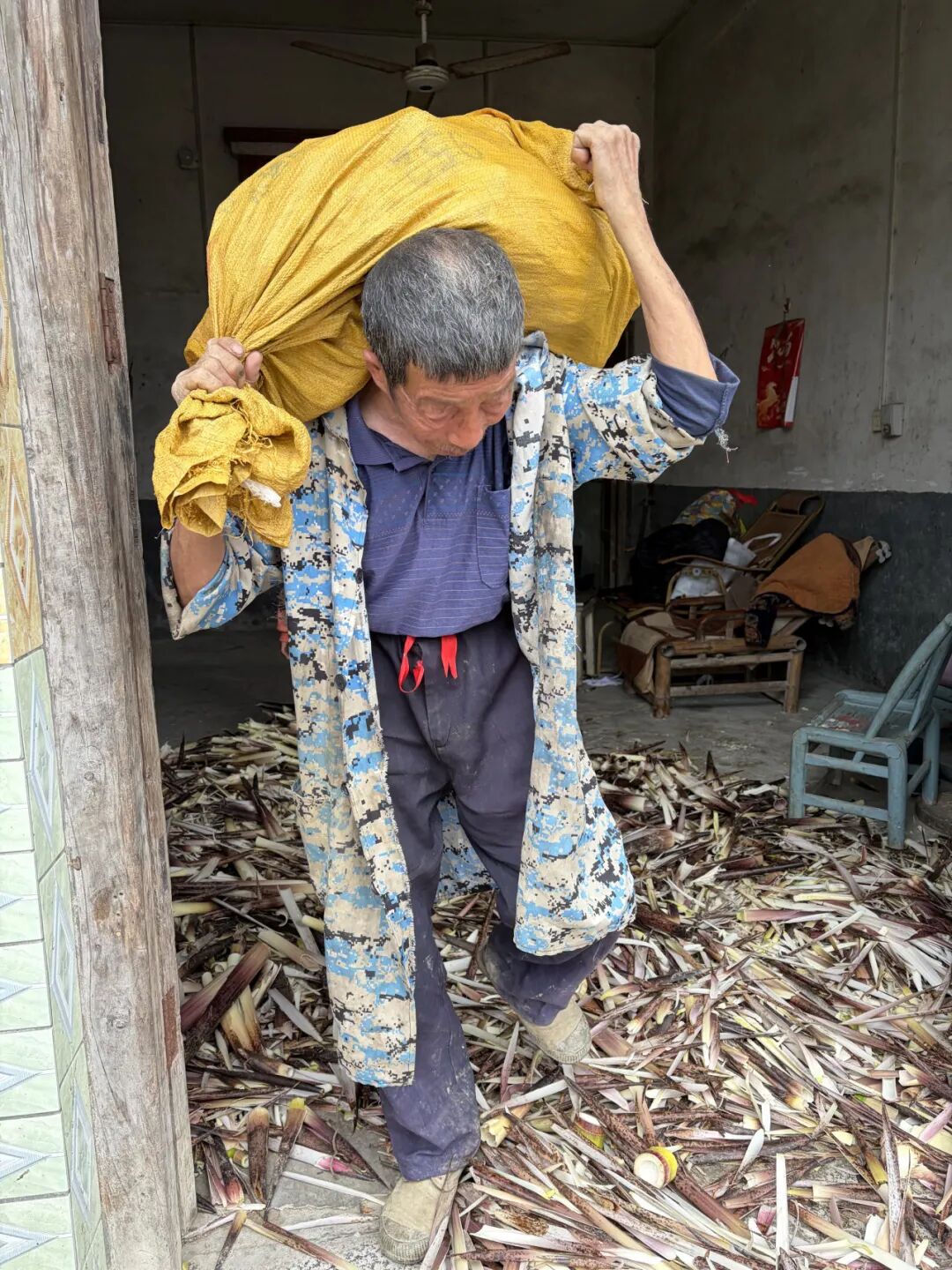
◉ Peeling bamboo shoots.
The peeled bamboo shoots then have to be boiled in a large pot for over an hour, until they turn yellow and are fully cooked, then quickly plunged into cold water while still hot, and laid out one by one on a rack to dry, being turned over from time to time. On sunny days, the shoots dry in two days. When it is a day without sun, it is troublesome: they have to be dried repeatedly over a wood fire. All in all, processing fresh bamboo shoots into dried bamboo shoots takes several hours a day.
Grandmother says that 100 catties of fresh bamboo shoots, once the husks are removed, yield only about 30 catties of bamboo shoot flesh. After drying, 10 catties of bamboo shoot flesh yields at most 1 catty of dried bamboo shoots. Some small bamboo shoots shrink even further. On 1 May, they gathered four or five hundred catties of fresh bamboo shoots. Grandmother says that the final yield of dried bamboo shoots was less than 20 catties and would not sell for even a hundred or two hundred yuan. Spread over three people and a whole day of pushing through the mountains, carrying, hauling, peeling, boiling, drying, turning and gathering in, the hourly wage is almost impossible to work out.
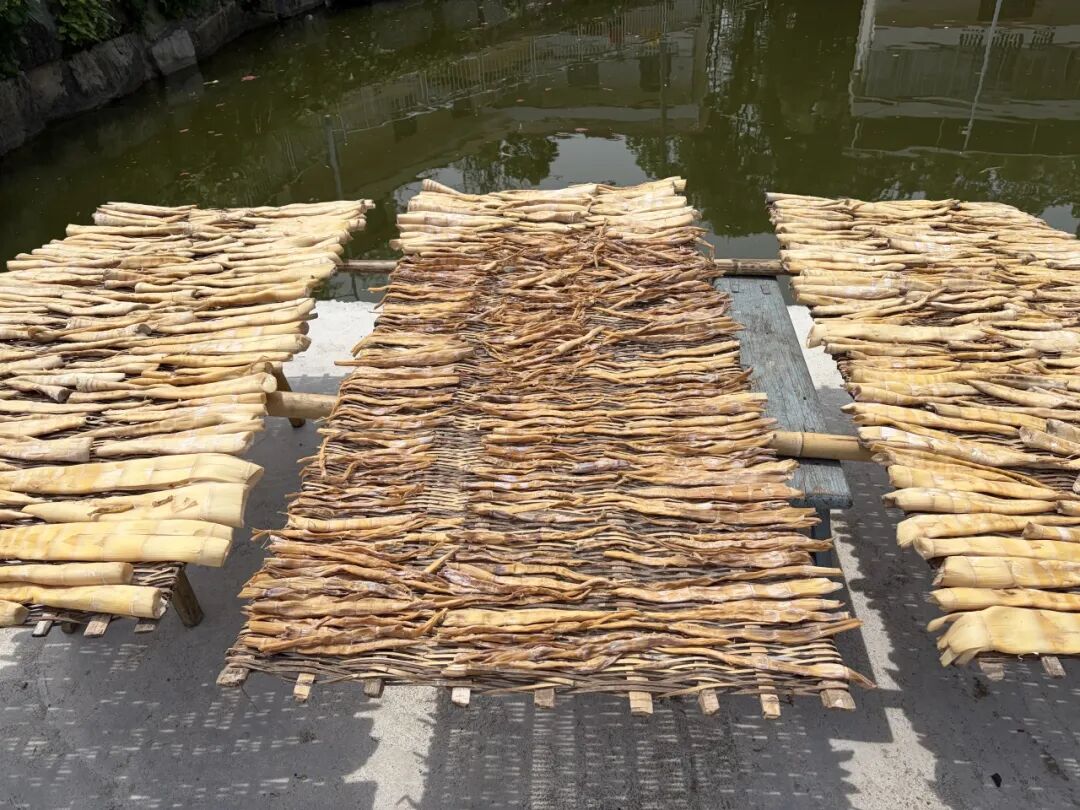
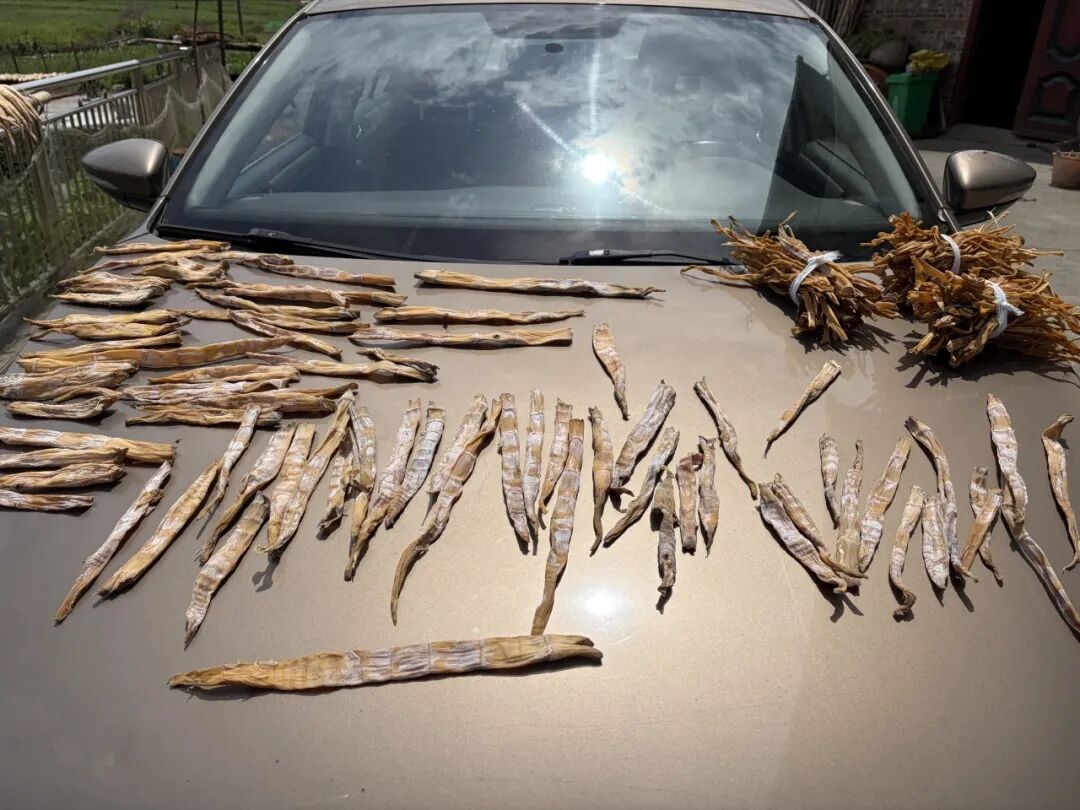
◉ Drying the bamboo shoots requires watching the weather closely. If it rains, and a heavy downpour suddenly comes down, and they are not gathered in in time, all the previous effort is wasted.
On e-commerce platforms, average prices for dried bamboo shoots are around 30 yuan a catty, with free delivery. This price is far beyond the reach of the grandmothers; they do not even know where the parcel collection point is, nor do they understand how to get delivery discounts. Some villagers have channels to sell directly to relatives, friends and restaurants, and can sell for 20 yuan a catty. But those without channels can only sell to buyers at a lower price.
Grandmother mainly works with the fixed buyer in the village, Boss Chen. He often drives his small three-wheeled vehicle to the village to collect goods; he buys forest produce, farm produce and medicinal herbs. They have worked together for over ten years. The price of dried bamboo shoots has fluctuated between 8 and 15 yuan a catty over the past two years. After receiving the goods, he removes the old roots and sorts them by age. Boss Chen says that when the market is good, they can sell for about 22 yuan a catty.
Sometimes, when Boss Chen’s price is low, Grandmother waits a while before selling. But Grandmother’s choices are getting fewer. In recent years, the number of people coming to the village to buy goods has clearly fallen. She used to go to the town herself to sell in small quantities, but over these past years many people have left the town, and there are fewer buyers too. On top of that, last year the village’s rural passenger transport service stopped; there is no fixed bus service, it takes more than an hour to walk to the town, and hiring a motorbike taxi costs another 12 yuan, so a round trip is no small expense.
If no one comes to collect it, forest produce is as good as rotting in your hands. In 2025, the price of Grandmother’s dried bamboo shoots was pushed down to 8 yuan a catty. Even so, the buyer was still reluctant to take them, and Grandmother, unable to stand it, stubbornly waited until winter, then had my aunt drive her into town to find another buyer.
At first, the female shopkeeper offered 11 yuan a catty. Later, after she had turned the dried bamboo shoots over, she said the quality was poor and that they had been sitting too long, and would only pay 10 yuan a catty. Grandmother did not dare to delay any further; that day she sold 46 catties and was paid 460 yuan. Beaming, she took me out to buy pork and spare ribs, saying she would make something tasty. The next day she sold all the remaining several dozen catties of dried bamboo shoots, and at last one worry was put to rest.
Growing Old
Work like gathering bamboo shoots — “low reward, high intensity and a lot of patience” — is something the men in the village are largely unwilling to do, but the women take it on gladly. They all hope to have an income of their own, and are unwilling to wait for their husbands to hand them money.
“In the countryside, where can one find work that brings in more than 2,000 yuan?” Grandmother Deng Lian said to me wistfully.
No one can help Grandmother Deng Lian; she alone has to do all the work, from going up the mountain to gather bamboo shoots to making dried bamboo shoots. Over these years, Grandfather’s health has also grown worse, and Grandmother no longer lets him help with many household chores and farm tasks. Most of the heavy work has fallen on her.
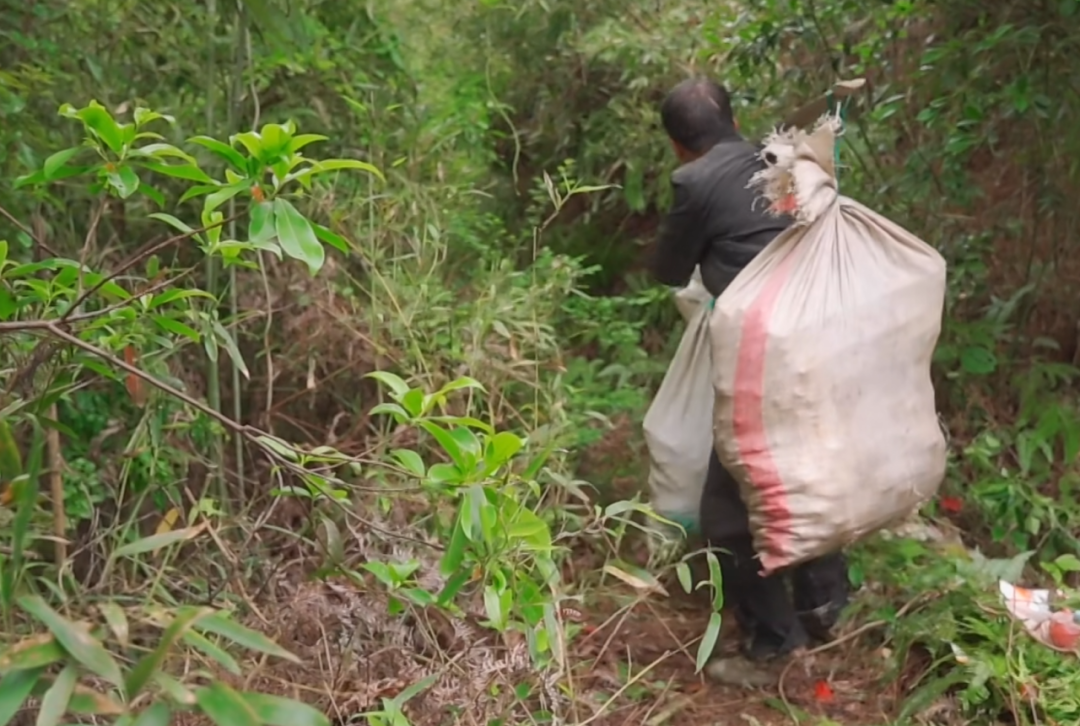
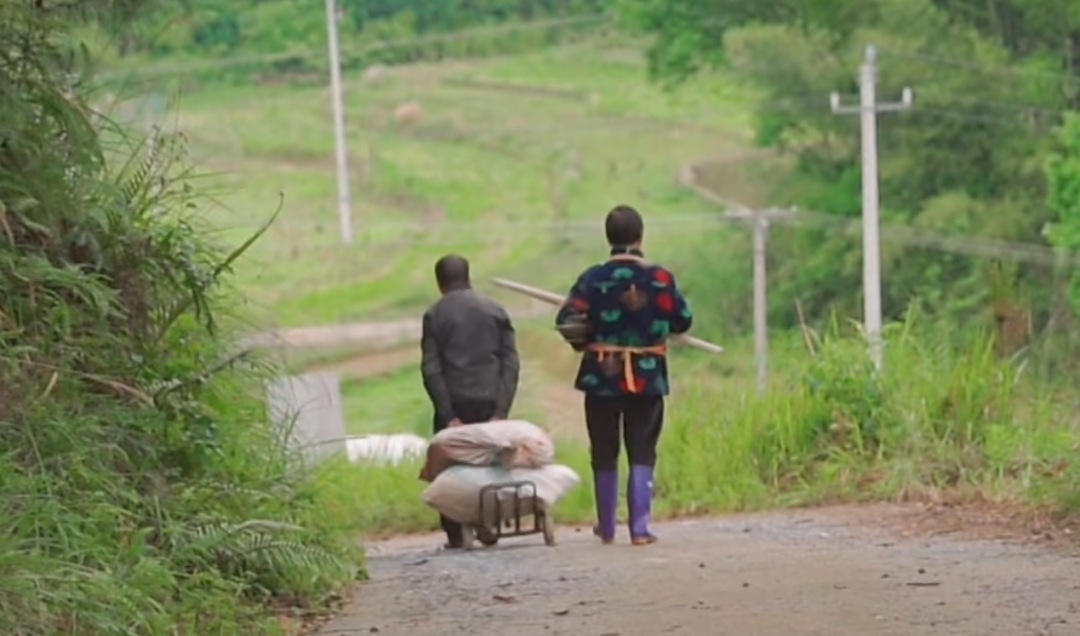
◉ During the 2022 bamboo-shoot season, Grandfather could still help carry a little. Now most of the farm work has fallen on Grandmother alone.
But Grandmother’s ageing is unstoppable, and the whole village is ageing too.
The passenger buses that used to be packed on market days are now always more than half empty. The houses in the village are becoming more and more stylish, but the doors have been closed for long stretches, one household after another. The street lights have been repaired, yet the people who used to chat at night are gone. In the second half of last year, the village’s fixed bus service stopped running because of heavy losses, as if it were finally setting a quiet note for the elderly left behind in this village.
Our village group has about 30 households in all; now only about 10 are permanently resident, and only seven or eight continue to work the fields. Ten or so years ago, going up the mountain to gather small bamboo shoots was very lively: a dozen or so middle-aged and older women, bringing their children, would go up the mountain chattering away. Every time Grandmother went, she had four or five companions, but later, one by one, those companions left. Neighbour Grandmother Yang passed away in spring; the bamboo shoots gathered on the last few trips with her had not had time to dry before they all moulded.
Now, only six or seven women in the village group go up the mountain to gather bamboo shoots. The oldest is the 84-year-old Great-Grandmother, but she only occasionally gathers a little on the way; the youngest is Axi, a left-behind mother in her 40s. The mainstays are only my grandmother, Grandmother Deng Lian, and Axi.
Fortunately, over these past few years my aunts have returned home. Because of their poor health, they can no longer go out to work on construction sites. Back at home, the daughters have occasionally taken on some of the farm work for their elderly mothers.
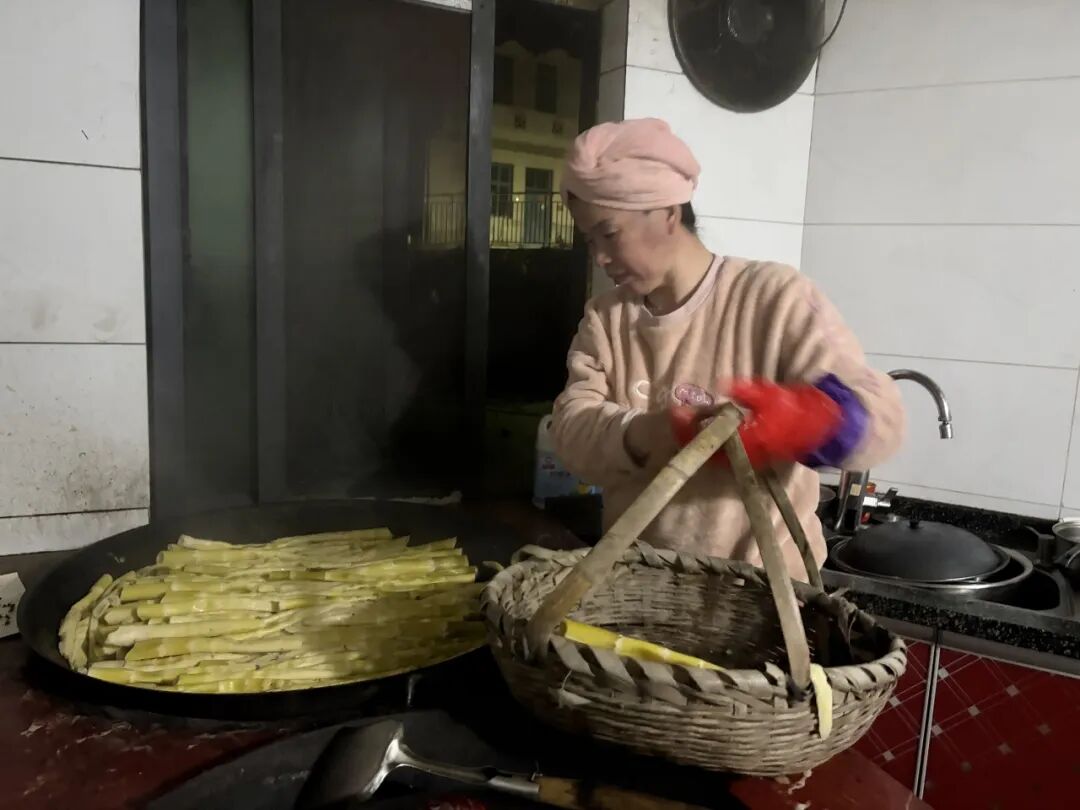
◉ My aunt helping to boil the bamboo shoots.
Dignity
These bamboo shoots are money, and not just money. For Grandmother, they also mean dignity.
Grandmother Yang Xiuying has always been a stubborn, proud country woman. She was one of nine siblings. Because her family had an outsider surname in the village, the family was especially poor, and none of the girls had been able to go to school. She attended school for only two days and could recognise fewer than two characters before her maternal grandfather called her home; after all, a seven- or eight-year-old girl was already a useful pair of hands, able to pull pig grass and chop firewood.
When she was young, before dawn she would cross mountains and ridges, going over Leizu Ridge, more than 600 metres high, to Hengnan County to look for grass, firewood and bamboo shoots, and not come home until dark. She told me that back then she was one of the few girls in the village who could sometimes bring back a small bundle of bamboo shoots. Such a small bundle, once peeled, yielded only one or two catties of bamboo shoot flesh, and was a rare extra meal for the family. The bamboo shoot sheaths left after peeling could be kept to feed the pigs; everyone treasured them.
Grandfather was also impressed by Grandmother’s hard work and endurance. In his youth, Grandfather himself recorded work points in the village and served as a weigher; he noticed that the small-statured Grandmother always carried back the most fodder, and was very capable. After they married, in the early years the family’s main goods for sale were groundnuts and sweet potatoes, and Grandmother would negotiate the prices. In the past, dried bamboo shoots were mainly kept for the family to eat at festivals. The older generation liked meat stir-fried with pickled bamboo shoots, and Grandmother’s bamboo shoots were always the most popular.
Grandmother held the family together in all things, big and small. In his youth, Grandfather was called away to build a railway and transport timber. His wages were meagre, and he was away for long periods. Grandmother alone tended three or four mu of land, earning work points while raising three children. Later, she also took on the responsibility of looking after me and my older brother. Not being able to go out to work away from home was a lifelong regret for her. “If it had not been for my lack of schooling and inability to recognise more than a few characters, I would certainly have made something of myself. I am no worse than anyone.”
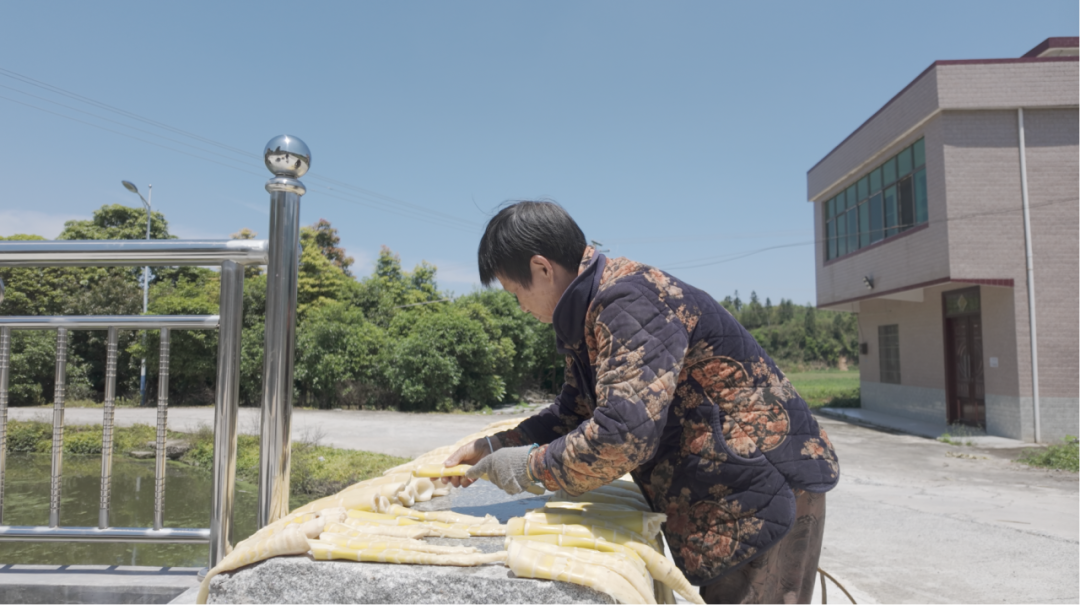
◉ Grandmother drying bamboo shoots, adapting to local conditions.
Time is unrelenting. From my high school days through university and into work, Grandmother had remained in that small mountain village. She could only rely on experience, using familiar work to earn a meagre income. As she grew older, her body developed more and more problems: long-standing stomach trouble, a bile duct resection, anaemia, cerebral atherosclerosis, and so on. Last year, when Grandmother was ill, it cost more than 3,000 yuan; stubbornly, she paid around 1,000 yuan out of her own pocket and did not want to use her children’s money.
In mountain villages and towns undergoing development, everything is changing. The mountain village is left behind by the city, and the elderly are left behind by the young. But Grandmother is still going up the mountain to gather bamboo shoots, year after year.
The small dried bamboo shoots are a lifetime of memories for her, and also the mountain wisdom she has accumulated year after year, giving her an income and a sense of confidence. Dried bamboo shoots are “something of her own” that she can proudly offer to younger family members and relatives. She always spares no effort in giving some dried bamboo shoots and glass noodles to all the relatives who come to visit.
Some relatives graciously accept the forest produce she offers and praise Grandmother’s goods as nice, while others find it a nuisance, but she still sets some aside every year. In recent years she has also learned to make pickled bamboo shoots: she blanches the newly picked small bamboo shoots in boiling water, puts them in a glass jar, adds a little salt water and leaves them soaking, seals it up for over half a year, so that when her children and grandchildren come home for the Chinese New Year they can eat pale, tender fresh bamboo shoots.
End of the Bamboo-Shoot Season
A complete bamboo-shoot season lasts about 45 days, generally falling between Qingming and Grain Buds on the lunar calendar. This year, it runs from early April to late May.
The bamboo-shoot season is divided into two phases. First, before Qingming, “large shoots” appear in the Moso bamboo groves. Only a few centimetres of the shoot tip may be visible, but the body of the shoot lies deep underground. The bamboo roots are tough, so the shoots cannot be pulled up by hand; they have to be dug out with a hoe, which tests both eye and strength. It can take nearly twenty minutes to dig out one large shoot. Rainy weather makes it even harder: a bag of harvested shoots is often mostly yellow mud, and weighs a great deal. As the large-shoot season draws to a close, small shoots spring up across the hills. The earliest to appear is rong mao sun, followed by water bamboo shoots, and then ma ke sun. Different shoots vary in the thickness of their bamboo shoot flesh. Ma ke sun, for instance, is not so tender to eat, but its flesh is thicker, so going up the mountain to gather ma ke sun for sale is the most worthwhile.
Apart from not going into the mountains on heavy-rain days and being busy with fieldwork, Grandmother is generally busy in the mountains for just over a month. Each time she goes into the mountains, she spends at least two or three hours pushing through the undergrowth; by the time she emerges, she is carrying bulging woven polypropylene sacks on her back.
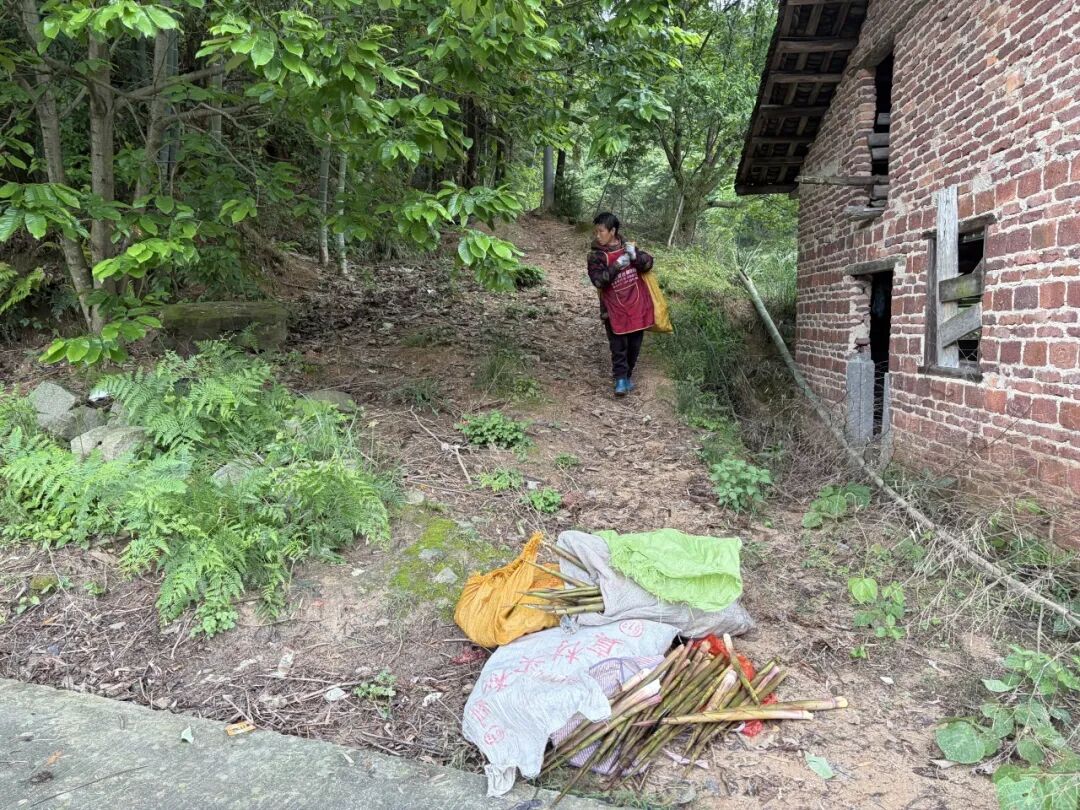
◉ Grandmother with several sacks of harvested bamboo shoots.
When the holiday ended, I returned to my workplace, and a heavy downpour started at home again. Grandmother said the water was pouring down as if it had been poured from the sky; fortunately, the bamboo shoots at home had almost all been dried.
At the time, she told me with great assurance: “I’m not doing it any more. It’s over.”
But two weeks later, on 15 and 16 May, she went up the mountain again, starting at 5 and coming down at 8, carrying back several dozen catties of fresh bamboo shoots and drying two bamboo racks’ worth. She said she wanted to take advantage of the dry weather to soak some fresh bamboo shoots in a jar for me, so that when I came home I would have some to eat.
The long bamboo-shoot season, which ran from the end of March this year to 16 May, has ended; Grandmother’s season this year cannot really be called a “bountiful harvest”. She told me that last winter there was little rain and many of the bamboo plants on the mountain have died, so there are actually not many bamboo shoots this year. The amount gathered this year is less than last year’s.
The end of the bamboo-shoot season does not mean the end of the work. When night comes, Grandmother is still working with the bamboo shoots. Under the lamp, she gathers up the dried bamboo shoots that have finished drying, smooths each one in her hands, ties them up neatly, sorts them by type, and sets aside some of the best so that the children can eat them when they come home for the Chinese New Year.
Outside, the night rain breaks all at once; the bamboo shoots left behind in the dim, heavy mountains will grow into new bamboo groves, again and again. Next year the bamboo groves will again send up new bamboo shoots, waiting for people.
– This is Foodthink’s 815th original article –

Foodthink
Author
Dusty Zhang Qiuqiu
A country girl who went to the city to work, a lazy lover of plant-based food, collecting fragments of life and writing about the stories around her.
About the “She and the Land” Column
This year is the United Nations “International Year of Women in Agriculture and Food Systems”. Foodthink is launching the “She and the Land” content column, focusing on women in agriculture and food systems. We will venture into fields, markets, fishing ports, pastures, kitchens, laboratories and city streets and lanes, to see the women who are often overlooked yet always present. They take part in production, research, cooking, distribution and care, and, with their working experience and wisdom, support our everyday lives. They are tillers of the land and key builders of rural and food systems. Through interviews, writing and workshops, we hope to tell their stories, understand how women’s participation shapes our food systems, and invite everyone to explore: for women who work in food and agriculture, how can a fairer, more dignified future come about?
Unless otherwise stated, all images are provided by the author.
Editor: Xiaodan
Layout: Xiaoshu
Scan the QR code to send a tip and support original food knowledge
▼

▼
Click the image to read related articles.
▼
Click on keywords to view more article collections
Seeds | Agri-tech | Policy | Fermentation | Nutrition | Fruit | Fisheries | Events | Jobs | Takeaways | Wet Markets | Livestock | Food Talk | Sharing Sessions | Book Clubs | Harvest Festival | Smallholder Stories | Climate Change | Rural Development | Cooperative Economy | Urban Farmers | Food Safety | Digital Technology | Biodiversity | Pandemic and Food | False Solutions | Lianhe Creative Programme | Ecological Agriculture Internship Programme
Beijing | Hebei | Shanghai | Guangdong | Guangxi | Henan | Sichuan | Jiangxi | Xinjiang | Shaanxi | Hong Kong | Chongqing | Zhejiang | Jiangsu | Guizhou | Northeast China | Taiwan | Inner Mongolia | Philippines | Canada | Russia | Mexico | Italy | United States | United Kingdom | Germany | Netherlands | Thailand | Sweden | Japan







🌟🌟🌟 Star us so you don’t miss our updates
“Like” “Share” “Watching” “Comment”
▼ Spread delicious food knowledge