The Flying Chef Who Couldn’t Fly Out of the System

In recent years, dining experience events such as “flying kitchens” and “shared small dining tables” have begun to become popular. As a former cook, I was itching to try it. Isn’t that the dream of anyone who loves cooking: to cook as you please, without feeling the pressure and tension of a commercial kitchen, to return to the original intention of cooking for others, and to connect people and build community through food?
So, when the opportunity arose to go to Shanghai, I resolutely decided to try my hand at being a “flying chef”.
Over more than a month of events, shuttling between different restaurants, bars and studios, I did connect with many people who love food and felt the joy of in-person interaction. But the first time I got involved in China’s food and drink system, I had a more complex experience. In foreign kitchens before, the tiredness was physical. In China, it was all about being utterly exhausted in body and mind.
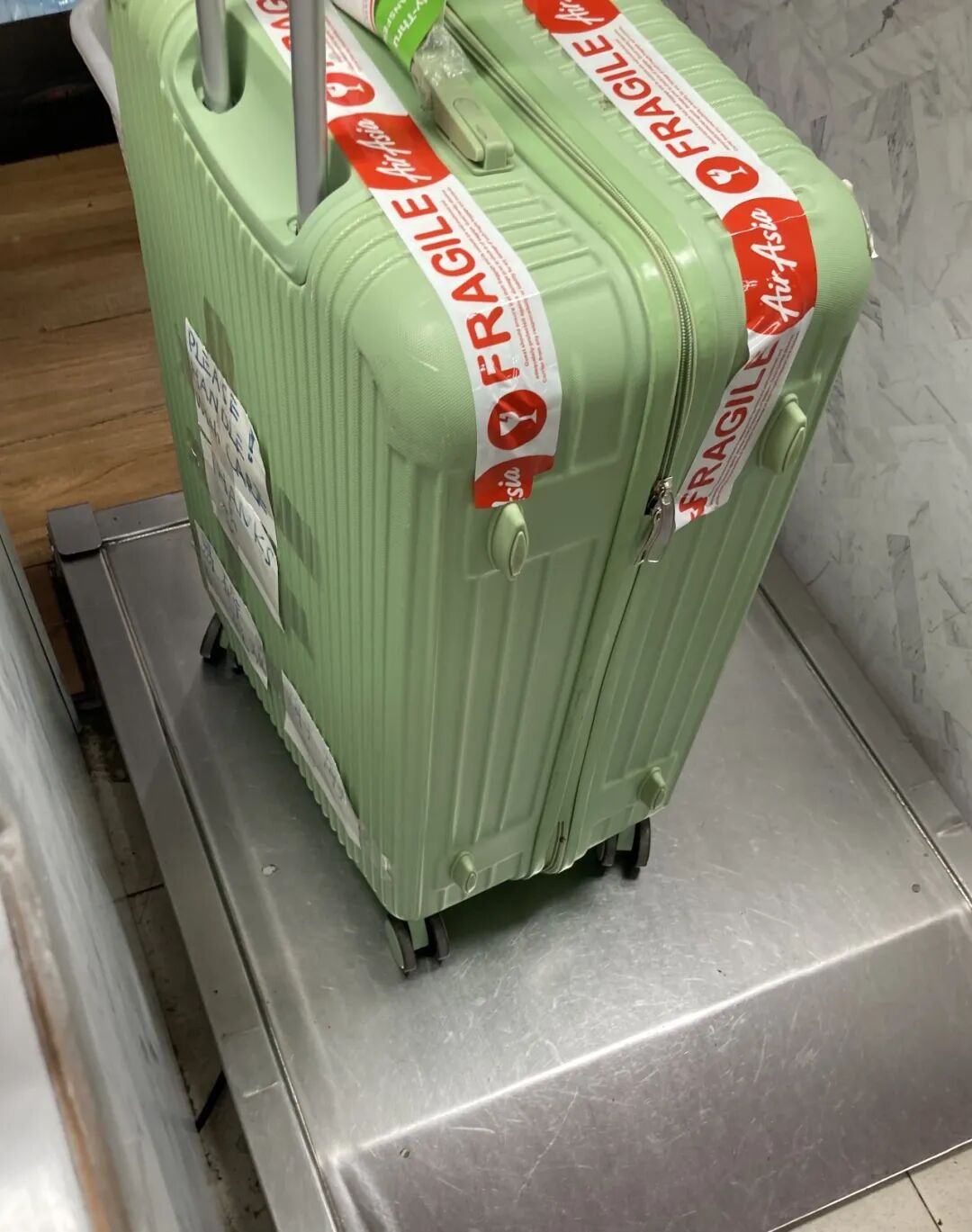
◉ Two-thirds of my 30-inch suitcase was ingredients and condiments I had brought back from Chiang Mai. I had heard another Thai restaurant chef in China say that 80% of the Thai soy sauce on the market is fake, and I had also packed some carefully selected fish sauce, shrimp paste and so on.
Food and Drink Professionals Trapped by the System
I met the bar owner, A (a pseudonym), because we both shared an interest in ecological agriculture and music. The bar was on a fashionable “influencer” street in Shanghai; despite its dark-toned, edgy style, its exterior was planted with a variety of herbs and vegetables, and A was more interested in local, lesser-known dishes. Our ideas were so unconventional that we hit it off immediately. I was grateful for his straightforward trust: he had confirmed the collaboration before even tasting the food. So, with a suitcase of condiments, I flew from Chiang Mai to Shanghai, brimming with the anticipation of making waves.

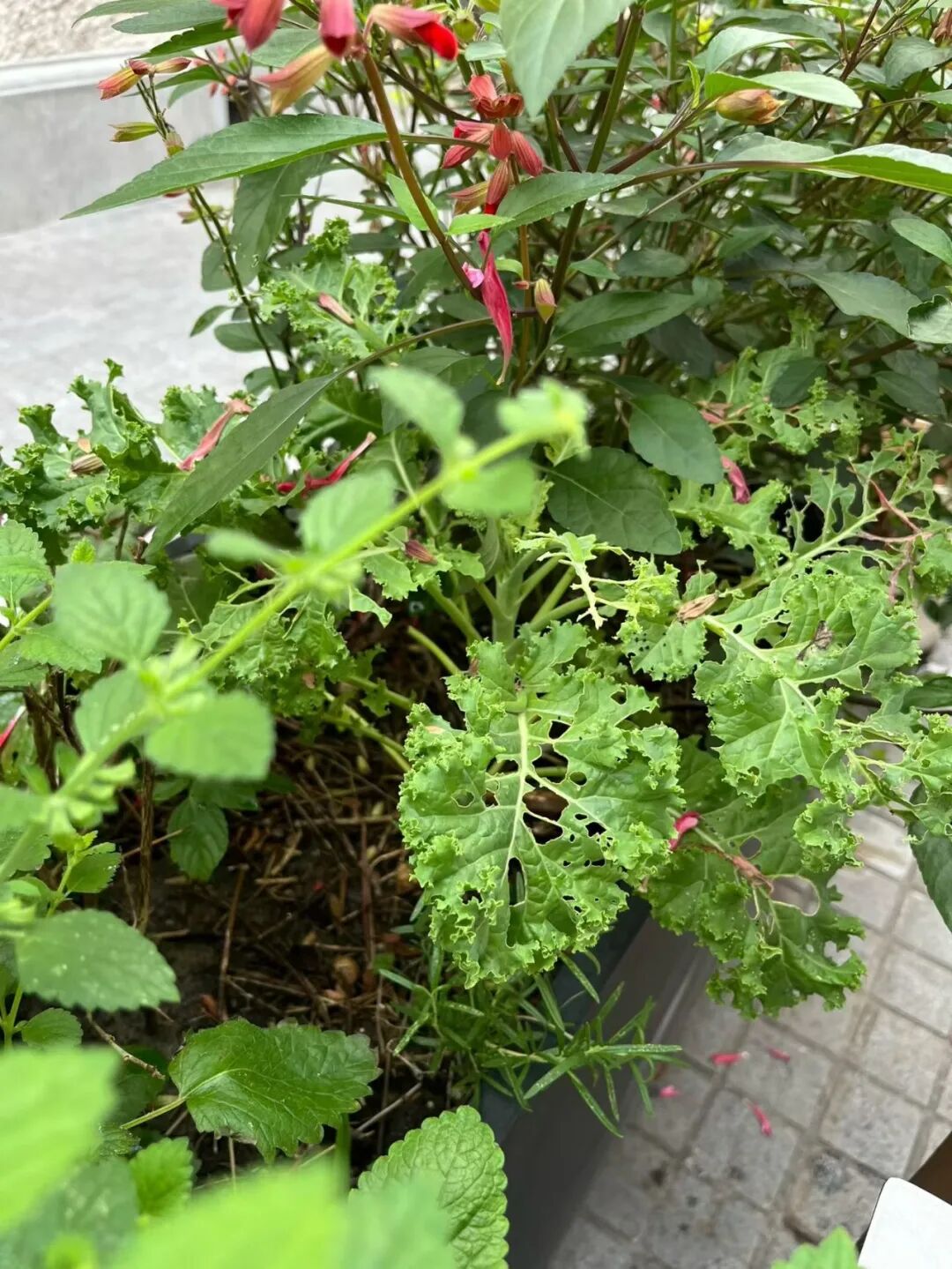
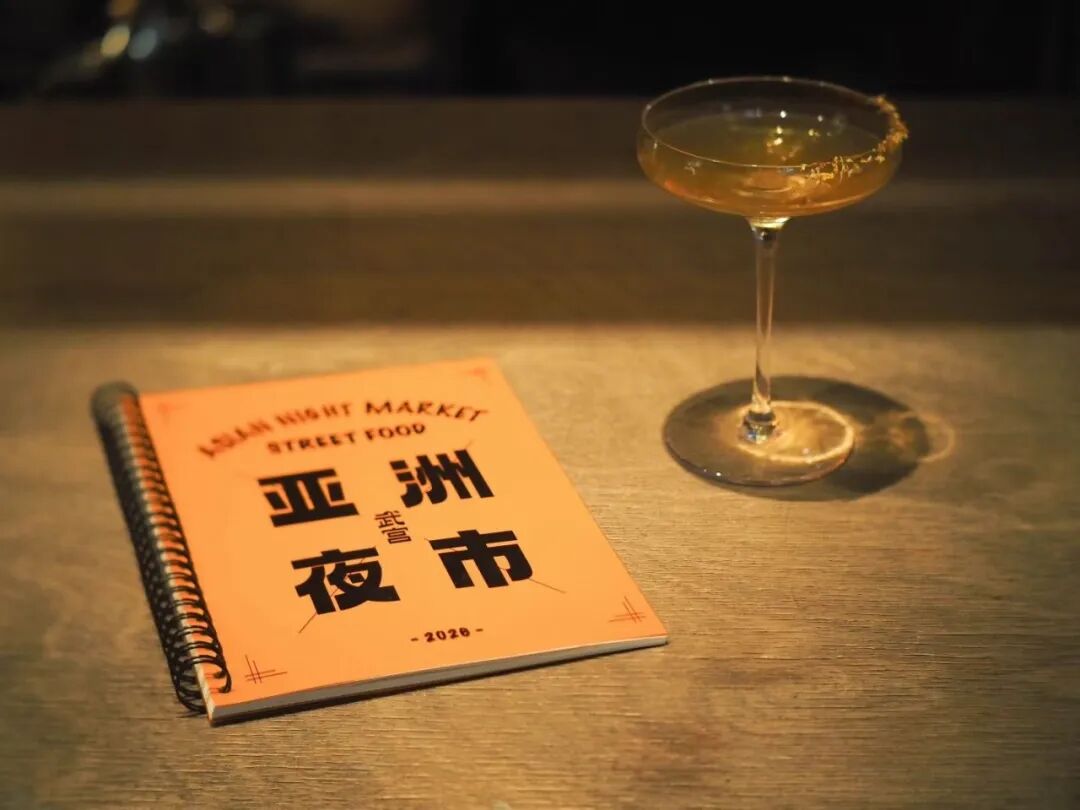
◉ Inside the bar: stylish cocktails and a flying kitchen menu; outside, vibrant herbs growing. Image source: Wu Gong
Because I had lived in Chiang Mai for a long time, I set the theme of the pop-up dinner as Northern Thai cuisine. For Chinese people, the typical impression of Thai food is the same few dishes almost every Thai restaurant serves—pad kra pao, papaya salad, tom yum soup and various curries. But just as kung pao chicken and tomato-and-egg stir-fry cannot encompass the diversity of Chinese cuisine, Thai cuisine is also divided into the major Northern, Northeastern, Central and Southern Thai branches, and Chiang Mai is the central hub of northern Thailand. I wanted to present more local Northern Thai dishes and let diners experience the rich variety of Thai food. For example, Khao Soi, a golden noodle dish that migrated from Yunnan and absorbed Lao and Northern Thai influences, and Nam Ngiao, Shan rice noodles with kapok flower hearts. Recreating these dishes in Shanghai—dishes that are hard to find outside northern Thailand—also meant more difficult sourcing and longer preparation.
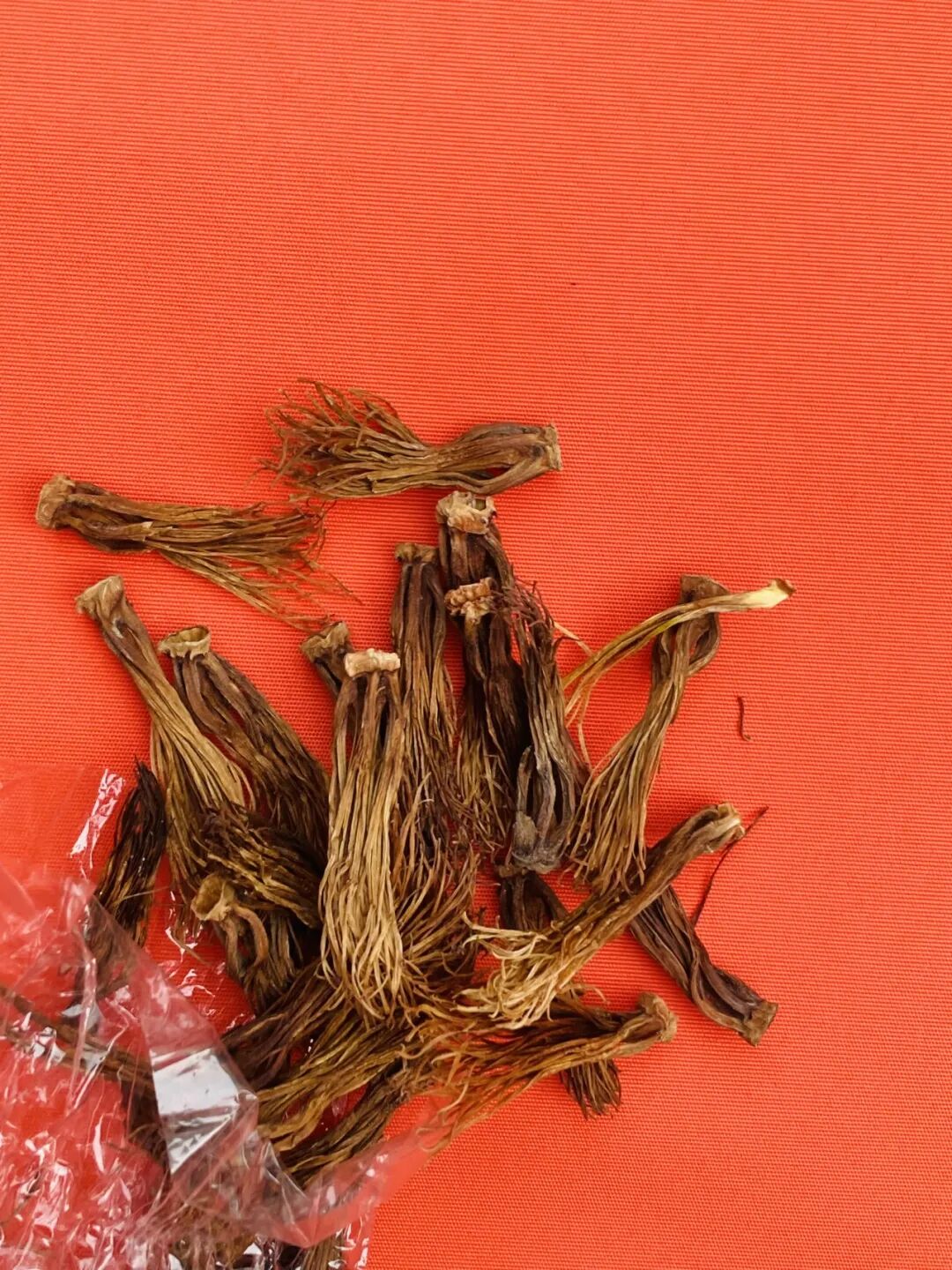
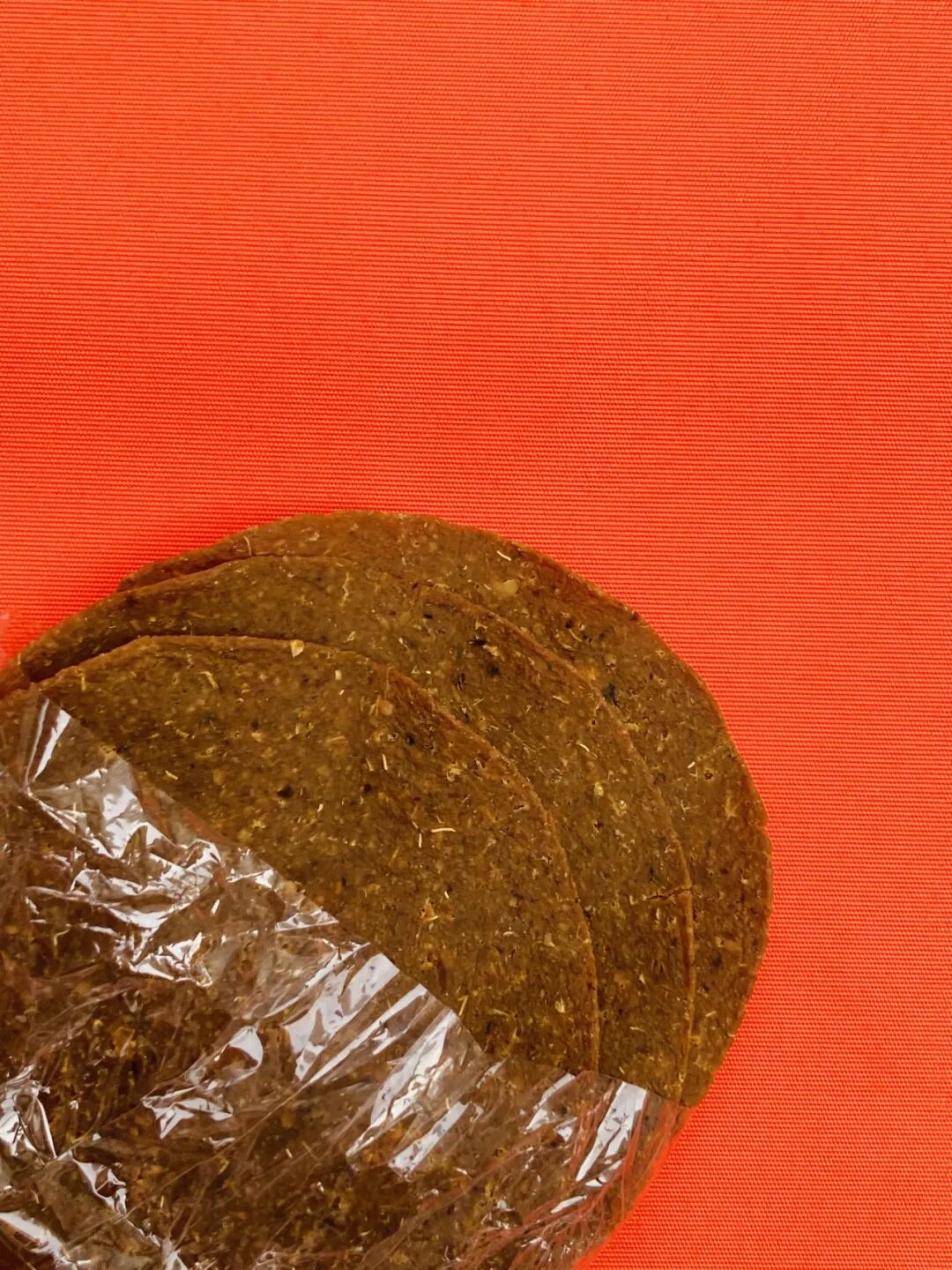
◉ Local ingredients used in Northern Thai Shan sour and spicy rice noodles, Nam Ngiao: dried kapok flower hearts (left) and fermented black bean cake, Thua Nao (right).
As a flying chef, the revenue-sharing arrangement with the bar was originally a flexible model. I had not expected that I, too, would become someone trapped by the system.
On a busy weekend during peak dining hours, the bar owner found a negative review on Dianping, complaining that the food had still not arrived after more than half an hour.
I could probably guess which guest it was—throughout the whole event, only one person repeatedly called waiters to the kitchen to urge us. It’s not that I hadn’t considered how it felt to be kept waiting; when it got busy, I would have the waitstaff remind guests when taking orders that they should expect to wait at least 20 minutes, and only take the order if they accepted that. There was just me and one kitchen assistant in the kitchen; the other mainly helped wash up and clean, while most of the work—including all the prep, hand-making all the curry bases and sauces, and the cooking—was done by me. Still, I could understand that, as consumers, they were more concerned about how much longer they would have to wait than about how chaotic the back kitchen actually was.
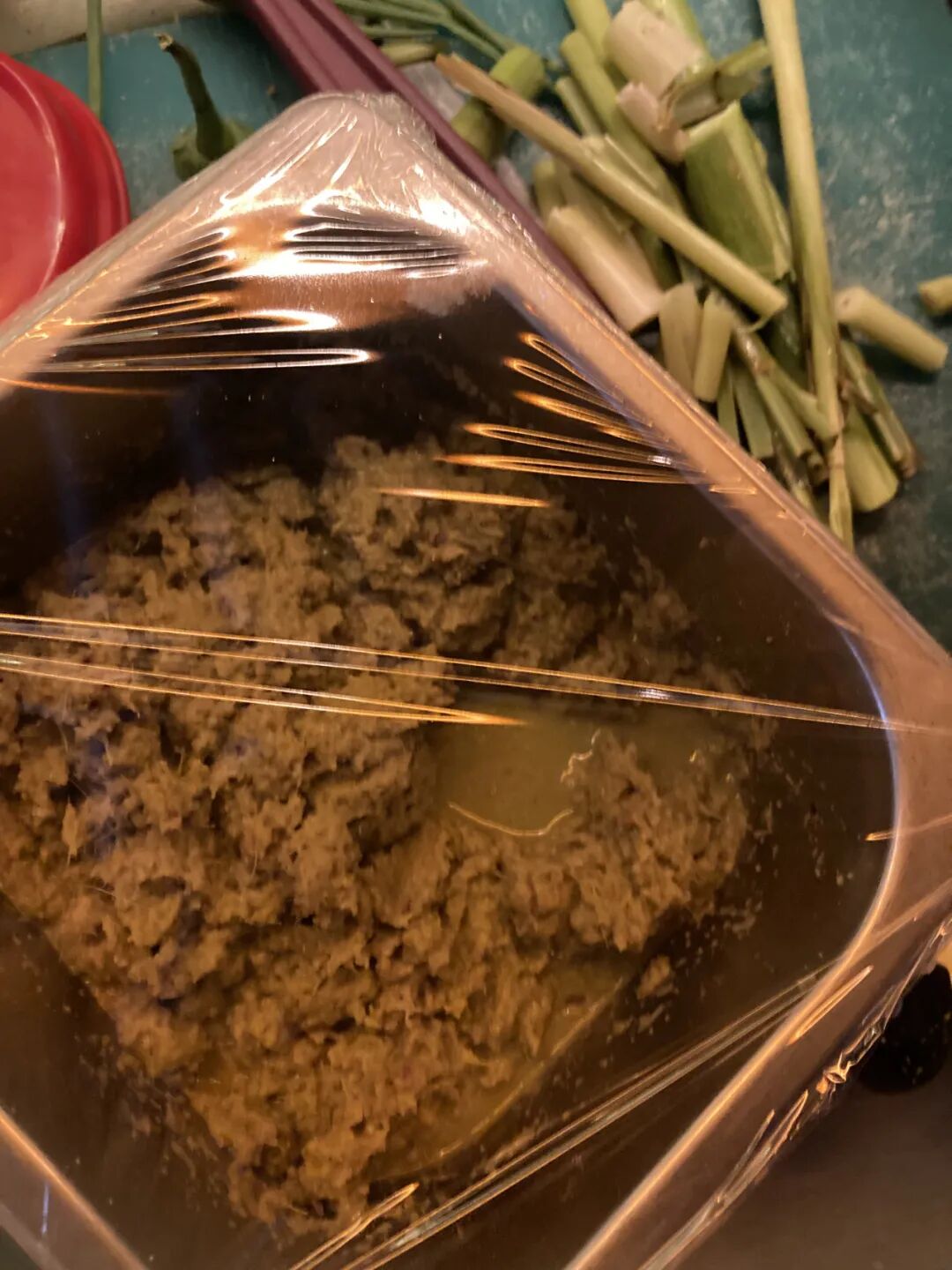
◉ Making curry paste from scratch. Calculating delivery dates for herbs bought online, ratios, testing recipes, making the curry paste, straining, packaging and preserving it… When all these tedious tasks fall to me, the pressure piling up inside me grows day by day.
A was an emotionally stable friend, and he had no intention of blaming me at all. But I could feel that this negative review was putting a lot of pressure on him. It was only later that I gradually worked out the logic behind that pressure.
Dianping works like this: negative reviews directly lower a restaurant’s rating, and the rating determines its platform traffic—the higher the rating, the greater the chance that the platform will recommend it to more users. If a restaurant wants to make the Must-Eat List or Black Pearl, the rating is a direct threshold. According to official data, in the period before and after being listed, restaurants newly listed in the 2023 Black Pearl saw search volume rise by more than 150% and actual in-store footfall increase by between 30% and 70%. Maintaining a rating is not just about a restaurant’s image; it is key to whether the business can keep running.
What makes it more complicated is that reviews from different users do not carry the same weight. The platform gives different weights to reviews depending on user level; the higher the level, the greater the impact. A friend of mine in restaurants told me, “A negative review on Dianping is the sort of thing that calls for a meeting at our restaurant. A single negative review dropping the rating by 0.1 points could mean a restaurant falling from page 1 to page 3 or 4 in Dianping search results. Exposure drops, and footfall is seriously affected. It may be that people are now too reliant on Dianping.”
If the person who leaves a negative review is a Dianping V8 user, for the restaurant it is an even greater “fatal blow”. In extreme cases, a single negative review from a V8 user can make a restaurant’s rating drop by half a star overnight. In other words, every high-level account the restaurant sees is not just an ordinary diner, but a hand that can hold a restaurant’s fate—life or death—in its grip.
For consumers, upgrading to V8 is no easy task either, and this has given rise to a grey industry chain. According to the rules set by Dianping, the difficulty jumps sharply from V7 to V8. Dianping itself also acknowledges that the higher the level, the more non-linearly the volume and quality of reviews that must be accumulated grow; the closer one gets to the top, the harder it is to upgrade.
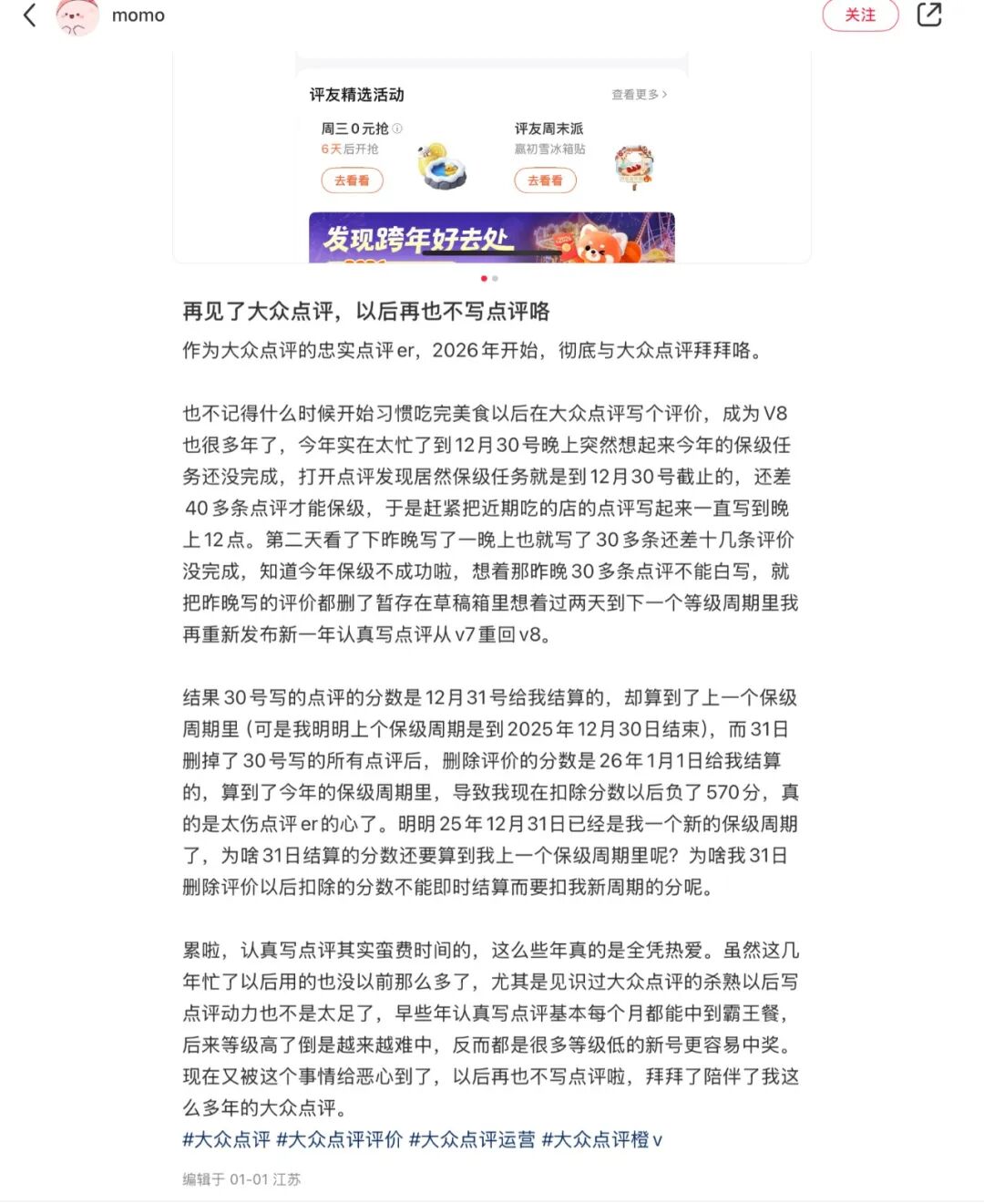
◉ Dianping users have also voiced dissatisfaction with the rating system.
This is also why, for a long time, a V8 account itself became a quantifiable asset, and why specialised third-party operators emerged to help businesses maintain their ratings. A 2021 investigative report in Caijing magazine noted that third-party operation companies would buy the services of writers of positive reviews at openly listed prices, tiered by level; the higher the level, the higher the price.
The platform itself also got involved, setting fixed prices for promotional activities that affected ratings. In 2021, a business owner interviewed by food journalist Mei Shanshan mentioned paying the platform 4,000 yuan per campaign to invite high-level users to dine for free, in order to accumulate positive reviews that carried weight.
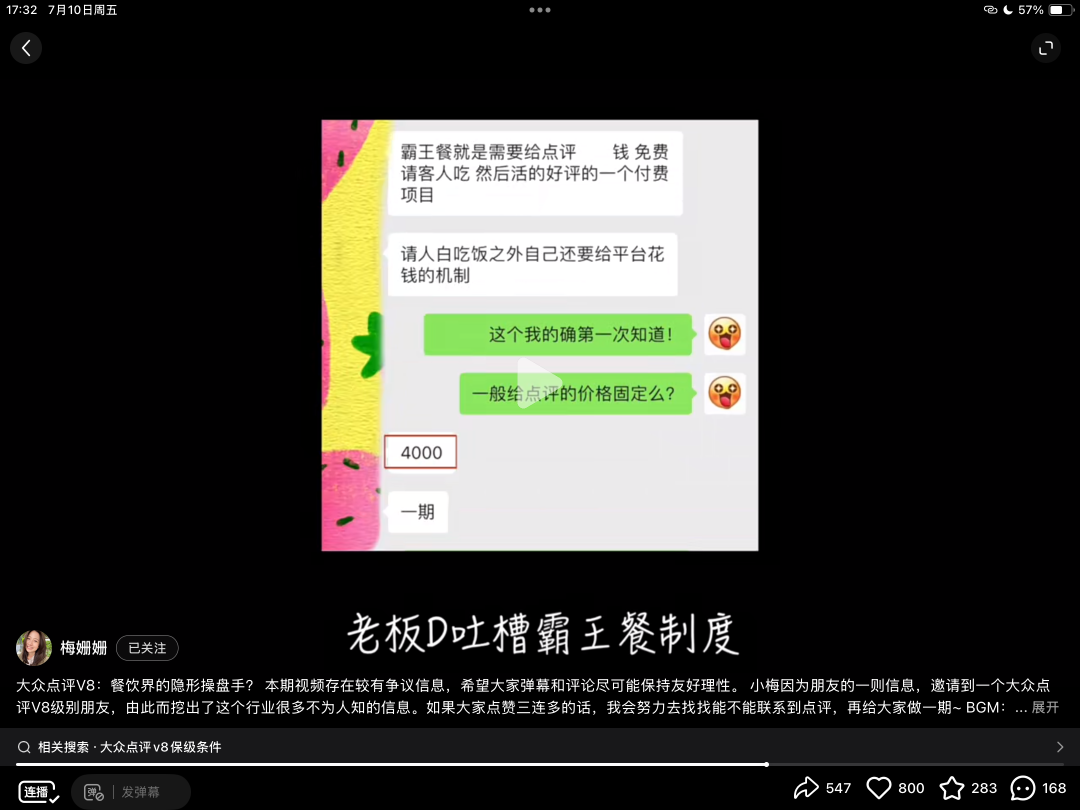
◉ In 2021, food journalist Mei Shanshan discussed Dianping and the “bawang can” free-meal mechanism on Xiaohongshu, drawing much discussion in the comments from users and businesses.
By August 2025, although Dianping claimed to have improved its rules, the star-rating gains of businesses that sent large-scale, intensive invitations for users to visit and write positive reviews were restricted, while stores less skilled at managing reviews but focused on food and service were more likely to gain stars through genuine word of mouth. According to Dianping’s own report on 2025 review transparency, published in March 2026, six months after the new rules were introduced, the number of businesses engaging in high-intensity review solicitation fell by 42%; over the full year, 310,000 businesses had their stars downgraded and 320,000 had their stars upgraded. In other words, the ratings that businesses had once won by any means necessary (including star-rating windfalls from treating V8 users to meals) were being actively narrowed by the platform.
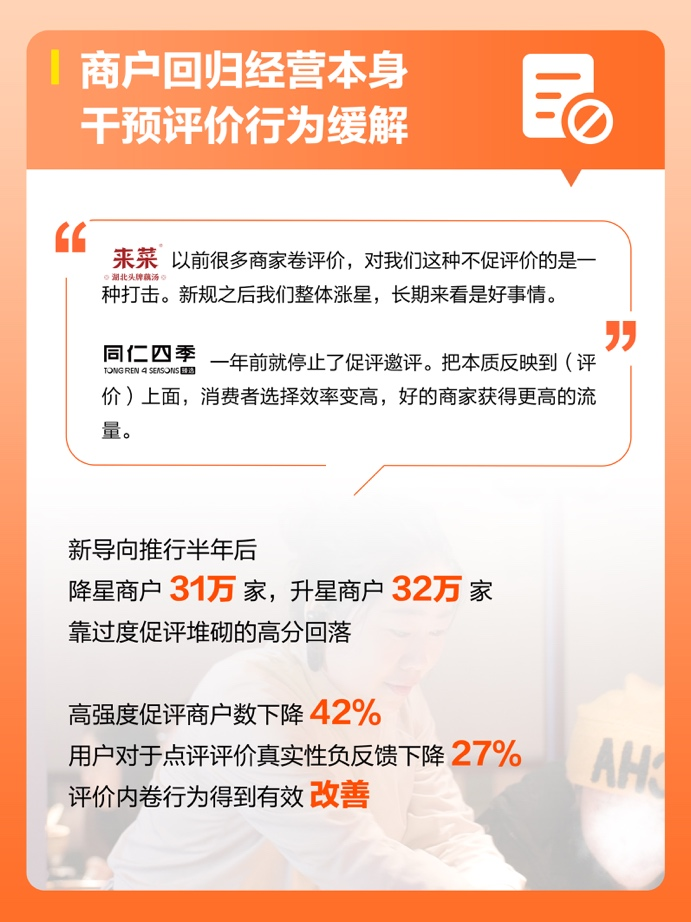
◉ Dianping selectively publishes favourable comments from some businesses about its rating reforms, while behind them lies the frustration of many more businesses that have been downgraded without cause.
Therefore, the industry chain is also evolving. Services that remove negative reviews on a client’s behalf have begun to be openly priced, at 60 to 1,500 yuan per review; the price depends on the star rating and the specificity of the content—the more detailed and evidence-backed a negative review is, the lower its removal success rate. At the same time, the AI moderation mechanism used to identify “malicious negative reviews” has also begun to generate new controversy: some users have reported on a complaints platform that their genuine negative review was taken down by the system within minutes on the grounds of “suspected peer competitor”, while the platform did not provide any specific basis for its judgment.
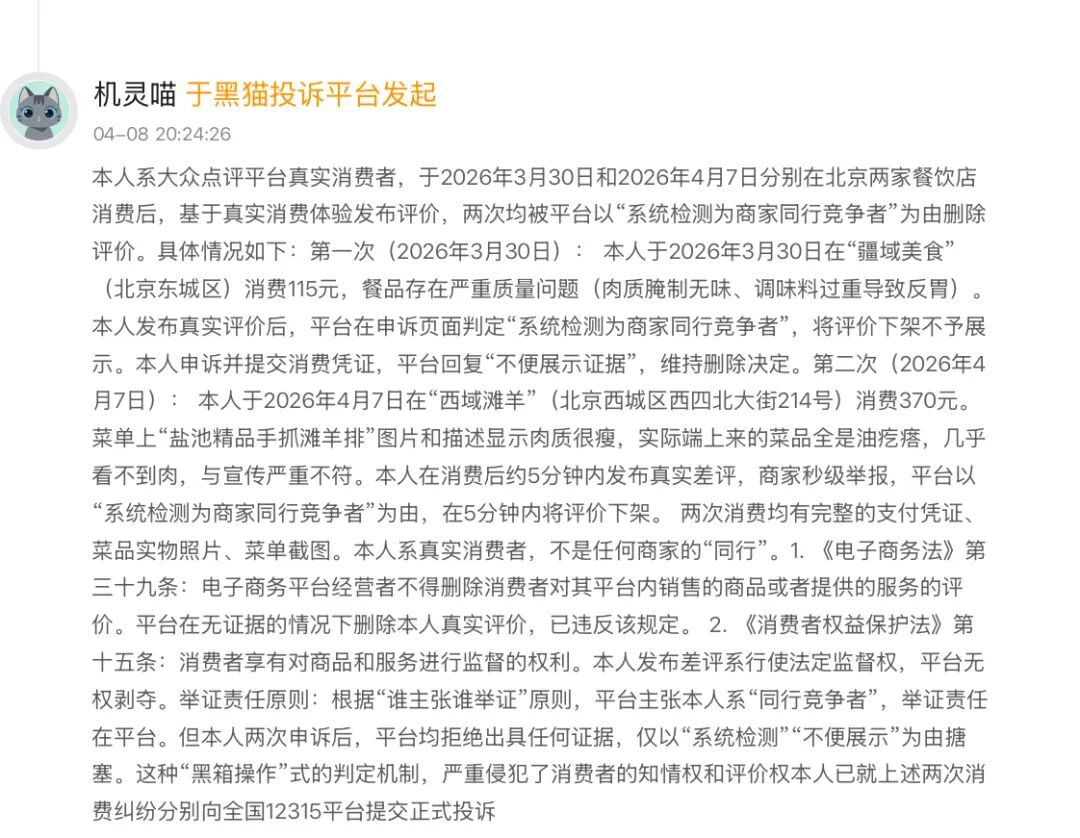
◉ On the Black Cat Complaints platform, a Dianping user complained that the platform had arbitrarily deleted their genuine review.
The bargaining power of Dianping’s V8 accounts may be being curtailed by the rules, but the game between businesses and this rating system has not become more transparent as a result.
Crying in the Kitchen for the First Time
After I understood all this, I could finally see why everyone was so tense: a single negative review could trigger a chain of problems. I was at the end of that chain, and all I could do was apologise and offer a remedy. I suggested that the manager contact the person who had written the review, tell them they were welcome to come back, and say that I would provide a complimentary meal. It was the only option I could think of, and even as I said it, I felt powerless.
For me, cooking always meant facing other people’s judgments; I had braced myself for that. The real pressure came from knowing that I was causing trouble for others. I was using a kitchen that A had run for many years. Our collaboration was short-term, so I could step away, but the trouble would be left for him and his team. Besides, a friend had chosen to work with me without even tasting my food; that was a trust I did not want to let down.
I had barely processed those feelings when, a day later, something similar happened. After several guests had finished eating, they asked staff to call me over and said the food was very bad and that they would not pay. I asked which dish had the problem—was it the sauce or the ingredients? They could not say. Although I did not quite understand how they could complain that the food was bad while finishing an entire table of it, I still tried to communicate politely and asked whether they would like the food remade. None of the guests answered the question directly.
I felt as if I were watching a play. One guest played the stern part: “I will not pay for food like this!” Another played the conciliatory part: “It’s all right, it’s all right, I’ll pay!” The other two wore impatient expressions, adding to the mood. Just as I was about to explain further, a member of staff held me back and said: “It’s all right! We’ll waive the bill! If the guests don’t like it, that’s fine—everyone has their own preferences, after all.”
In the end, the guests were offered a full waiver, and the staff and the owner present all breathed a sigh of relief: the guests had promised that, once the bill was waived, they would not publicise the incident online.
That night, I cried in the kitchen for the first time. I could not quite name the feeling—perhaps a sense of grievance and helplessness: when such a conflict arises, there is no room for normal communication. I did not blame the staff; I understood why they interrupted me, and I was very sorry to have put my friend in this position again, even though he said such things were normal in China.
Yet whether food tastes good is inherently a matter of personal taste, and different opinions are normal. Before online rating systems became so influential, no guest who disliked the food, even after finishing an entire table of it, would get their bill waived; nor would the business and its staff have to grovel so much, merely asking to waive the bill to make the trouble go away.
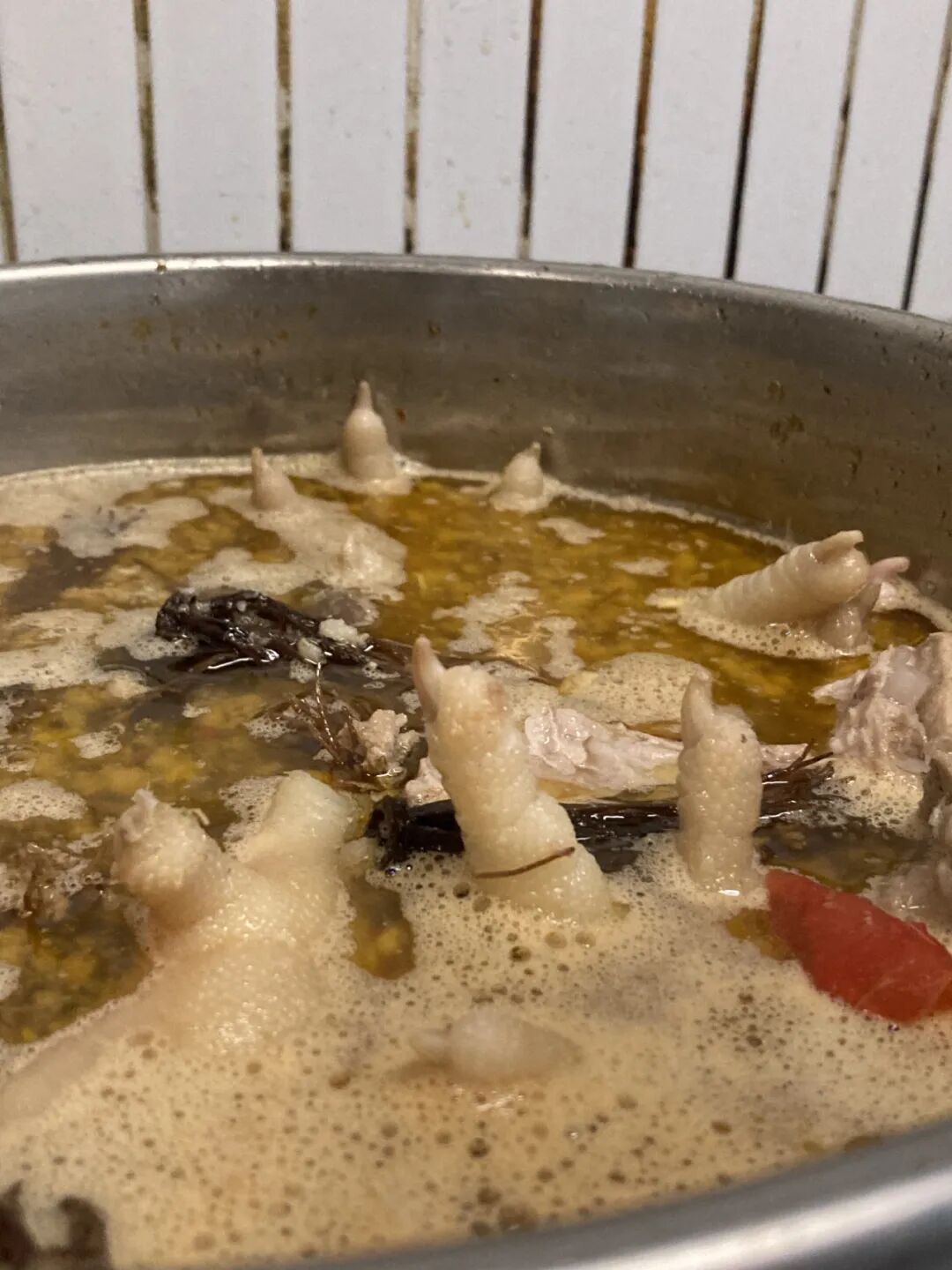
◉ While the soup was simmering, I photographed these chicken feet—deathly pale and mechanical-looking, in a way that matched my mood.
An Exception
But there are also hard-headed owners.
Another bar owner, Maizi, does not run any Dianping or social media accounts and relies solely on regulars. I was holding a pop-up dinner at Maizi’s bar. The food was all ready, but he still had not laid out chopsticks and spoons for the guests, and I could not help urging him on. He ran to the neighbouring restaurant to borrow some tableware and said with a smile, “Don’t rush. Slow is steady, and steady is fast.” The line suited his whole demeanour perfectly—there was no rush from him, and none from the guests either; the whole bar felt so laid-back that it was completely out of place in the Jing’an Temple commercial district.
Maizi’s kitchen was tiny; just two people standing in it made it feel cramped. Yet it was the most comfortable kitchen I had used in Shanghai: no one was rushing me. I thanked the guests for their patience, and they gave me the highest praise—cleaning their plates of the piping-hot food.
Maizi said that those who liked the place really liked it; those who did not would come once and never return. Many people came not just to drink, but even more to chat with him. On Dianping, his rating was only 3.8, but that did not stop regulars from coming back time after time. Some guests even had keys to the bar and would come in on their own to drink a beer and pay. For me, the biggest pleasure of coming to Maizi’s kitchen to work as a pop-up chef was, surprisingly, eating his sour soup dumplings. The chilli powder and the seaweed were both sent by his mother from back home.
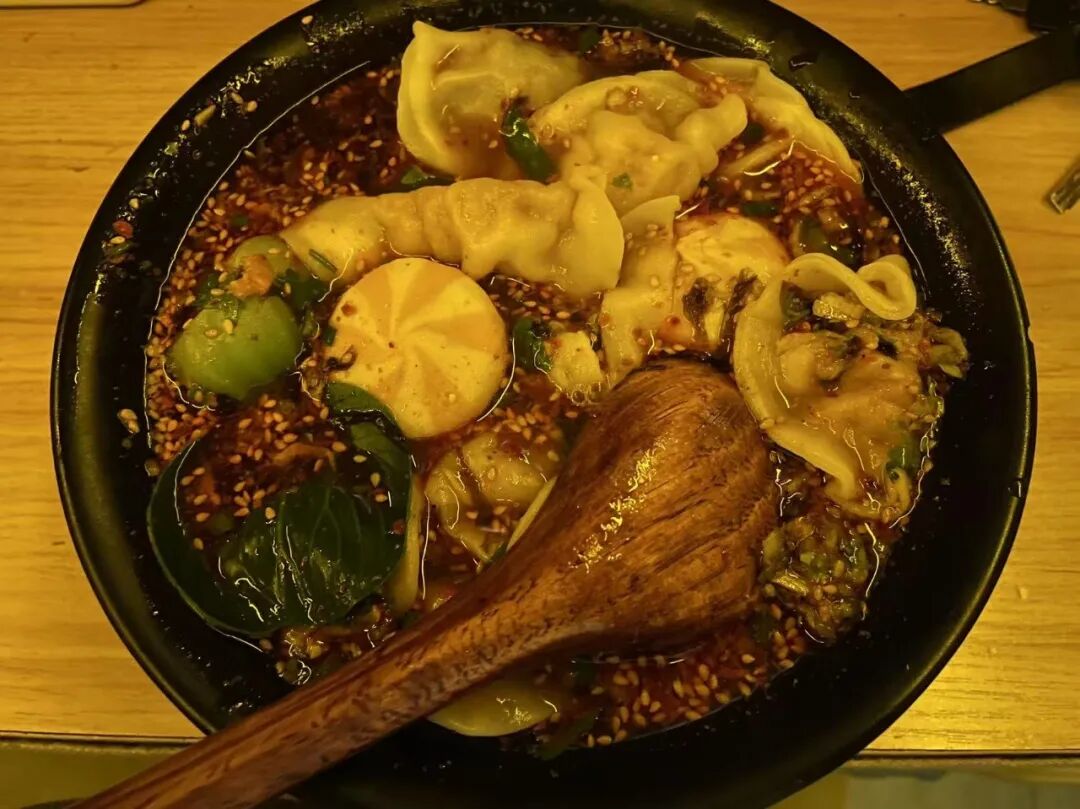
◉ Sour soup dumplings made by Maizi, a man from the northwest.
“I still think that ‘people’ are the most important element in my bar,” Maizi said to me. For eight years, he had run a bar in the bustling heart of Jing’an District, without relying on any platform for promotion or traffic. I asked Maizi what had allowed him to keep the bar going. He still replied, in a calm, understated tone, “Slow is steady, and steady is fast.”
Meeting Maizi by chance, perhaps his very presence is a reminder to me that this system has no one right way, and staying true to your original intention can also be a choice.
A Month Without Seeing the Sun
In Shanghai, I met several pop-up chefs and found that, surprisingly, the source of everyone’s stress was the same: mental exhaustion. The specifics of how it drained them varied from person to person, but the underlying logic was the same—one person shouldering every part of the operation, with no buffer zone if anything went wrong.
Procurement is the most draining part of the whole operation, so much so that now, when I go to the supermarket or the wet market, it feels as if I have stepped back into a job in procurement. Cleaning the kitchen, checking the refrigerator, writing down what needs to be restocked—none of it sounds difficult, but it takes at least an hour or two every day to plough through this tedious routine.
Herbs especially—perishable, aromatic ingredients such as Thai basil and holy basil—demand precise timing: buy them too early and they go off before they can be used, buy them too late and they may not arrive in time. Every day, I went back and forth between Taobao, Meituan Waimai, Hema, and the wet market, searching and comparing again and again. I am particular, and while keeping costs down, I try to find tomatoes with a proper tomato flavour and a good acidity, meat with the right amount of fat, Thai basil that is reliable in quality… In short, home-cooking prices, but a fine-dining conscience.
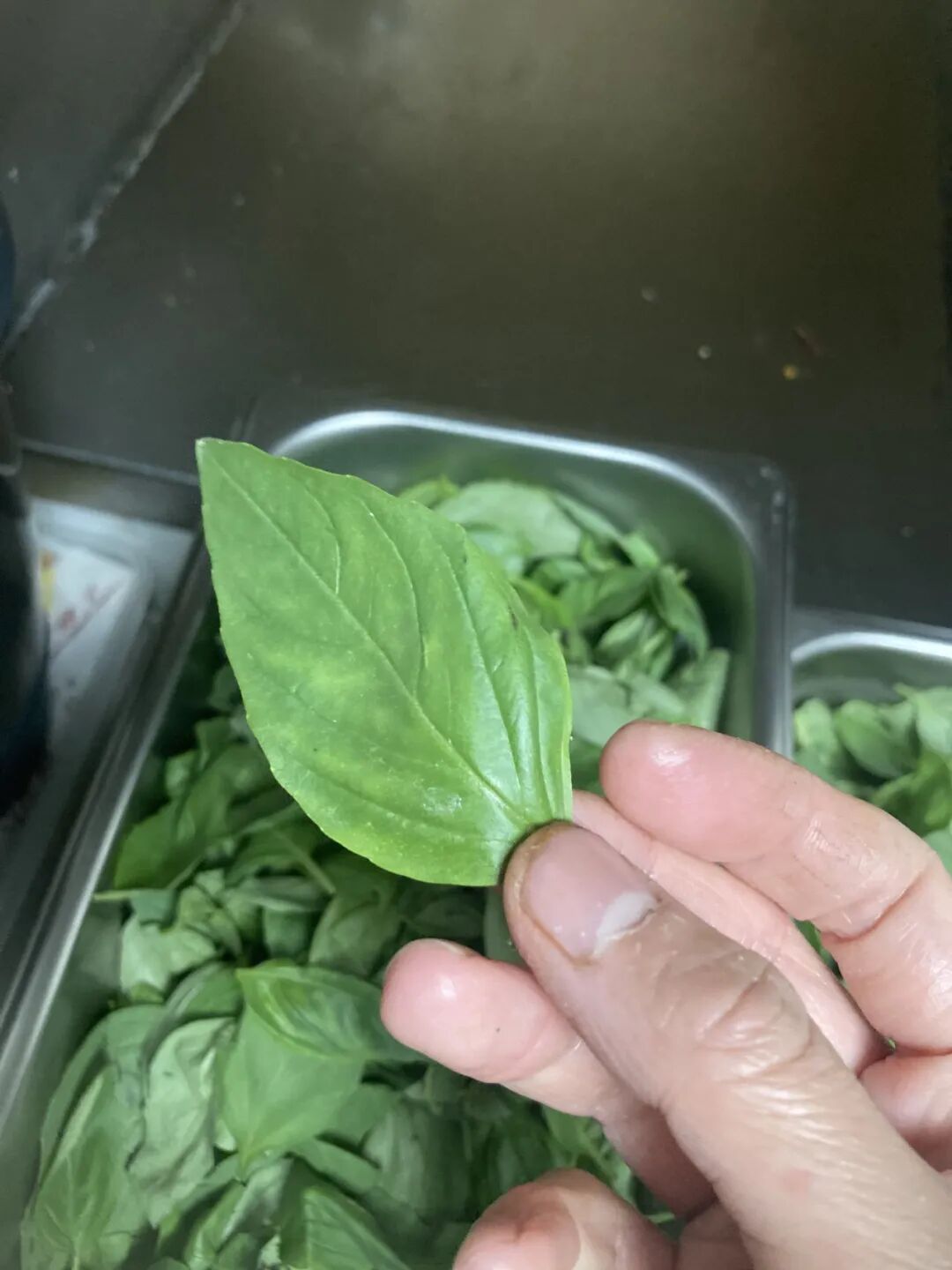
◉ Ordered Thai basil, but the shop sent holy basil. Dinner was almost on, and there was nothing for it but to grit my teeth.
So, outside the kitchen I am a purchaser, inside it a chef. Switching between the two, there is barely a moment to catch one’s breath.
I have always loved going to the wet market, picking things out with my own hands. But during that period, I actually began to dread the wet market. For example, when I was buying green chillies, I asked the seller how hot they were, and she rolled her eyes: how would I know how spicy you like it? She was right, of course, but I did not understand why she was so impatient… (though I did not leave a negative review over it).
Another time, when I was buying rice, the older woman who ran the shop stared at me after I had paid: “Is one of your hands longer than the other?” To this day, I have not worked out what she meant.
In the end, I simply switched to Hema and Dingdong: thirty-minute delivery, reasonably reliable quality, and, most importantly, it saved hassle. But relying on online shopping has its own troubles. Once, I forgot to update the address, and the order was delivered to my friend’s. I only contacted customer service to ask where it had gone, and the delivery rider promptly went over to my friend’s to check, declared the goods delivered, and then called me furiously, urging me to withdraw my complaint. I was just as confused—I had only asked where my things were, with no intention of filing a complaint. I do not know whether the misunderstanding left a record against him, and thinking about it now still leaves me uneasy.
Beyond the shopping, my whole daily rhythm was quietly warping. During the pop-up chef period, I finished work at nearly 11 p.m. to midnight every night, slept until 2 p.m., got up and washed, went into the kitchen at 4 p.m. to prep the food, and after service, the cleaning, and taking stock of the ingredients, it was the small hours again.
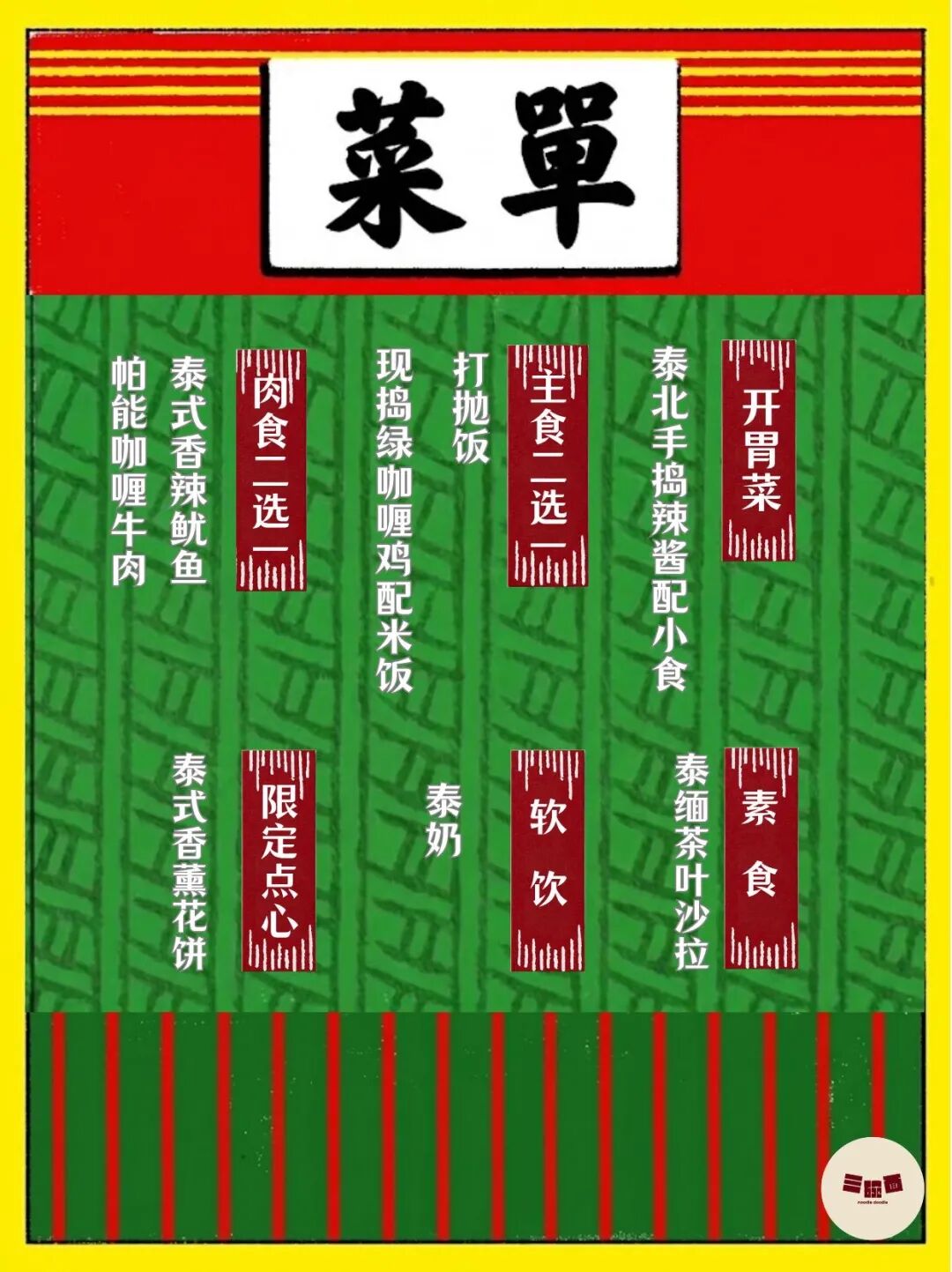

◉ When I was not shopping or cooking, there was menu design to do.
I had not properly been out in the sun for days. The bar’s regulars were in much the same boat—only getting to bed at 3–4 a.m., only getting up at 1–2 p.m., and back at work by 4–5 p.m. Exercise and daylight were luxuries. Seeing that everyone was often too busy to eat, I would often, after finishing work at 11 p.m., use the leftover ingredients to make something for everyone to eat, one of the rare moments of relaxation in the day.
What Algorithms Cannot Capture
Still, there were also moments during this month that made all that earlier exhaustion feel less crushing.
An artist who had come from Bangkok tried my cooking and said it tasted like home. A diner who had once gone to a temple specifically to learn vegetarian cooking tasted every dish on the menu at the vegetarian dinner and left me a long message, sharing their thoughts and suggestions for improvement. Compared with vague positive reviews, this kind of feedback made me feel that the work was meaningful. When another diner made a return visit, they sat at the bar for a long time and quietly helped me design a handwritten menu…
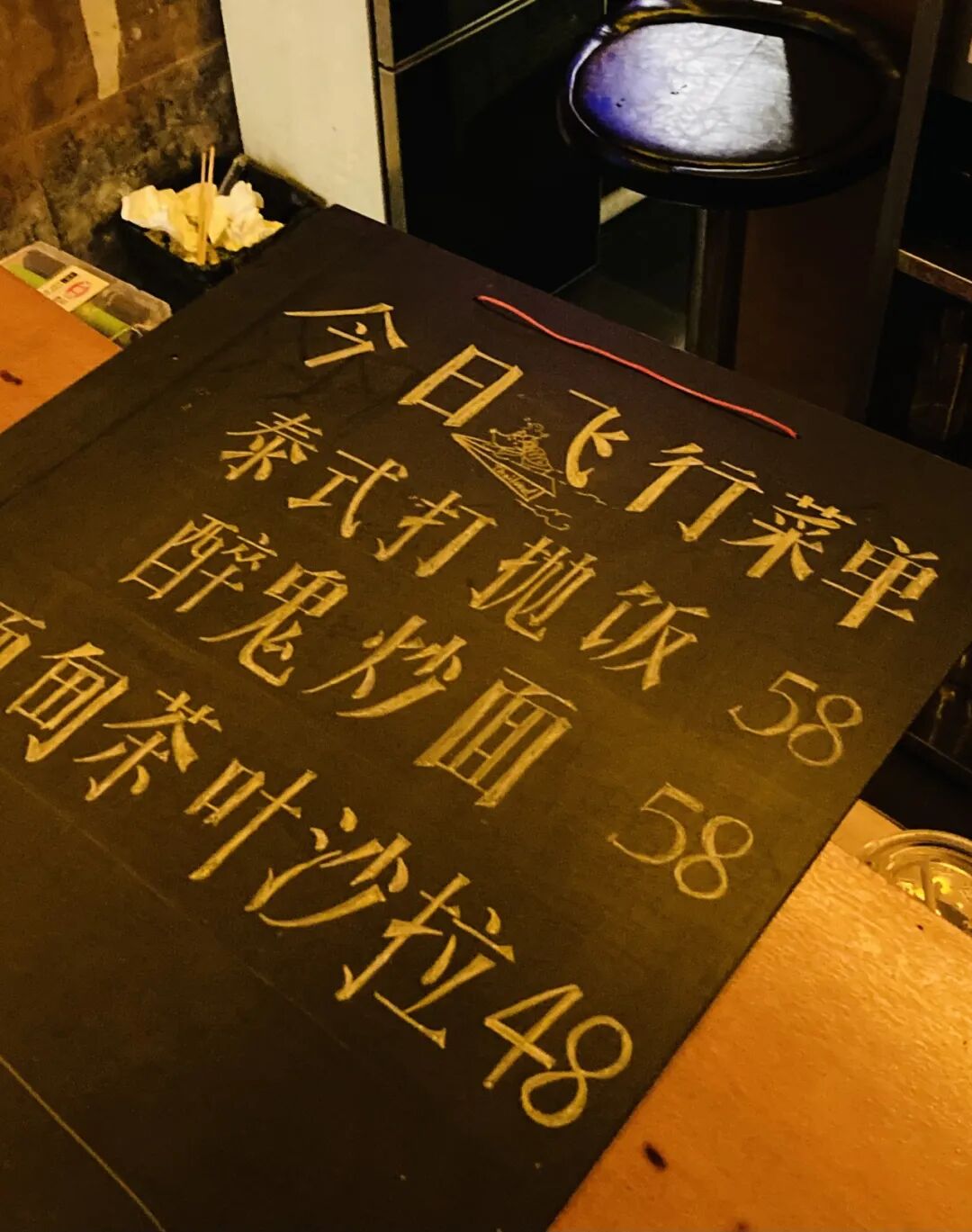
◉ A handwritten menu created with a customer’s help.
The most unexpected reward was sourcing the rice. Since I could not find suitable Thai fragrant rice in China, I felt the flavour of the dishes was still slightly lacking. A supplier who sells Yunnan rice from a small production area contacted me and sent some rice of her own accord. The scent of the steamed rice brought to mind the fresh, steaming aroma of rice in a narrow Thai alley, and made me realise that, for the next event, I should design the menu with more local ingredients. The supplier was a very lovely woman, and she said that seeing the dishes I had made whetted her appetite, so she thought they needed to be paired with delicious rice. Perhaps this way of thinking comes from a belief we share about food, as she put it: “Only by getting closer to food do we get closer to people.”
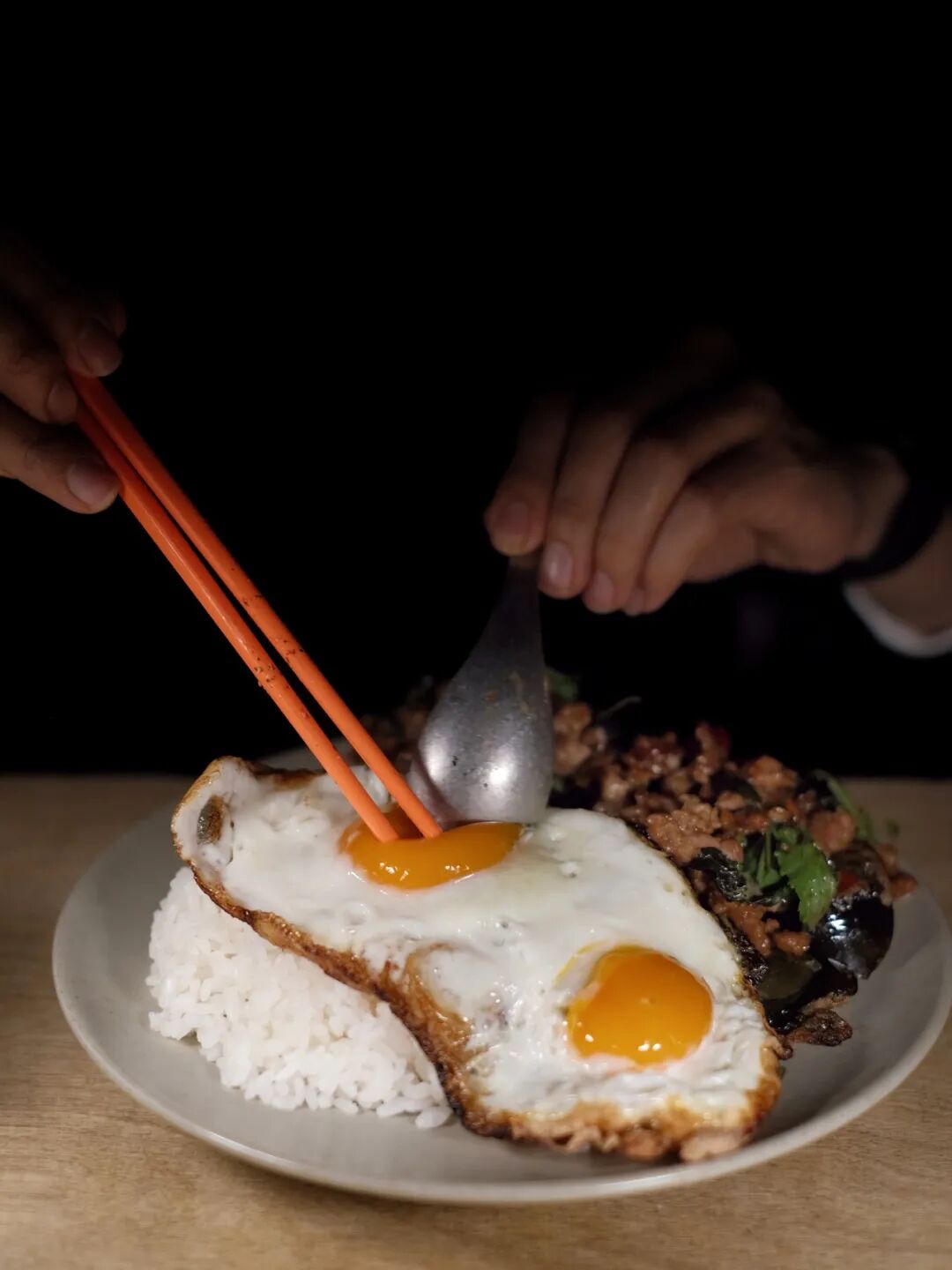
◉ Repeat diners who kept coming back photographed the food I made.
It was only after eating rice that was so fragrant, soft, glossy and full of rice aroma that I came to understand how germ rice, high-quality single rice varieties, soil and water influence the mouthfeel of the rice and diners’ physical health.
These moments that moved me were not calculated by an algorithm, nor would they be counted in any rating system.
From Dianping to Meituan, the rating mechanisms and the grey areas behind them seem to be an issue that people in the food and drink industry can never escape. During this month, I too have had a brief taste of what it feels like for food and drink workers in China to have their throats gripped by these apps. Every time I find myself trapped by these outside voices, I think of Maizi, the owner who has run a bar for eight years without operating any platform, saying slowly: “Slow is steady, and steady is fast.”
Perhaps this system is not quite so impervious as it looks; it is simply that most of those in it, myself included, have not managed to be as at ease as he is. But I still choose to believe that what carries us further along the road of working with food is not the “optimal solution” pushed by algorithmic recommendations, but the moments of savouring food and talking with real people.
– This is Foodthink’s No. 823 original article –

Foodthink
Author
Renso
A Southeast Asian Sanhe da shen, when it comes to anything I have not tried, full of
curiosity
All images provided by the author
Editor: Tianle
Layout: Minglin
Scan to tip and support original food content
▼

▼
Click the image to read related articles

▼
Click the keywords to explore more article collections
Seeds|Agricultural Technology|Policy|Fermentation|Nutrition|Fruit|Fisheries|Events|Jobs|Takeaway|Wet Market|Livestock|Food Talk|Sharing Sessions|Book Club|Harvest Festival|Smallholder Stories|Climate Change|Rural Development|Cooperative Economy|Urban Farmers|Food Safety|Digital Technology|Biodiversity|Pandemic and Food|False Solutions|Ecological Farming Internship Programme
Beijing | Hebei | Shanghai | Guangdong | Guangxi | Henan | Sichuan | Jiangxi | Xinjiang | Shaanxi | Hong Kong | Chongqing | Zhejiang | Jiangsu | Guizhou | Taiwan | Inner Mongolia | Philippines | Canada | Russia | Mexico | Italy | United States | United Kingdom | Germany | Netherlands | Thailand | Sweden | Japan