
Elderly Sugarcane Farmers Face a Glut: Can’t Sell, Yet Must Plant
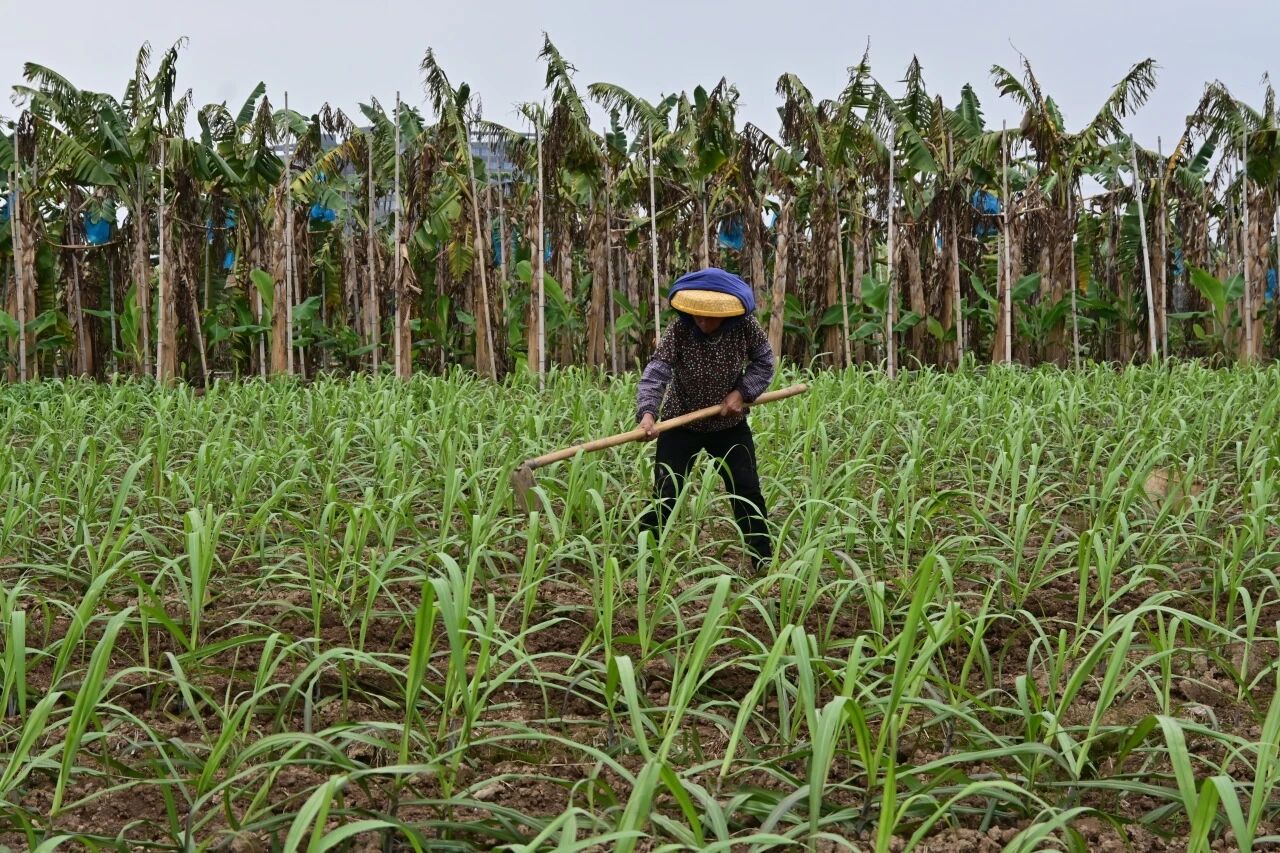
At around 7 a.m., 65-year-old Sister Zhen arrived at the sugarcane field. She clipped her badly scratched phone to the sugarcane, connected to the neighbour’s Wi-Fi, and opened Douyin. She murmured the steps to herself: “Tap the plus, swipe left, go live.” The camera pointed forward. In the centre of the frame, two pieces of cardboard hung from the sugarcane, reading: “Sugarcane, 1–2 yuan per stalk – Shunhe Village, Lanhe Town – The streamer is an elderly person.” This was a skill her son had taught her only a week earlier. Livestreaming like this for a whole day – no face on camera, no voice needed – she could attract kind-hearted visitors to help her sell the unsold sugarcane.

In late March, in Nansha, Guangzhou, the spring rains came and went, the air growing muggier by the day, thick with the sweet scent of decaying sugarcane leaves. Dense stands of black-skin sugarcane stood like needles thrust into the fields, piercing the heart. Fearing they would miss the spring planting, farmers gave their sugarcane to buyers for free, hoping only to have it harvested quickly. Each mu of sugarcane cleared for nothing meant a loss of over 6,000 yuan.
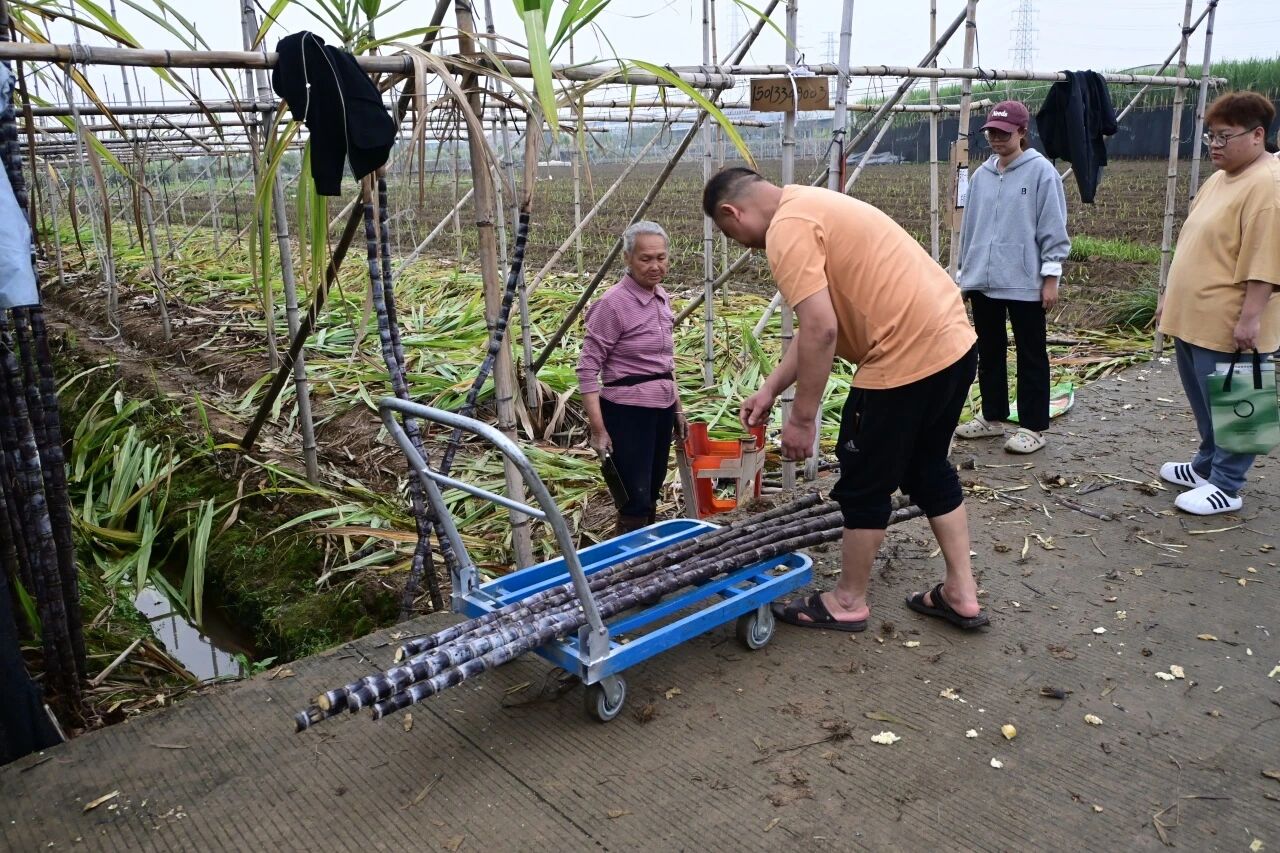
Most local sugarcane farmers are over fifty. Many households like Sister Zhen’s, helpless against the unsold crop, could only hang signs at the edges of the fields and at road junctions reading “One yuan a stalk – sugarcane to help farmers”, then wait by the roadside. News of the unsold sugarcane in Nansha attracted plenty of visitors eager to buy and cut their own canes; at 1–2 yuan a stalk, an acre could bring in around 3,000 yuan, letting farmers recover nearly half their costs.
Many other sugarcane farmers spent each day cutting cane, starting at 6 a.m. and working until dark, hefting over 100 jin of sugarcane on their ageing bodies, shifting 4,000 jin in a single day for just over 400 yuan. Only after more than two weeks of non-stop labour could they begin to offset the loss on a single acre.
And on the land where spring planting had already begun, tender green sugarcane leaves had once again sprouted across the fields. “What else could we plant?” The elderly had no other choice. “This year, we’ll take another chance.”
I. Sugarcane Farmers Forced into Street Trading
But this year’s market caught everyone off guard. After the last few cold snaps of 2025, Nansha’s black-skin sugarcane entered its prime eating season, yet few growers had actually started harvesting. She waited from the Gregorian New Year all the way through the Lunar New Year – two holidays came and went, and no buyer once asked the price. How was the market doing? Sister Zhen had no idea. Most sugarcane farmers are elderly and rely mainly on word of mouth among acquaintances for information. They have no sales channels either – all they can do is wait. But even by March, much of the sugarcane still had no takers.
Sister Zhen normally takes vegetables from her plot to nearby markets on her tricycle to sell. She has a battered tricycle, its seat half-worn through. From December last year, she began cutting the thinner, smaller sugarcane and hauling it around Nansha and Shunde to peddle on the street. Her face is darkened by years of sun, she wears loose trousers, her legs won’t quite close together, and she sways from side to side as she walks. When city inspectors gave her trouble, she didn’t dare argue. Sometimes her scales and cane were confiscated, but she didn’t go to get them back, afraid of being fined. Sugarcane can be sold by the stalk – no scales needed. If the day goes well, she can make just over a hundred yuan. But a single mu yields more than 2,500 stalks. Without any buyers, no amount of street vending can shift the whole crop.
Sister Zhen has a son and a daughter. Her son and daughter-in-law work and look after their child in Tanzhou, Zhongshan. Her daughter suffers from a mental illness and has no job. At 20 yuan a dan, the elderly couple would not only see a whole year’s labour go to waste but face a loss of over 10,000 yuan. They live on very little. The clothes she wears were given by a friend; her shoes were bought on Pinduoduo, eight yuan a pair, and she bought two pairs. The ones on her feet already have a hole, with both big toes poking through. The other pair, worn for half a year, is completely worn flat at the heel – and she hasn’t thrown it away. If she accepted that price, relying solely on their pension of six or seven hundred yuan a month, they couldn’t even pay off last year’s credit for pesticides and fertiliser. She turned down the only sugarcane broker who had offered a price this year.
II. No One Even Bothered to Ask the Price
Chen Shun wanted to wait until the cane grew on a little more, hoping for a higher price. By the New Year he was growing uneasy. He called in a sugarcane broker he knew and sold those two mu at 70 yuan per dan. Two years ago, the same black-skin sugarcane would have fetched over 100 yuan a dan. Half a month later, another mu went at 60 yuan. Over the Spring Festival period, seven mu were sold in batches at 40 yuan per dan. After deducting the 1,500 yuan per mu in land rent, labour and other costs, that price barely covered his expenses.
After the Spring Festival last year, the price of black-skin sugarcane had risen considerably. But this year, the prices quoted by sugarcane brokers slid from 40 yuan down to 5 yuan per dan – and for cane in poorer condition, no one would even take it for free. Chen Shun’s remaining seven mu still hadn’t sold by March.
“Entire fields of sugarcane with no chance even to be offered for sale.” A village official in Yansha Village, Lanhe Town, reported that in late March, households in the village had registered over 500 mu of unsold sugarcane, more than 400 mu of it black-skin. Villager Chen Jiao, over sixty, has over ten mu of black-skin sugarcane. Her husband passed away years ago; her children help out in the fields on weekends when they aren’t working. The land needs rent, and during peak periods, hired labour is essential – the cost per mu exceeds 7,000 yuan. Last year, when the market was good, a year’s hard work could earn 100,000 yuan. But this season, her sugarcane had no buyers. “No one has even come to ask the price.”
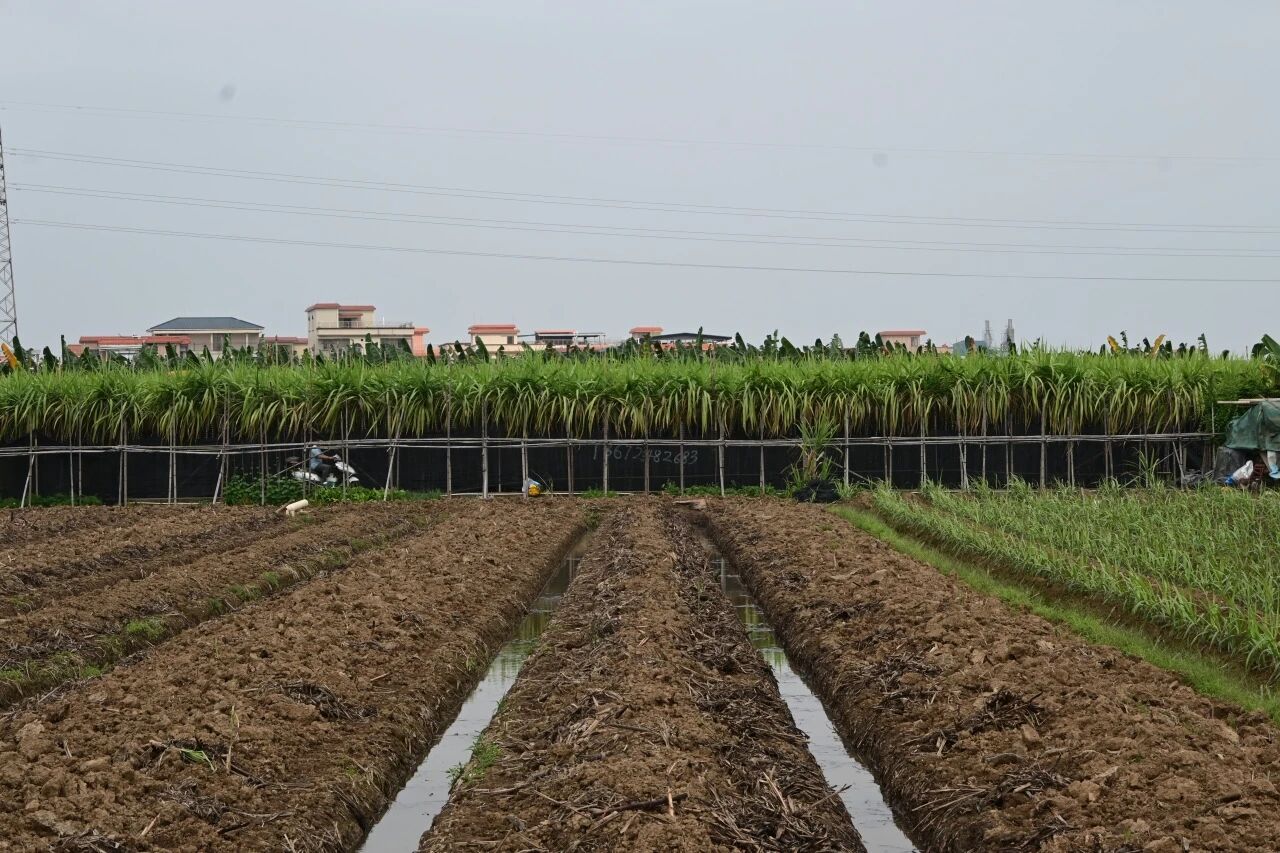
In Nansha, every sugarcane plot is wrapped in black screen cloth. Typically, after the sixth month of the lunar calendar, once the cane has grown tall and the sun grows fierce, the stalks need shading to prevent the skin from reddening. Well-presented black-skin sugarcane has a deep, glossy black skin. Farmers also write their phone numbers on the screen cloth. After the Mid-Autumn Festival, if a sugarcane broker or a buyer takes a fancy to a particular plot, they will ring ahead – some even place advance orders. Once a plot of cane has been booked, the farmer writes “Sold” on the screen.
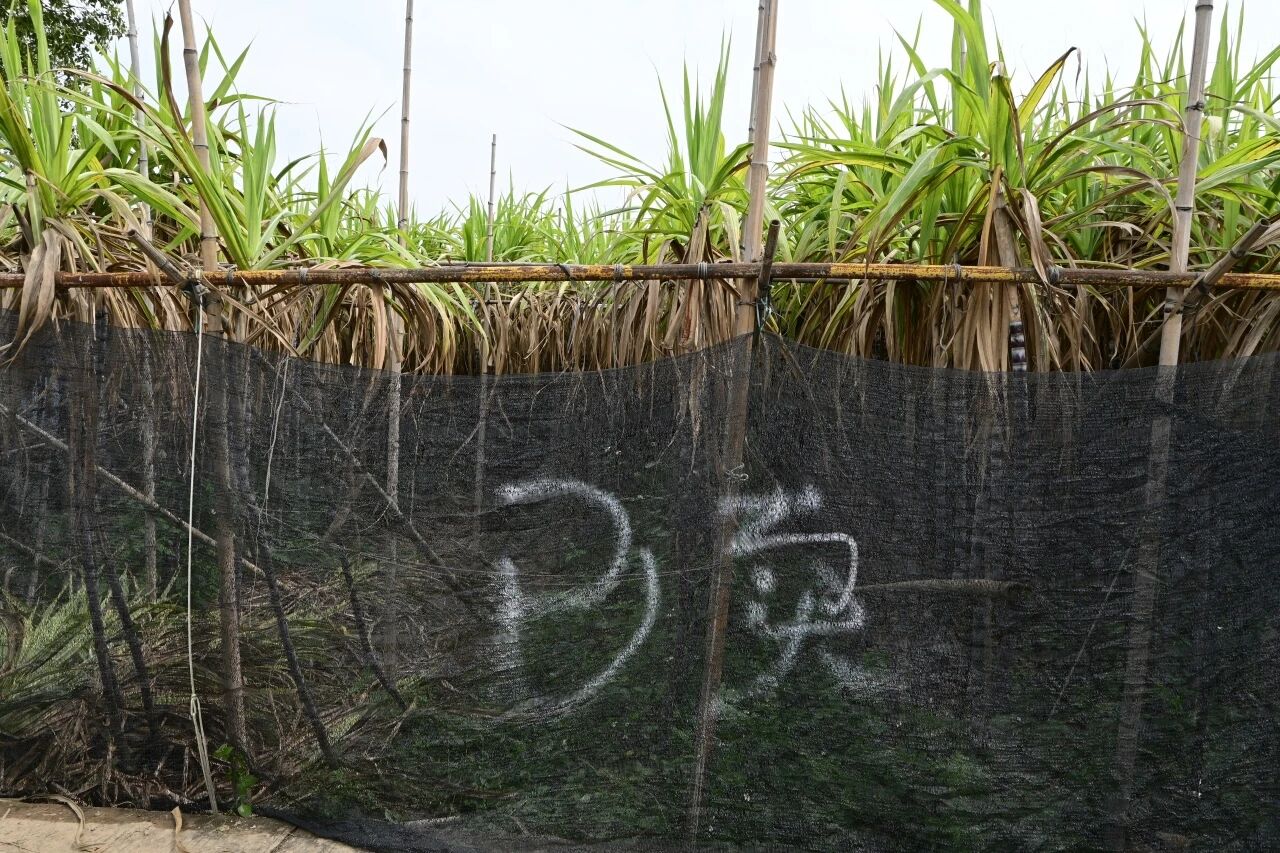
Chen Jiao, too, had written her number on the screen early on, but to this day no one has contacted her about a purchase. The growing cycle of eating cane in Nansha is roughly a year. For local sugarcane farmers, “spring planting” actually begins the previous winter. To get a new crop of black-skin sugarcane mature by year’s end, March is the absolute deadline. To avoid missing the planting window, Chen Jiao gave her earliest-planted, soon-to-be-out-of-season cane to the sugarcane brokers at a rock-bottom price – even for free – pressing them to cut it down as soon as possible. “Any later, and I won’t be able to plant at all.”
There is a local saying: “Sugarcane at Qingming is more poisonous than a snake.” As the Qingming period approaches, rising temperatures and humidity make poorly stored sugarcane prone to mould and reddening, which can produce a neurotoxin called 3-nitropropionic acid.
“The quality of out-of-season black-skin sugarcane declines,” the village official explained. Yellow-skin sugarcane can be sold all year round; the urgency is mainly with black-skin cane. In response, government offices, schools, hospitals and other public institutions, along with well-meaning members of the public, have joined the effort to help the farmers. But judging by village officials’ feedback, these efforts are largely drops in the ocean – far less effective than commercial buyers: a single truckload from a sugarcane broker can take away 35 tonnes from four mu, whereas a thousand visitors may not get through a single mu. On top of that, the local government has introduced a sugarcane-collection subsidy: for every mu harvested by a sugarcane broker or another farmer, a reward of several hundred yuan is paid out, with the scheme running until 5 April.
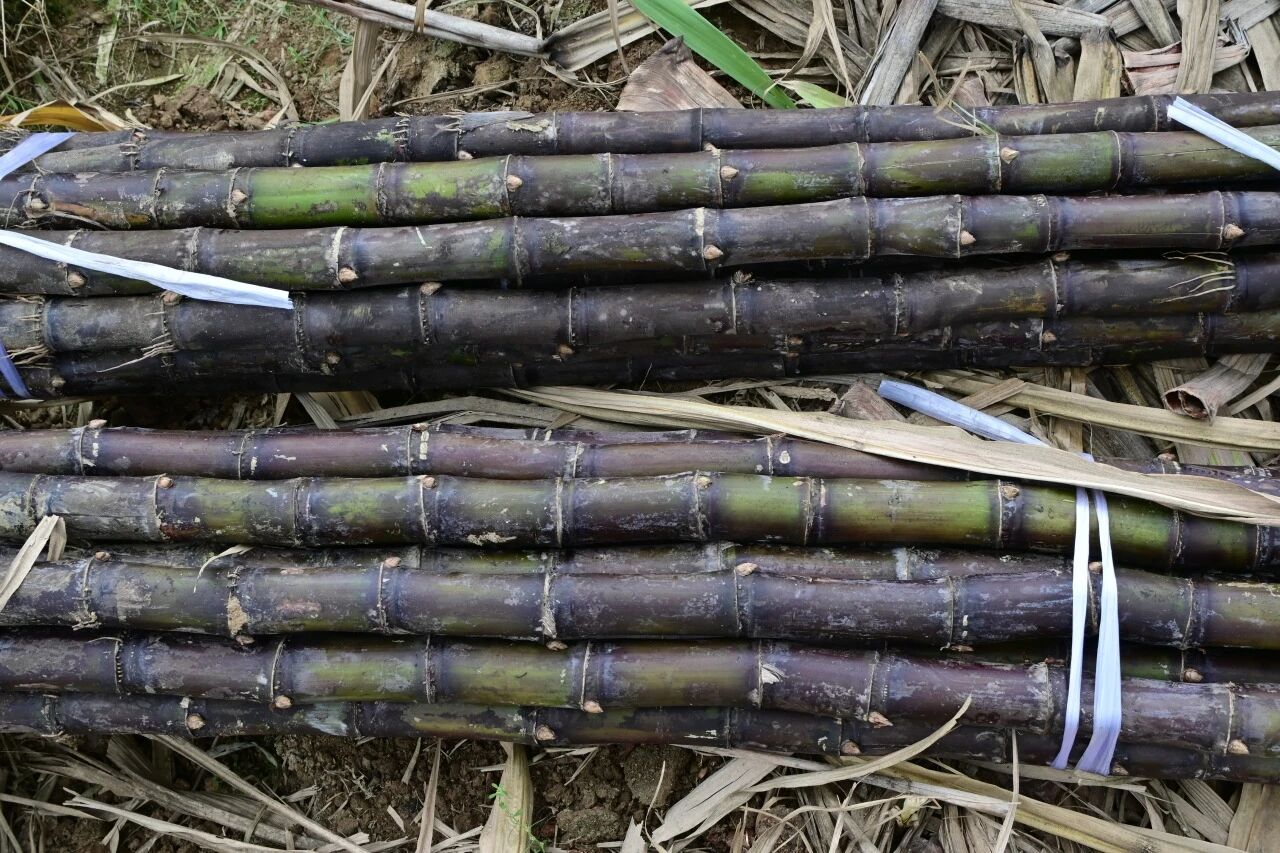
To clear the land as quickly as possible, Chen Shun had five mu cleared by mid-March at just 1,000 yuan per mu. “If I end up clearing it myself, I’ll still have to pay for the labour.” With two mu left, his wife, Auntie Huang, stands by the field every day, calling visitors over to buy. The price started at 2 yuan a stalk – now it’s down to 1 yuan.
Auntie Huang previously worked at a frozen-meat processing plant. In 2025, her 50th birthday arrived alongside the factory’s dismissal notice. “Once the age on your ID card hits fifty, the factory lets you go.” She lost her income, and her youngest daughter had just entered senior high school – into the “advanced class”. Anxiety drove her to become a sugarcane farmer.
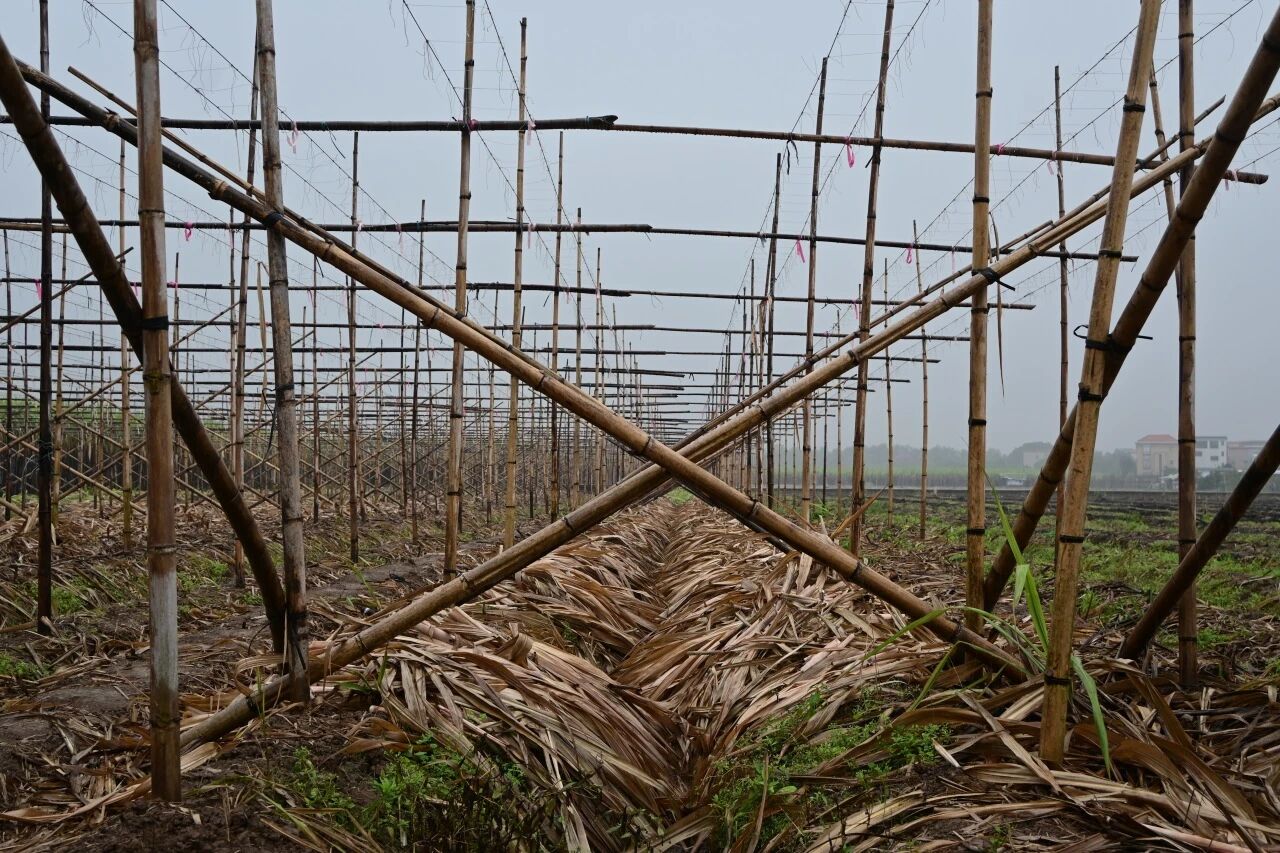
After a year of working the cane and the land, she offered her assessment: “Growing sugarcane is exhausting at every stage.” Beyond plastic film mulching, earthing up, and frequent applications of fertiliser and pesticide, growing eating cane also requires erecting and raising trellis frames.
If sugar cane grows at an angle, it doesn’t affect the milling. But eating cane has to grow straight and evenly thick to fetch a good price. So around the fifth month of the lunar calendar, when typhoon season begins in earnest and the cane has reached a metre tall, farmers need to set up bamboo frames across the field.
They thrust poles as thick as a bowl’s width half a metre into the ground, prop them with angled poles for support, and lash thinner bamboo poles across the top. Finally, ropes are strung. Two thick ropes run along each row of sugarcane, corralling the stalks; thinner ropes divide the space into square sections, each one enclosing two canes, drawing them upward and straight to keep them from toppling in the wind. As the cane grows taller, the bottom five leaves on each stalk are stripped away, and the topmost bamboo frame and netting are hoisted a little higher. Black-skin sugarcane can reach four metres in height, requiring the trellis netting to be raised roughly six times.
III. Even the Cane-Cutters Are Elderly
In past years, cane cutters had started taking work after the Mid-Autumn Festival. Cutting begins before 6 a.m. each day; most cutters must rise at four or five in the morning. Every cane-cutting team has a foreman who liaises with the sugarcane broker on location, quantity and price. The brokers, in turn, build long-term working relationships with the teams through these foremen.
A team numbers around a dozen, with specialised roles during cutting. The leading workers each take a row: they sever the cane’s base with a spade, lever the stalk from the earth, then scrape away the root fibres. The digging spade is custom-made, about a metre long, with a narrow, elongated blade whose edge is flat and sharp. The dug-up cane is generally propped back lightly into the ground – the trellis netting is still up, with ropes supporting the tops, so the stalks won’t topple.
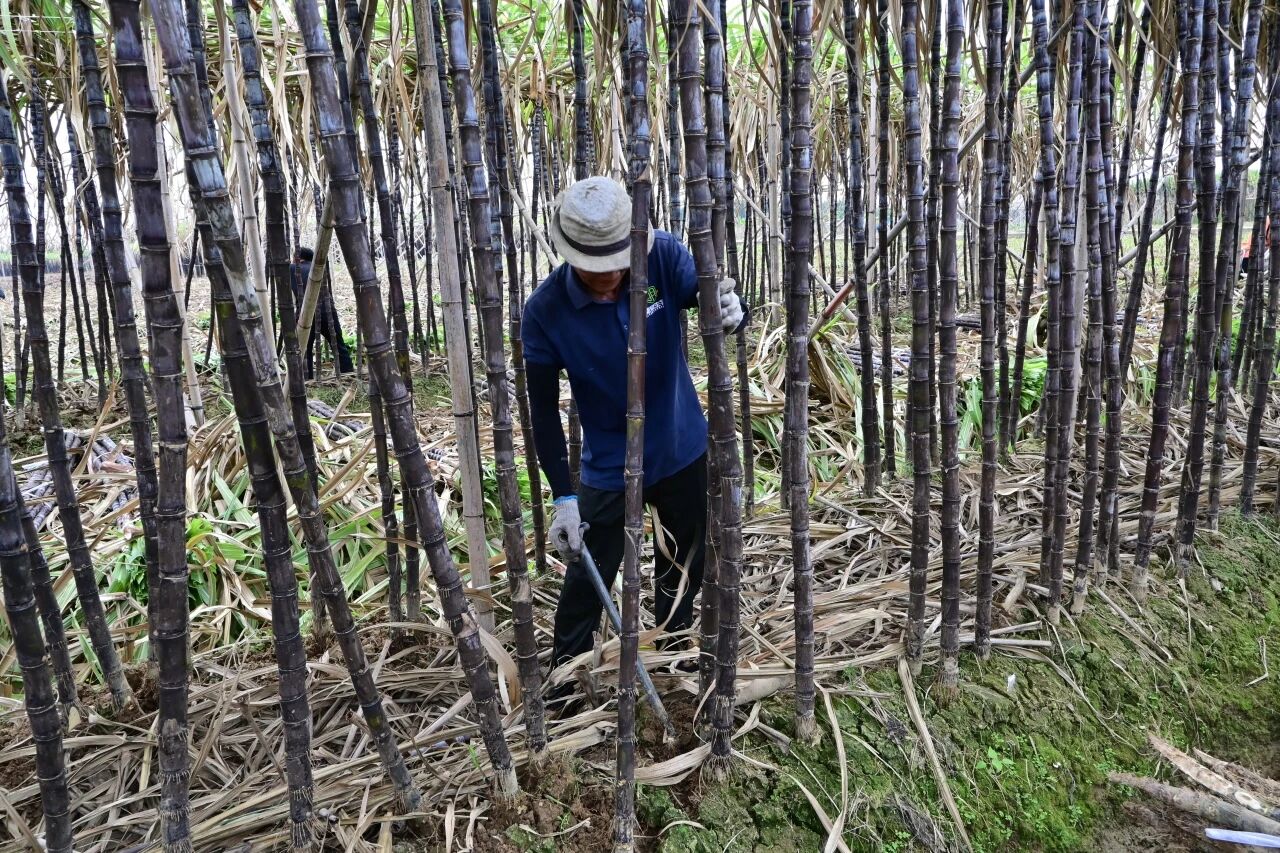
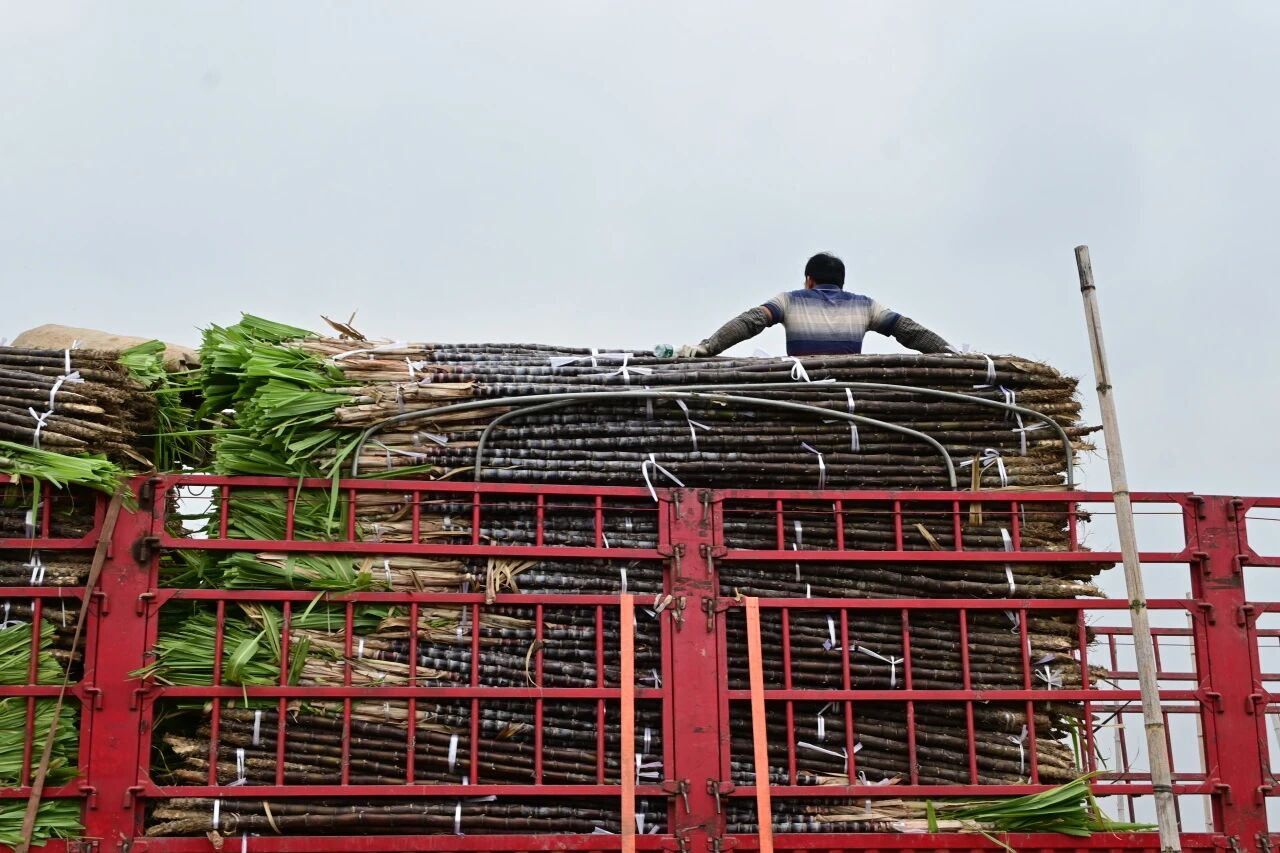
Once the cane is up, the whole team swings into an assembly-line rhythm. One group pulls the trimmed stalks free and strips the leaves from either side of the top. Another group turns iron stools upside down and lays the canes one by one into the troughs formed between the legs. Twelve to fourteen stalks make a bundle, each weighing over 100 jin. The canes are stacked and tied at four points for stability; finally, half the tail leaves are hacked off. This is “tail-on” cane – it keeps better and withstands long-distance transport.
Sugarcane leaves cut skin. Farmers who dress lightly to beat the heat end up with scratch marks running down their hands and necks. The marks are shallow, no blood, but they swell and redden. Sun, grit, dirt and sweat set them stinging fiercely.
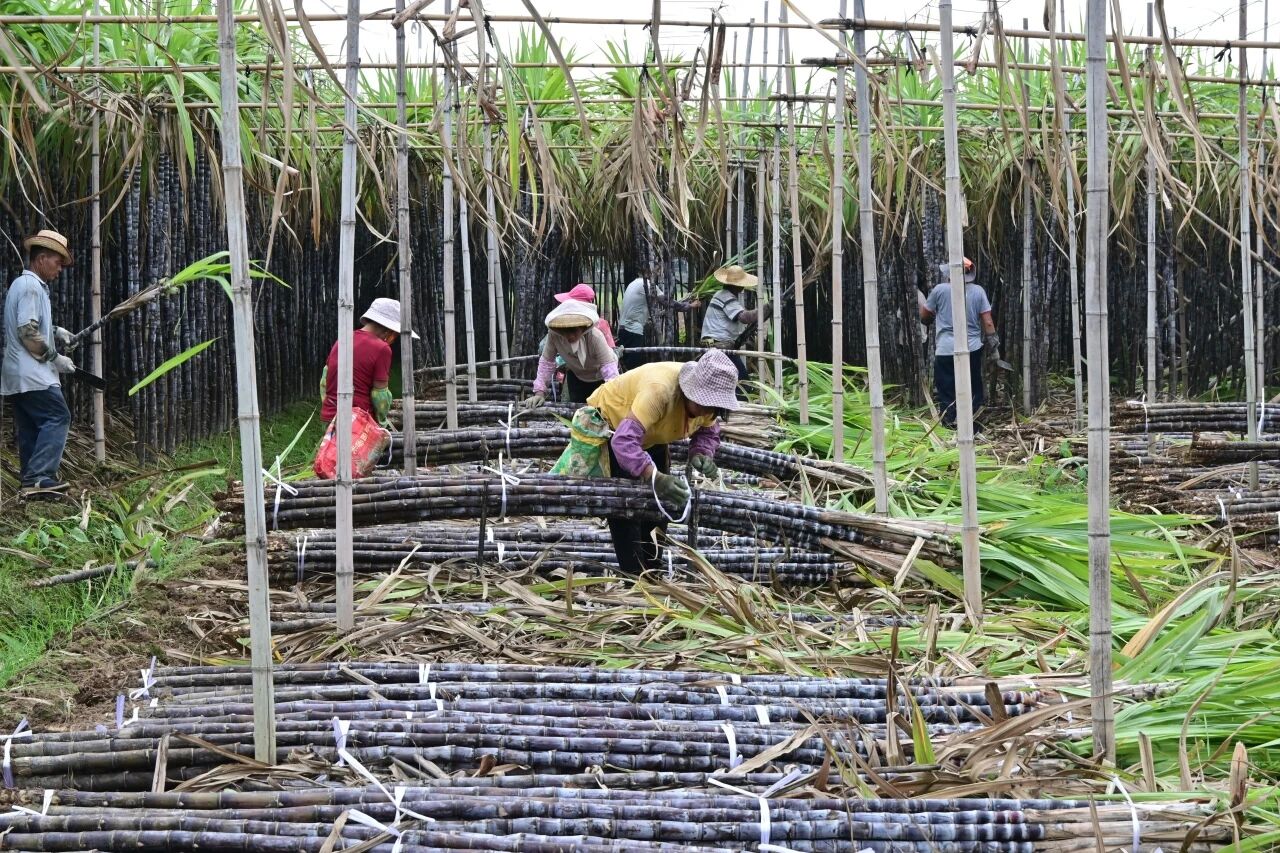
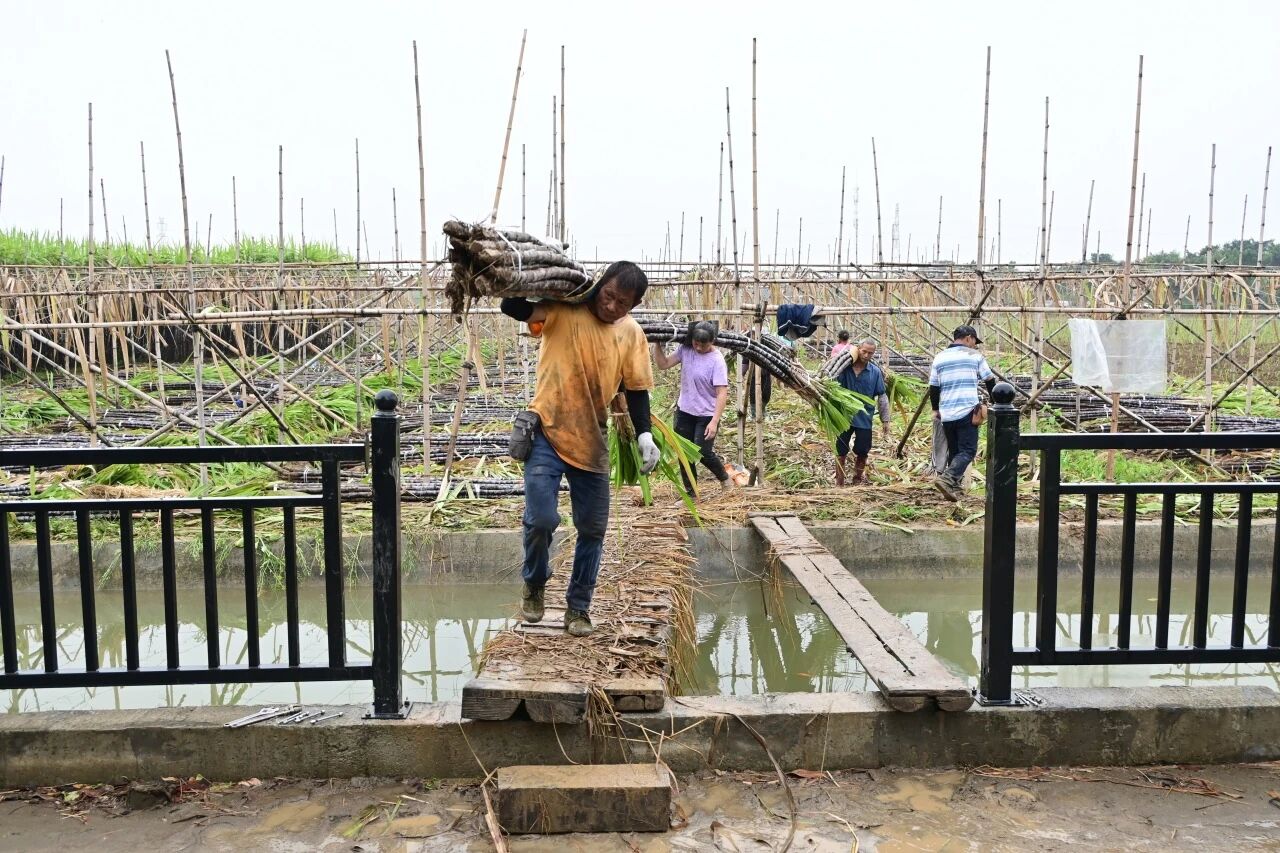
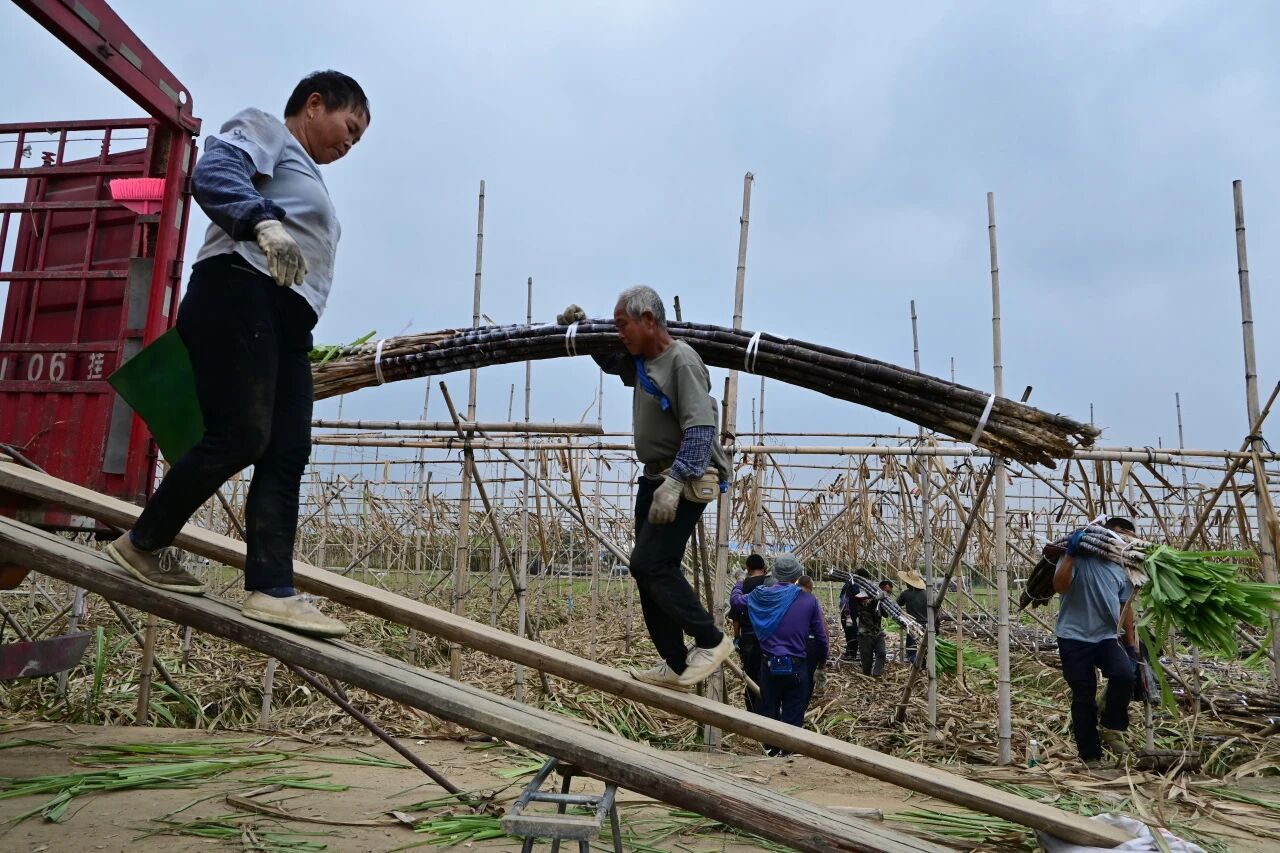
The hardest part is loading bundle after bundle onto the truck. Each bundle is too heavy for one person: two lift from either end while a third ducks his head and takes the middle across his shoulders. Cane is rigid and digs into the shoulder with raw pain if placed bare. Farmers pad the load with a bundle of cloth, a folded woven polypropylene sack, or a torn piece of cardboard.
The fields are pitted and uneven, demanding careful footing. Plank ramps bridge the gaps from field to road edge, and from road to truck bed. Crossing the plank is the most punishing stretch: the long canes press down on an ageing body until every face is set in strain.
On 24 March, in Shajiao Village, Lanhe Town, a sugarcane broker hired seventeen cane cutters to clear roughly four mu. A buyer from Anhui purchased all four mu at 15 yuan per dan; on top of that, the buyer must pay the sugarcane broker 1.1 yuan per dan and the cane cutters 11 yuan per dan. Uncle Wang, at forty-seven, is the youngest on the team. Their average age is over fifty-five; the eldest is seventy-two. Uncle Wang says that almost every year a cane cutter collapses at the field’s edge. Long hours, backbreaking intensity and scorching heat can all prove fatal.
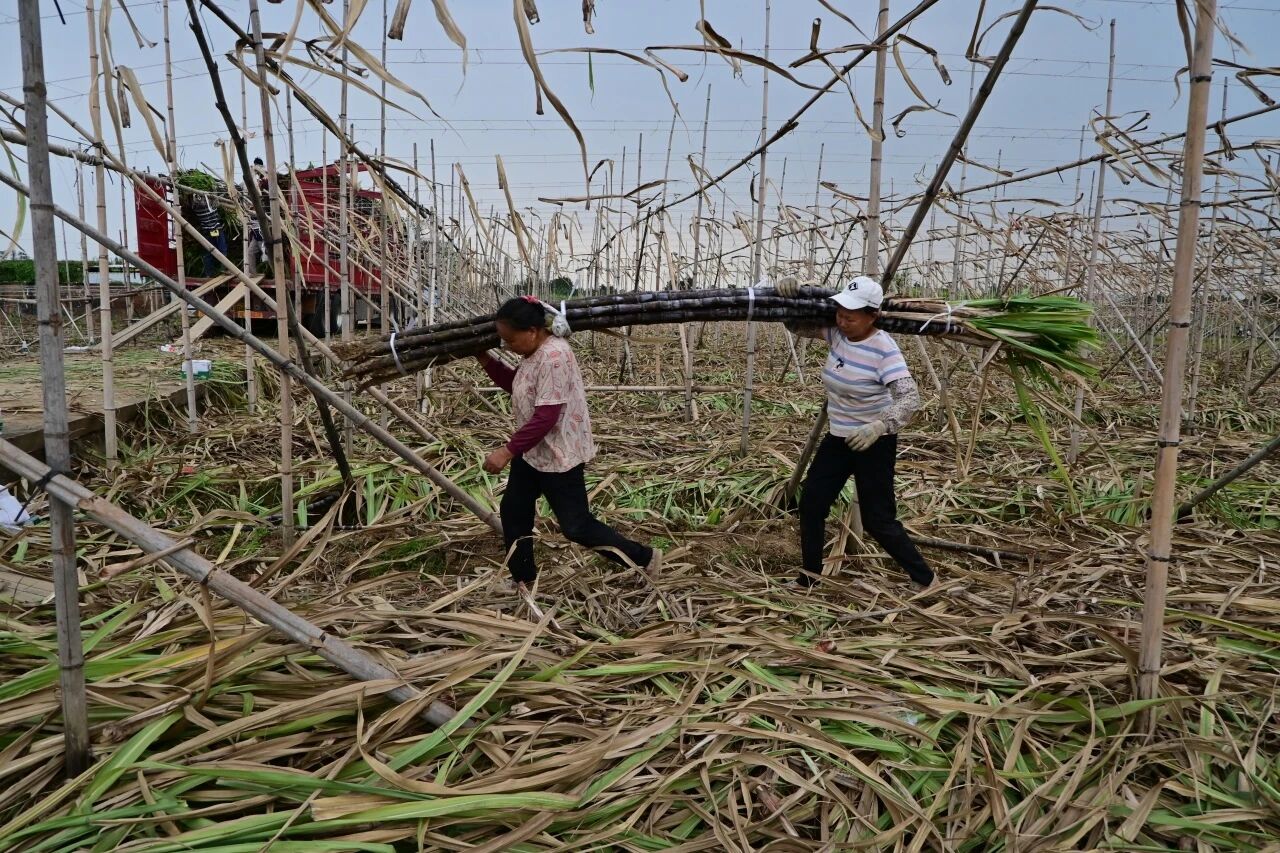
Rain is the most dangerous. Once work has begun, if rain falls mid-shift, the sugarcane broker will not agree to stop – delivery must be made on schedule. The fields turn to mud, the roads go slick, and even the plank ramps, soaked through, demand extra care.
A few years ago, Uncle Wang’s elder brother slipped off a plank ramp while loading a truck, shattering three toes on his right foot. Medical bills ran to 40,000 yuan, and he can no longer do heavy labour. It took Uncle Wang pushing him to confront the sugarcane broker before they secured 20,000 yuan in compensation. With steel pins now permanently fixed in his bones, his brother once asked Uncle Wang anxiously: “With these pins, can I never fly in a plane again?”
The cane cutters sort out their own lunch, usually heading together to a street-food stall and splitting the bill. The women sit together drinking tea; the men sit together drinking Jiujiang Double Distilled – a rice-scented spirit below 30 per cent ABV. Four liang down the throat, the furrowed brows ease, and the weariness seems to lift.
Finishing time varies with the day’s quota. At the earliest they knock off before dark; at the latest, eight in the evening or later. On Uncle Wang’s day, the quota was 35 tonnes and they can call it quits by six in the evening. After a full day, the sugarcane broker pockets 770 yuan while each cane cutter takes home 450 yuan. Apart from selling their own sugarcane, this is the most important income they earn all year.
IV. The Inertia of 30 Years of Continuous Cropping
A village official in Shangni Village explained that in past years, the village’s cutters were extremely busy over the Spring Festival, but this year most of them stayed home, idle. The village had little sugarcane to begin with; plenty of pre-booked crops still sat unharvested, and some buyers even demanded price cuts – a few would rather pay the cancellation penalty than collect their order.
The main reason for this year’s eating-cane glut is overcapacity. Last year saw a marked expansion in plantings and output across Yunnan, Guangxi, Fujian, and Qingyuan, Zengcheng and Shaoguan in Guangdong. Several village officials pointed out that eating cane from Yunnan and other regions was of better quality, and this year the market favoured yellow-skin sugarcane – whereas Nansha grows mainly black-skin. In fierce competition, Nansha’s eating cane fell behind.
Sister Zhen recalls that since marrying into the village forty years ago, she has grown rice on this land for only about ten years. Since then it has been black-skin sugarcane and bananas, season after season. The elderly couple have barely over four mu; growing rice or vegetables brings in far less than bananas or cane.
“When the market is good, a single mu of bananas or sugarcane can yield over 10,000 yuan in profit a year,” says a village official from Lü Village in Lanhe Town. The village has a population of over 2,000 and just over 1,500 mu of arable land – less than one mu per person on average. Those working these plots today are mostly middle-aged or elderly over fifty; of those already drawing a pension, most receive six or seven hundred yuan a month. The pressure of making ends meet pins families’ hopes for a better income on their few acres, so when it comes to choosing crops, rice is the first thing ruled out.
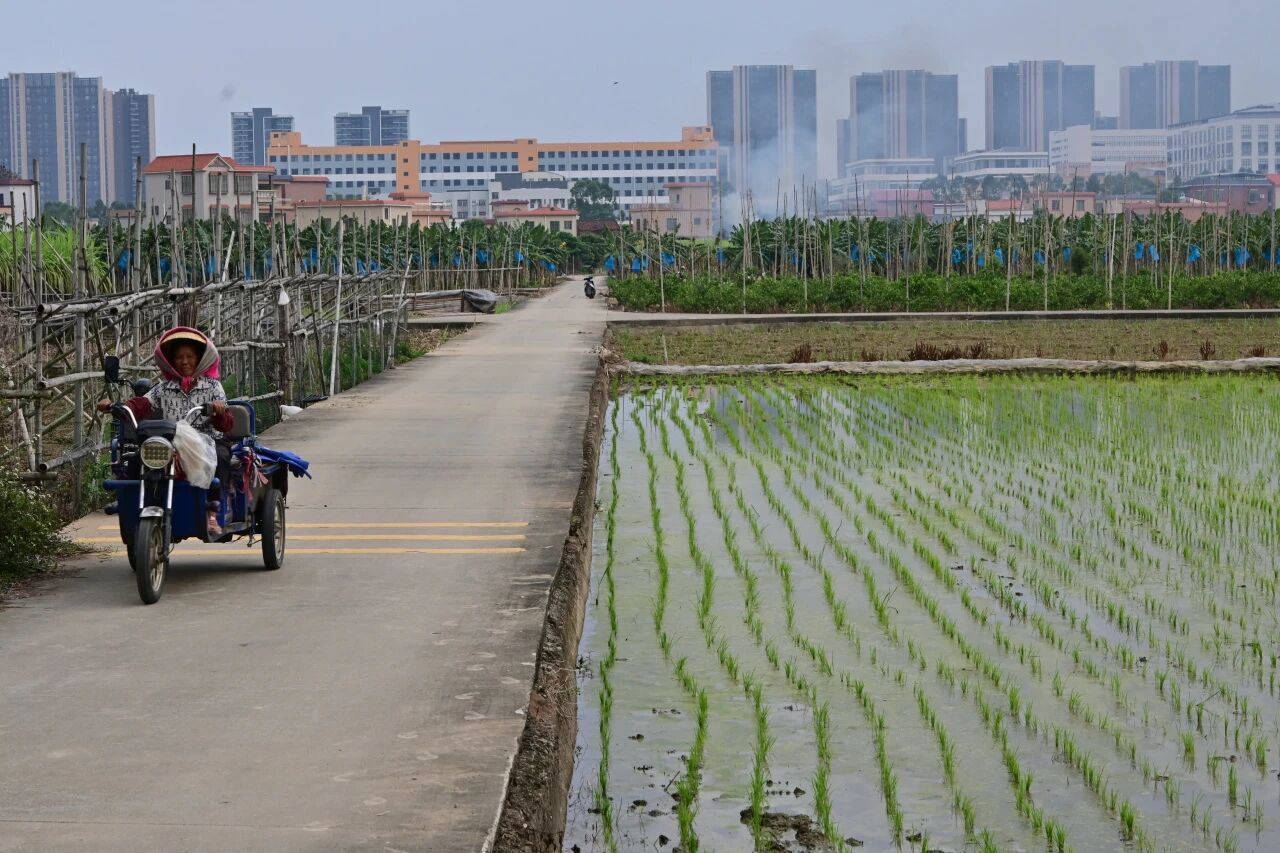
Continuous cropping degrades the soil and breeds disease. Years of growing sugarcane and bananas have brought both quality and yields down. In recent years, many local banana crops were hit by yellow leaf disease, suffering reduced yields or total crop failure. “Even the quality of our sugarcane isn’t great these days – the internodes are short, the stalks uneven in thickness, nowhere near what Yunnan and Fujian are producing on their newly expanded plots.”
Uncle Wang has been growing cane in Shajiao Village for nearly twenty years. He observed that ten years ago, four to five bags of fertiliser per mu (each bag 100 jin) were enough to see a crop through to harvest; now you need at least ten. And over-application of fertiliser further degrades the soil – “apply more and the cane still won’t grow.”
In recent years, the price of a bag of fertiliser has climbed above 300 yuan, meaning fertiliser alone costs over 3,000 yuan per mu. To maintain quality and market standards, cane farmers must keep buying the best fertiliser and pesticide they can get. He ran the numbers: factor in land rent, bamboo frames and labour, and total costs exceed 8,000 yuan per mu; even if the land is your own and you do not hire a worker, you still need at least 6,000 yuan.
V. No Choice but Sugarcane
Nansha has about 90 square kilometres of arable land, nearly two-thirds of it concentrated in the northern towns of Lanhe, Dongchong and Dagang. Those are precisely the areas where the district’s sugarcane and bananas are mainly grown. The Nansha District Special Plan for Farmland Protection (2021–2035) notes that returns on grain planting are significantly lower than on cash crops, farmers lack motivation to grow grain, and the problem of farmland shifting away from grain remains severe.
A cadre in Yansha Village explained that policy requires arable land to be used for food crops or for non-food crops such as cotton, oil crops, sugar crops and vegetables. Sugarcane falls under sugar crops, but growing higher-value fruits like bananas, papayas, guavas and citrus counts as “non-grain conversion” and is not permitted under policy.
In recent years, Nansha has stepped up its enforcement of the “non-grain conversion” crackdown. A public report from late December 2022 noted that in under two months, Lanhe Town had completed 86 rectification cases covering 237.41 mu, and overall completion of “non-agricultural conversion” and “non-grain conversion” remediation exceeded 30%. After bananas and other crops were cleared out, sugarcane was the only option left for local farmers.
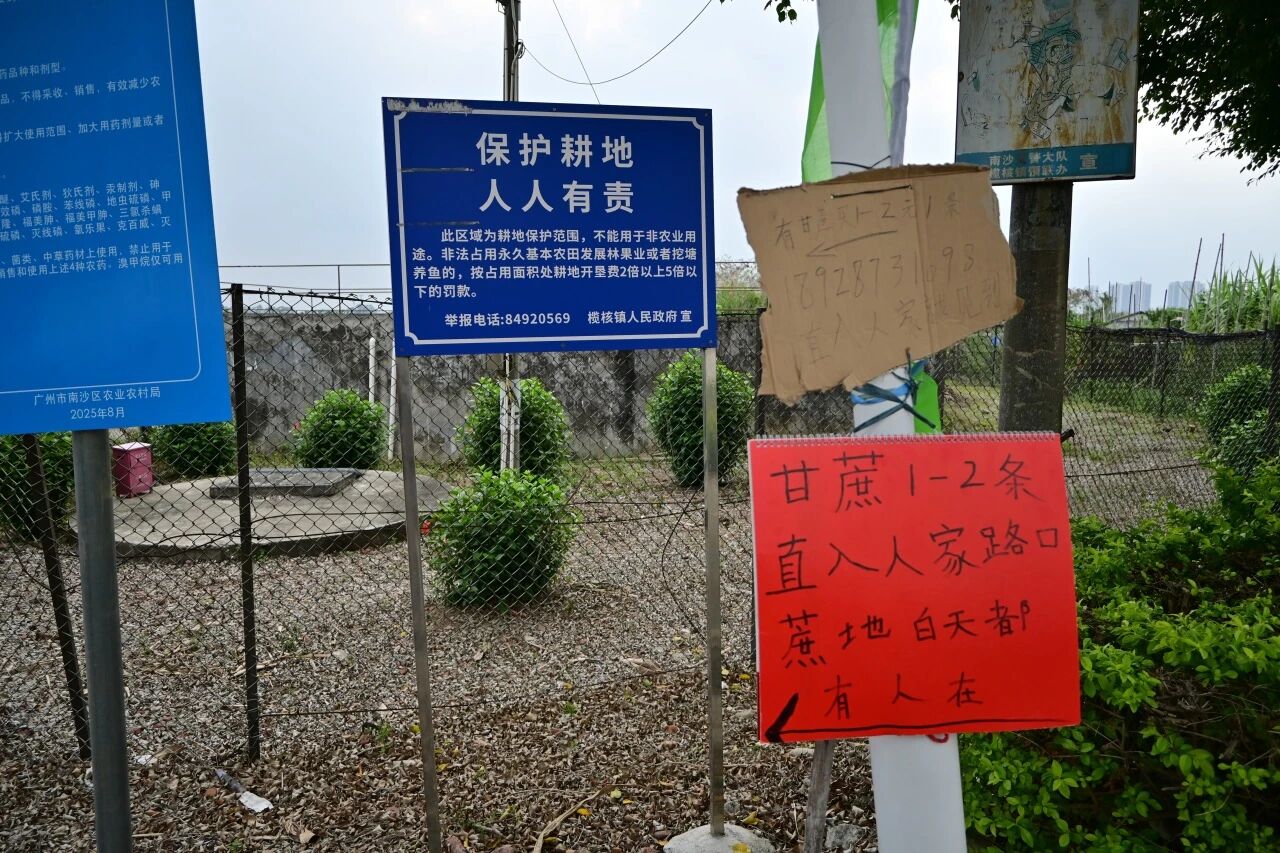
“After bananas were cleared out, sugarcane acreage has grown year after year,” a Yansha Village official revealed. In 2025, the village’s total sugarcane area exceeded 3,400 mu. Public reports show that in 2022, eating-cane acreage across Lanhe Town was just 13,800 mu; by 2025 it had reached 17,000 mu. The weight of “food security” settles on ageing farmers, who have chosen to reject the least profitable crop – rice – and to pick sugarcane from the government’s approved “whitelist” instead.
Protecting food security cannot be the farmers’ burden alone. The Lü Village official recalled that when every town and village rolled out “non-grain conversion” remediation, most villagers opposed it. Government also encouraged farmers to grow other “whitelist” crops, such as vegetables. But vegetable farming is low-margin and demands every hour spent in the field.
Farmers plant bananas and sugarcane not only out of nearly thirty years of habit, but also because it leaves them more off-season time for odd jobs elsewhere. After cutting cane, Uncle Wang heads to other provinces to build trellis frames for fellow cane farmers. Chen Shun has paid rent on four mu but has no intention of farming them; once spring planting is done on his other plots, he will be back at the construction site. Sister Zhen and her husband, both slight of build, usually pick a handful of vegetables to sell at street stalls.
Even with this year’s market slump, many still choose to plant again – they must lean on sugarcane to fill the losses and keep going.
March is nearly over. The livestreams have indeed brought Sister Zhen plenty of business. Someone drove all the way from Shunde and cut over a hundred stalks. Her husband helps in the field, and since customers typically want only the middle sections of the stalks, he hacks off the top thirty centimetres with the leaves still attached, for next season’s seed stock.
This year they will plant sugarcane once more. She is not willing to use virus-free seedlings – for her that would be yet another substantial expense, especially when this year she still needs to buy fertiliser on credit.

All interviewees use pseudonyms
Editor: Xiao Dan