
With Agriculture This Advanced, Why Do People Still Eat Wild Greens?
Shangri-La sits at the junction of Yunnan, Sichuan, and Tibet. Its landscape is varied, its agriculture and animal husbandry well developed, its forests rich in resources, and its farmers’ market buzzing year-round. Because of the great range in elevation, spring does not arrive all at once in Shangri-La. Apart from Bzenzalan Township in Deqin County, spring comes earliest to Tacheng Township in Weixi County.
The wild-greens stories of Shangri-La’s spring that I have lived through begin with Tacheng.
I. The Botanist’s Riddle: Why Do People Still Eat Wild Greens?
By then, the Michelia blossoms at the Songtsam Tacheng Mountain Lodge had filled every branch, and the bees hummed along with the fragrance. But while we were hiking to Dharma Cave, it actually snowed, and on the way down we were so hot we could only manage a thin shirt. That, right there, is Shangri-La’s spring.
Teacher Shen spent the whole walk explaining the various plants we passed: wild jasmine, a garden species found up in the mountains; pine pollen, each cone shedding billions of grains; prickly ash with its thorned leaves; and Meliosma just opening its little white blossoms…
When we reached the forest park, he introduced them with even more enthusiasm: this is alpine Daphne that hasn’t bloomed yet, that is the purple dwarf primrose just opening, and over there, bright red Delavay’s rhododendron. But my attention was drawn to a few strands of green fern at my feet. They grew from a cluster of dark old stalks, looking so crisp and tender you could almost take a bite.
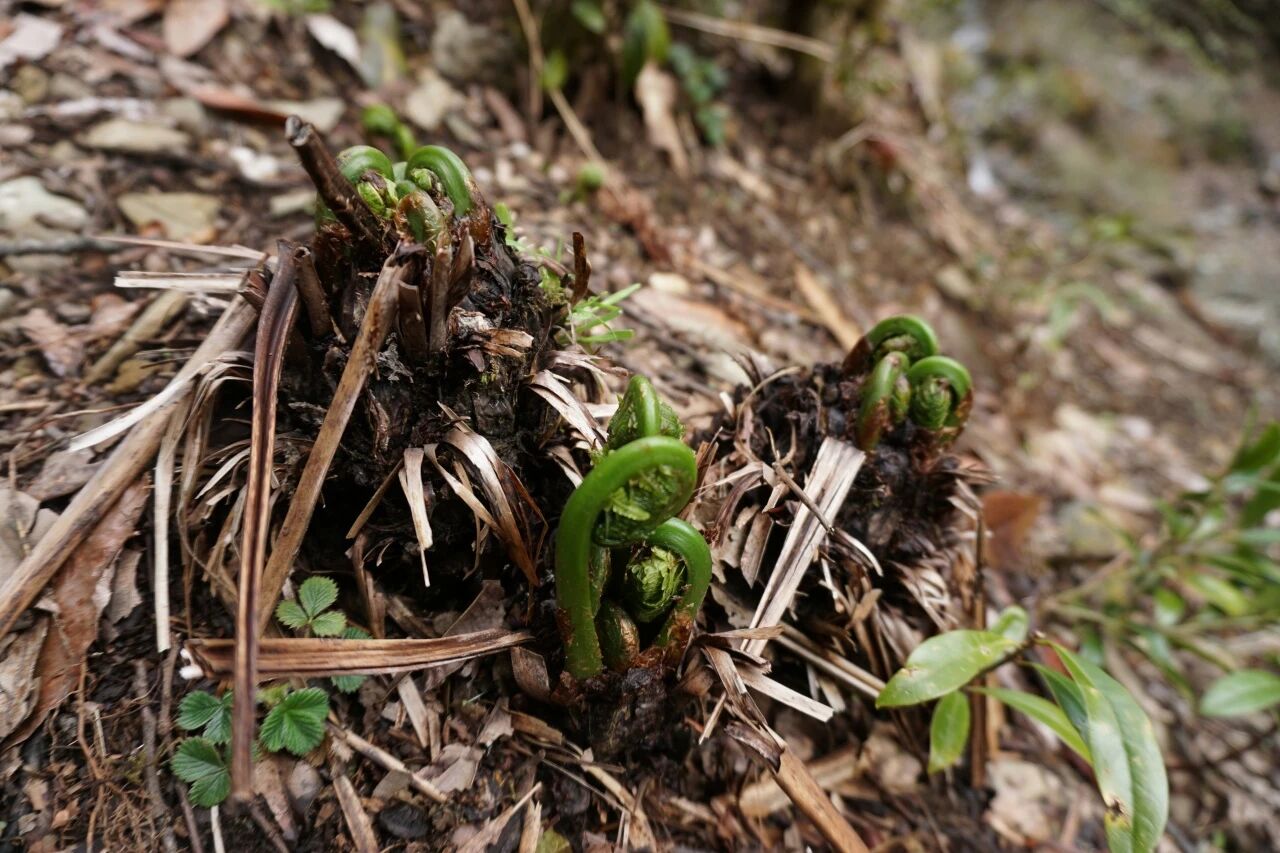
I asked Teacher Shen what it was. He glanced at it and said: “A species of Athyrium fern.”
My next question: Can you eat it? His answer was blunt: “No.”
Back at the lodge after the hike, A-Jie brought out a plate of stir-fry – lush greens, lean red ham – and announced the name: “Bracken with ham.”

Huh? This looks familiar. I asked Teacher Shen: ‘Isn’t this the very same thing we saw on the hillside? Didn’t you say it was inedible?’
So Teacher Shen had no choice but to set down his chopsticks and explain to me why ferns are classified as carcinogens. Before he could finish, I had already mopped up a full bowl of rice with that plate of ferns. It was crisp and tender, nothing like the slippery, stringy texture of the purple ferns I used to eat back home.
Teacher Shen had not touched his chopsticks at all. Watching us eat with such relish, he sighed and said : ‘With agriculture this advanced, why do people still need to eat wild greens?’ The unspoken second half: especially when they might be poisonous.
Nature-loving Teacher Shen lives in Dali most of the time and has his own little courtyard. I envied him: ‘Then you can grow your own vegetables!’ He said, as if he could not believe I had suggested it: ‘Who uses their courtyard for vegetables? If you want greens, you buy them at the market. A courtyard is for flowers – and the kind you cannot find anywhere else!’
I admire his scientific rigour and self-discipline as a botanist, but when it comes to eating wild greens, he is not necessarily in a better position than the locals to have the final say.

Of course, Teacher Shen was not one to refuse every single wild green.
Our next stop was Nixi Village in Shangri-La. Nixi free-range chicken is famous, and it must be cooked in a black earthenware pot. The secret to making the chicken soup especially fragrant in that pot: do not wash it too clean.
The vegetable to go with the chicken pot was dandelion, freshly pulled from the ground. Shangri-La’s rich earth gives the dandelions particularly thick roots. Beside it sat a plate of freshly fried Nixi chillies, the third most famous product of Nixi, renowned for their extraordinary heat and fragrance.
Teacher Shen had clearly underestimated this petite orange chilli. He picked one up, took a single bite, and within seconds his face went crimson; he pressed a hand to his face, tears streaming. Only devouring a good mouthful of dandelion brought any relief. So it seems: only wild greens with proven medicinal value in science are worthy of a botanist.


II. Only Those Who Have Picked Wild Greens Know the Joy
The people of Shangri-La, who have always lived off what the mountains provide, probably never once considered the question the botanist raised. Eating wild greens in spring, like eating mushrooms in the rainy season, is a tradition etched into the Yunnanese genome.
In Shangri-La, no matter how busy or exhausting the workday, the office grind is always diluted by the wild charm of the season. Lin Yun, a young woman from Tacheng in Weixi, is the most life-loving person I have ever met. The vases in the office are always filled with whatever flowers she brings in: plum blossoms, peach blossoms, crabapples, all manner of unnamed wildflowers…

It was spring 2022. While strolling through the village after lunch, Lin Yun spotted a calf huddled tightly behind its mother and called us over: “Look, what a tiny calf!”
She noticed a heap of cattle dung piled beside someone’s homestead and exclaimed, delighted: “Oh, what dark, gleaming dung! Where on earth did they scrape up a pile this enormous!”
On the way back to the office, she caught sight of a patch of fresh green grass by the roadside and beamed: “Quick, look at this grass! So tall, so tender, so soft – oh, I just want to be a little calf!”
Of course, Lin Yun’s love of life shows mostly in her eating.
One day she told me the Caragana bushes behind the office’s back door had bloomed and invited me to come pick some. “Now is exactly the time,” she said. “Once they’re all in full bloom the buds go tough and aren’t as good to eat.”
So in the afternoon we made our way to the Caragana bushes, tucked under the shade of willows where a stream ran through.

Caragana is the everyday name; its formal Chinese name, jinji’er, sounds, if anything, even more like a local nickname. Like the black locust blossoms that northerners love to eat in spring, it is a member of the legume family (Fabaceae). It is also one of the very few wild flowers that can simply be washed and eaten raw, and in the market it can fetch over a hundred yuan a kilogram.
Caragana branches are thick with sharp thorns; pick carelessly and you will get pricked. Lin Yun demonstrated the proper technique: with her left hand she pinched the tip of a flowering branch and lifted it free of the thicket, while her other hand nimbly plucked the unopened buds from side to side. Efficient, and no pricks.

I popped a bud into my mouth – sure enough, faintly sweet, just like locust blossom.
By the stream, Lin Yun plucked a broad leaf, then snapped off a small twig and threaded it through both ends of the leaf like a pin, curling the leaf into a little cone. She held it out for me to carry, and we dropped the picked Caragana inside. Before long we had a good big handful.
Then she rolled the leaf tips over with another twig to seal them, wrapping the Caragana inside so nothing would spill or dry out. That was how we went – four of us – and came back with three big bundles, plenty for a meal.

Just when I thought we were ready to head home laden with our haul, Lin Yun spotted shepherd’s purse growing beside the Caragana: “Look how well this shepherd’s purse has grown! Let’s gather some – dumplings with it would be wonderful!”
She produced a pair of flower shears and got to work digging up the shepherd’s purse. She actually carries flower shears with her! No wonder she always seems to conjure up so many flowers!
Remarkably, though Shangri-La is a plateau, the shepherd’s purse that grows here is even more luscious than the kind down in the Jiangnan region – the leaves soft and tender, inconspicuous in a stretch of green grass, and yet Lin Yun spotted them anyway. Between her and two little helpers, we soon had a big handful ourselves.

Back at the office, Lin Yun entered the kitchen and transformed into General Lin, strategist in her element: a few swift swipes and the shepherd’s purse was clean, chopped up with the pork she had brought down from her village a few days earlier, and dumplings were wrapped.
The Caragana got the most classic preparation: washed, a few free-range eggs cracked in and stirred together, then spread into omelettes. For nearly any wild green, this is the safest way to serve it.

She also bought a bundle of zhuyecai from the market. Zhuyecai (bamboo-leaf greens) is another wild green unique to Shangri-La at this time of year, with a very short market window. It is said the plants grown above 3,000 metres taste the best – the higher the altitude, the less bitter and the sweeter.
Lin Yun took out a piece of skin-on ham, added a little water, and set it simmering in a pot. Once cooked, she sliced the lean meat into deep-red ham slices and stir-fried them with the zhuyecai. The skin-on parts and the fatty sections were cut into thick slabs, plated, and served as they were. Then she poured the ham broth back into the pot, added the bunch of shepherd’s purse we had set aside, and a wonderfully fresh shepherd’s purse soup was ready to serve.

Amid all the bustle, Lin Yun even fried a potato and tossed it with lemon, bird’s eye chillies, coriander, and spring onions. I picked up a piece and popped it in my mouth, eyes widening: this fried potato is extraordinary. The crispy shell is scented with lemon, and with one bite the sharp tang of acid and heat bursts forth, releasing the sweet, soft, glutinous warmth that only highland potatoes can give.
Lin Yun beamed: “My daughter says my mixed potato salad could win first prize.”
In the end, this table – flowers and potatoes, wild mountain greens and free-range pork – came from a boundlessly generous nature, and also from the quiet, unhurried hands of the people who work this land. It was, without a doubt, my meal of the year.

III. Eating Wild Greens Is Human Instinct
And so, back to the botanist’s riddle: with agriculture this advanced, why do people still eat wild greens?
I think we do not really need to answer that question, because eating wild greens is human instinct.
Today, agriculture and science working together have greatly enriched our tables, yet they still cannot replace the gifts that nature offers people. Those wild greens that need nothing but sunlight, soil, and rain – even left entirely to their own devices, they grow beautifully, because growth, too, is a plant’s instinct. And those who wholeheartedly draw close to nature may, with a clear conscience, receive this “gift of the wild.”

Unless otherwise noted, all photographs in this article are by the author.
Editor: Zeen