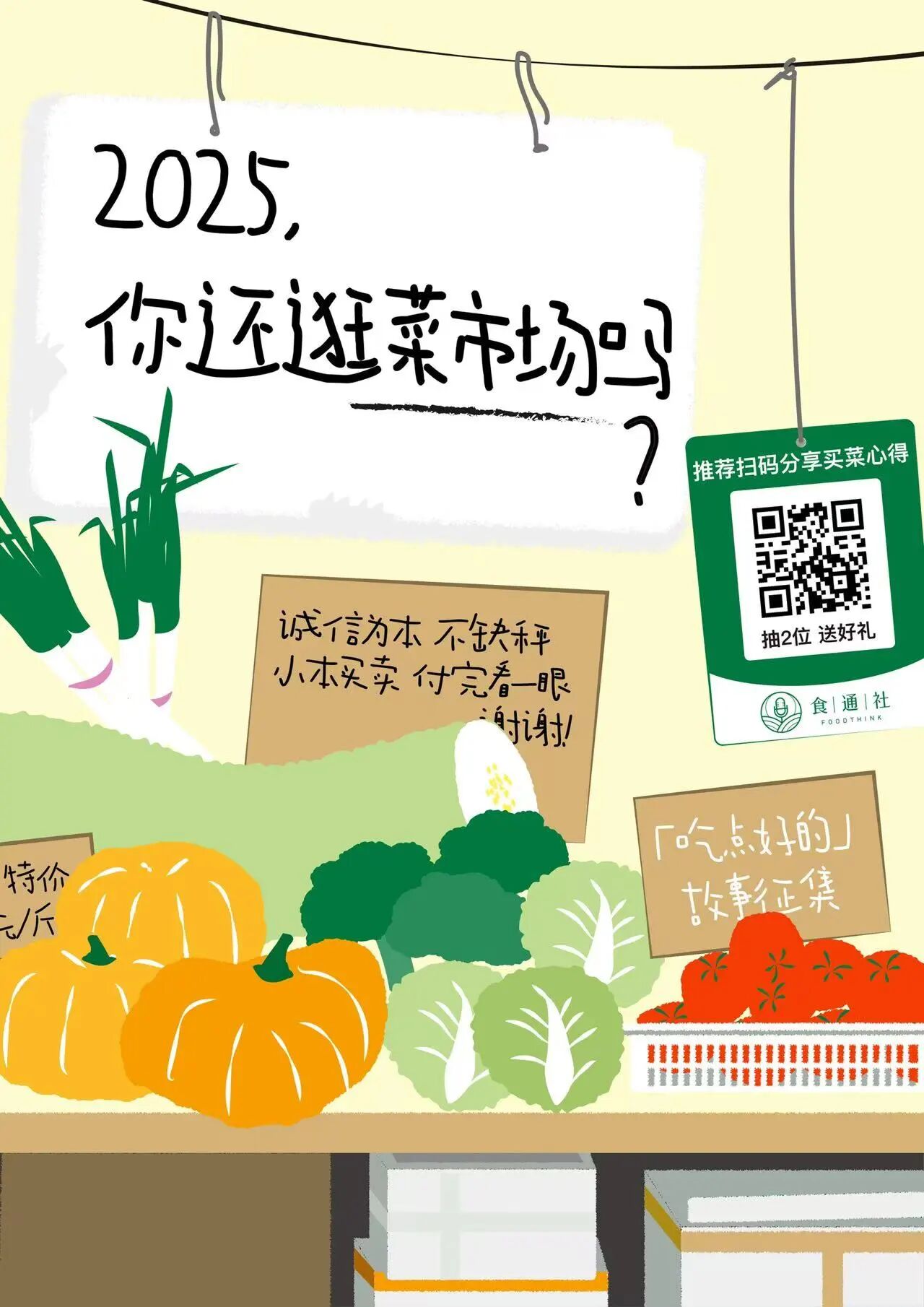
This is Foodthink’s “Eat Well” column’s sixth round of story submissions. The theme this time is “Wet Markets”. It is something of a surprise that, in an age when everything is accelerating, we still receive so many readers’ accounts of their experiences at wet markets.
Compared with the previous issues’“Takeaway”, “Plastic”, “Digital Side Dish” and other themes, the emotional tone of this round feels more positive and expansive, and one can see many readers’ finely detailed, grounded observations of everyday life. Whether in large cities or small towns, whether at home or abroad, whether in the far south or the far north, people’s lives are always intertwined with wet markets in all manner of ways. We even heard from a reader who had grown up in a wet market since childhood, telling us about the wet market as she sees it.
Some believe that wet markets will be the next space where the “20-Minute Theory” plays out, while others still see them as “dirty, messy, and run-down” places. Old and new perspectives overlap, yet neither seems able to articulate the full experience of a wet market. And the wet market simply rests in some corner of the city, entwined with the weight of daily livelihoods, breathing the air of everyday life.
Wet Markets, Supermarkets, E-Commerce
How Do We Buy Our Groceries?
Where do people tend to buy their groceries nowadays? There is no single right answer. It depends on each person’s pace of life — even on the different circumstances of the same person’s daily routine — and on how each city lays out its spaces and infrastructure.@阿猹 (Female, born in the 1990s, Beijing)
Visiting the wet market and cooking are now how I reclaim order in my life, but when I first started going to the wet market, it was purely about putting food on the table. I used to be what you might call a shoestring student — my family spent a great deal on my studies abroad, so I cooked as much as possible to keep food costs down, and I have kept up that habit of cooking at home since returning to China. I usually do a big shop once a week, buying meat, staple vegetables, seasonal fruit, and topping up my stocks of spring onion, ginger, and garlic. When I suddenly feel like cooking something, I check the e-commerce platforms the day before, or even on the day, to see if they have what I need. I rarely go to supermarkets. In my experience, the produce at Beijing supermarkets is such that chicken has no chicken flavour and fish has no fish flavour. I have been moving house recently. Everything about the new neighbourhood is great, except there is no wet market.
◉The Nongguangli Wet Market in Beijing, a favourite of A Cha. Photography: A Cha@南宛 (Female, born in the 2000s, Tokyo)
I am currently studying in Tokyo. I know that areas like Shin-Ōkubo and Kameido have wholesale vegetable markets similar to those back in China, and prices tend to be lower than at supermarkets. But because they are far from where I live and I pass several supermarkets and convenience shops on my way home, I still do my grocery shopping at supermarkets and convenience shops.@ray
I used to order takeaway a lot, but lately I have been growing to love cooking. Even so, I have found I cannot really shake off takeaway in the broader sense — fresh-food e-commerce platforms like Meituan Xiaoxiang and JD 7Fresh are incredibly convenient; you place an order and it arrives within 20 minutes. But it is not just an excuse — Beijing genuinely has very few wet markets. The nearest one to my home is about four kilometres away on foot.◉Sorting workers climbing to find stock in a JD 7Fresh supermarket warehouse in Beijing. Behind the convenience of the fresh-food e-commerce promise of “fastest 30-minute delivery” lies the sorters’‘30,000 steps a day, three jiao per item’‘ brutal struggle to survive. Photography: He Siqi@桔子 (Female, Wuzhou, born in the 1990s)
I work and live in Wuxi, where there are not many wet markets, and from my home it takes several metro stops to get to one. So I usually buy groceries through e-commerce platforms (Dingdong Maicai, Xiaoxiang Supermarket) or at nearby supermarkets (Hema, ALDI). But my hometown, Wuzhou, has plenty of wet markets. Since the city is small, they are not far apart, and I visit one almost every day. The nearest wet market is about five or six hundred metres away — a five-minute walk.
A Guide to the Ultimate Wet Markets (Unfinished Edition)
Below are some of the ultimate wet markets readers have recommended across various cities — come and see if any look familiar! Are there other hidden-gem wet markets you would like to recommend? Feel free to leave a comment!@桔子 (Female, Wuzhou, born in the 1990s)
I would like to recommend the market in my hometown, Wuzhou —Yijing Market— which is brimming with the warmth of everyday life. Fruit, fresh vegetables, fresh meat, seafood, prepared food, dried goods, household staples — you can find everything here. It is buzzing with life every morning. My mother runs a general-goods stall in the market, so I grew up wandering the aisles. I feel that buying groceries just does not have the right feel unless you go to a wet market.
◉The Yijing Market on the morning of 28 November. Photography: Ju Zi’s mother@阿努比斯 (Female, Hangzhou, born in the 1990s)
I am currently living in a rural township in northwestern Yuhang District, Hangzhou. There are wet markets in the township centres — I would recommend Pingyao Farmers’ Market and Huanghu Farmers’ Market. They tend to be livelier on weekends, with lots of stallholders setting up. It takes about a 20-minute bike ride from my home to the market.
@一碗鱼 (Female, born in the 1990s, Kunming)
I recommend Fengdeng Farmers’ Market. They have delicious pickled garlic and pickled vegetables, and vendors put out sprigs of mint, chillies, and Houttuynia root they have grown themselves, set by the windowsill.
@溜达卓 (Female, born in the 1990s, Deyang)
I am in Guanghan, Sichuan. If you come here for a visit, I would recommend the market nearest to my home, Weituo Hall Market, which used to be a temple. Inside, there are stallholders selling vegetables alongside farmers and gardening enthusiasts who set out their own home-grown produce. Beyond the usual fruit and vegetables, there is rice, noodles, cooking oil, flour, and a full range of seasonings. Sometimes people sell herbs — dried or fresh. Sometimes flowers, and occasionally something unusual turns up. All in all, everything you need for daily life is right there!@笋加鲜 (Male, born in the 1990s, Shenzhen)
I have been to wet markets in many places, such as Shaxi in Dali, Duyun in Guizhou, and Mangshi. Shenzhen does not have a great many wet markets, but finding a good one to browse is not too hard. If you live near Taoyuan Xuefu Road in Nanshan, I recommend the one at Dabanqiao — a five-minute walk from my home. You can find seafood, roasted meats, and vegetables from all over the country.
◉Agricultural produce — lotus root, mushrooms, lettuce, corn, and more — at a market in Duyun, Guizhou. Photography: Sun Jia Xian@菲 (Female, born in the 1980s, Guangzhou)
Every district in Guangzhou has its own characteristically unique market. Let me highlight the Shayuan Market, in the west of Haizhu District. It is made up of three sections, including the Shayuan Agricultural Products Market, and has over 1,000 shops and stalls. The goods on display are dazzling in their variety and the prices are remarkably affordable — Beibei pumpkins at ten yuan for four jin, Zhanjiang oysters at seven yuan a piece, to name just a few — giving visitors an authentic taste of Guangzhou’s trademark value: affordable, fresh, and excellent.
◉The Shayuan Agricultural Products Market in Haizhu District, Guangzhou. Image source: Yiding, Suyuan, Guo Yuan@南乡子 (Female, born in the 1970s, Beijing)
Living in Beijing, I am fortunate to have plenty of wet markets around. Near Xixiaokou, heading north you will find the Sanqi Baihui Wet Market, with an extraordinarily wide range of produce and a fish and meat hall well worth browsing; heading south there is the Yongtai Comprehensive Wet Market, which not only has fresh vegetables but also distinctive prepared foods and a well-regarded bean-products shop; and to the south-west is the Qinghe Wet Market, equally well-stocked across every category. None of them are far from my home — it takes only about ten to twenty minutes by electric scooter.
@晔酱
I once heard that temples have long served as centres of faith and community in Tainan, and markets selling fresh produce and general goods gradually sprang up around them. The market near Shuixian Temple is a local sensation, yet it still retains the character of a traditional Tainan wet market. Taiwan’s fisheries are incredibly abundant, so you will find countless stalls selling seafood and seafood products, many of them freshly making fish paste and fish balls on the spot. Under Shuixian’s gaze, I bought a few delicious fish balls. The cuttlefish balls were an explosion of flavour — bouncy, juicy, and quite simply the best fish balls I have ever tasted in my life.
◉A craftsman making fish balls. Photography: Ye Jiang
The Wet Market as “The Neighbourhood”
Wet markets are local. Using food as a medium, they bind together the people of a neighbourhood and exhale the living breath of a city. There is food there, but there is also emotion. Sometimes that emotion is crystallised in old memories; other times it flows through new relationships. In short, even though a wet market is far from perfect, compared with a supermarket or a fresh-food e-commerce platform, it remains a place where genuine human connection is most likely to flourish.◉ In a wet market, the rapid exchange of information demands the two most direct forms of communication — the spoken word and body language. Photography: Ju Zi’s mother@Renso (Female, born in the 1990s, Chiang Mai)
I live in Chiang Mai, and half of my friends here I met at the market. The locals are mostly warm and unassuming. When I shop, I often cannot tell one vegetable from another — they all look like the roadside greenery to me — so I ask what they are, and before you know it, we know each other. I joke that the Chiang Mai wet market is my Thai language classroom.
Chiang Mai has permanent wet markets as well as “pop-up” markets that appear only on certain Mondays or at the start of each month. I look forward every month to the one that comes only at the beginning of the month. There is a grandma whose egg-yolk pastries are absolutely delicious, and another auntie who grows fruit and vegetables that are incredibly fresh and sells homemade honey of exceptional quality. She once showed me her beehives and her little farm. All in all, going to the market is both a survival need and a social one.
@菲 (Female, born in the 1980s, Guangzhou)
The pork stall I used to visit regularly has relocated. The stallholder left no forwarding note, so I could only leave, disappointed. The next time I went back, I told myself a stall that good simply could not be gone for good. Then I wandered over to a newly opened stall, just to see if I was in luck, and sure enough, from a distance I spotted that familiar figure behind the counter! I rushed over to say hello, and they happened to have been talking about me just then — worried I might not be able to find them. When you never forget something, it will always find its way back to you!◉ Guangzhou’s Dongshan Wet Market, where Fifi likes to shop. Photography: FifiTung@阿猹 (Female, born in the 1990s, Beijing)
There is one stall where the vendor sells only tomatoes. I buy from him every single time. He remembers me and always gives me a discount — they are the best tomatoes I have ever tasted. I have since tried tomatoes of the same variety at other wet markets, and none come close to his. I have never stopped thinking about them.
Then there is something that still weighs on me. Last winter I bought some white strawberries at the market — incredibly sweet and delicious. I went through quite a lot of trouble to add the vendor on WeChat via a transfer message, because I wanted to get some for my grandfather, who was fighting cancer. But the next morning, before I had even finished packing to go home for the New Year, my mother called to say Grandpa had passed away suddenly. I went straight home to be with the family. Those white strawberries I never did manage to buy. Even now, thinking about it fills me with regret.
@晔酱 (Female, Heilongjiang)
I love browsing the morning market! Even as a child, I had to get up early in winter. I would be dragged out of bed at six and bundled off to the morning market with Grandma and Grandpa. Big cotton-padded coat over a second pair of padded trousers — wrapped up round as a ball, out the door we went. Mountains of “just-picked, garden-fresh” vegetables, whole truckloads of corn, Chinese cabbage and potatoes, hot stir-fried peanuts, melon seeds and walnuts, and stalls selling flowers and bonsai. Out of curiosity, I would talk to the chickens and pigeons in their cages, and Grandma would snatch me right back: ‘Look at all that filth!’◉ A morning market in Daqing, Heilongjiang (in authentic Northeast Chinese, the final syllable of “zǎoshì” must carry the erhua ‘r’ ending — “zǎoshìr”). Photography: Ye Jiang@Singharaja
I have visited wet markets many times this year. The most recent was during a summer trip back to China, at an old market tucked away in Chengdu. The alley was narrow, the stalls packed tight, and the air was thick with a mingled smell of spices, cooked food, and damp earth — the kind of place I have known since childhood. I was not in a hurry to buy anything. I just wanted to wander and look, to listen to the vendors’ calls and watch the haggling. For me, a wet market is a concentrated slice of everyday society. There you can see a city’s truest breath: an old woman counting coins for a bunch of spring onions, a stallholder peeling bamboo shoots while chatting with a regular — life is re-confirmed, again and again, in all these small sounds.@road
Compared with permanent wet markets, I feel a deeper pull towards the big pre-Spring Festival market fair. I love what a ‘集’ is — a place where people come carrying their own needs, their own resources, their own know-how, and meet one another. They haggle, they test each other, they trade when it suits them and part when it does not. There is no coercion, no flattery. Because the New Year comes first, everyone lets go of a little calculation and gains a little generosity. The 集 is, at its heart, a place for sending off the old and welcoming the new.
◉ Chestnuts flying in the wok as they are stir-fried at the pre-Spring Festival market fair in Shenyang. Photography: road@Ling
It has been two weeks since I helped my mother move to Singapore. She has barely set foot outside, seemingly with little interest in anywhere. The one thing that made her eyes light up and prompted her to say, “Let’s go”, was the pasar — the local wet market. Only there does she fall back into her familiar shopping rituals — rummaging through piles of vegetables for ages, chatting with stallholders her own age about everyday things, and haggling, all with the muscle memory of decades. Even after the goods have been weighed and bagged, she still casually tosses a handful of coriander onto the scales (for now my mother holds herself back, aware that she is a foreigner; she has not yet done what she would have done at home — telling the stallholder, “Let this bunch of coriander be your little extra”).
The fruit and vegetables at the pasar are all packed in plastic bags, imported from Malaysia, Indonesia, China, and elsewhere. There is no sense of earth, nothing truly local. In the end, it is not quite the same as the rural morning markets my mother is accustomed to, where farmers sell their own home-grown produce. And yet the pasar still weaves a daily web with food as the warp and human connection as the weft. Here, diners and stallholders alike build their lives by touch, keen eye, and the fine art of making every cent count.
◉ Ling’s mum, expertly selecting vegetables. Photography: Ling@溜达卓 (Female, born in the 1990s, Deyang)
I bring my own bags when I go shopping, so that fewer plastic bags go to waste. When vendors ask me why, I never say it is for the environment — that feels too far removed from their lives. I just say I am saving them a plastic bag. They always get a little happier about that, and sometimes they slip me a bunch of spring onions or something!@桔子 (Female, Wuzhou, born in the 1990s)
Ever since I was small, I have been hanging around my mother’s stall at the market. We sell an extraordinary range of things — on top of cooking oil, salt, soy sauce and vinegar, there are all sorts of bulk-sold ingredients, with a single category running to half a dozen brands. There is such a wealth of it that you could not finish listing the items in a whole day. So the little shop is always packed. People finish their vegetable shopping, lugging their big and small bags, then come back to pick up seasonings and other essentials.
◉ Ju Zi’s family’s seasoning shop. Photography: Ju Zi’s motherDuring the Spring Festival, I always go back to help out at the shop. People do not just buy and leave. They pepper you with all sorts of questions: ‘If I am making a particular type of pastry, what flour should I use?’, ‘What can you cook with yellow bean paste?’, ‘Are your century eggs any good — have you ever tried them?’When it comes to such questions, I usually steel myself and say, ‘Our century eggs are definitely delicious!’ The old lady then pushes back: ‘Hmph, of course you say your own goods are the best — have you really tasted them, or are you just making it up?’ ‘I… my mum has had them.’ I am hopeless at arguing. In the end it is always my mother who rescues me. She is remarkable — she can answer every question fluently, including how to make all sorts of pastries, and she can lay out for a customer the strengths and weaknesses of one brand of seasoning versus another.
To do well at a wet market, you need sincerity in how you treat people and a product you truly stand behind. Since a wet market is all about repeat business, customers who try something and like it will come back of their own accord. I love that genuine exchange between people, and I always look forward to spending the New Year helping out at the shop.
Wet Market Survival Guide
Read through this “Wet Market Survival Guide” written by a few wet-market veterans, and even a complete newcomer might feel bold enough to have a go at the sheer delight of browsing the market!@丁丁(Female, born in the 1980s, Xi’an)
My trick for the wet market is simple: walk the whole thing once first, compare everything, and only then choose the freshest and most fairly priced. Avoid vegetables that have been sprayed with water. With spinach, go for short stems and thick leaves — those tend to be better. For baby napa cabbage or Chinese cabbage, pick heads that feel loose rather than tightly packed, with the outer leaves just starting to turn yellow.
@阿猹(Female, born in the 1990s, Beijing)
Know what you want before you go. If you are vague about it, the stallholder will nudge you towards things you have no interest in simply because they say, “It’s delicious.” Keep a close eye on the weight. When you pick over the vegetables, handle them naturally — do not delicately pinch them as though you are afraid of dirtying your fingers. That is the surest giveaway of a novice. Give the stallholder a little feedback: “A friend recommended this place to me,” or “Auntie next door said your xx is really good, so let me try some.” They will feel that you are one of their own, and they will give you the freshest produce, or tell you a better way to cook a particular vegetable.
◉To a wet-market newcomer, the stalls may look like nothing but a sea of green. But to a veteran, every vegetable has its own shape, texture, and flavour. Photography: A Cha@菲(Female, born in the 1980s, Guangzhou)
If you are visiting a market for the first time, look for where the crowds have gathered, or simply trail an elderly local and see what they buy — that works too. Also, stallholders tend to place their freshest, best produce in the most prominent spots, so keep an eye out. For vegetables, look for what is grown locally and what is in season — as the saying goes, eat nothing out of season. Let the solar terms guide your choice of ingredients.@溜达卓(Female, born in the 1990s, Deyang)
I usually buy from farmers who grow their own vegetables, because I feel the work is so hard. Especially when you are buying seasonal leafy greens — for a few coins you can get a huge bunch, yet the physical labour, time, and effort behind it are enormous. My advice is to choose fruit and vegetables grown locally or in nearby areas. They will not taste bad, and the prices are fair. Produce shipped in from further afield actually costs more. So when you are buying from a vendor, ask about the origin of the vegetables.◉Many farmers set up their stalls on the outer edges of the wet market, selling the vegetables and fruit they have grown themselves. Photography: Ye Jiang@Vivek(Female, born in the 1970s, Dali)
The truth is, you need no sales patter. Stallholders are always happiest to meet a buyer who genuinely knows quality. When they encounter someone who is muddled yet insists on haggling and fussing over every last cent, they can see straight through the pretence of a seasoned shopper.@桔子(Female, Wuzhou, born in the 1990s)
Once you are inside the wet market, do not be intimidated. Chat with the stallholders, have a bit of a conversation. If someone seems rude, just walk away; if you hit it off, buy from them. If you are worried about being overcharged, check the current prices online beforehand — for example, compare them with the prices on a supermarket’s WeChat mini-program. Or ask at a few different stalls, compare the freshness and the prices, and then buy. At least you will have a baseline in mind.
As for selecting vegetables, look at the cross-section at the base: if it still looks moist, the vegetable is fresh; if the base has dried out and changed colour, it is probably past its best. When picking tomatoes, go for the ones with six calyx leaves rather than five — they are a little sweeter and juicier. But the best method of all is simply to ask the stallholder. They will be more than happy to teach you how to choose.
◉A stallholder and a customer, mid-chat. Photography: Yu Yang
Hidden Delicacies of the Wet Market
Unlike supermarkets, wet markets are closely intertwined with local food culture. If you are visiting a city for its sights and its food, do not overlook the delicacies hidden in the wet market. If your hometown has its own extraordinary local specialities, we would love for you to shout out the dish names in the comments!@イイϵ( ‘Θ’ )϶
If you are visiting a wet market in Yunnan, you simply must try the cold sliced beef from the Hui stallholders. Whether you dip it in a zhanshui dipping sauce or a sprinkle of salt and pepper, it is absolutely divine!
@晔酱
My favourite breakfasts are from the early morning market! There are stalls selling baked naan, sauce-flavoured pancakes sliced into wedges, tofu pudding, small wontons, and egg burgers. The fried-dough-stick stall always has an enormous queue — you buy a couple, then sit down under the canopy with a bowl of soy milk… It is still the same now, except I simply cannot get up early enough anymore.
◉Golden corn cakes. Photography: Ye Jiang@阿努比斯 (Female, Hangzhou, born in the 1990s)
At the Huanghu Farmer’s Market there is one lady’s stall selling a variety of homemade semi-prepared foods. Besides the usual steamed buns and rice cakes, the rest of the spread changes constantly — fish balls, filled pancakes, steamed pork with rice flour, and more. Every time I go to the wet market, I check in to see what she has made that day.
@Tianle Beijing
The wet market in Songyuli has an excellent sewing shop, and the market at Nongguangli has delicious sesame flatbreads. If I am going to the China Film Archive at Baiziwan for a screening, I always pop into the huge wet market next door for baked stuffed buns, braised goose, sausages, and the like. All the small stallholders make their own products, and there is a professional pride and a laid-back ease in them that you simply never see in a chain-store clerk. The flavours are wonderful too. The newly opened Teochew cuisine stall at Wudaokou Farmer’s Market is fantastic!
◉Welcome to Wudaokou Farmer’s Market in Beijing, where there is plenty of delicious food. Photography: Yu Yang@笋加鲜 (Male, born in the 1990s, Shenzhen)
Of course, the great delicacy at Guangdong wet markets is siu mei. I can get it right at the wet market near my home — they roast fresh chickens every single day, and a whole one costs only 60 yuan. It is better than the roast chicken at any restaurant nearby.
◉Siu mei — the joy that Guangdong people simply cannot give up! Image courtesy of Foodthink@梅子青 (Female, born in the 1990s, Anshun)
Braised meat at the wet market near the 303 Hospital in Pingba District, Anshun; roast duck at the old farmer’s market in Pingba District.
@南乡子 (Female, born in the 1970s, Beijing)
Braised pig’s head and plain tofu at the Yongtai General Market. The young man who sells the braised pig’s head always slices the meat and wraps it up neatly in waxed paper — I love that kind of old-fashioned, eco-friendly packaging.
@桔子 (Female, Wuzhou, born in the 1990s)
Hand-shredded chicken, poached chicken, roast duck, char siu, roasted pork belly — you will find them all at the Yijing Market in Wuzhou. Everything here is in the Cantonese style (I am drooling as I type…).
◉The big slab in the middle is roasted pork belly — in influencer-food terms, think crispy pork belly, haha. Photography: Ju Zi’s mother
What Do Wet Markets Look Like Abroad?
Since the last century, the open-air markets that farmers and urban residents had set up of their own accord in many countries have been replaced, in the march of modernisation, by standardised chain supermarkets. This process first took hold in Britain and then spread across the world. So do wet markets still exist abroad today? What do they look like?@Ling
It has been two weeks since we arrived in Singapore. A short walk across the footbridge from our estate leads to two chain supermarkets, FairPrice Finest and CS Fresh, but my mother refused to go back after a single visit. Instead, she is happy to brave the equatorial sun and trek twenty minutes just to browse the pasar. On our first visit, I was carrying my daughter — not yet two years old — through the wet, dripping aisles between the vegetable stalls, and the old aunties selling greens descended on us like hungry tigers, refusing to let us go, piling on every sweet compliment imaginable for the little girl. The aunties even got into a row among themselves over whether to feed my daughter chocolate, and I nearly had a full-blown social-anxiety episode on the spot.◉A fruit stall at the pasar. Photography: Ling
For an elderly woman like her, hailing from a fifth-tier town in China, the pasar brings together three things that make her feel at home: the wet market itself, a shared language, and human warmth. To drive home how much better the pasar is, my mother made me go and compare the supermarket prices of every box of eggs and every single luffa. After a round of unit conversions, I concluded that the prices on both sides were actually six of one and half a dozen of the other. My mother was still not convinced. “Look how fresh the eggs are at the pasar!” she said. “I kept chickens — I know that only really fresh eggs are hard to peel after boiling. Who knows how long those supermarket eggs have been sitting in a cold store!”
◉Pumpkins in Singapore, imported from Australia. Photography: Ling@晶晶
In Granada, Spain, aside from the city-centre wet market that caters to tourists and restaurants, some neighbourhoods have their own markets, open at fixed hours every day. Prices are relatively higher than at a budget supermarket, but the produce is fresh and plentiful.
@mundum
I travelled to Thailand for work this year, and the wet markets there are an absolute paradise for introverts. Markets large and small vary in positioning and price. Or Tor Kor is probably the most upmarket wet market I have been to in Thailand. Before I arrived, I read a few online reviews claiming it was the cleanest and priciest market in Bangkok. The reports are accurate: it really is spotless, and the fruit really is expensive — perhaps that is precisely the experience on offer. There are so many local specialty fruits — rose apples, sugar apples, mangoes, papaya, guava, sea coconut, green pomelo, small pineapples — yet the stallholder was fixated on recommending imported cherries to me…
◉An ordinary Thursday, perhaps still carrying the echoes of a shooting months earlier; by half past eight there are barely any customers. Trolleys laden with seafood wind between traders deep in conversation, and the durians have not yet been pried open and laid out. Photography: mundum@面团
I currently live in Europe. In the small Spanish town where I now reside, there are two street-stall markets each week on Saturday and Sunday, running until roughly two in the afternoon. After the stalls pack up, a municipal street-sweeper comes and cleans the ground in one go. To set up a stall here, you must be registered, and I have seen officials checking each trader’s paperwork. At these markets you can buy fresh, seasonal fruit and vegetables, as well as all manner of preserved vegetables, and even bedsheets, blankets, clothes, shoes and jewellery — genuine stall-fare, in every sense. The fruit and vegetables here are not only fresher and tastier than those at supermarkets or greengrocers, but cheaper as well.
@Ye
Last year, around Christmas, we travelled to Florida and stumbled upon a wet market south of Tampa. It was peak citrus season, and oranges, tangerines and grapefruits were piled in dazzling heaps at the stalls by the main entrance. Even from a distance you could feel a wave of hyper-saturated orange heat rolling from the tip of your nose all the way into your brain. The moment you step inside, it is like Sun Wukong tumbling into the Peach Garden: cacao pods, guava, passion fruit, star apple, sapodilla, star fruit, sugar apple, plantain… A family tree of tropical fruits spread out before you. Florida is a passionate, flamboyant place, and you need look no further than its wet market to see why.
◉Lean in and sniff, take a bite, and you will notice a strange kinship between tropical fruits. No matter how varied the flavours, there is always a single aromatic thread that shoots straight up the nose. Photography: Ye
Come Along to a “Farmers’ Market”
A “farmers’ market” is a place where producers bring locally grown foodstuffs into the city and set up stalls collectively, while city-dwellers come on hearing the news and buy produce directly from the growers. In this way, unlike an ordinary wet market, a farmers’ market places greater emphasis on the direct connection between the farming households who produce our food and the consumers who buy it.@阿努比斯 (Female, Hangzhou, born in the 1990s)
My hometown of Rizhao, Shandong, has plenty of wet markets, but what I would most recommend is going to the periodic village markets — the gatherings at the big village market days are wonderfully lively. The village I live in holds four market days in every ten-day cycle, as counted by the traditional lunar calendar. In addition, every morning a street market springs up along the pavement of one particular road. The fruit and vegetables at these markets are all local varieties: sweet-tart little cherries and grapes, tomatoes that actually taste of tomato, cucumbers that actually taste of cucumber… The farmers are always proud to introduce you to their produce.@冰缦
The wet market near my home, in the wake of the pandemic, saw a sudden drop in footfall. One day, Xiaohongshu pushed me the page for the Beijing Organic Farmers’ Market, and it was like a light switched on! For someone like me — who can only say they have “bought” their vegetables once they have been through their own hands — a market is my salvation. In the view of traditional Chinese medicine, people should eat seasonal, local fruit and vegetables. Those vegetables, vibrant and still caked with mud — they have never been mistreated with chemicals. They have embraced the sunshine, played in wind and rain, and been touched by the hands of every farmer friend I know.
◉At the Beijing Organic Farmers’ Market, small ecological-agriculture growers from the area and small workshops producing additive-free ingredients sell their products directly to consumers. Photography: Yan Qiange@菲 (Female, born in the 1980s, Guangzhou)
I rarely visit farmers’ markets, but recently a stallholder who drives over from Nansha all the way to Liwan to set up here let me buy some beautifully fresh Machong bananas and lemons!
@Adelaide
Since I started working in Jinan, I have noticed that some of the organic or even green-certified produce you find in large supermarkets is no cheaper than at the Beijing Organic Farmers’ Market — and I have no way of verifying the growing conditions behind the labels. Perhaps it could be said that, in the eyes of the ecologically minded farmers, a stable connection with consumers is more precious than a moment’s profit in any one place. Rather than deliberately “packaging” their produce in the way the conventional food system does, they speak frankly about the growth and management of every crop they tend, including the growing experiments that turned out less well.
◉A market regular at the Beijing Organic Farmers’ Market is picking out vegetables grown by Sister Chen Yanhong, a farmer in Beijing’s Shunyi District. Photography: Adelaide@张小猫 (Founder of the Chengdu Living Market)
For one day each month, small- and medium-scale farm owners from all over Sichuan load up with freshly harvested grain, fruit, and melons and, come rain or shine, make their way to a corner of the city to take part in the Chengdu Living Market, selling the fruits of their season’s hard labour. The feeling is nothing like ordering online and having goods delivered. What the market offers is an opportunity for people to meet face to face. It is not just consumers who come to see the stallholders — the stallholders themselves need this monthly gathering. Going it alone is lonely, and we all need a system of mutual support. (Excerpted from an article in “YOU Chengdu” titled “Take Your Bamboo Basket and Plate to Market”))
◉Sun Wenxiang, one of the stallholders at the Chengdu Living Market. The local heirloom variety “Hongzui” (Red-Beak) glutinous rice that he and his family have been conserving was recorded on the Ark of Taste by Slow Food International. Sun Wenxiang is also profiled, as a protector of rice varieties, in the book The Vanishing Foods. Photography: Zhang Xiao Mao
The Future of Wet Markets
What changes have wet markets undergone compared to the past? What impact have those changes had? Faced with the pressure from supermarkets and e-commerce, how should they develop in the future to safeguard their very survival?@章鱼 (Female, born in the 1980s, Osaka)
Let me tell you about the changes in the wet market back in my small hometown! First, management has become increasingly well-regulated. Second, the produce on sale has changed too: Before, people from villages on the city’s outskirts would come to sell vegetables they had grown themselves; now, most of it comes from large-scale commercial farms, brought in by wholesale middlemen. With improved transport links, the range of vegetables has grown richer — but the vegetable flavour itself has grown ever fainter.@梅子青 (Female, born in the 1990s, Anshun)
It is not the same any more. The market used to be dirty, cluttered and run-down — I remember the floor always had a thin layer of slippery mud, it was never truly clean — but it was full of human warmth, and there were always several stalls whose vegetables were both cheap and tasty, clean and trustworthy. Mention a stall name at home and everyone could locate it instantly. Now the market has been renovated into uniform stall positions with matching pure-white tiled surfaces. It looks pristine, but footfall has plummeted — people just do not enjoy browsing the wet market any more.@阿猹 (Female, born in the 1990s, Beijing)
It is cleaner than when I was small, and most of the vendors are resellers rather than the people who actually grow the vegetables. When I was a child, a cluster of quiet old folk would often sit in a corner of the market. They were not good at selling, but their chives were the red-rooted kind, and their crooked aubergines and cucumbers were all in season, straight from the soil. Now, sometimes when I ask a stallholder how to cook a particular vegetable, they know less than I do.@Vivek (Female, born in the 1970s, Dali)
Regulation of street stalls keeps tightening, and the open-air market has been turned into indoor stalls; the commercial feel grows thicker by the year. More and more vendors are resellers, fewer and fewer are actual growers, and ever more farmers are selling up or leasing out their land!@钟淑如
In my view, championing the cultural value of wet markets is not enough on its own. At the end of the day, a wet market is a place where food is bought and sold. How to draw younger shoppers in, and how to help the market keep pace with urban regeneration — that is the key to sustainable development.
In the course of my research, I found that many wet markets are thinking hard about their core business. For instance, to keep up with young people’s fast-paced lives, Guangzhou’s Lingnan Group plans to sell pre-matched, pre-cut meal kits at its wet markets, so that consumers can take them home and whip up a quick meal — letting young people who want to cook but lack the time scratch the itch for stir-frying. Technological upgrades are another trend. Hangzhou is building all sorts of “smart wet markets”: beneath clean, tidy, well-lit roofs, features such as QR-code food traceability, face-recognition payment, ordering online with produce delivered home within 30 minutes, and even live-stream shopping are woven in.
As long as there are still people who love going to market and cooking at home, and as long as city managers adopt an inclusive approach to governing wet markets, we have reason to believe that wet markets will continue to exist — growing ever more diverse and ever more vibrant.
◉The slippery, wet floor before renovation. Photography: Zhong Shuru◉After renovation, the floors are clean and dry, and the shopping experience has improved dramatically. Photography: Zhong Shuru