
Atlantic Salmon’s Paradox: The More We Farm, the More Endangered? | Book Selection
Foodthink Says
The Atlantic salmon is a creature of paradox. On the one hand, this fish has become one of the rarest animals in the ocean: very few of us will ever have the privilege of seeing one – let alone eating one. And yet fish farming has made it one of the most ubiquitous animals on earth. Within mere decades, aquaculture has transformed a delicacy once enjoyed by the few into a global commodity and the most widely traded fish in the world. Perhaps, ten thousand years after we domesticated cattle, pigs and sheep, we have set this fish upon the same path: through captive breeding, this animal thrives by the millions in cages (underwater fish cages in the open sea) only to disappear from the wild. And yet we cannot help but grieve for the fate of the wild Atlantic salmon. This fish is a natural barometer of the planet’s condition, holding an unmatched place among its kind. It can transform itself from a freshwater fish into a saltwater fish, and then back into freshwater again. That means that, as its life cycle unfolds, it travels from inland rivers to the sea and then returns to those rivers. Through the salmon, we can trace the cumulative impact of a cascade of human activities – deforestation, dam-building, pollution, overfishing, driving climate change – on the natural world. This drastic decline is a clarion call for the transformations under way in our seas and across our lands. If we wish to save the salmon, we must stop destroying the planet – it is that simple.
The fish is elusive, and its life cycle nothing short of miraculous. A female salmon will lay approximately 8,000 eggs among the gravel of a riverbed, after which males will race one another to fertilise them. Eight weeks later, tiny fry hatch from golden eggs and spend the next thirty days drawing sustenance from their yolk sacs. Growing from fry into parr, they leave the gravel shallows and swim into deeper, more perilous waters. In those depths, a salmon must survive for up to three years, finding enough food to grow to 15 centimetres and develop sufficient muscle before it can at last begin the great journey seaward. It must swim thousands of miles across the Atlantic to find rich feeding grounds in its northern reaches. Then, if it is fortunate enough to evade predators and storms, it will turn upstream two or three years later, surmounting every obstacle in its path to return to the little gravel stream where it first hatched. It will spawn in the very spot that marks both its beginning and its end. Of the original 8,000 eggs, only two will complete the entire cycle just described. It is one of nature’s most astonishing feats.

To leave the freshwater home of its youth and enter the saltwater sea, the salmon undergoes a physical transformation known as “anadromous migration”. Millions of years ago, as the oceans cooled and became a richer larder, salmon evolved this biological trait. The process triggers “smoltification”; the body becomes more streamlined, the skin turns silvery and more reflective, affording better concealment in the open ocean. In the river, the salmon is fiercely territorial and aggressive; as it drifts into deeper water and joins with other salmon to form a school, its temperament grows increasingly gentle. In the lower reaches, where the river is closer to the sea, the salmon draws in one final draught of the water chemistry of the waters it is about to leave. Scientists believe that this “imprint” is what enables the fish, after roaming thousands of miles through the ocean, to still find its way home. At the estuary where fresh water meets the sea, the salmon remoulds its gills and changes the way it breathes, adapting to its new surroundings and swimming near the surface. There it gorges on crustaceans, squid, small fish and large zooplankton such as krill. Yet while they hunt, they are themselves hunted. Their predators include cormorants, sharks, sea lions, seals and, of course, humans.
The salmon’s extraordinary odyssey unfolds across the North Atlantic, spanning more than 2,000 rivers and tributaries in Europe and North America. From Norway in the north to Spain and Portugal in the south, from Russia in the east to Canada in the west, the Atlantic salmon is found. Yet wherever its river of origin, the Atlantic salmon ultimately converges on the waters off Greenland’s west coast and the Faroe Islands to feed. Here, every salmon doubles in size and packs on fat to endure the cold of the North Atlantic and to fuel the journey home.
Much of what transpires during the salmon’s life cycle deserves a place in Rachel Carson‘s “ultimate mystery”. We do not truly know how the salmon navigates its return (it may be a confluence of memory, scent, a sun compass and Earth’s magnetic field), nor do we fully understand how it judges the moment to turn for home. We know only that the salmon will migrate come what may. Near Cloghan in County Donegal, Ireland, along the forty-mile River Finn, the salmon faces what seems an insurmountable barrier. The water plunges over a ten-foot waterfall, battering the unforgiving rock below. The salmon swim up from the pool at the base, leaping and leaping again. Some fling themselves clear of the water or rock face with their tails, bouncing up in stages; others launch themselves skyward in a single, breathtaking bound. At this stage, the migrating salmon is still burning through its energy reserves. Once back in the river, whether the return to its birthplace takes days, weeks or months, it will not feed again. Yet the salmon has been gorging in the sea for years and is at the peak of its physical prowess in every respect. So for the predators waiting along the banks – human and animal alike – the salmon on the run is at its finest.
The poet Seamus Heaney was an angler from childhood, fishing for salmon east of Cloghan Falls in County Donegal, Northern Ireland. He spoke of seeing the salmon’s shimmering silver bodies, blue-green scales and torpedo-shaped heads breach the surface as they fought their way back to the waters of their birth. Heaney’s poem “A Salmon Fisherman’s Address to Salmon” was published in 1969. At that time, the world’s wild Atlantic salmon numbered around 10 million. Today, fewer than 2 million remain. By contrast, another species – the sockeye salmon (which diverged from the same evolutionary group as the Atlantic salmon some 20 million years ago) – still surges upstream by the tens of millions to the rivers of its birth. That is precisely what makes the collapse of the Atlantic salmon so terrifying. Fifty years ago, half of every million salmon that left the rivers for the Atlantic made the return, spawned in their home waters and completed the life cycle. Today, a mere 30,000 manage to do so. Although the world strains to understand how this came about, we still cannot say with certainty why the Atlantic salmon has suffered such a precipitous fall. For any species, when numbers dwindle to such a level, the future becomes unbearably fragile. Some marine scientists believe that the wild Atlantic salmon could genuinely vanish for good.

The principal feeding grounds for Atlantic salmon lie off the west coast of Greenland, where thousands of salmon from different rivers converge. Today, these waters have become targets for industrial fishing. In the 1970s, Norwegian fleets alone were catching two to three million salmon every year – more than the world’s entire salmon population today. It was not until the 1980s that an international agreement was reached to halt the unchecked plunder. Most commercial salmon fishing has since been banned, and in Ireland only a handful of long-licensed fishermen are still permitted to fish in the estuaries. Drift netting has also declined sharply in Scotland, Britain and Norway. Yet salmon numbers continue to fall. There is something deeply wrong with our rivers and seas.
Ken Whelan, Ireland’s foremost salmon scientist, believes changes in sea temperature are a major potential factor. ‘In some of the areas where salmon feed, the plankton has already disappeared,’ he says. Meanwhile, new fish species have appeared off Ireland’s south coast. ‘The warming waters have brought Caribbean triggerfish and Mediterranean bream, which compete with the salmon for food. The ocean is changing, and the salmon are among its victims.’
And so the paradox arises. Although wild salmon numbers are in decline, the total number of Atlantic salmon is soaring. It is estimated that, at any given time, around 400 million salmon are held in fish farm enclosures along the Norwegian coast alone. The salmon contained in just ten of these vast fish farm enclosures outnumber the entire wild salmon population in every river, stream and stretch of the Atlantic on earth. As wild salmon dwindle, farmed salmon flourish. Some believe the two trends are connected.

Most of the world’s farmed salmon comes from a handful of Norwegian fish-farming companies, including Lerøy Seafood Group and SalMar, the largest of which is Mowi. Mowi operates farms in Norwegian waters and in the Faroe Islands, Scotland, Canada and Ireland, producing nearly a quarter of the world’s salmon consumption. Mowi’s global reach extends even to salmon farms off the coast of Chile, south of the equator. I was fortunate enough to tour Mowi’s operation on the west coast of Scotland from start to finish. At the hatchery, I saw newly hatched fry with their eyes still tightly encased in egg membranes. Mowi has twenty-five fish farms in Scotland, and at one of them I watched hundreds of thousands of salmon swimming ceaselessly in circles inside a fish pen, with one occasionally breaking the surface and leaping out of the water. ‘I entered this industry as an environmentalist,’ Ian Roberts, a Mowi manager, told me as he showed me around the farm, ‘I wanted to stop fishermen from taking the last wild salmon from the sea, so I offered them an alternative.’ He came to this view because, in recent decades, the world’s growing demand for fish has largely been met through aquaculture. More than half of the seafood humans eat now comes from fish farming.

To solve the problem, they drew on two hundred years of aquaculture experience. The principles laid down by Robert Bakewell in the eighteenth century still hold good. In the 1940s, the American scientist Jay Lush, who helped transform the US meat industry, further developed Bakewell’s theories. Borrowing from both Bakewell and Lush, the Norwegian breeders altered the genes of wild salmon within just a few years. They selected salmon from three rivers, each with different characteristics, and bred a strain that grew faster than wild salmon while eating less. The first generation grew 15% faster than previous strains; ten years later, that figure had doubled. The fish the breeders produced were indisputably salmon, but genetically they could be called an entirely new species. Some scientists argue that the difference between farmed salmon and wild salmon (Salmo salar) is so great that the new strain should be named “domesticated salmon” (Salmo domesticus).
For the Norwegian breeders and the world alike, this was a breakthrough. The wheat and rice of the Green Revolution had filled empty stomachs; livestock specialists had created cheaper and more abundant meat supplies. Farmed fish could bring this fish to more people. They believed the new breed could provide a new source of protein while also helping to tackle overfishing. In reality, though, the trade-offs are far more complex than imagined.
I came to this Mowi fishery on Loch Leven in February 2020. Just two weeks earlier, one of the company’s offshore pens at Colonsay had been torn open. The netting could not withstand Storm Brendan’s onslaught, and 74,000 farmed salmon escaped into the sea. Placing pens in more exposed, faster-flowing waters solved one of the problems found in sheltered inshore sites: in the salmon industry, the waste generated inside the pens – uneaten feed, faeces and chemicals – affects the marine life below and the ecosystem of the surrounding waters. Conversely, the surrounding waters can also devastate the fish in the pens; dense algal blooms threaten salmon life, destroying their gills and depleting oxygen in the water. Thousands of salmon can die as a result.
The salmon industry faces another problem just as intractable: sea lice. In the wild, this half-centimetre-long parasitic crustacean has co-evolved with the salmon. While salmon live in the sea, they may carry a few lice, but the lice cannot survive in freshwater and fall off as the salmon migrate upstream. Yet pens crammed with tens of thousands of fish create the perfect conditions for sea lice to proliferate. Once lice appear in a pen, they multiply rapidly. The lice move across the salmon’s skin, seeking the softest tissue near the face and gills, and once they find it, they begin to feed. A salmon stripped of too much skin tissue will die. At the same time, these “farmed” lice spread more widely, endangering wild salmon populations. Escaped farmed salmon also pose a threat to the long-term well-being of wild Atlantic salmon.
In a natural setting, the genetic difference between two salmon from different rivers is greater than the genetic difference between two people. Over countless generations of evolution, each salmon has adapted to the conditions of its home river: the length of the river, its speed, the amount of food available, the water temperature, and the various tastes and smells carried in the current. The salmon of each river have adapted locally, with unique strengths and weaknesses, and have developed a distinctive life cycle suited to their own environment. What has made this possible is the wild salmon’s migratory instinct – its innate ability to return to the waters where it was born in order to spawn.
Farmed salmon are different. Their breeding is built on a carefully selected set of genes designed for just two purposes: eat voraciously, grow fast. They lack the genetic toolkit needed for life in the wild and cannot complete the great journey from river to sea and back to river again. After hundreds of thousands of farmed salmon escape from a pen, they may interbreed with wild salmon. A farmed female might survive and lay eggs, which could then be fertilised in the river. Experts fear that this introgression – the mixing of wild and farmed salmon genes – could gradually alter wild salmon, increasing their vulnerability to disease and predation.
……
Discovering the World, Following in the Footsteps of a Chicken
Fruits of Memory: From Diversity to Monotony, What Disappears Is More Than Flavour
Growing Vanishing Glutinous Rice in the Sichuan Hills

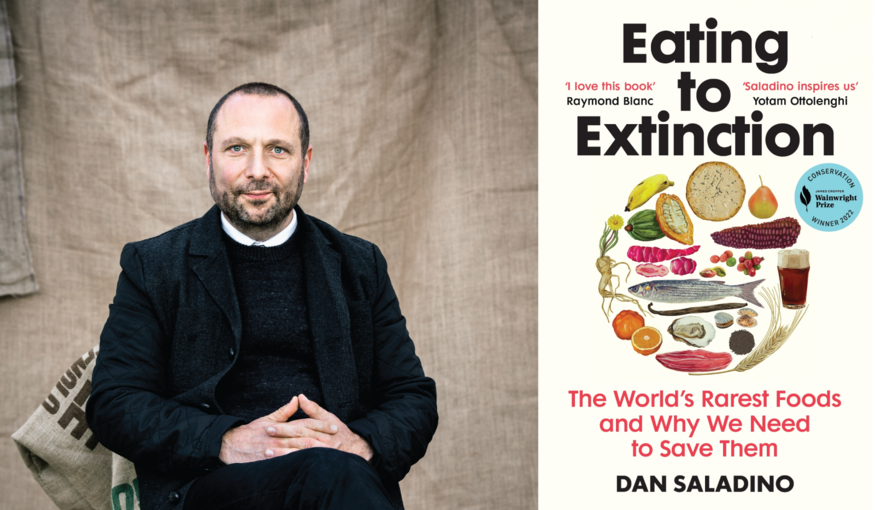
Eating to Extinction
Original title: Eating to Extinction:
The World’s Rarest Foods and Why We Need to Save Them
Author: Dan Saladino (UK)
Imprint: Beiyue Books
Publisher: Wenhui Publishing House
Translator: Gao Yubing
Publication date: November 2023
About the Author
Dan Saladino is a BBC journalist and broadcaster who produces in-depth stories for The Food Programme, specialising in food and agriculture. Over more than a decade, he has visited more than 30 countries and regions, documenting over 40 stories of foods at risk of extinction. He was named one of London’s most influential people.
About the Translator
Gao Yubing holds a bachelor’s degree in economics from the University of Cambridge and a master’s degree from the Journalism and Media Studies Centre at the University of Hong Kong. She previously worked at financial institutions including JPMorgan. Her translations include The Birth of the Magic Pill In the Currents of Whisky and Ink and 52 Blues, among others.