
Why Guizhou Can’t Do Without Sour Soup, and Sour Soup Can’t Do Without Guizhou? | Featured Book Reading & Livestream Preview
Foodthink Says
The following is an excerpt from the new book Fermenting China: Yunnan & Guizhou, from the chapter on Guizhou sour soup. We thank the authors for granting permission.
In Guizhou, the most touching taste of homesickness is undoubtedly that ladle of hot, spicy, tangy sour soup. Sour soup is found throughout the province, but especially in the Qiandongnan Miao and Dong Autonomous Prefecture, where it takes centre stage as an indispensable presence on the local dining table, “Go three days without sour food and your legs wobble as you walk.” This is a local proverb that speaks to the Guizhou belief that life is incomplete without sour food. Sour soup is eaten on ordinary days and is an essential part of important festivals alike, the New Harvest Festival, the Dragon Boat Festival, the Fishing Festival, the Miao New Year… On every joyous occasion, sour soup dishes serve as the fermented flavour that brings people together.

Guizhou sour soup comes in different varieties: white sour soup, which the locals call rice sour soup, is fermented from rice water or noodle broth using microorganisms including acetic acid bacteria, lactic acid bacteria, and yeast; red sour soup is primarily fermented from tomatoes, red chillies, and glutinous rice. Red sour soup made from tomatoes is called tomato red sour soup, while that made from chillies is called chilli red sour soup. In some areas, the two types are fermented separately, then blended together and fermented once more. Although the ingredients differ, red sour soup, like white sour soup, is produced through the mixed fermentation of multiple microorganisms. The key players include lactic acid bacteria, yeast, and acetic acid bacteria, all of which work in anaerobic conditions.
Why did sour soup emerge in Guizhou? Why does it carry such enduring vitality there? The answer lies in the Miao people’s history of development and migration. In the remote era of Yao, Shun, and Yu, the Miao lived in the middle and lower reaches of the Yellow River. Repeated military defeats drove them westward and southward to the Jianghan Plain. After a long period of recovery, the Miao who settled in the Jingchu region gradually rose in strength. The Zhou dynasty saw them as a threat: King Xuan (of Zhou) ordered Fang Shu to ‘march south and campaign against the Man frontier,’ and during the Warring States period Wu Qi used military force to ‘annex the Man and Yue to the south.’ Repeatedly suppressed, the Miao ancestors were finally forced to undertake their most significant migration, continuing south along the Wuling Mountains into remote, little-visited territories, through thorn-covered mountain trails and sheer-cliffed ridges, until they reached the Yunnan-Guizhou Plateau. In the Qiandongnan region, Miao Migration Song, ‘Over Mountains and Across Waters,’ sings: ‘Through a thousand hardships, through ten thousand sorrows. We migrated west to build a better life.’

These Miao ancestors once lived successively in the Central Plains and the Jingchu region, and their culinary culture was undoubtedly inherited across generations from the pre-Qin Central Plains. The Zhou Li (Rites of Zhou), in the Tianguan section under the Hairen (Officer of Sauces), already records many fermented seasonings and preserved foods, indicating that this was a well-established dietary habit of the time. When the Miao ancestors arrived in the Guizhou highlands, the specific geography and climate made fermentation—both as a method of food preparation and preservation—particularly vital. It was the result of generations of Miao ancestors adapting to their natural environment in order to survive. Geographically, the Guizhou plateau is a landscape of towering peaks and deep gullies. Salt resources were scarce and transport routes were blocked, making the cost of bringing in salt prohibitively high. These geographical factors kept the Miao regions of Guizhou in a chronic state of salt shortage. Ordinary Miao families could only make sour foods from their own rice harvests and wild vegetables, using sourness as a flavouring to replace salt. Climate-wise, Guizhou sits on the Yunnan-Guizhou Plateau under a subtropical humid monsoon climate, with abundant rainfall, little sunshine, frequent overcast days, and high humidity. The organic acids in sour soup serve to strengthen the spleen, stimulate the appetite, clear internal heat, and relieve the summer’s warmth.
Today we can explain the fermentation of sour soup through scientific principles, but for the Miao ancestors who had just migrated into the Guizhou mountains, making sour soup may well have been an accident. Miao ancient songs are the great encyclopaedia of the Miao people; many of their customs and traditions can be traced back to them. One ancestral song, in particular, reveals the origin of white sour soup: in the story of Jiang Yang, the Miao ancestor who opened heaven and earth during a great flood, Jiang Yang was bitten by his adversary Lei Gong (Thunder God). Jiang Yang’s son went to visit his wounded father, having specially filled a bamboo tube with rice water. The journey was so long that by the time he reached his father, the rice water had fermented and turned sour. But Jiang Yang, moved by his son’s filial devotion, insisted on drinking it and found that it tasted good. From then on, the Miao people began the tradition of drinking white sour soup, passed down through the generations.
Although in the ancient song white sour soup was accidentally made by Jiang Yang’s son, in Miao households the making of sour soup is a measure of a woman’s diligence and skill. On the stove of every family in a Miao village, there is at least one sour soup jar, used to brew white sour soup. The family’s own glutinous rice is the foundation of the household’s survival—and it can also be used to make white sour soup. The method is actually quite simple: boil the rice-washing water into a clear rice broth, then pour it into a jar to ferment for three to five days. It is not difficult to make, but the key lies in the quality of the water and the temperature. Mountain spring water from nearby or clean stream water gives the Miao sour soup its first layer of quality assurance. And placing the jar on the stove, where the daily fire for cooking provides warmth, aids the fermentation of the sour soup. The climate in the mountains is humid. The indigenous microorganisms dispersed in the air may be invisible, but they are active—interacting with, exchanging with, and co-evolving in each jar of sour soup. In about three days, the fermentation is essentially complete. When scooping out sour soup, it is essential that the ladle be clean and free of oil, because the key to fermentation in sour soup is lactic acid bacteria; poor handling can lead to rancidity and ruin the flavour entirely. When a family’s own sour soup jar runs low, they will borrow a spoonful of their neighbour’s “sour soup mother” to keep the fermentation going—and strengthen the bond along the way. This simple sour soup, white and clear, tangy with a fresh aroma, rich and full-bodied, lingers on the palate. In every single day it transforms into the most generous of flavours: vegetables, tofu, beef, fresh fish, pork trotters… anything can go into sour soup. Especially when the summer heat is unbearable, a bowl of sour soup brings that familiar taste, and immediately the mind settles into calm. Radiating outward from the Qiandongnan region at its heart, sour soup has become a key to Guizhou’s distinctive culinary culture. A land nurtures its own sour soup: though recipes vary slightly, across this land of Guizhou—among the Miao, the Dong, the Shui, the Buyi, and even on Han Chinese tables—the rich sourness that sour soup brings is the undisputed star.

Dietary culture is the finest mirror of its age, and Guizhou’s sour soup has quietly evolved through the long river of history. How did white sour soup give rise to its other star, red sour soup? It is time for the two leading players—tomato and chilli—to make their entrance. The tomato was introduced to China during the Ming dynasty, but for a long time it was grown purely as an ornamental plant. The Qun Fang Pu (Spectrum of Fragrant Plants), compiled in 1621, records: ‘Fànshì (foreign persimmon), also called June Persimmon: its stem resembles Artemisia, growing four or five chi tall; its leaves are like mugwort, its flowers like pomegranate blossoms. A single branch bears five fruits, or three or four, sometimes twenty or thirty. Tied to a trellis, it is most pleasing to look at. It comes from the Western Barbons, hence its name.’ The late Qing through the Republican era was the crucial period when Chinese people learned to eat tomatoes. Attitudes toward the tomato varied across the country—some loved it, others resisted it. Yunnan was a pioneer region in adopting the tomato. The 1937 Shiping County Gazetteer notes that the people of Shiping once mistakenly believed tomatoes were poisonous, but ‘in recent years they have become a fine food.’ For Guizhou, where everyone eats sour, meeting the tomato was perhaps the finest arrangement of fate. The Majiang County Gazetteer, published in 1938, mentions a method of storing tomatoes: “pickled in a jar with salt, garlic, fānjiāo (chilli), and sweet wine”—this must be the very Guizhou delicacy that is now famous for its popularity, ‘red sour soup.’ Chilli peppers did not reach China until the late Ming dynasty. Their earliest name was fānjiāo (foreign pepper), first recorded in 1591 in a book written by Gao Lian, a man from Hangzhou: Zunsheng Bajian (Eight Compositions on Nurturing Life), in which he writes: ‘The fānjiāo (foreign pepper) grows in dense clusters, with white flowers; its fruit closely resembles a worn brush tip, pungent in taste and red in colour—most attractive to behold.’ At the time, literati, scholars, and wealthy merchants in the Jiangnan region treated it as an ornamental flower. At the same time, on account of its “pungent” quality, the chilli was also used as a medicinal herb. In the eighteenth century, the chilli reached Southwestern China, where it was known as hǎijiāo (sea pepper). The 1721 Sizhou Prefecture Gazetteer records the appearance of the hǎijiāo and notes for the first time its function as a salt substitute, marking its emergence as a food. Once the tomato and the chilli formally entered the dining table, their exquisite combination of heat and tang gave rise to Guizhou’s distinctive spicy-sour flavour. And white sour soup, with its long history, began to diverge and evolve. From the late Qing onward, red sour soup has staged an entirely new flavour saga that belongs to Guizhou alone.
Unlike white sour soup, the making of red sour soup is closely tied to local climate conditions and the harvest season of local crops. From September onward, red chillies and xiǎomǐlà (small hot chillies) successively reach ripeness, and the season for making red sour soup arrives. The ideal red sour soup is made from local wild tomato (wild tomato), simmered down. This tomato is fleshy and firm, with a sufficiently sharp acidity. Combined with salt, rice wine lees, chillies, and other ingredients, it goes into a jar to ferment naturally. After ten to fifteen days, the lid can be lifted. The moment the jar is opened, a rich, heady aroma of fermented fruit fills the air. Although it is called sour soup, the sourness is not simple; it is a rich, multi-layered gustatory experience. It is not as sharp as fruit acid, nor as thin as acetic acid. The tang is like a long, slow breath—deep and shallow—blending with the savour of fresh meat until it settles in the stomach. In Guizhou, whenever one is eating a dish with sour soup, a dipping sauce of Litsea cubeba oil is the perfect soul mate. Litsea cubeba oil, also known locally as shāncāngzǐ yóu or shānjījiāo yóu, is a specialty spice. Fermented tomato juice and rice broth form the thick, tangy base of sour soup fish, and with the slightly piquant kick of Litsea cubeba oil, the sour soup achieves a rich, rounded mouthfeel—a seamless pairing of flavours.


Sour soup is not just a delicacy; it is a calling card through which people from outside Guizhou come to know the province. But for the people of Guizhou, it is simply part of life. When the local Miao hold their ancestral rites, sour soup is always on the table. When a daughter leaves home in marriage, her mother sends her with a pot of sour soup—thinking of her, hoping she will often come home to visit. A wanderer far from home, one mouthful of sour soup in a foreign land, and there it is—that deep, aching homesickness… The seasons turn, the years pass, and in every moment of life, sour soup is always there.

Fermenting China: Yunnan & Guizhou
*Click the cover to purchase this book
Ma Junli and Liu Xinzhen
China Light Industry Press
Published August 2025
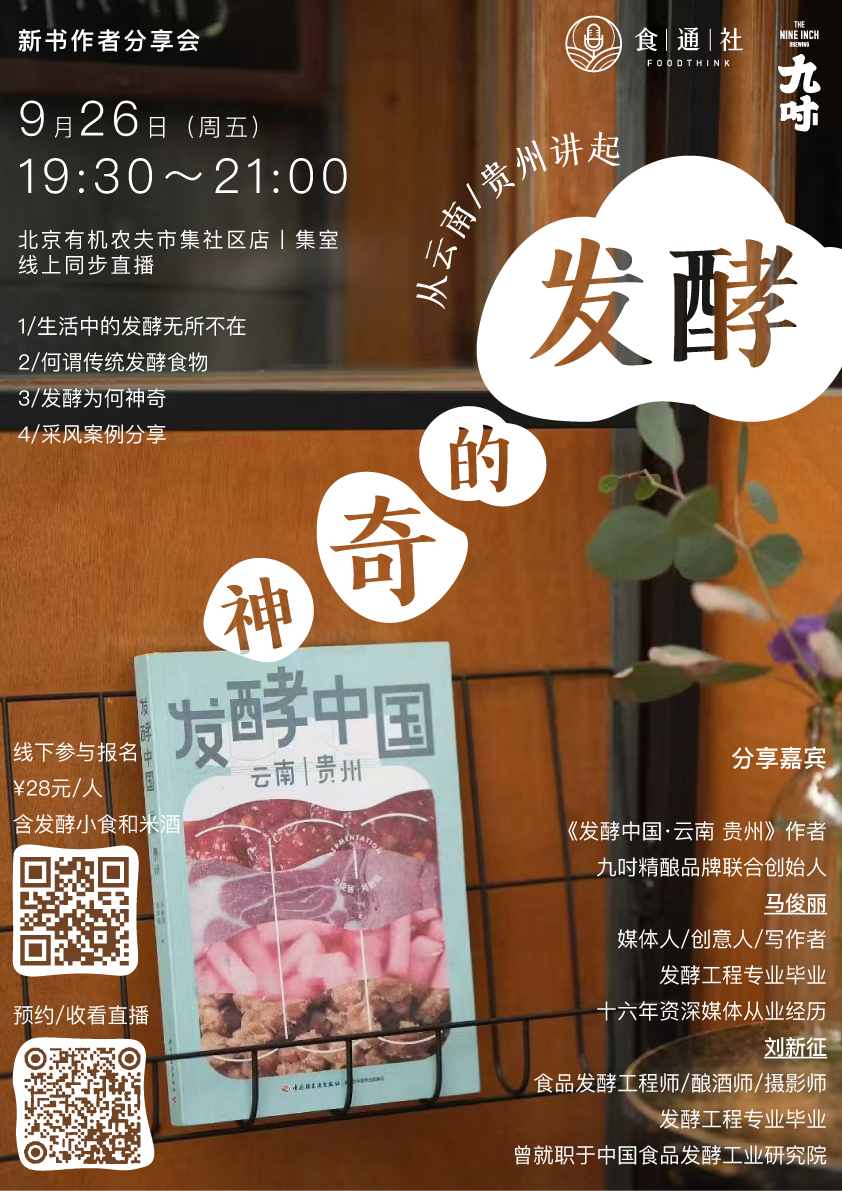
About the Event
◦ What qualifies as traditional fermented food
◦ Why fermentation is so remarkable
◦ Case studies from field visits
About the Authors
The two authors co-founded the Nine-Inch Craft Brewing brand in 2015
In 2022, they co-authored and published The Incredible World of Fermentation and Brewing
In 2025, they co-authored and published Fermenting China: Yunnan & Guizhou

Ma Junli
Media professional / Creative / Writer
Graduate in Fermentation Engineering
Sixteen years of senior media experience

Liu Xinzhen
Food fermentation engineer / Brewer / Photographer
Graduate in Fermentation Engineering
Previously worked at the China National Research Institute of Food and Fermentation Industries
How to Join
Event Format
In Person (Beijing) + Live Stream
Time
Friday 26 September 2025
19:30-21:00
In Person
¥28 per person
Surprise fermented snacks and fermented rice wine will be served on site
Plus fermented foods the authors collected during their field visits
Location
Beijing Organic Farmers’ Market Community Store | Jishi
Lixiang, Sanyuanqiao, Chaoyang District, Beijing
A book signing will take place on site
*In-person spots are full; welcome to watch the livestream online
How to Join Online
No registration is required to watch the livestream. Simply set a reminder for the broadcast on the Foodthink WeChat Channels account.
and join the Foodthink discussion group
Scan the QR code below to add Shitongjun on WeChat
Please add the note “分享会” (Sharing Session) to join the event discussion group
If you are already in the Foodthink community, no need to add again

About the Lianhe Creative Programme
Ah-Mei the Cleaner, Who Just Wants a Proper Meal | The Wage Worker’s Table
In Malaysia, Chinese Merchants Only Want Grade A Durians
“Fake Meat” Ousts Real Meat: Herders, the Table, the Amazon
Watermelons Guaranteed Sweet, Growing Them Guaranteed Bitter
From Mountain Yao to “Heaven-Chosen Mushroom Picker”: A Terite Mushroom Sparks a Foraging Frenzy
Poster: ZX