
72 Hours of Torrential Rain: Washed-Away Rice Paddies, Interrupted Lives

Foodthink Says
First came a once-in-60-years drought. From last November to this April, Guangxi’s average rainfall was nearly 70 per cent below the long-term average for the same period — the lowest on record since complete meteorological data began in 1961. Severe drought struck some areas, affecting 2.38 million people.
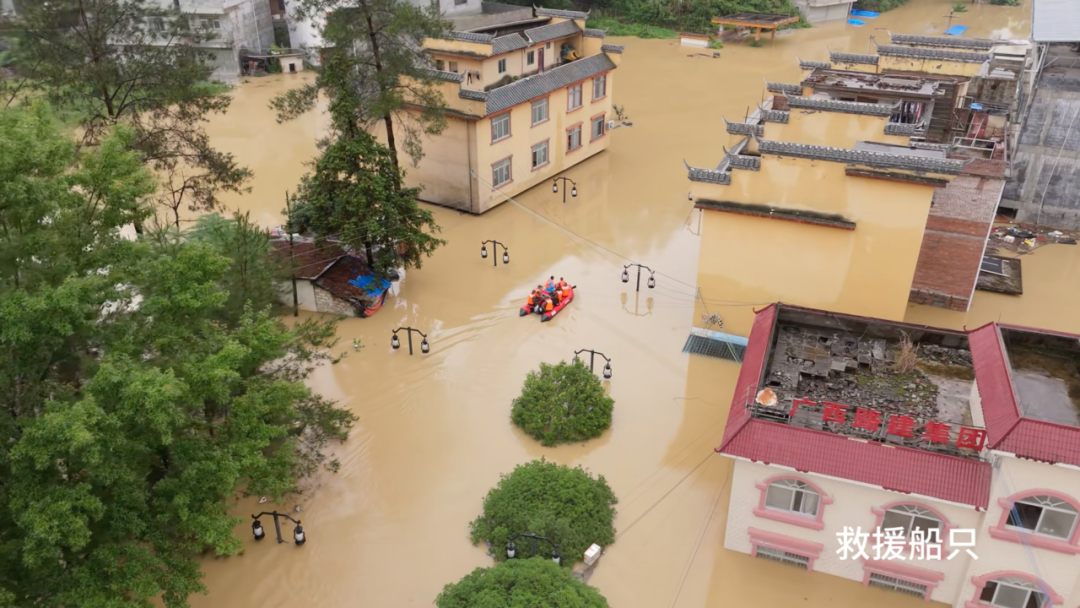
Once the flood season arrived, the drought turned to flood. Since 18 June, the Liu River basin has been hit by sustained, widespread heavy rainfall, with Liuzhou, Hechi, Baise and other areas experiencing heavy to very heavy rain and extreme downpours in some localised spots. Among the farmers in Hechi and Liuzhou known to Foodthink, several have been struck by the flooding — water and power outages, submerged rice paddies, poor pollination in fruit trees — disruptions that go beyond daily inconvenience and are seriously threatening this year’s livelihoods.
As climate change accelerates — with rising temperatures and increasing atmospheric moisture — the likelihood of an abrupt shift from drought to flood will only grow. Soil compacted by drought absorbs water even more poorly, so when torrential rain follows, flooding and landslides become more likely, and such events are even harder to forecast.
Foodthink has compiled first-person accounts from four people who lived through the disaster. Let us hear what they experienced and what they make of the flooding.

Heli Village, Sanjiang County, Liuzhou, Guangxi

The rain started here on 20 June — two days and two nights of torrential downpour. Water and power went out, there was no mobile signal, and we huddled in the dark at home, too afraid to go outside, feeling utterly agitated. Some people were so worried they put on straw hats or took an umbrella just to check on their rice paddies and fish ponds.
In all my life, the last major flood I remember was in 1996, but this time is even worse. Our mountains here are quite high, reaching up to 800 metres in elevation. Trees and rocks came crashing down. Entire patches of the tea plantation slumped in landslides, and the debris washed further down, destroying roads and farmland. It was a sight too dreadful to bear.
Every household has a small fish pond. We raise carp and grass carp ourselves, to eat when guests come during festivals and holidays. Now all the fish in the village have been washed away. At least the government has arranged agricultural insurance for rice paddies covering the whole village. They’re now asking us to take photos of our own fields, hand them in to the village committee for tallying, and hopefully the insurance company will pay out.

Once the rain eased, the first priority was to restore the water supply. The village’s source sits up on the mountain at 500 metres elevation and had been washed away too. The water source was built up there because there’s no farming on the slope, so the water is cleaner. The village had a small reservoir made to collect the spring water, ran two or three pipes down, passed it through two sedimentation tanks, and then distributed it to each household by pipe. The whole water-supply system runs along a mountain ravine, but the entire ravine has been scoured clean to bare rock. The reservoir has been destroyed, and the pipes — well, not even a trace of them remains.
Thank goodness, last year the villagers pooled their own money and labour to repair two water sources at the foot of the mountain. These two backup sources have become critically important now. Because the droughts have been so severe in recent years, we dug out some old mountain spring wells, repaired them for use, and built a timber pavilion over each one. That way, when villagers are going up and down the mountain for work, they can rest, have a drink, and the water can also serve as emergency irrigation.
When the initiative to repair backup water sources was first proposed last year, villagers said the drought was so bad that any extra security was welcome — and that in a major flood like this, the sources would come in handy too. Over the past couple of years, we’ve all come to realise that the climate is going haywire: it’s getting drier and, at the same time, floodier.
This storm knocked the pavilions to pieces, leaving them twisted and crooked. The villagers were first on the scene to clear out the wells. Thank goodness the water wasn’t too muddy. Then we rigged up some scrap pipes to divert the water rushing down the ravine into our homes for daily use. The day before yesterday we spent a full day going up the mountain to assess the damage and compile the details, then made our way to the county government’s water affairs bureau to ask for help. They said it wasn’t just our village — many townships are in the same boat. A lot of people have applied for relief. They’ll collect and compile the data, but they can’t fix things quickly.


In truth, we’ve grown accustomed to the droughts over these past years. The first half of this year was particularly dry. When it was time to transplant rice seedlings, there was no water to level the paddies. Those sources were barely enough for drinking. Even the drinking water was sometimes running low, let alone for irrigation. Each household had to take turns waiting for water to arrive so they could rake and level their field. The water would come down to your place first, then trickle on to mine.
We’d only just managed to finish transplanting, and then the flood swallowed most of it up. All that work went to waste. Each family here doesn’t have much land to begin with — we’re mostly self-sufficient. I grow a bit more than most. A few other villagers farm with me, and together we cultivate over ten mu of eco-rice that we sell into the town. Now four or five mu of that land have been washed out, submerged, or buried under silt and rubble that smothered the seedlings. At least the remaining five mu sit on higher ground, just where the floodwater didn’t reach.
When you face a disaster like this, there’s really nothing you can do. The fields that were washed away or buried in mud can’t be saved. I plan to go check on the flooded fields once the water recedes and see if I can straighten up the seedlings. Even saving a little is something.

It’s not that there’s absolutely nothing that can be done. Twenty or thirty years ago, our hillsides were covered in natural forest. But then, being so poor and needing to develop an industry, everyone cleared land to plant Chinese fir. Now the hillsides are mostly Chinese fir with little mixed woodland, and villagers have come to realise that severe droughts and floods are linked to this monoculture. The elderly folks say that in a mixed forest, with its diversity of narrow-leaved and broad-leaved trees, the pace at which they absorb and release water differs. Now it’s all Chinese fir, so they all absorb water at the same time and release it at the same time. In drought, they all draw moisture in; in rain, once they’re saturated, they all let it go at once — so when a flash flood builds up, it comes on incredibly fast.
In recent years we’ve started planting native, diverse species around public spaces, along roadsides, and near water sources on our own initiative. Hopefully it’ll make a difference.

Lihu Township, Nandan, Guangxi

It rained heavily all day last Thursday. Torrential rain has always brought flooding here, so we were used to it and didn’t think much of it. But I never expected the water to rise so fast this time. As far as I can remember, this is the most violent flood we’ve ever seen.
I heard the upstream reservoirs had released their water. Our area sits low and is karst topography, with an enormous number of underground caves. After this rain, everyone says they finally understand why it’s called Lihu. The underground rivers all connect to each other, and in our Lihu there are many outflows and inflows. Once the subterranean rivers surge, water gushes up from below.
This time the areas mainly flooded were Lihu Community and Badi New Village. My home is in Lihu Community. The street runs from one end to the other on a long, steep slope, and ours is in the middle, at a relatively higher spot, so it wasn’t flooded. Everything below the midpoint was basically underwater. An auntie of ours lives at the bottom end of the street. The river in front of her house is usually dry, but this time it turned into a major flood.
Auntie’s husband and her two eldest daughters are working away from home. Only she and her youngest daughter were at the house. The government issued an evacuation notice and set up a central shelter in the school’s dormitory building. But the two of them couldn’t bear to leave the things at home, so they kept moving belongings up to higher ground.
Our area is a White Pants Yao settlement. The women make their own ethnic clothing by hand. Auntie made several sets of ceremonial dress for her three daughters — they wear them to the New Year fair, when a relative passes away, and at weddings. Making one set of ceremonial dress costs a great deal for the accessories, and it takes years of hand-sewing to complete. During those two days of torrential rain, the two of them carried all the dresses up from the ground floor to the fourth. At night, when they were exhausted, they simply fell asleep right there beside the clothes.

At one o’clock in the morning on Saturday, watching the water still rising, the two of them finally decided to leave. But all the neighbours had long since evacuated. They wrapped themselves in plastic sheeting, went out through the back door on the second floor, braved the torrential rain, climbed up the hill to find a wild path, and walked to a relative’s house three kilometres away — roughly forty minutes’ walk. I said to them, “You two going out that late — isn’t that terrifying? Aren’t you scared?” They said, “We’ve got each other, so we’re not afraid.”
The day before yesterday during the daytime they came to stay at my house. They kept worrying about the dresses, regretting that they’d only managed to get them up to the fourth floor — if only they’d made it to the fifth. They were so upset they couldn’t sleep all night. Auntie phoned her husband, who’s working in Hunan. But both roads out (one towards Libo in Guizhou, the other towards Nandan county seat) had been cut off. Her husband made his way back from the Nandan direction — apparently he climbed the mountain and went all the way around the big hill before he got home.
The moment the rain stopped on Sunday, they went home and found the water had only reached the second floor. The dresses were intact, and they were overjoyed. If the heavy rain had continued for another day on Sunday, my house would surely have been flooded too.

The government brought rescue supplies by inflatable rescue boat: vegetables, water, and generators, because the power had been out for two days. By yesterday at midday, electricity had been restored on the street, but there was still no water. I took a 5-kilogramme bucket to a neighbour’s place at the top of the street and filled a few buckets to bring back for cooking and drinking. But then the top of the street ran dry too, so I had to go up the mountain to my mother’s house to get water. There was still water up there because the supply system feeds into a high reservoir first, then distributes to individual households. The reservoir still had enough.
A friend runs a restaurant on the street. Last Friday evening we were having an event and had booked dinner at their place. When I went back to return the pots and bowls, the restaurant was empty, so I went to check the kitchen. They were all down below moving things — the water was already up to their knees. The basement had chickens and pigs, all submerged. The chickens were easy enough to move, but they’d fattened those pigs up so much — each one was running to 200 to 250 kilos — and you’d have to herd them up a very steep staircase. I don’t know how they could have moved them. We’d even said, “We’ll come have breakfast at your place tomorrow morning.” The next day my husband said, “Forget it — everything’s flooded, the roads are cut off, it must have gone right up over the shop.”
Badi New Village was flooded too. Because it sits low, the new village floods every year. People used to live up on the mountain tops. I’m told that around 2008, after disasters such as ice damage and falling rocks, the government organised a phased relocation. But after moving down to Badi New Village at the foot of the mountain, people didn’t stay long before heading back. The houses are very small, and they’re far from everyone’s own land. It’s inconvenient to grow vegetables or keep chickens and pigs, and in the countryside you still need to gather firewood. We also have weddings and funerals, and when you need to call relatives over, the houses in the new village at the foot of the mountain are too small. We have to sing wedding banquet songs, and you can’t even fit a single long table. So everyone went back and built houses next to their own land up on the mountain.
Huaili Village, Lihu Township, Nandan, Guangxi

I arrived in Huaili Village on 11 June and was staying at the White Pants Yao Eco-Cultural Museum. This is my second time here researching the White Pants Yao’s mulberry silkworm culture. During my first week, I was helping villagers tend their silkworms, which were in the silk-spinning stage. Thank goodness it didn’t rain those few days. The villagers say that if a thunderstorm comes while the silkworms are spinning, the quality of the silk deteriorates, and the mulberry leaves they are fed must be completely dry.
It started raining just two days after the silkworm rearing was over. The evening of 20 June brought particularly heavy rain, and the village’s ethnic square was half submerged. In the small hours, the museum’s circuit breaker kept tripping, and then the power went out entirely. At first I thought the museum’s electricity meter had been flooded, but later, chatting with the villagers, they all said the substation had been flooded — and they had never seen the water reach such a height before.

On the afternoon of the 21st, Sister He, a staff member at the museum, brought her whole family over to stay. Sister He’s family runs a hardware store on the street; the area is low-lying and was hit hardest by the flooding. When the water started rising on the 20th, they moved products from the first- and second-floor shelves up to the third and fourth floors, working until four in the morning the next day, but it was no use — the water would reach the ceiling sooner or later, so they had no choice but to come and stay at the museum.
The whole township was without power. If you needed electricity, you had to go to the canteen at Lihu Primary School or the health centre to charge your phone. On the evening of the 21st, I had nothing much to do, so I walked with Sister He and the others to Huaili Dazhai, a friend’s place about a kilometre away. The solar street lamps along the way were actually still working.
No electricity is one thing, but you cannot go without water. There is a storage reservoir behind the museum, and villagers from several nearby hamlets come here to draw water. We had no trouble getting water — Sister Lüfen even came to the museum to do her laundry.
At half past eight on the morning of the 22nd, the floodwater had reached the gate of the township government office. When I passed by after three in the afternoon, the water had receded by at least thirty or forty metres. Volunteers from the township government were helping to clear the streets; some were in protective suits disinfecting. Sister He and her family went back to the street, constantly splashing the standing water out of the shop. Once the water had gone, a thin layer of silt was left on the ground.
Yaruo Hamlet, Laren Town, Du’an County, Hechi

My farm is in Yaruo Hamlet, Laren Town, 122 kilometres from the Du’an county seat and over 160 kilometres from Lihu Township, Nandan. We don’t have any big rivers here, so it rarely floods — unlike Sanjiang County, where Afu is, which sits downstream of the Rong River (Editor’s note: around the same time, Rongjiang in Guizhou was hit by a once-in-30-years flood). All my pomelo trees are planted on slopes with good drainage, and Laren Town has never experienced rain severe enough to trigger a landslide. Maybe it’s a feng shui gem of a spot.
Although we didn’t suffer flooding this time, it rained for over a week straight, washing all the passion fruit pollen away. Without pollination, the flowers won’t set fruit. I started growing passion fruit last year. The weather back then was the complete opposite of this year — the first half had plenty of rain, and I only got the seedlings in around 1 May. Planting late naturally meant a smaller harvest. I managed just over 1,000 jin from a little over one mu.

The first half of this year was dry. The new passion fruit seedlings went in, and we had to wait until May for rain to finally come. The weather forecast says more rain is on the way. There’s nothing to do but wait for it to stop, then cut back the passion fruit branches whose pollen has been washed off, and let them keep flowering. Passion fruit keeps growing, so there should be a batch ready for market next month.
Having had a wet first half last year, I was expecting heavy rain, but I really wasn’t prepared for a drought. The dry spell started in the second half of last year, by which time my fruit was almost all harvested, so I didn’t worry too much. Who would have thought the drought would go on from last year all the way into this one? My harvest from over two mu of corn is definitely going to be halved.
I started farming in 2013, and this is the first time I’ve experienced a drought this severe. It didn’t rain until mid-May this year. If it had been two weeks later, the corn would have been lost for good. When the weather is too dry, you can’t apply liquid fertiliser — I mix biogas-fermented pig and cow manure with water and pour it over the crops. No water, no fertiliser, and the crops just won’t grow. I also planted a few mu of small yellow ginger, which turns out to be quite drought-tolerant. I planted it in mid-March, but it’s been sprouting very slowly. If it could get another month of growth, the rhizomes would be considerably bigger.

It was not until 23 June that I gave the fruit trees their third spray of enzyme preparation. In previous years, by this time I would already have done five rounds. The recent drought combined with high temperatures affects the microbial activity of the enzyme preparation, so I have been slow to spray. I also heard people in the next village say the drought over there was so bad that even spider mites and thistle mites were eating mulberry leaves — something I have never heard of before.
When Extreme Weather Becomes the “New Normal”
When extreme weather, amplified by climate change, becomes the “new normal,” how exactly should we respond? I hope the first-hand flood experiences of our Guangxi farming friends will help readers grasp the real and complex impact of climate change on agriculture and rural life.
Every fraction of a degree that temperatures rise is a disruption and reordering of the life rhythms of all living things on this earth. People living in cities try to shield themselves from extreme weather with more energy and infrastructure, but in doing so they intensify greenhouse gas emissions while numbing their own sense of the climate — a frog-in-warm-water tragedy.
And what about the farmers, who are most sensitive to climate change — and also the most helpless, the most silent? What are they to do?