
Mulch Film Pollutes Farmland: Competent Authorities’ Absurd “Jurisdictional Duel” | Republication and Follow-Up
Foodthink Says
Two days after publication, WeChat deleted the article on the grounds that “a complaint had been received for violation of the Provisions on the Administration of Information Services Provided by Internet User Public Accounts”, and articles published by Foodthink on other platforms were subsequently taken down one by one. In view of the public attention the article attracted, and in order to preserve a basis for public discussion, the specific location has been withheld and the article has been republished with information retained to the fullest extent possible.
Although the article drew attention from relevant authorities after publication, there has been no substantive progress in remediating the pollution or pursuing accountability. At the request of the local sub-district office, the processing enterprise nearest to the affected farmer removed its processing equipment and raw materials from the farmland, then carried out ploughing of the temporary processing site and stockpile yard, burying the mulch film fragments beneath the soil. However, two peanut haulm processing enterprises in the same village are still operating. As of today, the local Ecology and Environment and Agriculture and Rural Affairs departments have still taken no enforcement action against the enterprises in question, citing an unclear division of authority. The affected farmer fears that as traces of processing and evidence of soil pollution disappear, pursuing accountability will become ever more difficult. So far, only the soil on the victim Old Li’s contracted land has been sampled and submitted for testing; soil remediation has yet to begin.
I. A “Mulch” Disaster from the Sky
Old Li can only gather a few workers to pick up the mulch film fragments in the cowshed. ‘The film is so thin and fragile – it looks like substandard ultra-thin mulch film.’
If left untreated, the mulch film will be mixed into the soil during ploughing, not only hindering this season’s crop but also rendering the film permanently unrecoverable. It is virtually impossible to break down and can only fragment very slowly into plastic pieces within the soil, potentially even being absorbed by crops in the form of microplastics.
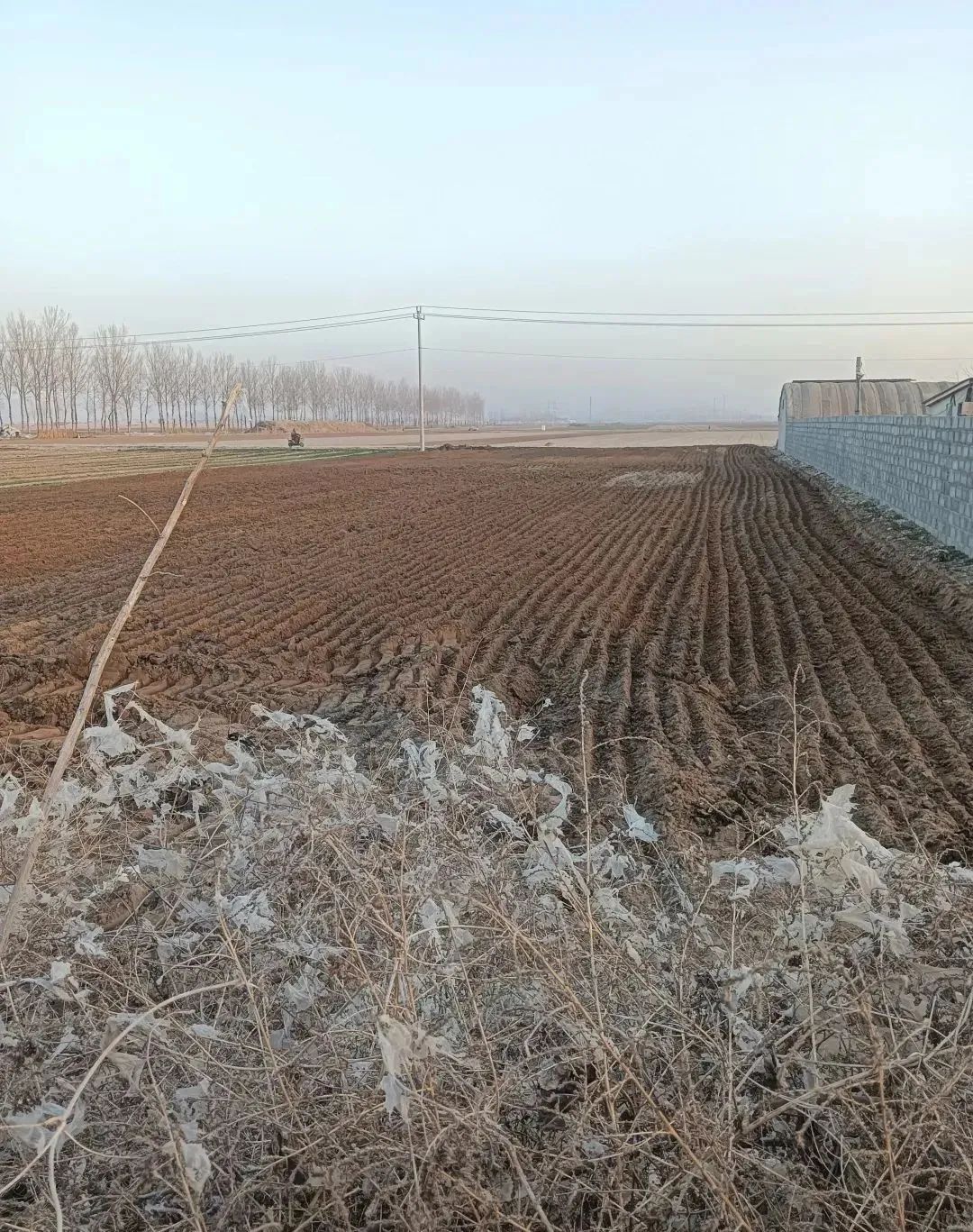
How has Old Li, who does not use mulch film himself, become a victim of mulch film pollution? It turns out that since 25 December last year, a temporary processing plant has been set up just 100 metres from the edge of his field. This small factory, covering only a few tens of square metres, buys up large quantities of peanut haulm from surrounding farmers, grinds it down and processes it into roughage for livestock feed. Because the mulch film was not removed when purchasing the peanut haulm, it remained tangled around the haulm and was fed into the machines together. Once shattered, the mulch film was swept by the wind onto neighbouring farmland – including Old Li’s.
The processing plant was erected on a temporary basis only after the peanut harvest, on land that had formerly been this village’s permanent basic farmland. Due to the rudimentary setup, there were no additional protective measures at the processing site, allowing mulch film to scatter in all directions.
On 1 January 2025, Old Li called the 12345 mayoral hotline to report the pollution. Since then, he has also submitted written reports to the local sub-district office, Ecology and Environment Bureau, Agriculture and Rural Affairs Bureau and other departments to bring the matter to their attention.
More than two months have passed since the incident began. It is nearly time to sow spring wheat. Old Li also plans to plant peas, garlic, oilseed rape, pak choi and other vegetables, which, once mature, will account for the main share of his annual income. But the mulch film in his soil has long prevented him from sowing, and with sowing season fast slipping away, his livelihood for the year is at stake.


When the processing plant refused to take any measures, Old Li had to pay out of his own pocket, handing two thousand yuan to the village Party Secretary to pass on to the other side. The processing plant then set up a rudimentary screen along the edge of Old Li’s farmland. It had also agreed to fund the village collective in hiring workers to pick up the mulch film that had blown into his fields, but after a few days it came to nothing, with the reason given: “We can’t afford to clean up every single day.” The enterprise is unwilling to halt production, yet as long as processing continues, mulch film will keep drifting in every day. With nowhere else to turn, Old Li can only continue filing complaints with the government.

II. Agriculture and Environment: A “Jurisdictional Duel” at a Distance
In their replies, both stated that the pollution caused by mulch film did not fall within their remit, and therefore they had no authority to take enforcement action against the enterprise in question, which should instead be referred to the other department.

The Agriculture and Rural Affairs Bureau, however, cited only the fourth clause: “The ecological environment departments at or above the county level shall be responsible for supervising and preventing environmental pollution in the recovery and reuse of agricultural film.”
In other words, in the chain of failures surrounding mulch film recovery and the resulting pollution, each department saw only the other’s dereliction of duty while turning a blind eye to its own responsibilities.
Second, the two departments also sparred remotely over a key point: is the mulch film that polluted Old Li’s farmland still legally “mulch film”?
The Ecology and Environment Bureau recommended handling the matter under Article 88 of the Law on the Prevention and Control of Soil Pollution: “Where producers, sellers or users of agricultural inputs fail to recover packaging waste of agricultural inputs such as fertilisers or agricultural film in accordance with the regulations… the competent agriculture and rural affairs department of the local people’s government shall order rectification.”
The Agriculture and Rural Affairs Bureau responded that the feed processing enterprise was neither a producer, seller nor user of mulch film, and therefore “our department has no legal basis for taking action.” It then cited Article 102 of the Law on the Prevention and Control of Environmental Pollution by Solid Waste, arguing that this constituted “solid waste pollution” and should be penalised by the ecology and environment department.
In other words: in this case, what blew into Old Li’s fields was no longer mulch film in the legal sense – it was solid waste.
“Solid waste” refers to materials generated in production, daily life and other activities that have lost their original utility, or that, although not yet depleted of utility, have been discarded or abandoned.
But the Ecology and Environment Bureau played them at their own game, using the Solid Waste Law to outmanoeuvre the Solid Waste Law. It cited Article 64 of the same law: “The agriculture and rural affairs departments of people’s governments at or above the county level shall be responsible for guiding the development of systems for the recovery and utilisation of agricultural solid waste, and for encouraging and guiding relevant units and other producers and operators to lawfully collect, store, transport, utilise and dispose of agricultural solid waste, strengthening supervision and management to prevent environmental pollution.”
To translate: Although solid waste is mine to regulate, agricultural solid waste is still the Agriculture and Rural Affairs Bureau’s responsibility.
Armed with two such replies, Old Li was beyond even tears. He continued to raise the issue through government website messages, hotline calls and other channels. To date, there has been no progress whatsoever.
III. Who Is Really in Charge of Agricultural Solid Waste?
Yet the very fact that discarded mulch film appeared in the processing setting must itself be a consequence of inadequate mulch film recovery in the fields. In 2023, the Chengde People’s Procuratorate in Hebei Province ordered the local agriculture and rural affairs department to fulfil its supervisory duties over mulch film use and recovery after a village’s widespread use of mulch film caused farmland pollution.
The logic of recovery and pollution is simple enough: recover it, and there is no pollution; fail to recover it, and pollution follows. But at the governmental level, recovery falls under the Agriculture and Rural Affairs department’s remit while pollution involves the environment department – the two departments’ responsibilities are like the two sides of a single coin. When a pollution incident occurs, the links each department is responsible for have inevitably both broken down, both bear a measure of responsibility, and both have grounds to step in and regulate.
Yet the status quo is that “both should act” has become “neither will act.” Despite the state having promulgated the Solid Waste Law, the Law on the Prevention and Control of Soil Pollution, the Agricultural Film Management Measures and a whole raft of other laws and regulations, it seems that the more provisions there are, the easier it is for the relevant departments to find grounds for deflecting responsibility.
An expert who studies solid waste noted that the Solid Waste Law’s language on the management of agricultural solid waste is rather vague, leaving the system for managing agricultural solid waste effectively a blank in practice.
Agricultural film, including mulch film, is the fourth largest category of agricultural means of production after seeds, pesticides and chemical fertilisers. Due to a long-standing emphasis on use over recovery, mulch film pollution in China is severe – nearly 300 million mu of land are covered with mulch film each year, with annual usage approaching 1.45 million tonnes, accounting for roughly 75% of global mulch film consumption.
Due to various constraints in recovery technology and equipment, China’s agricultural film recovery and utilisation rate has long remained below two-thirds. In 2017, the former Ministry of Agriculture issued the Action Plan for Agricultural Film Recovery, launching the construction of 100 mulch film management demonstration counties in the northwestern region, with a target of achieving a current-season mulch film recovery rate of over 80% in those counties within two to three years.
Although concrete steps towards addressing mulch film have finally been taken, these apply only to current-season recovery. The cumulative volume of residual mulch film in China has already exceeded one million tonnes.
According to monitoring data published by the Ministry of Agriculture in 2016, all mulch-filmed farmland soils in China show varying degrees of mulch film residue, with per-mu residue reaching 4–20 kg in some localities, and as high as 30 kg or more in individual plots – equivalent to six layers of mulch film. Residual mulch film damages soil structure, impedes crop emergence, obstructs root growth and leads to reduced agricultural yields. No authoritative statistics yet exist on the direct economic losses to agricultural production caused by mulch film accumulated over years across the country.
Additionally, a 2019 paper by Zhang Bin and colleagues at the Research Centre for Rural Economy under the Ministry of Agriculture and Rural Affairs noted that mulch film residue outside state-designated project areas remains a very serious problem, that ultra-thin mulch film is still widely available on the market, and that farmers have little incentive to recover residual mulch film.

Yan Changrong, a researcher at the Chinese Academy of Agricultural Sciences, once estimated in an article that, in order to use peanut haulm as livestock feed after film removal treatment, the processing cost is approximately 30–50 yuan per mu. Yet often no one pays this cost, which means the mulch film escapes into the environment and becomes a significant source of plastic pollution.
When mulch film mixes into animal feed, it has numerous adverse effects on animal health and can even be life-threatening in severe cases, damaging farmers’ livelihoods as well.
Plastic mulch film harms not only the soil and agriculture itself; mulch film blown by the wind also threatens public infrastructure. During the May Day holiday in 2021, a high-speed train on the Beijing–Guangzhou railway line was brought to a halt in the Dingzhou section of Hebei Province after mulch film became entangled with the catenary, causing dozens of other high-speed trains to be cancelled or delayed.
Headlines such as “Mulch Film Halts High-Speed Trains” are merely the tip of the iceberg visible to the public. Staff at both the sub-district office and the Agriculture and Rural Affairs Bureau have told Old Li that there are far too many similar mulch film pollution incidents in the area to manage effectively.
At present, Old Li’s primary demand is for an assessment of the pollution status of his farmland and that of neighbouring farmers, followed by soil remediation based on that scientific assessment – not only the visible mulch film fragments but also the invisible plastic particles.
He said: “I have been persevering in raising this issue, not just for myself but for the neighbouring villagers, and even more for the well-being of future generations. Our generation should not leave our descendants nothing but a scarred landscape.”
For Old Li, going online for help was a last resort after exhausting every other avenue, yet new developments in recent days have made him all the more anxious: after he began appealing to government departments, the enterprise in question stepped up its processing pace, and even more mulch film has been drifting out. He suspects they are trying to process the remaining raw materials quickly and then make a quick exit. Since the processing plant was erected temporarily on farmland, they are free to simply brush off their responsibilities and walk away.

Addressing mulch film pollution requires not only a clear division of responsibilities among government departments, but also well-designed solutions and detailed management measures.
Who will act? What will be done? Old Li needs an answer, and the polluted land needs an answer too.
If you also care about the plastic pollution caused by mulch film
and wish to discuss possible solutions,
you are welcome to scan the QR code to join our discussion group.

With thanks to Zhang Miao, Liu Jinmei, Tian Jing and Zhou Ya
for their assistance during the writing of this article.
Editor: Foodthink