How Much of Chinese Social Life Can One Grand Banquet Table Hold?

Foodthink Says
In “Welcome to the Dragon Restaurant”, Shen Teng plays a Chinese chef who leads a dozen or so children to cobble together a “makeshift troupe” and set up a grand banquet in a foreign land. Pan-frying, stir-frying, braising, deep-frying, iron-pot stew—you can almost smell the wok hei through the screen.
Chinese people love to eat, and they love to eat together. Grand banquets are especially so: a table of dishes carries local produce and delicacies, as well as social ties and the changes of an era. In the eighth issue of Foodthink’s “Eat Well” series, we invited readers to share stories about banquets, and turned memories from every corner of the country into this table of fine dishes.
The stove fire is roaring, and the stories begin with the flavours of home and childhood. Ba ba xi, chi bai jiu, nao re zhuo… different names, each with its own origin, and the character of a place comes to the table.
What exactly is eaten at banquets in different places? Are the dishes hand-prepared by relatives and friends, handed to a village chef team to organise, or simply pulled from bags, heated, and served out in bulk? Red envelopes, seating order, toasts, preaching, face, and one-upmanship—when young people’s sense of boundaries collides with the rules of the banquet table, how many undercurrents churn beneath the merriment? As people leave the villages, banquets move into the cities. Twenty years from now, will grand banquets still exist?
Everyone, please take your seats—we’re ready to begin.
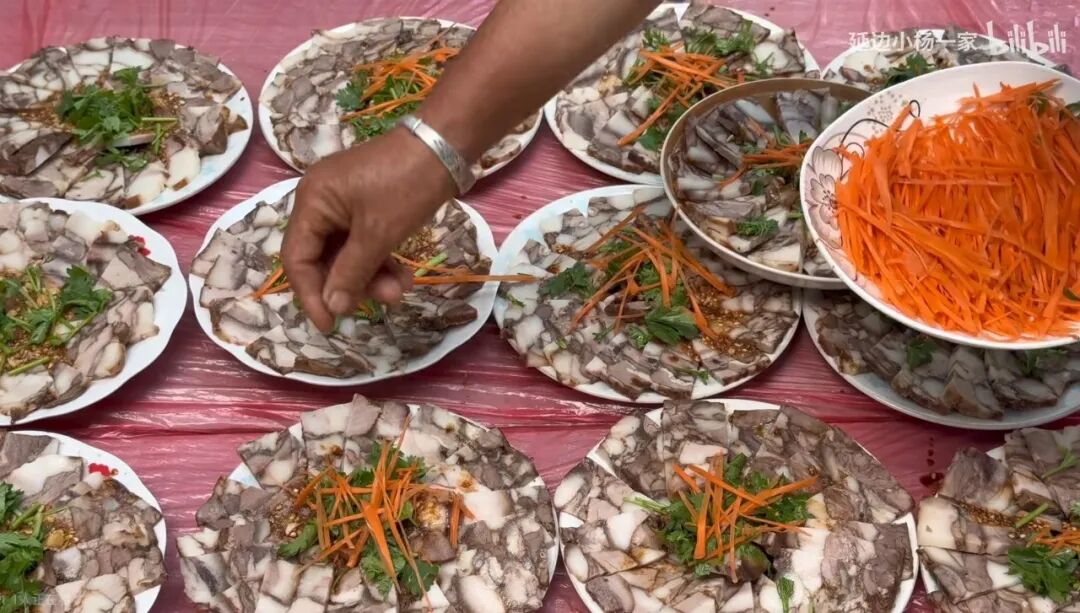
◉ A family-organised grand northeastern banquet, with the dishes being prepared. Image source: B站 UP @延边小杨一家.
The Hometown Banquet
For many people, their first impression of banquets dates back to when they were too short to reach the lazy Susan. Braised dishes bubble in big pots; meatballs fresh from the kitchen are still too hot to eat; and every time a new dish appears on the table, it draws a burst of gasps. Memories of banquets are also memories of home and childhood.
@小刘 (Baoding, Hebei)
I used to love going to banquets. Now, when I think back, it’s all the fish just fried, the big steamed buns fresh from the steamer, and the braised dishes bubbling away. The roast chicken was sent over by a nearby shop, and the peanuts and sunflower seeds were freshly roasted. Although a little burnt and a little hot, it was exactly that taste.
@汤汤 (Xi’an, Shaanxi)
I’m from Lantian. There are famous shao shao ke chefs here, and the cooking is really delicious. You can clearly see how a dish transforms from raw ingredients into a fine one. When there’s a banquet in the village, neighbours and fellow villagers all help each other to pull it off, and the host family prepares towels and soap as gifts for everyone. All the family helping in the kitchen are familiar faces, and when the meatballs are frying, they always let me sneak a bite. When I was little, I thought the bride was the most beautiful person in the world, even more beautiful than the stars in pictures, and we would all jostle our way to the front row to get a look. I don’t have that same feeling anymore.
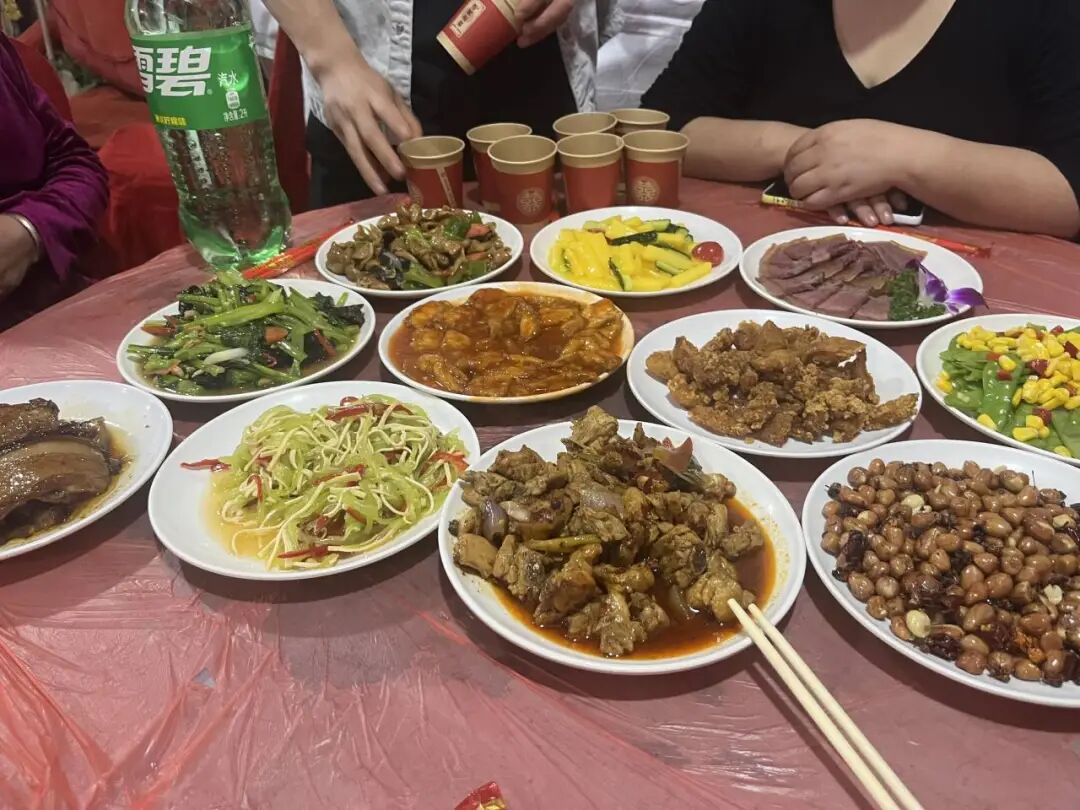
◉ A Shaanxi wedding banquet. Image source: Tang Tang
@鹞鹞 (Sichuan)
The most classic one in Sichuan is undoubtedly ba ba xi, where “ba ba” means an open-air space. On the third day of the Chinese New Year, my family go to my aunt’s home for a banquet. The banquet at my aunt’s home is delicious; the ingredients are all fresh, and my aunt and the relatives helping in the kitchen are skilful cooks. The home-reared free-range chickens are slaughtered on the spot, and the cured pork, sausage, and cured pork trotters are all made fresh that same year; a large pot set up nearby is steaming and stir-frying as it goes, so there is no risk of “pre-prepared food”. Since the guests are all close relatives, my aunt has been very attentive during this banquet. When I was a child, banquets were lively too; we all ran about playing, but I had to keep myself from tearing the plastic tablecloth. My aunt’s family used to have a lot of fields, and after eating we would go out to the field ridges to play with fire and chase ducks, playing all afternoon.
@乐乐 (Harbin, Heilongjiang)
In the past, at banquets, even before the food had been served, from the moment the chopsticks were handed out, people were already looking forward to the delicacies that would soon be on the table, and each dish that was brought out was met with a burst of gasps. The dishes at a grand banquet taste better than those in a restaurant. The guo bao rou and liu rou duan from restaurants in the north-east are, of course, delicious too, but they always fall a little short of the flavour of a grand banquet. I can’t quite put my finger on the reason: is it the chef, the ingredients, or the wok?
@林 (Heilongjiang)
Eating at a classmate’s school-advancement banquet was the most fun. We were seated at a special table, and besides the restaurant’s standard banquet dishes—braised pork belly, pork knuckle, large prawns, and scallops—there were also the things children love: fried chicken, burgers, and pan-fried cold noodles. At the end, a big dairy-cream cake arrived, Can you see what this means to a child with a sweet tooth! The whole class would have loved him to bits! You could also listen to his parents tell funny stories about his childhood, and learn a side of him you would never have recognised from school: it turned out that even this slow-to-warm-up, refined person of his had climbed trees and walls as a child.
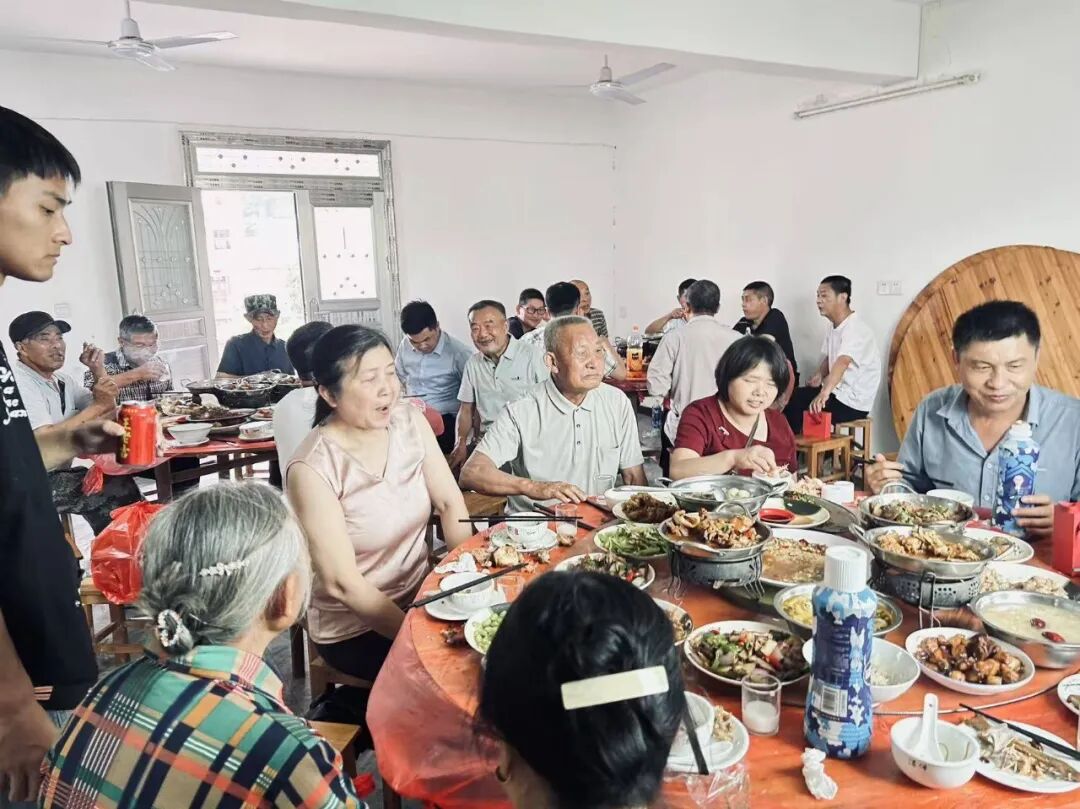
◉ A rural banquet served continuously in Jiujiang, Jiangxi. Image source: Guo Guo
One Banquet, One Local Flavour
Wenzhou has chi bai jiu, Chaoshan has nao re zhuo, and Shaanxi banquets begin early in the morning with a bowl of saozi noodles; in Ganzhou, after the autumn harvest, chestnuts and wild pear come to the table in season, water towns are never without fish, and the Bingtuan people’s steamed buns are laced with memories of past hardship and later sweetness. China is so vast that the banquet dishes from every corner of the country, laid out one after another, make a food map.
@汤汤 (Xi’an, Shaanxi)
🍝 Shaanxi people can’t go anywhere without a bowl of noodles. In our area, for weddings, funerals, and other family ceremonies, the morning meal must include a piping hot bowl of saozi noodles, with a topping made from a variety of finely chopped ingredients: Chinese chives, daylily, wood ear mushrooms, tomato and egg, diced meat, and radish. The noodles are usually hand-rolled too, sliced thin to the width of Chinese chive leaves and topped with vinegar and chilli oil—it’s so delicious, you can’t even describe it! The last dish at the banquet is meatball soup, and once the meatball soup is eaten, it is over, symbolising completeness and fullness. Shaanxi also has a tradition of eight cold dishes and eight hot dishes; no matter how cold it is, the eight cold dishes must come first!
@超超 (Tianjin)
The most memorable is a dish, “su hui er”—a stew of assorted vegetables, mainly brined tofu, red starch sheets, tofu skin, coriander, and minced ginger, and, most importantly, flavoured with fermented bean curd. The preparation varies slightly across the suburban counties, and nowadays it can basically only be eaten at this kind of continuous banquet.
@韩柳 (Shihezi, Xinjiang)
Shihezi is a Bingtuan city, with migrants from far and wide, and its food is a blend of northern and southern cuisines. In my memory, banquets were mainly made up of stir-fried dishes, with some local Xinjiang specialities mixed in. The most distinctive dish is called jun ken jia mo (probably that’s the name); in fact, it is large round steamed buns filled with chilli-stir-fried meat. Its origin is said to be that it was, during a period of material scarcity, the most delicious dish the Bingtuan people of that time could think of, and so it carries a hint of “remembering past hardship and later sweetness”.
Shu Guo Qian (Ganzhou, Jiangxi)
Before I left my hometown, I could eat at banquets three to five times a year. The autumn harvest banquets were the tastiest, because of the new produce, wild chestnuts, steamed wild pears, sand-fried tangpi, hairy chestnuts. These ingredients needed no special seasoning and could be put straight onto the table. The weather was mild, and appetites were just right. Banquet dishes also varied by season: in winter, you could have braised bamboo rat; in summer, fried purple sweet potato balls, fried fish slices, and fried small crucian carp.
@娜娜 (Wenzhou, Zhejiang)
In Wenzhou, we call it “chi bai jiu”. When I was a child, banquets were mostly held in the family house or courtyard back home, and the dishes served were all Wenzhou specialities. For example, Wenzhou-style pickled radish, which we call radish, is sweet and sour and very tasty. There is also sesame-oil duck and zha yang, and a fried fish for dipping in a sweet sauce like condensed milk.
@鹞鹞 (Sichuan)
I remember a dish, pork intestine stewed with peas, that was simply exquisite. The peas and intestines were stewed very soft and full of flavour (ba, a Sichuan dialect word meaning soft), and you could tell it had been made by a highly skilled veteran chef. You simply can’t find a dish like that anywhere else.
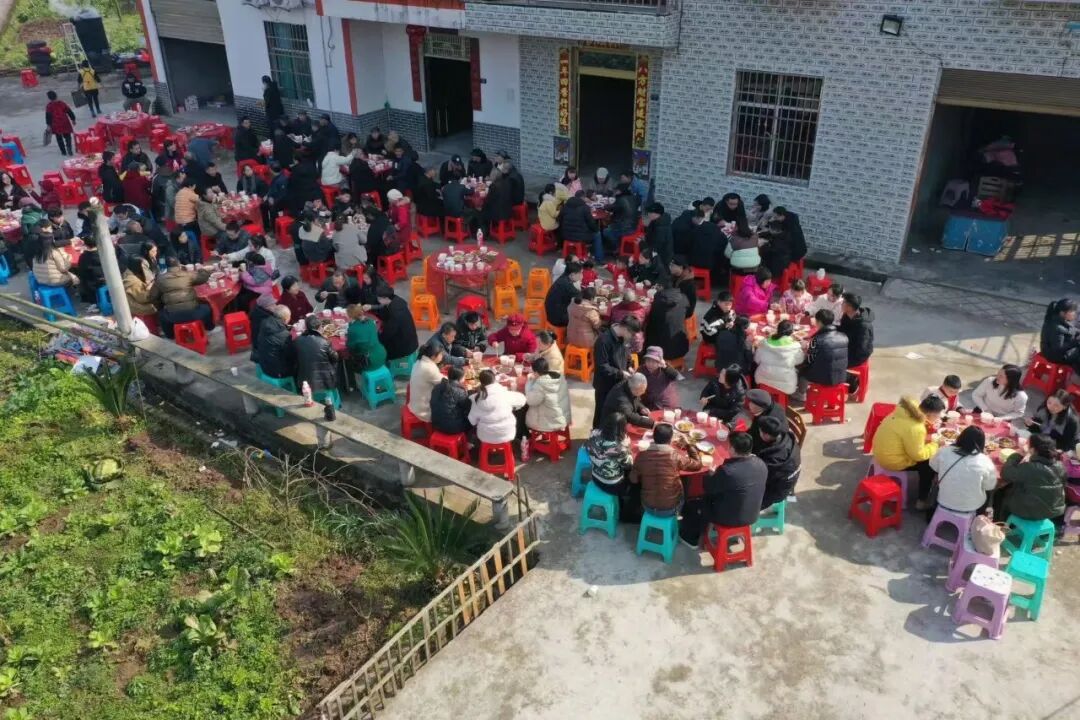
◉ After ancestor worship on the first day of the Chinese New Year, fellow clan members of the same surname in the village set up a ba ba xi near the ancestral graves. Image source: Yao Yao
@Morry (Central Hangzhou, Zhejiang & suburbs near Jiaxing)
We have a dish called “rou geng”, which is a dialect term. The recipe is actually very simple: bamboo shoots (or water bamboo shoots) and chicken gizzard are essential. Other ingredients are more optional, such as shiitake mushrooms and dried tofu. All the ingredients are cut into very small dice, about half a grain of rice in size. Then a broth is made, thickened with a very thick cornflour slurry, and the seasoning is left to taste. Although the flavour is quite an ordinary savoury one, both the chicken gizzard and water bamboo shoot have a satisfying chew, and the texture is lovely.
@阿青 (Chaozhou, Guangdong)
I was born and raised in Chaozhou. In our area, eating at a banquet is called “shi zhuo”, and when the organiser sets one up it is called “zuo zhuo”. There is a rather special shi zhuo activity in the Chaoshan region, called “nao re zhuo”. Every year, during the nao re, the village organises a group of people to bring out the deities they worship for a procession. People form drum and gong troupes, folk music ensembles, and flag-bearing teams to escort them, which is the lively deity procession. On the day of the nao re, most households in the village set up a nao re zhuo, entertaining their relatives and friends; the more people, the livelier it is, to ensure that everyone has better luck in the coming year. The nao re deity procession also draws on local geographical conditions and agricultural resources, for example, Xikou Village in Linxi Town historically produced sugarcane in abundance, so sugarcane is the main prop for the deity procession on the sixteenth day of the first lunar month each year. Villagers cut down sugarcane, hang lanterns from the tops of the stalks, and parade with the lanterns, also known as “chuan zhe xiang”.
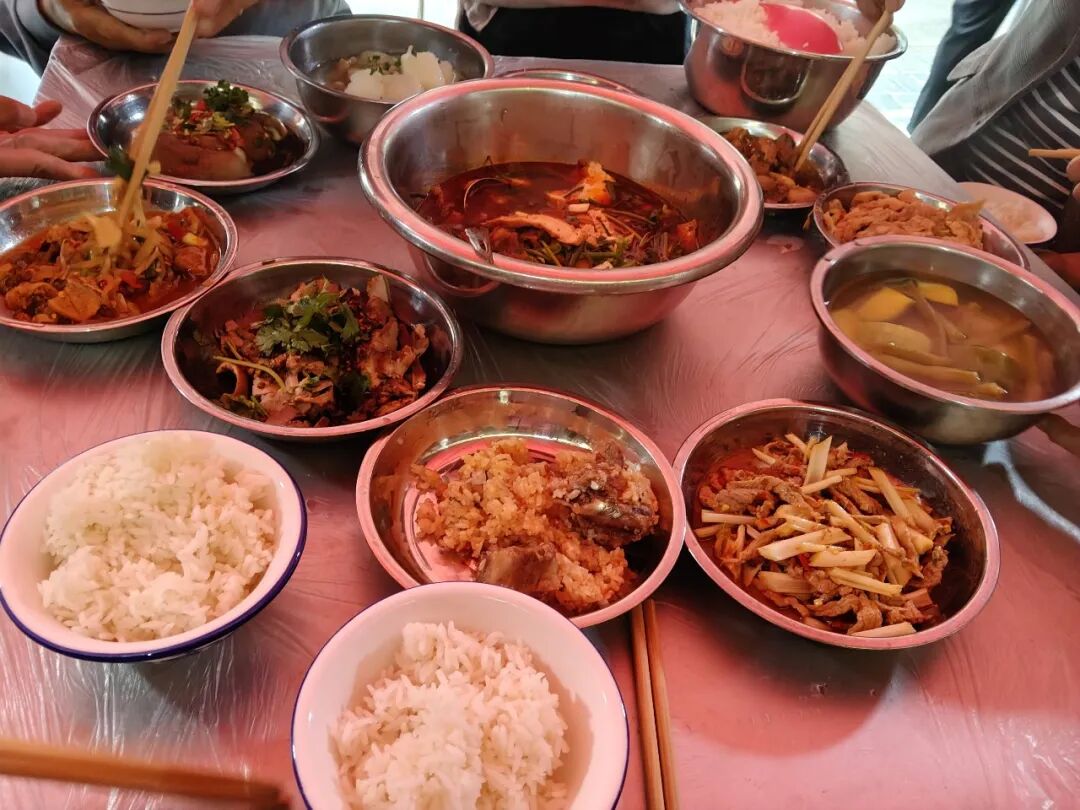
◉ A banquet in Renhuai, Guizhou. Image source: Xiao Li
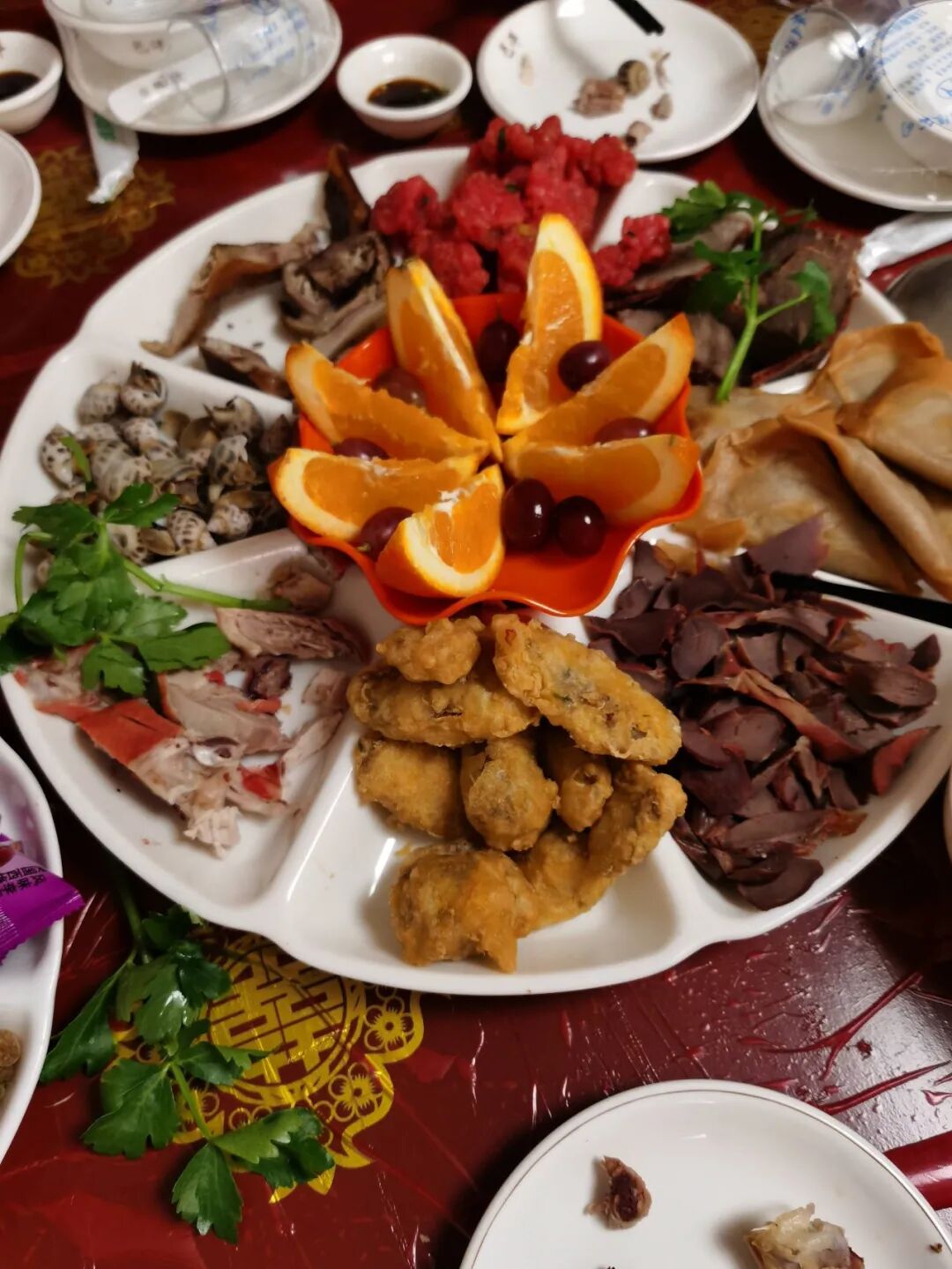
◉ A platter of braised and fried dishes at a grand banquet in Fuzhou. Image source: Lu De
The Evolution of the Banquet
Handmade, outsourced, or pre-prepared? A banquet itself lasts only a few hours, but preparation starts well in advance. From neighbours lending a hand, to paying for hired help, to the prevalence of pre-prepared food, the relations of production and modes of labour behind one banquet table have changed several times over.
@果果 (Jiujiang, Jiangxi)
In my childhood, material goods were scarce, and banquets were the only time to eat more and better food. In rural areas, banquets were always a matter of neighbours and relatives helping one another, with one family providing the bowls and chopsticks and another providing the stools, everyone washing, chopping and stir-frying the vegetables together, and the atmosphere was lovely.
@Rita (Hunan)
Last year my father held a birthday banquet, and I helped out with some of it. Back home now, people generally hire a village cook to run a banquet. There is a dedicated team, usually three people: one chef and two helpers. The chef is usually a man, and the helpers are women. It really does save trouble and is convenient, but I always feel like something is missing.
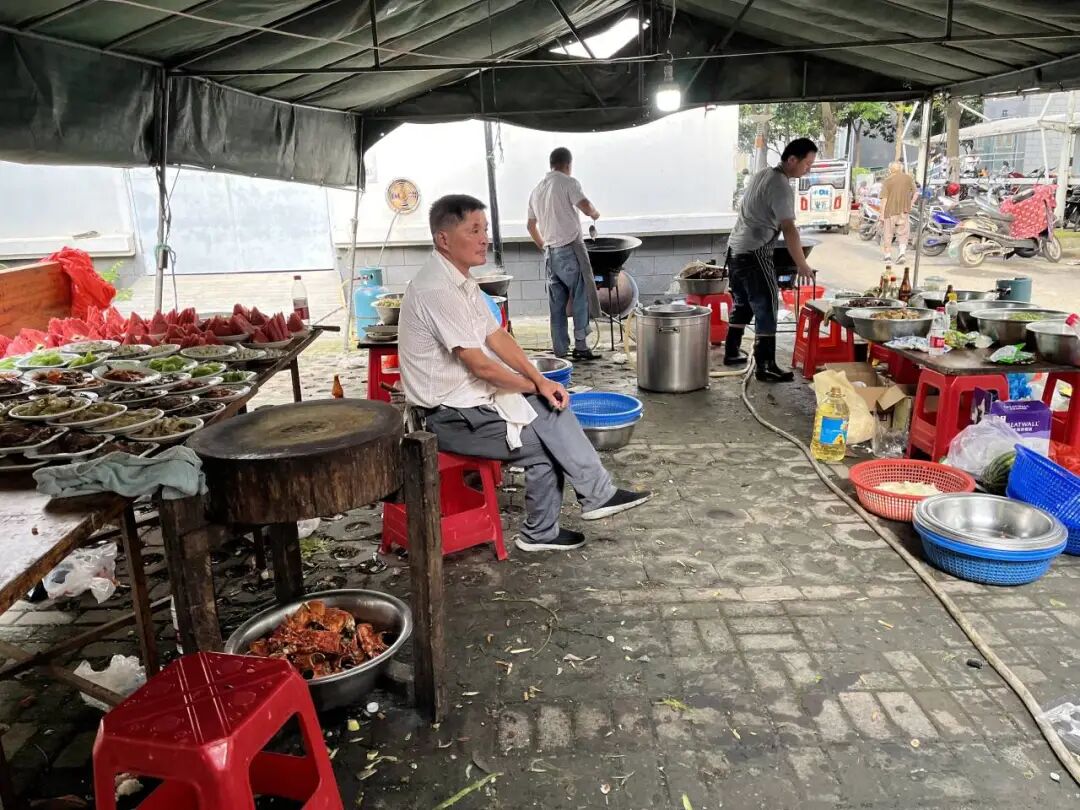
◉ In Suzhou, a village cook is preparing a wedding banquet, with finished dishes piled up. Image source: Wan Feng
@阿青 (Chaozhou, Guangdong)
I have spoken with several village cooks. In the past, when people were poor, many dishes at Chaozhou banquets were not as lavish as they are now, but relied on handwork. For example, fish balls had to be made from local fish, deboned and pounded into a paste, which took a great deal of effort. Although these hand-made dishes are still present on today’s table, almost all of them are now produced by factories using standardised methods.
@汤汤 (Xi’an, Shaanxi)
Rural banquets were originally prepared with relatives and neighbours pitching in, but now a head chef brings their own team of four to six, and everything has become an assembly-line operation. In recent years, I have also often eaten pre-prepared food in hotels, with some dishes served before the ice has even fully thawed.
@小刘 (Baoding, Hebei)
Now, hotel banquets don’t feel like much, to say they taste like chewing wax is a bit of an exaggeration, but to say they are all exactly the same is by no means unfair. On banquet tables now, there are no longer simple dishes that have to be made on the spot, such as fried fish, fried prawns, or prawns stir-fried with Chinese cabbage; although there are now more substantial dishes than in my childhood, such as steamed crabs and blanched prawns, they are not as good as those simple ones. Apart from the king of pre-prepared food, “Steamed Scallops with Garlic and Glass Noodles”, the staples also feel like they are all pre-prepared food: various bean buns, steamed buns and pastries, all kinds of brightly coloured, neatly angular cakes, glutinous corn, jujubes and chestnuts.
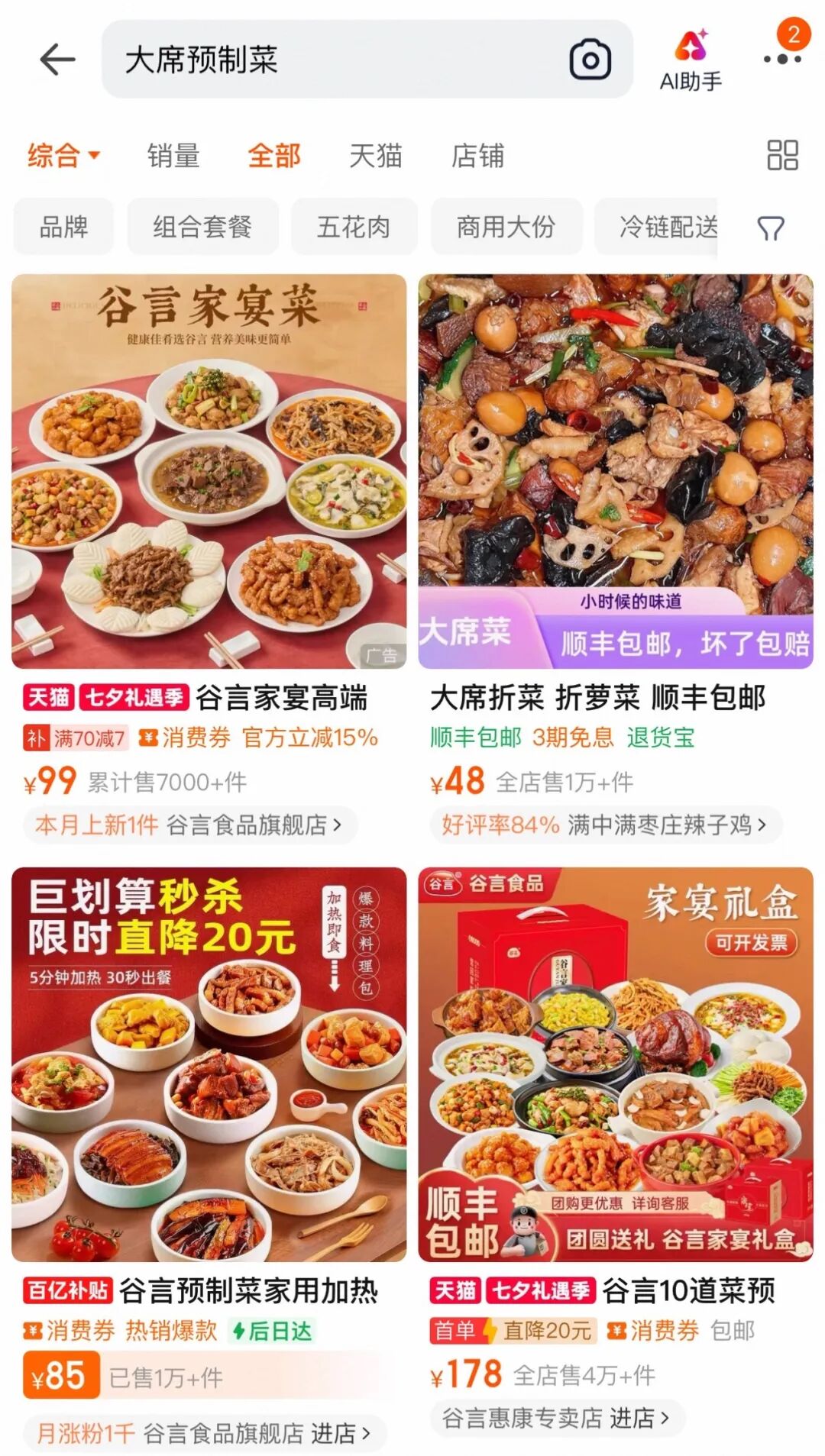
◉ Pre-prepared food for a grand banquet sold on a certain e-commerce platform. Image source: screenshot from an e-commerce platform.
@小庄 (Zhoukou, Henan)
I still remember when I was a child, apart from the chef, almost everyone bustling about in the kitchen and at the banquet was a woman: Grandmother, Mum, my aunt, and the village aunties, older sisters, and older sisters-in-law. When the banquet was being prepared, they got the ingredients ready and lent a hand; after the meal, they still had to wash the bowls and scrub the pots. They chatted as they worked and seemed quite happy, but even then I felt inexplicably tired, as if I had already caught a glimpse of my future self.
A few years ago, when I got married, I held my own banquet. I had originally only wanted to hold it at a hotel in the city, as it would be less trouble and would not inconvenience the family. But my father insisted on returning to the village to hold another one, saying that the relatives and neighbours had all seen me grow up, and that it only felt proper if everyone ate together. I hired a service team, with one chef leading five helpers, and they took on all the work involved in the grand banquet. The relatives and neighbours gathered round as usual to eat, chat and talk over family matters, and my father’s wish for everyone to bear witness was also fulfilled. It was only on that day that I realised, without all this supposed collective work, the group could still come together; that is the kind of banquet I wanted.
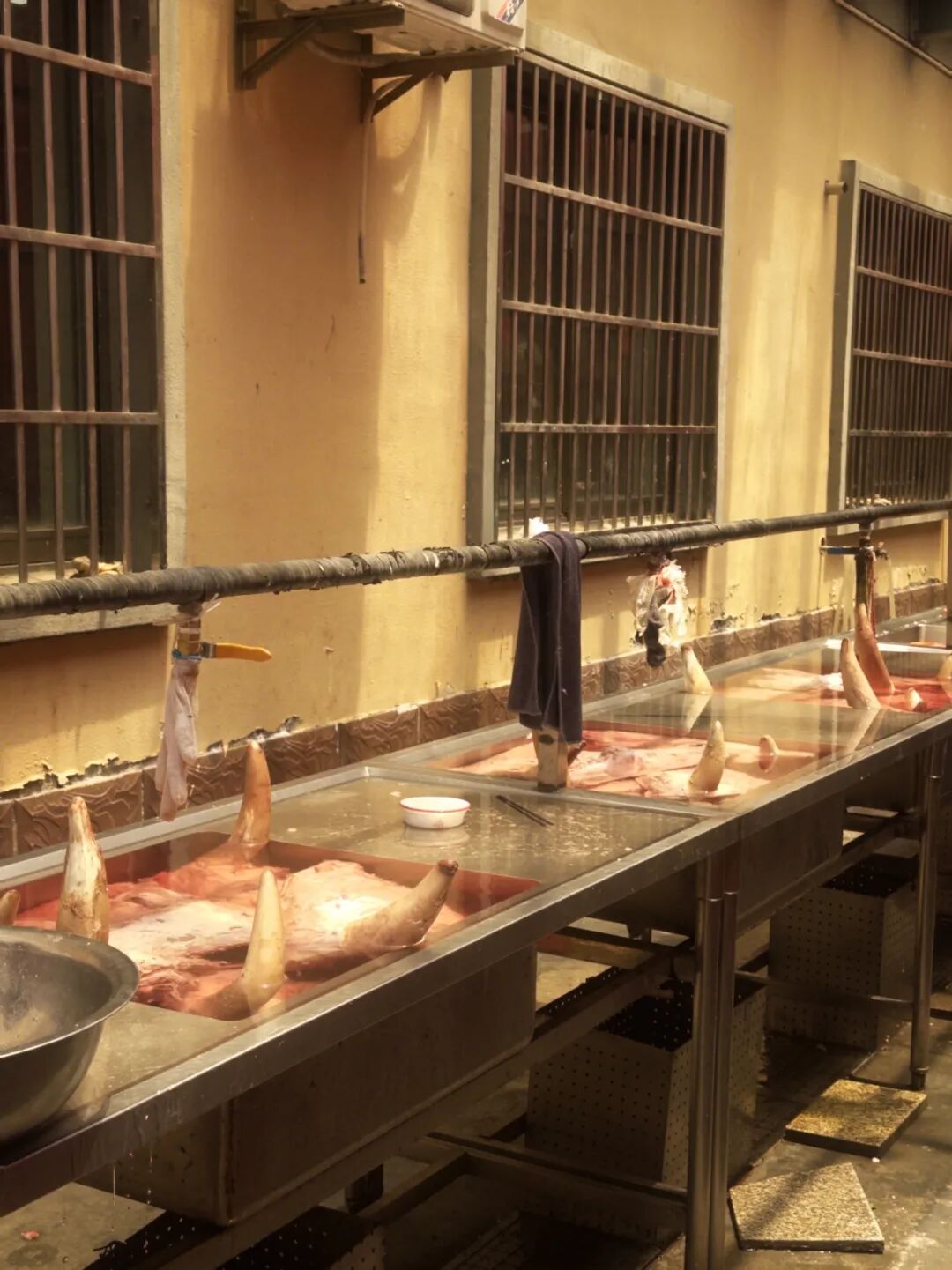
◉ In the back kitchen at a wedding banquet, a neatly trimmed ox head soaks in blood water. Image source: Xiao Zhuang
One Region, One Banquet Custom
A banquet has its own etiquette. How much to put in the red envelope, how many people from each family to send, who sits at which table, and when to offer a toast: every place has its own conventions.
@浩一 (Ganzhou, Jiangxi)
For village banquets here, each household gives a 20-yuan red envelope. Households in the same village but of different surnames send one person to attend; those of the same surname may send one or two, while close family all attend. The villagers observe local customs or village conventions of their own accord. It is a sincere feeling from the heart rather than an external requirement, and most people are not given to keeping score; throughout the event, warmth is evident everywhere.
@Rita (Hunan)
If it is a wedding banquet, the groom’s side will collect tea money (money that is not included on the social gift list), and everyone attending the banquet must give some. Inner relatives give a higher amount, while outer relatives usually give 50 or 100, depending. Occasionally, there are also moments of “laughing tea money” (when someone is asked for tea money again after they have already paid it). If it is the bride’s family marrying a daughter out, no tea money is collected, although this custom has become somewhat relaxed.
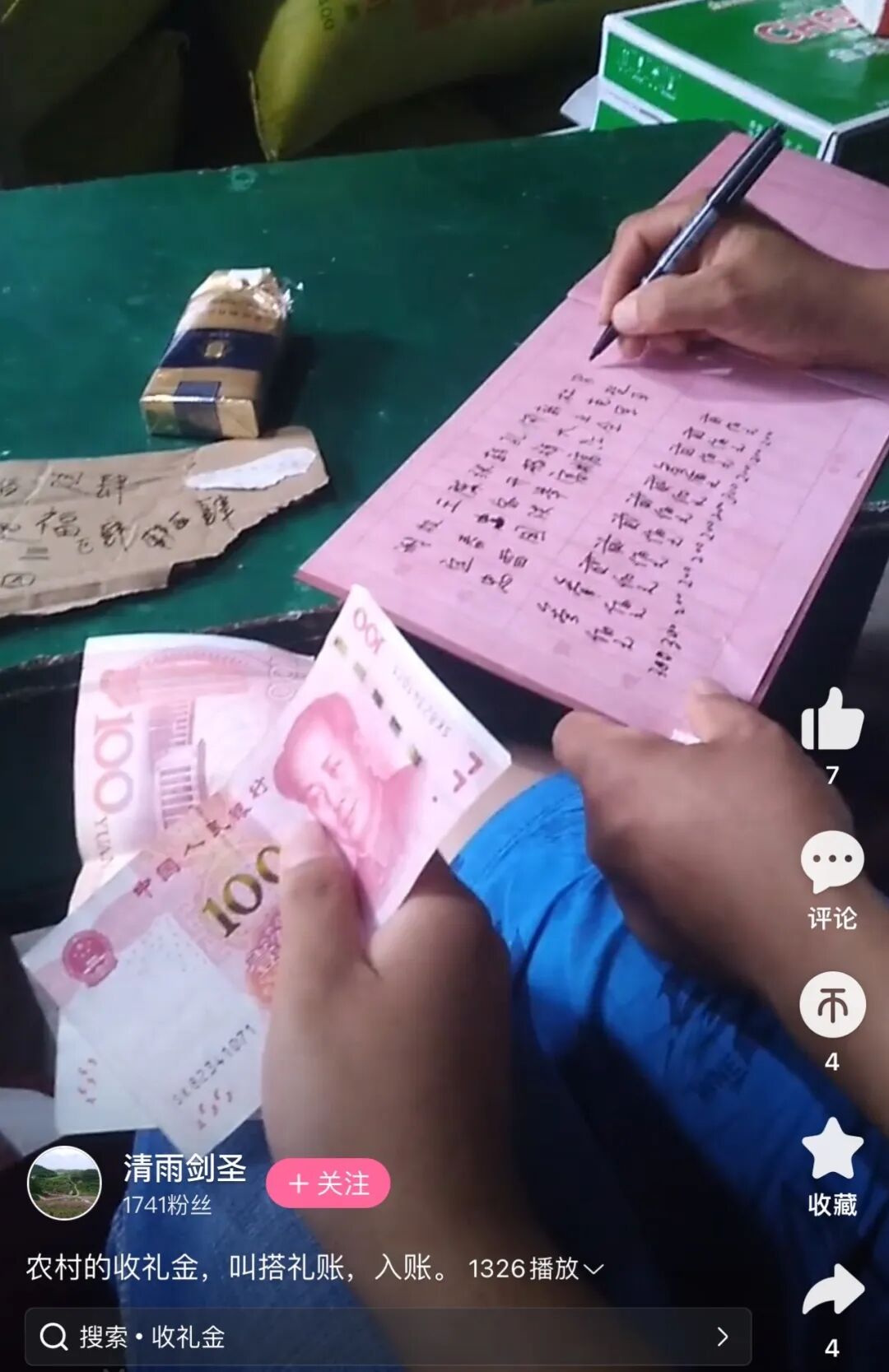
◉ While wedding gift money is being recorded, some netizens call it “libu shangshu”. Image source: Qingyu Jiansheng @Bilibili
@阿青 (Chaozhou, Guangdong)
I feel that banquets organised by different social groups have different styles, depending on the organiser and the people at the table who set the mood. Some people are particularly fond of drinking and smoking, and will urge others to drink; others are easygoing, and drinking Wang Laoji is fine. There are also default seating rules, such as older people and those of social standing sitting at one table, children and mothers at another, and young people at another.
@sanv (Qiandongnan, Guizhou)
At funerals, those keeping the vigil eat vegetables stir-fried in vegetable oil; only on the final day are meat dishes served.
@乐乐 (Harbin, Heilongjiang)
Now, to stop people from immediately piling in to help themselves and take food away, chopsticks are usually served last—at least in my hometown, Harbin.
True Colours at the Banquet
Banquets have always been inseparable from social obligations, and below the surface of the banquet an unspoken set of old conventions is at work. After a few rounds of drinking, work and income, marriage and prospects all become topics of conversation, and many deep-rooted ideas also alter the flavour of the food. Faced with remarks such as “Don’t blame me for prying” and “It’s all for your own good” from these “people who have been through it”, young people’s boundaries are constantly being tested.
@小晓 (Shangrao, Jiangxi)
At a banquet, what is really being eaten is face. The display has to be grand, and the more people who turn up, the better the family’s connections are. Families with money prefer to hold it at a hotel, even though the hotel food is far from as good as the village chef’s and is more expensive, but it is precisely because it is expensive that it shows off the family’s wealth and status.
@kkk (Guangxi)
My own admission-banquet experience was rather unremarkable. Nominally, it was to celebrate my admission, in substance it was a means of maintaining relationships and displaying status within the clan back home. Each household, with the senior male relatives at the centre, staged a three-day production. In the small hours, the men were still drinking noisily, playing drinking games and carrying on boisterously, without caring at all whether the women and children at home needed sleep. I entertained table after table of people completely unknown to me, posed for group photos as an NPC, and was lectured on the need to be grateful, because the neighbours who had come to help had worked so hard.
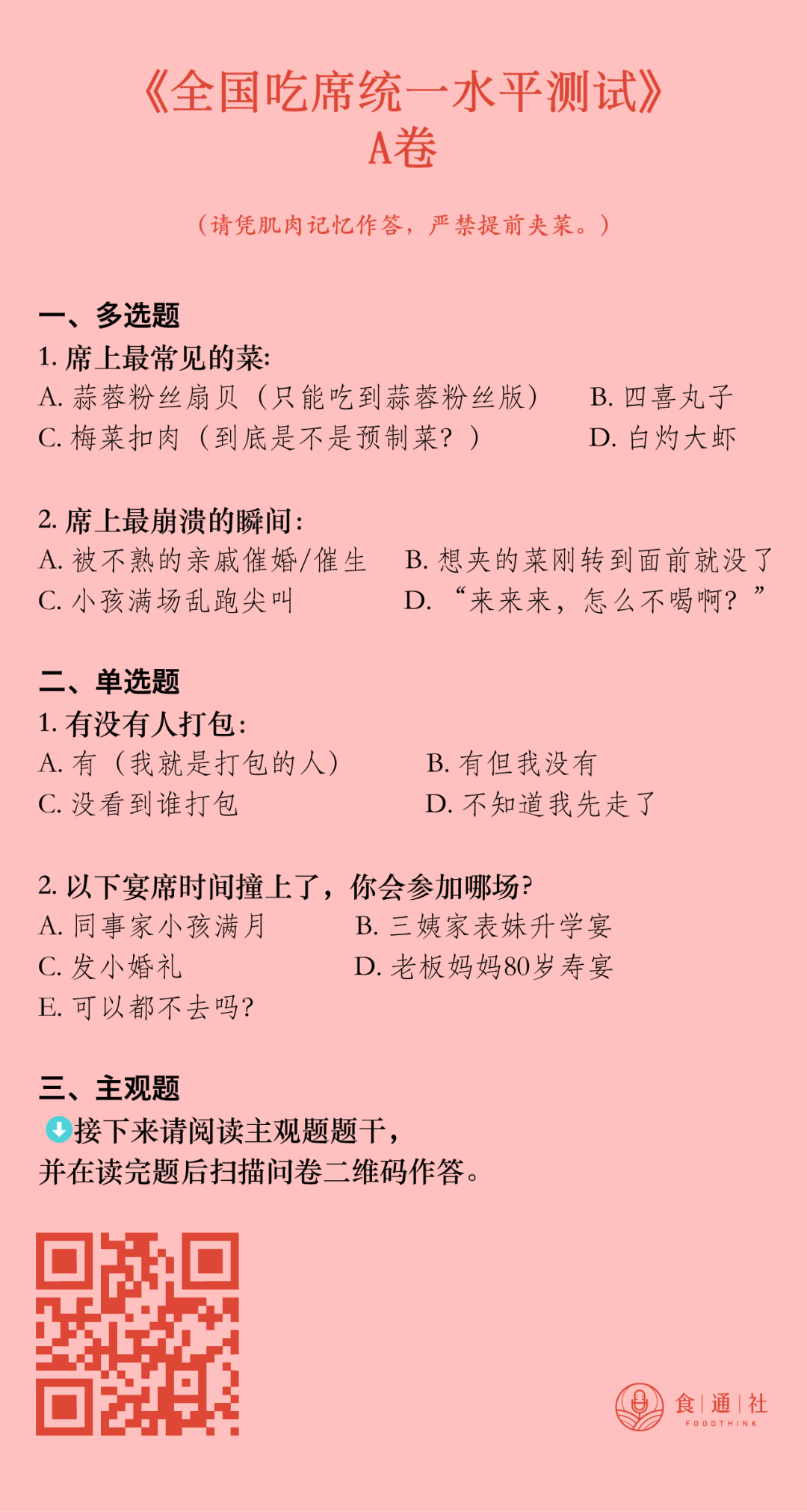
◉ Foodthink’s earlier survey on attending banquets. What other moments at banquets have made you feel overwhelmed or like you might just break down?
@韩柳 (Shihezi, Xinjiang)
At my admission-banquet before I went to university, there was a man I was not related to by blood but whom I had to call “uncle”. Perhaps it was also because his daughter had settled in Beijing, started a family and a career, and had a stable life. That day, he first gestured for me to stand up, then called over a few young people, and spoke to us chiefly about his daughter. After that, he began to “plan the future” for each of us, as if, in his words, our lives already had their own set directions.
@蔬果鉛 (Ganzhou, Jiangxi)
Once I was pressed by my family to go around offering toasts. At first I did not want to do it; I stood frozen in place, awkward, for over ten seconds, while the whole room was waiting for a show. My older male cousin poured my drink and egged me on to go over, but after I had finished toasting, my younger male cousin challenged me with particular contempt, asking why I had gone simply because they had wanted me to. This had a considerable impact on me. Other people’s glances and remarks are far too readily offered. To some people, one matter is a question of self-respect, while to others it seems of no consequence, and those who encourage you and those who look down on you will not bear any cost for you, and in that moment I felt a strong sense of loneliness.
Social Obligations One Cannot Swallow
Now that living conditions have improved and it has become easier to host banquets, why are we instead finding it harder and harder to get the satisfaction from a banquet that we used to get? From simply showing up to eat to paying out of our own pockets to give a cash gift, the “new generation” who used to be taken to banquets by their elders have also grown up and are gradually learning to hear the deeper meaning behind the joking and teasing at the table.
@韩柳 (Shihezi, Xinjiang)
When I was little, after my parents took me to sit at the table, I mainly watched the dishes on the round table and kept looking for the one who was turning it. Gradually, through a child’s eyes, I developed a habit of observing and found that people seated in different positions talked differently. Now I feel it more as an exchange of information and a bond that sustains certain relationships. At a family gathering, a meal with friends, or someone’s major life event, the real focus is on the money and face in what is said.
@浩一 (Ganzhou, Jiangxi)
A banquet organised in the village brings neighbours from all sides in to help; there is talk and laughter, quarrelling and noise, and children and dogs alike live out their own little lives, allowing people to be their natural selves. A hotel banquet confines everyone to the hall, each taking their seat, whispering to one another left and right or playing on their phones. With no open space or room to let go, it is as if, unseen, a system of urban life is holding people’s minds in check, and the experience is very stifling.
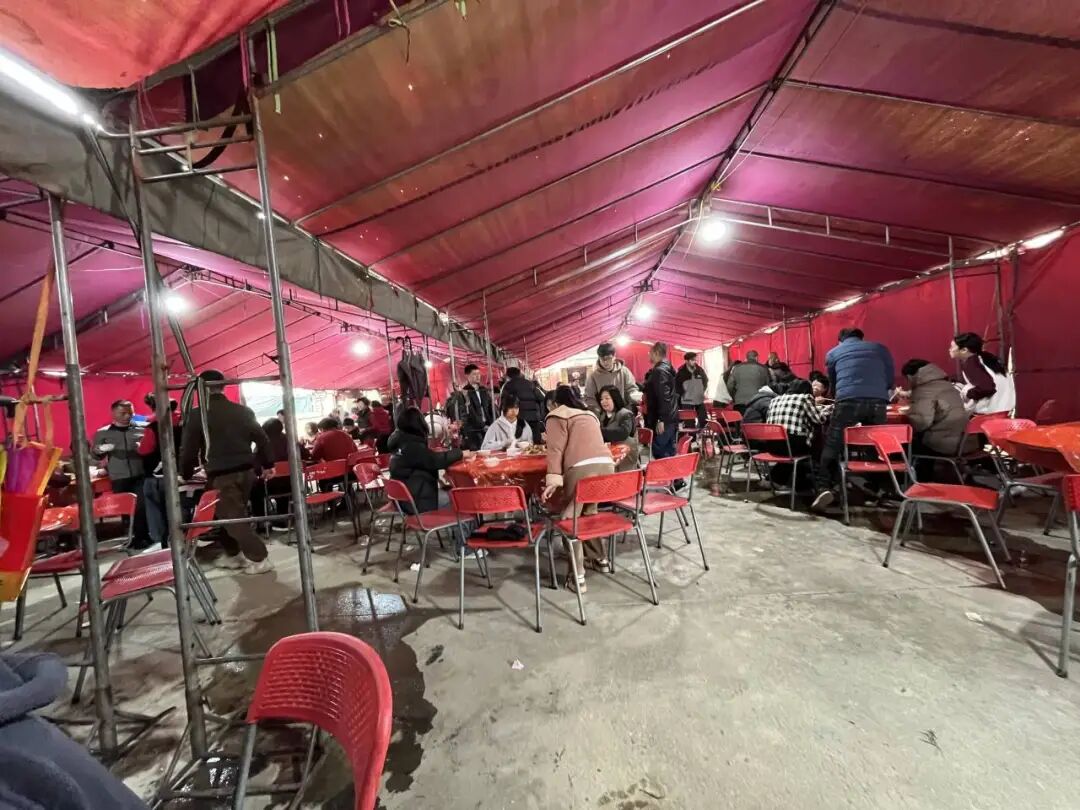
◉ A large rural banquet in Ganzhou, Jiangxi. Image source: Haoyi
@Rita (Hunan)
Now, because I work away from home, I attend banquets only rarely, and the occasional one is quite enjoyable. But if I were living back home, it would become a burden, as steadily rising cash gifts and frequent banquets can put a certain strain on finances.
@蔬果鉛 (Ganzhou, Jiangxi)
The deeper reason I don’t like banquets is that I am committed to remaining single; I find myself suddenly envious that at Meimei’s wedding the hosts can stipulate that there will be no photographs and no plus-ones, which is important for protecting privacy and breaking free of the web of social obligation. If it were a banquet elsewhere, I would still attend out of interest in the food, but hometown flavour has already become a bit “set”, as if, psychologically, it has been “pre-prepared”.
@林 (Heilongjiang)
When I was little, my mum used to carry me to banquets like a shoulder bag. After I had called out to all the aunts and uncles one by one, I became the cue for conversation: “Your child is lovely. What extra lessons have you signed them up for?” “So-and-so had a second child the other day. Why don’t you have another?” Deaf to the banquet buzz, all I did was sneak a few more scallops with glass noodles; I left the prawns—they were too much of a bother to peel.
Once I had grown up, eating was no longer the same. “How busy are you at work? Don’t let it get in the way of finding a partner!” “Girls really should find a partner early; if you have a child early, you can devote yourself fully to your career!” Mayday, mayday! Someone is breaching my boundaries! I had barely had two mouthfuls before the small talk had already run its course. From now on, could you wait until everyone has nearly finished eating before asking questions like that… I gave my cash gift… I’m stuffed, all from being angry.
Perhaps banquets have always been like this; I have simply grown up and begun to understand the deeper meaning behind those looks and words. I, too, now have a “weight” that can be measured, compared and put on the table, having inherited that set of information by which the previous generation prised into and exchanged details of one another’s lives.
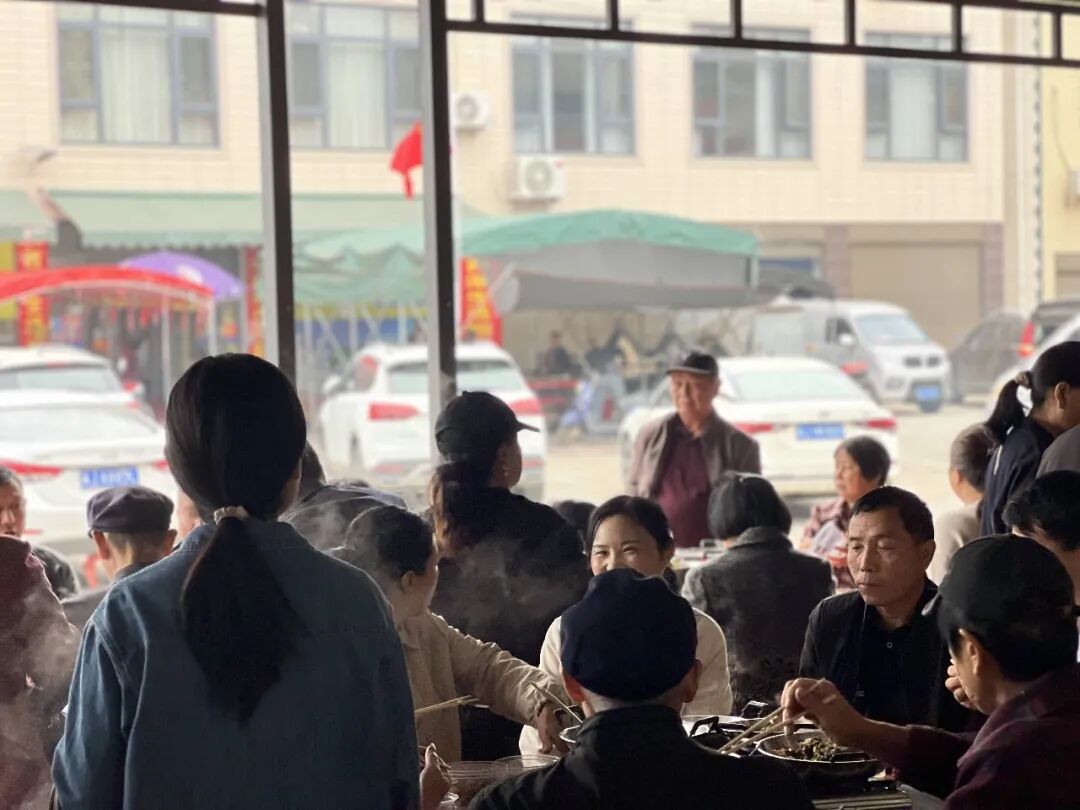
◉ All manner of scenes at the banquet. Image source: Rita
Will the Grand Banquet Disappear?
What makes a traditional village banquet possible is not just the stove and the chef, but also a relatively stable village and neighbours who come and go frequently. As the elders age and urbanisation brings population migration, such village banquets are growing rarer. In twenty years’ time, will the grand banquet disappear?
@超超 (Tianjin)
Every year at the Qingming Festival, in the suburban counties of Tianjin, continuous banquets are held in the countryside, with a fee collected per head, to provide a lunch for all the relatives while they perform ancestral rites and sweep graves. Now that many people have moved from the countryside into resettlement housing, if, around Qingming, you see large plastic sheds being put up in many suburban residential estates, that probably means the estate was relocated there as a whole village and still retains its village customs.
@Morry (main urban area of Hangzhou, Zhejiang, and suburbs near Jiaxing)
I am attending fewer and fewer banquets now; relatives in the main urban area mostly hold them at restaurants. As for relatives in the suburbs, they are probably all growing older, and the younger generation rarely hosts banquets.
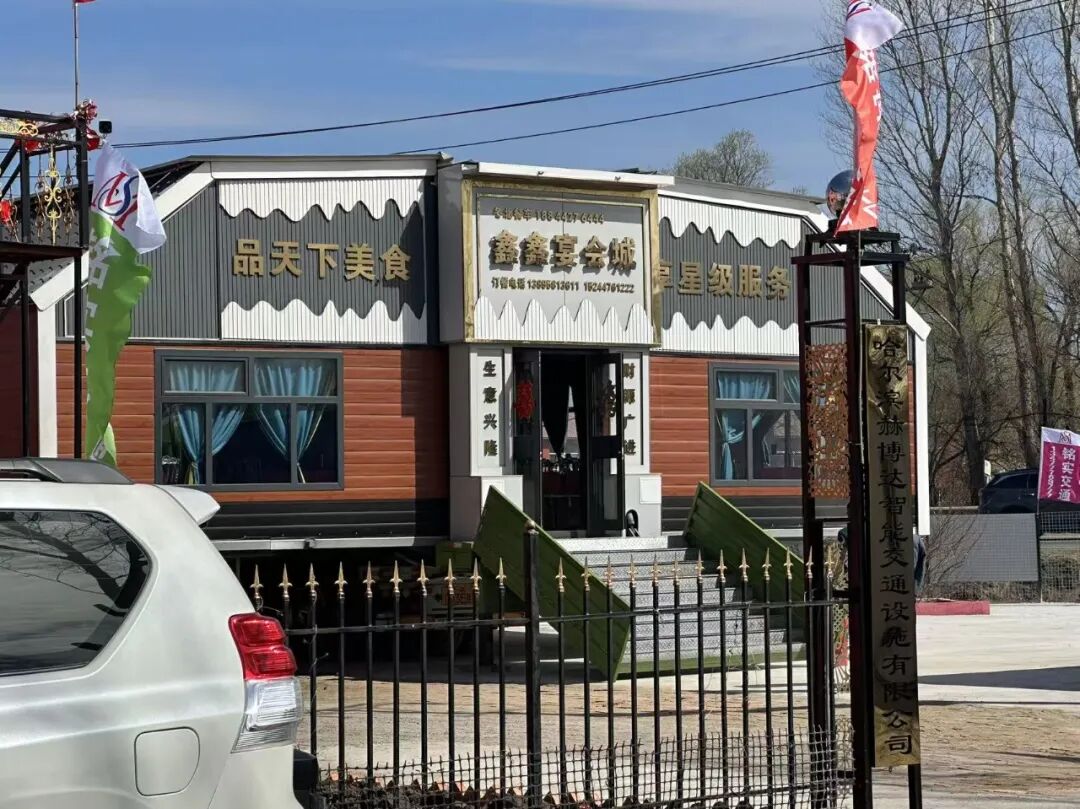
◉ The image shows a mobile banquet vehicle that is quite popular in rural areas of the northeast. As people leave the countryside, such a large vehicle can be driven straight to the host family’s open plot and, once unfolded, become a banquet hall, providing a “one-stop” service covering everything from the venue, kitchen, and tables and chairs to chefs, service, and waste clearance, greatly reducing the host family’s workload and the burden of social obligations. Image source: Kong Lingyu
@阿青 (Chaozhou, Guangdong)
Attending banquets in the city isn’t frequent, mainly because hosting one requires space; cities don’t have many public areas or open ground at ancestral halls. In the countryside, banquets are hosted more often. There are ancestral halls, and some people host them in their own factories or downstairs in their self-built rural buildings. I probably attend one or two a year; I went to more when I was a child, but once I grew up and left home, there have been fewer.
@林 (Heilongjiang)
As people have migrated, not only have banquets moved from villages to cities, but the way they are hosted has changed greatly. Recently, I attended a university classmate’s wedding, which dispensed with nearly all the traditional “banquet formalities”: the whole wedding was hosted by the couple themselves, and the venue was the restaurant where they had their first meal. Only close friends were invited; the dishes were chosen in advance by an online vote among the guests, and even the dishes on each table differed, so people could choose their seats based on their favourite dishes.
@小庄 (Zhoukou, Henan)
I now hardly ever go back to the village for banquets. Most of the friends I grew up playing with have gone to the city to study and work, and the elders in the village have also left, one by one. When someone in the village occasionally hosts a banquet, the notice still goes out to the group, but when I see a name, I sometimes have to stop and think for a moment whose family it is. My life has also reached a stage where there is little need to host grand banquets, and there are fewer and fewer occasions that can bring people back to the village.
Village banquets may indeed be slowly disappearing, after all, once relationships disappear, the rituals used to confirm and maintain them no longer need to exist either. I don’t know whether, in twenty years’ time, it will still be known as the grand banquet, but I think it will probably still exist. It may be smaller, freer, more proactive and inclusive. Perhaps it will simply be friends, partners, or like-minded people sitting down to a meal together.
Population movement brought about by urbanisation and marketisation, and the disintegration of rural communities, are eroding the social foundation on which the traditional grand banquet depends. People are leaving the villages, families are scattered across the country, and relationships maintained by blood ties, locality, and the society of acquaintances are gradually loosening. Meanwhile, a new generation of hosts is translating old rituals into new forms that fit today’s values. Rural society is receding, but perhaps people still need, at certain moments, to become “we” again.
🗣️
Do you think the grand banquet will disappear?
If you were the host,
what kind of banquet would you like to host?
Feel free to leave a comment and share your good ideas!
Unless otherwise noted, all images are from reader submissions.
Editors: Li Ye, Lele
Layout: Minglin
Scan the code to send a tip and support original food writing
▼

▼
Click the image to read related articles.
▼
Click a keyword to access more article collections.
Seeds | Agri-tech | Policy | Fermentation | Nutrition | Fruit | Fisheries | Food Delivery | Events | Jobs | Wet Market | Livestock | Food Talk | Sharing Session | Book Club | Harvest Festival | Smallholder Stories | Climate Change | Rural Development | Cooperative Economics | Urban Farming | Food Safety | Biodiversity | Pandemic and Food | False Solutions | Ecological Agriculture Internship Programme
Beijing | Hebei | Shanghai | Guangdong | Guangxi | Yunnan | Henan | Sichuan | Jiangxi | Xinjiang | Shaanxi | Hong Kong | Chongqing | Zhejiang | Jiangsu | Guizhou | Taiwan | Inner Mongolia | Philippines | Canada | Russia | Mexico | Italy | United States | United Kingdom | Germany | Netherlands | Thailand | Sweden | Japan