Crop Residue Burning Ban Relaxed, But Hebei Still Enforces a Blanket Ban: What Do Small Farmers Think?

In May this year I went back to my hometown in southern Hebei and, while I was there, looked into how straw incorporation—the returning of crop residue to the fields—was being carried out. When the villagers heard me explain why I was asking, they would first freeze for a moment, wearing a look of “What is there to talk about?” Whether it was bewilderment or resignation, their reactions were a mixture of several emotions—
Straw incorporation has been going on for over a decade, and even if you don’t want to do it, you get used to it;
Of course we would much rather burn crop residue, but that can get you detained;
Straw incorporation certainly has many problems, and it may even reduce grain yields, but what of that? With grain prices so low, a loss of a hundred or two hundred jin of grain makes no difference; just as a person who eats one fewer steamed bun won’t starve.
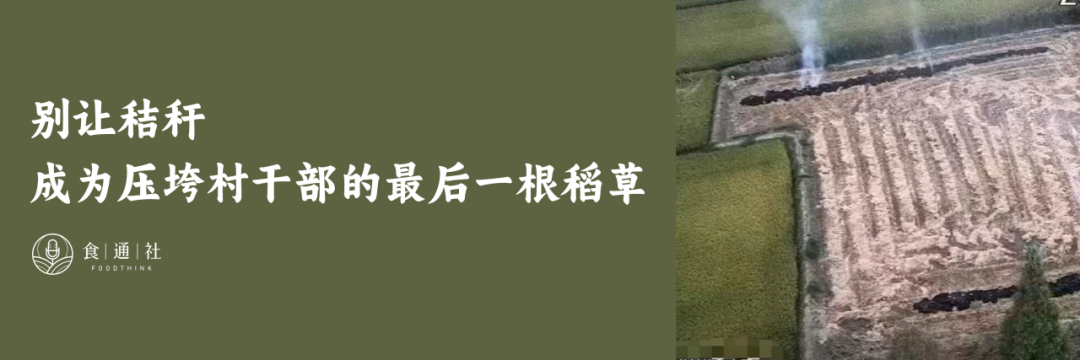
Before returning home, I witnessed several scenes of crop residue being burned in Heilongjiang. After ten years of being forced to incorporate crop residue, and owing to strong opposition from farmers, Heilongjiang Province effectively eased the burning ban last year, allowing farmers to carry out controlled burning after receiving instructions from higher-level authorities. Some other provinces are also undergoing similar changes. The Ecological Environment Code, which came into force this August, also requires that “local people’s governments at all levels shall strengthen, in a scientific and precise manner, the organisation, guidance and management of the burning of crop residue, fallen leaves and similar materials”, marking a new stage in which crop residue moves from a total ban on burning to “scientific and precise burning”.
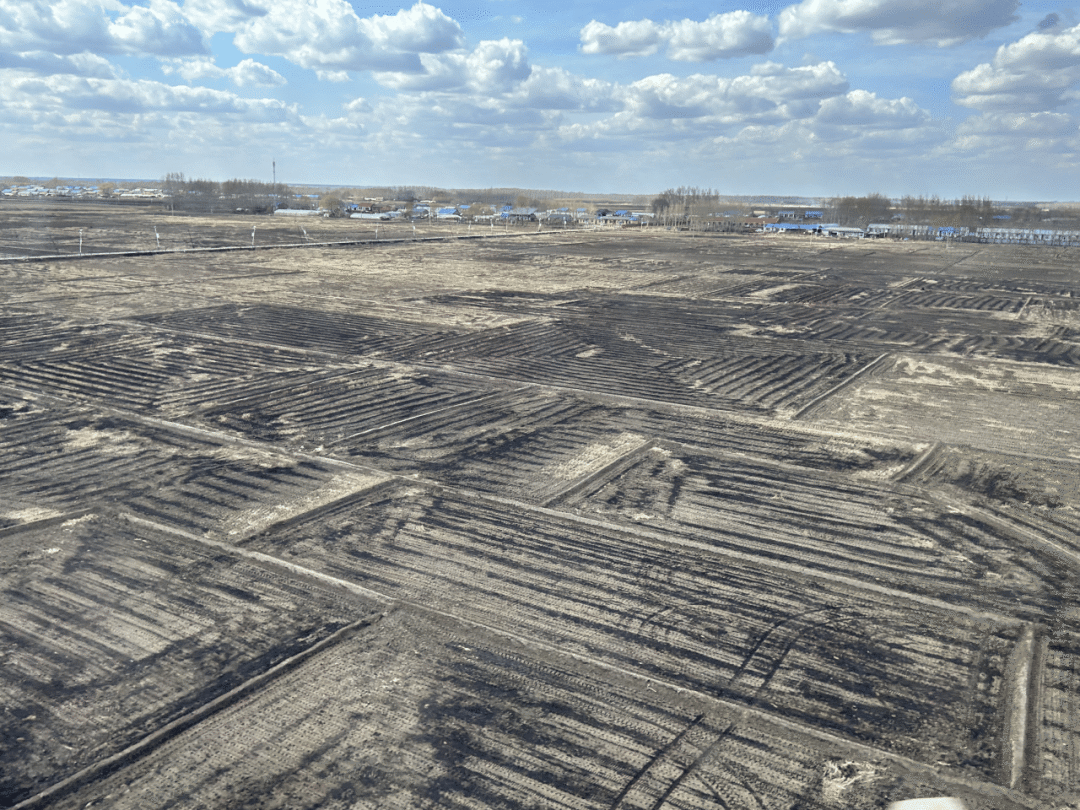
◉ Vast stretches of farmland in Heilongjiang that had just been burned, as seen by Foodthink in late April this year.
Yet compared with the northeast, the situation feels completely different to farmers in Hebei. Every farmer I spoke with was unaware that other provinces are allowing burning under certain conditions.
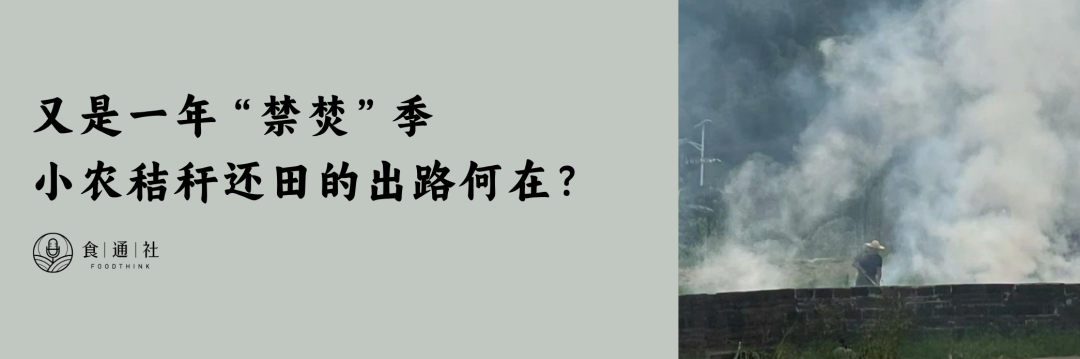
“If you light a fire here, you’ll get detained.” More than one person said so.
In other provinces, farmers often become agitated when the straw burning ban on crop residue comes up. But the villagers in Hebei wear a calm indifference, say little, and carry a resigned air of helplessness.
My home is in the North China Plain, a major grain-producing area, where winter wheat and summer maize are usually grown as two crops. Compared with the many problems I saw straw incorporation cause in other provinces, straw incorporation in Hebei has been relatively smooth, and conflicts are less pronounced. What exactly is the reason? Is it that straw incorporation fits the climate, crop types and cropping system better? Or is it that the ban on burning crop residue is enforced most strictly, so that, over more than a decade, farmers have already worked out effective coping strategies?
Sowing
At present, farmers’ main dissatisfaction with straw incorporation — returning crop residue to the field — is twofold: it interferes with sowing and encourages pests and diseases.
Wheat straw is not much of a problem. People generally say that the wheat straw is fine, soft and short; the wheat harvester simply chops it up and spreads it over the soil surface, and you can just leave it alone — what is called surface incorporation of crop residue. When it comes to sowing maize, a four-legged seeder drives over the field and, in one go, tills and sows the maize row. This leaves the spaces between the maize rows still covered with wheat straw; even the part of the wheat stalk up to 20 cm above the base is still stuck in the ground. “Leave it all in, for moisture conservation,” the villagers say.
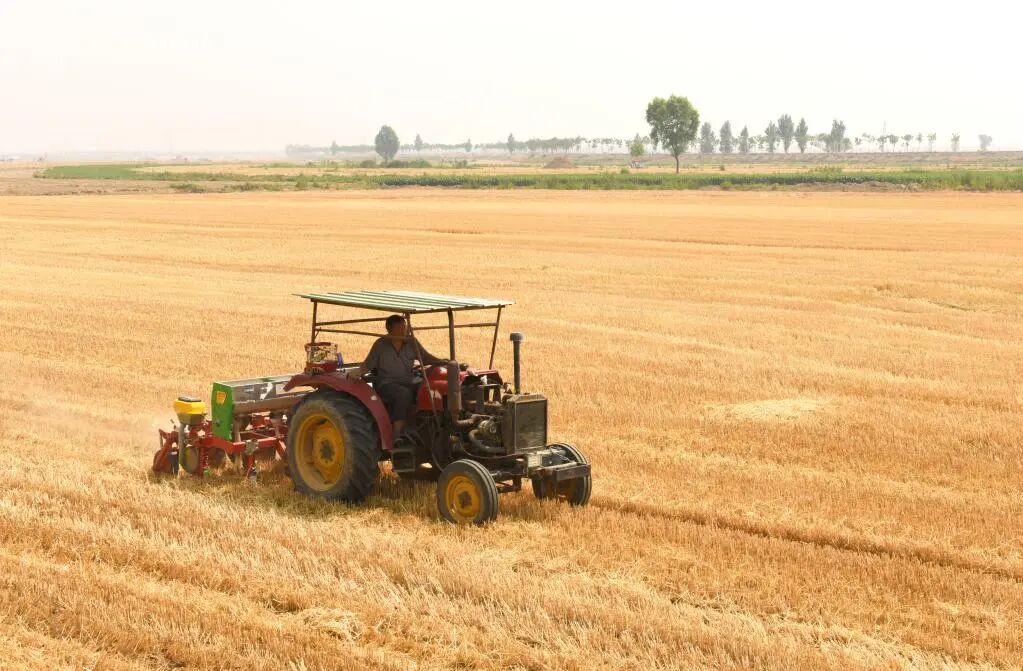
◉A farmer in Xingtai City, Hebei, is direct drilling maize in a freshly harvested wheat field. Image source: Xinhua
The real headache is maize stover. There is far too much of it. A farmer in Quzhou said: “Now maize is grown very densely, and the crop residue is very tall; if it is all returned to the field, there is no way to deal with it.” As a result, some farmers also haul part of the crop residue out of the field themselves. “Otherwise the field would be all crop residue, with no soil left.”
He described that, when the field is watered, the water hits the surface and a layer of crop residue is left floating on top.
As for the mechanism by which straw incorporation of maize stover affects seedling emergence, farmers have different explanations. Some think that crop residue causes the soil to become loose and soft; after sowing, as soon as it is watered, the seeds sink with the soil to a deeper level, delaying emergence.
Some also say that the wheat seeds get embedded in crop residue instead of in the soil, and are killed by the cold in winter. You can see the wheat dying in patches.
In response, one of the farmers’ coping strategies is to sow more seed, which naturally means more spending. Researcher Zhao Qinxu has long been based in villages in Hebei, working on high-yield grain production techniques. He cautions that whether straw incorporation is carried out properly directly determines the quality of sowing. In his experience, when incorporating maize stover, rotary tillage to a depth of more than 30 cm can ensure that crop residue is incorporated into a 20-cm soil layer. Once the crop residue is thoroughly mixed with the soil, it will not hinder subsequent sowing.
But the farmers I visited generally said that farm machinery operators would, at most, till to a depth of 20 cm. Everyone knows that tilling deeper is better, but the deeper you till, the more fuel it uses; what are farm machinery operators supposed to earn then?
When I asked them why they did not pay extra to have the farm machinery operator till to a depth of 30 cm, the farmers replied, “How do you know they will really do it the way you ask?” Some said, “Farm machinery operators can be good or bad; some just fob you off, tilling deeply at the edge of the field but shallowly in the middle.”
The end result is that, by unspoken agreement, everyone simply meets the minimum standard, tilling in the crop residue just deeply enough for sowing.
This is also because the profits from growing grain are so low that, in farmers’ view, “lower input costs” matter more than “producing more grain”. Even if this leads to a yield loss of 100 jin per mu, it amounts to only a little over 100 yuan. Zhao Qinxu says that, judging by what he has seen on the ground, straw incorporation — returning crop residue to the field — has little overall effect on grain yields, although a very few farmers have suffered yield losses of 60 to 70 per cent due to improper straw incorporation. Where straw incorporation is done well, yields can even rise by 10 to 15 per cent.
Some people also care about the quality of returning crop residue to the field, and will bring in a straw shredder to shred maize stover a second time, then use a rotary tiller to work it into the soil. A farmer in Fengfeng Mining District said that shredding one mu of maize stover costs 30 yuan. Some have even found that one pass of rotary tillage is not thorough enough, so it has to be tilled again. Naturally, this means higher costs.
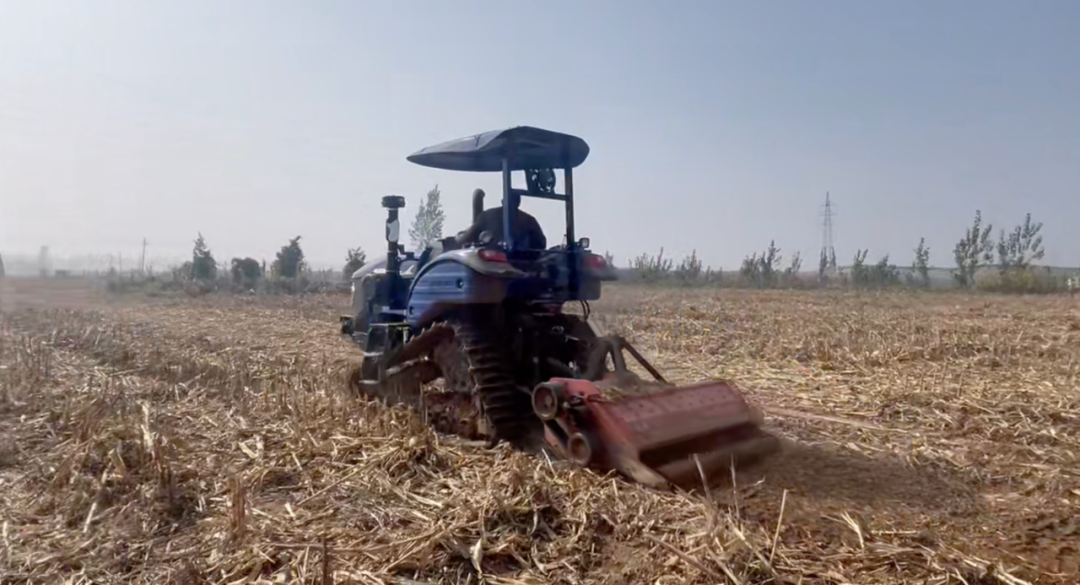
◉ A straw shredder for maize stover (crop residue) in northern China. Image source: Xianzi
Another coping strategy is passive resistance. In Quzhou, someone mentioned that, in order to get the farming done without problems, farmers can only rake out the surplus maize stover, or crop residue, and dump it in some unoccupied spot at the edge of the village.
“The village is also afraid, for fear of fires,” he said. “There’s nothing to be done. We’re not allowed to burn it, so where do we put it? In the end, we haul it all to a useless pit outside the village, find an excavator, and bury it.”
It can also count as “straw incorporation”.
Pests and Diseases
Wheat straw is easy to deal with and does not need to be worked into the soil by rotary tillage, but it is this very fact that makes this crop residue more likely to harbour insect pests. A farmer in Fengfeng Mining District said that wheat has more pests than maize, because after the wheat is harvested, about 20 cm of wheat stubble remains in the field. “It is in the little tubes of the wheat stalks that pests breed easily.”
“This year, the aphids have been particularly bad.” He said that, more than ten days before my visit, he had just done one spray. As we chatted, he was watering the wheat and planned to wait a few days after the watering and then spray again. He has observed that pests have clearly increased since straw incorporation — the return of crop residue to the field. Crouching at the field edge, he gestured emphatically at the scene: if no pesticides were used, the main stems of the wheat would be densely covered with black aphids. To control the pests, he said, the use of pesticides has increased by at least a third.
A farmer in Quzhou said that before straw incorporation there was little spraying, but after it — the return of crop residue to the field — each crop season requires at least two additional sprays. “In recent years, both wheat and maize have had to be sprayed several times. You simply cannot manage without spraying.”
Weeds have increased too. He thinks that straw incorporation crushes the weeds along with the crop residue, and the weed seeds fall into the soil and keep multiplying without end. “Moreover, there are more types of weeds than before. I’m in my forties or fifties, and all sorts of strange weeds I’ve never seen before have come up; we don’t know where they came from. Some flower, some don’t. Before, there were only a few kinds of weeds in the field.”
The increased number of sprays naturally means higher costs. A single spray costs about 20 yuan per mu, but a farmer in Quzhou thinks that pesticides do not cost much; the real expense is the labour needed for spraying. He himself runs a livestock farm and has no time to work the land; his parents are nearly 80, and he has stopped them from farming any further. He therefore has to hire people to do the spraying.
This is also why Zhao Qinxu has repeatedly stressed that the tilling depth for crop residue must be ensured, because thoroughly mixing it with the soil and burying it deeply helps suppress pathogens, pests and weed seeds.
Take the two-point cutworm as an example. Hebei was the first region in China where the two-point cutworm was found to be damaging summer maize. Since it was first discovered in 2005, the pest spread rapidly around 2011 in Hebei and in the Huang-Huai-Hai summer maize area, prompting Hebei to take the lead in formulating local pest-control technical procedures. In 2017, Farmers’ Daily interviewed several experts, who pointed out that the outbreak of the two-point cutworm was not caused by a single factor, but was closely related to new cropping systems in “wheat–maize” double-cropping areas, such as machine-harvested straw incorporation of crop residue and direct drilling.
Once wheat straw has been returned to the field as a surface mulch, it creates a shaded environment at the base of maize seedlings. This provides a suitable habitat for two-point cutworm larvae, which prefer cool, damp conditions, and also shields them from pesticide spraying, making it an ideal refuge. In response, plant protection experts from the Hebei Academy of Agricultural Sciences recommend either baling the wheat straw out of the field or breaking up this soft, thick layer of wheat straw, like a cotton quilt—for example, shredding the wheat straw more finely (so it is less likely to form a continuous cover layer), using a stubble chopper to crush the wheat straw and press it into the ground (reducing the space in which larvae can move), or removing the crop residue from the sowing lines.
The final point is quite similar to a simple local method that Zhao Qinxu heard from fellow villagers: once the wheat has come up, leave clear sowing lines for maize and sow the maize in the empty lines. This reduces contact between the maize and the wheat stubble and, to a certain extent, can also help reduce the incidence of pests and diseases.
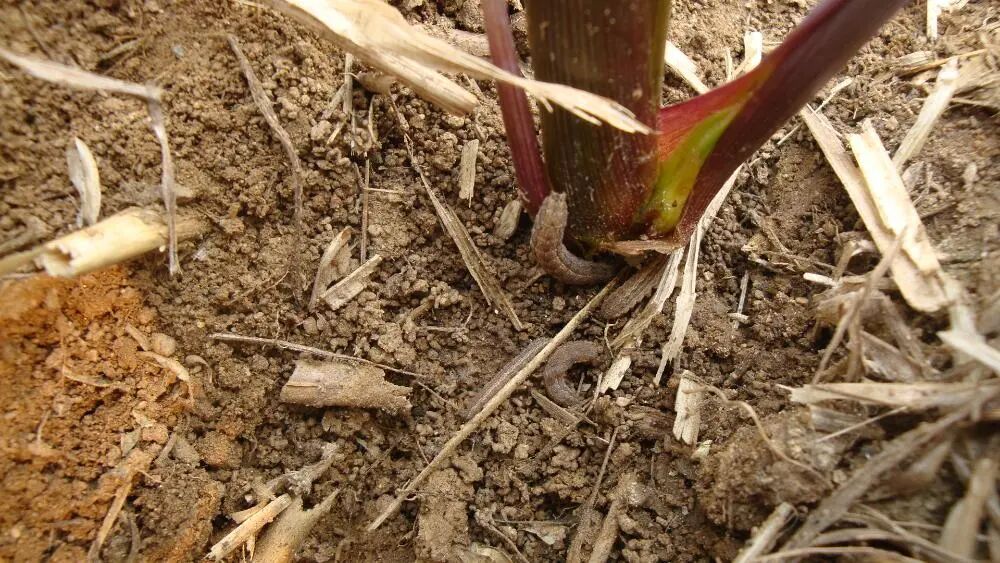
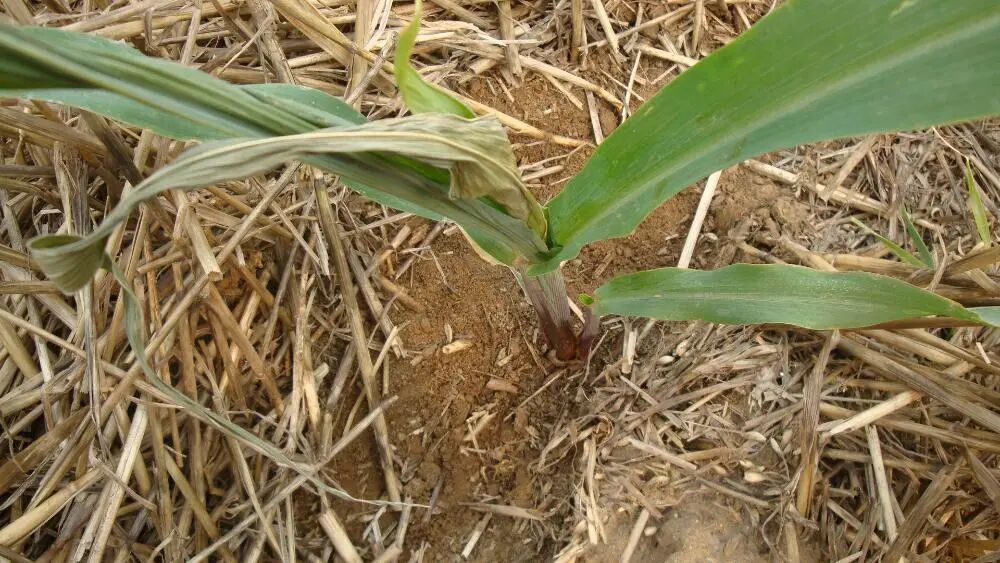
◉ Maize seedlings with dead hearts damaged by the two-point cutworm. The crop residue cover provides the larvae with a cool, damp hiding place. Image source: Lingshou County People’s Government
Doing the Sums
When the sums are done, the main additional costs for farmers from straw incorporation are pesticides, machinery (shredding crop residue, rotary tillage, etc.), seed, and labour.
When I interviewed a large-scale farmer, I asked him to set out in detail the costs of each stage of the farming process. An interesting finding is that straw incorporation — returning crop residue to the field — may place a heavier burden on small farmers.
First, in operations such as shredding crop residue and rotary tillage, all farmers, large-scale or small, need machinery to complete the work. However, farm machinery operators’ prices are lower for large-scale farmers. “People who bring the machinery do not like moving about. A large plot means he does not have to move, so he is willing to give a small discount.” Small farmers said they all understood. For example, the price of rotary tillage for one mu is usually 25-30 yuan for large-scale farmers, while small farmers have to pay 40 yuan.
Second, large-scale farmers use drones to spray pesticides and herbicides, at a price of around 4-5 yuan per mu. If pest and weed problems increase as a result of straw incorporation — returning crop residue to the field — spraying costs will also rise accordingly. In the view of large-scale farmers, these are costs that can be borne. But for small farmers who spray by hand, they all amount to bothersome extra labour. Because they usually do the spraying themselves, they cannot give an accurate figure to work out the economic cost; they merely complain, “It is too much of a bother.”
It is precisely these tiny “troubles”, which cannot be entered into cost calculations and are overlooked by everyone, that accumulate into the farmers’ very real predicament, so that the urge to burn crop residue keeps stirring restlessly in their minds.
In 2023, after fieldwork in Anhui, Zheng Jiaxin, a doctoral student in sociology at Wuhan University, argued that, because small farmers face higher machinery costs for straw incorporation (returning crop residue to the field), it has in effect accelerated their withdrawal from the land. In Hebei, however, I did not see this. Farmers said that although farming does not make money, they would continue to farm. Particularly after the pandemic, with job opportunities falling, some villagers who had been working in other provinces returned home, began farming, and in the agricultural off-season looked for nearby work. In short, for farmers, the land remains their last refuge.
An old farmer in Daming County came across the “straw incorporation bag” on Kuaishou and went to a farm supplies shop to buy some himself and give it a try. He spent just over 90 yuan on three bags and scattered them over five or six mu of land, hoping to make the maize stover (crop residue) break down a little faster. As for the results? He said, “It feels like it is breaking down a bit faster.” But when I pressed him on whether he intended to keep using it the following year, his answer was just as vague: “Let’s talk again over the New Year.”
Indifference, apathy — the general attitude I observed among farmers towards straw incorporation during my fieldwork in Hebei. They complain about poor seedling emergence and increased pest damage caused by straw incorporation — the return of crop residue to the field — but when it comes to yield, they say, “It hardly makes a difference.”
They themselves sometimes find this conclusion puzzling. They then go on to analyse it, saying that many factors can affect yield. Perhaps the water conservancy projects that the government has recently built have made irrigation secure? Perhaps the quality of fertiliser and seed has improved? But in any case, as long as the yield loss is not too large, they can accept it: “As long as it brings in some money, it will do.” After all, you cannot rely on farming to make money.
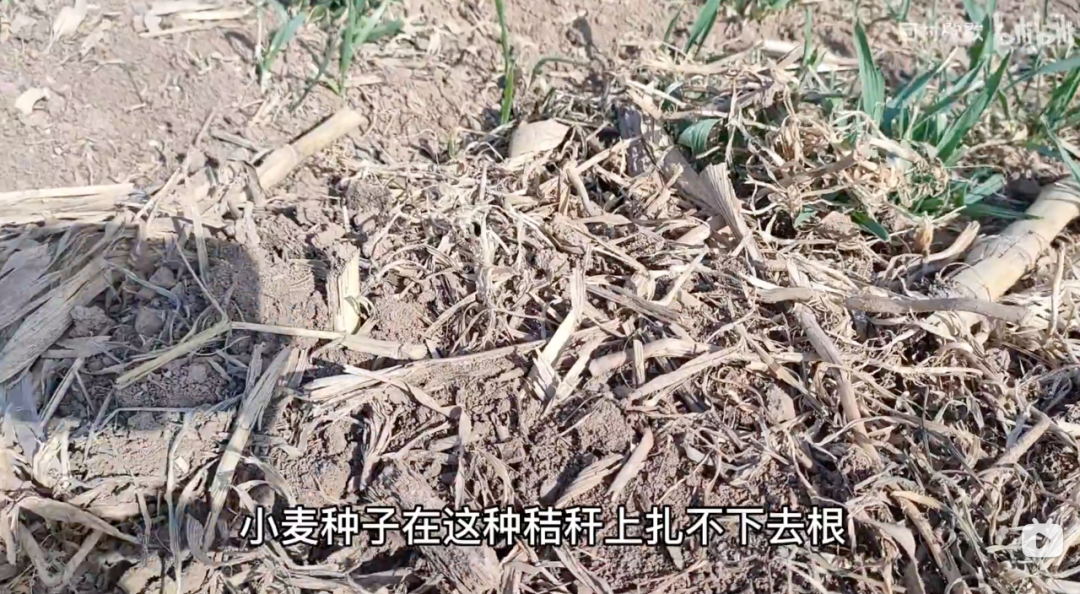
◉ If maize stover, or crop residue, is not shredded sufficiently and is not fully mixed with the soil, it can make wheat seedlings root less deeply and result in poor emergence. Image source: Bilibili uploader “Huicun Xiexie”
Baling
Although they have become accustomed to straw incorporation and it hardly affects yield, the farmers interviewed reached a remarkably consistent conclusion: they would still like to burn the crop residue. Once the crop residue has been burnt, the field is clean, easier to work, and there are fewer pests.
One small farmer has 12 mu of land. Next to his land, a large-scale farmer from the neighbouring city has come over and leased 800 mu. One year, he saw the large-scale farmer use large machines for baling the crop residue and taking it away. He was quite envious and has always hoped that someone would come to collect his crop residue. “I asked them to do the baling, but they said the plot was too small and refused.”
But among farmers who have experienced crop-residue baling, there have been more complaints. For example, a farmer in Feixiang said that more than ten years ago, just after burning was banned, someone came to bale the wheat straw. “It is rolled over once during baling and once when the bales are collected,” he said. “For maize, we would normally be able to sow directly. All that going back and forth compacts the ground.”
He does not know whether these farm machinery operators who do the baling have received any national subsidy. In any case, “If the subsidy does not reach farmers, who would let someone compact the ground for no reason?”
Weighing the two evils, he eventually decided to work the crop residue back into the soil.
Two years ago, something else happened that made him even more suspicious of farm machinery operators coming onto the land. Some years earlier, the government had promoted subsoiling and subsidised farm machinery operators to loosen the soil for farmers. “They simply cut a few trenches in the field for you, free of charge; they do not turn the whole plot over. It is left all in trenches, and it makes tilling difficult,” he said. After operators mess about like that, farmers do not want anyone to come and do subsoiling any more.
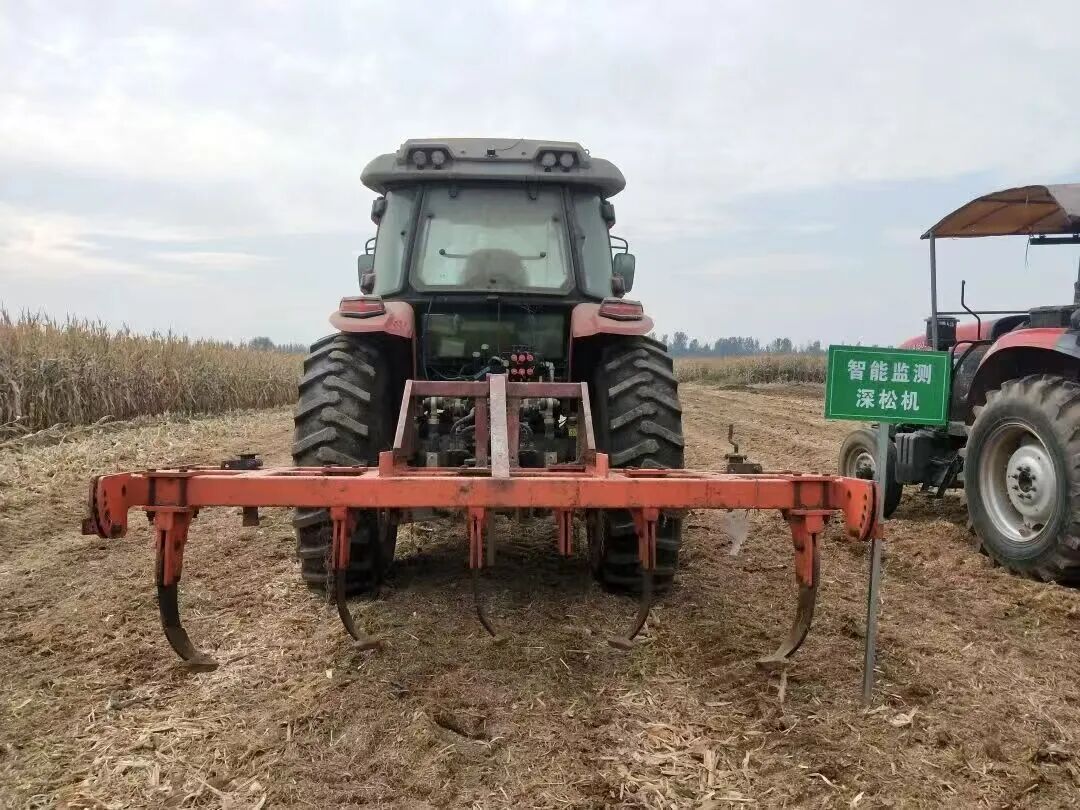
◉ To improve the quality of arable land, the central government has allocated funds for several consecutive years to support mechanised subsoiling and land preparation operations. But, as with straw incorporation—returning crop residue to the field—once it is watered down in implementation, it can instead make it harder for farmers to farm. Image source: Handan Xin San Nong
Decades of intensive cultivation using fertilisers and pesticides have depleted the land’s nutrients. This is precisely the problem that straw incorporation—returning crop residue to the field—aims to solve: replenishing organic matter, improving soil structure, and maintaining long-term soil fertility. But have farmers actually felt these benefits? The farmers I met all said that the soil has indeed become looser and no longer compacted. Zhao Qinxu also said that returning maize stover to the field can indeed increase soil organic matter, and that it can be seen simply by looking at the colour. “When you go into farmers’ fields, you can also see that the surface soil colour is somewhat darker. If you then test the soil organic matter content, you can measure it as well.”
But farmers have not reduced their fertiliser use. There are two main reasons: first, crop residue increases soil organic matter, while the readily available nutrients that crops take up still come mainly from fertiliser; second, many areas in China actually have a problem of excessive fertilisation, because farmers do not know their soil composition and, relying on experience and out of fear of reduced yields, continue their previous fertiliser use (or even increase it).
Farmers’ thinking is still stuck on the idea that “the more fertiliser is applied, the better.” This also hinders their understanding of the relationship between straw incorporation — returning crop residue to the field — and soil health. Only when straw incorporation is combined with measures such as soil-testing-based formulated fertilisation and nutrient balance management is the improvement in soil fertility more likely to gradually translate into reduced fertiliser use. How, then, can one truly understand the soil? This is both a blind spot in farmers’ knowledge and a gap in grassroots agricultural extension services.
Although straw incorporation — returning crop residue to the field — has become a widely accepted agricultural practice on the North China Plain, farmers have not genuinely embraced it.
– This is Foodthink’s 834th original article –
Foodthink
Author
Kong Lingyu
Project Director at Foodthink. Focuses on climate, environment, and food and agriculture issues.
At the interviewee’s request, Zhao Qinxu in this article is a pseudonym.
Editor: Pei Dan
Layout: Xiaoshu
Scan the QR code to give a tip and support original food knowledge
▼

▼
Click the image to read related articles.
▼
Click a keyword to view more article collections.
Seeds | Agri-tech | Policy | Fermentation | Nutrition | Fruit | Fisheries | Events | Jobs | Takeaway | Wet Market | Livestock | Food Talk | Sharing Sessions | Book Club | Harvest Festival | Smallholder Stories | Climate Change | Rural Development | Cooperative Economics | Urban Farmers | Food Safety | Digital Technology | Biodiversity | Pandemic and Food | False Solutions | Ecological Agriculture Internship Programme
Beijing | Hebei | Shanghai | Guangdong | Guangxi | Henan | Sichuan | Jiangxi | Xinjiang | Shaanxi | Hong Kong | Chongqing | Zhejiang | Jiangsu | Guizhou | Taiwan | Inner Mongolia | Philippines | Canada | Russia | Mexico | Italy | United States | United Kingdom | Germany | Netherlands | Thailand | Sweden | Japan