
Rice Is No Longer Rice, Flour Is No Longer Flour: Are Today’s Staples Still Healthy?
1. Staple Foods and Supplements in the Industrial Food Production System
As for texture, refined flour tastes better. It is pricier and harder to come by too. Without a grain ration booklet and a fixed allotment, the whole thing is off the table. Back then, steaming buns out of refined flour felt like a wanton waste — you saved it for dumpling wrappers. My wish was “eat refined-flour steamed buns to your heart’s content,” while my mother’s was “eat dumplings every single day.” When she was a girl, dumplings came only at New Year.
Thank the advance of the times and economic growth — we now live in such times.

Only later did I learn that this upscale, fancy-sounding “wheat germ flour” was simply the bran sifted out during flour milling.
Later still, I spent two years farming in Yilan, Taiwan, and made a whole circle of farmer friends. As the village’s resident brewer and practitioner of a European-style black oven, my home was always a gathering place. Farmers consider eating well the highest calling — whenever there was a meal to be had, they came at the scent, and no engagement was too important to cancel before food, with just one exception they would absolutely never break: “stir-frying rice bran.” Rice germ oxidises and spoils so easily that it must be milled and stir-fried on the spot. Stir-frying rice bran is skilled work — slow-roasting over a low flame can take a whole day. The roasted rice bran tasted exactly like the wheat germ flour I had once lugged all the way back from Taiwan, and in truth it amounted to the same thing: rice germ and wheat germ are close cousins. When I mentioned those early days to my farmer friends, they laughed and told me I had been a sitting duck. The wheat germ flour on Dihua Street was repackaged mainland produce for re-export. Taiwan does grow some wheat, but in quantities so negligible there is no indigenous wheat-germ industry. The greatest contribution of “Taiwanese wheat germ flour” is packaging — not merely the decorative labels in all shapes and guises, but the successful packaging of the concept itself, delivered with perfect aim into the minds of unsuspecting consumers.
While farming in Taiwan I also ran food workshops and cram-read a stack of related books. The biggest gullibility trap, I discovered, was not flying to Taiwan to buy back repackaged mainland goods — it was this modern wellness ritual of “refined-flour steamed buns plus wheat germ flour.”
2. Today’s “Rice, Flour, and Oil” Are No Longer What They Once Were
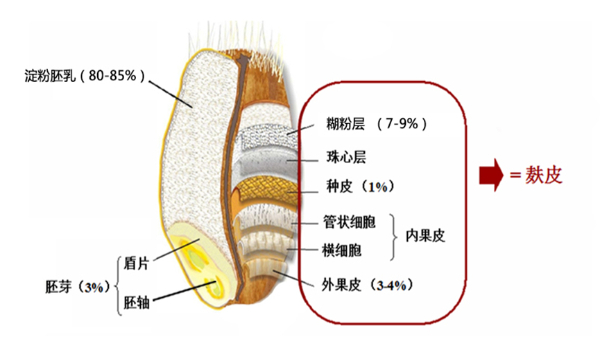
A small stone mill cannot produce refined flour. Refined flour is a product of the industrial age, made by great machines grinding flour to a finer grade while removing the invisible “unpleasant” bits. Thanks to the advance of the times and economic growth, refined-flour steamed buns can now be eaten freely at every meal.
Our species has undergone a vast evolution measured in units of “hundred thousand years.” Since the hunter-gatherer era we have eaten whole grains; evolution has written into our genes the need for every component. In the age of farming, Europe turned to wind and water; we relied on human muscle and donkey-drawn stone mills. Rice and flour in East and West have been passed down for a thousand years with no great change.
The Industrial Revolution was merely the last minute in twenty-four hours of human evolution. From refined flour’s emergence to its total dominance — that was a few seconds within that final minute. Greater refinement brought unprecedented delicacy of texture, but bodies shaped by tens of millions of years of evolution could not adapt, and modern ailments multiplied. So “wheat germ flour” rode the winds of the information age back into view. A single wheat grain, dropped into the modern processing system, passes through two rounds of value-adding: first the bran is stripped away to yield refined flour, then the bran is roasted for aroma and ready-to-eat convenience, ground fine to smooth the texture, and dressed in packaging as though it were something lofty and grand.
Take wheat: a quick internet search yields this: “Wheat germ flour is the essence extracted from the wheat grain, a nutritional supplement high in protein and vitamin E, low in calories, fat, and cholesterol. It contains B vitamins, vitamin D, unsaturated fatty acids, nucleic acids, folic acid, octacosanol, and more than ten minerals including calcium, iron, zinc (23.4 mg/100 g), and selenium…”
Check the claimed benefits of wheat germ flour: “It is the best natural, nutrient-rich food for balanced nutrition and strengthening the body. Wheat germ has therapeutic effects on cardiovascular and cerebrovascular diseases, resists radiation, slows ageing, prevents tumours, cleanses the intestines, relieves constipation, and lowers blood sugar and blood lipids; the dietary fibre it contains helps reduce serum cholesterol and prevent diabetes. Furthermore, wheat germ promotes the growth of beneficial gut bacteria…” Every brand of wheat germ flour screams “essential nutrients for the human body.” The very essence you removed during milling is now sold back as a supplement — what a pointless roundabout!


3. Rice and Flour as Ultra-Processed Foods
As modern people grow ever more concerned about food safety, they are beginning to eye their everyday staples with suspicion — specifically the “ultra-processed foods” lurking among them. Foodthink recently published an article introducing Carlos Monteiro’s classification system, which places rice and flour in the “unprocessed and minimally processed” category. Indeed, rice and flour in their literal sense — the staples of the agricultural age — were once minimally processed foods. The rice and flour we buy in supermarkets today, however, are already ultra-processed.
Michael Pollan traced the industrial food chain and, in 2006, published The Omnivore’s Dilemma, warning readers to beware of ultra-processed foods: “If your grandmother would not recognise it as food, or if it has more than five ingredients with names you cannot pronounce, it is most probably an ultra-processed food.”
Search “legal additives in flour processing” online and you will find: chemical substances used to modify flour properties, improve processing performance, and enhance food quality, chiefly dough strengtheners, flour bleaching agents, preservatives, and the like, all governed strictly by national standards (such as GB 2760-2024). Search “legal additives in rice processing” and you will find: rice processing additives refer to specific compounds permitted during rice processing, including sodium starch phosphate (thickener), sodium diacetate (preservative), and deacetylated chitin (thickener/coating agent).

In the agricultural age, stored grain came as paddy in its husk or whole wheat kernels. The intact seed coat was not merely a grain’s outer garment; it was a suit of armour, blocking external harm and preventing oxidation and spoilage. Once processed, the natural protection is lost, leaving the grain vulnerable to moisture, oxidation, and decay. In an era of industrial production and global sales, adding things has become the baseline practice. And so, in the journey from paddy and wheat to rice and flour, there has been excessive extraction and excessive addition. The words are the same ones they have been for centuries, but rice is no longer rice, and flour is no longer flour.
In fact, even measured against the definition of “ultra-processed foods” in Carlos Monteiro’s classification system — “foods with complex compositions, heavily industrialised, often containing emulsifiers, flavour enhancers, artificial flavourings, and other industrial ingredients; long shelf life and convenient to eat, yet far removed from their original form” — the rice and flour in our modern processing and retail system meet every criterion up to the last. Only one exception: they retain a similar outward appearance to their original form.
Under our national standard for wheat flour, GB/T 1355-2021, implemented in 2023, wheat flour is explicitly required to contain no food additives or food ingredients, and any flour with additives is classified as special-purpose flour. That is undoubtedly good news, but the standard is not mandatory. And so I still refuse to buy shop-bought steamed buns or noodles, and I do not eat purchased bread or pastries. I cannot be certain whether they are made from special-purpose flour, nor can I be certain whether something like borax has been added during cooked-food processing. More importantly, I can make these things myself — and my versions look and taste nothing like the shop-bought ones. Whether you choose to regard rice and flour as ultra-processed foods is entirely up to you. I have made my choice, so to speak; feel free to make yours. If anyone chooses to believe — truly to believe — in flour and flour products, well then… God bless those who have faith.
I must state clearly: I am not anti-modern nor a nostalgia-seeker. In 1800 the global average life expectancy was thirty-seven; by 2000 it had risen to 63.9. The advance of the times is a blessing for all humanity. I can say that simply living past sixty is itself a product of that advance.
And I must state further: were I a bulk grain processor dealing with long-distance transport and prolonged storage, I too would add those things.
4. Wanting This, Wanting That, and Wanting More
And yet there will always be people like me, greedy of mouth and greedy of heart, who want convenience AND health AND deliciousness. Is that even possible?
Smart as modern humans are, we can always find some way to have convenience and health and deliciousness — and, oh yes, happiness and joy on top.
To have lived as long as I have, I must thank the times; to have lived healthily, I must thank myself. At forty I was unwell in every conceivable way; at sixty, things had actually improved. The bodily ailments I once had were practically standard-issue for a modern city-dweller. I owe the change to those two years of farming in Taiwan in my fifties — nothing more to it: eat right, do right.
In Hsinchu, Taiwan, there is a small niche restaurant called Mai Ruixin, whose hallmark is homemade sourdough bread. They mill their own flour from organic wheat and use cold sourdough fermentation — which is really just a modern version of the bread oven beside a medieval European farmstead’s windmill or watermill. The founders include someone who studied in Europe; two of us are teacher and pupil to one another — he taught me bread-making, and I taught him brewing.
Mai Ruixin’s primary mission is not selling meals or bread but promoting homemade bread. With a fridge, an oven, and a home grain mill, you can make your own. If kneading sounds too much bother, a stand mixer will sort that. The only ingredient is organic wheat.
One kilogram of flour makes one wholemeal loaf. A home grain mill costs about a hundred yuan on Taobao or Pinduoduo. The flour is not finely milled, and the bran affects the texture, so you need long, cold fermentation — twenty-four or forty-eight hours in the fridge. The resulting loaf is a little rough to bite into, but satisfying to chew, and the more you chew, the more flavour it gives.
I have long since forgotten the names of Mai Ruixin’s key people, but I remember clearly what they said: perhaps one day Mai Ruixin will close its doors, but making your own bread will surely carry on.
Mai Ruixin opens its bread-making technique to all — learn freely, anyone can. By 2019, several hundred people were already baking bread their way. Only core members have opened shops; the vast majority are office workers concerned about their own health. Hsinchu is Taiwan’s high-tech hub; what we call big-tech’s golden children, they call “Hsinchu Science Park darlings”, and most of them bake once on the weekend and eat for seven days. Making one loaf or making several takes roughly the same amount of time, so various “bread-sharing groups” have sprung up — sharing bread, and building human connection.
If Mai Ruixin still sounds like too much trouble, there are even easier options: refuse foods whose names you cannot recognise; refuse the “blind-buy” habit.
For city-dwelling modern people who must rely on purchasing, those who can should seek out trustworthy platforms like Beiyuji, or head to supermarkets and online stores. Choose items with simple ingredient lists and raw materials you can actually name. If you can choose steamed buns, do that rather than custard buns or bread and cakes. China has some wonderful regional staples — the coarse corn chop porridge of the Northeast, the millet rice of the Northwest, and my own hometown’s Shandong jianbing — all closer to whole raw grains. Recommended.

I have always held that “additive-free” matters more than “organic.” Pollan advises choosing whole, recognisable foods first — peanuts, edamame, corn, sweet potatoes, pumpkins, potatoes themselves. I cannot recommend strongly enough: buy plenty of mixed grains and mixed beans, cook them with brown rice into porridge, make a large batch in one go, freeze it, and pull out portions whenever you need them. I once wrote for Foodthink, “If You Can’t Make a Bowl of Bean Porridge, How Can You Speak of ‘Being Made a Marquis’?” — this style of cooking is precisely what fitness influencers rave about as “bean rice.” Swapping it in for refined-flour steamed buns, noodles, or plain rice offers countless benefits — please look into it yourselves. An unexpected bonus from that article: a friend’s wife, in early pregnancy, was vomiting everything she ate. Bean porridge carried her through the hardest days.

*Editor’s note: Grandma Kouzi’s next piece will be about oil.
